We enjoy shooting steel targets with rifle, pistols, and shotguns. Hitting a steel target provides instant gratification with a loud “ping” and possible movement. You can shoot small, low-cost reactive steel targets with rimfire guns at short range. Or get the stronger high-grade AR500 steel targets for centerfire shooting at 50 yards and beyond. We’ve enjoyed varmint matches with steel targets placed at 100-yard intervals from 200 to 700 yards.
Action pistol and rifle matches are typically conducted with steel targets, some that spin, and others that may even be set on moving tracks. Dueling trees are another popular type of steel targets. These have multiple plates that swing horizontally from side to side. For long-range rifles, self-resetting targets are popular. These typically have a tombstone-style steel plate set with a spring-loaded base. When hit, the target goes down, but then pops back up again after a few seconds.
Dustin Ellermann’s Steel Target Playground
In this video, popular Top Shot champion Dustin Ellerman shows his entire Steel Target facility with dozens of targets. This range has one of the most diverse collections of steel targets in any single location.
Know Your Limits Portable Steel Targets
Know Your Limits (KYL) target sets typically provide a series of swinging targets of multiple sizes, running from larger to smaller. This provides increasing challenge with each shot. This Guns and Guitars Channel video showcases two portable KYL target sets you can easily transport in your car/truck. The host states: “I love how portable and easy to set up it is, I love how many targets you get… and most importantly, I love that Shooting Targets 7 offer the best price for AR500 steel targets on the internet.”
Ten Good Steel Target Offerings — Product Reviews
This 8-minute video shows steel targets in various sizes from multiple vendors/manufacturers. This is a good starter video if you are looking to purchase your first steel targets. The video covers a wide selection of shapes, sizes, and metal ratings. In order, the featured steel targets and target accessories are:
Highwild 6″ x 3/8″ Steel Target Set
Hotop Shooting Target Pipe Hang Hooks
Do-All Outdoors Steel Shooting Target
HD Targets AR500 Steel Shooting Targets
Do-All Outdoors Steel Auto-Reset Spinner Target
Do-It-Yourself REBAR Target Stands — Very Low Cost
This Guns and Guitars Channel Video shows how to make making the CHEAP and sturdy target stands from REBAR. The host says: “These things are basically bullet-proof and would probably stand up against a charging rhino. You can build these stands using a 10-foot length of 1/2″ rebar from your local hardware store. Bending it is not super easy, but it can be done without a rebar bender, just watch the video!”
If you are thinking of crafting your own target, you may also want to watch a good Tactical Rifleman channel video about building a range on your own property. The host notes: “There is so much more to it than just pushing up a berm and buying some steel targets. Med plan, legal restrictions, drainage, targetry, and 50 other things should be planned out BEFORE you start digging. CLICK HERE for “How to Build Make Your Own Shooting Range” video.
Steel Target Arrangements for Action Shooting Matches
This video from Tactical Hyve shows a variety of steel targets used in action shooting scenarios. The host is a knowledgeable gear analyst and a very good shooter. If you are looking to get started in action pistol disciplines this is a good video to watch.
Steel Target and Target Stand Varieties
This video reviews the key features and functions of a variety of steel targets — from large torso silhouettes to reactive dueling trees. The video also reviews various target stands and supports. This is worth watching if you are considering buying steel targets for your shooting club or home range.
Shooting Steel Targets Safely — Tips from Hickok45
In this video, YouTube host Hickok45 offers valuable safety tips on shooting steel targets, based on his 30+ years of steel shooting experience. This guy knows his stuff — as proven by the fact that he now has over 7.6 million subscribers to his Hickok45 YouTube channel.
TOP SHOT: The steel targets in the top photo are part of the extensive facility operated by Big Daddy Hoffman 1911. See more on his popular YouTube Channel, now with 315,000 subscribers.
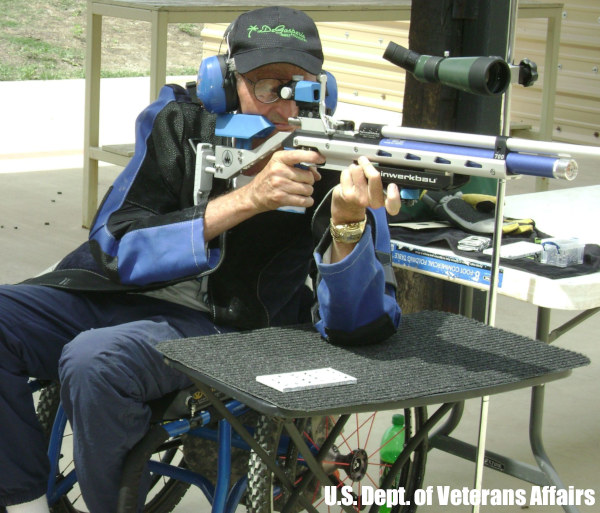
One of the great thing about shooting is that marksmanship is one of the few sports where physically-challenged persons can compete at the highest level — with some provisions for wheelchair access and mobility. For example, in the world of F-Class competition, Matt Schwartzkopf is one of the best in the nation. Matt, a rangemaster at Ben Avery in Arizona, is a double amputee (below the knee). He hasn’t let that challenge stop him. He has been a Top-10 finisher at major F-Class matches, and was chosen to shoot with F-TR Team USA.
F-TR Team USA member Matt Schwartzkopf is a double amputee below the knee, having had his lower legs removed due to a birth defect. That hasn’t held him back. Matt is an inspiration to us all. He told us: “This condition has not held me back from anything.” Jokingly, he added, “I may not have ‘a leg to stand on’, but that doesn’t mean I can’t still shoot 10s and Xs at 1000.” Matt is living proof that competitive shooting is a sport for all individuals — young and old, able-bodied and physically challenged.
Matt isn’t just a talented shooter — he runs range operations at Ben Avery in Arizona. During a major match, Matt can be seen supervising the firing line, organizing pit crews, and posting match results.
New USA Nationwide Adventure Database for Adaptive Shooters
Here’s a great new opportunity for shooters and sportsmen with physical limitations. The NRA has created a nationwide database of hunting and fishing adventures for individuals with disabilities. There are programs throughout the country with 45+ organizations such as Buckmasters, Freedom Hunters, Hope Outdoors, Hunting with Heroes, and Safari Club International.
“Venturing into the outdoors has long been acknowledged as healing for the body and soul”, said NRA National Adaptive Shooting Programs Manager Dr. Joe Logar, PT, DPT. “These benefits can be even more profound for someone experiencing an illness, injury, or disability.”
NRA’s Hunter Services and Adaptive Shooting Programs have maintained a list of organizations offering people with disabilities outdoor opportunities. Now available in a searchable database, any adaptive shooter can easily choose from adventures such as guided whitetail hunts, chartered fishing trips, and accessible hiking trails anywhere across the country. To find a program, visit the NRA Adaptive Shooting Program’s Hunting/Fishing Trip Database.
NRA Resources for Adaptive Shooting Events
The NRA Adaptive Shooting Program also provides information for organizations planning an event to include person with disabilities. Events may be organized by veterans’ groups, rehabilitation facilities, and gun clubs. For more information visit AdaptiveShooting.NRA.org.
Adaptive Shooting Programs in the United Kingdom
Across the pond, the National Rifle Association of the United Kingdom (NRAUK) also has adaptive shooting programs. The NRA.ORG.UK website has a wealth of information for shooters with physical challenges.
The NRAUK states: “There are many different types of target shooting available for people to try in Great Britain. Some of them are readily accessible to disabled people, others less so. Also, shooting clubs and facilities do not all cater for every discipline; some only offer one, whilst larger complexes can cater for many of them. The only place in the country where almost all disciplines can be tried is Bisley Camp in Surrey. Access to the outdoor ranges is being improved all the time, although most are already accessible.
If the disciplines that you particularly fancy are not suitable for your type of disability at the moment, or are not currently available in your area, do not give up hope! The key skills for target shooting are very similar for all disciplines, so you could start with a different but similar option, learn those key skills, and take up your first choice when it is available to you.”
Making Ranges Suitable for Disabled Shooters
The Summer 2019 issue of NRA Club Connections magazine has a feature on Adaptive Shooting. This article explains how range owners can make their lines of fire more accessible with the addition of a simple mat.
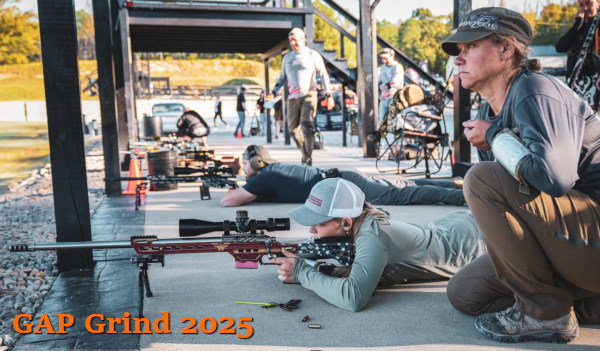
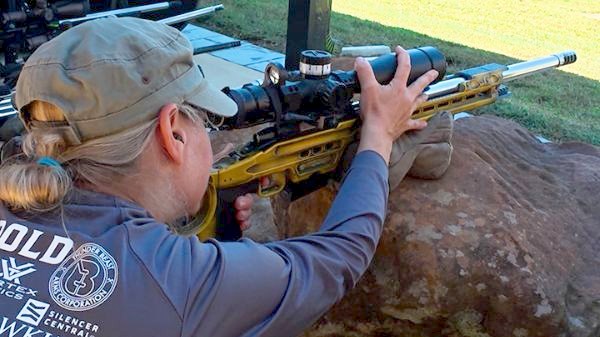
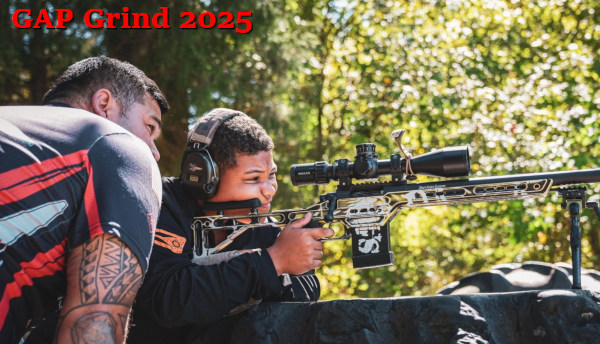
This week, Shooting USA TV spotlights the 2025 GAP Grind, America’s largest PRS Pro-Am Tactical match. The 14th Annual Bushnell Tactical GAP Grind Pro/Am shooting match was held from October 3 to October 5, 2025. The event took place at the K&M Precision Rifle Training Complex in Finger, Tennessee. The GAP Grind, the largest PRS match in the world, drew nearly 400 amateur and pro shooters. Recognized as the premier PRO-AM precision rifle match with both individual and team competition, the GAP Grind has introduced many new shooters to the sport. The next GAP Grind match will be held October 3–4, 2026 at the K&M Complex in Tennessee.
SHOW TIMES: This Shooting USA Episode airs Wednesday, July 8, 2026 at 9:00 PM Eastern and Pacific; 8:00 PM Central. If you miss the regular broadcast, you can stream on Vimeo for $0.99 per episode. You can also see hundreds of shooting videos for free on Shooting USA’s YouTube channel.
In this video Eagle Eye Shooting Shares Highlights from the 2022 GAP Grind
Big Prize Table at 10th Annual GAP Grind Event
The year’s largest PRS match drew hundreds of attendees, and more than 80,000 rounds were fired throughout the three-day event. Bushnell provided thousands of dollars worth of prizes to the top competitors. Trophies were awarded to the top 5 teams, top 5 professionals, and to the top 5 amateurs.
Lots of Action, with 20+ Stages
The GAP Grind is a challenging, “high tempo” match with minimal down-time between stages. Over the course of 20+ stages, competitors will fire 200+ shots at a variety of steel, paper, moving, and reactive targets out to 1,200 yards. Targets vary in size/difficulty based on the shooter’s position, distance, and time allotted. Most stages include “stressors” — i.e. time limits or required movement(s).
GAP Grind Pro-Am Format — Seasoned Shooters Help Newcomers
The GAP Grind typically attracts nearly 400 competitors — half experienced shooters and the other half newcomers to the sport. The key to growing the shooting sports is attracting new shooters. The best way to bring in “new blood” seems to be the Pro-Am type format. At the GAP Grind, experienced shooters share their knowledge and guide the new shooters through the competition.
GAP Grind Hardware
You’ll find the latest and greatest PRS/NRL hardware at the GAP Grind. Over the past few seasons, most top competitors have “stepped down” from the 6.5/6mm Creedmoor to the smaller, more efficient 6mm Dasher, 6BRA, 6 GT and other 6mm cartridges. These 6mm cartridges offer excellent accuracy with less recoil than the 6.5 Creedmoor.
This site is for and about accurate shooters. So today we feature the short-range group Benchrest game, where it’s all about shooting tiny groups in the ones and even “zeros”. Seeing the tiny groups 6 PPC aces produce, it’s easy to think the precision is all about the equipment. But there is a lot more involved. A talented human still has to watch the flags, run the gun properly, and tune his loads for the conditions. Here are some tips from one of the world’s best benchresters, Charles Huckeba.
Texan Charles Huckeba was the top individual shooter at the 2013 World Benchrest Championships (WBC) held near Sydney Australia in October 2013. In this video, 2013 WBC Two-Gun Overall winner Charles shoots a 1/8th MOA group at 200 yards — “a little bitty dot” as a fellow Team USA shooter observes. That’s impressive. If you can describe Huckeba’s style in a nutshell it would be “smooth, consistent, and rapid but not hurried”.
Charles also employed some unusual hardware. In the video, take a close look at the joystick on the Farley Coaxial front rest. There’s no knob at the end. In its place is a small, wood ammo caddy. Charles removed the standard knob from the handle of his Farley rest and replaced it with a home-made wood block that holds cartridges for the record target. The 10.5-lb Light Varmint rifle is chambered in 6PPC with a BAT Machine Action and a composite wood and carbon-fiber stock.
Watch Charles Huckeba Shoot 1/8 MOA, 200-yard group at World Benchrest Championships
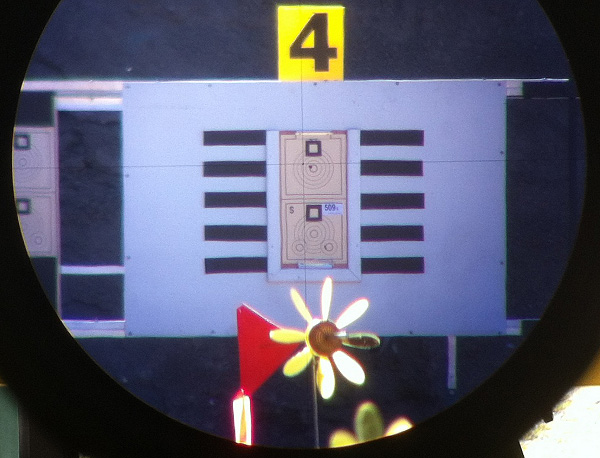
Here is the actual 200-yard, 5-shot group Charles shot in the video. Photo (by Stuart Elliot) taken through the lens of Huckeba’s 50X March scope (reticle has 1/16th MOA Dot).
Analyzing the Fine Points — What Makes Huckeba So Good
Short-range benchrest shooter Boyd Allen saw some interesting things in Huckeba’s WBC performance, as captured on video. Boyd noticed Huckeba’s smooth gun-handling and efficient loading. But Boyd also spied some interesting equipment, including an innovative joystick “handle-caddy”.
1. Low Friction Bags — When Huckeba slid his rifle, there was very little apparent friction. The front bag features the new 3M material (ScotchLite) on the sliding surfaces. The rear Protektor bag has ears of the same low-friction material.
2. Pause Before Chambering — While he was watching the flags and deciding when to start firing, Charles kept his first round in the action, but out of the barrel’s chamber, probably so as not to heat the cartridge and change the round’s point of impact.
3. Ammo Caddy on Joystick Arm – Charles shoots a Right Bolt/Left Port action, so he pulls his rounds with his left hand. Note that Huckeba’s record rounds rest in a small, wood ammo caddy attached to the end of the joystick shaft. Look carefully, you’ll see the wood ammo block in place of the normal black ball at the end of the joystick. That allows Charles to pull shots with the absolute minimum of hand movement. Ingenious! Huckeba is very fast, with a great economy of motion. I believe that because his ammo was literally at hand, Charles was better able to keep his focus on aiming and the flags.
4. Smooth-Cycling BAT Action — Note how smoothly Huckeba’s action operates. When Charles lifts the bolt handle (to extract a round and cock the firing pin), this does not disturb the rifle. Likewise, as he closes the bolt, the gun doesn’t wobble. The smooth action allows Charles to hold point of aim even when shooting relatively quickly. Huckeba’s BAT action is chrome-moly steel. Some shooters believe this metal makes for a smoother action than stainless steel or aluminum.
5. Long-Wheelbase Stock — The wood and carbon fiber stock is light, long, and stiff. Yet, importantly, the stock is also well-damped. The longer-than-average stock length (with extended forearm) seems to help the gun track well without jumping or rocking. The longer forearm allows a longer “wheelbase”, effectively shifting the weight distribution rearward (less weight on the front, more weight on the rear). This places a greater share of the gun’s weight on the rear bag, as compared to a more conventional benchrest stock. Huckeba’s stock, built by Bob Scoville, is at the cutting edge of short-range benchrest design. Its light-weight balsa wood and carbon fiber construction provides a combination of stiffness and vibration damping that allows its relatively long fore-end to be fully utilized to increase the weight on the rear bag (always an issue with 10.5-pound rifles).
To learn more about this benchrest stock design, read the comments by stock-builder Bob Scoville in our PPC with Pedigree story in our Gun of the Week Archives. Bob observed:
“There is a lot more to the structure of the stocks than meets the eye. The carbon fiber skin with which I cover the stocks creates a light, tough exterior surface. However, this contributes very little to the overall performance of the stocks. The real strength and stiffness is the result of an internal beam utilizing balsa core/carbon fiber technology.
This type construction can be found in aircraft, race cars, powerboats, and sailboats. It is interesting to note, balsa has the highest strength to weight ratio of all woods and carbon fiber is one of the lowest stretch (modulus of elasticity) relative to weight of all materials. The marriage of these two materials is common in the high-performance world. Additionally, balsa is used commercially for vibration dampening and sound reduction.”
Video find by Boyd Allen. Video by Stuart Elliot of BRT Shooters Supply, Brisbane, Australia.
We are very sad to report that G. David Tubb, one of the greatest marksmen who ever lived, passed away on Thursday, July 2, 2026 in the afternoon. David, who was 71, died from heart and blood oxygen issues following surgery to remove one leg at the knee. The amputation procedure followed serious major problems from multiple knee replacements in the past.
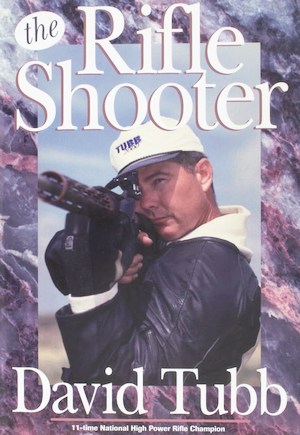
David was, without question, one of the most talented and successful marksmen in history. David recorded 11 High Power Rifle Championships, 6 Long Range National Championships, and 7 High Power Silhouette National Championships. Over his career David won 130 NRA trophies for various competitions. No one has even come close to that number of Championships and honors in rifle competition.
A close friend of David, James Schmidt, recently posted: “Legendary firearms shooter David Tubb has left the range. David was an incredible innovator in the firearms industry and was credited in every way with many many excellent creations for shooters all over the world. His love for the industry and extreme accuracy shooting is unsurpassed at any level. His personal shooting skills will remain in history as amazing, remarkable and at times unbelievable! Perhaps his shooting accomplishments will never ever be achieved again.”
David Tubb Competition Shooting Accomplishments:
11 Time – NRA National High Power Rifle Champion – Camp Perry
6 Time – NRA Long Range Rifle (600-1000 yard) National Champion
7 Time (Consecutive) – NRA National High Power Rifle Silhouette Champion
6 Time – NRA National High Power Hunting Rifle Silhouette Champion
4 Time – NRA National Smallbore Hunting Rifle Silhouette
7 Sportsmen’s Team Challenge Championships
2 Time – Wimbledon Cup Winner
2019 ELR World Record Holder recognized by 50 Cal. Shooters Association
2019 NRA ELR Heavy Gun Winner
Over 130 NRA Championship Event Trophies (Individual Match Winner)
David Tubb Interview Podcast with Erik Cortina
In this 2024 Podcast, David Tubb was interviewed by ace F-Class shooter Erik Cortina. This 66-minute video is worth watching start to finish. David covers a wide range of topics include match strategies, marksmanship training, ELR competition, and cartridges he has developed including the 6mm XC (6XC), 338 XC, and 375 XC.
Sierra Bullets Post Honoring David Tubb
All of us at Sierra Bullets are deeply saddened to learn of the passing of David Tubb. Our hearts go out to his family, friends, and everyone whose life he touched. David’’s passion for precision shooting, relentless pursuit of excellence, and willingness to share his knowledge left a lasting mark on the shooting sports. His influence reached far beyond the firing line, inspiring generations of competitors and marksmen to strive for continuous improvement.
We extend our sincere condolences to the Tubb family during this difficult time. May they find comfort in knowing that David’s legacy will continue to live on through the countless shooters he inspired and the enduring impact he made on our community.
Rest easy, David. Thank you for everything you gave to the shooting sports.
On this 4th of July, 2026, the 250th Anniversary of American Independence Day, we thought it would be good to feature lever-action rifles. Lever-action rifles have been an important element of American history. These were truly the rifles that “Won the West”. Today, lever-action rifles remain popular with hunters and cowboy-action shooters. And rimfire lever guns are fun for short-range shooting at reactive targets. Easy to carry, lever guns can also be very effective on varmints.
For this Saturday-at-the-Movies installment, we feature seven videos about lever-action rifles. These videos review modern lever guns as well as historic 19th-century lever-action rifles. Two of these videos features sophisticated 3D computer animation so you can look inside the rifles to see how the internal mechanisms function to feed, fire, and eject cartridges.
How a Lever-Action Rifle Functions
This video shows the inner mechanisms of a classic lever-action rifle. It shows how the lever actuates case-feeding from the under-barrel tube, then how the hammer is cocked/fired, and finally how the ejection works after the shot is fired. This video also covers lever-action rifle history, looking at the Winchester 1873 as well as popular modern lever-action firearms.
Classic American Lever-Action Rifles — Hickok45’s Insights
Hickok45 is one of the more knowledgeable YouTube gun reviewers, and he personally owns a number of lever guns. In this video, which has over 2.5 million views, Hickok45 first showcases the original Henry Rifle, and the brass-receiver model 1866 (aka “Yellowboy”). Then he reviews Winchester’s model 1873 and model 1876 (Centennial). Next comes Winchester designs by J.M. Browning — the model 1886, model 1892, model 1894, and lastly the distinctive model 1895 with vertical magazine. The Model 1895 was a favorite of President Theodore Roosevelt.
This insightful Hickok45 video has garnered 2.5 million YouTube views. If you can take the time to watch the entire 37-minute video, this is a great history lesson for 19th-century lever guns. In the video, Hickok45 also shows cartridges used in the various rifles.
Top Five Lever-Action Rifle for Hunting and Home Defense
This video combines reviews from multiple YouTube hosts, including .22 Plinkster. It is a good starting point if you are considering purchase of a modern, lever-action rifle for hunting or home defense. We recommend, prior to purchase, that you go to a gun store to inspect the rifles and work the actions. Some lever guns are significantly smoother in operation than others. You’ll also want to check the triggers, and see the options for mounting optics. This video provides a quick look at a variety of lever guns including: Henry Side Gate Lever Rifle; Winchester Model 1866 Short Rifle (replica); Browning BLR Lever Rifle; Marlin Dark Model 336; and Marlin 1895 Custom Shop 45-70.
Seven Reasons to Own a Lever-Action Rifle
We own a variety of lever-action rifles, including Marlins well as handsome replica Uberti 1866 and 1873 rifles. There is much to be said about the lever gun design. Compared to typical modern bolt-actions, lever guns are narrower and lighter. With a little tuning, the replica 19th-century lever-action rifles cycle very quickly and smoothly. And the modern lever guns are good choices for hunters, with their ability to mount scopes and fire modern high-velocity cartridges. This video reveals the reasons every serious shooter should have at least one lever-action rifle in his or her collection.
How a Winchester 1873 Works
This video has over 15 million views on YouTube. The Model 1873 was one of the most successful Winchester rifles of its day, with Winchester marketing it as “The Gun that Won the West”. The original Model 1873 was manufactured between 1873 and 1923, and it is still available today in replica versions. The 1873 was originally chambered for the .44-40 cartridge, the first significant centerfire cartridge. The 1873 was later produced in .38-40 and .32-20, all of which later became popular handgun cartridges of the day. The Model 1873 was produced in four variations: a 24-inch barrel rifle, a 20-inch barrel carbine, and a “musket”—which was aimed at military contracts and only made up less than 5% of production. The standard rifle-length version was most popular in the 19th century, although Winchester would make rifles to order in any configuration the customer wished, including longer barrels or baby carbines with barrels as short as 12 inches, octagonal-shaped barrels, color case-hardened receivers and fancy engraving.
The Henry Big Boy Lever-Action .44 Magnum
Here’s good, thorough 16-minute review of a modern Henry Big Boy side-gate lever-action rifle chambered for the potent .44 Magnum round. This rifle shows the benefits of modern manufacturing methods, and shows good fit and finish. The review puts the rifle through its paces, show how quickly a modern lever gun can be cycled. We think this would be a good choice for a home defense rifle that could share ammunition with a defensive revolver.
Marlin 336 XLR Tactical-Style Lever-Action Rifle
And now for something a bit different… Here a Marlin 336 XLR lever-action rifle has been updated with a tactical-style forearm, rail-mounted optic, and suppressor. The reviewer noted how well the rifle functioned: “Recently I got my hands on this 336 XLR from Marlin and all of my preconceptions of tactical lever action rifles has now changed. What I found was a very modern and capable twist to an old school platform.”
More Information on Lever-Action Rifles
Want to learn more about lever-action rifles? RifleShooter magazine has published an interesting article, the 10 Greatest Lever-Action Rifles of All Time. Writing for RifleShooter, Brad Fitzpatrick examined a wide selection of lever guns produced in the past 150 years, and came up with this list of ten “all-star” lever-action rifles:
Savage Model 99
Winchester Model 1873/73
Winchester Model 1888/88
Winchester Model 1892/92
Winchester Model 1894/94
As with all “Top 10″ lists, this will be controversial. Where is the Winchester model 1866 “Yellowboy”, the favorite of Native Americans? Where is the iconic Winchester model 1895, the beloved gun Teddy Roosevelt called “Big Medicine”? But other choices are hard to fault. The classic 1860 Henry Rifle surely belongs on the list. And, believe it or not, the Winchester Model 94 is the best-selling sporting rifle of all time in the USA, according to RifleShooter.
There is an excellent article about primers on the Shooting Times website. We strongly recommend you read Mysteries And Misconceptions Of The All-Important Primer, written by Allan Jones. Mr. Jones is a bona fide expert — he served as the manager of technical publications for CCI Ammunition and Speer Bullets and Jones authored three editions of the Speer Reloading Manual.
This authoritative Shooting Times article explains the fine points of primer design and construction. Jones also reveals some little-known facts about primers and he corrects common misconceptions. Here are some highlights from the article:
Size Matters
Useful Trivia — even though Small Rifle and Small Pistol primer pockets share the same depth specification, Large Rifle and Large Pistol primers do not. The standard pocket for a Large Pistol primer is somewhat shallower than its Large Rifle counterpart, specifically, 0.008 to 0.009 inch less.
Magnum Primers
There are two ways to make a Magnum primer — either use more of the standard chemical mix to provide a longer-burning flame or change the mix to one with more aggressive burn characteristics. Prior to 1989, CCI used the first option in Magnum Rifle primers. After that, we switched to a mix optimized for spherical propellants that produced a 24% increase in flame temperature and a 16% boost in gas volume.
Foiled Again
Most component primers have a little disk of paper between the anvil and the priming mix. It is called “foil paper” not because it’s made of foil but because it replaces the true metal foil used to seal early percussion caps. The reason this little disk exists is strictly a manufacturing convenience. Wet primer pellets are smaller than the inside diameter of the cup when inserted and must be compacted to achieve their proper diameter and height. Without the foil paper, the wet mix would stick to the compaction pins and jam up the assembly process.
Have you recently purchased a new scope? Then you should verify the actual click value of the turrets before you use the optic in competition (or on a long-range hunt). While a scope may have listed click values of 1/4-MOA, 1/8-MOA or 0.1 Mils, the reality may be slightly different. Many scopes have actual click values that are slightly higher or lower than the value claimed by the manufacturer. The small variance adds up when you click through a wide range of elevation.
In this video, Bryan Litz of Applied Ballistics shows how to verify your true click values using a “Tall Target Test”. The idea is to start at the bottom end of a vertical line, and then click up 30 MOA or so. Multiply the number of clicked MOA by 1.047 to get the claimed value in inches. For example, at 100 yards, 30 MOA is exactly 31.41 inches. Then measure the difference in your actual point of impact. If, for example, your point of impact is 33 inches, then you are getting more than the stated MOA with each click (assuming the target is positioned at exactly 100 yards).
How to Perform the Tall Target Test
The objective of the tall target test is to insure that your scope is giving you the proper amount of adjustment. For example, when you dial 30 MOA, are you really getting 30 MOA, or are you getting 28.5 or 31.2 MOA? The only way to be sure is to verify, don’t take it for granted! Knowing your scopes true click values insures that you can accurately apply a ballistic solution. In fact, many perceived inaccuracies of long range ballistics solutions are actually caused by the scopes not applying the intended adjustment. In order to verify your scope’s true movement and calculate a correction factor, follow the steps in the Tall Target Worksheet. This worksheet takes you thru the ‘calibration process’ including measuring true range to target and actual POI shift for a given scope adjustment. The goal is to calculate a correction factor that you can apply to a ballistic solution which accounts for the tracking error of your scope. For example, if you find your scope moves 7% more than it should, then you have to apply 7% less than the ballistic solution calls for to hit your target.
NOTE: When doing this test, don’t go for the maximum possible elevation. You don’t want to max out the elevation knob, running it to the top stop. Bryan Litz explains: “It’s good to avoid the extremes of adjustment when doing the tall target test.I don’t know how much different the clicks would be at the edges, but they’re not the same.”
Should You Perform a WIDE Target Test Too?
What about testing your windage clicks the same way, with a WIDE target test? Bryan Litz says that’s not really necessary: “The wide target test isn’t as important for a couple reasons. First, you typically don’t dial nearly as much wind as you do elevation. Second, your dialed windage is a guess to begin with; a moving average that’s different for every shot. Whereas you stand to gain a lot by nailing vertical down to the click, the same is not true of windage. If there’s a 5% error in your scope’s windage tracking, you’d never know it.”
Verifying Scope Level With Tall Target Test
Bryan says: “While setting up your Tall Target Test, you should also verify that your scope level is mounted and aligned properly. This is critical to insuring that you’ll have a long range horizontal zero when you dial on a bunch of elevation for long range shots. This is a requirement for all kinds of long range shooting. Without a properly-mounted scope level (verified on a Tall Target), you really can’t guarantee your horizontal zero at long range.”
NOTE: For ‘known-distance’ competition, this is the only mandatory part of the tall target test, since slight variations in elevation click-values are not that important once you’re centered “on target” at a known distance.
Protect Your Hearing — Wear Protection Whenever You Shoot
Noise-induced hearing loss and tinnitus are two of the most common afflictions for recreational shooters and hunters. Everyone knows that gunfire is loud, but very few people understand the repercussions that shooting can have on their hearing until it’s too late.
The better quality suppressors can reduce the noise of a gunshot by 20 to 35 decibels (dB). Good muffs or plugs will reduce sound by 23 to 33 dB. By decreasing the overall sound signature, suppressors help to preserve the hearing of recreational shooters and hunters. Even the most effective suppressors, on the smallest and quietest calibers (.22 LR) reduce the peak sound level of a gunshot to between 110 to 120 dB. To put that in perspective, according to the National Institute for Occupational Safety and Health (NIOSH), that is as loud as a jackhammer (110 dB) or an ambulance siren (120 dB). For normal caliber handguns and rifles, suppressed sound levels routinely exceed 130 dB, just shy of OSHA’s “hearing safe” threshold of 140 dB.
According to Dr. William W. Clark, the current Director of the Washington Univ. School of Medicine’s Audiology/Communication Sciences Program, a “serious threat to hearing comes from recreational hunting or target shooting”. This is in large part due to the fact that many people choose not to use traditional hearing protection devices like earplugs and earmuffs because they want to be able to hear their surroundings. Multiple studies have found that between 70 to 80% of hunters never wear earplugs or earmuffs, and nearly half of all target shooters don’t consistently wear traditional hearing protection. Thus, it should come as no surprise that for every five years of hunting, hunters become seven percent more likely to experience high frequency hearing loss.
This article is based on information from the American Suppressor Association (ASA). Since the ASA’s formation in 2011, three additional states have legalized suppressor ownership and 18 states have legalized suppressor hunting. For more information, visit www.AmericanSuppressorAssociation.com.
Millions of Americans now exercise their Constitutional right to “keep and bear arms”, specifically to carry a pistol for personal protection and home defense. In response to the rapid growth of the CCW (Concealed Carry Weapon) market, numerous gun-makers have introduced compact handguns specifically designed for concealed carry. These “Carry Guns” tend to be smaller, lighter, with smoother, rounded edges on slide and frame. Today, many modern carry guns are also “Optics Ready”, meaning they have slides that can accept smaller red dot sights. And some companies are now selling handguns with the optics pre-installed.
For today’s Saturday video showcase, we feature six videos covering a wide range of popular semi-automatic carry guns. You’ll see offerings from Beretta, Glock, HK, Kahr, Kimber, Ruger, Smith & Wesson, Taurus, Walther and more. In addition, we’ve included a video that covers the pros and cons of installing optics on carry pistols. Finally, as a bonus, we’ve included a video that highlights five handguns that you may want to avoid, as they have not lived up to expectations.
Seven Best Carry Pistols for the Money
Here the Honest Outlaw Channel reviews seven semi-auto pistols. The host states these are the “7 best pistols for the money,” adding that “these handguns are reliable, accurate, durable, light weight, and cost less than most alternatives.” This video was released in late 2025. It covers these current-generation pistols: Ruger RXM (1:42 time); S&W Bodyguard 2.0 (3:45 time); CZ P-07 (5:55 time); Sig P365 X Macro (7:40 time); Canik Mete MC9 Prime (9:12 time); CZ P-10 Series (10:57 time); S&W Shield Plus Performance Center (13:13 time).
Five Favorite Carry Pistols — Colion Noir’s Top Handguns
Colion Noir is a very popular gun reviewer and Second Amendment advocate. In this video, which has over 1.1 million views, Colion covers the five guns he personally carries. Why five? Colion states: “When it comes to my concealed carry guns, I practice tactical polyamory. Essentially, I don’t just carry one gun. I have a rotation of guns I carry based on what I’m wearing that day, where I’m going, and what I’m doing. I put a lot of thought into my carry rotation, which changes based on my needs. Sometimes a gun that’s better at handling the job comes out, and I’ll carry it once I’m comfortable with its reliability. That said, there are five guns I consistently carry[.]”
Five Top Choices among CCW & EDC (Everyday Carry) Handguns
The host notes: “We are going over the five best CCW firearms that I reviewed this year and ranking them from 1 to 5. We are going to save the best for the last. Some of the criteria for ranking these firearms isn’t only based on performance. We are ranking based on performance, price, reliability, and comfort.”
Five Modern Micro-Compact Pistols for Concealed Carry
In this video, testers for the respected Pew-Pew Tactical site field test and review five popular 9mm ultra-compact “micro-pistols”. If you’re looking for the best micro pistols, this video should be helpful, discussing micro-compact pistol features, performance, and value. The testers ranked these five pistols as follows:
Editor’s Pick: Sig Sauer P365 Optics-Ready
Best Value: Smith & Wesson M&P9 Shield Plus
Best Features: Springfield Armory Hellcat OSP
Best For Large Hands: Mossberg MC2c
Best Budget (Bang for Buck): Taurus GX4
Four years ago, Kimber’s R7 Mako pistol won the 2022 Golden Bullseye Award from NRA’s Shooting Illustrated magazine, winning the magazine’s “Handgun of the Year” category. The R7 Mako is very compact, with good ergonomics, yet it offers 12-rd (11+1) capacity (and 13+1 with extended magazine). The R7 Mako showed outstanding accuracy when tested indoors (see video at 15:25 time-mark).
The R7 Mako is offered Optics Ready for $599.00 MSRP or with Crimson Trace Red Dot Optic installed for $799.00 MSRP. SEE Shooting Illustrated Review.
Heckler & Koch CC9 Double-Stack Micro-Compact
Heckler & Koch (HK) has released its new CC9 micro-compact, striker-fired 9x19mm pistol. With great accuracy, ergonomics, and reliability, the HK CC9 should be a top choice among micro-compact pistols. Designed and produced in the USA, this is the smallest double-stack carry pistol HK has ever built. The CC9 features a modular grip with swappable backstraps. With a “Safe Take Down Feature” for disassembly, there is no need to pull the trigger during field-striping, making the CC9 safer than a Glock. The slide is optics-ready and there is a short Picatinny rail on the front of the polymer frame for mounting accessories. The micro-compact CC9 is 6.03″ long and 0.99″ wid and the CC9 weighs 18.4 ounces without magazine.
Tiny But Impressive — Best Pocket-Carry Pistol
Repected gun reviewer (and attorney) Colon Noir has tested dozens of pistols in multiple calibers. While he recommends using a holster and carrying a 9mm pistol with good ergonomics, he recognizes that some folks want an option of a very thin, ultra-compact handgun that can be carried in a man’s pocket. This video review Colon’s favorite “pocket pistol”, the Ruger LCP Max, a slim .380 ACP handgun that weighs just 10.6 oz. and has a 0.75″-wide slide.
Optics on Carry Pistols — Factors to Consider
Red Dot sights are becoming more popular than ever. Many pistols today are “Optics Ready”, and some handguns can now be purchased with optics already installed. There are both strengths and weaknesses having optics on CCW handguns. This video reviews the features and function of six affordable compact red dots suitable for CCW pistols. Along with covering the factors to consider, the video provides advice on red dot mounting, zeroing, and more.
BONUS: Five Handguns to Avoid
When shopping for a handgun, it’s helpful to know which models to avoid, because of poor reliability or other shortcomings. This Honest Outlaw video reveals five handguns that are not the best choices for concealed carry: Smith & Wesson CSX, SCCY CPX-2, Remington RP-9, Kahr CW 380, and Taurus PT 22.


 F-TR Team USA member Matt Schwartzkopf is a double amputee below the knee, having had his lower legs removed due to a birth defect. That hasn’t held him back. Matt is an inspiration to us all. He told us: “This condition has not held me back from anything.” Jokingly, he added, “I may not have ‘a leg to stand on’, but that doesn’t mean I can’t still shoot 10s and Xs at 1000.” Matt is living proof that competitive shooting is a sport for all individuals — young and old, able-bodied and physically challenged.







 3. Ammo Caddy on Joystick Arm – Charles shoots a Right Bolt/Left Port action, so he pulls his rounds with his left hand. Note that Huckeba’s record rounds rest in a small, wood ammo caddy attached to the end of the joystick shaft. Look carefully, you’ll see the wood ammo block in place of the normal black ball at the end of the joystick. That allows Charles to pull shots with the absolute minimum of hand movement. Ingenious! Huckeba is very fast, with a great economy of motion. I believe that because his ammo was literally at hand, Charles was better able to keep his focus on aiming and the flags.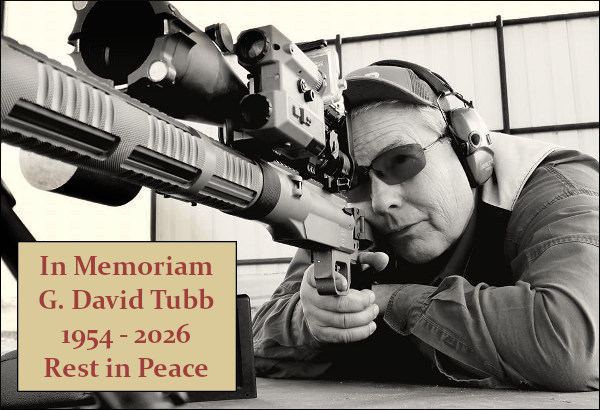
 David was, without question, one of the most talented and successful marksmen in history. David recorded 11 High Power Rifle Championships, 6 Long Range National Championships, and 7 High Power Silhouette National Championships. Over his career David won 130 NRA trophies for various competitions. No one has even come close to that number of Championships and honors in rifle competition.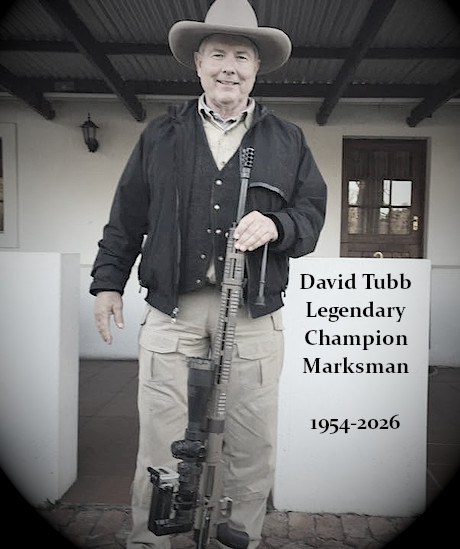


 Verifying Scope Level With Tall Target Test


