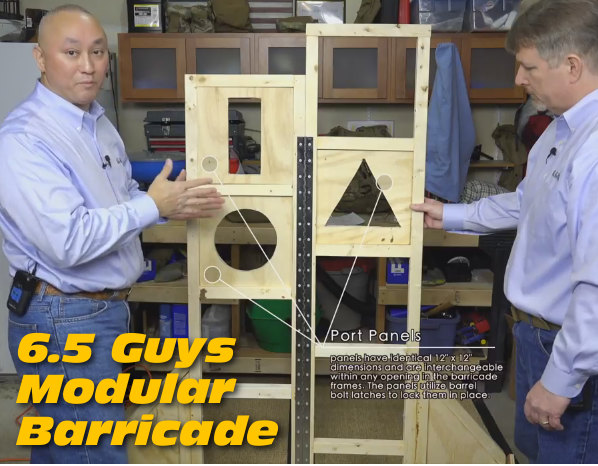
Here’s a great Do-It-Yourself project for tactical shooters. Ed and Steve of the 65Guys.com have created a versatile wooden barricade designed for easy transport. The goal with this design was to create a stable barricade that offers a variety of shooting positions, but can also fit in the bed of a pick-up or the back of an SUV. The 69″ tall barricade is hinged in the middle, so it’s just 27″ wide. To deploy the Barricade you simply fold it open and then nest the lower wings in ground-level stands.
We call this the BYOB Project — Build Your Own Barricade. Anyone with basic wood-working skills should find the Barricade prettyeasy to make. The only tricky part is cutting the side Dado joints for the left and right lower wings. But when you’ve got it completed, you have a low-cost unit that is versatile and sturdy yet easy to pack in a truck and carry out on the range. In the video below the 6.5 Guys showcase their Gen 2 barricade and explain how to build one just like it.
Looking at the 6.5 Guys Modular Barricade
The Modular Barricade was drawn up by Steve in PowerPoint and then dimensions added. Once the entire plan was created, Steve cut components to size and then used ordinary wood screws and wood glue to assemble the barricade frame. This was done to ensure maximum rigidity due to the light weight construction using 2″ x 2″ frame members. A long piano hinge was used to allow the Barricade to fold in half, while still having high torsional rigidity. Each of the Barricade openings are 12″ x 12″ square. This consistent ‘window’ spacing allows interchangeable panels with different cut-out shapes to be placed at varies heights/locations in the Barricade.
Modular Barricade Key Features
— Lightweight construction using low-cost 2×2 wood beams.
— Collapsible frame with center hinges for easy transport and deployment.
— Multiple Support levels at 6″ vertical intervals (6″ variance R to L).
— Modular port design allows ports to be changed and moved as desired.
6.5 Guys’ Modular Barricade — Construction Tips
The Modular Barricade can be constructed over a weekend with the proper materials and basic shop tools such as a power saw and electric screwdriver. Steve used a router for the side panel dado joints but a table saw could also be used for that task. Steve’s only real issue with the build involved the port panels — getting them to fit right. The 2″ x 2″ frame wood wasn’t always straight; even a small variation in the wood could cause a port panel to be too tight or too loose. Steve had to do a lot of extra sanding and planing to get the port panels to fit just right.
Where and How to Use the Barricade for Training
Because the 6.5 Guys’ Modular Barricade is so easy to move, you can simply pack it up and deploy it at your local range for practice. (Do ensure club/range rules allow shooting from barricades.) While the Barricade is designed to sit on the natural ground, the base stands can also be placed on concrete if your range does not allow deployment forward of the normal firing line. While you can use the Barricade for training on your own, Ed and Steve say novice shooters can benefit from a formal clinic.
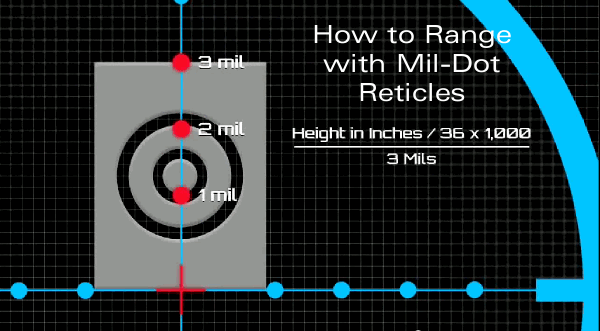
MIL-system scopes are popular with tactical shooters. One advantage of MIL scopes is that the mil-dot divisions in the reticle can be used to estimate range to a target. If you know the actual size of a target, you can calculate the distance to the target relatively easily with a mil-based ranging reticle. Watch this helpful NRA video to see how this is done:
Milliradian Definition and Yardage Ranging Formula
“MIL” or “Milrad” is short-hand for Milliradian, a unit of angular measurement. The subtension of 1 mil equals 3.6 inches at 100 yards or 36 inches at 1,000 yards. (In metric units, 1 mil equals 10 centimeters at 100 meters or 1 meter at 1,000 meters.) Knowing this subtension and knowing the size of the target (or a reference object near the target) allows the distance to the target to be estimated with considerable accuracy. The formula used to calculate range (in yards) based on MIL measurement is:
Height of Target in inches (divided by 36) x 1000, divided by the number of mils.
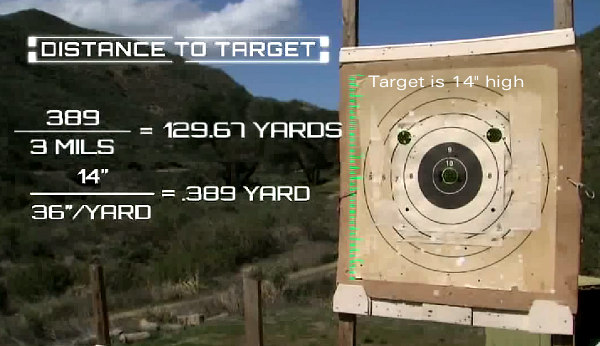
For example, if a 14″ tall target spans 3 mils from top to bottom, the distance is 129.67 yards calculated as follows: 14/36 x 1000 = 389, then divided by 3 = 129.67. You can also use a different conversion to find distance in meters.
Can You Estimate Range with an MOA-Marked Reticle? Yes You Can…
Reader Josh offers this handy advice: “It worth noting that the ability to measure range is not unique to mil-based systems. A MIL is just another unit for measuring angles, and any angular measurement will work. Considering that just about everybody knows that 1 MOA is about an inch per hundred yards, similar formulae can be developed for ranging with MOA marks. The advantage with mils is the precise relationship between units — the MOA-inch measurement is imprecise (being off by 0.047″) — so in principle MILs are a better unit”.
This report comes from the American Suppressor Association (ASA).
The Bureau of Alcohol, Tobacco, Firearms and Explosives (ATF) has announced the imminent launch of a new electronic system for NFA transfers. Known as the eForms system, this overdue modernization will allow consumers to submit both ATF Forms 1 and 4 electronically, hopefully resulting in a significant decrease in transfer times when compared to traditional paper Forms. This should speed up acquisition of firearm suppressors, since these require a Form 4.
According to ATF, the transition to the new system will occur sometime after December 15th, but before Christmas. The new eForms system will handle all existing NFA transfer forms, including the ATF Form 4, which is used for transfers of suppressors.
What is the NFA?
The National Firearms Act of 1934 (NFA) requires the Federal registration of fully-automatic firearms, of short-barreled rifles and shotguns, of rifles over .50 caliber, and of firearms sound suppressors (termed “silencers” under the NFA).
Do NOT Withdraw an Existing Form 4 Submission
If you recently submitted an NFA application, keep it in the queue. The ASA cannot stress this enough. Withdrawing your Form 4 and re-submitting electronically will take longer than allowing your Form 4 to make its way through the approval process. Withdrawing and re-submitting electronically will add months to your overall application process.
That’s because ATF isn’t going to dig through the tens of thousands of forms being processed to find your application. They’re going to wait until your Form 4 reaches an NFA examiner’s desk – the exact point at which it would normally be approved – to process your withdrawal. Instead of approving it though, they will acknowledge your withdrawal and release your serial number. You will not be able to re-submit an eForm 4 with the same serial number until ATF acknowledges your withdrawal and puts it back into your dealers’ inventory.
While traditional paper-based applications will remain a viable option, ASA recommends that suppressor buyers submit new NFA applications electronically. That’s because, if the new eForms system works as promised, it will increase efficiencies by reducing form submission and payment processing times, eliminating weeks of delays in data processing, and all but eradicating data entry errors.
The ASA plans to provide updated information about eForms as soon the ATF officially launches the new program for submitting ATF Forms 1 and 4 electronically. In the meantime, stay tuned by following the American Suppressor Association on Instagram, Facebook, and YouTube.
Once the transition to the new eForms system begins, ATF estimates that the transition will take between two to four days to complete, at which point the new eForms system will go live. ATF has indicated that it will notify the industry 24 to 48 hours prior to the transition, and the ASA will post information as soon as it receives this notifice.
These three videos show how the classic Model 1911 pistol works. This pistol requires the hammer to be cocked in order to fire. Watch the video to see the operation of the trigger, hammer, firing pin, and slide. After the round is fired the slide retracts and the cartridge ejects. Then, a new round rises in the magazine and chambers as the slide moves forward back into battery. With the hammer cocked when the slide came back, the m1911 is ready for the next shot.
Striker-Fired Glock Pistol — Modern Design
For comparison with the Model 1911 shown above, this video shows the Glock 19 (Gen 4) pistol with 3D animation. This modern, polymer-framed, striker-fired pistol has constant trigger pull for all shots. Some folks call this a DAO (double-action-only) trigger but that’s not really correct. Unlike the Model 1911, on a Glock there is no external safety on the frame or slide. The trigger “shoe” (the part that contacts finger) includes a central blade. This prevents the gun from firing unless the trigger is depresses normally. Glock calls this the “safe action”.
Probably 95% of all civilian rifle shooting is done from the bench — if you include fun shooting, load development, sight-in sessions, practice days, youth training, as well as actual benchrest and club competitions. If you shoot with iron sights, or a low-power optic, you’ll definitely need a spotting scope to see your shots on target. And if you’re shooting long-range, that spotting scope will help you see mirage, as well as hits on far targets.
It’s not always easy to place a spotting scope near your bench. There are short benchtop tripods, but they take up precious bench-top space and can interfere with your non-favored arm placement/functions. Or you can deploy a complete separate tall tripod, next to the bench, but, frankly, that’s inconvenient, and with some bench structures it’s difficult to get the scope close enough to the shooter’s eye.
Here is a smart solution from Creedmoor Sports — a specialized, clamp-on Spotting Scope Support that mounts directly to the side of your bench. This will work with heavy, thick range benchtops as well as thinner-top portable shooting benches.
Creedmoor Spotting Scope Bench Mount
This mounting system clamps to the bench, allowing your spotting scope to be suspended near your face, with nothing below it to get bumped. If your buddy wants to look through the scope, simply spin the horizontal boom piece away from the bench. This system adjusts up and down and left and right. Set the scope head in any configuration you prefer. The $219.95 kit has everything you need, including all clamps AND the blue adjustable scope head. Select either 3/4″ rod diameter or 1″ rod diameter. (Bigger is better for heavier spotting scopes).
Creedmoor Bench Mount Spotting Scope Stand Features:
1″ or 3/4″ aluminum rods for vertical and horizontal support (18″ in length)
Anti-pivot pins to keep the mount from twisting on the edge of the bench
Includes high-grade Blue anodized adjustable scope head
Durable anti-slip rubber on the clamp
Micro-adjustment clamping stopper
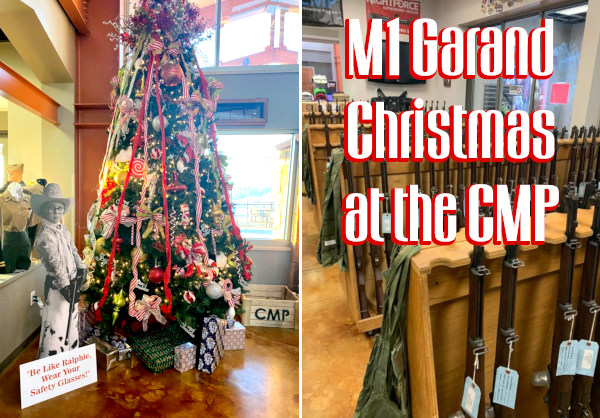
We think every serious vintage rifle collector should acquire an M1 Garand at some point. If you ordered from the CMP this fall, perhaps you may find an historic M1 Garand under your Christmas tree this year. The CMP has, in the past couple of years, received over 90,000 Garands from overseas arsenals, so there are plenty to be had currently. This article explains how to order an M1 Garand from the CMP, and how to select the right grade for your needs and budget.
How to Order an M1 Garand from the CMP
To purchase an M1 Garand through the CMP, you must be an adult U.S. Citizen, and a member of an affiliated organization who has participated in a “Marksmanship Activity”. This basically means you need to join a gun club and participate in a clinic or match. Proof of club membership and citizenship is mandatory for all ages. However, the marksmanship requirement is waived for those over 60 years of age. Garands must be ordered by mail or through official CMP Auctions. CLICK HERE to Start Order.
This handsome M1 Garand was built with a CMP barreled action fitted to an aftermarket figured Walnut stock. That’s not war-worn GI wood.”
Here are two videos that explain the procedure for ordering an M1 Garand from the CMP. Along with mail-order sales, the CMP has brick-and-mortar stores where M1 Garands can be inspected and purchased and then transferred via your FFL (in compliance with state law). The three CMP stores are located in Anniston, Alabama; Talladega, Alabama; and Port Clinton (Camp Perry), Ohio.
M1 Garand Barreled Actions and Aftermarket Barrels
Along with complete M1 Garand rifles, the CMP also offers barreled actions. This can save you money, and also makes sense if you are looking to create a rifle with high-grade wood, or you want to bed the action for improved accuracy. You can order an M1 Garand barreled action, as well as complete M1 Garand rifles, from the Civilian Marksmanship Program (CMP). The eligibility requirements and ordering process will be the same for a barreled action as for a complete rifle.
If you already have an M1 Garand, but need a new barrel, you can order a pre-chambered Criterion barrel in .30-06 Springfield. Criterion tell us: “This is a direct replacement barrel for the M1 Garand rifle, manufactured to Mil-spec print #6535448. It has the original G.I. contour and Parkerized finish. Receiver threads are timed, all milling cuts are made, and all M1 Garand barrels are hand-lapped.” NOTE: Each barrel is .010 short-chambered and should be headspaced by a qualified gunsmith. These Criterion .30-06 replacement barrels, priced at $259.95, are legal for use in Service Rifle and John C. Garand matches.
If you want to re-chamber your M1 Garand to .308 Winchester, the CMP eStore sells brand new Criterion-made barrels in .308 Win for $199.95. These authentic-profile barrels are chambered and headspaced within .010″ of finished size, with final fitting to be done by a competent gunsmith. The barrels are also externally Parkerized to match your vintage M1 Garand.
Once you have an M1 Garand in your collection, you’ll want to keep it in tip-top condition so it works flawlessly for vintage military matches and fun shooting. Below we’ve linked two good SSUSA articles on M1 Garand maintenance. Following that you’ll find two excellent videos covering M1 Garand Disassembly, Cleaning, and Lubrication. Finally there are links to recommended print manuals for the M1 Garand.
M1 Service and Maintenance Shooting Sports USA (SSUSA) published an excellent article on Service and Maintenance of M1 Garand Rifles. This offers some smart tricks, such as using smoke from burning masking tape to darken the front sight post. There is also an older SSUSA article that covers basic cleaning and servicing and also explains how to upgrade the performance of your Garands. READ Article HERE.
As a resource for Garand owners, SSUSA recommends GarandGear.com: “[At] Garand Gear you’ll find USGI spec parts, tools, gauges, clips and a few Garand accessories. They also have some interesting freebies, most notably a direct analysis of M1 gas port pressures produced by different brands of commercial .30-06 ammunition, showing which ones exceed M2 Ball pressure, as well as the pressures produced by ammo manufactured specifically for the M1 Garand, such as Hornady’s M1 Garand Match and Federal’s American Eagle M1 Garand. Here you’ll also find free, downloadable and printable PDF copies of War Department M1 Garand maintenance manuals TM9-1275 and TM9-1005.”
Here’s something you’ve probably never seen before — a rimfire tracer bullet split in half on the blade of a machete. This pistol trick shot is performed by 22Plinkster, an avid rifle/pistol shooter with a hugely popular YouTube Channel. This impressive split bullet demonstration was filmed with high-speed cameras. This lets you see the bullet fly onto the machete blade in slow motion, with red tracer particles streaming behind. And then a freeze-frame clearly shows the two bullet halves after they have passed through two balloons. Check it out:
The high-speed camera (which allows super slow-motion playback) was provided by RatedRR studios. The .22 LR tracer ammunition was provided by Piney Mountain Ammunition Company.
Watch .22 LR Tracer Shooting Montage (Shots Synced to Music):
Here’s a very cool video that shows .22 LR Rimfire Tracer Rounds shot at a variety of targets. There’s a nice musical background that adds to the entertainment value. This video has been viewed over 240,000 times with over 2600 “likes”!
Curious about suppressors (aka “silencers”, “moderators”, or “cans”)? Below you’ll find an informative NSSF Infographic that covers the history, legal status, design, and operation of modern-day suppressors.
Here’s a cool video showing how suppressors work. This video features see-through rifle suppressors filmed with ultra-high-speed (110,000 frame per second) cameras. When played back in super-slow-motion, you can see the flame propagate through the suppressor and the bullet move through each baffle before it exists the muzzle. Check it out!
See Through Suppressor in Super Slow Motion (110,000 fps) — Click Arrow to Watch:
Suppressor Facts — What You Need to Know
In this infographic, the NSSF provides the history, specifications, benefits and uses of firearm suppressors. Don’t suppress your knowledge!
Suppressors reduce gunfire sound levels by using baffles that contain expanding gasses exiting a firearm’s muzzle when ammo is discharged. Suppressors are similar to car mufflers that were, in fact, developed in parallel by the same inventor in the early 1900s. Well-designed suppressors typically reduce the gun sound levels by 30-35 decibels (dB). Suppressors are becoming more popular even though it still takes many months to get approved. In fact, the number of suppressors registered with the ATF grew by over 1 million from 2011 to 2017. That’s a 355% increase.
Women are arming themselves — millions of females now have carry permits and female gun ownership is up 77% since 2005. What factors should women consider when choosing a handgun for self-defense? What are good choices for a lady’s defensive handgun, suitable for concealed carry? Is a self-loading pistol better than a revolver? In this article we include two videos focusing on handgun options for females. The videos cover six key factors: function, size, weight, ergonomics, reliability, and concealability.
Classic Swiss Precision — the Sig P239
The single-stack Sig P239 is an ultra-reliable, compact pistol with a grip suitable for smaller female hands. Weighing 25 oz. in 9mm, it is slightly heavier than polymer-framed handguns, but that may be a good thing. During my handgun training days, this Editor found most women shot the Sig P239 better than Glocks, with more control over recoil. This is a hammer-fired pistol with decocker but no separate safety. There are many other good handgun options for concealed carry — some smaller, thinner and lighter, but the Sig P239 provides a good benchmark for reliability and accuracy. Shown is the .40 S&W model. We prefer the 9mm Luger version. Photo Creative Commons BY-SA 3.0.
Choosing a Self-Defense Handgun — Ladies Explain the Options
Not Just a Guy Thing — Half of New Gun Buyers Are Women
According to the Wall Street Journal, over the past two years, “Close to half of all new U.S. gun buyers since the beginning of 2019 have been women.” And the percentage of female gun owners overall has increased dramatically. Here’s an interesting statistic — according to an NSSF survey, the percentage of gun owners who are female has increased dramatically. The National Shooting Sports Foundation (NSSF) has documented a 77% rise in female gun ownership since 2005, just 16 years ago.
And now nearly one-quarter of American gun owners are female. According to statistics from the NRA, around 23% of women in the U.S. own guns currently, when just 13% did in 2005.
The vast majority of first-time female gun buyers acquire a handgun for defensive purposes. However, the statistics also show that many new female gun owners are also getting involved in sport shooting and/or competitive shooting. An interesting TWAW survey shows that 76% of female gun owners are over 45 years of age, and most are married or in a serious relationship.
NRA News host Cam Edwards has interviewed Celia Bigelow, who has written about the rise of gun ownership among ladies on the Townhall.com website. Follow Cam’s interview in this YouTube video:
This old lever gun is something special — the most expensive rifle ever sold at auction, according to the Rock Island Auction Company (RIAC), the world’s leading firearms auction house. This rifle sold in 2016 for $1,265,000.00 — the highest auction price ever recorded for a rifle (and twice what RIAC expected). The rifle went for such a high price because it was Serial Number 1 and because of its special connection to the Wild West and Indian Wars. SEE: RIAC Most Expensive Guns.
From Rock Island Auctions: “This 1886 Winchester set what was at that time the world record for the most expensive single firearm ever sold at auction… this particular model 1886 happened to be serial number one! If that weren’t enough, the gun was presented by firearms designer Lieut. George E. Albee to his friend and fellow Medal of Honor Recipient Capt. Henry W. Lawton, upon Lawton’s accepted surrender of Apache leader Geronimo.”
This historic Winchester Model 1886, Serial Number 1, was given to then Captain Henry W. Lawton as a gift to honor Lawton’s successful raid to capture the renegade Apache leader Geronimo. The rifle was gifted by his friend, Lt. George E. Albee, who worked with Winchester. Both Army officers were Medal of Honor winners. This rifle “represents the 25 years of bloodshed between the U.S. Army and the Apache Indians in the Southwest, and the end of the Indian Wars. Being serial number one and possessing such outstanding condition would alone be enough to draw six figures at auction. When you add one of the most famous names in the history of the Old West you have a huge crossover appeal”, said RIAC President Kevin Hogan.
Click the links below for the full, illustrated history of Geronimo’s capture by Captain Henry W. Lawton.
Lawton was a “soldier’s soldier” who fought in the Civil War, Indian Wars, Spanish-American War, and Philippine-American War, finishing his career with the rank of Major General. He lead an Army contingent that traveled 1300 miles to capture Geronimo in the summer of 1886. He was killed in combat in 1899 at the battle of San Mateo, in the Philippines. Ironically, the leader of the Philippine Revolutionary troops he faced was named Gen. Licerio Geronimo. Strange but true.
Rock Island sells over 23,000 firearms every year, but “never before had Rock Island offered Serial Number 1 of a production grade, investment-quality firearm” said RIAC. Given the rifle’s unique history and well-established provenance, “this truly is a prized national treasure”. This is the first production Winchester model 1886, with the single digit ONE stamped on the lower tang. The barrel is also inscribed “Albee to Lawton 45-70″.
“The rifle’s story begins with two brothers-in-arms during the Civil War who went their different ways after that conflict, one electing to continue a lifelong military career while the other pursued firearms and their development,” stated RIAC. “When the former, Captain Henry Ware Lawton, captured Geronimo in 1886, the latter, Lieutenant George E. Albee, was working for Winchester and able to secure serial number one of their newest rifle design. He presented it to his old war buddy and lifelong friend to commemorate Lawton’s remarkable achievement.”