I have been looking for a bag that can securely carry a large spotting scope as well as chronograph hardware, wind meter, and camera gear — all the extra stuff I typically take to the range in addition to the essential cleaning and shooting products that go in my regular range kit. The folks at Grizzly Industrial told me to check out their new 20″ Range Bag by Bald Eagle. These 20″ Range Bags, are very versatile and well-made. With eyepiece removed, my jumbo-sized Pentax PF-100ED spotting scope fit perfectly inside the padded central compartment. At the same time I could haul ALL the peripherals for my PVM-21 chronograph, plus a camera, wind meter, spare Pentax eyepiece, AND a netbook computer. Without the netbook, there is room for four pistols along the side channels. If you don’t need to pack a large spotting scope, the main compartment could easily hold 3 more pistols in Bore-Store socks, plus holsters, ammo boxes, and earmuffs.
Watch the video to see how much stuff will fit in this bag. NOTE: If you carry a tripod or windflag stand using the straps under the case lid, be sure to position the foam padding carefully to prevent any direct contact with a spotting scope in the main compartment. Overall, the 20″ Range Bag is a remarkably capable gear-hauler. With the nicely-padded interior it will safely carry expensive items such as laser rangefinders, and binoculars. There is also a slash pocket on the rear side (not shown in video) that will hold thin items such as target stickers and shooting log-books. The 20″ Range Bag is offered in four (4) different colors: Red, Black, Green, and Camo. Price is $59.95 for solid colors and $61.95 for camo.
Smaller, 15″ Range Bag Offered Also
Grizzly also sells more compact, 15″-wide Bald Eagle Range Bags. There are six (6) color choices for the 15″ Range Bag: Red, Black, Navy Blue, Green, Hot Pink (for ladies), and Camo. Solid colors cost $45.00, while the Camo Bag costs a couple dollars more ($46.95). If you don’t need to haul a spotting scope, you may prefer the smaller version. The 15″ version still offers lot of carrying capacity — it’s big enough to hold ammo, muffs, target stickers, and much more.
REVIEW Disclosure: Grizzly Industrial provided the 20″ Range Bag for testing and evaluation.
This review first appeared in 2011. Having graduated from college in 2012, Kelly is now working full-time, and he has started a business,KellysGunSales.com.
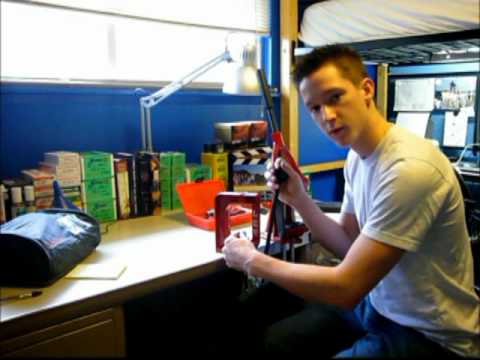
Most readers recognize Kelly Bachand from the popular Top Shot TV show on the History Channel. Kelly didn’t win the $100K grand prize, but he was a talented competitor who became an audience favorite with his accurate rifle shooting and “toughness under fire” (Kelly survived more one-on-one challenges than any other competitor). Last spring, with the cooperation of Forster Products, AccurateShooter.com supplied Kelly with a new Forster Co-Ax® Press. As a college student, Kelly had previously reloaded with a low-priced Lee Challenger Press — all that his “starving student” budget would allow. (In fairness to the Lee — it did produce some match-winning ammo for Kelly over the years.)
Kelly has been very impressed with the Co-Ax Press and he put together a video review for us. Kelly likes the ease with which dies can be swapped in and out of the press, and he also enjoys the added mechanical leverage provided by the coaxial design. Kelly favors the Forster’s straight-drop, spent primer-capture system. On other, conventional presses, spent primers and debris can collect around the base of the press, or end up on the floor, on your carpet, or on your bench-top.
Forster Co-Ax Press Design Features The Co-Ax’s spring-loaded shell holder jaws float with the die, allowing cases to correctly center in the die. Dies snap easily in and out of the jaws so you can change dies in a couple of seconds. Many folks believe this improves die alignment, producing loaded rounds with less runout.
We really like the primer recovery system on the Co-Ax. Spent primers pass straight down into a cup — no more primers and carbon on the carpet. Every other single-stage press we’ve tried will toss a spent primer now and then, and primer residue builds up around the ram shaft.
PROS: Floating jaw shell-holder design delivers low run-out ammo. Smooth stroke without wobble. Best spent-primer collection system.
CONS: Clearance can be an issue with some very tall dies (but you can mill the yoke to accommodate). Dies must be equipped with cross-bolt style lock rings. We recommend the Hornady lock-rings.
If you need power for case sizing, the Co-Ax delivers three times the mechanical advantage of some conventional presses. The Co-Ax’s dual parallel guide-rod design also ensures that the ram movement is straight and smooth throughout the power stroke. With a center-mounted handle, the Co-Ax works equally well for both right- and left-handed reloaders.
The Co-Ax press accepts any standard 7/8″x14 threaded reloading die. You will need to use cross-bolt-style lock-rings on your dies. We recommend the Hornady rings. These are steel and have a hex-head cross-bolt. The Co-Ax requires no expensive shell-holders. The standard “S” jaw set supplied with the press fits nearly all common calibers except: 378 Wby., 45-70, 256 Win. Mag., 44 S&W, 416 Rigby, 416 Rem., 45-90 and 348 Win. These calibers can be used if you purchase the optional “LS” Jaws.
At SHOT Show we checked out the all-new, side-focus 15-55x52mm Competition™ Scope from Nightforce Optics. This comes in both Silver finish and Matte Black. The black version looks like an NXS. The silver looks good but the finish is pretty shiny and contrasts with the black controls (some folks will like that, others won’t). We worked the knobs and side-parallax controls. The clicks are positive and the dial resistance seems just about right (very similar to an NXS). The ED (low-dispersion) glass in the new 15-55X provides high contrast, low chromatic aberration, and 92% light transmission. And this scope is a LOT lighter than the current 12-42x56mm — nearly half a pound less! The new 15-55x52mm sells for $2231.00.
Watch Video to See NF 15-55x52mm Competition Scope (and B.E.A.S.T. sneak preview.)
The big news is that, with a weight of just 27.8 ounces, the new 15-55X Nightforce Competition Scope is 24% lighter than the NF 12-42×56 Benchrest model, and 20% lighter than the NF 12-42×56 NXS. Like the NXS series, the new Competition scope offers side parallax adjustment; and, it will focus from 25 yards to infinity, making it suitable for rimfire and airgun shooting as well as centerfire competition. The turrets provide positive and repeatable .125 MOA (eighth-minute-of-angle) clicks. Each rotation provides 5 MOA of adjustment. And we’re pleased to see that the Competition Scope offers a full 60 MOA of travel — for both windage and elevation. That’s impressive. We’re pleased to see the new scope offers a fast-focus, European-style diopter eyepiece (photo below right). Two reticles will be offered initially: the CTR-1 (fine crosshair with target dot) and DDR (double dot with hold markers). You can see the reticles in the video above.
Thankfully, you won’t have to wait long to get a 15-55x52mm Comp Scope. Nightforce says it will start shipping in mid-February. CLICK HERE for more information.
At SHOT Show we got a “first look” at the new Kahles K-1050, a 10-50x56mm scope with unique, centerline parallax control. This is a very interesting new high-magnification competition scope. Kahles’s patented centerline parallax control allows the marksman to adjust windage, elevation, AND parallax all with ONE HAND. If you’re in prone position, for example, you simply reach forward with your right hand to dial windage, then slide your hand to the central turret to dial elevation and, finally, set the parallax by adjusting a separate concentric ring.
Watch Video to See Kahles K-1050 Features and Centerline Parallax Control
NOTE: The big-diameter metal ring is OPTIONAL. You can remove the big metal ring and still adjust parallax (from centerline) using a smaller, built-in control ring on the top turret.
Designed for benchrest and field target use, this scope has a 30mm main tube, 55 MOA elevation, and 1/8-MOA clicks. There are three (3) total turret revolutions. The turret “Rev Count” is displayed with a clever red-and-white striped “barber pole” button in the center of the top turret. One red stripe indicates REV 1, red + white indicates REV 2, and red + white + red indicates REV 3. It’s simple, but it works.
The new K-1050 also features a nice European-style +/- diopter control on the eyepiece. If you have less that perfect vision, this allows you to get a sharp target image even without eyeglasses.
We liked the scope. The glass was bright and sharp, and the clicks were positive and precise. Competition shooters have shown great interest in the new K-1050, and Kahles plans to bring the new scope to the USA by mid-summer 2013. Price is expected to be around $2800.00 USD.
At SHOT Show 2013, Lapua announced it was expanding its line-up of Scenar L projectiles to include two new 6.5mm bullets and three new .30-caliber Scenar Ls. We applaud this news. This Editor has tested 6mm Scenar L bullets in his own rifles, and they have proven to be some of the most consistent bullets we have ever measured. The Scenar Ls also shot great in 8-twist barrels from Brux, Krieger, and PacNor.
Two New 6.5mm Scenar Ls
Guys with .260 Rem, 6.5×47, 6.5 Creedmoor, and 6.5-284 rifles have been eagerly awaiting the new 6.5mm Scenar Ls. These will be offered in two weights: 120 grains and 136 grains.
Scenar Ls in .30 Caliber
Lapua will release three new .30-Caliber Scenar L bullets. Along with a new 155gr Palma bullet (GB 552), Lapua will offer a 175gr Scenar L (GB 550), plus a 220gr heavy-weight Scenar L (GB 551). In magnum and short magnum chamberings, the 220-grainers should prove very effective in Long Range comps.
What Makes the Scenar Ls So Good
While all Lapua Scenar bullets are made to exacting standards, Lapua “raised the bar” with its Scanar L series. Scenar L bullets feature closer weight tolerances, tighter jacket wall concentricity standards, and greater uniformity in every dimension. Building bullets this good isn’t easy — you have to get everything right — from the gilding metal cup, to the lead wire and jacket forming, core-jacket assembly, and finally boat-tail pressing and nose-tipping. To build L-series bullets to such high standards, Lapua had to adopt new manufacturing procedures, and install proprietary new machines and advanced instrumentation never seen before in bullet production. Lapua also took its already high quality control standards and kicked them up a notch.
New 6.5mm Scenar Ls — First Look
At SHOT Show, Lapua unveiled its much-awaited new 6.5mm (.264 caliber) Lapua Scenar L bullets. There are two (2) new 6.5mm Scenar Ls: a 120gr tangent ogive design and a 136gr multi-ogive design. These are both all-new bullets, though the new 120gr Scenar L bears a “family resemblance” to the current (and very accurate) 123gr standard Scenar. One look at the new 136-grainer, and you can see that this is NOT just a “tweak” of the popular 139gr standard Scenar. The new 136gr Scenar L has a streamlined secant-ogive shape that blends into a more conventional tangent ogive as the bullet approaches full diameter. This dual-ogive design enhances the bullet’s BC, making it more slippery. That should translate to less drop and less drift at long range.
These new 6.5-caliber Scenar Ls should hit the market very soon. Check with Grafs.com for availability. As soon as we can get our hands on Lapua’s new 120s and 136s we will test them in a 6.5×47 Lapua bench gun and see how they perform. The .30-Cal 175gr and 220gr Scenar-Ls should arrive by late spring according to Kevin Thomas of Lapua. Kevin is a member of our Forum and he can answer your questions about the entire line-up of Lapua projectiles, along with Lapua cartridge brass.
If you’ve tried to buy powder lately, you know that many of the most popular propellants are in short supply. To find out when we can expect powder supplies to catch up with the increased consumer demand, we headed to the Hodgdon Powder Company booth at SHOT Show. There we met up with Chris Hodgdon.
Chris understands that people are frustrated with the current shortages. But Chris assured us that his company is moving aggressively to get more powder on store shelves. Production is being stepped up and Chris said his employees are working “nights and weekends” to increase propellant shipments. But there is no “quick fix”. Chris reports: “We are trying to fill as much of the demand as we can right now, but we have got way more demand than supply obviously right now…”
Try Alternative Powders with Similar Burn Rates
For those customers who can’t find their favorite powder (such as Varget or H4350) right now, Chris suggests trying similar-burn-rate IMR- and Hodgdon-brand powders that are currently available in ample quantities. For example, Chris suggested that Varget users try IMR 4064. This powder offers excellent accuracy and a very similar burn rate. Likewise, if you can’t find H4350 you can try IMR 4350 or H414. Fans of H335 powder will find that Benchmark and CFE 223 are suitable replacement powders.
Of course, when changing to a different powder you can’t simply substitute loads. That’s a big no-no. You need to consult a good load manual or find a safe starting load on the Hodgdon Reloading Data Center. But you may find that, with a little load development effort, your “second choice” or “third choice” powder options shoot just as well as a previous favorite. We know guys who switched from Varget to IMR 8208 XBR in the .308 Win and they liked the 8208 XBR so well they never looked back.
The new RCBS Summit Press attracted a lot of attention when we first revealed it in the Daily Bulletin earlier this month. Readers wanted to know how well this radical new design really worked. To answer that question, we headed to the RCBS booth at SHOT Show 2013. There our buddy Kent Sakamoto gave us complete run-down on the new Summit. With the Summit, unlike other presses, the case does not move. As you can see in the video, the reloading die comes DOWN to the case.
The Summit’s open-front design is definitely a plus, and we really like the fact that all press operations take place ABOVE the benchtop. There are no linkages running below the bench, which lets you use the Summit on a bench with cabinet-style drawers. The Summit press is definitely beefy. With its massive center column, the design operates smoothly with no flexing issues. RCBS says the Summit has no more head flex than the classic “O”-design RockChucker.
The new Summit Press features a rugged cast-iron frame with all-steel linkages. The handle can be switched from right to left side (good for southpaws), and the open-front design provides good access, facilitating quick die changes. The 4.5-inch opening allows you to work with tall cases. Beneath the shell-holder is a spent primer catcher. The press will accept larger bushings for oversize 1-inch dies. Street Price in the new Summit Press is about $220.00 (optional Short Handle is another $19.95).
RCBS Summit Press Features:
• Bench-top operation
• Massive 2-inch diameter ram
• Ambidextrous handle
• Compound leverage
• 4.50-inch operating window
• Spent primer catcher
• Full frontal access
• Accepts bushings for 1″ die bodies
• Press adapter bushing
• Zerk lubrication fitting
• Made in USA
How would you like a modular precision rifle that can shoot .338 Lapua Magnum, .300 Win Mag, and .308 Win rounds — all from the same action and chassis? And how would you like to be able to swap calibers in the field (with barrel and bolt change-outs) with just a couple simple hand tools? This kind of rifle system is not just a pipe-dream. Accuracy International’s PSR Rifle system is truly three guns in one, and it’s now in production. Watch the video to see the features of this advanced modular rifle.
Scott Seigmund, V.P. of Accuracy International (North America), gave us a run-down on the features of AI’s new PSR (Precision Sniper Rifle) modular system. By changing barrels, bolts, and magazines, the gun can shoot three different cartridge types. All the equipment (including bipod, optics, extra bolts, barrels, and mags) are carried in AI’s fitted “deployment” box.
If the full $17,200 three-barrel system is not enough for you, and you need something even more exotic — AI offers a special take-down version of the PSR rifle. Scott showed us a complete .338 LM rifle (with 20″ barrel) stowed in a transport box smaller than a typical carry-on case. Scott said the price on the take-down system has not yet been set.
At SHOT Show 2013 we had the chance to chat with legendary barrel-maker John Kreiger of Krieger Barrels. In this wide-ranging interview, John addressed a number of questions our readers often pose…. What is better for a 6mm, 0.236″ land or 0.237″ land? What are the pros/cons of various barrel types: 3-groove, 4-groove, 6-groove, 8-groove, and 5R? What types of land/groove configurations clean up more easily? (John says the 5R might be the winner there).
John also discusses barrel cleaning and he explains why it’s unwise to pull a dirty brush back across your delicate crown: “The problem comes from the fact that abrasive materials — powder and primer residues in particular — get embedded in the brush. Essentially that is how a lap works.”
When we suggested that Krieger Barrels might want to offer three-groove barrels in the future, John surprised us by revealing that he has been considering putting a 3-groove design into production. John says that, in theory at least, a canted-land 3-groove holds a lot of promise. John hopes to build some prototype 3-grooves to test. Krieger Barrels has a 300-yard underground tunnel where barrels with various land/groove configurations and calibers can be tested using a return-to-battery fixture. John admits that tunnel testing of barrels is “on the back burner” as his company focuses on filling orders. But he says that he has a strong personal interest in testing different land/groove configurations, different amounts of choke, and different internal dimensions. We hope we’ll be able to share some results from the Krieger Barrels test tunnel in the near future.
Sinclair Int’l has released a 7-part series of video interviews with Walt Berger (founder of Berger Bullets) and Eric Stecker (Berger’s Exec. VP and Master Bulletsmith). The series is hosted by Sinclair’s President, Bill Gravatt. You can watch Parts 1 and 2 of the interview here, and we’ve provided links to the remaining Parts 3 through 7. All seven interview segments offer interesting material. Part 6 mentions up and coming stuff like the reloading manual. Part 7, over 13 minutes long, contains interesting discussions of bullet testing and the hunting performance of Berger VLDs. NOTE: You can view this entire video series (and many other videos) on Sinclair’s YouTube Channel Page.


 I have been looking for a bag that can securely carry a large spotting scope as well as chronograph hardware, wind meter, and camera gear — all the extra stuff I typically take to the range in addition to the essential cleaning and shooting products that go in my regular range kit. The folks at Grizzly Industrial told me to check out their new 20″ Range Bag by Bald Eagle. These 20″ Range Bags, are very versatile and well-made. With eyepiece removed, my jumbo-sized Pentax PF-100ED spotting scope fit perfectly inside the padded central compartment. At the same time I could haul ALL the peripherals for my PVM-21 chronograph, plus a camera, wind meter, spare Pentax eyepiece, AND a netbook computer. Without the netbook, there is room for four pistols along the side channels. If you don’t need to pack a large spotting scope, the main compartment could easily hold 3 more pistols in Bore-Store socks, plus holsters, ammo boxes, and earmuffs.
 Watch the video to see how much stuff will fit in this bag. NOTE: If you carry a tripod or windflag stand using the straps under the case lid, be sure to position the foam padding carefully to prevent any direct contact with a spotting scope in the main compartment. Overall, the 20″ Range Bag is a remarkably capable gear-hauler. With the nicely-padded interior it will safely carry expensive items such as laser rangefinders, and binoculars. There is also a slash pocket on the rear side (not shown in video) that will hold thin items such as target stickers and shooting log-books. The 20″ Range Bag is offered in four (4) different colors: Red, Black, Green, and Camo. Price is $59.95 for solid colors and $61.95 for camo.


 Most readers recognize Kelly Bachand from the popular Top Shot TV show on the History Channel. Kelly didn’t win the $100K grand prize, but he was a talented competitor who became an audience favorite with his accurate rifle shooting and “toughness under fire” (Kelly survived more one-on-one challenges than any other competitor). Last spring, with the cooperation of Forster Products, AccurateShooter.com supplied Kelly with a new
 The Co-Ax’s spring-loaded shell holder jaws float with the die, allowing cases to correctly center in the die. Dies snap easily in and out of the jaws so you can change dies in a couple of seconds. Many folks believe this improves die alignment, producing loaded rounds with less runout.


 At SHOT Show we checked out the all-new, side-focus


 Designed for benchrest and field target use, this scope has a 30mm main tube, 55 MOA elevation, and 1/8-MOA clicks. There are three (3) total turret revolutions. The turret “Rev Count” is displayed with a clever red-and-white striped “barber pole” button in the center of the top turret. One red stripe indicates REV 1, red + white indicates REV 2, and red + white + red indicates REV 3. It’s simple, but it works.

 At SHOT Show 2013,
 New 6.5mm Scenar Ls — First Look

 If you’ve tried to buy powder lately, you know that many of the most popular propellants are in short supply. To find out when we can expect powder supplies to catch up with the increased consumer demand, we headed to the
 Try Alternative Powders with Similar Burn Rates
 RCBS Summit Press Features:


 At SHOT Show 2013 we had the chance to chat with legendary barrel-maker John Kreiger of


