by Ian Kenney A week before the fall Allegheny Sniper Challenge (ASC), I first saw Adaptive’s Field Density Altitude Compensator (FDAC). I was impressed by its capabilities and compact size and I managed to take one home from the ASC prize table the very next weekend. The FDAC comes from Adaptive Consulting and Training Services in Stafford, VA. The guys at Adaptive know a thing or two about long-range shooting — many of them are former USMC Scout Snipers. Their long-range shooting and combat experience helped them perfect the FDAC.
At first glance the $39.95 FDAC appears to be just another data card. However, in a number of ways, it is completely different than traditional data cards. The FDAC was designed to be simple and accurate, so that any military or civilian shooter could pick it up and, within minutes, effectively employ it. Anyone familiar with a Midot Master should find the FDAC simple and intuitive. Another plus is that, unlike electronic gadgets, the FDAC doesn’t need batteries or shielding from the elements. You don’t have to carry around extra batteries, chargers, and “ruggedized” weather-proof cases.
FDAC Offers Multiple Cards for More Precise Solutions
The FDAC is quite different than traditional data cards that calculate trajectories based on a single muzzle velocity in a given set of conditions. The problem with those traditional data cards is that, as soon as one variable changes, the card’s ballistic solution becomes less valid. The FDAC solves this problem by employing several cards for different muzzle velocities and using Density Dltitude to compensate for the differences in environmental conditions. For the uninitiated, Density Altitude combines the temperature, humidity, barometric pressure, and elevation figures into one number that is more easily used over a wider range of conditions. Density Altitude can be obtained with a portable weather station (such as a Kestrel). If a portable weather meter is not available, the basic chart printed on the card itself works pretty well even when guessing at the physical altitude and temperature.
FDAC Ballistic Solutions Deliver First-Round Hits in the Field
I first tested the FDAC at Reade Range in Pennsylvania, shooting from 500 to 1000 yards. I used the 2700 fps velocity card that came with my FDAC for the 175 Sierra Match King since that most closely matched what I had loaded up. Starting out with a cold bore shot from the 500-yard line, I obtained the density altitude using my Brunton ADC Pro, and slid the card over until the proper density altitude column was showing. With 3.2 mils of elevation and .2 mils of left wind dialed into my Nightforce 3.5-15×50 (first focal plane) scope, I went for my cold bore shot, hoping the FDAC would put me close. I was happily rewarded with a first round, center mass hit, just a little left of center.
The FDAC continued to shine at longer ranges. FDAC solutions gave me first-round hits at 600 and 800 yards, a second round hit at 1000 yards. Several weeks later I found myself in a field in rural North Carolina once again putting the FDAC to good use this time without any electronic aids. To my surprise, my guestimate of about 500’ for density altitude was pretty darn close to what the Kestrel my friend had was saying also. Just like at Reade Range, the FDAC values delivered cold bore hits that were nearly point of aim = point of impact. That demonstrated how well the FDAC worked in warm weather.
This winter I was able to see how the FDAC performed in cold conditions. In cooler, denser air, a bullet requires more elevation correction to get on target than it would need in warmer temps. So I went out one chilly January morning and confirmed that the FDAC can handle cold conditions. The FDAC solutions once again gave me first round hits from 250 yards to 730 yards. The little DA chart put me in the right vicinity for density altitude just by knowing my altitude and making a guess for the air temperature. Since I’ve started using the FDAC I’ve found that the data is either spot on or within about .2 mils of the correct dope at nearly all distances when using the correct density altitude column. This is very impressive. I found that the FDAC delivered practically the same data as popular digital PDAs and field ballistic calculators. But the FDAC can be even faster in use (once you become familiar with its operation), and, at $39.95, it costs a fraction of what a dedicated electronic ballistics solver would cost. The FDAC is practical, very accurate, inexpensive, compact, lightweight and never needs batteries — what’s not to like?
Below is a SnipersHide Video Review of the FDAC Tool
New Enhanced Milspec FDAC Released this Year
Adaptive has put much R&D into the FDAC and it shows. Thousands of Field Density Altitude Compensators have been provided to soldiers and marines, who are making good use of the devices. At the 2011 SHOT Show, Adaptive unveiled an enhanced FDAC, the MILSPEC-XR. This new version includes a new Density Altitude calculator, extended range dope for the .338LM and .300WM, as well as tools for slope dope and moving targets. Adaptive also offers conversion tables and compatibility charts so that the FDAC can be used with other bullets besides the original FDAC default projectiles. (For FDAC owners, the conversion charts are FREE!) The FDAC is truly one of those few products that I wish I had when I was deployed to Afghanistan. I highly recommend it to any long-range shooter using .308 Win, .300WM or .338LM cartridges (with a mil-based optic). For more information, or to order an FDAC tool, visit the Adaptive website, ACTSVirginia.com, or call (540) 657-8541.
The Drop Port is a great feature for benchrest shooters. You can run a bolt without an ejector, yet your cartridge will extract smoothly and reliably each time you pull the bolt back. Stiller’s Precision Firearms pioneered the Drop Port design, and Jerry Stiller offers this as a popular option with his Cobra, Viper, Python, D-Back, and Diamondback actions. The Drop Port is amazing in its simplicity (watch video below). As you pull the bolt rearwards, the fired case slides downward into a funnel. As it tilts nose-down, the case rotates free of the six-o’clock extractor, falls nose first down the funnel, and finally exits through a hole in the bottom of the stock. Gravity does all the work.
S&S Panda Drop Port Conversion
Until recently, if you wanted a Drop Port, your only option was to purchase a Stiller action or engineer a conversion yourself. Now the owners of Kelbly Panda actions can enjoy drop-port functionality via a conversion performed by S&S Precision Rifles in Texas. The folks at S&S will mill a slot in the bottom of your action, and then install a drop funnel in your stock. The conversion work is done so well you’d think the Pandas were originally made as Drop Ports by Kelbly. Drop Port conversions will be available for popular small match cartridges including 22 PPC, 6 PPC, 6mmBR, 6BRX, 6 Dasher, 6.5 Grendel, and 30 BR (plus other wildcats in the BR family).
Conversion Will Be Costly — New Actions Are Best Candidates
This conversion will not be cheap. Because Drop Ports require a six o’clock extractor, you’ll probably need a replacement bolt for your Panda. S&S is in discussion with Pacific Tool & Gauge to provide these bolts. You can probably resell your existing bolt, but the upfront conversion cost could approach $400 with new bolt and labor. S&S hopes to announce firm pricing in 4-6 weeks. Don “Stick” Starks, S&S’s lead gunsmith, also cautions that this conversion is most cost-effective with Panda actions that have not yet been installed, or which are set up with pillars (as opposed to glue-ins). Stick explained: “If your Panda is already glued in, then we have to remove the action, mill the port, install the funnel, and then re-bed the whole thing. That’s going to substantially increase your cost. It’s more logical to do this on a Panda that has not yet be put in a rifle.”
In the video above, you can watch S&S Precision convert a Stolle Panda action to a Drop Port, and then see how the converted Panda functions. The rifle is a 30BR owned by FORUM member Truckincars, who also created the video.
Whether you’re on the East Coast or West Coast, you can have fun this weekend at an outstanding varmint match, shooting reactive targets for fun, glory (and maybe a little cash). Easterners — head down to Virginia for the Roanoake Egg Shoot. Westerners — navigate to the Pala Range near Oceanside in Southern California.
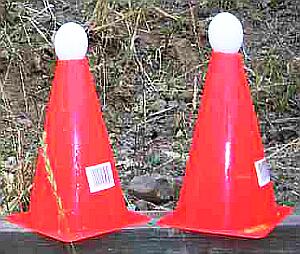
Roanoake Egg Shoot, Saturday April 30th In Virginia, the Roanoake Egg Shoot will be held Saturday, April 30, 2011 at the Roanoake Rifle and Revolver Club in Hardy, Virginia. This is a real test of shooter and equipment. You want challenge? Try hitting an egg at 500 yards. That requires a skilled triggerman (or woman) and a very accurate rifle. In addition to the 500-yard egg event, Roanoke also offers long-range plate shooting. There will be three classes this year: 1) Factory Guns; 2) Hunter/Tactical; and 3) Custom Benchrest. The custom gun class will shoot 2″-diameter steel plates at 425 yards while the Factory and Hunter class guns will shoot 3″ plates at 425 yards. All shooting is from a 20-bench covered firing line. The entry fee is just $20.00 per gun/class entry. Pay $60.00 and you can shoot all three classes. Cash prizes will be awarded to the top shooters. For more info, contact Mark Schronce (540) 980-1582 rmschr@comcast.net or Epps Foster, (540) 890-4973. The club is located at 1305 Gun Club Drive, Hardy, VA 24101. GET DIRECTIONS.
Pala, California Multi-Stage Varmint Silhouette Shoot About 24 miles east of Oceanside, California (near the Camp Pendleton Marine base) is the Pala Reservation. On that Native American land you’ll find an impressive Casino Resort, plus an excellent shooting range. The first Sunday of every month, shooters come to Pala to enjoy a challenging Varmint Silhouette Match. At five different yardages, ten steel “critter” targets are set as follows: 200 Meters – Field Mice (“pikas”); 300 meters – Crows; 385 meters – Ground Squirrels; 500 meters – Jack Rabbits; 600 yards – Prairie Dogs.
There’s a North County Shootist Association Varmint Silhouette match this Sunday, May 1st. You’ll need a very accurate rifle, and 80-100 rounds of ammo. You can shoot either rested prone (F-Class style), from bipod, or from a wooden bench with front pedestal and rear bag. Any rifle 6.5 caliber or under is allowed, with no weight restrictions. Muzzle brakes are permitted. There’s a one-hour sight-in period starting at 8 am, and the match starts at 9 am sharp. The folks at Pala run a tight ship, cycling multiple relays efficiently, so everybody gets to shoot 50 targets (10 each at five different yardages), and the show is usually completed by 1:00 pm. (Then if you want… head over to the Pala Casino for gambling fun, or a spa treatment.) CLICK HERE for Match Info.
If you’re a fan of the History Channel’s Top Shot series, but you missed the season finale, don’t despair. You can watch the full episode online and see who wins $100,000 and the title of “Top Shot”. We won’t reveal any spoilers here, but we can say that some dramatic surprises will unfold as you watch.
These professionally-produced, High-Def videos teach safe handling and use of firearms. Each 90-second video covers one or more Basic Firearm Safety Rules. “Firearm Safety, Gun Safety or Hunter Safety; it doesn’t matter which term you use, this is a very important topic for everyone who spends time around guns – whether as a collector, a shooter or a hunter,” says Larry Potterfield, Founder and CEO of MidwayUSA. Potterfield will announce the new Videos on Saturday, May 30, at 1:30 pm at the NRA Annual Meeting in Pittsburg, PA.
MidwayUSA VIDEO Downloads: Right click and “save as” to download to your computer.
If you missed this week’s “Shakedown” episode of Top Shot, you can now watch the full episode on the History Channel website. We think this is one of the best Top Shot shows so far, because there is plenty of shooting, with modern guns, over interesting courses of fire — the kind you’d see at a multi-gun match. And the elimination round was a true skills test. This week’s “expert” is none other than Iain Harrison, the Top Shot Champion from Season One. Iain selected four firearms for this week, and they are good ones: Sig p228 (9mm), Browning High Power (9mm), AR15 (5.56×45), and FN-FAL (7.62×51).
Competitors shoot all four weapons in sequence, off-hand, over a timed course. To add challenge, each shooting station offers an unstable platform — with wood planks that swing, wobble, or bounce. At left you can see the AR15 station — a wood platform suspended by ropes. You’ll be surprised with the performance of some of the favored shooters (including Gunny Zins), and you’ll see why it may be a good thing that the U.S. Military switched from the 7.62 NATO cartridge to the 5.56 round. Most of the shooters had big problems with the heavier-recoiling 7.62×51 “battle rifle” at 100 yards.
If you want to learn how to shoot accurately at very long-range, one of the very best places to learn is the Williamsport 1000-Yard Benchrest School. The next School session runs May 20, 21, & 22, 2011. Classes are held at the Original Pennsylvania 1000-Yard Benchrest Club Range, one of the best 1K ranges in the country. Classes are taught by top 1K shooters, including our Asst. Editor, Jason Baney.
While these Benchrest schools typically sell out, there were still eight (8) student slots available as of April first. If you want to grab one of the remaining slots for the 3-day school, don’t hesitate. To see what the 1K Benchrest school is like, watch the slide show/video below, produced by Sebastian Reist, an alumnus of the 2009 Williamsport 1000-yard BR school. Sebastian, a talented professional photographer, captured the highlights of his Williamsport 1K training weekend:
For more information or to sign up for the 2011 1000-Yard Benchrest Class this May, contact School Director Frank Grappone, or visit the Williamsport website, PA1000yard.com.
The 2011 ISSF Combined World Cup shooting competitions were held in Sydney, Australia on March 21-31. In Sydney, the world’s top shooters vied for coveted Olympic “Quotas” that would secure eligibility to compete at the 2012 London Olympic Games. 34 Olympic Quotas were awarded during the course of the 15 ISSF pistol, rifle and shotgun events in Sydney. Lead by its shotgunners, Team USA performed superbly in Australia, finishing with 8 total medals, including 3 Golds, more than any other country. China finished second in the medal count.
American Medal Winners:
Gold: Jamie Beyerle (Lebanon, PA), Women’s 50m Rifle Three Position
Gold: Kim Rhode (El Monte, CA), Women’s Skeet
Gold: Jon Michael McGrath (Tulsa, OK), Men’s Skeet
Silver: Matt Emmons (Browns Mills, NJ), Men’s 50m Rifle Three Position
Silver: Amy Sowash (Richmond, KY), Women’s 50m Rifle Three Position
Silver: SFC Eric Uptagrafft (Phenix City, AL), Men’s 50m Rifle Prone
Silver: Staff Sergeant Joshua Richmond (Hillsgrove, PA), Men’s Double Trap
Silver: Caitlin Connor (Winnfield, LA), Women’s Skeet
Young Americans Win Gold
The United States fielded one of the youngest teams in Australia. But the young shooters more than held their own. Team USA rifle shooter Jamie Beyerle dominated the Women’s 50m three-position event, to win Gold with a total of 685.3 points. Beyerle’s fellow American Amy Sowash finished second. Beyerle shot great in windy conditions that bothered many of her rivals. You can watch Jamie shoot in the first video linked below.
Another gold-medal performance was turned in by 18-year-old skeet shooter John McGrath, the current ISSF Junior World Champion. McGrath qualified for the Men’s Skeet Final by hitting 124 of 125 targets, and then “cleaned” all his 25 Final targets. In an exciting finish, McGrath took the Skeet Gold Medal by beating 2007 World Champion Georgios Achilleos of Cyprus in a shoot-off.
Highlights of the 2011 ISSF Shooting World are now available on the ISSF’s YouTube Channel. Linked below are videos of the Women’s 50m 3-Position Highlights and Men’s Prone 50m Air Rifle event. You can also visit www.ISSF-Shooting.org for the complete tournament results, interviews with shooters, and the latest international shooting news.
Horus ATrag Ballistics software is now embedded in Kestrel 4500 NV Pocket Weather Trackers, eliminating the need for a PDA. Since the ballistics software is built into the Kestrel unit, environmental data automatically flows from the Kestrel side to the ATrag solver for accurate and instant ballistics solutions. You don’t have to punch in wind speed, temp, or air pressure — that’s all done automatically. The 4500 NV Weather Tracker is IP67 waterproof and MIL-STD-810F rugged. MSRP for the Kestrel with Horus Ballistics is $619.00 (non-Bluetooth).
Features of Horus ATrag
By integrating ATrag capabilities, you can now go to the field with just one device for weather AND Ballistics, eliminating the need to carry a separate PDA or smartphone. Along with a ballistics solver, ATrag includes an extensive gun list, customizable targets, and truing capability. Truing takes your factual data and models an accurate outcome of bullet drop, rather than a predictive one.
The new unit allows users to load and customize multiple guns and rounds from the extensive proprietary Horus database. You can create up to six targets, each customized for location, distance, direction, declination and winds. The Kestrel meter will meter wind velocity and direction, and, using its built-in digital compass, it will give the bearing to the targets. Once these parameters are set, the Kestrel meter takes over — tracking the current met data and automatically updating the firing solution. The Horus ATrag software even compensates for coriolis and spin drift at extreme long range.
When you switch out of Ballistics mode, you still have all the capabilities of a 4500 NV unit which can measure: speed and direction, temperature, humidity, heat stress, barometric pressure, altitude, density altitude, crosswind and more.
Tonight, on the Outdoor Channel, you can watch four of America’s best female action and multi-gun shooters. In tonight’s episode of the Shooting Gallery on the Outdoor Channel, ace USPSA shooters Julie Golob, Tasha Hanish, Lisa Munson, and Randi Rogers show off their skills with pistols, rifles, and shotguns. Golob, captain of Team Smith & Wesson, is a National Champion Pistol Shooter who is now taking up the multi-gun challenge. Hanish, one of the top shooters for Team FNH, is a two-time USPSA Multi-Gun National Champion (Women’s Tactical Division). Lisa Munson has captured 11 National Pistol titles over the years, and now competes with Team Smith & Wesson, along with Golob. Randi Rogers (aka ‘Holy Terror’) is a multi-time Cowboy Action Ladies World Champion who has been shooting modern pistols with Team Glock for the past few years. Randi has won numerous tournaments for Glock. If you ever get a chance to watch Randi shoot a lever gun (from her cowboy action days) — you will be amazed. In speed events, using her lever gun, she could beat most male competitors who are using modern semi-auto rifles. She is that fast and accurate.
Preview Tonight’s Shooting Gallery Episode
Here is a preview from Tonight’s Shooting Gallery, hosted by Michael Bane.
Outdoor Channel Airtimes are: 03-16-11 at 3:30pm, 7:00pm, 9:00pm | 03-17-11 at 3:00am.
Tasha Hanish at Multi-Gun Nationals — You Go, Girl!
In the following video, taken at the 2010 USPSA Multi-Gun Nationals, you can see Tasha Hanish blaze through a 3-gun stage. Tasha starts with her 9mm pistol, then grabs her shotgun to blast steel plates, and finally engages a bank of 200-yard targets with her FNH SCAR rifle. Tasha won the Ladies’ 2010 Multi-Gun Championship in the Tactical Class.


 A week before the fall Allegheny Sniper Challenge (ASC), I first saw Adaptive’s Field Density Altitude Compensator (FDAC). I was impressed by its capabilities and compact size and I managed to take one home from the ASC prize table the very next weekend. The FDAC comes from Adaptive Consulting and Training Services in Stafford, VA. The guys at Adaptive know a thing or two about long-range shooting — many of them are former USMC Scout Snipers. Their long-range shooting and combat experience helped them perfect the FDAC.

 S&S Panda Drop Port Conversion
 In Virginia, the Roanoake Egg Shoot will be held Saturday, April 30, 2011 at the
 About 24 miles east of Oceanside, California (near the Camp Pendleton Marine base) is the Pala Reservation. On that Native American land you’ll find an impressive Casino Resort, plus an excellent shooting range. The first Sunday of every month, shooters come to Pala to enjoy a challenging


 If you missed this week’s
 Competitors shoot all four weapons in sequence, off-hand, over a timed course. To add challenge, each shooting station offers an unstable platform — with wood planks that swing, wobble, or bounce. At left you can see the AR15 station — a wood platform suspended by ropes. You’ll be surprised with the performance of some of the favored shooters (including Gunny Zins), and you’ll see why it may be a good thing that the U.S. Military switched from the 7.62 NATO cartridge to the 5.56 round. Most of the shooters had big problems with the heavier-recoiling 7.62×51 “battle rifle” at 100 yards.


 The 2011 ISSF Combined World Cup shooting competitions were held in Sydney, Australia on March 21-31. In Sydney, the world’s top shooters vied for coveted Olympic “Quotas” that would secure eligibility to compete at the 2012 London Olympic Games. 34 Olympic Quotas were awarded during the course of the 15 ISSF pistol, rifle and shotgun events in Sydney. Lead by its shotgunners, Team USA performed superbly in Australia, finishing with 8 total medals, including 3 Golds, more than any other country. China finished second in the medal count.

 Young Americans Win Gold


 Horus ATrag Ballistics software is now embedded in Kestrel 4500 NV Pocket Weather Trackers, eliminating the need for a PDA. Since the ballistics software is built into the Kestrel unit, environmental data automatically flows from the Kestrel side to the ATrag solver for accurate and instant ballistics solutions. You don’t have to punch in wind speed, temp, or air pressure — that’s all done automatically. The 4500 NV Weather Tracker is IP67 waterproof and MIL-STD-810F rugged. MSRP for the Kestrel with Horus Ballistics is $619.00 (non-Bluetooth).
 Tonight, on the


