Keith Glasscock is one of America’s greatest F-Class shooters, as well as a highly respected wind coach. A High Master, Keith finished second overall at the 2021 NRA F-Class Long Range Championship in F-Open division. He also finished second at the 2020 Nationals, tied with F-Open winner Pat Scully on points, but with fewer Xs. And he took second also at the 2019 Nationals. His consistency is unrivaled, which means he definitely knows the secrets of long range wind calling and loading ultra-accurate ammo.
Keith has a popular YouTube Channel with new content every week. On Keith’s Winning in the Wind channel, Keith offers 60+ informative videos on a wide range of topics including wind reading, reloading, component selection, load development, and training. For today’s Video Showcase, we offer four of our favorite Keith Glasscock videos. Each video has important points that can benefit any competitive rifle shooter, whether you shoot in local 100-yard fun matches or compete at the National Level in F-Class, LR Benchrest, Palma, or High Power.
How to Find (and Fine-Tune) Seating Depth
This is Keith’s most popular video. Keith definitely knows how to maximize accuracy by finding the optimal seating depth for each particular barrel. He is achieving groups in the high Ones for three shots. That would be good for a short-range benchrest cartridge, but Keith is achieving that with a .284 Winchester which has much more recoil. If you shoot F-TR or F-Open or even PRS, you should watch this video.
How to Lower your ES/SD and Reduce Vertical at Long Range
This is Keith’s first video in a series on how to improve long range groups, precision, and accuracy by reducing velocity Extreme Spread (ES) and Standard Deviation (SD). To achieve the lowest ES you need to look at multiple processes, including precision powder weighing, careful seating, brass annealing, and primer selection. Another factor is bullet selection. Not all bullets of the same nominal caliber and weight class have exactly the same bullet diameter or shape. Sometimes you can get better accuracy AND lower ES by trying a different brand of bullet. We have found bullet diameters, of the same stated caliber, can vary by up to .0008″ (eight ten-thousandths). Some barrels like the fatter bullets, while other barrels may favor the skinny bullets.
How to Find Bullet-to-Rifling Touch Point
Before you even start to load for a new rifle you need to know the point at which the bullet in a loaded round will first touch the rifling. (This will be a base to ogive measurement on your round). Beyond that point you are “in the lands”. If you load shorter than that base-to-ogive length you are “jumping” your bullets. Some cartridge/bullet combos typically shoot best in the lands, while with other bullets and cartridges, jumping is the way to go. Additionally, with some disciplines it is wise to jump your bullets since you may have to unload a chambered round while on the firing line. In this video Keith shows a number of methods to determine “length to lands” with repeatable precision.
Field Test and Review of SEB Mini-X Coaxial Front Rest
While gear reviews are not the primary focus of Keith’s YouTube Channel, Keith does talk about products he likes and uses. In this video. Keith reviews the SEB Mini-X, the newest coaxial tripod rest from SEB Rests. The Mini-X offers fast, precise windage and elevation adjustment with the joystick control. The unit is much easier to pack and transport than a large, heavy front rest such as a SEB NEO or Farley. The latest Mini-X also has upgraded foot controls that make it easier to level the rest on uneven ground. For more info, see our SEB Mini-X Report.
In the video below, Shiraz Balolia takes you through the essentials of fire-forming brass with his custom-made, water-cooled benchrest railgun. Shiraz is a current Team member (and former Team Captain) of the U.S. F-Class Open Rifle Team. Shiraz has competed on the National and World level for more than two decades, and has won multiple major International championships in 1000-yard shooting. In this video he will walk you through fire-forming cartridges in .284 Shiraz, a wildcat based on the .284 Winchester.
Fire-forming properly is a pre-requisite for accuracy in a match rifle. Done right, fire-forming can improve cartridge consistency shot to shot. Creating a fire-forming fixture like this, or even a more basic design, can save you time and potential frustration on the range, Shiraz explains. The key is getting the initial case expansion to match your competition chamber quickly but without generating excessive heat. Follow along as Shiraz takes you through the methodology of fire-forming both in his work shop and on the range.
Here Shiraz Balolia takes you through the essentials of fire-forming brass with his custom-made, water-cooled benchrest railgun.
Along with running the successful Grizzly Industrial enterprise, Shiraz is a top competitor and member of the U.S. F-Open team. He has competed in three world championships. In recent years he captured three straight Canadian National F-Class Championships (READ 3-Peat STORY). So, this guy knows his stuff.
Shiraz shows fellow shooters how to fire-form cases efficiently without burning precious match barrel life. In the video above he uses a custom-designed railgun that employs water cooling for the barrel. This is done with hoses running from a sink, so that cool water is constantly flowing through the barrel jacket.
Shiraz says the fired cartridge are actually cool to the touch because the water-jacketed barrel keeps everything at a moderate temperature. (See video at 8:00)
With barrels, one wonders “Can a little more length provide a meaningful velocity gain?” To answer that question, Rifleshooter.com performed an interesting test, cutting a .308 Win barrel from 28″ all the way down to 16.5″. The cuts were made in one-inch intervals with a rotary saw. At each cut length, velocity was measured with a Magnetospeed chronograph. To make the test even more interesting, four different types of .308 Win factory ammunition were chronographed at each barrel length.
This is a very useful test is you’re thinking about building a .308 Win hunting rifle, or perhaps thinking of going shorter for your F-TR rifle to save weight.
Test Barrel Lost 22.7 FPS Per Inch (.308 Win Chambering)
How much velocity do you think was lost, on average, for each 1″ reduction in barrel length? The answer may surprise you. With a barrel reduction from 28″ to 16.5″, the average speed loss of the four types of .308 ammo was 261 fps total. That works out to an average loss of 22.7 fps per inch. This chart shows velocity changes for all four ammo varieties:
Summary of Findings:
The average velocity loss per inch, for all four ammo types combined, was 22.7 FPS. By ammo type, the average FPS loss per inch was: 24.6 (Win 147 FMJ), 22.8 (IMI 150 FMJ), 20.9 (Fed GMM 168gr), and 22.5 (Win 180PP).
Interestingly, these numbers jive pretty well with estimates found in reloading manuals. The testers observed: “The Berger Reloading manual says for the 308 Winchester, ‘muzzle velocity will increase (or decrease) by approximately 20 fps per inch from a standard 24″ barrel’.”
How the Test Was Done
The testers described their procedure as follows: “Ballistic data was gathered using a Magnetospeed barrel mounted ballistic chronograph. At each barrel length, the rifle was fired from a front rest with rear bags, with five rounds of each type of ammunition. Average velocity and standard deviation were logged for each round. Since we would be gathering data on 52 different barrel length and ammunition combinations and would not be crowning the barrel after each cut, we decided to eliminate gathering data on group sizes. Once data was gathered for each cartridge at a given barrel length, the rifle was cleared and the bolt was removed. The barrel was cut off using a cold saw. The test protocol was repeated for the next length. Temperature was 47° F.”
CLICK HERE to Read the Rifleshooter.com Test. This includes detailed charts with inch-by-inch velocity numbers, multiple line charts, and complete data sets for each type of ammo. Rifleshooter.com also offers ballistics graphs showing trajectories with different barrel lengths. All in all, this was a very thorough test by the folks at RifleShooter.com.
Much Different Results with 6mmBR and a Longer Barrel
The results from Rifleshooter.com’s .308 barrel cut-down test are quite different than the results we recorded some years ago with a barrel chambered for the 6mmBR cartridge. When we cut our 6mmBR barrel down from 33″ to 28″, we only lost about 8 FPS per inch. Obviously this is a different cartridge type, but also our 6mmBR barrel end length was 5″ longer than Rifleshooter.com’s .308 Win start length. Velocity loss can be more extreme with shorter barrel lengths (and bigger cartridges). Powder burn rates can also make a difference.
On the 6.5 Creedmoor Facebook page we found an eye-catching Savage Model 10 BA Stealth. Rifle owner Derek P. has done some important upgrades, starting with a wicked, spiral-fluted McGowen barrel with red-painted flutes. The red theme was carried over to the chassis which combines fire-engine red with matte black in the middle. The scope rings and even the magazine were painted red to match as well. The whole effect is very striking, as you can see.
The barrel is a 29-inch 1:8″-twist McGowen. The optic is a 4.5-27x56mm Vortex Razor HD GenII with sunshade. That supper-stable rear sandbag is a Protektor DR Bag, one of our favorites. The front sandbag is also a Protektor. The front Rest is the new Protektor Aluminum Rest with Mariners Wheel. Look carefully and you’ll see a flat 2.5″-wide block on the underside of the forearm. That improves stability and tracking.
What we really like is the upgraded rear buttstock section. This is NOT standard by any means. Rifle owner Derek has fitted an aftermarket XLR Tactical Lite Buttstock that sits properly in that Protektor DR rear bag. This unit combines an adjustable buttpad with a nice cheek-rest (with upgraded pad from Tactical Works). And, very importantly, the XLR can be fitted with a “tactical bag rider” or you can easily make your own bag rider.
As the Savage 10 BA Stealth Comes from the Factory
This video shows a box-stock Savage 10BA Stealth. Note how different the stock buttstock/cheekpiece assembly is compared to Derek’s Red Hot Savage.
Thinking of getting started in the Practical/Tactical shooting game? Looking for ways to be more stable when shooting from unconventional positions? Then you may want to read Marcus Blanchard’s Practical Shooter’s Guide (A How-To Approach for Unconventional Firing Positions and Training). Unlike almost every “how to shoot” book on the market, Blanchard’s work focuses on the shooting skills and positions you need to succeed in PRS matches and similar tactical competitions.
Blanchard provides clear advice on shooting from barricades, from roof-tops, from steep angles. Blanchard says you need to train for these types of challenges: “I believe the largest factor in the improvement of the average shooter isn’t necessarily the gear; it’s the way the shooter approaches obstacles and how they properly train for them.”
Blanchard also offers good tips on shooting fundamentals. Here’s an example:
Blanchard on Trigger Control
“There will always be some amount of wobble when shooting in positions other than prone, and timing the shot to go off when the reticle is within the target is difficult to accomplish when poor trigger techniques are employed. The most common [mistake] I have seen is ‘slapping’ the trigger. The finger is usually hovering off the trigger, and when the shooter determines that NOW is the time to fire, they quickly pull their finger to the rear and ‘slap’ the trigger. The finger never pulls the trigger in the same place and often provokes a sympathetic contraction of the rest of the muscles in the hand, which results in unwanted movement before the bullet exits the muzzle.”
Author Marcus Blanchard has the credentials. A Marine Corps veteran, Blanchard is a regular Top 10 finisher in Precision Rifle Series events. In 2015 Blanchard was ranked 8th overall (nationwide) in the PRS series at year’s end. In 2016 Blanchard won the New Mexico Precision Rifleman’s Championship.
Check out the Table of Contents to see the Topics Covered:
Click image above to view larger Table of Contents.
6.5 Guys Recommend Practical Shooter’s Guide
The 6.5 Guys have reviewed Blanchard’s book and they recommend it highly: “What’s a good book for the beginning shooter who wants to get into long range precision rifle or the intermediate shooter who wants to improve his scores? [The Practical Shooter’s Guide] is particularly useful because it explores firing from various positions and props that are encountered in long range precision rifle [events]. This knowledge is completely missing from more traditional books where the shooter is usually slung up and shooting at a paper target. Marcus… goes into considerable detail about shooting from rooftops, reverse rooftops, side slopes, tank traps, barricades etc. This is the type of information that is very difficult to find. We consider ourselves reasonably knowledgeable shooters and this book provided us with new and useful information.” CLICK HERE for 6.5 Guys REVIEW.
6.5 Guys Review Marcus Blanchard’s Practical Shooter’s Guide
Former USMC scout-sniper Frank Galli explains that there is no voodoo when it comes to precision rifle marksmanship, but there ARE techniques that, when practiced, make the difference between good marksmanship and great marksmanship. Understanding the reasons that a bullet hits or doesn’t hit its intended target at ultra-long distances is a crucial element to learning.
Galli’s explanations of how to understand and compensate for wind speed and direction are excellent. In this book, Galli offers great wind-reading advice.
Published in 2020, Galli’s treatise is four years newer than Blanchard’s book, so it includes more of the latest gear and equipment. Galli’s book covers the fundamentals of precision marksmanship with easy-to-understand methodology. The book follow the same instruction process Galli uses in his live marksmanship classes (CLASS REPORT HERE).
Published in 2020, this well-illustrated, 272-page book covers the latest equipment (scopes, LRFs, chassis systems, magazines, bags, bipods, tripods) favored by tactical competitors in PRS/NRL type matches.
U.S. Supreme Court building, photo by Joe Ravi CC-BY-SA 3.0.
A major Second Amendment case is now before the U.S. Supreme Court (SCOTUS). At issue are restrictive New York State gun control laws which make it virtually impossible to carry handguns in some New York cities. This case, officially New York State Rifle & Pistol Association, Inc. v. Bruen, could be the most important gun rights case in the last decade. With its decision, the Supreme Court could establish once and for all that there is an individual right to self-defense outside of the home.
Dave Workman, posting on Ammoland.com, explains: “The case, which was accepted for review by the high court in the upcoming term that begins in October, challenges New York’s restrictive requirement that anyone applying for a permit to carry a handgun outside the home must provide a ‘proper cause’ for wanting to carry a firearm for personal protection. This authority is all-too-often used to deny applicants their right to bear arms under the Second Amendment”. Along with the plaintiff New York State Rifle & Pistol Assn. (NYSRPA), the restrictive laws are being challenged by the Citizens Committee to Keep and Bear Arms (CCKRBA) and the Second Amendment Foundation (SAF).
“A right limited to someone’s home… is no right at all, and the court now has an opportunity to make that abundantly clear, settling an important constitutional issue once and for all.” — Alan Gottlieb, SAF
In addition to ruling on the restrictive NY laws, this case will give the High Court the opportunity to clarify Second Amendment legal precedents. It has been over a decade since the Supreme Court ruled that the Second Amendment protects an individual right to have a handgun in the home for self-defense in District of Columbia v. Heller. In 2010, the Court also ruled that the Second Amendment is a fundamental right that applies to the states in McDonald v. City of Chicago.
Case is Very Important for Second Amendment Rights
The NRA-ILA states: “It is hard to overstate how important this case is. The decision will affect the laws in many states that currently restrict carrying a firearm outside of the home. NRA-ILA is working hard to defend your constitutional rights and is prepared to argue this case in order to protect the rights of Americans everywhere.”
This could be the most important Second Amendment decision since D.C. v. Heller. The Supreme Court has not decided a major Second Amendment cast for over a decade. The make-up of the Court has changed, and this could result is a far-reaching decision that would impact multiple states.
Dave Workman explained: “It has been more than ten years since the Supreme Court hear a Second Amendment case. The court has declined to review several good gun rights cases, but that was before the SCOTUS majority shifted, with … three appointments by former President Donald Trump[.] If the court rules against New York, it will open the floodgates for similar challenges of laws in New Jersey, Maryland and … other states where citizens must provide a ‘good cause’ to exercise their constitutional rights.”
SAF Founder Alan Gottlieb stated that “so-called ‘proper cause’ requirements are routinely used to deny law-abiding citizens the ability to carrying firearms for personal protection outside their homes. Such laws are arbitrary in nature and they place an absurd level of authority in the hands of local officials and their subordinates to deny citizens their constitutional right to bear arms.”
The U.S. Supreme Court will hear NRA-backed case about New York state’s concealed carry laws.
Gottlieb added: “The Second Amendment should no longer be treated like the ugly stepchild of the Bill of Rights. Its language is clear, that the amendment protects not only the right of the individual citizen to keep arms, but to bear them, and that right extends beyond the confines of one’s home. A right limited to someone’s home is no right at all, and the court now has an opportunity to make that abundantly clear, settling an important constitutional issue once and for all.”
Two national gun rights organizations — the Second Amendment Foundation and the Citizens Committee for the Right to Keep and Bear Arms — have filed amicus briefs in support of the NYSRPA’s challenge to New York’s ultra-restrictive carry laws. You can read the text of the briefs below. For easier reading, ZOOM IN via the PLUS SYMBOL below each entry, or click the FULL PAGE icon (ARROW symbol at extreme right).
Amicus Briefs Filed by CCKRBA and SAF (Click + to Zoom)
With the 2021 Tokyo Olympic Games kicking off tomorrow, July 23, 2021, we thought our readers might be interested in the “winningest” pistol ever used in the Olympic Games. There is currently no centerfire pistol shooting in the Olympics, but in the early part of the 20th century, centerfire pistol shooting was an Olympic sport. (Now Olympic pistol shooting is limited to Air Pistol and Rimfire Pistol.*) Today’s story showcases a Colt .38-Cal pistol that captured FIVE Gold Medals in the hands of shooter A.P. Lane.
A.P. Land and His .38-Cal Officer’s Model Colt
A.P. Lane was one of the greatest pistol shooters of his generation. He shot scores that were typically 25-50 points higher than those of his competitors. And he exhibited true Corinthian spirit. At the 1912 Olympics, Lane shared his match ammunition with another competitor who used that ammo to capture the Silver Medal (Lane won the Gold).
Click Photo to See Full-Size Image
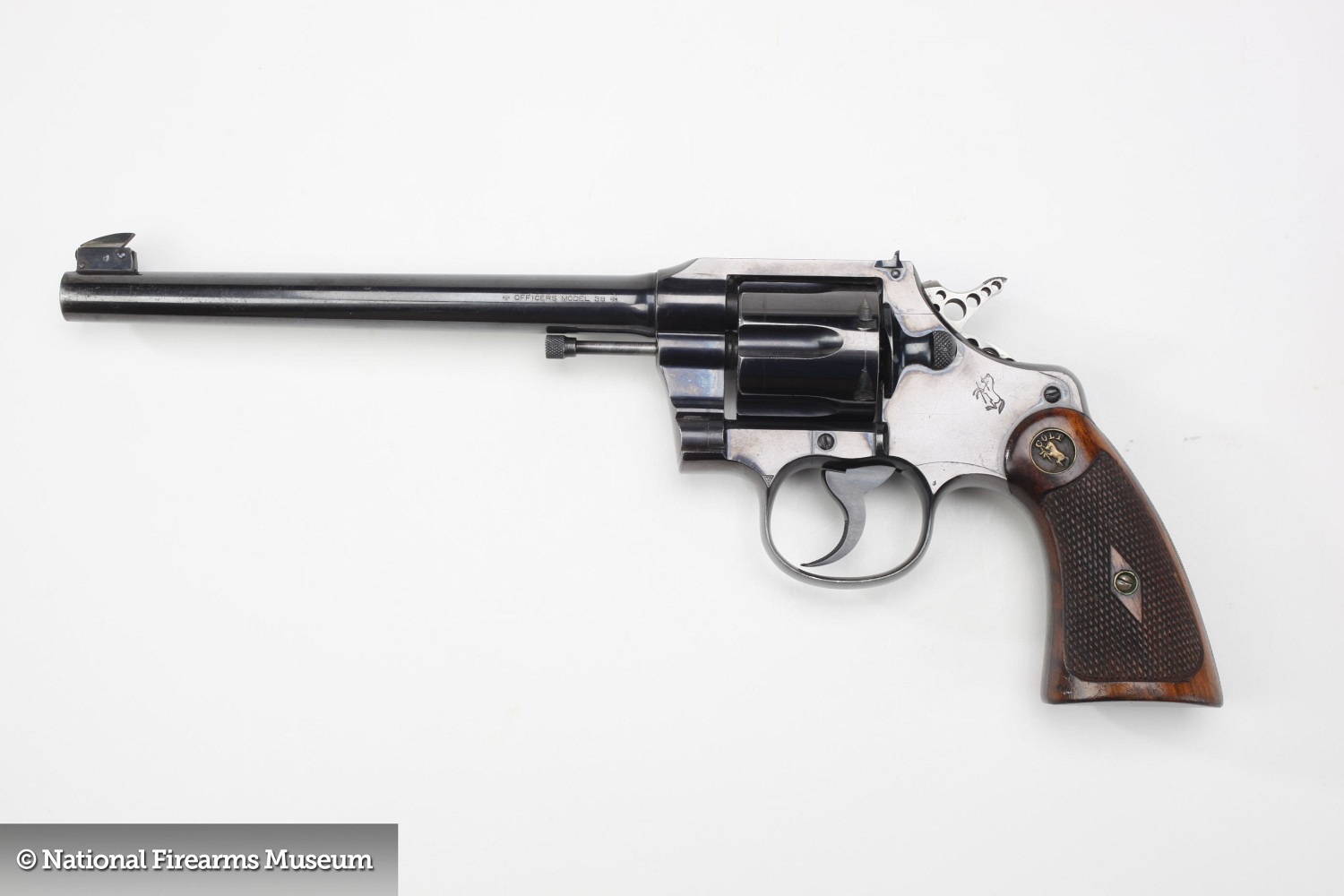
This revolver, factory-fitted with a skeletonized hammer, was used by American A.P. Lane in winning five Olympic Gold Medals in the 1912 and 1920 Olympic Games. It’s a .38 caliber, Colt Officer’s Model centerfire revolver from the early 20th century. Olympian A.P. Lane’s Gun can be found in Gallery 13, Firearm Traditions for Today, at the NRA National Firearms Museum in Fairfax, Virginia. The Museum exhibit includes a panoply of Lane pieces – his revolver, his five Gold Medals, and the five Olympic certificates that went along with them.
Watch Video History of the A.P. Lane Revolver
* There are air pistol and rimfire (.22 LR) pistol matches in Tokyo this year. Matches include 10M Women’s and 10M Mixed Team air pistol, and 25M Women’s Pistol and 25M Men’s Rapid-Fire Pistol.
The anvil is the tripod-shaped thin metal piece protruding above the bottom of the primer cup. Getting the primer sitting fully flush on the bottom of the case primer pocket, without crunching it too much, requires some keen feel for the progress of primer seating.
Sadly, Glen Zediker passed away on October 1, 2020. But his technical insights and helpful advice live on thanks to his written works — his books and articles. In two informative Midsouth Blog articles, Glen Zediker presented helpful advice on priming. First he examined what happens to the primer itself as it is seated in the cup. Glen then explained why some “crush” is important, and why you never want to leave a high primer.
Glen also reviewed a variety of priming tools, including his favorite — the Forster Co-Ax Bench Primer Seater. Then he offers some key safety tips. Glen provides some “rock-solid” advice about the priming operation. You’ll find more great reloading tips in Glen’s Top-Grade Ammo book.
Priming Precision vs. Speed
Glen wrote: “The better priming tools have less leverage. That is so we can feel the progress of that relatively very small span of depth between start and finish. There is also a balance between precision and speed in tool choices, as there so often is.”
Benchtop Priming Tools — The Forster Co-Ax
Glen believed that the best choice among priming options, considering both “feel” and productivity, may be the benchtop stand-alone priming stations: “They are faster than hand tools, and can be had with more or less leverage engineered into them. I like the one shown below the best because its feeding is reliable and its feel is more than good enough to do a ‘perfect’ primer seat. It’s the best balance I’ve found between speed and precision.”
Load Tuning and Primers
Glen cautioned that you should always reduce your load when you switch to a new, not-yet-tested primer type: “The primer is, in my experience, the greatest variable that can change the performance of a load combination, which is mostly to say ‘pressure’. Never (never ever) switch primer brands without backing off the propellant charge and proving to yourself how far to take it back up, or to even back it off more. I back off one full grain of propellant [when I] try a different primer brand.”
Priming Safety Tips by Glen Zediker
1. Get a good primer “flip” tray for use in filling the feeding magazine tubes associated with some systems. Make double-damn sure each primer is fed right side up (or down, depending on your perspective). A common cause of unintentional detonation is attempting to overfill a stuffed feeding tube magazine, so count and watch your progress.
2. Don’t attempt to seat a high primer more deeply on a finished round. The pressure needed to overcome the inertia to re-initiate movement may be enough to detonate it.
3. Keep the priming tool cup clean. That’s the little piece that the primer sits down into. Any little shard of brass can become a firing pin! It’s happened!
Many years ago, when we decided to do a story about SAKO’s TRG series of rifles, we remembered our friend Terje Fjørtoft in Norway. Terje has owned, and hunted with, both the TRG-22 (in .308 Win), and its big brother, the TRG-42 (chambered in .338 Lapua Magnum). Unlike many TRG owners in the USA, Terje has carried his “tactical hunters” into the field, and tested their effectiveness on large game in both coastal and mountain environments, in warm weather and cold. Terje tells us the TRGs have proven to be rugged and reliable. And they are accurate. The .308 Win TRG-22 delivers about 0.45 MOA groups at 420 yards shot from bipod. The .338 LM TRG-42 shoots about 0.55 – 0.7 MOA at that distance.
A Tale of Two TRGsby Terje Fjørtoft
I live in Brattvåg, along the coast of Norway, but I hunt and shoot at the nearby island “Fjørtoft” (same as my last name) and a small island outside Fjørtoft. I grew up on Fjørtoft as a child, and we hunt seals there in the spring and fall. The large, top photo shows me with my black TRG-42 338 Lapua Mag (“LM”) during a seal hunt a couple years ago. Click on the thumbnail at right to watch a video that shows me shooting the .338 LM. Most of the photos in this story are from that hunt. Because the .338 LM was really “overkill” on the seals (and expensive to reload), I replaced that rifle with a TRG-22 in .308 Winchester.
We hunt seals primarily for wildlife control. This is because the seals carry an internal parasite, called “Kveis”, a small worm that breeds inside the seals (after eating contaminated fish). When the seals expel the Kveis into the water, the Kveis larvae are consumed by the fish and then the fish become unfit to eat. The parasite literally eats the fish from the inside out. It’s not very pretty and it has hurt our Norwegian fishing industry. So there is an important purpose for our seal hunting. We hunt mostly from islands, targeting the seals in the water, and retrieving them with a small boat.
Because the seals spend most of their time in the water, a seal-hunter needs a very accurate rifle [to take head shots at distance]. I like the TRG-22 because it is very accurate out of the box, with a very nice bipod that works well in the field. The stock is comfortable with good adjustment range. The TRG features a 10-rd magazine and the barrel is pre-threaded for a muzzle brake or suppressor.
I have also used my TRGs for hunting big game, deer and what Americans call “Elk”. You can see, further down on this page, a picture from a hunting stand taken late in the evening, in the fading light. Yes I successfully bagged a nice buck during that trip with my TRG-42. When hunting, I use a Leica 900 rangefinder, Swarovski 7×42 Habicht binoculars, and a Silva windwatch. For Optics on the TRG-22, I have a Zeiss 6-24×56 scope, in Tikka Optilock rings. To get more scope adjustment I milled 0.9 mm off the front scope base mount. The Zeiss is great for viewing small targets past 400 meters. It was very difficult to find a longer shooting place than 575 meters on this Island (Uksnøy) but I found a place where I can shoot out to 930 meters, and I’ve made an 80-cm steel gong for a target. At this range, the bullet must fly nearly all the distance over the water.
Terje Shooting the TRG-42 without suppressor. Big recoil, big flash.
Both the TRG-22 and TRG-42 are very accurate right out of the box. The only thing I did before I first shot the TRGs was to clean the barrels very thoroughly. This is because the SAKO factory test shoots the gun without cleaning the barrel. I also adjust the cheek piece upward when shooting the rifles with a big scope. However, if you raise the cheek piece too high you can’t get the bolt out without removing the whole cheek piece. The only real modification I’ve made to my TRGs was to put rubber foot pads on the feet of the SAKO factory bipod. This gives the bipod better grip on slick surfaces such as concrete, or the rocks on the offshore islands.
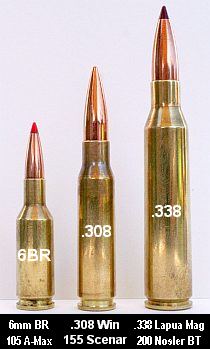
.338 LM vs. .308 Win — Smaller Can Be Better
A few years ago I had a black TRG-42 (338 LM), but after a year, I sold it, and ordered a TRG-22 from the SAKO factory. After a one-year wait, I got the new green TRG-22 in February this year. One main reason I changed to .308 Win was the cost of ammo. I can reload .308 Win ammo for about one-third the price that it costs to reload .338 LM. One other reason is that my usual shooting distance is about 390 meters–at that distance the .308 is more than effective enough. Also, with the .338 LM, the barrel and the suppressor heated up after only a few shots, but with my new .308, I can shoot at my own pace without this problem. After my most recent shooting trip I once again confirmed how accurate, and fun-to-shoot, the TRG-22 is. I think now the TRG-22 has become my favorite plinking gun.
Though it is fun to experience the big boom and flash of the .338 LM, I’ll admit that it is just too much rifle for most applications. The .338 LM is REAL overkill for seal hunting. Here in Norway we have a rule that the smallest caliber we can use is 6.5×55 with a 140gr (or heavier) bullet, but everyone who hunts seals knows that the seals stay mostly in the water, and therefore you must take a headshot at distance up to about 200 meters. Making the headshot with a smaller caliber is advised for two reasons. First, when a big .338 bullet hits the water, there is a danger it will skip and ricochet quite some distance. Second, if you use too powerful a load/gun/caliber and take a headshot on a swimming seal, the seal sinks like a rock.
Reloading for the TRG-22 (.308 Win) With the TRG-22, I found it was easy to get an accurate load. My groups with 155gr Scenars are consistently good with a variety of different powders. I’ve tried both light and heavy bullets, but I favor the 155gr Scenars over the 185gr Scenars because the 155s fly a lot faster and drop less.
Three loads (all with Fed 210m primers) that have worked well are: 155gr Scenar with VV N150, 885m/sec; 155gr Scenar with Norma N-11, 890m/sec, and 185gr Scenar, VV N150, 770m/sec. Norma N-11 is a low-cost powder for target shooting. N-11 is similar to Norma 203B or Norma 202 but it varies quite a bit from lot to lot.
I use a RCBS Rock Chucker press, and currently use a standard RCBS full-length die kit to reload my .308 rounds. However, I recently ordered a Redding Competition 3-die set with a .335 bushing. I look forward to trying the Reddings. I have just started to test different seating depths. The 155s just “kiss” the lands at 74.10 mm. I’ve tried 74.00 mm, 74.10 mm and 73.55 mm, but so far saw no significant differences.
Reloading for the TRG-42 (.338 LM)
For the .338 LM, I started with a 250gr Scenar and 95 grains of Vihtavuori N-170. That load was very accurate at about 850 m/sec, but it produced excessive muzzle flash. And, in the winter, the muzzle velocity was inconsistent, and there was too much unburned powder. Next I tried Norma N-15, which proved very accurate at about 880 m/sec. With that load I shot my best TRG-42 group at 380 meters. I set the 250gr Scenar to touch the rifling with 93.2 mm COAL, and I used Federal 215m primers in Lapua-brand brass. Norma MPR2 and VV N-560 (860 m/sec) also were very accurate with the 250 Scenar.
My seal hunting bullet was the 200gr Nosler BT. This bullet grouped very well with 90-94 grains Norma N-15. Velocity was about 970m/sec if I remember correctly. I also tried the 300gr Sierra MK, and got 1/2″ 3-shot groups at 100 meters with 93.5 grains of VV N-170, but this combination produced terrible groups at longer range.
Loading for the .338 LM was not difficult — about the same as loading for .308 Win, except that you use nearly twice the amount of powder. I didn’t crimp the bullets in the neck, didn’t use any special tricks or neck lube. I used RCBS .338 LM full-length die. That functioned, but it would not be my first choice today. Overall, my better loads in the .338 shot in the 0.5-0.7 MOA range. My best group was four shots in 25mm (1″) at 380 meters (416 yards).
Hunting in Norway
I’m not a competitive sport-shooter. Normally, the only time I go to a “commercial” rifle range is to take the test for my hunting license. Every year, I must re-qualify for a shooting license to hunt big game and seals.
Hunters Tested Annually
In Norway, you must pass an actual shooting test before you can hunt big game. This test requires five shots at a deer silhouette target at 100 meters. No rests are allowed–you must shoot off-hand or with a sling only. You have to place five shots inside a 30 cm circle over the front leg.
Every big game hunter that passes this test is authorized to hunt at “dusk and dawn” and in moonlight. So, we do a lot of our hunting in the twilight hours. However, no night-vision or artificial illumination (spotlights) are allowed. We usually hunt deer at dusk and dawn. In the evening, we go on post two to three hours before it is dark, and sit there waiting for the deer to show up–hopefully before it is too dark. In the morning we go to the post one hour before you see any light of the sun, and wait for the deer to show up until the daylight. But when it is full moon we sometime have enough light to hunt in the middle of the night. In the photo, you can see a deer through the scope of my TRG-42. This was very late in the evening. CLICK HERE for BIG Photo.
Sound Suppressors for Hunting Rifles
Suppressors are legal to use for hunting in Norway. I have suppressors on all my rifles, even my little CZ 452 in 17 HMR. To me, shooting a rifle without a suppressor is like driving a car without an exhaust system. The suppressor reduces both noise AND recoil significantly. With a good suppressor, there is no loss of accuracy. The only “negative” in using a suppressor is extra weight on the end of the barrel.
I crafted my own home-made suppressor. It’s similar to my commercially-made TRG-22 suppressor, but the core is made from titanium to be lighter in weight and more corrosion-resistant. I used a lathe at work to craft the inside of the new suppressor. The core of the unit is built from a 27.5 cm X 40mm round bar of titanium while the outer cylinder is made from a 42mm stainless steel tube. I wanted to use titanium for the exterior cylinder as well, but I couldn’t source the right size titanium tube.
Commercial Suppressor on TRG-42
Comparing .308 Win vs. 6mmBR I also have a 6BR hunting rifle (compensated of course). I have a lot of field time with the 6BR rifle, and feel very confident with that gun. When I got the Krieger 6mmBR barrel on the SAKO Varminter, I fell in love with that rifle from day one, and that rifle is my first choice for small game hunting.
I also like the TRG-22 gun very much and enjoy it more and more with each new field trip. That .308 is my big game rifle and my long-range target rifle.
I recently tested my TRG-22 rifle at 387 meters. This was just “fun shooting” at steel plates, and I didn’t measure groups. But I was happy with the results. Once I corrected for the 5 m/sec crosswind, I was able to put five successive shots on a 10 cm (4″) diameter steel target at 387 meters (423 yards).
My SAKO Varminter in 6mm BR and my TRG-22 are two very different rifles. The TRG-22 is much heavier. I guess the TRG-22 is about 6.5-7 kg while my SAKO 6BR is about 4.5-5 kg, both with suppressor, scope, and bipod. The 6BR with suppressor is much quieter than the TRG-22 with suppressor. The recoil of the 6BR is a lot softer than the TRG-22. So far my 6BR is more accurate. A typical three-shot group with the 6BR is 25-40 mm at 387 meter (423 yards), and that is with just 10X magnification from a Zeiss scope. With my TRG-22, my 3-shot groups run about 50-60 mm, shooting with bipod and beanbag. But I think with a better .308 Win reloading die and more practice, I can improve my groupings with the TRG-22.
SPEC SHEET
The SAKO TRG-22 and TRG-42 are built in Finland by SAKO, a subsidiary of Beretta. In America, the guns are distributed by Beretta USA. Both TRGs (22/42) are available in forest green or a matte black textured finish. A two-stage match trigger is standard.
The stock is somewhat unconventional. It is an external shell, bolted to an internal metal chassis. The action bolts directly to the chassis, without bedding. The injection-molded stock is adjustable for comb height, length of pull (with spacers), vertical butt-pad height and cast-off.
Weight TRG-22 4.7 kg (black) 4.9 kg (green)
Barrel TRG-22 660 mm (26″), hammer-forged, optional stainless or phosphate finish
Forum member F-Class John is an avid F-Class competitor and expert handloader. John reviews reloading hardware and shooting-related products for his popular F-Class John YouTube Channel, which now boasts 220+ videos. John also does important product testing for AccurateShooter.com. Through his YouTube channel, John has reviewed many of the latest and greatest reloading tools and accessories. For today’s Video Showcase, we selected eight F-Class John tool and reloading product reviews.
If you like these selected videos, consider joining F-Class John’s Patreon Channel for live video meetings, more in-depth videos, and detailed explanations.
21st Century Hydro Press and Standard Arbor Press
John notes: “You can’t really talk about precision reloading without taking about inline dies and arbor presses. For my money there’s nothing better than the lineup from 21st Century Shooting. They offer the Hydro Seater which is hands-down the best manual seater out there as well as their standard arbor press which is great for taking on the road to push back bullets as needed.”
Primal Rights Competition Priming Seater (CPS) Review
If there is a Ferrari of priming tools, it has to be the Primal Rights Competition Primer Seater (CPS). This impressive bench-mounted tool allows very precise control over primer seating depth. A vertical tube holds primers ready for insertion. The action is smooth and precise. John believes that this is definitely the best priming tool on the market, though it may not be for everyone given its premium $600.00 price.
Lyman Powered Case Trimmer Review
The Lyman Case Trim Xpress is an efficient, precise unit that allows easy adjustment of trim length with a click-adjustable collar. The trimmer comes with a set of cartridge-specific bushings that index off the case shoulder. One nice feature is a variable speed control. For the price, $154.99 on Amazon, this trimmer delivers excellent performance. F-Class John has another video review of the Lyman Case Trim Xpress which shows set-up and operation.
Dillon 750 Tips and Tricks
The Dillon XL 750 is a favorite of high-volume reloaders. With the optional case feeder, the XL 750 offers high output with great reliability. And Dillon offers one of the best warranties in the business. In this video, F-Class John features upgrades including the Armanov tool-head holders from Europe. These are drilled and tapped for all FIVE stations allowing the user to put threaded dies in any station.
Gunsmithing Torque Wrench Comparisons
When you are working on custom rifles that might cost $5000+, and mounting scopes that can run $3000 (or more), you need to use very high-quality tools. Precise torque settings are essential, both to avoid damage to valuable parts, and to have the rifle and optic perform optimally. In this video, F-Class John looks at a variety of torque wrenches suitable for gunsmithing duties.
Concentricity Checking with Accuracy One Gauge
Every serious hand-loader needs a quality concentricity gauge. The Accuracy One Concentricity Gauge boasts a smart design that delivers precise, repeatable results. We like the unit’s easy adjustability and its ability to work in a variety of configurations. The Accuracy One Gauge measures internal and external neck runout of cartridge cases as well as seated bullet runout. It can also measure the runout of the ogive, bearing surface, and boat-tail of individual bullets. And it can even measure your primer pocket runout.
Teslong Rigid (Shaft) Borescope with Monitor
Seeing inside your barrel can provide clues to how well you’re cleaning and the bore’s overall health. One of the best tools on the market is the Teslong Rigid Borescope. This features a solid rod for easy use in barrels. Plus it comes with a self-contained high-definition viewing monitor so no smartphones or WiFi tablets are needed. If you’re looking for something more portable and a bit more versatile, try the Teslong Flexible Borescope, $99.99 including monitor. John was impressed with the new rigid Teslong he tested, and he likes having a dedicated monitor (no WiFi required).
Zero Turret Press with Whidden Sizing Die
The new Zero Press from Area 419 is arguably the best turret press ever crafted. It offers unrivaled precision, along with the highest-capacity turret head with NINE die/tool stations. Milled from billet aluminum and stainless steel, this press moves with the help of 14 bearings. In this video, F-Class John shows how to use a Whidden Gunworks full-length sizing die on the Zero Press. And John has two other video reviews of the $1200 Zero Press: 1. Zero Press First Thoughts Video; 2. Loading on a Zero Press.




 U.S. Supreme Court building, photo by Joe Ravi CC-BY-SA 3.0.



 Because the seals spend most of their time in the water, a seal-hunter needs a very accurate rifle [to take head shots at distance]. I like the TRG-22 because it is very accurate out of the box, with a very nice bipod that works well in the field. The stock is comfortable with good adjustment range. The TRG features a 10-rd magazine and the barrel is pre-threaded for a muzzle brake or suppressor.
 Both the TRG-22 and TRG-42 are very accurate right out of the box. The only thing I did before I first shot the TRGs was to clean the barrels very thoroughly. This is because the SAKO factory test shoots the gun without cleaning the barrel. I also adjust the cheek piece upward when shooting the rifles with a big scope. However, if you raise the cheek piece too high you can’t get the bolt out without removing the whole cheek piece. The only real modification I’ve made to my TRGs was to put rubber foot pads on the feet of the SAKO factory bipod. This gives the bipod better grip on slick surfaces such as concrete, or the rocks on the offshore islands.
 .338 LM vs. .308 Win — Smaller Can Be Better
 Reloading for the TRG-22 (.308 Win)
 Reloading for the TRG-42 (.338 LM)
 Hunting in Norway


 I also have a 6BR hunting rifle (compensated of course). I have a lot of field time with the 6BR rifle, and feel very confident with that gun. When I got the Krieger 6mmBR barrel on the SAKO Varminter, I fell in love with that rifle from day one, and that rifle is my first choice for small game hunting.


