The National Shooting Sports Foundation (NSSF) and fourteen firearm manufacturers, distributors, and retailers has filed a major lawsuit in Federal Court, NSSF et al vs. Letitia James (N.Y. Atty. General). This action seeks to overturn New York States “public nuisance” law which targets gun makers for the criminal misuse/unlawful possession of firearms in New York no matter where they were purchased. The plaintiffs also moved for a preliminary injunction challenging the misguided New York statute as unconstitutional.
The NSSF brought this legal action to “uphold the foundations of tort law, fight government overreach, and protect the firearm businesses that lawfully operate and employ over 340,000 Americans.” Along with the NSSF, the other 14 plaintiffs include: Beretta USA, Central TX Gun Works, Davidson’s, Glock, Hornady Mfg., Lipsey’s, Osage Co. Guns, RSR Group, Shedhorn Sports, SIG Sauer, Smith & Wesson, Sports South, Sprague’s Sports, and Sturm Ruger & Company.
The challenged law, signed by disgraced Democratic Party Governor Andrew Cuomo, allows civil lawsuits by municipalities, such as the city of New York, as well as the State of New York, against the firearm industry for the criminal actions by non-associated third parties. The “public nuisance” statute also permits private lawsuits by persons who have been harmed or threatened by criminals using firearms. Both New York State and the City of New York were part of a wave of similar lawsuits filed over twenty years ago that led to Congress passing the bipartisan PLCAA in 2005.
New York’s “public nuisance” law subjects firearm industry companies to civil lawsuits for the criminal misuse or unlawful possession of firearms in New York. The law would impose liability on industry members for firearms lawfully sold anywhere in the United States that end up being criminally misused or illegally possessed in New York thereby allegedly contributing to a “public nuisance” in the state. The NSSF lawsuit challenges the New York law as preempted by the Federal Protection of Lawful Commerce in Arms Act (PLCAA). It also challenges the law as unconstitutionally vague in violation of the Due Process Clause of the United States Constitution. The lawsuit further challenges the law as an impermissible attempt by New York State to regulate interstate commerce in violation of the Commerce Clause of the Constitution.
The NSSF states that “New York is trying to use the threat of crushing liability to coerce out-of-state businesses to adopt sales practices and procedures not required by Congress or the law of the state where they operate. The Constitution reserves the power to regulate interstate commerce solely to Congress.”
In these days of Smart Phones, WiFi-equipped cars, and Alexa digital assistants, conventional books may seem old-fashioned. But for presenting a wide range of information, with charts, tables, photos, and a handy index, there is much to be said for conventional paper publications. These can be used anywhere and anytime, even where there is no cell service. You can annotate the pages with your own comments, and make simple, manual bookmarks for your most-used pages.
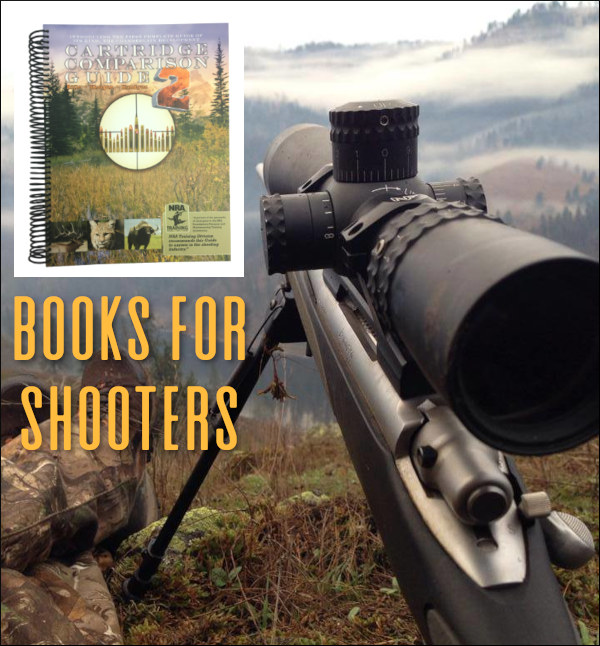
One resource we use regularly is the Cartridge Comparison Guide V2, a remarkably comprehensive 340-page spiral-bound book. Covering over 250 cartridges, the 2nd Edition of the Cartridge Comparison Guide covers most available factory cartridges from .17 caliber all the way up to .50 caliber. This resource also compiles cartridge data from major manufacturers Barnes, Federal, Hornady, Norma, Nosler, Remington, Sierra, Swift, Weatherby, and Winchester. If you shoot factory ammo, you should definitely get the Cartridge Comparison Guide.
Shooters building a resource library have many good choices. Creedmoor Sports has a large collection of books in stock, with many on sale. On Creedmoor’s Book/Video page, you’ll find dozens of printed books. You can search by format, author, price, and date. In addition, while you’re visiting Creedmoor Sports, you’ll find many tools and shooting accessories on sale.
Here Are Nine of Creedmoor Sports’ Most Popular Book Titles:
Shooting Sports Crossword Puzzle Book
Here’s an interesting book for gun owners. Get away from the TV and test your skills on these gun-centric crossword puzzles. The Shooters Book uses terms and names relating to firearms, their use, and development. At 178 pages, this crossword puzzle/word search book offers something for all firearm enthusiasts. Each crossword puzzle has correlated word searches included to help solve it.
Airport photo by Politikaner under Creative Commons License.
Record Number of Airport Gun Seizures in 2021
According to CBS News: “Nearly 5,700 firearms have been confiscated at airport security checkpoints in 2021, the highest number recorded by the Transportation Security Agency (TSA) since its inception. A whopping 5,674 guns were stopped in 2021 alone[.] The vast majority of weapons — 85% — were loaded with ammunition.”
“It’s an all-time high,” TSA Administrator David Pekoske told reporters during a TSA briefing this week. He said the previous high mark was 4,400 guns confiscated in 2019. This year, the locations with the highest number of gun seizures were airports in Atlanta, Dallas-Fort Worth, and Houston.
If you DO bring a handgun to the airport, be sure to comply with ALL regulations. The gun must be UNLOADED in a locked, locked hard-sided container sent as checked baggage only. Declare the firearm and/or ammunition to the airline when checking your bag(s) at the ticket counter. NEVER put in it your carry-on — the gun will be confiscated and you could be charged.
Firearm magazines, whether loaded or empty, must be securely boxed or included within a hard-sided case. And there are specific transport requirements regarding ammunition — ammo must NEVER be transported in a carry-on case. No guns, no ammo EVER in the passenger compartment. NOTE: — If you have ever used a duffle or backpack at the range and then later use that as a carry-on, double-check BEFORE you bring it to the airport. You might just find a live round deep in a side pocket.
Here are the TSA’s key guidelines for travel with firearms:
Firearms
When traveling, comply with the laws concerning possession of firearms as they vary by local, state and international governments.
If you are traveling internationally with a firearm in checked baggage, please check the U.S. Customs and Border Protection website for information and requirements prior to travel.
Declare each firearm each time you present it for transport as checked baggage. Ask your airline about limitations or fees that may apply.
Firearms must be unloaded and locked in a hard-sided container and transported as checked baggage only. As defined by 49 CFR 1540.5 a loaded firearm has a live round of ammunition, or any component thereof, in the chamber or cylinder or in a magazine inserted in the firearm. Only the passenger should retain the key or combination to the lock unless TSA personnel request the key to open the firearm container to ensure compliance with TSA regulations. You may use any brand or type of lock to secure your firearm case, including TSA-recognized locks.
Bringing an unloaded firearm with accessible ammunition to the security checkpoint carries the same civil penalty/fine as bringing a loaded firearm to the checkpoint. You may find information on civil penalties at the Civil Enforcement page.
Firearm parts, including magazines, clips, bolts and firing pins, are prohibited in carry-on baggage, but may be transported in checked baggage.
Replica firearms, including firearm replicas that are toys, may be transported in checked baggage only.
Rifle scopes are permitted in carry-on and checked baggage.
Ammunition
Ammunition is prohibited in carry-on baggage, but may be transported in checked baggage.
Firearm magazines and ammunition clips, whether loaded or empty, must be securely boxed or included within a hard-sided case containing an unloaded firearm. Read the requirements governing the transport of ammunition in checked baggage as defined by 49 CFR 175.10 (a)(8).
Small arms ammunition (up to .75 caliber and shotgun shells of any gauge) must be packaged in a fiber (such as cardboard), wood, plastic, or metal box specifically designed to carry ammunition and declared to your airline.
Ammunition may be transported in the same hard-sided, locked case as a firearm if it has been packed as described above. You cannot use firearm magazines or clips for packing ammunition unless they completely enclose the ammunition. Firearm magazines and ammunition clips, whether loaded or empty, must be boxed or included within a hard-sided, locked case.
Please check with your airline for quantity limits for ammunition.
This video reviews popular options for airline transport cases for pistols and rifles:
Choose a quality gun case with strong locking hasps. The container must completely secure the firearm from being accessed. Locked cases that can be easily opened are not permitted.
The NRA Blog has produced an interesting graphic guide to firearms function. This “How Guns Work” infographic shows the basics of bolt-action rifle operation and how a centerfire cartridge propels a bullet through a barrel during the “firing sequence”. There’s some good artistry here, with cutaway drawings letting you look inside an action and cartridge.
Enjoy this technical graphic. The NRA Blog says: “In celebration of cartridges big and small, we partnered with OutdoorHub to bring you a detailed look into how guns work. While the infographic will be most instructive to newcomers, we think avid shooters will find it interesting, too.”
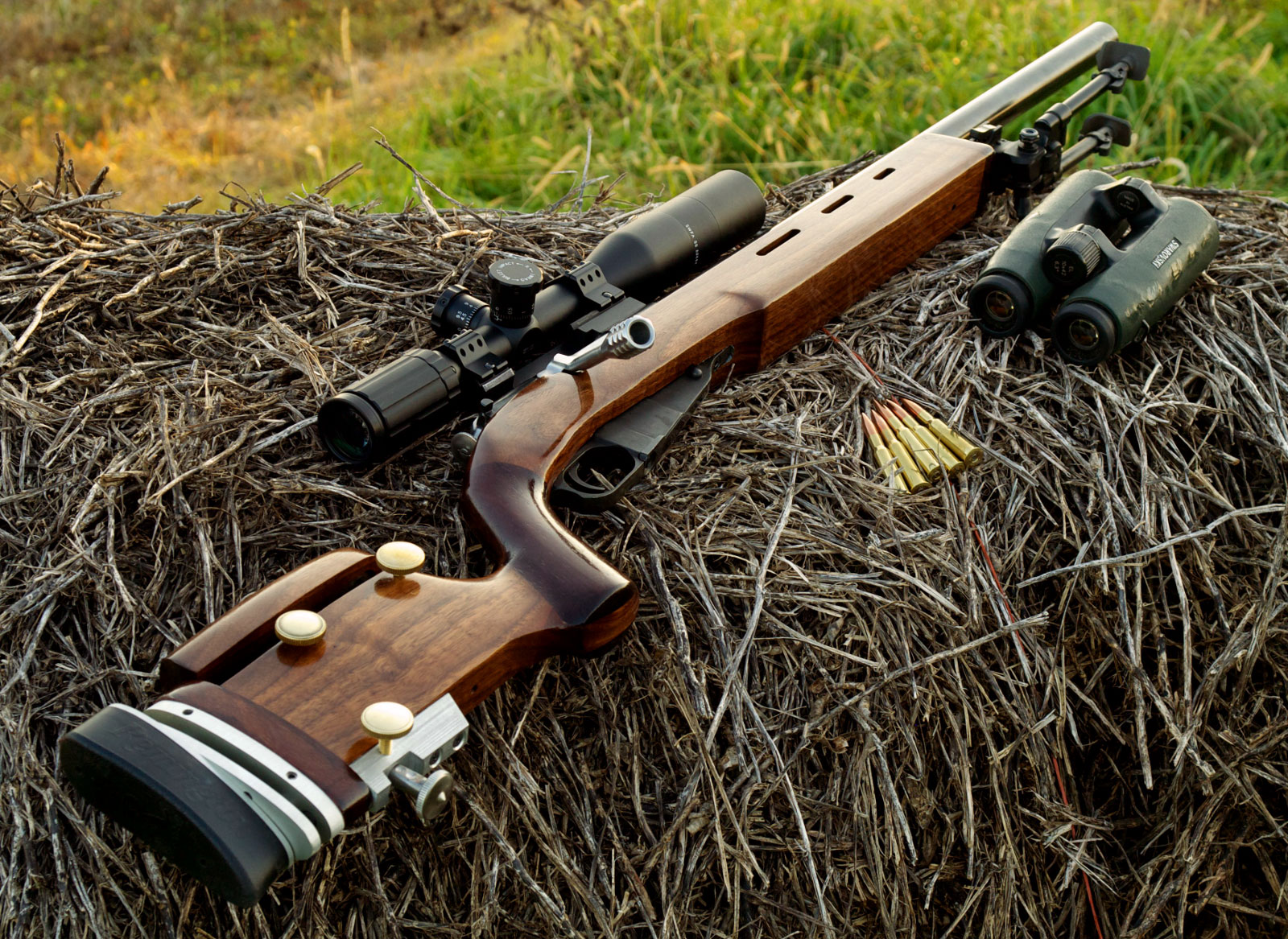
One of the most popular features of our Shooters’ Forum is the Official ‘Pride & Joy’ Rifle thread. There you’ll find dozens of interesting rifles, with photos and descriptions supplied by proud owners. Today we’re spotlighting one of the more interesting ‘Pride & Joy’ rifles unveiled this year, a Mosin Nagant “senior citizen”. This 72-year-old Russian bolt gun is not like any Mosin Nagant you’ve ever seen before. It has been brought into the 21st Century with a handsome target stock and some first-class upgrades, including Lothar Walther barrel and Timney trigger. Here’s a look at a very nice Russian rifle, belonging to Forum member Ben C. (aka “Grimstod”):
Video Shows Rifle Shooting Sub-Half-MOA from Bipod (in the Snow):
Name of rifle: Smyert Mk3 (Modified Mosin Nagant)
Make: Izhmekh/Izhevsk (“Izzy”) High Wall
Model: 91/30 | Year: 1942
Scope mount: Rock Solid (looks like an action sleeve)
Scope: SWFA 20x42mm MRAD
Gunsmith: Sheppard
Bolt handle: Rock Solid with Surgeon tactical handle
Bipod: Versa Pod
Total Weight: 18.6 lbs
Grimstod’s Mosin Nagant Custom Shoots Under 0.5 MOA From Bipod
Even in harsh winter conditions, the rifle shot well. (I guess we should expect that for a Russian gun). The photo below shows a group shot from bipod. (The video shows Grimstod’s snow-bound range session). Grimstod calculated the group at 0.394 MOA measuring from outside edge to edge. Using our On-Target software, which measures center to center of most distant shots, we came up with 0.428 MOA. Still that’s impressive for an ancient action being shot in the dead of winter with snow falling. To learn more about this rifle (and view photos of the build process), visit the SurplusRifleForum.com.
The History and Features of the Mosin Nagant M1891
Now that you’ve seen a modernized Mosin Nagant, we through we’d provide some information about the original rifle, first issued in the late 19th century. It is one of the most mass-produced military bolt-action rifles in history with over 37 million units having been made since 1891.
The is a lengthy Wikipedia article on the Mosin Nagant rifle design and history. The 3-line rifle M1891, known in the West as Mosin Nagant and in former Soviet Union as Mosin’s rifle (Russian: винтовка Мосина), is a five-shot, bolt-action, internal magazine–fed military rifle. It is primarily chambered for its original 7.62×54mmR cartridge. The 3-line rifle, Model 1891, its original official designation, was adopted by the Russian military in 1891. There have been several variations from the original rifle, the most common being the M1891/30, which was a modernized design introduced in 1930.
Here is a test of the Sniper Version of the Mosin Nagant:
Photo credit: Nemo5576 retouched by Ewan ar born, Copyrighted free use, via Wikimedia Commons.
Like the Gewehr 98, the 1891 Mosin uses two front-locking lugs to lock up the action. However, the Mosin’s lugs lock in the horizontal position, whereas the Mauser locks vertically. The Mosin bolt body is multi-piece whereas the Mauser is one piece. The Mosin uses interchangeable bolt heads like the Lee–Enfield. Unlike the Mauser, which uses a controlled-feed bolt head in which the cartridge base snaps up under the fixed extractor as the cartridge is fed from the magazine, the Mosin has a push-feed recessed bolt head in which the spring-loaded extractor snaps over the cartridge base as the bolt is finally closed similar to the Gewehr 1888 and M91 Carcano or modern sporting rifles like the Remington 700. Like the Mauser, the Mosin uses a blade ejector mounted in the receiver. The Mosin bolt is removed by simply pulling it fully to the rear of the receiver and squeezing the trigger, while the Mauser has a bolt stop lever separate from the trigger.
Photo courtesy Armémuseum (The Swedish Army Museum), public domain.
Like the Mauser, the bolt lift arc on the Mosin Nagant is 90 degrees. The Mosin bolt handle is similar to the Mannlicher: it is attached to a protrusion on the middle of the bolt body, which serves as a bolt guide, and it locks protruding out of the ejection/loading port in front of a split rear receiver ring, also serving a similar function to Mauser’s “third” or “safety” lug.
In this video Jerry Miculek tests the carbine version of the Mosin Nagant:
The rifling of the Mosin barrel is right-turning (clockwise looking down the rifle) 4-groove with a twist of 1:9.5″ or 1:10″. The 5-round fixed metallic magazine can either be loaded by inserting the cartridges singly, or more often in military service, by the use of 5-round stripper clips.
Photo courtesy Armémuseum (The Swedish Army Museum), public domain.
Wikipedia text courtesy Creative Commons Attribution-ShareAlike 3.0 Unported License (CC BY-SA).
Area 419’s ZERO reloading press is a brilliantly engineered 9-station turret press with some very unique features. This press was designed to be the most precise turret ever created. As tested by Gavin Gear of UltimateReloader.com, the ZERO turret press delivered very impressive shoulder-bump consistency and ultra-low seated bullet run-out (about +/- 0.0005″). The numbers were as good as you can get from a quality single-stage press, so Area 419 did some impressive engineering. We would expect that, as this is an expensive product — MSRP is $1200.00. SEE FULL REVIEW on UltimateReloader.com.
The ZERO turret press lets you install up to nine (9) different reloading dies in the large top turret, which revolves around a central axis. But unlike most turret presses, the ZERO doesn’t have flex or wobble when you’re loading. This is because Area 419 includes a clever system for locking the turret in position after you’ve selected the die from your array. Area 419 also uses a unique system for securing shell-holders (see video at 12:00). This, likewise, adds to the precision of the press.
In the video above, you can see how the turret is secured with a “wedge clamp”. By loosening the wedge clamp you can index the press easily to any station. Then, when you have selected your die, you tighten the wedge clamp again. You can see this important procedure at 13:20 – 13:35 timemark in the video.
ZERO Turret Press Has Very Smooth Operation
Gavin observed that this ZERO turret is both smooth and very precise, thanks to smart engineering and the use of multiple bearings. Area 419 describes the design features:
— Turret (zero-slop) eliminates variability induced when removing and resetting dies
— The turret head holds nine 7/8×14-threaded dies (1-1/4 thread in future)
— Available ram-stroke here is 4.4″, allowing use of very tall cartridge types.
— Adjustable/interchangeable handle setup for maximizing leverage/feel based on operation
— Internally contained primer-catch system, slide-out drawer
Important Features of ZERO Turret Press
1. Press frame: 6061 Aluminum, clear anodized
2. Wedge clamp (locks turret into indexed position)
3. Turret (7075 aluminum and steel construction)
4. Adjustable handle with roller knob (set either left- or right-handed operation)
5. Bearings: Ball bearing plus roller thrust bearings for side plates
6. Ram riding in self-lubricated linear bearing
7. Spent primer catcher drawer
Milled from American billet aluminum and stainless steel, this press employs 14 bearings, including a self-lubricating linear sleeve bearing for the precision-ground 1.25″ ram. The linkage system also glides on bearings providing smooth operation with near-ZERO slop. The oversized ram features a 0.75″-diameter steel arm and ZERO-friction knob. The turret system is located with an oversized ball-detent system and secured using an over-sized, custom-made ZERO-point pull-stud. Locking the turret after indexing require only a half-turn of the supplied T-handle (see photo above). When indexing the turret, repeatability variance of the system should be less than .0005″.
The opening in the press will allow for sizing and seating of cases up to.338 Lapua Magnum, and will accept standard 7/8″ dies and standard shellholders. NOTE: Area 419 will be making and selling shellholders specifically fit to the system later in 2020.
SUMMARY — Impressive Press Delivers Precise Results
Gavin Gear was very impressed with Area 419’s new Zero Press, which he said offers the precision of a quality single-stage with the versatility of a turret: “There will always be people that prefer a traditional single-stage. Where the ZERO will be compelling is to those who want the precision of a single-stage without the need to screw dies in and out. Leaving your dies set can have benefits for precision as well — everything comes back to the ‘same place’ when dies are indexed into position. Screwing dies in and out can impose variation, and variation is the enemy of the ‘white lab coat shooter’. I plan on testing the ZERO press with ultra-high-end dies, and custom dies that I ream to my own specifications. I’m thinking that will show the true potential of this press!”
Area 419 ZERO Press Video with Operation Instructions
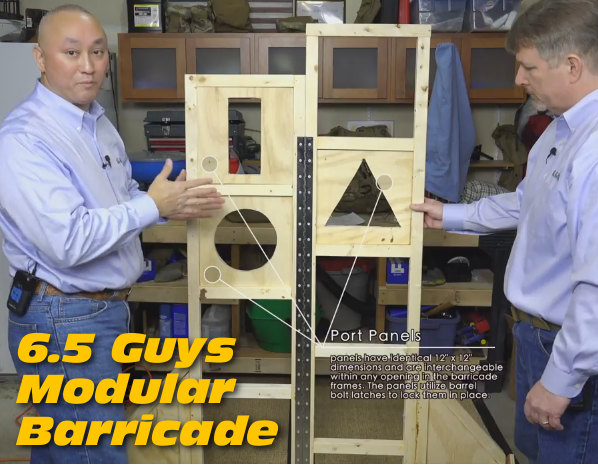
Here’s a great Do-It-Yourself project for tactical shooters. Ed and Steve of the 65Guys.com have created a versatile wooden barricade designed for easy transport. The goal with this design was to create a stable barricade that offers a variety of shooting positions, but can also fit in the bed of a pick-up or the back of an SUV. The 69″ tall barricade is hinged in the middle, so it’s just 27″ wide. To deploy the Barricade you simply fold it open and then nest the lower wings in ground-level stands.
We call this the BYOB Project — Build Your Own Barricade. Anyone with basic wood-working skills should find the Barricade prettyeasy to make. The only tricky part is cutting the side Dado joints for the left and right lower wings. But when you’ve got it completed, you have a low-cost unit that is versatile and sturdy yet easy to pack in a truck and carry out on the range. In the video below the 6.5 Guys showcase their Gen 2 barricade and explain how to build one just like it.
Looking at the 6.5 Guys Modular Barricade
The Modular Barricade was drawn up by Steve in PowerPoint and then dimensions added. Once the entire plan was created, Steve cut components to size and then used ordinary wood screws and wood glue to assemble the barricade frame. This was done to ensure maximum rigidity due to the light weight construction using 2″ x 2″ frame members. A long piano hinge was used to allow the Barricade to fold in half, while still having high torsional rigidity. Each of the Barricade openings are 12″ x 12″ square. This consistent ‘window’ spacing allows interchangeable panels with different cut-out shapes to be placed at varies heights/locations in the Barricade.
Modular Barricade Key Features
— Lightweight construction using low-cost 2×2 wood beams.
— Collapsible frame with center hinges for easy transport and deployment.
— Multiple Support levels at 6″ vertical intervals (6″ variance R to L).
— Modular port design allows ports to be changed and moved as desired.
6.5 Guys’ Modular Barricade — Construction Tips
The Modular Barricade can be constructed over a weekend with the proper materials and basic shop tools such as a power saw and electric screwdriver. Steve used a router for the side panel dado joints but a table saw could also be used for that task. Steve’s only real issue with the build involved the port panels — getting them to fit right. The 2″ x 2″ frame wood wasn’t always straight; even a small variation in the wood could cause a port panel to be too tight or too loose. Steve had to do a lot of extra sanding and planing to get the port panels to fit just right.
Where and How to Use the Barricade for Training
Because the 6.5 Guys’ Modular Barricade is so easy to move, you can simply pack it up and deploy it at your local range for practice. (Do ensure club/range rules allow shooting from barricades.) While the Barricade is designed to sit on the natural ground, the base stands can also be placed on concrete if your range does not allow deployment forward of the normal firing line. While you can use the Barricade for training on your own, Ed and Steve say novice shooters can benefit from a formal clinic.
“December 7, 1941, a date which will live in infamy…”
Today, 80 years later, it remains important to remember what took place at Pearl Harbor, and to honor those soldiers, sailors, marines (and civilians) who lost their lives in the surprise attack. The tragic memory of Pearl Harbor reminds us that our nation should never be lulled into complacency. The world remains a dangerous place. The nation must remain alert to all dangers, and be prepared to respond to all threats, both known and unknown. As Wendell Phillips said famously: “Eternal vigilance is the price of liberty.”
The Shooting Wire noted: “Today, as we live in another period of uncertainty … we owe our lives and success as a nation to the more than 16 million Americans who left their homes and traveled over the world to protect freedom.” According to U.S. Department of Veterans Affairs, only about 240,000 of the 16 million Americans who served in World War II are alive in 2021. Today, it’s appropriate to remember them and the sacrifices they made for us.
This Editor’s father and uncle both fought in WWII, father in the Army, uncle in the U.S. Navy. A Lieutenant in the Corps of Engineers, my father took part in three landings — North Africa, Sicily, and the south of France. I still have his invasion armband — a treasured memento. Sadly, we lost my uncle in 2019, when he died at age 100. While in the Pacific, he served at the Tulagi Navy Base, where he knew Lt. (JG) John F. Kennedy. Of Kennedy, my uncle told me: “Jack? He was a good kid… and he loved his country.”
Thoughts on Pearl Harbor, by Dennis Santiago
When I think of December 7th, I remember it is the day my elders began the most difficult four years of their lives. I have seen in their eyes the fear, anger and resolve that come from experiencing what it was like to survive in territory occupied by the Empire of the Rising Sun. My mother had never heard of Pearl Harbor. For her, World War II began on the same day seeing the Japanese bomb a U.S. naval installation called Cubi Point, at the entrance to Manila Bay in the Philippine Islands.
My maternal grandfather never spoke of what horrors he had seen on the Bataan Death March or his years in the prison camps. When I look at my father, I think of my other grandfather’s memories of his son — my father — hanging off the side of a Japanese patrol boat in Subic Bay with an Arisaka pointed at him, forced to give up the catch needed to feed his family….
Time has passed but the poignancy has not faded. Each December 7th, I’m thankful my elders survived because I would not be here to muse about it, had they not. The echoes of their ordeal drive me deeply to make sure that such a thing will never happen again. Whether called the Greater East Asia Co-Prosperity Sphere or some other name made up by the contemporaries of my day, the evil that lurks underneath those who believe their ideas justify the horrors they impose must always be confronted and defeated.
This week, starting on Tuesday evening, a snowstorm is predicted to hit the upper Midwest and Northeast, with snow from West Virginia to Maine. (SEE Weather Report) But if you want to go shooting this week, don’t let a little snowfall stand in your way. Heck, just grab your snow shovel and head to the range. That’s how Forum Member Nick (aka “ChevyTruck 83″) coped with winter’s fury back in 2012 (See Forum Thread). Never underestimate the resourcefulness of a dedicated AccurateShooter Forum member.
Weather.com reports: “Snow showers could sweep through the upper Midwest on Tuesday and then the Ohio Valley and Central Appalachians on Tuesday night. Bands of light snow could spread through parts of the mid-Atlantic and Northeast on Wednesday. This might include parts of the Interstate 95 corridor from northern Virginia into New England.”
We admire the fortitude of Forum Member Nick who, a few seasons back, braved wintry weather to enjoy a day at the range in his native Pennsylvania. A little snow on the ground couldn’t stop this intrepid shooter, who brought snow shovel and arctic gear to his range session. Folks, here’s a true “hardcore” fan of shooting! Despite the “relentless snow”, Nick reports that “at least it wasn’t windy”. Nick shot a variety of long guns, including his .22 LR rimfires, a .223 Rem, and a .308. Not daunted by the cold, Rick said it was fun to “play like a kid once in a while.” That’s the spirit!
Nick reports: “There was no wind to speak of — just relentless snow. I’ll tell you what — it’s awesome to get out and play like a kid once in a while.”
Nick’s foray into the winter wonderland really puts things in perspective for “fair-weather” shooters. After viewing Nick’s Forum thread about his snowy range session, fellow Forum member DennisH observed: “I will never complain about our super hot sugar cane fields in south Louisiana ever again! We can hold matches 12 months a year. I have NEVER had, owned, or used a snow shovel.”
Image Courtesy NSSF. This story is based on an NSSF Article.
‘Tis the season of gift-giving (and Christmas Day is nearly here). Perhaps you’re considering giving a a first rifle to your grandson or perhaps a carry pistol to a spouse. When making a gun gift to a friend or family member, however, there are some very important legal considerations. Also the rules on firearms gift transfers vary from state to state. Bottom line here — you need to know the law BEFORE you deliver that shiny new firearm to a family member, close friend, or relative.
The first thing to remember if you’re thinking about giving someone a gun is that … it’s a gun! You already know that ownership of a firearm brings with it some serious legal and ethical obligations that other consumer products don’t. So let’s look at some questions you may have about giving a firearm as a gift.
Image Courtesy NSSF
The first question you have to ask is whether the intended recipient can legally own the firearm where he or she lives. With more than 20,000 different gun laws on the books, even the kinds of firearms that law-abiding citizens can own vary from place to place. For example, juveniles (under age 18) generally speaking are precluded by law from possessing a handgun. Check out the Bureau of Alcohol, Tobacco, Firearms and Explosives (ATF) website for an overview of local laws and, whatever you do, don’t forget that you can never under any circumstances transfer a firearm to someone you know — or have reasonable cause to believe — legally can’t own one. That’s a federal felony, so be careful.
There’s no federal law that prohibits a gift of a firearm to a relative or friend who lives in your home state. Abramski v. United States, a recent Supreme Court decision involving a “straw purchase” of a firearm did not change the law regarding firearms as gifts. The following states (California, Colorado, Connecticut, Delaware, New York, Oregon, Rhode Island, Washington State) and the District of Columbia require you to transfer a firearm through a local firearms retailer so an instant background check will be performed to make sure the recipient is not legally prohibited from owning the gun. Maryland and Pennsylvania require a background check for private party transfer of a handgun. There are exceptions, so it’s important to check the law of your state or ask your local firearms retailer.
Consider a Gift Card Instead of Direct Gift
The ATF recommends that if you want to give someone a new firearm, rather than going to a gun store and buying the gun on your own, consider instead purchasing a gift certificate/card from your favorite gun retailer. Then give that gift card as the present. That way the recipient can choose the exact gun he or she wants, and there’s no question about who is “the actual buyer of the firearm,” which is a question any purchaser must certify on the Federal Form 4473 at the time of purchase. The Gift Card option avoids any “straw purchaser” issues.


 One resource we use regularly is the









 We admire the fortitude of Forum Member Nick who, a few seasons back, braved wintry weather to enjoy a day at the range in his native Pennsylvania. A little snow on the ground couldn’t stop this intrepid shooter, who brought snow shovel and arctic gear to his range session. Folks, here’s a true “hardcore” fan of shooting! Despite the “relentless snow”, Nick reports that “at least it wasn’t windy”. Nick shot a variety of long guns, including his .22 LR rimfires, a .223 Rem, and a .308. Not daunted by the cold, Rick said it was fun to “play like a kid once in a while.” That’s the spirit!


 The first question you have to ask is whether the intended recipient can legally own the firearm where he or she lives. With more than 20,000 different gun laws on the books, even the kinds of firearms that law-abiding citizens can own vary from place to place. For example, juveniles (under age 18) generally speaking are precluded by law from possessing a handgun. Check out the
  Consider a Gift Card Instead of Direct Gift


