Report by NRA-ILA
In recent weeks, Americans have rightly become concerned over a somewhat obscure ATF recordkeeping regulation that has a profound impact on gun rights. If gun control advocates get their way in changing this federal regulation for the worse, altering how ATF maintains these records… American gun owners would find themselves subject to what amounts to a backdoor gun registry.
The type of electronically searchable database the ATF is seeking to develop would amount to a partial firearm registry. Firearm registries facilitate firearm confiscation.
Federal law requires those who purchase a firearm at a Federal Firearms Licensee (gun dealer or FFL) to fill out a form 4473. This record of the firearm transfer is then stored by the dealer on their premises. This creates a system whereby if a gun is found at a crime scene ATF can trace the firearm to the last retail purchase. However, since the records are stored with each FFL, the system is decentralized in a manner that protects against government abuse of gun owner data.
Gun dealers are required to maintain 4473s for 20 years. When a dealer goes out of business they must send their last 20 years of records to ATF’s National Tracing Center to facilitate firearm traces. Some of ATF’s materials appear to deliberately omit the 20-year requirement, seemingly in the hopes that FFLs will send all of their records to the National Tracing Center, regardless of age.
Under this system, over a million out-of-business dealer records are sent to ATF each month. Records obtained by gun rights advocates show that in 2021 ATF processed a staggering 54.7 million of these records.
ATF proposed rule 2021R-05 would make this record-keeping requirement more burdensome for FFLs and diminish gun owner privacy. Under the proposed rule, FFLs would be required to maintain 4473s indefinitely and relinquish all such data to ATF upon going out of business. NRA-ILA is opposed to this rule change.
The type of electronically searchable database the ATF is seeking to develop would amount to a partial firearm registry. And as all gun rights supporters and gun control advocates know, firearm registries facilitate firearm confiscation.
This understanding was at the heart of the debate over the Gun Control Act of 1968 and the development of the current recordkeeping system. In 1985, Sen. James McClure (R-Idaho) explained, “The central compromise of the Gun Control Act of 1968 — the sine qua non for the entry of the Federal Government into any form of firearms regulation was this: Records concerning gun ownership would be maintained by dealers, not by the Federal Government and not by State and local governments.”
—————–
The National Tracing Center could take another step towards a firearm registry if anti-gun lawmakers criminalize the private transfer of firearms — sometimes referred to as universal background check legislation. By funneling more firearm transfers through FFLs, lawmakers would create additional opportunities for recordkeeping on firearms and gun owners that could end up in the National Tracing Center database.
Gun owners have every reason to jealously guard information pertaining to firearm transfers. NRA-ILA will continue to work to help ensure gun owner privacy and to keep gun owners apprised of the ongoing attempts to cobble together a backdoor firearm registry.
In the wintertime, it’s common to encounter problems with static electricity when throwing your powder charges. The static can cause powder kernels to cling to the surface of reloading components, and can cause powder clumping. Clumped or sticky powder may make your measure bind or grab in the middle of the cycle, which can throw off your charge weight. Here are a couple simple ways you can minimize the effects of static electricity and improve the consistency of your powder measuring.
Ground Your Powder Measure — If you’re throwing powder charges in the fall or winter and have problems with bridging or sticking powder, use a ground wire. Bullet-smith Victor Johnson (Johnson Precision Bullets) tells us: “I have a 25-foot piece of real small wire with alligator clips on each end. It’s that long so I can run it down the hall to a water pipe. Use the wire tie from a bread bag to hold it in a small roll to put in the range box. When using it at the range use a 6″ nail from the co-op or Lowe’s / Home Depot and just push it into the ground.”
Use Bounce Dryer Sheets — A quick pass with the thin sheets used in dryers will eliminate “static cling” on your plastic reloading parts like powder throwers, powder funnels, and reloading press guides. Thanks to Doc76251 for this tip.
Reduce Electronic Scales’ Drift with Anti-Static Spray
Reloading Tip by GS Arizona from Riflemans Journal
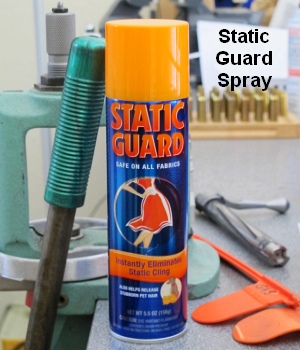
Apparently reducing static charges on and around electronic scales can reduce their propensity to drift, lessening the problem of “wandering zero”. Just how and why static charges interfere with scale performance is unclear, but many shooters have noticed that static electricity can cause electronic scales to behave strangely. So how do you reduce static charges around your digital balance? GS Arizona has found a very simple solution — an anti-static aerosol spray — that, by all indications, actually works. When this “spray-can solution” was suggested by a fellow shooter, GS was skeptical. However, he tried the stuff and he says that it really does help the scale maintain zero over time, with much less observed drift.
GS explains that the use of “Static Guard” spray helped mitigate the problem of a drifting zero on his Ohaus electronic scale: “My electronic scale… suffers from drifting zero (as they all seem to). I’ve read dozens of forum posts about drift and how to minimize its occurrence, so I know this problem isn’t limited to my scale or my workshop. Sometime last year, John Lowther mentioned the use of anti-static spray as a solution to the drift problem. John stated that the spray had virtually eliminated drift for him.”
GS found that the Static Guard actually worked: “The spray works great, just as John said it would. I spray all surfaces that I touch with my hands and arms as well as the pan (top and bottom), the metal tray on which the pan rests and the table under the scale. In six months or so of using the spray I’ve re-applied it about two or three times; it certainly isn’t something that you need to do each time you sit down to load. Before using the spray, it was not uncommon for me to re-zero the scale 10 times in the course of loading 72 rounds; now it might need it once during a session.”
This Wednesday, November 17, Shooting USA will feature the Adaptive Defensive Shooting Summit (ADSS) held September 10-11, 2021 at the SIG Sauer Academy in Epping, New Hampshire. Camp Freedom and SIG Sauer teamed up with Trevor Baucom for the third year of this accessible shooting event, designed for people with disabilities. The ADSS helps adaptive shooters train and learn at a world class facility. For persons with disabilities, including injured military and law enforcement members, the ADSS Summit provides the opportunity to learn new skills and adapt to challenges.
This hour-long episode will be broadcast on the Outdoor Channel Wednesdays at 9:00 pm Eastern/Pacific, and 8:00 pm Central. The entire episode can also be streamed later online for a small fee.
Adaptive Shooting Programs
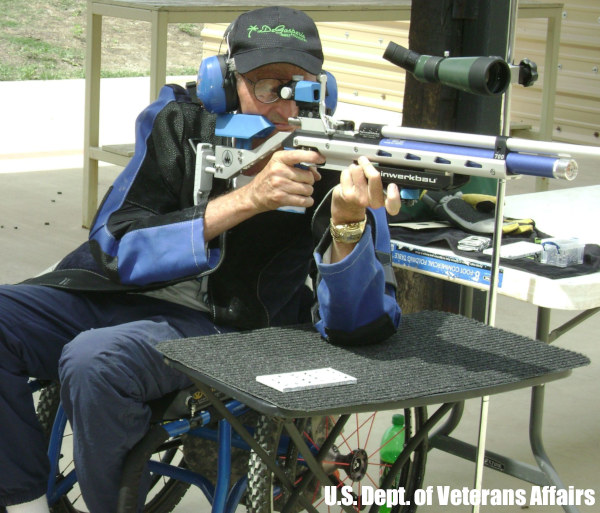
Marksmanship is one of the few sports where physically-challenged persons can compete at the highest level — with some provisions for wheelchair access and mobility. For example, in the world of F-Class competition, Matt Schwartzkopf is one of the best in the nation. Matt, a rangemaster at Ben Avery in Arizona, is a double amputee (below the knee). He hasn’t let that challenge stop him. He has been a Top-10 finisher at major F-Class matches, and was chosen to shoot with F-TR Team USA.
NRA Resources for Adaptive Shooting Events
The NRA Adaptive Shooting Program also provides information for organizations planning an event to include person with disabilities. Events may be organized by veterans’ groups, rehabilitation facilities, and gun clubs. For more information visit AdaptiveShooting.NRA.org.
Making Ranges Suitable for Disabled Shooters
The NRA Club Connections magazine has a feature on Adaptive Shooting. This article explains how range owners can make their lines of fire more accessible with the addition of a simple mat.
NRA’s Hunter Services and Adaptive Shooting Programs have maintained a list of organizations offering people with disabilities outdoor opportunities. Now available in a searchable database, any adaptive shooter can easily choose from adventures such as guided whitetail hunts, chartered fishing trips, and accessible hiking trails anywhere across the country. To find a program, visit the NRA Adaptive Shooting Program’s Hunting/Fishing Trip Database.
Adaptive Shooting Programs in the United Kingdom
Across the pond, the National Rifle Association of the United Kingdom (NRAUK) also has adaptive shooting programs. The NRA.ORG.UK website has a wealth of information for disabled shooters.
The NRAUK states: “There are many different types of target shooting available… in Great Britain. Some of them are readily accessible to disabled people, others less so. Also, shooting clubs and facilities do not all cater for every discipline; some only offer one, whilst larger complexes can cater for many of them.”
You’d like to protect your hearing, and maybe you’re a little curious about how your rifle might shoot suppressed. So you’re thinking of buying a suppressor (aka “can”, “moderator”, “silencer”). You can’t just get one off the shelf at Walmart. Acquiring a suppressor requires filling out paperwork and paying a Federal $200 Tax Stamp. Plus there is typically a pretty long wait. However, the good news is that suppressor ownership is now legal in 42 of the 50 American states — that’s 84%! For most American adults, getting a suppressor is legal, provided pass the required background checks.
States Where Suppressor Ownership is Allowed
Currently, the following 42 states allow private ownership of suppressors: AL, AK, AZ, AR, CO, CT, FL, GA, ID, IN, IA, KS, KY, LA, ME, MD, MI, MN, MS, MO, MT, NE, NV, NH, NM, NC, ND, OH, OK, OR, PA, SC, SD, TN, TX, UT, VT, VA, WA, WV, WI, WY.
Note: Even if you live in one of the states listed, you should still verify that owning a suppressor is legal in your area. Some states may have municipal- or county-based restrictions.
States Where Suppressor Ownership is Prohibited
Unfortunately, there are still eight (8) States that forbid private ownership of suppressors. The eight No-Go States are: California, Delaware, Hawaii, Illinois, Massachusetts, New Jersey, New York, Rhode Island. In these eight states, private ownership of suppressors (aka “silencers”) is forbidden. Hopefully that a few of those eight hold-out states will change their laws in the months ahead.
Looking Inside a Suppressor in Action
Popular YouTube Channel Smarter Every Day recently released a cool video featuring rifle suppressors with see-through acrylic sleeves. The team filmed shots through the suppressors using ultra-high-speed (110,000 frame per second) cameras. When played back in super-slow-motion, you can see the flame propagate through the suppressor and the bullet move through each baffle before it exists the muzzle. Watch the results in the video below — it’s mesmerizing:
See Through Suppressor in Super Slow Motion (110,000 fps) — Click Arrow to Watch:
Suppressors, On Average, Reduce Noise Levels about 30 Decibels
In an article for Ammoland, gunwriter Sam Hoober says that you can expect about 30 decibels (dB) of noise reduction from the average suppressor: “Looking at a few different products, SilencerCo attests their suppressors reduce the sound pressure of a 9mm gunshot to anywhere from 125.7 dB to 131.5 dB, depending on the model. Advanced Armament Co, another popular supplier, attests a 23 dB to 33 dB reduction or down to 127 dB. Liberty Suppressors, another manufacturer, attests a reduction of 24 dB to 38 dB, depending on model and other factors. In short, we can presume something on the order of 30 dB of attenuation as an average.”
Using that 30 dB number you can quickly discern that you’ll still need hearing protection — good hearing protection — when shooting any suppressed firearm (even a .22 LR). “Spikes of 130 dB and more can result in permanent hearing damage instantly”. Source: NRA Blog.
Airport photo by Politikaner under Creative Commons License.
Thanksgiving is less than two weeks away. We know many readers will soon be traveling to spend the holiday with family members. If you will be flying with firearms this November, you should read this article. You need to familiarize yourself with current Federal Regulations on gun transport before you get anywhere near an airport. Thankfully, the Transportation Security Administration (TSA) has a web page that states the important requirements for airline passengers traveling with firearms* and/or ammunition.
You’ll want to visit the TSA Firearms and Ammunition webpage, and read it carefully. In addition, before your trip, check the regulations of the airline(s) with which you will fly. Some airlines have special requirements, such as weight restrictions.
Here are the TSA’s key guidelines for travel with firearms:
You may transport unloaded firearms* in a locked hard-sided container as checked baggage only. Declare the firearm and/or ammunition to the airline when checking your bag at the ticket counter. The container must completely secure the firearm from being accessed. Locked cases that can be easily opened are not permitted. Be aware that the container the firearm was in when purchased may not adequately secure the firearm when it is transported in checked baggage. Contact the TSA Contact Center with questions you have regarding TSA firearm regulations and for clarification on what you may or may not transport in your carry-on or checked baggage.
Firearms
When traveling, comply with the laws concerning possession of firearms as they vary by local, state and international governments.
If you are traveling internationally with a firearm in checked baggage, please check the U.S. Customs and Border Protection website for information and requirements prior to travel.
Declare each firearm each time you present it for transport as checked baggage. Ask your airline about limitations or fees that may apply.
Firearms must be unloaded and locked in a hard-sided container and transported as checked baggage only. As defined by 49 CFR 1540.5 a loaded firearm has a live round of ammunition, or any component thereof, in the chamber or cylinder or in a magazine inserted in the firearm. Only the passenger should retain the key or combination to the lock unless TSA personnel request the key to open the firearm container to ensure compliance with TSA regulations. You may use any brand or type of lock to secure your firearm case, including TSA-recognized locks.
Bringing an unloaded firearm with accessible ammunition to the security checkpoint carries the same civil penalty/fine as bringing a loaded firearm to the checkpoint. You may find information on civil penalties at the Civil Enforcement page.
Firearm parts, including magazines, clips, bolts and firing pins, are prohibited in carry-on baggage, but may be transported in checked baggage.
Replica firearms, including firearm replicas that are toys, may be transported in checked baggage only.
Rifle scopes are permitted in carry-on and checked baggage.
Ammunition
Ammunition is prohibited in carry-on baggage, but may be transported in checked baggage.
Firearm magazines and ammunition clips, whether loaded or empty, must be securely boxed or included within a hard-sided case containing an unloaded firearm. Read the requirements governing the transport of ammunition in checked baggage as defined by 49 CFR 175.10 (a)(8).
Small arms ammunition (up to .75 caliber and shotgun shells of any gauge) must be packaged in a fiber (such as cardboard), wood, plastic, or metal box specifically designed to carry ammunition and declared to your airline.
Ammunition may be transported in the same hard-sided, locked case as a firearm if it has been packed as described above. You cannot use firearm magazines or clips for packing ammunition unless they completely enclose the ammunition. Firearm magazines and ammunition clips, whether loaded or empty, must be boxed or included within a hard-sided, locked case.
Please check with your airline for quantity limits for ammunition.
More Airline Travel Tips from Tom McHale
Tom McHale has written an excellent article for the Beretta Blog, Ten Things You Need to Know about Flying with Guns. We suggest you visit the Beretta Blog to read this informative story. Here are two of Tom McHale’s Travel Tips:
Weigh your gun case and ammunition
Most airlines will allow up to 11 pounds of ammunition. And, like any luggage, you will be charged more for any baggage weighing more than 50 pounds. This sounds like a lot, but when traveling to the Crimson Trace Midnight 3 Gun competition last year, my case with shotgun, rifle, pistol and ammunition tipped the scale past the 50 pound mark.
Pack ammo in the same locking case
This is another area that’s misunderstood and full of internet myth. Your ammo just needs to be stored in some type of safe container and not loose. Technically, you can keep ammunition in magazines, but I wouldn’t recommend it. It meets the letter of the law storage requirement, but too many airline and TSA agents will give you grief. Use a plastic ammo box or original cardboard packaging and you’ll be fine carrying that in the same lockable case as your gun.
* United States Code, Title 18, Part 1, Chapter 44, firearm definitions includes: any weapon (including a starter gun) which will, or is designed to, or may readily be converted to expel a projectile by the action of an explosive; the frame or receiver of any such weapon; any firearm muffler or firearm silencer; and any destructive device. As defined by 49 CFR 1540.5 a loaded firearm has a live round of ammunition, or any component thereof, in the chamber or cylinder or in a magazine inserted in the firearm.
“On that day, let us solemnly remember the sacrifices of all those who fought so valiantly, on the seas, in the air, and on foreign shores, to preserve our heritage of freedom, and let us reconsecrate ourselves to the task of promoting and enduring peace so that their efforts shall not have been in vain.”
– 1954, President Dwight D. Eisenhower, Veterans Day proclamation.
103 Years Later…
On the 11th hour, of the 11th day, of the 11th month of 1918, bugle calls signaled the ‘cease fire’ ending the First World War. (The official Armistice was signed earlier that morning.) To those who endured it, WWI was the “Great War”, “the War to End All Wars.” Tragically, an even greater conflict consumed the world just two decades later.
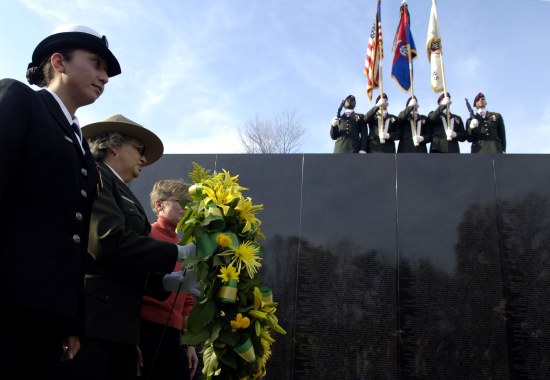
Today, 103 years after the end of WWI, Americans mark the anniversary of the WWI Armistice as “Veterans Day”. In Canada it is known as Remembrance Day. On this solemn occasion we honor all those who have served in the military in times of war and peace.
While more WWII veterans pass away each year, there are still over 20.4 million veterans in the United States. Take time today to honor those soldiers, sailors, and airmen who have served their nation with pride. Today we remember that… “All gave some, and some gave all.” History of Veterans Day.
Former Secretary of Veterans Affairs Dr. James Peake asked Americans to recognize the nation’s 20.4 million living veterans and the generations before them who fought to protect freedom and democracy: “While our foremost thoughts are with those in distant war zones today, Veterans Day is an opportunity for Americans to pay their respects to all who answered the nation’s call to military service.”
On Veterans Day we especially need to remember the seriously wounded combat veterans. These men and women summon great courage every day to overcome the lasting injuries they suffered in battle. Some of these soldiers have lost limbs, yet volunteered to return to combat duty. That is dedication beyond measure — true patriotism.
National Veterans Day Ceremony
The Veterans Day National Ceremony is held each year on November 11th at Arlington National Cemetery. The ceremony commences precisely at 11:00 a.m. with a wreath laying at the Tomb of the Unknowns and continues inside the Memorial Amphitheater with a parade of colors by veterans’ organizations. The ceremony is intended to honor and thank all who served in the U.S. Armed Forces. Major regional ceremonies and events are also held throughout the country.
Brownells will donate a percentage of sales during Veterans Day week to Special Operations Wounded Warriors (SOWW), a 501(c)3 charity dedicated to helping Purple Heart recipients of the Special Operations community. Donations to the SOWW organization will be generated by virtually all purchases this week from Brownells, including Current Sale Items.
Starting Monday, November 8, and lasting through Sunday, November 14 (11:59 pm CST), Brownells will track purchases made at www.Brownells.com and give 4% of those sales to the veterans’ charity, up to a total donation amount of $175,000.
How SOWW Benefits Wounded Veterans and Active Duty Personnel
SOWW’s main mission is to provide therapeutic outdoor experiences to wounded veterans from the various Special Operations forces of the United States military. SOWW also offers other services and counseling to both Special Operations veterans and their families. SOWW is a not-for-profit group that provides outdoor experiences and therapeutic retreats, as well as assistance with medical, physical, and mental therapies for both veterans and active-duty members of the U.S. Special Operations Forces who have been wounded in action. SOWW is funded by donations and is run and operated by unpaid volunteers. Its low operating costs mean over 93% of all donations directly support the veterans and active duty personnel SOWW serves.
“SOWW does great work to help people who have put everything on the line for us and our country,” said Vice President of Marketing Ryan Repp. “Brownells has supported SOWW for a long time, and we are proud to keep finding ways to help them help our Special Operations veterans.”
To learn more, and see short video interviews with veterans who have benefited from SOWW’s efforts, visit the Brownells SOWW page.
About Special Operations Wounded Warriors (SOWW)
SOWW (Special Operations Wounded Warriors), a 501(c)(3) charity, was formed in August of 2012 for the distinct purpose of providing outdoor experiences to a select group of both active duty and veteran U.S. Military Special Operations Forces, that have received wounds in battle, and have received our country’s prestigious Purple Heart Medal. To donate or to get more information, visit www.sowwcharity.org.
SOWW President Jud Kuhn Talks about His Organization:
Back in 2015, the firearms collection of famed gun writer Elmer Keith went to auction. The Keith Estate auction drew interest from around the globe, and bidding was strong. When the dust settled, and all the individual lots were totaled, Keith’s remarkable collection sold to various bidders for $1,905,458!
High-priced highlights from the auction are shown below. NOTE: You can see more than 60 other Elmer Keith firearms, along with a list of final auction prices. The Guns & Ammo website has a detailed, illustrated report on the Elmer Keith auction with dozens of high-quality photos.
Elmer Keith was an American rancher, firearms enthusiast, and author. Keith was instrumental in the development of the first magnum revolver cartridge, the .357 Magnum, as well as the later .44 Magnum and .41 Magnum cartridges, credited by Roy G. Jinks as “the father of big bore handgunning.” These videos recount Keith’s personal history and his influence on the design of modern Magnum cartridges.
Lot 1038: Colonel Jim Corbett’s .450/.400 “Tiger Rifle” (Sold for $264,500.00)
Dangerous Game Rifles in Collection
The legendary “Corbett Tiger Rifle”, a Jeffery boxlock .450/400 was used by famed hunter Edward James “Jim” Corbett. This rifle was featured in Corbett’s book Man-Eaters of Kumaon. Two of the man-eating tigers Corbett hunted were believed to have killed over 800 humans in the Kumaon Hills of India.
Lot 1005: Colt SAA No. 5 .44 Special “The Last Word in Sixguns” (Sold for $80,500.00)
This famous revolver started as a Colt SAA, but then was heavily modified. The top strap of the frame was welded up into a flat-top target configuration, with an adjustable rear sight added. The hammer was modified with a Bisley-type target spur. The unique grip of the Number Five was created by marrying a modified Bisley backstrap to a Single Action Army trigger guard. His most famous pistol, Keith called this handgun “The last word in fine six-guns”.
This video showcases this rare Colt SAA revolver, as viewed at the auction:
Lot 1060: Pachmayar Custom Model 70 .375 H&H (Sold for $22,425.00)
This may be one of the most beautiful model 70 Winchesters ever created. Listed as “Pachmayar Custom M70 .375 H&H with Full Coverage Engraving and Exhibition Wood” this rifle sold for $22,425.00 at the Elmer Keith Estate Collection auction. Look at the figure in that wood! The detailed engraving on the action and barrel is fantastic, as is the checkering on the grip.
Lot 1041: Westley Richards Droplock .476 NE (Sold for $69,000.00)
Used by Elmer Keith on safari in Tanzania, this was Keith’s preferred Elephant Rifle.
Lot 1020: Smith & Wesson Triple Lock Target Revolvers. (Sold for $39,100.00)
This rare set belonged to Gerrit Forbes and Ed McGivern before being acquired by Elmer Keith.
Photos courtesy of James D. Julia Auctioneers, Fairfield, Maine.
We support Hunters for the Hungry, a program that feeds needy families in the USA. Hunters for the Hungry (HFH) is a nationwide program that gives back to communities by supplying meals throughout the country. The NRA works closely with state agencies that supervise meat donations. Since the program’s inception, Hunters for the Hungry has brought millions of pounds of game meat to homeless shelters, soup kitchens, and food banks across the United States. This program has been in place for 27 years. In recent years, HFH affiliates donated 2.1 million pounds of meat on average, supplying over 10 million meals.
Hunt and Help Others
Many American hunters are able to harvest more than they can eat or share with friends and family. Through Hunters for the Hungry you can help share your bounty with those in need. All donated game must be field dressed and legally harvested. Note that each state has different rules and regulations for donations, please check with your local drop off location prior to donating.
Big Horn Armory Gives 5% of Sales Proceeds to Wyoming Hunters for the Hungry Program
To help support H4H efforts, Big Horn Armory has partnered with the Wyoming Wildlife Federation (WWF) for a special Pay it Forward H4H program. From November 1st through 30th, 2021, five percent (5%) of all net proceeds from sales made from the Big Horn Armory website will be donated to the WWF’s H4H program. This donation will help offset the costs of processing donated game meat, which will be distributed to local food banks, pantries, and other food services within Wyoming.
“Last year we were able to donate $3,000 that was used to process meals for donation to food-insecure families within Wyoming, and this year our goal is higher. We are excited to work with the WWF’s Hunters for the Hungry Program again to help ensure that even more Wyoming residents will get healthy meals,” commented Greg Buchel, president of Big Horn Armory.
Winter is coming soon. For many Americans that means indoor training if they want to maintain their shooting skills. Even if you can shoot outdoors all year long in your location, it makes sense for position shooters to work on their rifle holds. The Mantis systems help with that. These advanced smart devices record and plot the movement of your firearm as you aim and then break the shot. There are systems for both dry-fire and live-fire training, starting at $99.99. Considering the cost of bullets these days, and the difficulty of finding primers, it makes sense to increase your dry-fire training.
Mantis X2 for Dry-Fire, $99.99
Built for dry-fire use only, the Mantis X2 ($99.99) provides real-time, shot-by-shot feedback for both pistol and rifle users. You can track multiple training sessions with data-driven insights, and monitor your progress. This unit has earned high user reviews such as: “As a new gun owner the Mantis X is a game changer for me. I have not been able to get to the range during the lockdowns and being able to practice at home [is great].” And another: “Easy to install[.] The App is free and easy to use.”
The Mantis X2 is a good value. The manufacturer states: “There is nothing at this price point that will give you this level of feedback for dry fire.” There are actually four Mantis models: X2 ($99.99), X3 ($169.99), X7 Shotgun ($199.99) and X10 Elite ($249.99). The X3 adds live fire functionality. MORE INFO HERE.
Mantis X10 Elite– Advanced Training System
The advanced Mantis X10 Elite ($249.99) is 50% lighter and 40% smaller than the original Mantis, with three times the battery life and four times the data transfer rate. This new quick-detach X10 system offers all X2 and X3 functions PLUS recoil analysis and software support for all shooting sports (pistol, rifle, shotgun, archery). Collecting thousands of data points per second, the X10 works with dry fire, live fire, airsoft/CO2, and simulated firearm systems.
Mantis Blackbeard Trigger Reset System for AR-Platform Rifles
If you compete with an AR-platform rifle, you can definitely benefit from the Mantis Blackbeard system, a drop-in Bolt Carrier + Magazine replacement that works with your existing trigger. Using electromechanical wizardry, the $199.00 Blackbeard quickly resets the hammer between each shot, so you can stay in position through multiple practice shots. Installation takes less than a minute — remove the bolt carrier group, drop in the red upper unit, place the red Mantis magazine and you’re good to go. All Blackbeards now support both direct impingement and piston-driven ARs. Guys we know say that a few sessions with this system delivered marked improvement in their service rifle scores.
Mantis X3 for Live-Fire or Dry-Fire, Rifle and Pistol
The Mantis X3 collects thousands of data points per second and analyzes your shooting in real-time. For both pistols and rifles, the X3 works with dry fire and live fire. It will also work with airsoft/CO2/compressed air, and simulated firearm systems. Priced at $169.99, the Mantis X3 mounts to standard universal accessory rails. (No Picatinny rail? Creedmoor Sports sells adapters). The X3 is part of the second generation of Mantis Shooting Performance Systems.


 Federal law requires those who purchase a firearm at a Federal Firearms Licensee (gun dealer or FFL) to fill out a form 4473. This record of the firearm transfer is then stored by the dealer on their premises. This creates a system whereby if a gun is found at a crime scene ATF can trace the firearm to the last retail purchase. However, since the records are stored with each FFL, the system is decentralized in a manner that protects against government abuse of gun owner data.

 Apparently reducing static charges on and around electronic scales can reduce their propensity to drift, lessening the problem of “wandering zero”. Just how and why static charges interfere with scale performance is unclear, but many shooters have noticed that static electricity can cause electronic scales to behave strangely. So how do you reduce static charges around your digital balance? GS Arizona has found a very simple solution — an anti-static aerosol spray — that, by all indications, actually works. When this “spray-can solution” was suggested by a fellow shooter, GS was skeptical. However, he tried the stuff and he says that it really does help the scale maintain zero over time, with much less observed drift.