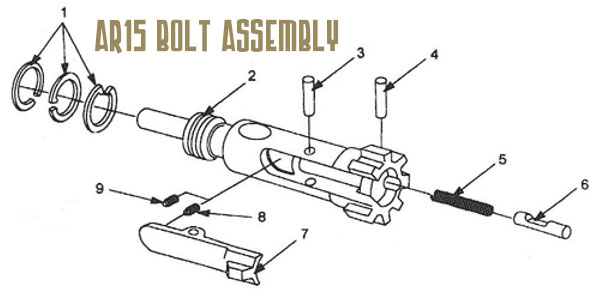
AR-platform rifles can be maintenance-intensive beasts. But some AR owners make the situation worse by not regularly cleaning important small parts, or by using too much oily/greasy lubricants in the wrong places. A properly maintained and lubricated AR15 can shoot hundreds of rounds (between cleanings) without a problem. If you learn where (and where not) to apply lubricant, you’ll find that your AR will run more reliably and the task of cleaning the bolt and bolt carrier will be less of a burden.
Here is a good video that explains AR-15 Cleaning and Maintenance. In this 30-minute NSSF video, Gunsite Academy instructor and gunsmith Cory Trapp discusses the proper way to clean and maintain the AR-15 carbine. Very knowledgeable, Trapp provides rock-solid advice for AR owners. Along with cleaning procedures, this video explains how to inspect key components and how to function-test your AR before each shooting session.
If you want to keep your black rifle running smoothly and reliably, you must clean it regularly and follow the correct maintenance procedures. Here’s another good video that explains how to properly disassemble and clean AR-platform rifles.
Take-Down and Full Cleaning of AR15 by Jerry Miculek
Here ace shooter Jerry Miculek takes down and cleans an AR-platform rifle belonging to his daughter Lena. This is a good video because Lena’s rifle was “run hard and packed up dirty” so you can see where carbon and grease build up. This 35-minute video is very thorough. Jerry is one of the nation’s top action carbine shooters, so listen carefully to his advice on cleaning and lubrication.
For this Sunday GunDay article we feature a “blast from the past” — David Tubb’s engineering tour de force, the Tubb 2000, or “T2K” for short. With the remarkable T2K, David earned multiple NRA High Power championships, and David shot the first-ever perfect score in the NRA Long-Range “any sights” championship 16 years ago.
Our write-up this week focuses mostly on “hardware” because David’s performance with the rifle speaks for itself. He has won eleven High Power National Championships at Camp Perry, and in 2004 David mounted a scope to his rifle and captured the Long-Range “any sights” Championship with a 1450/1450, the first and only perfect score ever logged at Camp Perry. He did this all with his trusty 6XC-chambered T2K, shooting the DTAC 115gr bullet in a 1:7.5″-twist Schneider P5 barrel. For more information about this remarkable competition rifle, read on.
[Editor’s NOTE: Because this is an article from our older Archives, some technical details may have changed with time. For all current specifications on TUBB rifles, including the TUBB 2000, visit DavidTubb.com. For more information on the particular T2K rifle featured in this story, CLICK HERE.]
Mag-Feed Action with Unique Bi-Camming Bolt
The action is machined from 17-4 stainless steel to true benchrest quality standards. The design features a solid top with a loading port. This increases action stability, stiffness, and strength. The loading port is easily accessible and is angled to aid the shooter in single loading rounds. The Tubb 2000 is fed via 10- or 20-round box magazines.
“I prefer using 20-round magazines with the Tubb 2000 because it provides a secure hand hold when shooting off the bipod. For across the course competition, the 10-round magazines are the best choice as they do not encumber sling-supported shooting positions. There is no difference in the functioning or reliability of either capacity magazine.”
One-finger Bolt Operation
Low effort bolt operation was a key goal in the design of the Tubb 2000 action. The exclusive bi-camming design employs two cams that engage during bolt lift to radically reduce bolt lift effort. Bolt lift is 75 degrees. The cone-faced bolt has two locking lugs which are narrower and taller than on conventional actions. This design allows the magazine to be mounted higher in the action for smoother, more positive feeding. The bolt handle is designed for superior performance in sustained fire operation. Its ergonomic shape allows operation with a single finger, if desired. The bolt is machined from 8620 carbon steel and rides back into the butt extension, under the shooter’s face so the bolt can be operated without the shooter having to change his head position. This low center of gravity also improves the rifle’s feel and performance under recoil.
The action features a full-length Picatinny rail that will accept Weaver®-style mounts. The action’s adjustable sight mounting system allows the rail to be mounted at one of three pre-set mounting angles — 0, 5, and 10 degrees — to allow the shooter to level the sights to fit his shooting style. A custom base is available to mount match iron sights. All barrels have a small section at the muzzle turned down to accept a clamping-style front sight mount or cant indicator.
The T2K’s Lock Time is ONE millisecond — over three times faster than a Model 70 Winchester.
Barrel Configuration
Tubb 2000 rifles featured hand-lapped stainless steel match barrels with the exclusive “Tubb Contour.” This unique contour maximizes accuracy and minimizes weight — it’s the perfect balance. According to David: “It’s a contour where the barrel wouldn’t shoot one bit better if it was one bit bigger.” The Tubb 2000 was conceived as a “switch barrel” gun — it’s designed to be easily re-barreled by the customer. This feature means that the same rifle can support different calibers and shooting disciplines. Finished barrels in a variety of calibers were available for “do-it-yourself” installations. The gun shown here has a Schneider barrel.
The Tubb 2000 has, over the years, been offered in a variety of chamberings including: .22-250; .243 Winchester; 6mmBR Norma (6BR); 6XC; .260 Remington; 7mm-08; and .308 Winchester. Available accessories include finished barrels, extra 10- or 20-round magazines, cleaning rod guide, adjustable bipods, custom adjustable handstop, fore-end weight rail, and cant indicator.
Trigger, Stock Adjustment and Other Features
The Tubb 2000 uses the superb Anschütz® fully-adjustable two-stage trigger (with safety); one of the finest available to the precision rifleman. This trigger can also be adjusted to provide single-stage operation. The buttstock assembly, forend, buttstock clamping block, and magazine housing, trigger guard assembly are made from 60-series aluminum, hard anodized in the customer’s choice of 6 colors: light and dark teal, purple, red, forest green, and black. (The T2K Tactical (see below) comes in matte black only.) These four parts are each available in any of the listed colors, allowing the purchaser to design his own distinct rifle.
The buttstock is FULLY adjustable for length, height, cant (angle), and offset. The cheekpiece is adjustable for height. An easily accessible knurled wheel allows the shooter to adjust the cheekpiece from the shooting position. Shooter comfort is further augmented by an ergonomic pistol grip. All adjustment features on the Tubb 2000 were designed for easy shooter access. The butt extension, clamping block, shock housing, and buttplate all have index marks to allow the shooter to record and repeat adjustment settings. The tubular fore-end can be rotated and positioned to accommodate the shooter’s preference. An integral accessory rail accepts a custom adjustable handstop or bipod. The fore-end also incorporates a built-in barrel heat wave blocking system which eliminates optical distortion in the sighting plane.”
David Tubb Explains T2K Stock Adjustments
I advocate setting stock length a little longer than most people might. I am a firm believer that it is best to “reach” slightly for the pistol grip as this ensures a strong, secure hold on the rifle. I pull the rifle firmly into my shoulder pocket when shooting offhand, and also prefer to have what I would characterize as very firm contact between rifle butt and shoulder in the sitting and prone positions as well. When using a sling in prone or sitting, stock length (and sling tension) should be great enough so that, at the least, you have to push the buttpad forward with your hand in order to place the stock into the shoulder pocket. My buttstock is shortest offhand and longest prone. If my standing setting is “0”, I’m usually out about 1-1/2 inches for sitting and about another inch for prone. I have found that many people tend to shoot with a stock that’s too long in sitting and too short everywhere else.
I have found the cast off/on adjustment feature on the buttstock to be of great help to me in attaining the natural shooting positions I desire. For prone, I offset the clamping block so the buttplate moves outward [the index mark on the clamp is to the right of center on the scale on the receiver extension tube]. I swing it a little bit inward for offhand and slightly more inward for sitting. The amounts of cast on/off (in clock-face terms) are approximately 6:30 for standing, 4:30 for prone, and 8:00 o’clock for sitting.
Stock Length Adjustment Procedure
The buttstock is adjustable in length 4+ inches. This adjustment is accomplished by moving the buttplate tube in or out after loosening the four screws on the clamping block. Ensure that the buttstock tube is fully contained in the block. The extent of rearward (lengthening) movement is determined by the front of the buttstock tube fitting flush with the front of the block.
Stock Cast and Cant Adjustment Procedure
The buttstock is adjustable for cast or offset by loosening the four screws on the clamping block and swiveling the block on the receiver extension tube. The buttplate itself is adjustable for cant up to 360 degrees and after loosening the screw directly in the center of the rubber recoil pad is adjustable for height at approximately 1-1/2 inches. The cheekpiece is adjustable vertically approximately one inch. The vertical cheekpiece adjustment is accomplished via the top knurled ring. The lower knurled ring will then secure the setting.
About David Tubb — Tubb 2000 Designer
David Tubb is arguably the winningest centerfire rifleman in history. He has won a record eleven NRA National High Power Rifle Championship titles at Camp Perry, along with six NRA Long Range HP Championships. In addition, David is an NRA Silhouette Rifle legend, having won nearly 30 open, individual National Championship titles in all four rifle categories. David has also won seven Sportsmen’s Team Challenge Championships and multiple Wimbledon Cups. His latest big win was the 2019 NRA ELR Championship in Heavy Gun Class.
For more information on the
Tubb 2000 Rifle contact:
David Tubb Accuracy
and Precision Gun Parts
800 N. 2nd Street
Canadian, TX 79014 DavidTubb.com
Phone: (806) 323-9488
Every serious competitor needs a good spotting scope support. Spotting scopes are not just for iron sights shooters. Even if you have a powerful riflescope, the spotting scope, typically set at 15-25X magnification, lets you observe wind flags, mirage, and other shooters’ targets. If you are looking for a high-quality, made-in-USA support for your spotter, consider the Polecat V2 system from Creedmoor Sports. Our friend Gavin Gear of UltimateReloader.com recently posted this video review:
Creedmoor Sports has offered excellent products for competitive shooters for decades. The Made-in-USA Polecat V2 system is updated version of Creedmoor’s best-selling spotting scope stand. After collecting feedback from shooters across many disciplines for several years, the designers brought some major advances to this scope stand. First, no pretension are adjustments needed. Horizontal and vertical resistance is controlled by the knurled tightening knob. Second, the Polecat boasts a pre-aligned Delrin clamp so you don’t have to spin the clamp to align with the rods during stand assembly. You can order a Polecat V2 with 3/4″-diameter rod for $296.95 or get the 1″-diameter rod version for $364.95.
Either version can be used for both left-handed and right-handed shooters, with about 5″ standoff from the center of the stand to the scope’s centerline. Polecat V2 packages include head, stop collar, one extension rod, and base. Additional aluminum rods are available to extend height.
Polecat V2 Key Features
— Adjustable head (spotting scope mounts to head)
— Bump stop (protects spotting scope from accidental knock if dropped)
— Base with three fold-out legs
— Leveling adjustment for uneven ground (one leg can be adjusted downward, faced in downhill direction)
— Zero play (slop), giving you the ability to quickly and easily make adjustments
— One-handed operation/adjustment
— 1/4″-20 standard spotting scope thread
— The scope may be positioned above or below the scope head
Joe Biden and running mate Kamala Harris want to take a wide variety of guns away from Americans. (See DNC Platform.) That may prove difficult because Americans own over 393 millions guns according to a recent story. With 393,300,000 firearms in the hands of Americans, that means that there are more guns than people in the USA.
Biden Buy-Back? What could it really cost?
If the Democrats want to confiscate even 10% of firearms with a $500 average buy-back per gun, that could cost nearly $20 BILLION dollars.
Here’s the math for 10% of total guns: 39,300,000 x $500 buyback = $19,650,000,000.00
Where do these numbers come from? This 393 million number comes from the Switzerland-based Small Arms Survey. While the USA has roughly 4% of the world’s population, we have nearly 40% of civilian-owned guns on the planet, “ranking the U.S. number one in firearms per capita” (source: WAMU.org. According to the NSSF and Gallup polls there are about 105 to 110 million gun owners in America.
Referring to that same SAS survey, Forbes Magazine noted: “The United States has more guns than people and the research estimates that it had a grand total of 393,300,000 civilian-owned firearms in 2017 — 120.5 for every 100 residents. So how does that compare to other countries? India has a population of 1.35 billion and it comes a very distant second in the gun-ownership league with an estimated 71.1 million weapons. China, the world’s most populous country, comes third with 49.7 million. Pakistan is in fourth place with 43.9 million civilian-owned guns while Russia rounds off the top-five with 17.6 million.”
Yes, the Pandemic is still here, but at least we are seeing major shooting events taking place again (with health precautions). One of the most popular multi-discipline matches in the Southeast, the Talladega 600, IS going forward in 2020. The CMP’s Talladega 600 kicks off Monday, November 16. A variety of matches and training sessions will run through Sunday, November 22, at the CMP’s Talladega Marksmanship Park in Alabama. CLICK HERE for registration info, entry forms, and complete match schedule.
The Talladega 600 will include a mix of rifle and pistol competitions for all ages and experience levels.
Matches include Garand, Springfield, and Vintage/Modern rifle events, and versions of prestigious National Trophy Rifle Matches. A rifle Excellence-In-Competition (EIC) match, a 4-Man Team match, M1A Match and the retitled Congressional 30 and Dixie Double competitions add an elite level of competition. Additionally, Carbine, .22 Rimfire Sporter, and Vintage Sniper will be held at the Talladega 600.
NEW Garand Benchrest and Rimfire Sporter Benchrest Matches
New for 2020, two test matches will also be fired at the Talladega 600: a Benchrest Garand Match and a Rimfire Sporter Benchrest Match. Competitiors at these new events can use sandbags to support/stabilize their M1 Garands and .22 caliber rimfire sporter rifles. The use of sandbags should help competitors of any age, with increased ease and safety on the firing line.
Pistol Matches Are Always Popular
Those eager for pistol events will be able to look forward to .22 Rimfire EIC and Service Pistol EIC matches, along with As-Issued 1911 and Military & Police matches.
Rifle Marksmanship 101 Class Is Open
For an educational experience, a Rifle Marksmanship 101 Class (which features an M16 EIC Match) is also open to both new and advanced individuals looking to enhance their marksmanship knowledge.
State-of-the-art Kongsberg target systems are used at the CMP’s Talladega Marksmanship Park.
About Talladega Marksmanship Park
The 500-acre CMP Talladega Marksmanship Park is one of the most advanced outdoor shooting facilities in the Western Hemisphere. The facility includes a 600-yard rifle range, a 100-yard multi-purpose range, and a 50-yard pistol range, equipped with Kongsberg electronic targets and scoring monitors. Since the 54 targets at each line register hits and calculate the scores instantly, no pit duty is required at Talladega. The park regularly hosts rifle, pistol and shotgun events throughout the year.
Safety Protocols in Effect
During the match, CMP staff will be monitoring and assuring safety guidelines are followed. Please note that Masks will be required when off of the firing line. Sanitation procedures will also be administered, along with other precautions to ensure the well-being of staff and guests.
This SunDay GunDay story features a stunning rifle constructed as a raffle prize to benefit Team USA members who will be traveling to South Africa in 2021 for the upcoming F-Class World Championships. Raffle tickets purchased for this F-Open rig, as well as two other rifles, will help defray expenses for Team USA members, both adults and juniors. Along with the stunning F-Open rifle featured here, there are two other great prizes: A KW Precision-built .308 Winchester F-TR rifle with Borden Rimrock action, and a Kelbly Koda Rifle in 6.5 Creedmoor with Nightforce scope.
.284 Shehane F-Open Prize Rifle with Superb Components
Report by Katie Blankenship
This eye-catching F-Open rifle was crafted by Blake Barrel and Rifle in Arizona. This prize rifle features all top-of-the-line components: Borden BRMXD Action, Cerus multi-laminate stock with forearm extension, R.A.D. recoil reduction system (hydraulic-damped buttpad), Bix ‘N Andy trigger, and Nightforce Competition scope. The stainless Blake barrel is chambered for the .284 Shehane wildcat, and sports an F-Class Products tuner on the end.
If you like this rifle, you can participate in a Team USA Contest with a chance to win this beauty. Team USA is running a raffle that supports all three divisions of the United States F-Class Team: F-Open, F-TR, and Under-25. After each member sells $250 dollars worth of tickets, the proceeds go into individual accounts to pay for trip expenses such as air travel, hotel, food, entry fees, uniforms, ammunition, and other costs.
The prize drawings will be held at Ben Avery Range in Phoenix, AZ in November 2020. All winners must comply with all Federal and State laws in order to take possession of firearms. $2,500 may be awarded in place of firearm. Entrants do not need to be present to win. Winners will be announced after confirmation of legal eligibility and with consent of the winner. Raffle tickets cost $10.00 each or you can get three tickets for $25.00. CLICK HERE for prize raffle details.
About the Under-25 F-Class U.S. Rifle Team
My sister Kaycie and I are both on the Under-25 United States F-Class Team. We both started out shooting F-Class on the Wickenburg High School Rifle team. I started in 2012 while Kaycie started in 2015. We went from using loaner guns with Wickenburg to shoot the F-Class sport, to now having a couple generous sponsors and making the Under-25 United States Team.
The raffle is for three different rifles. The one featured here is the sponsored F-Open rifle built by Blake Barrel and Rifle. For this special rifle, I was actually involved in the build process at Blake Machine in Phoenix, Arizona, where I work.
How Sisters Katie and Kaycie Got Involved in Rifle Competition
Kaycie and I grew up in a family that spent a lot of quality time together in the outdoors — hunting, shooting, and fishing. With my passion for hunting (inspired by my Dad), I wanted to further my shooting skills. So, I decided to join Wickenburg High School’s Rifle Team coached by Rex Powers. Upon joining, since I was a small, 90-lb girl, some people thought I would never be a top competitor on the team — not able to compete with the bigger boys on the team. But within my freshman year of high school I was the team’s top shooter and held that spot all 4 years of high school. I developed a passion for F-Class shooting. After graduating from HS, I continued to assistant-coach the team and compete in local matches. My sister Kaycie accompanied me in 2015 and also found a love for the sport. Now a senior in high school, Kaycie is still shooting with the high school team, while earning a sport on the Under-25 U.S. F-Class Rifle Team.
What Katie Likes about F-Class Competition
F-Class shooting has given me the opportunity to meet many influential people, to travel, and to work in a specialized job that I love. This sport has taught me patience, attention to detail, and discipline. And that, in turn, has had a positive impact on many other areas in my life. Kaycie and I’ve have also met many other junior shooters who have become great friends. It’s great to have that camaraderie at matches. The community behind this sport includes many very generous people with tons of knowledge — there is such a healthy competitive atmosphere at the range.
How Young Shooters Can Get Started in F-Class
If you are interested in F-Class we highly suggest going to your local range and watching an F-Class match being held. There are so many people willing to provide knowledge and guidance to help you get started in the sport and join the fun!
The Bryan Blake Connection — How He Helps Young Shooters
I met Bryan Blake (Blake Barrel and Rifle) in early 2018 at a local mid-range Championship. At the time I was shooting a 6.5×47 Lapua with a shot-out barrel and was just there for fun, knowing my scores would be low. Bryan loaned me one of his rifles for a string and offered to loan me a gun for the upcoming October State 600-yard championships. Since then I now have my own F-Class rifle build by Blake Barrel and Rifle and now work for Bryan’s family-owned business. Bryan has helped raise my shooting to the next level with his knowledge of the sport and his dedication to encouraging young competitors.
Get Rifle Prize Raffle Tickets to Support Team USA
Team USA Raffle Prize Drawing will take place in November 2020.
Kaycie and I are proud to represent our country in the 2021 F-Class World Championships. We appreciate your support for F-Class Team USA by purchasing raffle tickets. You can purchase tickets on the webpage linked above. NOTE: When tickets are purchased through that page, the funds will go directly towards travel expenses Kaycie and I will incur going to the 2021 World F-Class Championships.
NOAA photo of flooding after Hurricane Floyd in 1999. The Colt Python Revolver once belonged to Elvis Presley (Rock Island Auction).
Firearms owners who have seen their guns and stored ammunition submerged by flood waters in storm-wracked areas are probably wondering if their firearms and ammunition can be salvaged and safely used. To answer these questions, the NSSF and the Sporting Arms and Ammunition Manufacturers’ Institute (SAAMI®) created two documents outlining the proper response to submersion of guns and ammo. If you’ve got wet guns and/or ammo, download these two PDF files and read them carefully.
The SAAMI document “Guidance on Firearms That Have Been Submerged or Exposed to Extensive Amounts of Water” points out two major concerns about firearms that have been exposed to water: parts susceptible to moisture and rust damage such as metal parts, wood stocks and grips, and optics; and, secondly, infiltration of the action, barrel and safety systems by grit, silt and other foreign debris.
#1 Always unload firearms before beginning any treatment process.
It’s important to limit moisture and corrosion damage to the component parts of the firearm. This can be accomplished by disassembling the component parts and using up to two coats of a moisture-displacing lubricant such as Hoppes #9 MDL or WD-40 to clean and stabilize the parts while, importantly, following the product’s directions so as not to damage, for instance, plastic or synthetic parts. Another tip is to allow wood stocks and grips to air-dry and not be force dried by exposure to heat.
The document emphasizes that once the firearm has been thoroughly dried, consideration must be given to having the firearm inspected and serviced by the manufacturer, an authorized service center, or a qualified gunsmith before putting the firearm back in service.
Dealing with Ammunition That Was Submerged
Bottom Line, if your ammo has been submerged — DON’T USE IT. SAAMI explains why…
To help firearms owners determine what to do with ammunition that has been affected by water and moisture, SAAMI offers another helpful document, “Guidance on Ammunition That Has Been Submerged in Water.” This document covers differences in moisture resistance between centerfire, rimfire and shotshell ammunition, and potential hazards associated with “drying out” cartridges, including possible deterioration and damage to cartridges due to drying methods.
Another serious hazard that could result from using compromised ammunition is the potential for a bore obstruction due to partial ignition of either the priming compound or the propellant powder charge, or both. Firing a subsequent round through an obstructed barrel can result in bodily injury, death and property damage.
SAAMI provides the following cautionary conclusion: “It would be impossible to ascertain for certain the extent of the deteriorating affect, if any, the water may have had on each individual cartridge. Therefore, the safe answer is that no attempt be made to salvage or use submerged ammunition. The ammunition should be disposed of in a safe and responsible manner. Contact your local law enforcement agency for disposal instructions in your area.”
2020 IBS 1K Nationals at Vapor Trail Range in Missouri
Report by Jim Bauer
“COVID Nationals” — That’s an unusual description for the IBS 1000-Yard Nationals, but it has been a very unusual year. On September 5th and 6th, 2020, Vapor Trail Valley Range held the IBS 1000-Yard National Benchrest competition. This year 63 shooters attended the event. While down from last year, that’s a good number considering the last-minute venue change. The IBS has worked hard this year to secure ranges where members can shoot and compete.
Vapor Trail Steps Up to Host 1K Nationals
When it appeared that holding the IBS 1K National event in North Carolina wasn’t going to be possible due to COVID-19 restrictions, Tom Jacobs, owner/operator of the Vapor Trail Valley Range in Spickard, Missouri stepped up. Along with Sara and Rory Jacobs, the Vapor Trail team accept the challenge of running a major National event. With only two months to prepare, the Jacobs hosted an outstanding event.
The precision with which this event was handled was impressive. Vapor Trail installed additional target frames to accommodate the larger attendance. A large TV screen streamed the scores, groups, relay winners and shooter positions as targets were measured. The Target Crew, managed by Sary and Rory Jacobs, had complete relay target changes done in less than five minutes. Tom Jacobs orchestrated the match from his newly constructed “Command Center” in the middle of the Firing Line and not once was there any confusion or time lost due to Shooter or Management Issues. Vapor Trail also supplied a BBQ lunch for all on Saturday and a ribeye steak lunch on Sunday. Nobody worried about going hungry.
This monitor showed immediate updates as the relays were scored. Jim Bauer notes: “it was really nice to see the scoring as it happened”.
Impressive Line-Up of 1000-Yard Competitors
The competition at this match was as tough as it gets. Competitors included IBS Long Range record-holders Mike Wilson, Tom Mousel, Bart Sauter, and Andy Ferguson. Past National Champions on hand included Glen Sterling Jr., Richard Schatz, Jason Walker, Glenn Hiett, and Carrol Lance. If you won a championship this year, you earned it. New IBS National 2-Gun 1000-Yard Champion Allan Carmichael can be very proud of his accomplishment this year.
Match Started with Good Conditions, But Then Got Tough on Day 2
Day one started off with good weather and mild wind conditions, allowing some impressive groups and scores. Then, in typical Vapor Trail fashion, the wind started to shape the results. At the end of Day One, two of the three Light Gun (LG) relays had been shot and one of three Heavy Gun (HG) relays were completed. The second day menu was to start with a HG relay, finish the Light, followed by the third and final Heavy Gun relay.
30 to 40 MPH winds at End of Day 2
On Day Two, the first HG session had relatively nice conditions, but then things got interesting. The south wind, a head wind at Vapor Trail, had a steady increase all day. By the time the Light Guns started to shoot again the wind was 15 mph plus with a switch from head on to a quarter in from the southwest. Groups and Scores opened up and the leader board had many unpredictable changes.
After the Light Guns were done, the Heavies stepped up for the final Relay sequence. The wind started to howl with peak velocities in the 30-40 mph range. If you were one of the unlucky Heavy Gun shooters in that final HG Relay on Day Two, it was tough. Over half of the shooters on the line DQ’d in a couple of target sequences (sub-sets of final relay). The shooters watched the wind flip over clay targets, laying on the berm, used in the sighter period. When all was said and done, due to the high winds, approximately 40% of the competitors DQ’d during the match at some point.
Top Competitors, left to right: Jason Boersma (HG Score + Overall), Glenn Hiett (HG Group), Allan Carmichael (2-Gun Champion), Jim Bauer (LG Group, Score, + Overall), and two of Jim’s grandsons.
When the match was over and the wind quit blowing us around, the winners were announced. For the prestigious 2-Gun title Allan Carmichael is our new IBS 1K Champion. Allan is from Carter Lake, Iowa. Allan has been an active shooter at Vapor Trail for years but wasn’t able to compete last year due to the Midwest flooding that happened last year. Not bad shooting for a guy that hasn’t been able to compete for almost 2 years. Allan used the same gun in both Light and Heavy classes. Allan campaigned a 6 Dasher built with a BAT SV action, Krieger barrel, and Jewell trigger in a stock that Alex Wheeler trued for him. Allan was shooting Berger 105gr VLDs with Varget and CCI 450s. Allan deserves credit — h did some great shooting under tough conditions for sure.
The Heavy Gun Overall Champion and HG Score winner was Jason Boersma from Sioux Falls, SD. Jason is a fierce competitor who has been winning since 2010. Jason is currently leading the IBS 1K Shooter of the Year race. Jason’s Heavy Gun is a .300 WSM with a Defiance action, 8″-wide forearm stock similar to a Maxi-Tracker, Krieger barrel, and Jewell trigger. He was shooting 215gr Berger Hybrids in Hornady .300 WSM brass filled with H4350 and Federal 210Ms.
Jason told us: “My Heavy Gun choice was pretty lucky, I brought both my HGs with me and on Thursday I shot them both and the WSM shot much better than my 6.5 Outlaw HG, so I decided to go with it. That’s why on the equipment list it has my 6.5 written down. I just finished my .300 WSM one week before the match and wasn’t even sure about bringing it along, but I’m glad I did. In Light Gun I was just trying to focus on not making a mistake and hope the conditions held each time. On Sunday the winds got pretty bad and strong gusts and I was just trying to get all the shots off quickly and hope they stayed on paper. The strong winds caused many DQs, but overall it was a great Nationals and a great time spent shooting with friends. You are only as good as the people you shoot against and the best were there that weekend.”
Jason’s Light Gun features a Borden action, Bix ‘N Andy trigger, and a stock he crafted himself. His LG cartridge was a wildcat, the 6.5 Outlaw. Jason said the case is essentially a 6.5×47 Lapua AI. The velocity is 2850 fps using 140gr Berger Hybrids, H4350, and CCI BR4 primers.
Jim Bauer was was Light Gun Score, Group, and Overall champion [Editor: Mighty impressive trifecta Jim!] Jim’s rifle featured a BAT B action, Krieger barrel, Bix ‘N Andy trigger. The stock is a modified ST-1000 with truing and modifications by Gordy Gritters who has been Jim and Sally’s gunsmith for 15+ years. Jim’s cartridge is the 6 Dasher loaded with Varget powder and 103gr Vapor Trail bullets. Notably Jim was using CCI 550 Magnum PISTOL primers (yes FIVE-Fifty). Jim says some of the Deep Creek, Montana 1K shooters have also tried these CCI 550 pistol primers with success.
Glen Hiett was the Heavy Gun Group champion this year. A great competitor, Glen was the 2-Gun champion at Hawk’s Ridge last year AND he was also the 2019 IBS 1K Shooter of the Year. Remarkably, Hiett earned those major achievements in his rookie year. I think we are going to be seeing a lot more of Glenn in the winner’s circle. Glenn ran the 6 BRA cartridge (6mm BR improved). His rifle featured a BAT B action, Jewell trigger, Brux barrel, and Alex Sitman stock. He was using Vapor Trail 103gr bullets with Alliant Reloder 15 powder and CCI 450s.
Ladies Champion Donna Matthews with Vapor Trail Range Owner Tom Jacobs (left).
The 2020 Ladies Champion is Donna Matthews from North Carolina. Donna was the Ladies Champion in 2019 as well. Along with her husband David, they are the IBS goodwill ambassadors.
Praise and Thanks for Vapor Trail Range and IBS Sponsors
There are lots of stories to be told from this year’s 1K Nationals. As confirmed in AccurateShooter Forum threads, the match ran flawlessly. Everyone was thankful that we had a place to shoot a game that we love. The food, the friendships, the camaraderie, all made for a fun, inviting environment. We thank the Jacobs family clan for hosting us. Give credit also to Mike McBride for the scoring program that he created for the 600-yard discipline and the modified version he built for this event. Thanks to all within the IBS who worked hard so that we could still hold this event in this Pandemic year.
We want to thank all of our sponsors that made the match and ample Prize Table possible. We certainly realize that 2020 has been a challenging year. We thank the guys from Hornady — Craig Anderson, John Potratz, Justin Morrow, Trampas Kluender, and Chad Donscheski. They have supported Vapor Trail Range for years and their contributions are appreciated. We also want to thank AMP annealing, Bench Source, 21st Century Shooting, Krieger Barrels, Hawkhill, Bart’s Bullets, and SEB Rests.
We’re in the thick of hunting season now, so we’re featuring an impressive new hunting rig from Springfield Armory. The new Model 2020 Waypoint rifles feature advanced carbon-wrapped barrels*, TriggerTech triggers, and carbon-fiber, hand-painted camo stocks. The actions are pretty impressive too — with precision machining, enlarged ejection port, and integral recoil lug. These Waypoint rifles rival full-custom hunting rigs, yet are reasonably affordable. Starting price is $1699.00 with stainless barrel, while the deluxe model with carbon-wrapped barrel and adjustable cheekpiece is still under $2,400.00.
Handsome Hand-Painted Carbon-Fiber Stocks
Minimum gun weight with carbon-wrapped barrel and fixed cheek is just 6.6 pounds.
All Model 2020 Waypoint rifles feature strong, light-weight, carbon-fiber-reinforced stocks with hand-painted camouflage finishes. Springfield Armory worked with AG Composites to develop these handsome stocks. You could easily pay $700-$800 just for an equivalent camo-painted stock from McMillan or Manners Composite Stocks.
Four Chambering Choices
The Model 2020 Waypoint is offered in four popular chamberings: 6mm Creedmoor, 6.5 Creedmoor, 6.5 PRC, and .308 Winchester. Those are all desirable options. However, because this is a hunting rifle, we would also like to see a 7mm option, and a larger .30-caliber option. At least the barrel twist rates will allow modern, high-BC bullets: 1:7.5″ for the 6mm Creedmoor, 1:8″ for the 6.5 Creedmoor, and 1:10″ for the .308 Win. All barrels are threaded 5/8-24 for the included SA Radial Muzzle Brake.
TriggerTech Adjustable Trigger and Fast Lock Time
We were pleased to see the Model 2020 Waypoint comes with a very good TriggerTech trigger that easily adjusts from 2.5 to 5.0 pounds. This trigger, as combined with a modern fire control system, achieves a very good 19 millisecond lock time — that rivals some custom benchrest actions, and is up to 45% faster than some other factory actions. FYI, “lock time” is measured from the break of the trigger until the firing pin strikes the primer.
Modern Coated Action with Big Ejection Port — Takes AICS-Compatible Mags
Springfield Armory did a nice job with the action. There is a large ejection port and EDM-crafted raceways. The fluted bolt and the action body are coated for corrosion resistance and smooth operation. Additionally, the bolt features dual cocking cams for ease of operation and tool-less disassembly for maintenance.
Factory 3/4-MOA Accuracy Guarantee
Springfield offers an impressive 0.75 MOA three-shot accuracy guarantee with “with quality match-grade factory ammunition, in the hands of a skilled shooter.” That is actually pretty impressive for a hunting rifle that weighs in under 7 pounds before options (carbon bbl version). You could spent a LOT more on a custom rig and not do much better accuracy wise.
Bottom Line — How Does It Feel and How Does It Shoot?
Respected gun writer and hunter Wayne Van Zwoll tested a carbon-barrel Model 2020 Waypoint for Hunting Digital Magazine. He was impressed with the feel of the rifle, the quality of the components, the crispness of the trigger, the smooth mag-feeding, and the demonstrated accuracy:
“This rifle balances well. Running this rifle is a delight! It slurps cartridges seamlessly from the box and is easy to top-feed with single rounds. The magazine is a cinch to release and easily inserted. Springfield Armory’s Waypoint Model 2020 is notable for its relatively modest price — under $2,400 for even the most expensive version, and a starting price of $1,699 — [and] the quality of its parts and workmanship.
Accuracy — My first three shots, after bore-sighting and two to zero, cut a 0.62″ knot. I printed some more groups, which measured .63″ and .70″. Such accuracy from a rifle that, stripped, scales under 6¾ pounds should please any shooter! It’s also a credit to Hornady’s excellent ammunition.
In sum, the Waypoint offers features and performance now expected of top-rung multi-purpose rifles, without bleeding budgets. It should impress hunters as well as shooters scrambling in cross-terrain rifle competition[.] The first new Springfield Armory bolt rifle in a century has impressed me!”
* The base Model 2020 Waypoint has a fluted stainless barrel. The carbon-wrapped barrel is an extra-cost option, as is the adjustable cheekpiece.
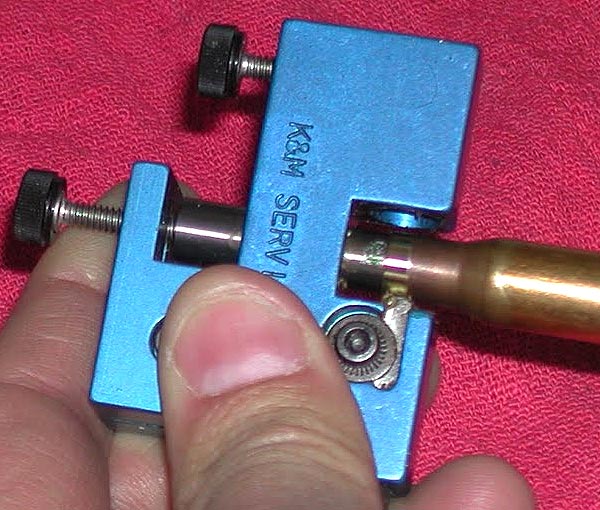
When neck-turning cases, it’s a good idea to extend the cut slightly below the neck-shoulder junction. This helps keep neck tension more uniform after repeated firings, by preventing a build-up of brass where the neck meets the shoulder. One of our Forum members, Craig from Ireland, a self-declared “neck-turning novice”, was having some problems turning brass for his 20 Tactical cases. He was correctly attempting to continue the cut slightly past the neck-shoulder junction, but he was concerned that brass was being removed too far down the shoulder.
Craig writes: “Everywhere I have read about neck turning, [it says] you need to cut slightly into the neck/shoulder junction to stop doughnutting. I completely understand this but I cant seem to get my neck-turning tool set-up to just touch the neck/shoulder junction. It either just doesn’t touch [the shoulder] or cuts nearly the whole shoulder and that just looks very messy. No matter how I adjust the mandrel to set how far down the neck it cuts, it either doesn’t touch it or it cuts far too much. I think it may relate to the bevel on the cutter in my neck-turning tool…”
Looking at Craig’s pictures, we’d agree that he didn’t need to cut so far down into the shoulder. There is a simple solution for this situation. Craig is using a neck-turning tool with a rather shallow cutter bevel angle. This 20-degree angle is set up as “universal geometry” that will work with any shoulder angle. Unfortunately, as you work the cutter down the neck, a shallow angled-cutter tip such as this will remove brass fairly far down. You only want to extend the cut about 1/32 of an inch past the neck-shoulder junction. This is enough to eliminate brass build-up at the base of the neck that can cause doughnuts to form.
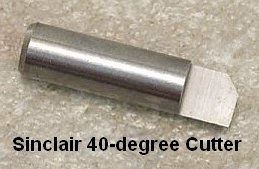
The answer here is simply to use a cutter tip with a wider angle — 30 to 40 degrees. The cutter for the K&M neck-turning tool (above) has a shorter bevel that better matches a 30° shoulder. There is also a 40° tip available. PMA Tool and 21st Century Shooting also offer carbide cutters with a variety of bevel angles to exactly match your case shoulder angle*. WalkerTexasRanger reports: “I went to a 40-degree cutter head just to address this same issue, and I have been much happier with the results. The 40-degree heads are available from Sinclair Int’l for $15 or so.” Forum Member CBonner concurs: “I had the same problem with my 7WSM… The 40-degree cutter was the answer.” Below is Sinclair’s 40° Cutter for its NT-series neck-turning tools. Item NT3140, this 40° Cutter sells for $14.99. For the same price, Sinclair also sells the conventional 30° Cutter, item NT3100.
Al Nyhus has another clever solution: “The best way I’ve found to get around this problem is to get an extra shell holder and face it off .020-.025 and then run the cases into the sizing die. This will push the shoulder back .020-.025. Then you neck turn down to the ‘new’ neck/shoulder junction and simply stop there. Fireforming the cases by seating the bullets hard into the lands will blow the shoulder forward and the extra neck length you turned by having the shoulder set back will now be blended perfectly into the shoulder. The results are a case that perfectly fits the chamber and zero donuts.”
* 21st Century sells carbide cutters in: 15, 17, 20, 21.5, 23, 25, 28, 30, 35, 40, and 46 degrees. PMA Tool sells carbide cutters in: 17.5, 20, 21.5, 23, 25, 28, 30, and 40 degrees, plus special short-neck cutters.




 Trigger, Stock Adjustment and Other Features


 Stock Cast and Cant Adjustment Procedure


 When neck-turning cases, it’s a good idea to extend the cut slightly below the neck-shoulder junction. This helps keep neck tension more uniform after repeated firings, by preventing a build-up of brass where the neck meets the shoulder. One of our Forum members, Craig from Ireland, a self-declared “neck-turning novice”, was having some problems turning brass for his 20 Tactical cases. He was correctly attempting to continue the cut slightly past the neck-shoulder junction, but he was concerned that brass was being removed too far down the shoulder.