2020 has been a challenging year for the shooting sports. The CMP National Matches at Camp Perry and NRA National Championships at Camp Atterbury were cancelled due to Pandemic health concerns. Other major matches have been dropped from the calendar due to COVID-19. That’s why we are pleased to report that the IBS was able to conduct the 2020 Benchrest for Score 100/200 Meter National Championships. Attendance was solid, and competitors had a good time. Here is the match report from IBS member Todd Payseur.
IBS 100/200 Score Nationals at Mid-Carolina Gun Club
Report from Todd Payseur
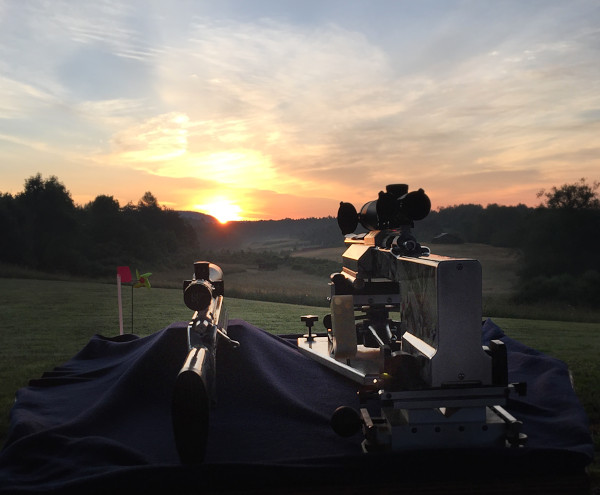
The morning light breaks and shooters begin to set the final touches on their wind flags. Yes, it’s time for the Nationals! For what has been a crazy COVID-impacted year with a lot of cancelled matches, dates being changed, and some states still not able to hold matches, many shooters had cabin fever for the Nationals.
Several people had concerns beforehand with even having a match in August at the Mid-Carolina Gun Club because of how brutal our summers can be, but Mother Nature really blessed us with a calm weekend. Saturday started with overcast skies and projected highs around 87 degrees, which for August is almost unheard of. A few showers during the day, but nothing that really amounted to much or effected any of the relays. The winds stayed calm and 20 VFS shooters stayed clean and 2 Hunter guns went for 250-10X with Peter Hills creedmooring Ronnie Milford for the top 6-power at 100 meters. In VFS a familiar face, Wayne France shot a great 250-21X edging out rookie shooter Will Till at 250-20X.
Lisa Moore, grandmother of Gage and Remy Logsdon, prepares for the next relay with bolt removed.
This is Will’s second season in VFS and he has steadily improved. His second place finish at 100 meters is the start of many great finishes ahead for this young man. Speaking of young people, I’m pleased to say we had a great showing of Junior shooters this year and they all deserve to be mentioned. Defending rookie of the year Tori Allen (below right) was the top junior, followed by first-year rookie Remy Logsdon. Gage Logsdon rounded out the top three junior shooters. With such young talents coming into the benchrest game, we are very optimistic about the future of our sport.
Wayne France (Left) with 100-yard 1st Place Agg patch. Tori Allen (Right) was the top Junior shooter.
Sunday at 200 meters was the Lin Smith show! Lin shot both a Heavy and a Light Varmint rifle and turned in a very impressive 500-17X for the day. This fine work led him to two of the top three places at 200 meters and a first and fourth in the Grand Agg. I can’t say enough about how happy everyone is for Lin. He is one good man that those of us in the southeast region are honored to compete with and call a friend.
Grand Agg winner Lin Smith really put on a display of fine shooting this weekend.
In the 6-power Hunter Rifle class, Jim Cline turned in an impressive 249-5X at 200 meters for the win and that led him to his first place finish in the Grand Agg followed by a solid 245-4X by Ronnie Milford who took second-place in the Grand Agg.
Here are all the winners with their wood. Left to Right: Will Till, Gage Logsdon, Lee Martin, Tori Allen, John Bosley, Lin Smith, Peter Hills, John Ridgeway, Remy Logsdon, Wayne France, Jim Cline and Ronnie Milford.
CLICK Chart for Full Spreadsheet with Results for ALL Shooters
View back to the benches from the 100-meter targets at Mid-Carolina Gun Club. the Orangeburg swirl is lurking in those trees… just waiting to push bullets where they just shouldn’t go!
Great Competition, Great Food, Great Location
Overall we had a good turnout with 35 VFS guns and 8 V/VH guns on Saturday and 34 and 7 on Sunday. Competitors came from as far away as Maine and Michigan and everywhere in between. The food was outstanding with meals available both Friday and Saturday evenings at the range along with lunches Saturday and Sunday. One thing is for certain, if you enjoy great food and great company, then the IBS VFS circuit is something you should come check out, I’m sure you won’t be disappointed!
About the Mid-Carolina Gun Glub in South Carolina CLICK HERE for more information on the Mid-Carolina Gun Club in Orangeburg, South Carolina. This club boasts a great facility with plenty of room for cleaning/loading, plus a large, covered eating area with serving line. There is also parking for campers on the club property. I would like to personally thank Jim Cline and the whole Mid-Carolina Crew for another great weekend and cherished memory!
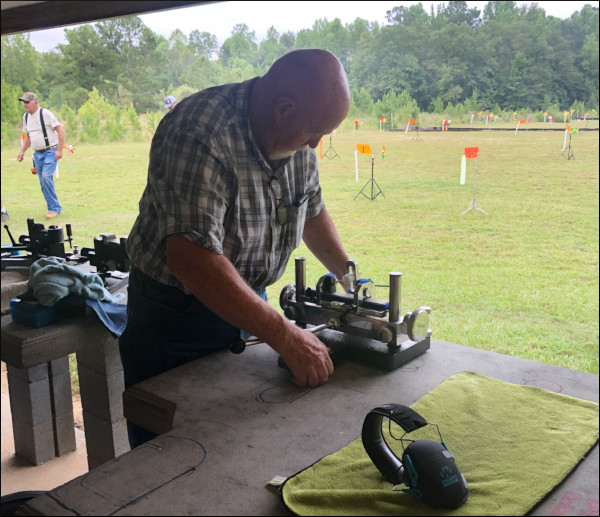
Jerry Powers from the Ashe County gang setting up a SEB MAX. SEB rests, both MAX and NEO, are very popular with score BR shooters.
Sierra BulletsBallistic Technician Gary Prisendorf has written a nice essay about how reloading can become a life-time hobby, a rewarding pastime that can bring together a father and son…
Memories of My Father — Reloading As a Life-Time Hobby
by Gary Prisendorf
For as long as I can remember I have been around reloading. I have tons of childhood memories of my father reloading and shooting. I remember how he would let me help him load his ammunition, by letting me clean primer pockets or wipe the sizing lube off of his cases. I really thought I was doing something. Well, I guess I was, I was spending quality time with my father doing something that would become a great hobby and eventually land me a great job working for Sierra Bullets.
If you are a reloader, teach someone. You may just give them a hobby for the rest of their life and who knows, you could help them find an enjoyable career, doing something that they love.
— Gary Prisendorf
I remember watching my father sizing cases on his Herters press, dropping his powder charges with a Belding & Mull powder measure and weighing powder charges with his Texan scales. Heck, I can even remember when he would buy powder at a local pawn shop, and they would weigh it out and put it in a paper sack. He would save his empty powder cans, wrap them with masking tape and write what the powder was on them with a black magic marker.
When I was in Junior High, I got my first shotgun, a 20 gauge Mossberg 500 and within a couple of weeks my father came home with a 20 gauge Lee Load-All and a pound of Blue Dot. He gave me a crash course on how to use it, and got me up and running with a couple of safe loads. I put a lot of shells through that old 20 gauge.
From that day forward I was hooked. If I got a new gun, I was loading ammunition for it. I don’t buy factory ammunition unless I just want to shoot it up so I can get some once fired brass. I reload everything that I shoot, except for rimfire stuff, and if I could figure out how to do that safely, I would probably load that too.
Through the years I have learned to appreciate things — such as once-fired military .30-06 cases that can be converted to obscure cartridge types. And I know the value of a five-gallon bucket of lead wheel weights that will be melted down and cast into bullets.
I remember finding 19 once-fired Norma 7.7×58 Arisaka cases laying on the ground at a public shooting range, and it was like Christmas came early. I must have looked for that 20th case for about thirty minutes, but I never did find it.
I can’t thank my father enough for getting me started in reloading, he gave me a great hobby, many wonderful memories and taught me the skills that gave me a career doing something that I love.
SUMMARY: Powder can have a very long shelf life. You need to watch for changes in smell and color. A reddish tinge, almost like rust on the powder, is a bad sign, as is a foul odor, not to be confused with a normal chemical smell. Either of these signs indicate it is time to dispose of your powder by means other than shooting.
Ever wondered about the stability of the propellants in your reloading room? There are some important things you should know about powder storage, to ensure consistent powder performance and safety. On its website, Western Powders (vendors of Accurate, Norma, and Ramshot powders) published an informative Q & A series entitled Dear Labby: Questions for our Ballistics Lab. Here are some excerpts that pertain to powder storage and shelf life. Worried that your powder may be too old? Western’s experts explain how to check your propellants for warning signs.
Proper Powder Storage
Q: I live in southern Arizona where it is very hot. I am told powders will become unstable if stored in an area not air-conditioned. My wife says no powder or primers in the house. Can powder be stored in a refrigerator? What about using a fireproof safe? I would appreciate your ideas. — M.C.
Lab Answer: SAAMI guidelines are pretty clear on issues of storage. They recommend storing smokeless powder in containers that will not allow pressure to build if the powder is ignited — ruling out gun safes and refrigerators.
In their original containers smokeless powder’s lifespan is quite long, even in your hot, arid climate, typically longer than the average handloader would need to store them. Stored safely in a garage or outbuilding, your powder should last years. If you see the powder developing a reddish tint, or giving off a foul odor, it is time to discard it.
Clumps in Powder Container
Q: I ordered some of your Accurate 1680 powder back about in December. I just now opened it … and it is full of clumps. My knowledge tells me that means moisture. Am I wrong? I just now broke the seal and it has been stored in a ammo can with desiccant packs around it and a dehumidifier running 14-16 hours a day. I can’t imagine this being my fault, if this does indicate moisture. I don’t know if the pink part on the label is suppose to be red or not, but it is definitely pink, so if it was red I am wondering if I was shipped an old container? I hope that this isn’t bad and I am stuck with it…
Lab Answer: All powder contains a certain amount of moisture. When the powder is stored or during shipping, it can go through temperature cycles. During the cycling, the moisture can be pulled to the surface and cause clumping. Clumping can also be caused by static electricity if too dry or the powder has limited graphite content. You can break up the clumps before metering and they shouldn’t be a problem. This will not affect the powder performance, so your product is fine. Accurate 1680 labels are designed in Pink. As a side note, specification for testing powder is at 70° F and 60% humidity.
Shelf Life and Packaging Dates
Q: Does powder ever get to old to use and what identifying marks does your company put on the canister for when it is made, You have helped me out a while ago when I asked about keeping my cowboy shooting under 950 fps and it works great less stress on the hand and the recoil is very minimum. — R.B.
Lab Answer: On one pound bottles, the number is on the corner in a silver box. If the powder was poured today, it would read 012815 followed by a lot number. The whole number would look something like 012815749. Eight pound bottles have a sticker on the bottom with an obvious date code. The lot number appears above the date.
Every serious, long-range shooter needs a modern, accurate wind meter. And the higher-level Kestrel Wind Meters include a sophisticated ballistics engine that can calculate drops and wind-holds at any distance. These “smart” Kestrels can communicate (via Bluetooth) with a powerful App on your mobile device(s). For this exclusive review, our Editor F-Class John field tests the Kestrel 5700 Elite Weather Meter with Applied Ballistics, and explains its many impressive features. This unit offers great functionality for a $699.00 MSRP. Shop at KestrelBallistics.com or Amazon.com. For this article, F-Class John has created THREE (3) videos which are well worth watching.
Kestrel 5700 Elite Ballistics Review, Video Part 1
Kestrel 5700 Elite — Field Test and Evaluation
by F-Class John
In order to make accurate shots at long range, whether in the desert knocking down steel at a mile or shooting paper at 1000 yards, you need to know and understand the effects of your environment (wind, temperature etc.), along with your bullet’s ballistics. Traditionally, shooters gauge wind speed/angle with a wind meter and then input the data into a ballistic program on a mobile device. That program then produces a firing solution after calculating bullet drop and wind drift. While this method works, it can be time-consuming and cumbersome, and there’s always the potential for error when transposing the information from wind meter to mobile device.
Enter the Kestrel 5700 Elite Applied Ballistics with Kestrel LiNK. This all-in-one unit allows for incredibly accurate firing solutions by using a variety of measurements such as average, head, and cross winds as well as other atmospheric conditions which are then analyzed by built-in Applied Ballistics software. This yields ultra-accurate results from a handheld unit that easily fits in your pocket. Describing the 5700 Elite can be a little difficult. Yes, it is an anemometer at its core, but it is also a complete weather station, a ballistic calculator, and a target card creator.
The Kestrel 5700 Elite’s own menu has three Mode options: Weather, Easy, and Ballistics. The Weather Mode option (great on its own) features the ability to measure altitude, barometric pressure, crosswind, density altitude, dew point temperature, headwind/tailwind, heat stress index, relative humidity, station pressure, temperature, wet bulb temperature, wind chill, wind direction and wind speed/air speed. These readings are available both on the screen by themselves or grouped three at a time. Access is quick and easy with readings updating constantly so you always have the most accurate information at hand.
In addition to Weather Mode, the Kestrel 5700 Elite Ballistics boasts two other Modes, EASY and BALLISTICS. NOTE — before using Easy Mode or Ballistic Mode I recommend creating gun profiles and bullet profiles in the Kestrel directly or through the Kestrel App. This is easy, as the Kestrel Ballistics App connects directly to any LiNK-enabled Kestrel unit. After the initial startup you’ll want to begin with Gun Profile Management tab. This tab allows you to enter both your gun information as well as your loads. The Elite allows up to 30 gun profiles to be created. Notably, the Elite’s included Applied Ballistics software constantly updates bullet profiles. In fact, during my testing, new bullet profiles were added twice. So I was assured I had the most up-to-date bullet choices when creating load profiles.
Kestrel 5700 Elite Ballitics Review, Video Part 2
Along with gun profiles, the Kestrel 5700 Elite Ballistics allows you to create 10 separate Target Profiles. This can be done a couple different ways. The first is Easy Mode — a great option for those want to get a firing solution but don’t need or want to enter a lot of information. It allows you to set up your target range (distance), target data (wind, direction, etc), and choose your rifle profile. Other variables are muzzle velocity, compass, and latitude. Easy Mode allows you to enter the most vital information without feeling overwhelmed, yet Easy Mode still provides for a very accurate solution.
Kestrel 5700 Elite Ballistics Review, Video Part 3
Switching from Easy Mode to Ballistics Mode provides even more options. These include setting up your target (target angle, target speed, wind direction, and more), wind input, gun profile, environment (temp, barometric pressure, altimeter humidity, etc.), target cards, and range cards (with fixed distances). You also get full access to the Applied Ballistics calculator as well as your ability to manage gun profiles. The target card is a really great feature for multi-target disciplines such as PRS where you may be able to range targets ahead of time. The target card allows you to enter any 10 exact distances and the Applied Ballistics software will calculate solutions for all of them in an easy-to-access chart. This is a great feature that can save you time and improve scores.
The Kestrel 5700 Elite’s associated Applied Ballistics software offers additional advanced functionality. For example you can calculate the actual BC of your bullet and adjust for transonic bullet flight. Once you get the hang of how to use these additional features, they really make you realize how powerful this tiny unit is. The App is configured for easy data entry and it even has the classic Snake game as a fun hidden feature in the “About” section of the menu.
SUMMARY — Outstanding Handheld Device with Full Ballistics Functionality
The Kestrel 5700 Elite with Applied Ballistics demonstrated that it is truly the most feature-packed handheld weather meter/ballistic calculator available on the market today. In fact, after several weeks of testing I feel there were still more minor features that I could have used to get even more information about my ammo, firing solutions, and environment. If you’re a technology-driven shooter looking for the ultimate Weather/Ballistics tool at the range, the Kestrel 5700 Elite is for you. This is an outstanding product.
Our friend Bill Marr of Rifleshooter.com has done it again — conducted a fascinating 6mm Creedmoor barrel cut-down test that reveals how velocity changes with barrel length. This time Bill started with a 24″ Proof Research stainless steel barrel on a Howa action. Bill says this was a well-used barrel, with over 1800 rounds through it. So, the velocities might be a bit different than a new barrel of similar length. Bill cut the barrel down in one-inch increments. Here are some results from the test:
For this latest test, Rifleshooter cut the barrel in one-inch increments from 24″ to 16.1″ (just over legal minimum). Velocities were measured with a MagnetoSpeed V3 chronograph mounted on arm attached to the stock. This allowed the chrono to be adjusted inwards as the barrel was cut shorter, inch by inch.
For the 6mm Creedmoor cartridge, Bill loaded Hornady 108gr ELD Match bullets over 41.5 grains of Hodgdon H4350 with CCI 200 primers in new Starline brass.
The results were interesting to say the least. Bill reports: “Muzzle velocities ranged from 2,893 ft/sec at 24″ to 2,598 ft/sec at 16″ for a decrease in muzzle velocity of 295 ft/sec. Muzzle velocity changes per inch of barrel length ranged from 6 ft/sec per inch between 20 and 19 inches to 63 ft/sec per inch between 19 and 18 inches. Average velocity change per inch of barrel length was 37.9 ft/sec.”
Bill concludes: “An average drop of 37.9 ft/sec/inch of barrel is fairly significant and is what would be expected with a fast moving 6mm cartridge like the 6mm Creedmoor. While I’m used to seeing 6mm Creedmoors with slightly longer barrel lengths than 24″, when coupled with a sound suppressor the additional length can make moving the rifle quickly more difficult.
I’d suggest staying with longer barrel lengths wherever possible with this cartridge. At shorter lengths, it does give up more performance than its big brother the 6.5 Creedmoor.”
More 6mm Creedmoor Velocity Data from 2017 Cut-Down Test
If you’re curious about 6mm Creedmoor velocities at longer barrel lengths, back in 2017 Rifleshooter completed a 6mm Creedmoor barrel cut-down test from 31 inches all the way down to 17 inches. The test included four bullet types from 95 grains to 110 grains. With the 110gr Sierra MK, velocity at 31″ was an impressive 3110 fps. Surprisingly the velocity didn’t decrease that much for the first few inches. Even at 26″ (a five-inch reduction), measured velocity with the 110s was 3073 fps, a loss of 7.4 fps per inch on average. With a barrel shortened all the way to 20″ however, velocity had dropped down to 2949 fps, a significant (161 fps) loss. CLICK HERE for complete results from that 31″-17″ Barrel Cut-Down Test.
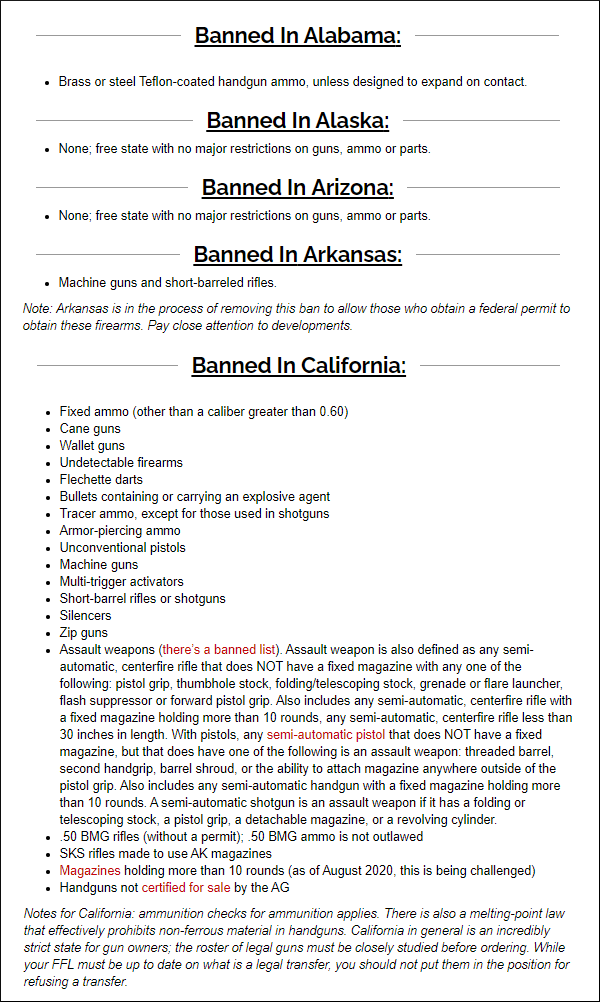
Cheaper Than Dirt (CTD), a Texas-based gun product retailer, has compiled a great resource that can benefit gun owners. CTD has created a “BANNED LIST” which catalogs firearms, ammo, and gun-related products (such as magazines) that are banned in particular states. This Overview of Restricted Guns, Ammo and Parts in Each State is searchable by state, so you can quickly identify the guns, ammo, and gun-related products banned in your location.
Wilburn Roberts, CTD Blog editor, explains: “You must be aware of local laws. I have authored more than 6,000 firearm-related articles, written 14 books on the topic of firearms and served as a peace officer and security professional for decades. I’m still learning new things related to laws every day.
Why read up on this topic? For starters, some things you would never have guessed are illegal. As an example, did you know that some states ban ‘wallet holsters?’ These are holsters that allow you to carry a handgun like a Beretta .25 ACP (or sometimes a small revolver) in the back pocket.
Be careful, as many things you are able to purchase easily online could be illegal in your home state. Some are patently illegal, others are illegal only if you carry them.
That being said, this is a report on certain items that are banned in one state or another. Feel free to use it as a reference for your own research. It contains pertinent gun laws nationwide and is separated on a state-by-state basis. It is ultimately your responsibility to study your own state laws and those of the states you travel in. Lawws might be … more complex than they first appear. Double-check the laws for your state. Also, remember that these laws are subject to change. At the end of the day, you should never order anything that is illegal in your state.”
DISCLAIMER: This is not intended to be a comprehensive or complete list of gun laws. The information provided is not intended as legal advice or a restatement of law. For any particular situation, it is highly recommended that a licensed local attorney be consulted for an accurate interpretation. The opinions and statements expressed in this article belong to the author and do not necessarily represent Cheaper Than Dirt, nor is the company at fault for any gun-related legal decisions you make.
Report by Andrew Murtagh
I’ve been a long range shooter for the past 17 years. Like most shooters in this game I’ve built, bought, and sold numerous rifles during my tenure. Here’s my tale of two special rifles, a Heavy Gun and a Light Gun, both sporting Patriotic stock graphics. I shoot both of these rifles in competition at Reade Range and The Original Pennsylvania 1000-Yard Club, aka “Williamsport”, where I serve as Club Vice-President.
My two Patriots were both acquired second-hand from a fellow shooter, Mike Bonchack. As purchased, they were very different from what they are now. I first decided to rechamber them using my reamers. The Light Gun (LG) is now chambered in 6×47 Lapua with 0.267″ neck, while the Heavy Gun (HG) is a 6mm Dasher with 0.266″ neck. After re-chambering the barrels, next I decided to get both guns up to maximum weight. The LG already had an adjustable weight system so it was easy to get it to 17 pounds. For the HG, I added an additional 25 pounds of lead/epoxy fill which was milled into the barrel channel and butt stock.
The Story Behind the Patriotic Graphics
I was initially going to have the LG painted until a close friend and fellow shooter, Tom Murtiff, suggested hydrographics. I landed on the patriotic theme because I’m a right-wing leaning Constitutionalist who still believes in the principles upon which our Founding Fathers built this nation. I wanted to express my support of our country’s Constitution and its Amendments. The search for the perfect patriot print was on.
This was my first hydrographic print experience and I was overwhelmed with the sheer number and variety of prints available. I spent a few days searching when I found the Amendment print. I then contacted Rick Schuh, owner of Boyzhid Hydrographics. He then prepped, hydro-dipped, and clear-coated the LG. Late in 2017 I purchased the HG and through a lengthy process in 2018 the metal work and stock additions were completed. I was now back in search of the perfect print. This was also lengthy, and I couldn’t find anything that spoke to me except for a suggestion to have “twin” rifles. I liked the idea — a pair of “Patriots!”
Rick was again employed to dip the Heavy Gun. That became a real undertaking because the stock alone (no metal attached) now weighed 35 pounds. He had to manufacture reinforced hangers to apply the graphics without flaw. The stock came out perfect to my eye, but not to his. On the bottom, which is rarely seen on any HG, he airbrushed a small flag to cover an area that stretched the print. Rick also made a jeweled plate for the toe of the butt.
I’m including this image so everyone can see Rick’s extra effort to make the HG perfect. I often joke with him about the added work no one would see. Well now the world can view his workmanship.
1000-Yard Heavy Gun Specifications:
Kelbly Stolle F-Class Panda dual-port, right eject with Kelbly Picatinny rail
Modified Ryan Miller HG stock bedded/pillared/weighted by David Powley
Bartlein 1:8.5-8″ gain-twist 0.236″ bore barrel
— chambered in 6mm Dasher 0.266″ neck by David Powley
Ryan Miller barrel-block fitted with nylon bushing by David Powley
Harrell’s muzzle brake
Jewell trigger
Optic One: NightForce 12-42x56mm NXS in Vortex rings
Optic Two: Leupold 7-35x56mm Mark 5 HD in Leupold rings
1000-Yard Light Gun Specifications:
BAT Machine B Action RB/LP/RE
McMillan MBR stock bedded by David Powley
Bartlein 1:8″-twist 0.237″ bore 30″ barrel
— chambered in 6×47 Lapua 0.267″ neck by David Powley
Harrell’s radial muzzle brake
Jewell trigger
NightForce 15-55x52mm Competition Scope in Harrell’s rings
Stock Graphics: Both rifles share a Patriot Constitution Hydrographic print (and clear-coat) by Rick Schuh of BoyzHid Hygrogaphics.
How to Succeed in the 1K Benchrest Games — Q & A with Andrew
Q: How Do You Choose a Chambering/Cartridge for a particular Match or Relay?
Andrew: Cartridge choice depends on the wind forecast. I always have several rifles with particular cartridge/loads for each depending on the forecast. If it’s a light wind day, say 4 to 8 mph with light gusts, I’ll be shooting either a 6×47 Lapua or a 6mm Dasher. If it’s blowing around 10 to 12 mph, I’ll campaign a 6×47 on its high node to get it down range flat. But if it’s really blowing or constantly changing direction, I shoot a big .300 WSM with either 200gr or 210gr bullet.
Q: What Is Your Load Development Method?
Andrew: Initial load development is always done over the chronograph at 100 yards until I get low ES/SD for 5 shots utilizing the same 10 pieces of absolutely perfect brass. Once I’m satisfied with the raw data I move to 1000 yards with a set of match brass and shoot 5-shot strings to find the best-performing exact powder charge. I have found this is usually within 0.20 grains of what performs well over the chronograph.
Q: What Brass, Primers, Powders, and Bullets Do You Use?
Andrew: I use Lapua brass for all things 6mm and Norma brass for my big .30 Cal stuff. I never change primers and shoot CCI BR2s or BR4s. I’m a Varget and H4350 fan. I’ve tried other powders, but they never were fruitful at 1K. Currently the only bullets I shoot are Sierra Match Kings. In the 6mm Dasher and 6×47 Lapua I use the 6mm 107gr SMK. In my .300 WSM I use .308-cal 200gr and 210gr SMKs.
Q: What Advice Do You Have for Novice 1000-Yard Competitors?
Andrew: Leave your ego at home and be willing to learn each and every time you come to the range. The discipline evolves rapidly and so must the shooter. It won’t take long to get left behind and become extremely frustrated with the game if you are not willing to learn and adapt. Find a tutor who is a great shooter and who is willing to mentor you. John Hoover and Tom Murtiff helped me and are very dear friends and great 1000-yard shooters. Believe me, having a good mentor takes years off the learning curve. Lastly, enroll in the Benchrest Shooting School offered by The Original Pennsylvania 1000 Yard Benchrest Club. I’m an instructor there and I, along with all the cadre, will help new shooters rapidly advance their skills.
Q: What’s the Secret to Judging the Wind? (In this discipline there are no target markers after each shot.)
Andrew: That’s the million-dollar question. What I do is find the condition that seems to hold. Once I’m committed into the record string, I follow it to the end. At Williamsport the wind flags can change at every distance so you simply need to pick one flag and hope it’s the one that remains truthful.
Long Range Competition Advice from a Leading 1K Benchrest Competitor
FIVE Key points to remember when shooting 1000-Yard benchrest
1. Be positive and have a clear state of mind when competing.
2. Bench set-up and shooting mechanics must always be the same — every shot. Then follow the shot through your optic.
3. Shoot two (2) shots before making a scope adjustment unless you’re under a minute of the sighter period.
4. Trust yourself and your equipment. You never want to second guess anything you put on the line.
5. Once you commit to shooting your record string, DO NOT STOP.
Invitation to Join Andrew at Williamsport in Pennsylvania
I currently serve as Vice President of The Original Pennsylvania 1000 Yard Benchrest Club, PA1000yard.com. Situated near the municipality of Williamsport, Pennsylvania, it has become known as the “Williamsport Club”. We would like to invite any shooting enthusiast to come out and visit our club during a match weekend. My rifles are only a sampling of the beauty and craftsmanship that is often on display at Williamsport’s 1000-yard line. Please stop by and visit with us.
Here are UPCOMING EVENTS at our club this summer and in 2021:
Light Gun and Heavy Gun Match #5, August 22/23, 2020
Light Gun and Heavy Gun Match Match #6, September 12/13, 2020
Light Gun and Heavy Gun Match Match #7, September 26/27, 2020
Long Range Benchrest School June, 2021
Annual 1000-Yard World Open Match July, 2021
Andrew wanted to give credit to the many talented guys who have helped with his rifle builds and his reloading equipment. In alphabetical order, these are Mike Bonchack, John Hoover, Tom Murtiff, David Powley, and Rich Schuh (Boyzhid Hydrographics).
One recent trend in F-TR competition is the use of low-profile, benchrest-type stocks shot with a light hand-hold and little or no face contact. For this method of F-TR shooting to work, you need the right equipment, and practice a “minimalist” shooting technique. One of the pioneers in this style of F-TR shooting is action-maker John Pierce of Pierce Engineering. Above you can see John shooting one of his F-TR rifles at the 2015 Canadian F-Class Championships. Note the straight-line stock and see how the adjustable bipod is set quite low to the ground (in fact the bipod’s arms are almost straight out).
Members of the Michigan F-TR Team, including Bryan Litz, have used similar rigs with success. Bryan said it took a while to adapt his shooting technique to this kind of rig, but there is a pay-off. Armed with a Pierce-built F-TR rifle, Bryan won his first-ever F-TR Match. Bryan explains the technique he uses when shooting this kind of rifle:
“Coming over from sling shooting, I knew there would be unique challenges to F-TR which I wanted to learn prior to (not during) a major tournament. I learned a new shooting position which doesn’t involve drawing the right knee up. For F-TR I get more straight behind the gun rather than at an angle. I found that the rifle shoots best with very light cheek, shoulder and grip pressure, approaching free recoil. This is how Eric Stecker shot his similar rifle into second place in the SW Nationals [with high X-Count by a large margin]. I learned the rifle’s sensitivity to different bipod and rear bag supports, and found the best buttplate position to allow the rifle to track and stay on target after recoil. This set-up shot best with a mostly free-recoil approach, that means ‘hovering’ over the comb, rather than resting your head on the stock. This took some ‘getting used to’ in terms of neck and back muscle tone. These are the kind of details I think it’s important to focus on when entering a new discipline.”
Bryan’s Pierce-built F-TR rig is a tack-driver: “I can certainly vouch for this set-up! In [a 2015] mid-range State Championship in Midland, MI, I shot my Pierce rifle into first place with a 598-44X (20 shots at 300, 500 and 600). Once you get used to the positioning and way of shooting these rifles, they just pour shots through the center of the target.”
Pierce F-TR Rifles with Scoville Stocks
Shown below are three complete Pierce F-TR rifles, along with a barreled action for comparison. The carbon-fiber/composite stocks are built by Bob Scoville. These Scoville stocks are very light, yet very strong and very stiff.
Main photo from NRAILA.org. The NRA supports Second Amendment rights.
Article by AccurateShooter.com Editor-in-Chief
In the last month, a half-dozen acquaintences have asked me about getting a handgun for self-defense at home and while traveling. What is notable is that all of these persons have never owned a handgun before. Moreover, two of the six are pretty staunch liberals who, prior to 2020, thought the Second Amendment was a “historical anachronism” that should be repealed. With the widespread riots and “defund the police” activism, that has all changed. These six people now realize that there are real threats in current society and they may find themselves in a situation where armed self-defense is the only option.
Try Before You Buy — Find a Gun with Good Reliability, Controls, and Ergonomics
These six persons asked for recommendations on handguns. I explained that there was no one “best gun” for every person. I also stressed the importance of training, and of trying various handguns to compare ergonomics, weight, balance, sight arrangement, controls, and trigger pull.
Folks, ergonomics and grip shape DO make a difference. I used to give pistol instruction at a local club. I provided four 9x19mm pistols: Beretta 92, HK USP, SIG P226, and Glock 19. Two-thirds of the students shot best with the SIG P226, and only 10% shot best with the Glock 19. The majority of the students kept “pulling shots” with the Glock, even with a lot of practice. Not so with the SIG P226. I attribute that to lower center of gravity and more ergonomic grip shape/angle.
Caliber Choice — Factors to Consider
We are not going into the long caliber debate today. I have owned semi-auto pistols in .380 ACP, 9x19mm Parabellum, .40 SW, .45 ACP. Each cartridge has its pros and cons. But for a first-time gun owner, looking for a self-defense round, I will recommend the 9mm. It will have noticeably less muzzle flip than the .40 SW, but still carries much more energy than a .380 ACP. I love the .45 ACP for target shooting, but it is more expensive for practice, and there are fewer pistol options. For revolvers, the .357 Magnum is a great defense round, but some of the smaller carry pistols are limited to .38 Special.
Semi-Auto 9mm Carry Gun Recommendation: S&W M&P9 Shield EZ
I have considered a wide range of 9mm carry pistols from Glock, Ruger, SIG Sauer, Smith & Wesson, Taurus, and Walther. There are many very good pistols out there. But what I recommended to my acquaintances was the new Smith & Wesson M&P9 Shield EZ 9mm. This gun features a back-strap grip safety and is offered with or without thumb safety. There is also a M&P9 EZ model with built-in Red Laser.
Here are the key reasons I recommended the M&P9 EZ 9mm pistol:
1. Good Accuracy and Balance
2. Integral Grip Safety and optional Thumb Safety
3. Good Ergonomics: 18-degree grip angle for natural point of aim
4. Reasonable 4.5-lb Trigger Pull (some other pistols are 7+ pounds*)
5. Easy-to-Rack Slide
6. Take-Down does NOT require trigger pull (unlike Glock)
7. Availability of built-in laser or accessory rail-mount lights/lasers
8. Good Price: $479.00 base MSRP with $399.99 street price
9. Outstanding Smith & Wesson reliability, warranty, and customer service
This detailed, authoritative M&P9 EZ video review also covers the M&P .380 Shield EZ:
Small Deep Concealment Carry Gun Recommendation — S&W Model 638
I am a big fan of revolvers. I have probably put more rounds through my S&W Model 617 .22 LR revolver than all my other handguns combined. Revolvers are accurate, solidly built, and the shorter-barrel models conceal easily. In addition, revolvers are inherently simple — they can be put into action without racking a slide or dealing with mag latches and the like. I’ve actually seen trainees drop magazines on the ground when they were drawing pistols from holsters — they hit the mag release by accident. If this can happen in a class, it can happen in a threat situation.
For concealed carry, I recommend the Smith & Wesson Model 638 revolver. IMPORTANT — the Model 638 has a hammer so it can be shot single-action OR double-action. Having the single-action option is great when a slower, more precisely-aimed shot is needed. Unique among S&W revolvers, the 638’s hammer is shielded — this way the hammer will not snag when the gun is carried in purse or pocket.
As for accuracy, you will be surprised with the Model 638 with good self-defense ammo. Despite the short site radius, the little 1.875″-barreled Model 638 will easily outshoot most self-loading .380 ACPs. With my 638 Airweight, slow-fire, I can put all five rounds inside 2″ at 20 feet with ease.
* Some folks may criticize this S&W Shield 9mm EZ because it lacks a heavy 7-9 pound trigger pull. The thinking is that a heavy DA pull is better for novices. We understand the argument. However, in the real world we found that novices shot much worse with very heavy trigger pulls, even after much training. We believe a 4.5-lb pull is moderate and will actually allow better accuracy for the average shooter. A typical Glock pull-weight is about 5.5-6 pounds.
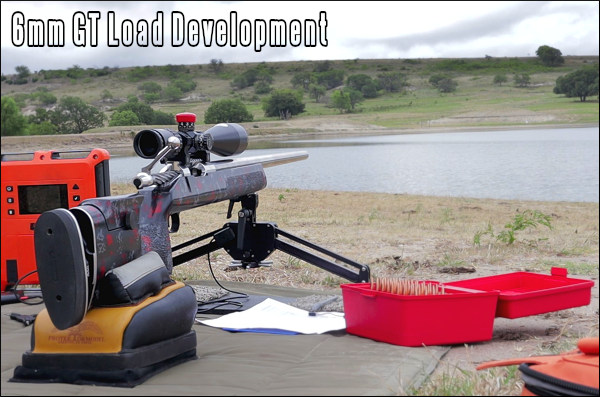
The 6mm GT (aka 6GT) cartridge was conceived as a “bigger Dasher” for PRS and NRL competition. The 6mm GT’s creators wanted 6mm Dasher accuracy and moderate recoil delivered via a cartridge with a slightly longer case body for better mag-feeding, longer neck for seating flexibility, and more moderate pressures. So far the 6GT has performed very well in PRS competition. Today’s story is a bit different — this is about an experiment — running a 6mm GT in an F-TR type rifle. Understand that, under current NRA rules, you may only shoot .223 Rem (5.56×45) or .308 Win (7.62×51), in official, sanctioned F-TR competition, but the 6GT is fine for F-Open. Mike McCasland wanted to see the potential of the cartridge for long-range target shooting, so he put a 6mm GT-chambered Bartlein barrel on a nice custom rifle with McMillan XIT stock and Kelbly F-Class Panda action. The results were impressive.
6mm GT — New Cartridge with Multi-Discipline Potential
Story by Mike McCasland, Texas Precision
The 6mm GT began garnering attention within PRS circles in early 2019. It promised to shoot 105-110gr 6mm bullets at 2950-3000 FPS, yet not suffer from mag-feed issues sometimes found with 6mmBR variants such as the 6 Dasher, 6BRX, and 6BRA. Moreover, since it burned less powder, the 6mm GT promised increased barrel life compared to the 6mm Creedmoor or 6XC. The 6mm GT case size should still work with the accurate powders in the Varget burn-range. I found the 6GT also worked great with H4350.
As someone who aspired to building a repeater and jumping into the PRS game, and had a spare F-TR rifle sitting around, I thought it would be fun to build up a 6mm GT to see if there was any merit to the hype. My smith, Wes Ripley of RIP Precision in Texas, builds a lot of PRS rigs, and already had the reamer on hand (a 0.120″ freebore variant).
Whidden Gunworks had some 6mm GT FL bushing die kits in stock, so I figured why not see what all the fuss was about? At the very least I could play around with the 6mm GT in F-Open Class at local club matches to see how it compared to the 6BRA, 6 Dasher, and other popular 6mm cartridges.
How the Project Got Started with Backup F-TR Rig
My 6mm GT build really started as a project spawned purely from COVID-19 Isolation boredom. This rifle primarily serves as a backup F-TR gun, and it had been relegated to performing some load development on .308 barrels, so I could spin new ones on my main match rifle. The only problem was, I had run out of .308 barrels that needed load development. So, I basically had an ideal test platform just collecting dust in the safe. All I needed was a 6mm GT-chambered barrel, since (like the 6mmBR) the 6mm GT works in a short action with a .308 Win-sized bolt-face.
6mm GT Rifle Specifications:
Action: Kelbly Panda F-Class SA RB/RP
Stock: McMillan XIT with RAD 2A
Barrel: 30″ 5R Bartlein 1:7.5″-Twist, HV Contour
Scope: Vortex Golden Eagle 15-60x52mm
Trigger: Jewell Benchrest, about 2 ounces
Bipod: Phoenix Precision
About the 6mm GT Cartridge
BRASS — The first thing you’ll find is cartridge brass choices for the 6mmGT are rather limited currently. At present, the only commercial options are Hornady and Alpha Munitions. For the die-hard Lapua fans, you can technically make 6mm GT brass from 6.5×47 Lapua, however that process is very labor-intensive.
I have used both Hornady and Alpha brass in this rifle and haven’t noticed much difference between the two. I will say that my batch of Alpha brass was slightly softer than Alpha brass I’ve used in other calibers; you could feel a difference when neck turning cases. I’m unsure if that’s a batch issue, or something specific to their 6mm GT brass as a whole. As far as performance, there was little discernable difference. Oddly enough, the Hornady brass seemed to have slightly less case capacity than the Alpha; with most other cartridges it’s the other way around.
POWDERS — The 6mm GT was designed with Hodgdon Varget in mind, and that popular powder works exceedingly well in this platform. That said, the 6mm GT can work with a wide variety of powders, some yielding better performance than Varget.
I’ve tried a multitude of powders during my initial 6mm GT load development: Varget, Shooters World Precision, RL16, VV N140, H4350, and RL-15 to name a few. In my barrel, Hodgdon H4350 seems to deliver the best velocity/accuracy combination. SD and ES also seemed to be the lowest with H4350.
Load Development for the 6mm GT — Many Powders Tested
BULLETS — The most common 0.120″ freebore chamber allows for the majority of high-BC 6mm projectiles found in both F-Class and PRS. I had good luck with the pointed 107gr Sierra Match Kings (SMK), as well as the 110gr Hornady A-Tips in my rifle. For those looking to run the heavier 112-115 grain 6mm offerings, I believe GAP designed a 0.160″ freebore reamer that gets those bullets out of the neck/shoulder junction. Shown below is the 0.120″ freebore JGS reamer print:
SUMMARY — Good Cartridge with Much Potential
Generally speaking, I think the 6mm GT is a good little round. Some may not subscribe to this theory, but I believe some cartridges are inherently easier to tune than others. I’m not sure the 6mm GT is as easy-to-tune as a 6mmBR, 6 Dasher, or 6 BRA, but I don’t think it lags that far behind.
With relatively little trouble, I was able to find loads with both Varget and H4350 that would consistently shoot very well — 0.2 to 0.3 MOA. Moreover, I found the 6GT cartridge lives up to the velocity claims made by G.A. Precision. I was easily able to push the 110gr A-Tips to 2950 FPS, and the 107gr SMKs to low 3000 FPS range without any pressure signs, or unnecessary wear and tear on the brass.
As a fun test, I ran my 6mm GT rifle in a local 1000-yard F-Class match with the 110gr A-Tips, just to see just how well they would perform. Although wind conditions of the day and some E-Target issues prevented my 6mm GT rig from getting the better of the larger 7mm and .30-Cal rifles, the 6mm GT proved itself an accurate little round at distance. Here is a 1000-yard ShotMarker target:
After putting several hundred rounds through my 6mm GT rifle, I anticipate building another 6GT on a repeater action to give PRS a try. I think if you are looking for a dual-purpose rifle that can run tactical matches (with 100% feeding reliability), and can also be used for mid-range, F-Open Class competition, the 6mm GT would be a very good option.
About the author, Mike McCasland:
Mike McCasland is an avid shooter who competes regularly in F-Class matches. Based in Texas, Mike is the creator of the Texas Precision YouTube Channel. There you’ll find many videos covering reloading, gun projects, and marksmanship. Mike has done some notable product reviews including a comparison test of Micrometer Competition Seating Dies. To access Mike’s YouTube Channel, CLICK HERE.




 For this latest test, Rifleshooter cut the barrel in one-inch increments from 24″ to 16.1″ (just over legal minimum). Velocities were measured with a





 As someone who aspired to building a repeater and jumping into the PRS game, and had a spare F-TR rifle sitting around, I thought it would be fun to build up a 6mm GT to see if there was any merit to the hype. My smith, Wes Ripley of
 BRASS — The first thing you’ll find is cartridge brass choices for the 6mmGT are rather limited currently. At present, the only commercial options are Hornady and

 SUMMARY — Good Cartridge with Much Potential


