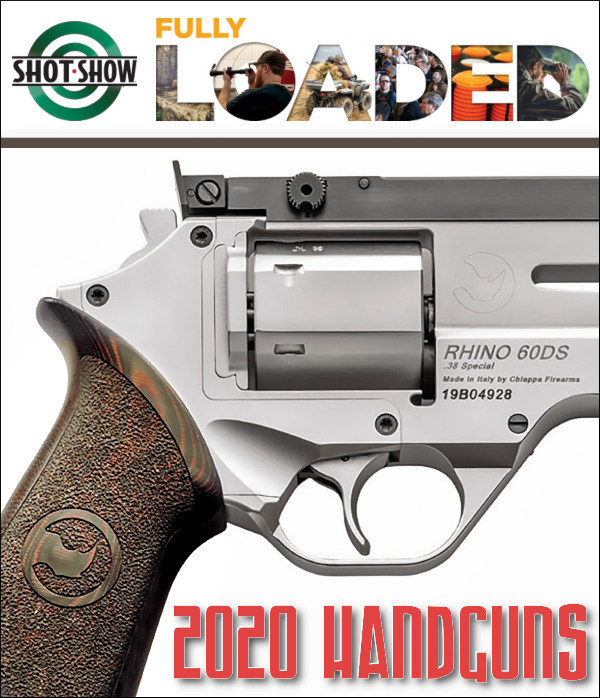
When covering SHOT Show 2020 our reporters will focus primarily on rifles, optics, and reloading equipment, because this website is dedicated to rifle accuracy. However we know many of our readers are interested in semi-auto pistols and revolvers, and we bet the majority of our Forum members own handguns. This Editor has competed in various pistol disciplines and I still love my semi-autos and wheelguns. So, for you fellow pistoleros out there, here’s our “Pick Six” — a half-dozen new handguns (both semi-auto pistols and revolvers) — all new for 2020.
1. Korth (Nighthawk Custom) — Korth Ranger
The new German-made Korth Ranger revolver is one of the most impressive wheelguns you can buy — at any price. Sold in the USA by Nighthawk Custom, Korth revolvers feature best-in-the-world workmanship, superb triggers, and outstanding accuracy. Designed for revolver match shooting, the Korth Ranger features a top Picatinny rail for Red Dot optics. The barrel shroud has lightening cuts which reveal a Lothar Walther match barrel with target crown.
2. Ruger 57 — New Competition Pistol for 5.7×28 Cartridge
The all-new Ruger 57 is an impressive full-size pistol with 4.94″ barrel. This looks like it will be a hoot to shoot. The 5.7×28 cartridge is a high-velocity, low recoil round — sort of a 22 WMR on steroids. Expect to get close to 1700 fps from a 40gr cartridge. We expect this long-slide pistol will be used mostly for gun games, but with a 20-round magazine, it certainly can handle self-defense duties too. According to a recent VIDEO REVIEW by 22Plinkster, the new Ruger 57 performs well. READ Ruger 57 Field Test.
3. Colt Python for 2020 — Stainless with 4.25″ or 6″ Barrels
The 4.25″ barrel Python is 9.75″ long and 42 ounces. The 6″ model is 11.5″ long and 46 ounces.
The Snake is back baby! For 2020, Colt’s Manufacturing Co. LLC will offer a refined and upgraded Colt Python with a hefty $1499.00 MSRP. The legendary double-action revolver, which originally debuted in 1955, returns in stainless steel in 4.25″ and 6″ barrel lengths. It is designed to be stronger than before. Numerous improvements were made to reinforce the revolver, including the use of stronger stainless steel alloys and a re-designed rear sight which allows for a 30% increase in the cross-sectional area of the top strap — meaning more steel for a stronger revolver.
4. Keltec P17 — New Compact, Budget-Priced .22 LR Pistol
Keltec’s new P17 rimfire pistol is lightweight, easy to handle, and features a fiber optic front sight and an adjustable rear. Priced at just $199.95 MSRP, the .22 LR P17 has 16+1 round capacity and ships with three, 16-round magazines. This is a small pistol — it weight just 14 ounces and OAL is 6.65″. Keltec states: “The new, affordable P17 pistol makes range days a lot less expensive and far more fun.” With low cost .22 LR ammo and a 16+1 capacity, this should be fun to shoot.
5. Ruger Super GP100 Revolver in 9mm Luger (9x19mm)
The 9×19mm Parabellum (aka 9mm Luger) cartridge was introduced in 1902 by German weapons manufacturer Deutsche Waffen und Munitionsfabriken (DWM) for the Luger semi-auto pistol. Now 118 years later, Ruger is bringing us a sturdy, 6″-barrel revolver for this popular cartridge. Ruger adapted its existing Super Redhawk frame for this Super GP100 9mm revolver, which features a rather short 8-round PVD-coated cylinder to better fit the 9x19mm round. According to Guns.com the 9mm GP100 “uses a cylinder and extractor cut for moon clips to speed up reloading [and] sports a 6-inch half-lug sleeved and shrouded barrel with an 11-degree target crown[.]”
6. Wilson Combat — Experior Series 1911 Pistols
Wilson Combat’s new Experior handguns feature match-grade components, sweet triggers, and accuracy guarantees. Wilson states that “The Experior lineup [is] the most fully-loaded package we offer, showcasing nearly every tactical, functional and cosmetic option as a standard feature. They are a unique blend of classic 1911 design, paired with modern-day reliability and ergonomic enhancements[.]” Experiors will be offered in both 9mm and .45 ACP in a variety of barrel lengths. There will be both single-stack and double-stack Experior models.
MORE HANDGUNS HERE: You’ll find 18 other new-for-2020 pistols featured on the Guns Holsters & Gear (GHG), Shot Show 2020 Preview Page
BONUS — Upgraded for 2020
Smith & Wesson M&P M2.0 C.O.R.E. Pro Series Pistols
Smith & Wesson M&P 2.0 pistols were introduced back in 2017, so they aren’t new. But for 2020, S&W is offering Performance Center variants with cool new features. The New M&P M2.0 Performance Center pistols include porting and Competition Optics Ready (C.O.R.E.) slides. Chambered in 9mm and .40 S&W, the new Performance Center M&P M2.0 pistols are available with either a 4.25″ or 5″ barrel. Features may include ported barrels and slides and fiber optic sights. For those looking to mount an optic without custom work, the new C.O.R.E. pistols have slides cut for optics straight from the factory. These will support the majority of popular pistol reflex sights.
“A well regulated Militia, being necessary to the security of a Free State, the right of the people to keep and bear Arms, shall not be infringed.”
If you’re reading this, you’re probably a firearm owner (most of our Daily Bulletin readers are). But how much do you really know about the history of the Second Amendment to the U.S. Constitution? The Second Amendment itself contains only 27 words (printed above), but those words have a rich history behind them.
To illuminate the origins of the Second Amendment, and to explain how its interpretations have evolved over the years, Arizona Attorney, the journal for the State Bar of Arizona, has published a detailed two-part “Illustrated History” of the Second Amendment by attorney Robert J. McWhirter, an expert on the Bill of Rights. To read the two-part series, CLICK Here for PART ONE, and CLICK Here for PART TWO.
We think all gun owners should read McWhirter’s article, which is both entertaining and insightful. Don’t worry — this is not a dull “law school” treatise. McWhirter’s article features dozens of illustrated footnotes (some fascinating, some merely amusing). Here are some sample footnotes — you can see this is a treasure trove of Second Amendment trivia.
*The American Bar Association has published Mr. McWhirter’s book Bills, Quills, and Stills: An Annotated, Illustrated and Illuminated History of the Bill of Rights.
Creedmoor Sports has released a series of helpful “how-to” videos in its new InfoZone web page. In the latest InfoZone video Bill Gravatt shows how to seat bullets using L.E. Wilson Hand Dies and an Arbor Press. The basic process is simple, particularly with a micrometer-top seating die. That makes it easy to adjust and set seating depth. Before you start seating bullets, you want to adjust the height of the arbor so the stroke is appropriate to the height of your die.
Bill Gravatt Shows How to Use Hand Seating Dies — Creedmoor INFOZONE
ARBOR PRESS TECHNIQUE: When using an arbor press, smooth is good. You don’t want to slam the handle down quickly. Try to repeat the same motion each time. You can also experiment by seating the bullet part way, then rotate the cartridge (in the die) and do the final seating with a second stroke. If your arbor press has a force gauge, note both the max value of the gauge needle and how it moves as you seat the bullet. If the needle spikes too rapidly, or bounces back and forth irregularly, set that cartridge aside and/or mark it. You could have neck tension issue with that case or some other fault. You might even have a bad bullet. That’s rare, but can happen. The key to success is moving the press arm in a smooth motion every time, maintaining the same down-pressure with each cartridge.
Here Bill Gravatt Offers a Simple Tip for Adjusting Wilson Seating Dies
One of our Forum readers asked “How can I get a custom in-line seater for my new rifle?”. First, we would say that, if you are not shooting an unusual Wildcat, check first to see if L.E. Wilson makes a stainless Micrometer Seater Die for your rifle. These dies are a joy to use, and we’ve found the fit to be exceptionally good with many calibers. Typically priced from $90-$100, Wilson stainless micrometer-top seaters are available for dozens of cartridge types: .204 Ruger, 20 BR, .222 Rem, .223 Rem, 22 PPC, 22 BR, .22-250, .223 WSSM, 6 PPC, 6mmBR, 6XC, 243 Win, .243 WSSM, 25 WSSM, 6.5×47 Lapua, 6.5 Creedmoor, 6.5-284, 26 Nosler, .270 WSM, 7mm-08, .284 Win, 28 Nosler, 7mm RUM, 30 BR, 30 IHMSA, .308 Win, .300 WinMag, .338 Edge (and MORE).
If you do want a custom seater die, the process is relatively simple. Purchase a die blank from Wilson and have your gunsmith run the chambering reamer in. Forum member Gunamonth explains: “I start with a Wilson seating die blank. They’re available from Sinclair and other vendors. Just run the reamer in. For some of my rifles, where I wanted the stainless die with the micrometer adjustment, I bought a smaller die and had the smith ream it with the chamber reamer. That’s how I had my 6 Dasher and 6mm AI seaters made. With the Dasher I stared with a 6mmBR Micrometer die.”
SEATER STEM TIP: If, on your seated bullets, you are seeing a sharp line around the jacket near the ogive, you may want to smooth out the leading edge of the Wilson seater stem (see above left). Do this by putting a little lapping compound on one bullet and manually spin this around in the stem. Without much effort you’ll have a smooth bullet/stem interface.
Micrometer Top Add-on
We really like micrometer tops on a seating die. But what if Wilson doesn’t make a micrometer top seater for your chambering? Don’t despair, Sinclair Int’l sells a $39.99 micrometer top that can be added to Wilson standard seaters or to a custom seater die made from a Wilson die blank.
22Plinkster Tours CCI/Speer Idaho Factory
Trickshot artist and YouTube host 22Plinkster recently got a chance to tour the CCI/Speer production facility in Lewiston, Idaho. This large plant produces both rimfire and centerfire ammunition. While touring the plant, 22Plinkster was allowed to capture video showing the creation of .22 LR rounds from start to finish. This is a fascinating video, well worth watching.
This revealing video shows all phases of .22 LR ammo production including cupping, drawing, annealing, washing, drying, head-stamping, priming, powder charging, bullet seating, crimping, waxing, inspection, and final packaging. If you’ve got ten minutes to spare, we really recommend you watch the video from start to finish. You’ll definitely learn some new things about rimfire ammo.
Field & Stream Tours Federal Ammo Plant in Minnesota
Note to Viewers — After Starting Video, Click Speaker Icon to HEAR audio!
Last year a Field & Stream writer toured the Federal ammunition production facility in Anoka, Minnesota. This large plant produces both rimfire and centerfire ammunition. While touring the plant, the reporter was allowed to capture video showing the creation of .22 LR rounds from start to finish. This is a fascinating video, well worth watching. Click speaker icon for sound.
The Manufacturing Process for .22 LR Rimfire Ammunition Shooting Sports USA explains: “Rimfire cartridge cases are the oldest self-contained cartridge in existence, having been in continuous production since the mid-1850s. Rimfire cases are drawn from a thin piece of brass and formed with a hollow rim. A priming compound is then forced into the case using centrifugal force, where it is charged with powder and a bullet is seated in the mouth of the case. The case is then crimped around the bullet to ensure sufficient push and pull when the round is fired. When the firing pin strikes the thin brass rim of the case, the hollow rim is crushed and the primer is ignited.” Source: SSUSA.org 9/2/2017.
Buried in CCI Rimfire Ammo
22Plinkster was literally up to his neck in ammo while touring the CCI/Speer Idaho ammo plant. He says: “This was truly a dream come true for me. I can’t thank the people at CCI and Speer enough for allowing me to do this. I couldn’t possibly show everything that went on at the factory. However, hopefully I showed you enough for you to grasp the concept of how rimfire [ammo] is made.”
History — Speer Brothers Brought Ammo Production to Lewiston
Here is an interesting historical footnote. Today’s large CCI/Speer operation in Idaho can be traced back to the companies founded by the Speer brothers. After settling in Lewiston in 1944, Vernon Speer started Speer Bullets. A few years later, in 1951, Vernon’s brother Dick (with partner Arvid Nelson) started Cascade Cartridges Inc., a producer of small-arms ammunition and primers. Yes, as you may suspect, Cascade Cartridges Inc. is now CCI, a Vista Outdoor company, and one of the largest manufacturers of primers and loaded ammunition. Today, the CCI/Speer Lewiston plant produces both Speer bullets and CCI-branded ammunition and primers. Vista Outdoor’s predecessor, ATK, acquired the plant in 2001. Vernon Speer died in 1979, and Dick Speer died in 1994.
In the world of F-Class, PRS and other precision rifle disciplines, scope manufactures such as Nightforce, Kahles, and Vortex currently dominate the firing lines. However, Oregon-based Leupold has set out to change all that. Long known for premier hunting and military scopes, Leupold has set its sights squarely on the long-range competition market with the Mark 5HD series scopes. With these scopes (available in both MIL and MOA versions), Leupold now has a clear, repeatable, versatile scope in a wide range of magnifications, all the way up to 7-35X. We tested the Leupold Mark 5HD 7-35x56mm MOA second focal plane (SFP) optic. Though it features a very large 35mm (yes thirty-FIVE mm) main tube, it is one of the lightest scopes in its class — a bonus for guys struggling to make weight with their comp rifles.
Leupold Mark 5HD 7-35x56mm Field Test Report by F-Class John
The Mark 5HD is a beast of a scope packed into a great-looking and sturdy form factor. While mounting and bore-sighting the scope, I immediately like the size, shape and feel of the elevation and windage knobs. The knobs have a solid, positive feel with distinct, lovely clicks every time they were turned. I was happy to see that Leupold designed the elevation to actually go under zero which can be helpful in some situations.
Scope Box Test in Tunnel
I ran a box test while shooting in a 100-yard tunnel going clockwise then counterclockwise around the corners. I found that the repeatability to be “spot on” with each 5 MOA adjustment landing me basically back on top of the previous shots. After five passes back and forth I was left with four ragged holes in each corner. That’s impressive.
The power ring became one of my favorite features, with its incredibly functional throw lever. Actually more of a throw knob, this allows for quick and smooth change of power. Combine these features with 100 MOA of vertical adjustment and 50 MOA of windage and you have just about everything need to achieve your goals.
Reticle Options for Mark 5HD 7-35x56mm — TMOA Plus on Test Scope
Leupold currently offers two reticle options for its second focal plane (SFP) Mark 5HD 7-35X scope: the TMOA Plus (above) and the Impact-60 (right). The Impact-60 reticle features Xmas Tree-type vertical and horizontal hold-offs. My test scope had the TMOA Plus reticle, a much simpler design with an open aiming point in the center of the reticle for precise shot placement.
The TMOA Plus takes a little getting used to especially if you’re coming from a center dot or crosshair like I did. This is because there’s nothing dead center in your reticle, only four small hold squares at 3, 6, 9, 12 o’clock around center. You can use the aiming center to center up on a bullseye or any of the points around the center as hold off points. A side benefit is that the center set of squares are designed to perfectly fill the X ring at 1000 yards for easy aiming. I will say that once you get used to the reticle configuration it starts to become more intuitive and you can find different ways to use it when holding off for different conditions.
Leupold Mark 5HD Delivers Outstanding Brightness and Clarity
As I got behind the scope, I was surprised by the amount of light coming in through the large 35mm main tube. I tested the scope in the early morning just after dawn, during mid-day, and also at night. Where I shoot there is often a good amount of head-on light coming over the hills in the morning. With my current premium scope, I often see a faint glare (often seen as a haze or whiteness) that will ultimately resolve itself by mid-day but nonetheless bothers me in those early relays. The Mark 5 had NONE of this. The first time I thought it was a fluke but after countless mornings without the annoying haze I was convinced it was the glass. Leupold told me that the Mark 5HD’s superior haze- and glare-free morning performance was a function of how the lens coatings are applied.
While many top-end scopes have quality coatings, the method of applying coatings can produce micro flaws. Leupold explained that such flaws, under certain light conditions, can create a hazy view through the lens. Leupold has clearly mastered this process, achieving a visually clear scope no matter what direction the light comes from, even head-on.
HD Glass Eliminates Chromatic Aberration
Optical performance during mid-day was bright and clear. Importantly, I did notice the absence of chromatic aberration which I have experienced with some other popular-brand scopes. Chromatic aberration usually manifests as fringes of color around hard edges and can be seen even in some of the better scopes. This can affect your ability to see mirage, or to see details on a long-range target. With the Leupold Mark 5HD, chromatic aberration was noticeably absent.
The Leupold Mark 5HD also worked great during an evening shooting session. My club has night shooting for our 600-yard matches. We do it every Tuesday night, so I had lots of time to test the scope in the evening. Our club has lit targets, and even with the rest of the range dark, the targets were clear and bright, making it easy to aim precisely.
SUMMARY — Great Sharp, Clear Scope — More Magnification Would be Welcome
The majority of my testing was in F-Class and while I found nearly every aspect of the scope enjoyable, I did find myself wanting just a little more magnification. I have no doubt that in other disciplines such as PRS and ELR the 7-35X is more than enough and in fact perfectly suited. However, in the current F-Class world, 35X max magnification is on the low end, as other leading optics-makers offer scopes in the 50-60x range.
Overall, I really enjoyed this scope and think it’s going to become the favorite for a lot of shooters. It is easy to use and incredibly clear. Despite its beefy look it actually weighs less than many scopes in this category. Leupold says the Mark 5HD is “up to 20 ounces lighter than other scopes in its class”. That’s great for disciplines with tight weight limits. If you’re in the market for a new competition optic you should give one of the new Mark 5HD scopes a try.
The U.S. Army Marksmanship Unit (USAMU), in cooperation with Shooting USA TV, has created a series of instructional Pro Tip pages covering a wide range of shooting disciplines. All totaled, there are more than 50 USAMU Pro Tips. Most relate to rifle marksmanship but there are also numerous tips for shotgunners and pistol shooters. Each Pro Tip entry includes multiple photos and 6-15 paragraphs, in an easy-to-follow format. Many Pro Tips also include an instructional video produced by Shooting USA. Here are three Pro Tip videos, and links to seven more Pro Tip web pages.
USAMU TOP TEN PRO TIPS
1. Reading the Wind with SGT Sherri Gallagher.
Apart from gravity, wind has the most pull on the bullet as it travels down range. Being able to accurately read the wind and mirage will greatly enhance your performance on the rifle range. National Champion, SGT Gallagher gives you some of her tips.
2. Angle Shooting with SFC (Ret.) Emil Praslick.
SFC Praslick shows you how to determine the angle to your target, and then how to include that to change your data necessary to hit your target on the first shot.
3. Rifle Grip, Stance and Body Position for 3-Gun with SFC Daniel Horner.
Professional 3-gun marksman SFC Daniel Horner, U.S. Army Marksmanship Unit (USAMU), give tips on how to properly handle a semi-automatic rifle, including grip, stance and body position.
Happy New Year to all our readers worldwide, and especially the 48,120+ members of our AccurateShooter Forum. We hope 2020 brings you happiness in your lives and success in your endeavors. And we wish for small groups, good scores, and successful hunts in the New Year.
Forum Members — Upgrade Your Membership to Get Unlimited Classifieds for 12 Months.
Looking Forward to 2020 Every year we work to improve AccurateShooter.com. In 2016 we completely overhauled the Forum, making it faster and more mobile-friendly. In 2017 we upgraded our servers. In 2018 we started vetting every new sign-up to prevent scammers. In 2019 we added more security measures, expanded our popular Deals of the Week, and commenced our first-ever exclusive Promos for Gold and Silver members. We hope you’ll continue to enjoy our feature articles, our Daily Bulletin, our match reports, and our Forum Classifieds. The formula seems to be working — our audience is bigger than ever.
Forum Membership Increased 11.5% in 2019
Our Shooters’ Forum grew significantly in 2019. Our membership grew by 11.5% as Forum ranks swelled to 48,120+ members! More people are successfully buying and selling in our Forum Classifieds section than ever before. Silver and Gold members get unlimited Classifieds for 12 months. Gold members also get custom Avatars and other privileges.
We need your support. For 16 years the site has relied largely on volunteer efforts. But as the site grows, we need the assistance of Forum moderators, product testers, web gurus, and computer software experts. Those guys don’t work for glory alone.
Consider this — you’ll pay $25 for a couple movie tickets and a large popcorn these days. For the same twenty-five dollars you can become a Silver Forum member for a YEAR and help this site provide info, tests, tech tips, bargains, and shooting news.
And consider the benefits — Silver or Gold Members get unlimited classifieds for 12 months. If you were to sell just ONE $1500 rifle through Gunbroker.com, you would pay $58.75 in fees! That’s more than our Gold Membership — just to sell one single rifle.
In the last quarter of 2019 about 470 site users have donated or upgraded their Forum membership to Silver or Gold Levels. That’s less than 1% of the membership. We thank all those who have generously contributed. But that still leaves tens of thousands of users who access the site every week without contributing. With more donations we can deliver more premium content and offer more services to our members.
How to Contribute
If you are a Forum member, you can help the site by UPGRADING your membership. CLICK HERE to UPGRADE.
If you’re not a member, making a donation to the site is simple and easy. Just click on the orange “Donate” button at right. If you have a credit card, you don’t need a Paypal account to contribute.
IMPORTANT: After you click on the orange button a PayPal screen will load. You’ll also see a field that says “0.00”. For desktop users that field will be on the right (with other pre-set amount buttons on the left). Fill in the amount you want to give. For example, to give $25, type 25.00 in the amount field.
Help Support this Site by Making a Secure Donation.
If You Don’t Like PayPal, You Can Send a Check.
Make the check payable to: Jeff Williams. Please list your Shooters’ Forum Log-In Name (if any), and mail the check to:
Jeff Williams
P.O. Box 240
Solon Springs, WI 54873
Winter testing image from Alex Wheeler and TM — That’s dedication!
There’s a nice article in the Western Powders Blog that any varminter will enjoy. In this hare-raising tale, gunwriter Jim Waddell explains how he used a self-loading Savage A17 rifle to take care of a serious jack-rabbit problem on a rancho in California. “[My friends] purchased a huge amount of acreage that had some existing alfalfa fields and [surrounding sagebrush]. Sagebrush is home to jack rabbits. Lots of jack rabbits. The previous owner of this property didn’t do any varmint or predator control[.] The ink wasn’t dry on the escrow papers before [my friends] started asking for help shooting rabbits. A problem in taking these critters is it has to be done at night when they come out to feed as they lay low in the bush during the daylight hours.”
Savage A17 Comes to the Rescue
Initially Waddell and some friends took on the jack-rabbit hordes using Ruger 10/22s and a .44 Magnum Marlin lever gun. Neither option was ideal. The .44 Magnum just couldn’t keep up the desired shooting pace (it took too long to reload) ant the .22 LRs were too anemic. So Waddell decided to give the more potent 17 HMR a try. He acquired a Savage A17 and went back for a second bunny-busting session. He came away convinced that the 17 HMR cartridge in the modern semi-auto Savage works great for small varmint control.
Waddell writes: “I wanted more than a .22 after seeing the problems my pals had with their [10/22] bullets not anchoring the rabbits. Armed with my new Savage A17 it was time to head back to the alfalfa fields. This time my hunting partner was Dan, my son-in-law from Seattle. We hunted for four nights. Each night was either raining, windy or both. My question about whether or not rabbits would be out in the weather was answered immediately. They were everywhere. As miserable as the weather was, we got all the shooting we wanted and that Savage rifle was up to the task. We got so many rabbits it was impossible to count.” CLICK HERE for the full account of Waddell’s jack-rabbit adventures on the California rancho. It’s worth a read. Here is a sample:
Wabbits, Wabbits Everywhere — Even Running Right at You
I couldn’t believe my eyes when I saw a sea of rabbits as far as the lights would shine and when the light beams hit the bunnies, they became confused and as often as not, would run right at the lights so a good percentage of our shots were literally in spitting distance. It was also a new experience shooting at targets that are running TOWARD you. Most of us who’ve done much hunting for game or varmints have experienced moving targets but how many of those targets are coming at you?
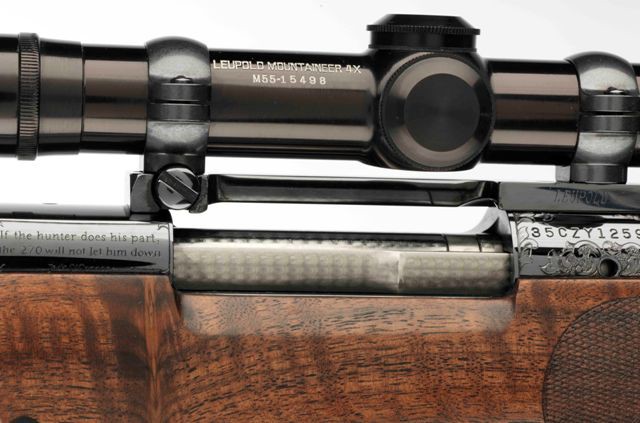
“If the hunter does his part, the .270 will not let him down” — Jack O’Connor.
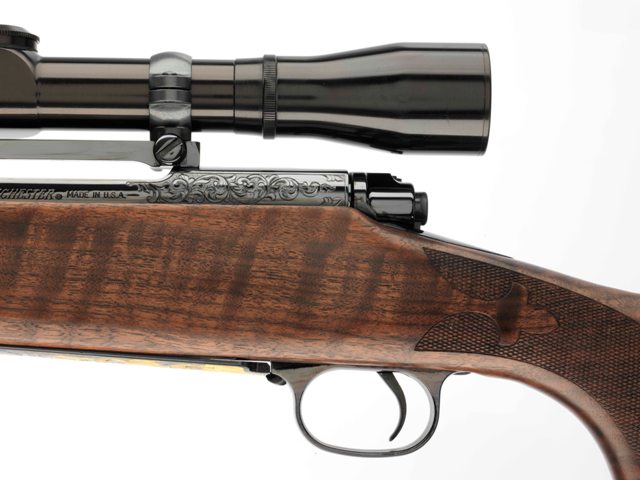
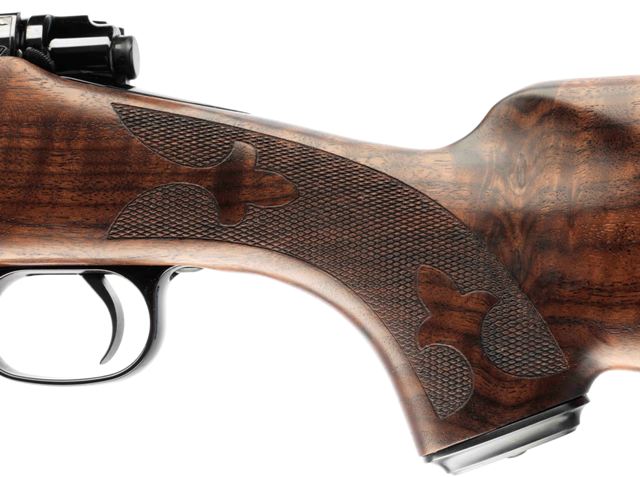
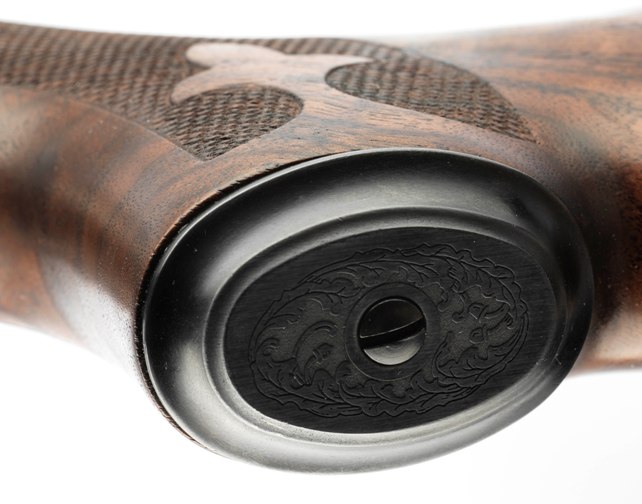
Classic hunting rifles never go out of style. We thought our readers would enjoy this very special high-grade Jack O’Connor Tribute rifle in .270 Winchester. This unique Model 70 was a SHOT Show featured rifle back in 2013. It was auctioned off with the proceeds benefiting hunting and shooting sports. Jack O’Connor, a legendary outdoorsman and hunting writer, would have been proud. In his 1964 classic work The Rifle Book, O’Connor wrote: “I like a handgun. I hold a shotgun in high regard; but rifles — well, I love the darn things…”
Winchester Repeating Arms declared that this 2013 SHOT Show Winchester Model 70 would be the last-ever Jack O’Connor Tribute rifle. The stock for this rifle is AAA grade Claro Walnut with Ebony forearm tip and shadowline cheekpiece. The rifle’s metalwork has been hand-engraved by the artisans at Baron Engraving. The rifle features a featherweight contour, free-floating barrel with target crown. Interestingly, the Leupold 4X Mountaineer riflescope mounted on this rifle is an original 1950s-era Mountaineer from the vaults of Leupold & Stevens.
Click each image to see larger version with detail.
“A good sporting stock should enable the shooter to get a shot off quickly and accurately, and it should also be a thing of beauty. Many fine sporting stocks are handsome but of little aid in accurate shooting. Many others that hold and shoot well are homely and clumsy.
The very best sporter stock design results in a stock with handsome, graceful lines and one which also enables the man behind it to do his best work.” — Jack O’Connor, The Big Game Rifle (1952).
About Jack 0’Connor “Dean of Outdoor Writers”
Jack O’Connor, sheep hunting, and the Model 70 Winchester in .270 are linked in our collective subconscious. In 1939, O’Connor was appointed new guns editor for Outdoor Life, and in 1941, he took over the Arms and Ammunition column. In those days, Coues deer and desert sheep were his passions, and a lot of rifles came and went through his hands. By the end of 1946, O’Connor had hunted enough North American sheep to complete three grand slams.
By 1954, he thought he had his ultimate rifle, a custom Model 70 in .270 Winchester that he had taken to Wyoming for elk, to India for blackbuck, and to Iran for red sheep and ibex. He liked the rifle so much, he called it his No. 1 and set out to build a second to give his favorite a break from testing new bullets and developing loads.
Sporting Classics offers a collection of great Jack O’Connor stories from the pages of Outdoor Life, Field & Stream, Petersen’s Hunting and other popular magazines of his day. This 440-page book, entitled Classic O’Connor: 45 Worldwide Hunting Stories, is a sequel of sorts to Sporting Classics’ popular compendium, The Lost Classics of Jack O’Connor.
In this collection, Jack O’Connor recounts his worldwide hunting adventures, during which he pursued everything from ducks to grizzlies, pheasants to kudu. Classic O’Connor presents several of the author’s greatest gun stories and a large selection of never-before-published photographs of the celebrated sportsman and his family on hunting adventures around the world. The book is illustrated with 40+ drawings by acclaimed artist Ron Van Gilder. This excellent O’Connor collection is available on Amazon in hardcover or paperback, starting at $38.99 (used) or $59.98 (new).
The Hunting Rifle by Jack O’Connor
Another O’Connor title worth reading is The Hunting Rifle, still considered one of the definitive works on selecting a hunting rifle and cartridge. One owner of The Hunting Rifle explains:
“It would benefit every hunter to take the time and read this book. It offers a corrective to the spirit of things that have gripped the hunting scene lately. Today, if one reads a hunting magazine, [one is] offered the view that you need the fastest and loudest cartridges, rifles with special finishes and the most expensive of anything. Ole Jack reminds us that many have killed game with ‘lesser’ guns for a very long time, and that these new gimmicks will not make you a more lethal hunter.”
In our Shooters’ Forum, one member recently asked: “What makes an AR accurate? What parts on an AR can really affect accuracy — such as free-floating handguards, barrels, bolts, bolt carriers?” He wanted an honest, well-informed answer, not just sales pitches. Robert Whitley posted a very comprehensive answer to this question, based on his experience building and testing dozens of AR-platform rifles. Robert runs AR-X Enterprises, which produces match-grade uppers for High Power competitors, tactical shooters, and varminters.
Building an Accurate AR — What is Most Important
by Robert Whitley
There are a lot of things that can be done to an AR to enhance consistent accuracy, and I use the words “consistent accuracy” because consistency is a part of it (i.e. plenty of guns will give a couple great 5-shot groups, but won’t do a very good 10- or 20-shot groups, and some guns will shoot great one day and not so good on others).
Here are 14 key things we think are important to accuracy.
1. Great Barrel: You’ll want a premium match-grade barrel, well-machined with a good crown and a match-type chambering, true to the bore and well cut. The extension threads must also be cut true to the bore, with everything true and in proper alignment.
2. Rigid Upper: A rigid, heavy-walled upper receiver aids accuracy. The typical AR upper receiver was made for a lightweight carry rifle and they stripped all the metal they could off it to make it light to carry (which is advantageous for the military). The net result are upper receivers that are so thin you can flex them with your bare hands. These flexible uppers are “strong enough” for general use, but they are not ideal for accuracy. Accuracy improves with a more rigid upper receiver.
3. True Receiver Face: We’ve found that truing the receiver face is valuable. Some may argue this point but it is always best to keep everything related to the barrel and the bore in complete alignment with the bore (i.e. barrel extension, bolt, upper receiver, carrier, etc.).
4. Barrel Extension: You should Loctite or glue the barrel extension into the upper receiver. This holds it in place all the way front to back in the upper receiver. Otherwise if there is any play (and there typically is) it just hangs on the face of the upper receiver completely dependent on the face of the upper receiver as the sole source of support for the barrel as opposed to being made more an integral part of the upper receiver by being glued-in.
5. Gas Block: You want a gas block that does not impose pointed stress on the barrel. Clamp-on types that grab all the way around the barrel are excellent. The blocks that are pinned on with tapered pins that wedge against the barrel or the slip on type of block with set screws that push up from underneath (or directly on the barrel) can deform the bore inside of the barrel and can wreck the accuracy of an otherwise great barrel.
6. Free-Float Handguard: A rigid, free-float handguard (and I emphasize the word rigid) really makes a difference. There are many types of free-float handguards and a free-float handguard is, in and of itself, a huge improvement over a non-free-float set up, but best is a rigid set-up. Some of the ones on the market are small diameter, thin and/or flexible and if you are shooting off any type of rest, bipod, front bag, etc., a rigid fore-end is best since ARs want to jump, bounce and twist when you let a shot go, as the carrier starts to begin its cycle before the bullet exits the bore.
7. Barrel Contour: You want some meat on the barrel. Between the upper receiver and the gas block don’t go real thin with a barrel (we like 1″ diameter if it’s workable weight-wise). When you touch off a round and the bullet passes the gas port, the gas system immediately starts pressuring up with a gas impulse that provides vibrations and stress on the barrel, especially between the gas block back to the receiver. A heavier barrel here dampens that. Staying a little heavier with barrel contour through the gas block area and out to the muzzle is good for the same reasons. ARs have a lot going on when you touch off a round and the gas system pressures up and the carrier starts moving (all before the bullet exits the bore) so the more things are made heavier and rigid to counteract that the better — within reason (I’m not advocating a 12-lb barrel).
8. Gas Tube Routing Clearance: You want a gas tube that runs freely through the barrel nut, through the front of the upper receiver, and through the gas key in the carrier. Ensure the gas tube is not impinged by any of them, so that it does not load the carrier in a stressed orientation. You don’t want the gas tube bound up so that when the gas tube pressures up it immediately wants to transmit more force and impulse to the barrel than would normally occur. We sometimes spend a lot of time moving the gas block with gas tube on and off new build uppers and tweaking gas tubes to get proper clearance and alignment. Most gas tubes do need a little “tweaking” to get them right — factory tubes may work OK but they typically do not function optimally without hand-fitting.
9. Gas Port Tuning: You want to avoid over-porting the gas port. Being over-gassed makes the gas system pressure up earlier and more aggressively. This causes more impulse, and increases forces and vibration affecting the top end and the barrel. Tune the gas port to give the amount of pressure needed to function properly and adequately but no more.
10. Front/Back Bolt Play: If accuracy is the game, don’t leave a lot of front/back bolt play (keep it .003″ but no more than .005″). We’ve seen factory rifles run .012″ to .015″ play, which is OK if you need to leave room for dirt and grime in a military application. However, that amount of play is not ideal for a high-accuracy AR build. A lot of front/back bolt play allows rounds to be hammered into the chamber and actually re-formed in a non-consistent way, as they are loaded into the chamber.
11. Component Quality: Use good parts from a reputable source and be wary of “gun show specials”. All parts are NOT the same. Some are good, some are not so good, and some aftermarket parts are simply bad. Don’t be afraid to use mil-spec-type carriers; by and large they are excellent for an accuracy build. Also, remember that just because a carrier says “National Match” or something else on it does not necessarily mean it’s any better. Be wary of chrome-plated parts as the chrome plating can change the parts dimensionally and can also make it hard to do hand-fitting for fit and function.
12. Upper to Lower Fit: A good upper/lower fit is helpful. For quick and dirty fit enhancement, an Accu-Wedge in the rear helps a lot. The ultimate solution is to bed the upper to a specific lower so that the upper and lower, when together, are more like one integral unit. For the upper receivers we produce, we try to get the specs as close as we can, but still fit the various lowers in the market place.
13. Muzzle Attachments: Don’t screw up the muzzle (literally). Leave as much metal on the barrel at the muzzle as you can. People like to thread the muzzle for a flash hider, suppressor, muzzle brake, or some other attachment, but if you really want accuracy, leave as much metal as you can there. And, if you have something that screws on, set it up so that it can be put on and have it stay there without putting a lot of torque and stress on it right where the bullet exits the bore. If you are going to thread the end of the barrel, make it concentric with the bore and make sure what you screw on there is as well. For all muzzle attachments, also ensure that the holes through which the bullet passes through are dead true to the bore. Many aftermarket screw-on things are not so good that way. Anything that vents gas should vent symmetrically (i.e. if it vents left, it should vent equally right, and likewise, if it vents up, it should vent down equally). Uneven venting of gas can wreck accuracy.
14. Quality Ammunition: Ammo is a whole story by itself, but loads that are too hot typically shoot poorly in an AR-15. If you want accuracy out of an AR-15, avoid overly hot loads. Shown below are test groups shot with four (4) different uppers, all with moderate loads. These four uppers all pretty much had the same features and things done to them as explained in this article, and they all shot great.




 “A well regulated Militia, being necessary to the security of a Free State, the right of the people to keep and bear Arms, shall not be infringed.”


 One of our Forum readers asked “How can I get a custom in-line seater for my new rifle?”. First, we would say that, if you are not shooting an unusual Wildcat, check first to see if




 5. Gas Block: You want a gas block that does not impose pointed stress on the barrel. Clamp-on types that grab all the way around the barrel are excellent. The blocks that are pinned on with tapered pins that wedge against the barrel or the slip on type of block with set screws that push up from underneath (or directly on the barrel) can deform the bore inside of the barrel and can wreck the accuracy of an otherwise great barrel.


