It’s summer time. That means many of our readers are on the road (attending major shooting matches or enjoying summer vacations). How do you do your reloading chores while living like a gypsy for a few weeks? Here’s a solution from Forum member Dave Gray (U.S. Army Retired).
Dave is a self-declared “full-time RVer” who spends most of his time on the road. Behind his Ram 3500 pickup, Dave tows a huge 41-foot Heartland Cyclone toy hauler featuring a 12X8 foot garage in the rear. In the rear garage area, which holds a Smart Car, Dave has set up a removable reloading bench complete with RCBS Rockchucker single stage press and Dillon progressive press.
Reloading Bench Mounts to RV Wall with Brackets
Dave explains: “I used a 2″X6″X5′ board for the bench. It’s perfect for my needs, and is easy to disassemble. I made it this small so that I can park my Smart Car in the garage during travel to my destinations. The bench, attached to the wall frames, is very solid. The presses’ centers are 3″ and 6.5″ from the brackets. [There are] four bolts on the wall into aluminum wall frame and 3 bolts in the bench. If I ever have to replace the current board, I’ll do so with oak or birch or hickory. When I’m not reloading, I remove the presses and store them in a protected space. I can easily attach other equipment to the bench by using C-Clamps.” Dave’s “rolling reloading room” looks very well thought-out. We commend Dave for his inventiveness.
Today is National Hunting and Fishing Day. To help the avid hunters among our readers, here are Twenty Tips that can help ensure a safe and successful hunt. These tips have been compiled from our AccurateShooter Hunting Forum, with help from Hunting Editor Colton Reid (who has already been out deer hunting this month). Some items are preparatory — such as working with maps, sighting in the rifle, and improving physical fitness. We also talk about equipment — having the right gear, from proper boots to a GPS for multi-day hunts.
Of course there are entire volumes written on hunting, but these 20 Tips can benefit all hunters. Follow these suggestions and you should have a safer hunting experience with greater likelihood of success. If you liked these pointers, you’ll find two dozen more helpful hints on the NSSF Website.
Preparations Before The Hunt
1. Map Your Hunt and Notify Others — Before your hunt, make a plan and notify friends and family members about WHERE you are going and your intended return date and time. Print out a Google Satellite map and locate landmarks and trailheads. Mark where you plan to park your vehicle and give a copy of this map to friend and/or family members. A hunter may injure himself by falling off a rock, or tumbling in a creek-bed. After that kind of injury the hunter may be confused or unable to walk. If you get stranded in the wilderness, you want trusted persons to know where you are. So, before you leave on a trip, provide a map to a friend or family member. Show them where you will leave your vehicle, and where you expect to be every day of your hunting adventure.
2. Licenses and Permits — Make sure you have a valid hunting licenses and all the necessary tags. Begin this process with ample time before your intended hunt(s). The NSSF adds: “If you are crossing state or national borders, find out about any special considerations you must take care of. Border crossings can mean knowing about firearm transport laws or Chronic Wasting Disease-related regulations.”
3. Work on Your Fitness — On a multi-day hunt you may be trekking many miles. You need to be in good shape. If you are out of shape you may be putting yourself in a precarious situation, particularly if you underestimate the terrain difficulty. As the NSSF says: “Not being able to handle the conditions lessens your chances of success, can turn a great experience into an agonizing one and can endanger your health.”
4. Do Your Homework — Study the area you will be hunting. Talk to other hunters. Look at satellite photos. Get a real sense of the walking and terrain challenges. For a multi-day hunt, MAKE a PLAN. The NSSF states: “Eliminate surprises. Learn as much about where you will be staying, the area you will be hunting, what the weather might be like and what you need to bring[.]”
5. Rifle and Ammo — Make sure your rifle is sighted-in and your ammo is tested. Sight-in your rifle with the ammo you plan to use on your hunt. CLICK HERE for 4-Shot Sight-in Method. After sighting-in from the bench, confirm your zero by shooting from typical hunting positions (kneeling and with forearm supported on a rock or post).
6. Shooting Positions — Practice the shooting positions you will use in the field. Practice sitting, kneeling, and prone positions. You should also practice with shooting sticks, using your day pack as a rest, and with a bipod. Try to have a rock-steady rest before taking your shot.
7. Back-Up Irons — If possible, select a rifle with back-up iron sights. While modern scopes are very durable, they can and do fail (glass can crack). If you’ve invested a lot of time and money in your hunt, back-up iron sights can keep you in the game even if your riflescope fails.
8. Communications and GPS — Bring a GPS if you are in a true wilderness area far from civilization. It’s a good idea to bring a cell phone, but you may not have any coverage if you’re quite a distance from populated areas. A smart-phone also doubles as a digital camera to record your trophies.
9. Select Good Gear — Make sure you have GOOD BOOTS that are comfortable — you’ll spend a lot of time on your feet. You may want a pack with harness for your rifle so you have both hands free. On a multi-day trip, make sure you can carry enough water, and that you will stay warm enough at night. Good practices for backpacking apply to multi-day hunts.
10. Make a Checklist — Create a complete checklist of the gear and supplies you need. That includes arms, ammunition, rangefinder, binoculars, proper clothing (including spare clothes), hunting accessories, sleeping gear (on multi-day hunts), toiletries, medications. Don’t forget a good first aid kit — lots of bad things can happen during any wilderness trip. You can cut a hand, break an ankle or worse.
During The Hunt
11. Have a Plan — know where you plan to go and when. Try to be where you want in the early morning and early evening hours when deer are likely most active.
12. Take Your Time — If you spot a deer and get too excited and don’t take your time you may spook him. Go slow and glass. If possible, wait for the animals to bed down and relax. Then work out the best way to approach your prey. Remember, “You get so few opportunities, don’t screw it up!”
13. Glass More, Walk Less — Let your eyes do the walking — get good binoculars and use them. With their heightened senses of smell and hearing, deer/elk are able to spot you way better than you can spot them. If you are walking around a lot, chances are you are getting spotted by your prey.
14. Riflescopes Are Not Binoculars — Never use a riflescope as a substitute for binoculars. The temptation to do so is real, but when one does this, one is by definition pointing the muzzle of the gun at unknown targets. We like binoculars with built-in rangefinders. When glassing at long range, try supporting your binoculars on your pack.
15. Be Sure of Your Target before Shooting — Every year during whitetail season, farmers everywhere are forced to spray-paint their cattle or risk having them “harvested” by hunters who don’t bother confirming the species in their sights. Hunters with “buck fever” can make mistakes. When in doubt, don’t shoot.
16. Know When to Unload — When finished hunting, unload your firearm before returning to camp. You should also unload your gun before attempting to climb a steep bank or travel across slippery ground.
17. Hearing Protection — While pursuing and stalking your prey you’ll want full sensory use of your ears. But when you’re finally ready to take the shot, slip in hearing protection. A shot from a large-caliber hunting rifle can exceed 170 decibels. Unprotected exposure to noise from a SINGLE 170+ dB shot can cause permanent hearing damage. (Source: ASHA.org). If you make a follow-up shot, you double that noise hazard. Therefore a hunter with a non-suppressed rifle should have hearing protection available.
You can keep a pair of quick-insert plugs on a cord around your neck. Or, get the Howard Leight Quiet Band QB2HYG. This is a plastic ring with earbuds, you can keep around your neck.
“Once a hunter is successful, the REAL work begins.” — Colton Reid
18. Harvesting the Animal — When dressing your animal, be careful with the meat. You’ll want very sharp knives. Some hunters prefer knives with replaceable, razor-sharp blades. Don’t rush the task. Make sure you don’t get moisture or dirt on meat. The three spoilers of meat are heat, moisture, and dirt.
19. Pace Yourself When Packing Out — If you DO succeed, and bring down a big buck, will you be able to dress the animal and carry out the meat? Always be prepared to hike out with extra weight. If you are successful, make sure not to waste the meat you worked so hard for. Choose a pack that can help you carry a heavy load. Remember, this is not an insignificant challenge — you may be carrying 60 to 100 extra pounds in addition to your other gear. Again, take your time. Rest as needed. Don’t hurt yourself.
20. Remember to Enjoy the Experience — Our Hunting Editor, Colton Reid, offers this sage advice to all hunters, but particularly to novices: “Have fun, and appreciate your hunt, whether you bag a buck or not. It is a privilege to experience the wilderness and to get away from the city. Enjoy it while you’re out there. And keep your spirits up. You may get tired, but remember that ‘comes with the territory’. At the end of the day, yes you may be exhausted. And you may want to quit and go home. But stay positive, stay focused. Be patient, the experience is worth it.”
CLICK HERE for Hunter Training/Mentoring Programs State-by-State.
Prepare For Your Hunt — Get Fit and Practice Positions
As part of the NRA’s Tips & Tactics video series, Kristy Titus explains how to prepare for a hunt. Titus, co-host of the Team Elk TV show has hunted around the globe. She grew up in the outdoors, running pack mules in Oregon with her father. In this video, Kristy discusses fitness training and demonstrates field positions that can be employed during a hunt.
Kristy explains: “Hunting can lead you into some steep, rough country. It’s really important that you train both your body and your mind to handle the elements and the rigors of hunting So, if you plan on going on a mountain hunt, get out and train your body. Train with your firearm. Get off the bench and have some fun with this. Do some positional shooting or, if you want to add a stress dynamic… have someone put you under a time parameter.”
Visit WhereToHunt.org
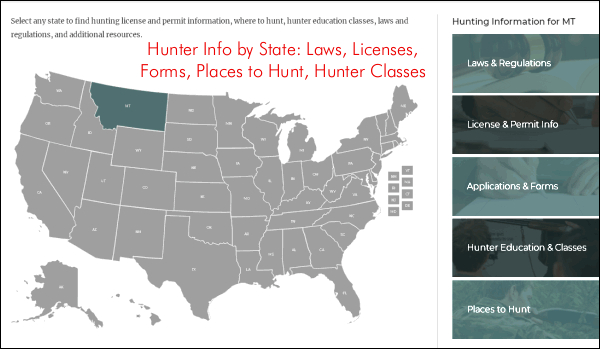
There’s a great online resource for hunters that will help you find game locations in your state and ensure you have all the proper permits and game tags. WheretoHunt.org features an interactive map of the country. For all 50 states, the NSSF has compiled information about hunting license and permits, where to hunt, hunter education classes, laws and regulations and more. For each state you’ll also find a link for required applications and license forms.
Today, September 28, 2019, is National Hunting & Fishing Day. The annual celebration takes place on the the 4th Saturday of September every year. National, regional, state and local organizations will run thousands of “open house” hunting- and fishing-related events around the country. Events will include Fishing Derbys, Hunting Expos, Wing-shooting tournaments, and much more.
Hunting Safety Checklist
A good hunt begins with preparation. And during the hunt, safety is a key priority. To help hunters, the National Shooting Sports Foundation (NSSF) has created a Safety Checklist for hunters. This Hunting Safety Checklist, produced as part of the NSSF’s “Hunt S.A.F.E.” campaign, helps hunters follow good, safe practices in the field and at home.
Honored American Veterans Afield (HAVA) is a volunteer organization that provides hunting and shooting experiences for American military veterans and injured active military personnel. HAVA has sponsored events in Texas, Georgia, South Dakota, Montana, North Carolina, California, Washington, Florida, and other states. HAVA was conceived and organized in 2007 by shooting sports industry executives to help the healing and re-integration of disabled veterans and injured active military back into normal American life through participation in outdoor events.
One of the most recent HAVA events was the 7th Annual HAVA/Rockcastle Family Day at the Park City, KY shooting complex on Saturday, September 14, 2019. Over 300 disabled veterans, family members, and volunteers assembled to share a day of shooting, winning prizes, eating good food, and enjoying fellowship with other military veterans who have bravely protected the American dream.
Every year, HAVA conducts a series of hunting and shooting events for groups of disabled veterans and injured active military. Many of these events include instruction by world-class shooting experts, such as Jerry Miculek. The next major HAVA event will be the 12th Annual National Family Day, to be held in San Antonio, Texas on October 19, 2019. EVENT INFO HERE. Admission is FREE, and all disabled veteran participants will receive a backpack full of gifts.
HAVA organizes hunting adventures throughout the United States
HAVA states: “These veterans have given their full measure of commitment to the preservation of their country’s values, and deserve America’s contribution to their healing process to whatever degree necessary to accomplish physical, mental and cultural rehabilitation.”
HAVA, through its Sustaining Sponsors, contributors, and volunteers, provides services to veterans in recognition of their sacrifice and service to a grateful nation. If you would like to support HAVA’s programs, you can make a tax-deductible donation through www.HonoredVeterans.org.
About HAVA — Honored American Veterans Afield
HAVA is a 501(c)3 organization formed by companies in the shooting and outdoor industry with the purpose of raising awareness and assisting disabled veterans with their healing process through guided hunts, shooting events, and other outdoor sports activities. Sustaining sponsor companies are: Smith & Wesson, National Shooting Sports Foundation (NSSF), SIG SAUER, Academi, Arnold Defense, Crimson Trace, E3 Training, FMG Publications, GLOCK, Hornady, Leapers/UTG, Leupold & Stevens, Mossberg, National Association of Sporting Goods Wholesalers (NASGW), Operation Hat Trick, Ruger, Savage, Surefire, Taurus, Vista Outdoor/Federal, XS Sights, and Yamaha Outdoors among numerous contributing companies. To learn more about HAVA, go to: www.HonoredVeterans.org.
The National Rifle League (NRL) started off sponsoring major centerfire tactical matches, similar to PRS competitions. That proved successful and the NRL added a .22 LR Rimfire series, called NRL22. The NRL22 rimfire discipline has been a success, as rimfire guns are fun to shoot and ammo is very affordable. The most popular NRL22 matches have drawn up to 150 rimfire competitors. Get more info at NRL22.org.
NRL22 is a great way to get into competition shooting with minimal expense. There are Five (5) classes: Open, Base, Ladies, Young Guns (8-16), and Air Rifle. Base Class is for the budget-minded shooter — the combined MSRP of Rifle and Optic may not exceed $1050.00 (so you could spend $550 on a rifle and $500 on a scope for example). That keeps the sport affordable. Open, Youth, and Ladies Classes have no price limits on Rifle and Optic. Visit NRL22.org to find an NRL22 match near you.
The two videos above from Long Range Shooters of Utah feature footage from the January 2019 course of fire from the NRL22 Rimfire Competition Series. Note the snow-capped hills in the lower video. Useful commentary explains how competitors establish their shooting positions.
NRL22 Publishes Monthly Courses of Fire
This video from a Utah NRL22 Match features shooters from each of the four rimfire classes. With the NRL22 program, scores from from local matches like this are ranked against scores from other matches nationwide. In advance of match dates, NRL22.org publishes 5 courses of fire to be used in that month. Each course of fire will always include 2 prone stages, 1 positional, 1 barricade, and a fifth that can be any of those. Details of the course of fire, including target distances, target sizes, time limits, and barricade profiles, are listed at NRL22.org.
Official NRL22 Rimfire Steel Target Package
This video reviews the official NRL22 Rimfire Steel Target Kit. Crafted by JC Steel Targets from AR500 steel, this kit from JC Steel Targets includes 8 hanging targets, 4 KYL (Know Your Limits) targets, plus all needed Hangers. That’s lot of steel and hardware for $329.99.
About NRL22 Tactical/Practical Competition The goal of NRL 22 is to make Precision Rifle competitions more available to every community. However, nearly all localities have access to 100-yard ranges and most shooters own a .22 LR rifle. The NRL22 program is designed so any facility with a 100-yard range can host matches. Participants at local NRL22 events can then attend a National Championship. NRL22 started with four classifications: Open, Base, Ladies, and Young Guns (8-18 age). Air Rifle is the new fifth class. For the 2018/2019 Competition Season, over 700 shooters attended NRL22 matches. In the 2019/2020 Competition Season, the NRL22 expects significant growth and is excited to welcome new members and clubs.
Airport photo by Politikaner under Creative Commons License.
With hundreds of readers traveling home this week from the 2019 F-Class Nationals in Raton, NM, and many others planning hunting trips out of state, we thought we’d repeat an article providing important information about air travel with firearms. If you will be flying with firearms this fall, you should read this article. You need to familiarize yourself with current Federal Regulations on gun transport before you get anywhere near an airport. Thankfully, the Transportation Security Administration (TSA) has a web page that states the important requirements for airline passengers traveling with firearms* and/or ammunition.
You’ll want to visit the TSA Firearms and Ammunition webpage, and read it carefully. In addition, before your trip, check the regulations of the airline(s) with which you will fly. Some airlines have special requirements, such as weight restrictions.
Here are the TSA’s key guidelines for travel with firearms:
More Airline Travel Tips from Tom McHale
Tom McHale has written an excellent article for the Beretta Blog, Ten Things You Need to Know about Flying with Guns. We suggest you visit the Beretta Blog to read this informative story. Here are two of Tom McHale’s Travel Tips:
Weigh your gun case and ammunition
Most airlines will allow up to 11 pounds of ammunition. And, like any luggage, you will be charged more for any baggage weighing more than 50 pounds. This sounds like a lot, but when traveling to the Crimson Trace Midnight 3 Gun competition last year, my case with shotgun, rifle, pistol and ammunition tipped the scale past the 50 pound mark.
Pack ammo in the same locking case
This is another area that’s misunderstood and full of internet myth. Your ammo just needs to be stored in some type of safe container and not loose. Technically, you can keep ammunition in magazines, but I wouldn’t recommend it. It meets the letter of the law storage requirement, but too many airline and TSA agents will give you grief. Use a plastic ammo box or original cardboard packaging and you’ll be fine carrying that in the same lockable case as your gun.
*SEE United States Code, Title 18, Part 1, Chapter 44. A “firearm” is defined as: any weapon (including a starter gun) which will, or is designed to, or may readily be converted to expel a projectile by the action of an explosive; the frame or receiver of any such weapon; any firearm muffler or firearm silencer; and any destructive device. As defined by 49 CFR 1540.5 a loaded firearm has a live round of ammunition, or any component thereof, in the chamber or cylinder or in a magazine inserted in the firearm.
This story is about a great shooter, Joe Hendricks Jr., and his Eliseo RTS Tubegun, chambered in 6mm Competition Match. With this versatile rifle, Joe Hendricks Jr. won the 2019 CMP Cup Aggregate Title for Match Rifles. Joe comes from a long line of talented marksmen. His father AND his grandfather are elite competitive shooters. His dad has been a National Champion, and all three generations have shot together, shoulder to shoulder, on the Remington Rifle Team. Like grandfather, like father, like son.
Joe says: “I think it’s pretty cool that there have now been two major Across the Course Championships won by a Hendricks using a Gary Eliseo chassis, one by me this year, and one in 2014 when my father (Joe Hendricks Sr.) won the NRA National Championship.”
Photography by Meghan Hendricks.
Joe Hendricks Jr.’s Rifle — Eliseo RTS Chassis, Rem 40X Action, Krieger Barrel
Joe’s rifle is built on a Competition Machine RTS Target Model chassis. This Tubegun features a Remington 40X action with Pacific Tool & Gauge Bolt and Jewell trigger. The scope is a Leupold 6-18x40mm. The barrel is a Krieger chambered in 6mm Competition Match. Joe explains: “The 6mm Competition Match is a cartridge that my dad came up with. It is basically a .243 Winchester with a 31° shoulder.”
If you look carefully in the photo below, you’ll note the silver-toned, adjustable butt-plate. That’s an upgrade Joe added: “I did a small modification to the stock, where I put on an Anschutz buttplate instead of the standard one Gary Eliseo uses. This Anschutz hardware provides a little bit more adjustability.”
Here Joe Hendricks Jr. fires at 200 yards from the standing position.
The Standing Position — Why It’s Critical to Match Success
Joe told us: “As far as shooting strategies and training methods go, I shoot a lot of standing practice — at least 50 shots per session. I still train the other positions of course, but I believe if you start your day off with a great standing score, it really makes the rest of the day easy because then you don’t feel like you’re playing catch-up the whole time.”
Joe explains: “When I’m shooting standing, I shoot in a manner very similar to the way that Carl Bernosky does. He’s written a few articles about the standing position. He always talks about making sure the shot goes off inside his hold, and I’m the same way. I don’t try to do too much. I just let the gun do its thing and when/if it stops in the Ten Ring, I shoot the shot. If it doesn’t, I don’t.”
About the CMP Cup Two-Day Course of Fire
The CMP Cup is a two-day match comprised of two, 1000-point Aggregates, for a 2000-point Grand Agg. Each day, the competitors fire 100 shots total from the 200, 300, and 600 yard lines. The match starts with 20 shots slow fire standing at 200 yards. Next are two, 10-shot, rapid fire strings in 60 seconds from the sitting position. Next are two, 10-shot strings in 70 seconds prone at 300 yards (rapid fire prone). Each day’s course of fire concludes with two, 20-shot sequences of slow-fire prone at 600 yards.
6mm Competition Match Cartridge — Slower Powder Yields Better Barrel Life
My dad was shooting a 6XC for a while and was getting tired of going through almost two barrels a year. So, he came up with the 6mm Competition Match. Like I said, it is a .243 Winchester with a 31-degree shoulder. This delivers the same (if not better) velocity as the other popular 6mm cartridges, but we get almost double the barrel life because we increased the case capacity, so we can shoot a slower burning powder. The barrel I took to Camp Perry that won the CMP Cup had over 3700 rounds on it when I was finished. [EDITOR: Take note readers! Most 6mm barrels are toast after 2500 rounds.] Granted it definitely needed to come off at that point, but it obviously was still shooting well enough to win!
Accurate Load with Peterson Brass, Berger Bullets, and Vihtavuori N165
The two loads I shot all week were Berger 108gr BT behind Vihtavuori N165 in Peterson Cartridge Company brass for 200 and 300 yards, and then Berger 115 VLD behind N165 in Peterson brass for 600 yards. Both loads are easily going over 3000 FPS. I try to only use the best components for reloading, so that’s why I go with Berger, Vihtavuori, and Peterson. Obviously Berger and Vihtavuori quality are pretty known, but I believe Peterson is right up there with Lapua[.] I’ve visited the Petersen factory many times. I’m always blown away by the time and effort Peterson puts into everything.
Winning Marksmanship — the Mental Game
The other big thing I’ve been focusing on lately is my mental game. In order to be at the top of a sport, regardless of the sport, the athlete has to have a solid mental approach. For me, I’ve learned that my key is confidence. A good shooting buddy, who was with me the first day of the CMP Cup, suggested I was arrogant because I kept telling him I was going to win. Then I told him it was confidence not arrogance. If I was confident in my ability, I did not think there was any way I could lose. [Editor: To help build confidence and visualize success, we recommend With Winning in Mind, by Lanny Bassham, an Olympic gold-medal winning marksman.]
All in the Family — Three Generations of Hendricks Marksmen
Joe’s father, Joseph Hendricks Sr., has been a National Champion rifle shooter. Joe’s grandfather, Gary Hendricks, is also a talented marksman. In fact, all three men — grandfather, father, and son — shot together on the Remington Rifle Team. Joe says that the shooting sports have helped build strong family bonds. He and his father enjoy shooting together, and competing against one another: “I learn so much just by watching my dad… shoot. Even though I have been competing for 10 years now, I’m still incredibly new to the shooting sports compared to my dad. My father is always there to help.”
“I feel very privileged to have grown up in the family that I did, with not only my father as a competitive shooter, but my grandfather as well. I definitely would not be the person I am today, let alone the shooter, without either of them. At one point, all three of us were on the Remington Rifle Team. I’ve had the opportunity to shoot team matches with all three of us on one team, as recently as this past summer.”
“Initially when I began shooting competitively, I was putting a lot of pressure on myself. I wanted to be as good a shooter as my dad and grandfather. I was trying so hard that it was really affecting my scores negatively. Then one year, I told myself I was just going to have fun, and not worry about match scores. That year was the year I really started to win things, and shoot some good scores.”
“When my father won the NRA National Championship in 2014, I was so proud, but along with being proud, all it did was make me more motivated. Ever since I started shooting, I wanted to win a National Championship, but after he won, it just fueled my fire more. There is a bit of father/son rivalry. It’s a lot of fun if we are shooting right next to each other at the same time. We just give each other crap about shooting a bad a shot, or shooting a lower score by a point or an X.”
“My dad started shooting when he was around 10, so he has a vast amount of knowledge compared to most people, especially me. He is always there to help whenever I have a question on anything firearm or shooting related. To this day, whenever I’m done with a match, I always talk to my dad. He always has time to listen to what I have to say.”
“Science tells us that exposure to continuous noise of 85 dB for eight hours is enough to cause permanent hearing loss, and worse, spikes of 130 dB and more can result in permanent hearing damage instantly.” Source: NRA Blog.
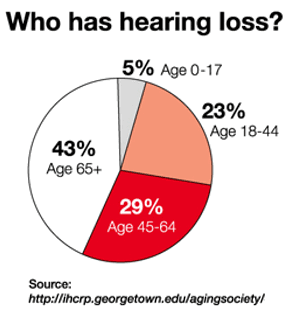
The Risk of Hearing Loss
Hearing loss can be progressive and irreversible. If you are a shooter, this is serious business. As the NRA Blog cautions: “You may not even realize you’re harming your hearing. Hearing loss occurs gradually, and can go effectively unnoticed until symptoms become severe. By then, the damage is done.”
Nobody wants to go deaf. But we often see shooters without effective hearing protection when they are walking around a few yards behind the firing line. That’s bad — even if you are away from the firing line, gunshot noises can damage your hearing. You MUST use effective hearing protection every time you go to the range. Good foam earplugs costs mere pennies but they can prevent deafness in your later years. Many folks also wear muffs over plugs.
Sound Levels for Common Noises:
9mm Luger pistol: 160 dB
Jet aircraft engine (near): 140 dB
.22 LR pistol: 134 dB
Normal human pain threshold: 120 dB
Noisy Nightclub: 110 db
Riding Motorcycle at 65 mph: 103 db
Power Lawnmower: 95 dB
Hearing damage possible: 85 dB (sustained for 8+ hours)
Ringing Telephone: 80 dB
Normal conversation: 60 dB
The Myth of the “Quiet” .22 LR
The NRA Blog notes that “many rimfire shooters, particularly those using the beloved .22 Long Rifle cartridge, argue that the small .22 LR caliber doesn’t produce enough sound to damage your hearing”. So, is that really true … or is it a myth?
In fact, a .22 LR can be much louder than you think — a .22 LR pistol can produce sound levels of 134 dB. That’s well above the normal human pain threshhold.
Highest Protection NRR 34dB-Rated Ear Muffs
For under $15.00 you can buy quality ANSI-approved muffs with a 34dB Noise Reduction Rating — the best you can get. Chose the Bright Yellow TR Industrial Muffs at $13.48, or the dark green Walker EXT Range Muffs for $13.99. Both products have padded head-bands which retract. Another dual-shell design with a 34dB NRR rating is the new FNova Muffs priced at just $12.88.
Many hunters and competitive shooters prefer low-profile ear muffs. As these typically have a lower Noise Reduction Rating, perhaps NRR 22-24, we recommend running earplugs under muffs, particularly when you are at a busy range or shooting a match. If you use low-profile electronic muffs, such as Howard Leight Impact Sport Muffs, you should still be able to hear range commands even with plugs underneath.
Howard Leight MAX NRR33 Earplugs, Just $7.98 for 50 Pairs.
20 Pairs
50 Pairs
These Howard Leight NRR33 Max plugs are your Editor’s favorite foam earplugs. Between shooting, motorcycling and mowing lawns, I probably have Max plugs in my ears 3-4 days a week. This is a very good price for a bulk pack of 50 pairs. And if you act soon, you can get free shipping to boot. This Editor just bought a 50-pack myself. And, yep, I got 50 pairs for $7.98 delivered, less than a pint of premium beer costs at my local pub:
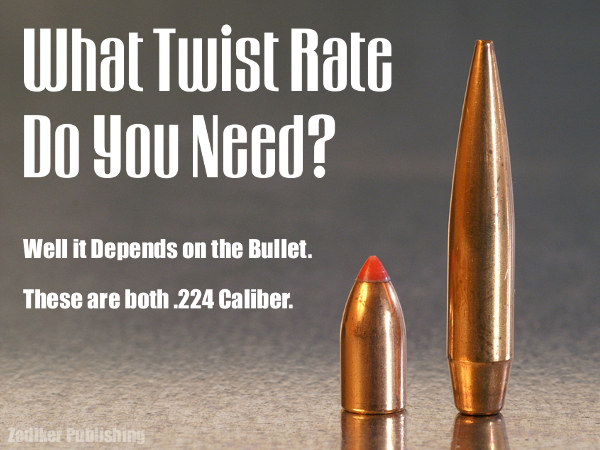
Here’s an extreme range of .224-Caliber bullets: 35gr varmint bullet and 90gr match bullet. Of course, along with bullet length/design, you need to consider MV when choosing twist rate.
Even with the same caliber (and same bullet weight), different bullet types may require different rates of spin to stabilize properly. The bullet’s initial spin rate (RPM) is a function of the bullet’s muzzle velocity and the spin imparted by the rifling in the barrel. You want to ensure your bullet is stable throughout flight. It is better to have too much spin than too little, according to many ballistics experts, including Bryan Litz of Applied Ballistics. Glen Zediker has some basic tips concerning barrel twist rates and bullet stability. These come from his latest book, Top Grade Ammo.
Choosing the Right Twist Rate
I’d always rather have a twist too fast than not fast enough. Generally… I recommend erring toward the faster side of a barrel twist decision. 1:8″ twist is becoming a “new standard” for .224 caliber, replacing 1:9″ in the process. The reason is that new bullets tend to be bigger rather than smaller. Don’t let a too-slow twist limit your capacity to [achieve] better long-range performance.
Base your next barrel twist rate decision on the longest, heaviest bullets you choose to use, and at the same time realize that the rate you choose will in turn limit your bullet choices. If the longest, heaviest bullet you’ll shoot (ever) is a 55-grain .224, then there’s honestly no reason not to use a 1:12″. Likewise true for .308-caliber: unless you’re going over 200-grain bullet weight, a 1:10″ will perform perfectly well.
Bullet Length is More Critical than Weight
Bullet length, not weight, [primarily] determines how much rotation is necessary for stability. Twist rate suggestions, though, are most usually given with respect to bullet weight, but that’s more of a generality for convenience’s sake, I think. The reason is that with the introduction of higher-ballistic-coefficient bullet designs, which are longer than conventional forms, it is easily possible to have two same-weight bullets that won’t both stabilize from the same twist rate.
Evidence of Instability
The tell-tale for an unstable (wobbling or tumbling) bullet is an oblong hole in the target paper, a “keyhole,” and that means the bullet contacted the target at some attitude other than nose-first.
Increasing Barrel Length Can Deliver More Velocity, But That May Still Not Provide Enough Stability if the Twist Rate Is Too Slow
Bullet speed and barrel length have an influence on bullet stability, and a higher muzzle velocity through a longer tube will bring on more effect from the twist, but it’s a little too edgy if a particular bullet stabilizes only when running maximum velocity.
My failed 90-grain .224 experiment is a good example of that: I could get them asleep in a 1:7″ twist, 25-inch barrel, which was chambered in .22 PPC, but could not get them stabilized in a 20-inch 1:7″ .223 Rem. The answer always is to get a twist that’s correct.
These tips were adapted from Glen’s newest book, Top-Grade Ammo, available at Midsouth. To learn more about this book and other Zediker titles, and read a host of downloadable articles, visit ZedikerPublishing.com.
With the U.S. F-Class National Championship running this week in Raton, NM, we thought we’d highlight a very important .284 Win rifle. This is the .284 Winchester rig that Charles Ballard used to win back-to-back F-Open titles in 2008 and 2009. Ballard’s huge success with the .284 Winchester cartridge helped make the .284 Win (and .284 Win Improveds) the dominant cartridge in F-Open competition worldwide. Enjoy this trip back in time to when the .284 Win was the “new kid on the block”.
Ballard Wins Back-to-Back F-Open Championships
In a very short span, Ballard and this rifle racked up an impressive string of performances. Ballard won the NRA Long-Range Regional, setting a new National Record in the process — 200-23X at 1000 yards. He also won the North Carolina F-Class Championship with the gun, and then captured the 2008 F-Open National Championship, followed by a second F-Open title in 2009. At the 2008 Nationals in Lodi, Wisconsin, Charles shot a 1337-65X with Berger 180gr bullets. At the 2009 F-Class Nationals, held at Camp Butner, NC, Ballard shot a 1328-62X to win his second straight National title.
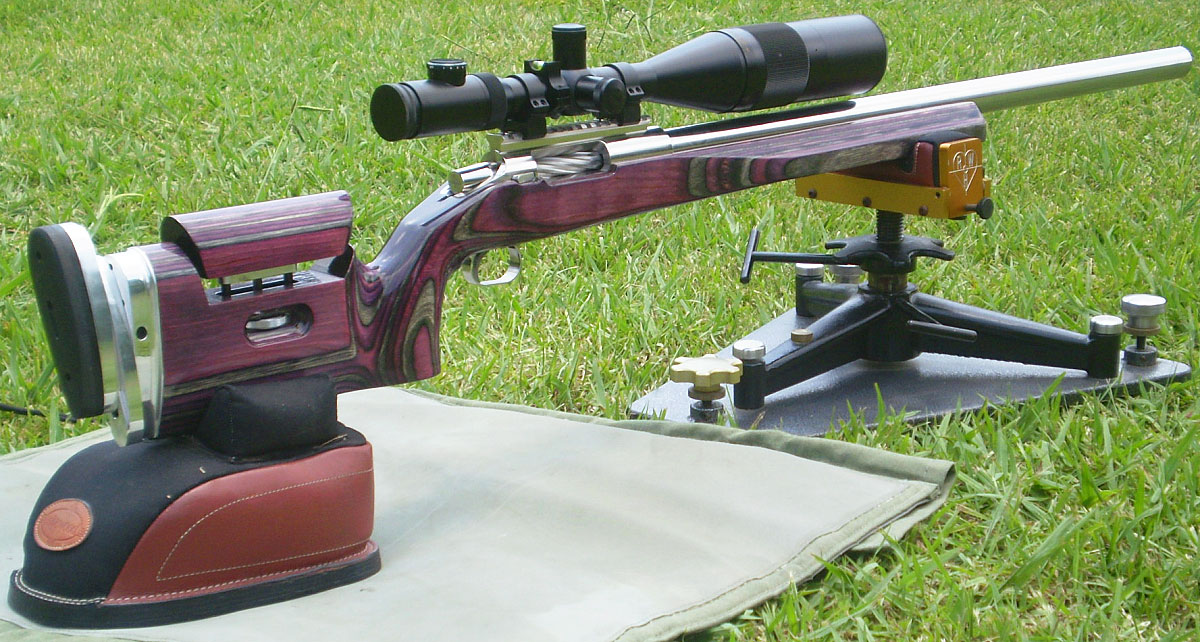
Ballard’s “Purple Haze” rifle features superb components, including a BAT MB action, Nightforce 12-42 BR Scope, and a wickedly accurate 32″ Broughton barrel.
Charles Ballard always used eye and ear protection. For these photos, he removed safety glasses.
Building a Championship-Winning F-Classer
by Charles Ballard
This rifle project began several years ago. My purpose was to find a cartridge that would launch the high-BC, 180gr 7mm bullets at competitive velocities for F-Class competition. I also sought barrel life that would be far superior to that of a 7mm WSM or 6.5-284. I read the article on 6mmBR.com about Jerry Tierney’s .284 Winchester and the cogs began to turn. After speaking with Mr. Tierney at the 2006 US F-Class Nationals, I decided the .284 Win would be the chambering for the new gun, despite several shooters telling me I would not be able to obtain the desired velocities. Jerry said “go for it” and, as it turned out, the rifle delivered the velocity I wanted, plus extraordinary accuracy to boot. This gun has more than exceeded my expectations, winning matches and setting a new 1000-yard, single-target F-Class National Record (200-13X).
Rifle Specifications–All the Hardware
My action of choice was a beefy 1.55″-diameter, round BAT MB, Left Bolt, Right Port. I chose this action based on BAT Machine’s impeccable reputation. I also liked the fact that the MB (medium long front) action offered an extended front end. This would provide better support for a very long barrel and give more bedding surface. The action is topped with a stainless BAT tapered (+20 MOA) Picatinny scope rail. Housed in a polished, stainless BAT trigger guard is a Jewel trigger set at 5 ounces.
The barrel is a 32″ Broughton 5C. The chamber was cut with a reamer made for Lapua 6.5-284 brass necked up to 7mm. It’s throated for the 180gr Bergers. I selected a Broughton 5C because, as my gunsmith says, “They just shoot”. This is a 1:9″ twist, 1.250″ straight contour for 32″. Yes, that’s a long, heavy barrel, but I think the length gives me a velocity advantage. On other guns, a 32″ tube could cause the rifle to be front-heavy and out-of-balance. The stock by Precision Rifle & Tool has a 3″-longer fore-end which solves the problem. The purple .284 balances very well and tracks great.
Speaking of the stock, there was only one choice, a “Purple Haze” laminated F-class model from Precision Rifle & Tool. This stock features a fully-adjustable buttplate plus a removable cheek-piece with thumb-wheel adjustment. Most importantly, the stock features an extra-long, super-stiff, low profile fore-end. This design rides the bags better than any stock I have ever shot. The action area of this stock has been beefed up to house the large BAT MB action. The final component on this rifle is a 12-42×56 Nightforce BR with DD-1 reticle set in Leupold Quick Release rings.
The Ultimate F-Open Rig
To start this project, I contacted Ray Bowman of Precision Rifle & Tool, PrecisionRifleSales.com. The first order of business was to get the action ordered, knowing how long it would take to get a BAT left bolt, right port action, plus scope rail, and trigger guard. We knew we wanted a Broughton 5C, but what twist rate? Based on the success I had shooting 210s in my 300 WSM with a “slower” 1:11″ twist we opted to go with a 1:9″ twist 7mm to shoot the 180gr Bergers. A dummy round was sent to Pacific Tool and Gauge to have a reamer ground to our specs.
Not shooting free recoil, I needed a stock that would fit me like a prone stock but track like a benchrest stock. Precision Rifle & Tool’s F-Class stock fit this bill to perfection. Ray keeps Jewell triggers in stock so the only piece left to acquire was the scope. On the old F-Class targets I would have been content with a Leupold 8-25 LRT, but on the new target a scope with 1/8-MOA adjustments and high magnification is a must. I considered the Leupold competition scopes but ultimately decided on the Nightforce BR. The variable power and unobstructed DD-1 reticle of the NF were deciding factors.
NOTE: Charles Ballard always employs eye and ear protection when shooting. For these posed photos, he removed his safety glasses.
Ballard’s Tips for F-Class Competition
In this section, Charles Ballard explains the basics of shooting an F-Class match, from the initial prep period to end of match. He covers sighter strategies and techniques for record fire, and he also explains, in detail, how he dopes the wind and judges hold-offs based on mirage.
Three-Minute Prep Period
I spend the first part of my 3-minute prep period making sure my front rest and rear bag are in-line. This insures the gun returns to the same spot after recoil. After I am happy with my set-up, I take a position similar to that of a conventional prone shooter. My face rests on the stock and my shoulder is placed firmly into the buttplate. With the Right Bolt, Left Port action, I can shoot the entire match with minimal movement. The last segment of prep time is spent trying to dope the wind.
Sighter Strategies
In a match with only two sighters, I’ll make a wind call and try to hit the center with my first shot. In matches with unlimited sighters, I generally hold dead center with a no-wind zero and use the point of impact as feedback. If I feel there is a constant condition, I will click for the wind. This allows me to use the center as my primary hold. After I get the feedback I need from my sighters it’s time to go for record.
Record Fire
After record fire begins I shoot very fast, holding off for the wind. I’ll make my wind call while the target is in the pits; if my previous shot went where I thought it would I will take my next shot as soon as the target stops. I predominantly shoot and adjust my aim based on mirage. If I have switching conditions, I will remove all wind from the scope, slow down, use the flags and mirage, still holding off. I do this because I have never had success waiting on a condition to come back.
Cleaning Procedures
I do not clean until the match is over. This means I typically shoot 120 to 150 rounds on average between barrel cleanings. I quit cleaning every relay after reading Mr. Tierney’s article, but I would still clean on Saturday night after I got home. After getting in late one Saturday night, I forgot to clean my rifle. I remembered this as I was preparing to shoot the first relay Sunday morning. At the time I was shooting a 300 WSM. Well, guess what… that relay I shot a 200-19x, and the next relay I shot a 200-17x (these scores were on the old, larger F-Class target). I found that the 300 WSM’s vertical really tightened up after about 50 rounds. The same has proven true of my .284 Winchester–vertical improves once 50 rounds are through the bore.
When I do clean, it’s simple. I use Bore Tech Eliminator on three patches, then follow with a wet nylon brush. These steps are repeated until the bore is spotless. I then push one wet patch of Eliminator through the bore and leave it.
Load Development and Accuracy Testing
My philosophy on load development differs from many shooters. I don’t primarily shoot for groups. The only goal I have is to obtain the lowest ES and SD I possibly can. Holding elevation in F-Class is crucial. Uniform velocity gives me more consistent vertical point of impact.
As we commenced load development, Jerry Tierney’s .284 Win load data posted on this 6mmBR.com gave us a good starting point. We loaded 53.0 grains of Hodgdon H4831sc and shot one round, cleaned, shot three rounds, cleaned, then shot 10 rounds and cleaned. From this point we worked up in half-grain increments until pressure signs developed at 2950 fps. Then we backed the powder charge down until the bolt lift was smooth and the primers were nice and round. [Editor’s Note: Jerry Tierney is no longer with us. We mourn his passing.]
Success: 2910 FPS with Ten-Shot ES of 7 and SD of 3
At this point I began working with different primers, neck tension and seating depth. After trying Federal 210m primers, CCI BR-2 primers, light tension, heavy tension, jamming, jumping, we settled on 56.0+ grains of H4831sc with CCI BR-2 primers. We ran about .002 neck tension with the 180s seated just touching the lands. This load gave us 2910 fps velocity with an Extreme Spread (ES) of 7 fps and a Standard Deviation (SD) of 3 fps over ten (10) shots.
NOTE: If you’re skeptical of those single-digit chron readings, click on the Video Playback screen below to view Ballard test-firing a load that delivers an ES of 5 and SD of 2 for five shots. At the end he holds the Oehler Chrono up to the camera so you can view the readout yourself. Seeing is believing!
Houston–We Have a Problem
I thought we had a load dialed-in, so I was fairly confident going to the North Carolina Long-Range State Championships. Let’s just say it didn’t go as planned. I encountered vertical, vertical, and more vertical. Turns out this was my fault. I had committed a big reloading “No-No”. I had used the ball expander in the die to neck the cases up from 6.5 to 7mm. Big Mistake! The cases we had previously used for load development were first necked-up with Ray’s expander mandrel and then run through the Redding bushing dies. Lesson learned: use an expander when necking-up the brass! This step was performed on the cases for the next match and it corrected the problem, as I lost no points to elevation.
Surprise–Velocities Rise, So Load Must Be Tweaked
After the NC State Champs, the gun went into hibernation for the winter. In February of 2008, NSSC held its annual winter Palma match. On Saturday my .284 was absolutely hammering, but Sunday I started noticing a hard bolt lift. Eventually, at the end of my last string, the gun blew a few primers. Luckily, however, it was still shooting very well. On the following Monday, we went back to the test bench and chrono. To my surprise 57.0 grains of H4831 was now shooting 2975 fps! That’s way too hot. At this point the barrel had 439 rounds through it. I started calling anyone I could thing of to see if they had any idea what could be causing this problem. Nobody I spoke with had ever experienced this problem until I spoke with a very knowledgeable F-Class shooter named Andy Amber.
Andy informed me that this had happened to him with several rifles. For whatever reason, between 100 to 300 rounds, as the barrel gets broken-in, the velocity climbs significantly.. Andy told me if I loaded back to the previous velocity, in his experience, it would stay there. Andy was spot on. My load came back together with 54.5 grains of H4831sc. The Oehler consistently gave me readings of 2892 fps to 2902 fps with an SD of 4 fps using once-fired brass. New brass gave slightly slower velocity but better numbers: ES of 7 to 9 fps, and SD of 2 to 3 fps. All this data was duplicated on several occasions. This rifle now has 554 rounds through it, but only .003″ throat erosion. The bullet was moved out .003″ to maintain position relative to the lands.
I’m very exacting in my loading procedures. I think that’s why I’ve been able to build loads that consistently deliver single-digit Extreme Spreads with ultra-low SDs. Here’s my loading method.
Case Prep: I start with Lapua 6.5×284 brass necked up to .284 with an expander mandrel. Next I sort the cases into one-grain lots, for example 194.0 to 194.9 grains, then 195.0 to 195.9 grains, and so on. After the brass is sorted, I chamfer the case mouths with an RCBS VLD tool. Any residual lube from case expansion is then cleaned out of the case mouth with alcohol on a bronze brush. Finally all the cases are run through a Redding Type ‘S’ FL sizing die with .312″ neck bushing.
Loading Procedure: My CCI BR-2 primers are seated with a RCBS hand priming tool. Powder charges are dispensed and weighed with an RCBS ChargeMaster Electronic Dispenser, which is regularly calibrated with check-weights to assure accuracy. Then the 180gr bullets are seated using a Redding Competition Seating Die.
Processing Fired Cases: My fired cases are tumbled in walnut shell media, then cleaned off. Cases are full-length resized, but I bump the shoulders only .0005″ (one-half thousandth). After sizing, the case mouths are cleaned with a spinning bronze brush.
IMPORTANT TIP: After 3 firings I will uniform the primer pockets and anneal the case necks. I found this very important in holding good elevation (minimal vertical dispersion).
CALIBER CHOICE: The Case for the .284 Win
Comparison: 6.5-284, .284 Win, and 300 WSM
For shooters who are not sold on the .284 Winchester, I give you a real-world ballistics shoot-off. We comparison-tested a 6.5-284 rifle launching 142 SMKs at 2975 fps, a 300 WSM rifle firing 210 Bergers at 2850 fps, and my .284 Winchester shooting 180 Bergers at 2900 fps. We had three shooters and each rifle was fired simultaneously with no-wind zeros on three separate targets set at 1000 yards. The shooters then exchanged rifles and we repeated the test a couple times. The 6.5 and 300 stayed consistently within an inch of each other. But my .284, with its high-BC Berger 180s, shot inside both the 6.5 and 300 by at least 3″ every time. BC rules in the wind. I was sold!
Cost Comparison: .284 Win vs. 6.5-284
The cost of reloading the .284 Win is roughly $.07 more per round than that of the 6.5-284. The .284 uses a grain or two more powder than the 6.5-284, and 7mm bullets cost about $6.00 more per 100-count box. However, to truly compare the cost of shooting the two calibers you must figure in barrel life. My 6.5-284 barrel went south at 900 rounds. My .284 barrel now has 1,036 rounds, and by all indications it will shoot well to 3,000+ rounds. For cost comparisons sake, let’s use 1,200 rounds for the 6.5-284 and 3,000 rounds for the .284 Win. The average cost of a barrel, chambered and fitted, is $500.00. Using these figures, the barrel cost of a .284 Win is $.17 per round vs. $.42 per round for the 6.5-284. That’s a $.25 per round difference, equivalent to a 60% savings for the .284.
OK, if we now net the barrel cost savings (-$.25) for the .284 with the higher cost of 7mm reloading components (+$.07), I figure the .284 Win costs $.18 per round LESS to shoot than the 6.5-284. Over the span of 3,000 rounds, that’s a $540.00 savings.
Editor’s NOTE: These numbers are 10 years old. But the key fact is the extended barrel life of the .284 Win overcomes the increased bullet cost.
Gun Handling and Recoil
If there is a down-side to the .284 it would be recoil. Now don’t get me wrong, at 22 pounds with a decelerator recoil pad, the .284 is comfortable to shoot. The recoil difference between the 6.5-284 and the .284 is about the same as the difference between a 6x250AI and a 6.5-284. In the versatility section I will elaborate more on this subject.
Ease of Load Tuning
Despite the issues I explained in the load development section with low initial velocities on new barrels, I would say the .284 is fairly easy to tune. The barrel with which I shot my record was removed after that match so I don’t put too many rounds on it before the Nationals. The new barrel on this rifle was tested using the same load. As with the first barrel, the second barrel yielded 2775 fps with a “starter load” of 53.0 grains of H4831sc. With only 11 rounds through the new tube, I shot a 600-yard match on June 22, 2008. I loaded 44 rounds using 55.0 grains of H4831sc. This load ran at 2825 fps. After my first string this load started hammering. I shot a 200-7X with no elevation change on my last string.
Multi-Discipline Versatility
The .284 is my hands-down choice for shooting F-Class. I recently shot my first 600-yard benchrest match. I shot the .284 Win in heavy gun. In this match I found the first weakness in my beloved .284. On a bench you do notice the recoil. The 6mmBR pilots could run off five shots before I could shoot two. My groups were respectable: a four-group, 3.055″ Agg. But, the added recoil of the .284, even with front and rear rests aligned, took me off target. All this being said, if a man wanted just one caliber for F-Class, long-range benchrest, and hunting, I would still suggest the .284 Win.
WARNING: The loads stated in this article may be TOO HOT for many .284 Win rifles. Always START LOW and work up gradually in small increments, looking for pressure signs. With 7mm Sierra 175s, Hodgdon’s starting load is 52.0 grains of H4831sc.


 Reloading Bench Mounts to RV Wall with Brackets




 The goal of NRL 22 is to make Precision Rifle competitions more available to every community. However, nearly all localities have access to 100-yard ranges and most shooters own a .22 LR rifle. The NRL22 program is designed so any facility with a 100-yard range can host matches. Participants at local NRL22 events can then attend a National Championship. NRL22 started with four classifications: Open, Base, Ladies, and Young Guns (8-18 age). Air Rifle is the new fifth class. For the 2018/2019 Competition Season, over 700 shooters attended NRL22 matches. In the 2019/2020 Competition Season, the NRL22 expects significant growth and is excited to welcome new members and clubs.


 The Risk of Hearing Loss



 Increasing Barrel Length Can Deliver More Velocity, But That May Still Not Provide Enough Stability if the Twist Rate Is Too Slow


 This rifle project began several years ago. My purpose was to find a cartridge that would launch the high-BC, 180gr 7mm bullets at competitive velocities for F-Class competition. I also sought barrel life that would be far superior to that of a 7mm WSM or 6.5-284. I read the article on


 The Ultimate F-Open Rig
 NOTE: Charles Ballard always employs eye and ear protection when shooting. For these posed photos, he removed his safety glasses.
 Three-Minute Prep Period
 Surprise–Velocities Rise, So Load Must Be Tweaked
 Andy informed me that this had happened to him with several rifles. For whatever reason, between 100 to 300 rounds, as the barrel gets broken-in, the velocity climbs significantly.. Andy told me if I loaded back to the previous velocity, in his experience, it would stay there. Andy was spot on. My load came back together with 54.5 grains of H4831sc. The Oehler consistently gave me readings of 2892 fps to 2902 fps with an SD of 4 fps using once-fired brass. New brass gave slightly slower velocity but better numbers: ES of 7 to 9 fps, and SD of 2 to 3 fps. All this data was duplicated on several occasions. This rifle now has 554 rounds through it, but only .003″ throat erosion. The bullet was moved out .003″ to maintain position relative to the lands.
 CALIBER CHOICE: The Case for the .284 Win
 Gun Handling and Recoil


