A few season back, our friend Kevin Thomas acquired a bit of living history — a reproduction Model 1873 Trapdoor Springfield. Here is Kevin’s story of his new rifle and the legacy it carries.
Today marks the 143rd Anniversary of Lt.Col. George Armstrong Custer’s historic ride into the valley of the Little Big Horn, along with 200+ men of the U.S. Seventh Cavalry. June 25, 1876 did not go well, as Custer and his men became a well-known, sad footnote in U.S. history. [Editor: Well it was sad for Custer fans. Native Americans have a different perspective.]
For years now, I’ve wanted one of the rifles Custer and his men carried that day, a Model 1873 Trapdoor Springfield, chambered for the 45/70 cartridge. I finally acquired one, when I walked into a gunstore a while back and saw a handsome repro Trapdoor sitting peacefully on the shelf. It called to me.
Somewhere in the distance, I could hear the bugle calls, the Sioux and Cheyenne war cries and the thundering of cavalry across the plain. It simply had to go home with me, and so it did. It seemed an especially insistent demand with this being the 138th anniversary and all, so I took it along to our regular Wednesday night practice session. All I can say is, I’m glad we don’t have to do rapid-fire with one of these in our matches today, because they do have a mule-like kick to them!
The Trapdoors were a cost saving measure that the Armory came up with at the end of the Civil War, to convert muzzle-loading Springfield muskets into breech-loading cartridge arms. A quick look will give several dead giveaways that many of the parts on the “new” rifle were actually interchangeable with the old 1861 and 1863 Springfield muskets. The parts that were altered or newly fabricated were relatively minor changes.
Above, you can see where these rifles got their name. Loading was done by flipping a lever which opened up a trap door that provided access to the chamber. Flipping that same lever and opening the trap door then ejected the case after firing.
Here is the opposite side, trapdoor open. The ring and slide on the side of the stock was to facilitate an attachment point for a lanyard that the troopers wore over their shoulders. Remember, they often used these while at a full gallop, not an easy feat!
Want to see the details?CLICK HERE to view full-screen photo.
Five targets, each with FIVE shots in essentially one hole. The events of this story happened two years ago. We are reprising our report because this five-target Aggregate arguably represents the most impressive feat of 100-yard accuracy in the history of marksmanship on this planet.
Check out those five targets. The Aggregate (average) of all five targets is a tiny 0.0840 inches! These were shot by Gary Ocock at 100 yards in a California benchrest match on August 6, 2017. Though Gary’s 0.0840 Agg beats existing records, this was not a “sanctioned” match, so Gary’s killer Agg will NOT be submitted for IBS or NBRSA records. So, sadly, the Agg won’t appear in the record books, but this remains a spectacular, verified feat of rifle accuracy, accomplished in competition.
The argument can be made that this is the Most Accurate Gun Ever Built. As far as we can determine, no one has ever shot a smaller 5-target Agg anywhere, at any time.
The Unlimited Benchrest Record That Will Never Be (Official)
Report by Boyd Allen
Gary Ocock’s stunning unlimited Aggregate is beyond amazing. That’s an average of five, 5-shot groups of .0840. Shot under sanctioned match rules, but at an unsanctioned 100-yard fun match, this Aggregate is well under the current 100-yard official records of the IBS (.1386), and the NBRSA (.1242). The fourth of the five groups measured a minuscule .018, less than half the size of the existing NBRSA Unlimited record of .049 (also shot by Gary). Check it out:
When the top 15 shooters all post teen Aggs, conditions must be pretty favorable. However there were some light switchy winds — Gary said that he shot better in the left to right condition.
GUN SPECIFICATIONS
Ocock’s red Jay Young Unlimited Railgun features one major difference from Young’s typical Railgun designs. The bottom of the barrel block is integral with the top (moving part), of the gun. The barrel is Ocock’s usual 1:13.5″-twist Krieger chambered for the 6 PPC. The BAT Neuvo action* is unusual in that its lugs are horizontal at lock-up instead of the usual vertical. With horizontal lugs, both lugs maintain contact with their abutments when the action is cocked. In the more normal configuration when cocked the top lug is forced off of its seat by a combination of the angle of the trigger cocking piece interface, the pressure of the striker spring, and bolt clearance at the rear of the action.
LOAD SPECIFICATIONS
Gary shot this remarkable Agg with well-used brass, Vihtavuori N133 powder, and self-made 66gr BT bullets** seated at “jam”. This amazing Agg was shot on the second day of a 2-day Unlimited Benchrest match. On Day 1 Gary had experimented with various loads using both surplus IMR 8208 and Vihtavuori N133, but was not satisfied with the results. For his first group on Day 2, Gary tried a light load of N133. After seeing the result, however, he decided to go to the other extreme — a super stout N133 load — with the same powder. As you can see, Gary’s willingness to experiment paid off.
Notably, Gary used light neck tension. Ocock found that for these bullets and this barrel, light neck tension worked best (contrary to “normal” N133 benchrest practice). Ocock used a bushing that only produces .001″ difference between the diameters of sized and loaded case necks.
Comment on Ocock’s Achievement
Congratulations to Gary Ocock for superb shooting (and smart loading). Even though the match was not sanctioned (so the Agg will never be a record), Ocock has raised the bar very high, and given us a new standard of ultimate accuracy.
Though this 0.0840 Aggregate and 0.018 group will never go into the record group, they are still noteworthy. There’s virtually no doubt that they would have survived inspection by any record committee. Except for the lack of fixed backers, an IBS requirement (for detecting cross-fires), all other conditions were met for an officially-sanctioned match.
*The new BAT Neuvo actions are the result of a collaboration between Dwight Scott, and Bruce Thom, featuring Dwight’s ideas and BAT’s proven manufacturing expertise.
** Ocock shot his own, boat-tail match bullets, made with George Ulrich-crafted dies using Hood cores. Although he said that it had been a while since he had weighed any, his best guess was that they weigh something around 66.5 grains.
Do you occasionally get completely unexplained flyers, or have a shot land straight down at 6 O’Clock, right below your point of aim? That could be caused by poor or inconsistent trigger technique. How you pull the trigger can and does affect your accuracy.
Many gun enthusiasts start with pistols. When they later start shooting rifles they may carry over some not-so-good practices acquired from shooting handguns with heavy 4 to 6-pound trigger pulls. You may want to “re-learn” your trigger techniques to get better rifle results.
Shooting Sports USA has a good article on trigger technique that offers many useful tips. That article also has many helpful illustrations, including the one shown above. Another illustration shows different types of trigger shoes (straight vs. curved) and explains how each makes a difference: “With a lightly curved trigger, the shooter’s finger can contact the trigger either high or low according to preference. Higher contact will increase the resistance.” READ ARTICLE HERE.
The article analyzes common errors, such as pulling the trigger with the very tip of the finger rather than the pad of the index finger: “Using the tip of the finger can lead to lateral pressure on the trigger, which throws off the shot.”
The article also explains that you should check your trigger regularly to make sure it is functioning properly and is not out of adjustment: “Just like any other moving part, the trigger can suffer from wear. In such a precise mechanism, tiny amounts of wear can cause major problems.”
The ergonomics of the Eliseo Tubegun allow a nice, straight trigger pull.
Trigger Tips
Six Suggestions for Making your Trigger Control More Consistent.
1. If your triggers are adjustable, set the pull weight appropriate to the discipline. For a hunting rifle, you don’t want an ultra-light trigger pull. For High Power, you may want a two-stage pull, while on a Benchrest rifle you may prefer a very light trigger.
2. If you have a two-stage trigger, experiment with different combinations of First Stage and Second Stage.
3. Have a friend watch you as you pull the trigger, and maybe even take a close-up video as you pull the trigger. This can reveal a variety of flaws.
4. Practice dry-firing to see if flaws in trigger technique are causing gun movement.
5. As an experiment, try pulling the trigger with your middle finger. Ergonomically, the middle finger has a more straight alignment with the tendons in your hand. This exercise can help you identify alignment issues with your index finger.
6. For stocks with adjustable Length of Pull you may want to set the LOP differently for bench shooting vs. prone or F-Class shooting.
The Bix’N Andy trigger is one of the very best you can buy. It can be fitted with a variety of trigger shoes according to shooter preference.
You don’t hear much about PacNor barrels in long-range competition, but FORUM member Wes J (aka P1ZombieKiller), proved that they can shoot “lights-out” in a rig assembled by a talented gunsmith. A few seasons back, Wes decided to upgrade a 6mmBR for mid-range benchrest and varmint matches. Wes tells us: “Since I restocked my 6BR … I have not had a chance to shoot it much since I have been playing the 100-200 game. I decided to take it out and do some playing at 500 yards. I have to give some serious props to my buddy (and fellow FORUM member) ‘PREACHER’ who did the chambering and barrel work for me. He can certainly make a gun shoot good. The barrel is a PacNor 1:8″ twist. My load was 105gr Berger VLDs pushed by 29.6 grains of Varget.” The five-round, 500-yard group shot by Wes J with his 6BR, measured just 1.240″, as measured by OnTarget software. Now that’s one accurate rig!
Five by Five — 5-Shot Group at 500 Yards, 1.240″, 0.237 MOA
This Editor knows something about the potential of a PacNor barrel. I have a 3-groove stainless PacNor SuperMatch on a Savage-actioned 6BR. This barrel shoots honest quarter-MOA in calm conditions, and it cleans up super-easy. The interior finish is so good, I’ve never had to brush the bore or use abrasives, and after 750 rounds it shoots as well as ever. I attribute the easy cleaning to the fact the lands in a PacNor 3-groove are wide and flat, so they are gentle on bullet jackets. I think accuracy is helped by the fact that my PacNor runs on the tight side (0.236 land dimension) with a good amount of choke. That works well with the 105gr Lapua Scenars and 103gr Spencers I like to shoot. You can read more about my rifle, nick-named the “Poor Man’s Hammer”, in this Feature Article from our archives. On one particularly calm day, in the hands of my friend (and ace trigger-puller) Joe Friedrich, the Poor Mans’ Hammer put 3 shots in under 0.200″ (measured center to center) at TWO Hundred yards. If you get a good one, PacNor three-grooves can definitely shoot.
Target Measurement with OnTarget Software
We used OnTarget software to measure the 5-shot group in the target above. This easy-to-use software is very repeatable, once you get a feel for plotting the shots. The latest On Target v2.25 Precision Calculator is FREE for a 15-day evaluation period. If you like it (and you will, trust us) there’s a modest $11.99 registration fee to activate the program. In addition to group size (in inches), OnTarget plots distance to aiming point, and the software automatically calculates the group’s vertical height, horizontal dispersion, average to center (ATC), and group size in MOA.
You can run a measurement on a scanned target or a photo of a target. You’ll need some known reference to set the scale correctly. The target above had a one-inch grid so it was easy to set the scale. Once you’ve set the scale and selected bullet diameter and target distance, you simply position the small circles over each bullet hole and the OnTarget software calculates everything automatically, displaying the data in a data box superimposed over the target image. To learn more about OnTarget Software, read AccurateShooter.com’s OnTarget Product Review. This article covers all the basics as well as some advanced “power user” tips. NOTE: Since the review was written, On Target has updated the software, and the free version now has a time limit.
Alpha Unknown, which had two shooters in the match, reported “This was the coolest place we’ve ever shot from… we’ll see you next year.”
Joe Burdick, owner of Rock Solid Shooting Solutions, provides this report from Wyoming: “I’m having a blast at the Nightforce ELR Steel Challenge at the Q Creek Ranch south of Casper, WY. Made my longest hits ever in competition at 1800 and some change. This 300 Winchester Magnum is absolutely PUNISHING the steel. The short targets here are at a thousand yards. I had multiple hits and clean runs on stages with targets from 1200-1800 yards. I missed the longest target of the match (2100 yards) by about 0.2 Mils.”
All photos by Joe Burdick other than as indicated by Alpha Unknown and Mitchell Fitzpatrick.
Target locations are indicated with red dots.
Burdick had high praise for the match and the venue: “This is a super cool match in an incredible location. It is remote but the size and beauty of the venue make it well worth the trip. The range is covered with life-size elk, wolf, ram, antelope, and even kangaroo targets with plenty of circles and squares as well.” The vast Q Creek Ranch encompasses 560,000 acres of scenic Wyoming landscape.
Burdick, whose company Rock Solid Shooting Solutions runs matches and sells custom gun covers, wanted to acknowledge his sponsors and equipment suppliers: Bushnell, Kelbly’s, WildEar, Precision Rifle & Tool, Huber Concepts, The Heritage Flag Company, Armageddon Gear, MasterPiece Arms, Kahntrol Solutions, BEST Targets, and Patriot Cases.
“Incredible location. It is remote but the size and beauty of the venue make it well worth the trip.”
Confirming Elevation Dope Is Essential for ELR Competition
Prior to the match, Joe verified his long-range “dope” at the Q-Creek Ranch shooting at distant targets. Joe reports: “Shooting my 300 Winchester Magnum, I made my longest hit ever with any rifle at 2086 yards.”
The 2086-yard target is marked with the red dot on the photo. The yellow dots represent the location of the 1000, 1409, 1725, and 1816 yard targets for reference.
And the Winners Are…
Chris Gittings and Brent Wood tied for Overall and Hunter Class honors at 115 points with Brent taking the tie-breaker. Notably, Brent’s son Tyler won the Junior Division. With 114 points, Mitchell Fitzpatrick took First Place in Open Division at the Nightforce ELR Steel Challenge. Congrats to all four marksmen on their great shooting! Fitzpatrick works with Applied Ballistics in the AB Weapons Division. He was shooting an AB Weapons Division M30TS rifle chambered for AB’s new .338 EnABELR cartridge, running 300gr Berger Hybrid OTM bullets at 3160 FPS. The scope was a 5-25x56mm NF ATACR with T3 reticle.
Soon after Lapua released the 6.5×47 cartridge, wildcatters recognized the potential of a necked-down 6mm version of the case. The 6-6.5×47 has emerged as a great, do-it-all cartridge that performs well in High Power competition, 600- and 1000-yard benchrest, and PRS tactical matches. But the 6-6.5×47 is not just for paper-punching. An efficient cartridge with great inherent accuracy, the 6-6.5×47 can be an excellent, flat-shooting, long-range varmint round. Here we feature Stan Stewart’s BAT-actioned 6-6.5×47 varminter. Fitted with a Krieger 1:10″ barrel, Stan’s rifle excels with a wide variety of varmint bullets. Whether driving 70-grainers at 3700 fps, or pushing the Berger 88gr High-BC FB bullet at 3400 fps, this 6-6.5×47 delivers half-MOA (or better) accuracy, in a well-balanced, easy-handling rifle.
The 6-6.5×47 for Precision Long-Range Varminting
The rifle carries a 12-42x56mm Nightforce NSX in Nightforce rings “hand-lapped for optimal fit/alignment”.
‘Seller’s Remorse’ Spurs 6mm Project Report by Stan Stewart
After selling my 6mm Remington Ackley Improved a couple of years ago and wishing I hadn’t, I begun to think about a new custom rifle for work on Prairie Dog towns and New York wood chucks at 600+ yards. I have a .223 AR and 22-250 for medium ranges but I missed my 6mm AI for long-range work so I started asking questions.
The 22-250 is a fine chambering, but it is hard on barrels, and I think the 6mms may have an accuracy edge out past 400 yards. Also, shooters today enjoy a vast collection of really great 6mm bullets. Barrel life and bullet options were two main reasons I decided to build a 6mm rather than another .224-caliber gun. But the question remained… what 6mm chambering to choose?
I started doing serious research on the 6-6.5×47. I received a lot of good advice from AccurateShooter.com and other websites on the pros and cons. I also talked to gunsmiths — quite a few recommended the new cartridge as well. Some of the cartridge attributes I liked was the small rifle primer, enough case capacity to efficiently reach 3700 fps with a 70gr bullet and 3400 fps with an 85-grainer without being terribly over-bore. Most important was the 6-6.5×47’s reputation for inherent accuracy without being finicky like my 6mm AI. So, having chosen my cartridge, I started asking for gunsmith recommendations. Again the folks on the AccurateShooter.com Forum were very helpful. After many conversations I settled on Dave Bruno in Dayton, Pennsylvania. He was a good choice.
Putting Together the New Rig with Premium Components
From the get-go, I knew I wanted a BAT action and Krieger barrel. BAT Machine and Krieger Barrels enjoy a great reputation in the shooting industry. BATs are beautifully-machined, smooth, and strong. Krieger cut-rifled barrels are known for dependable accuracy and long barrel life. While many 6-6.5×47 shooters choose an 8-twist barrel to shoot the 100-108gr bullets, I would be using smaller, varmint-weight bullets, so I selected a 1:10″ twist Krieger. This would allow me to shoot bullets from 60 grains up to 90 grains. Dave chambered the barrel with a .269″ neck and fluted the barrel to save weight. I also had Dave install a Vais muzzle brake. Dave fitted the BAT with a 2 oz. Jewell trigger, mounted a +20 MOA scope rail, then pillar-bedded the BAT into a McMillan Hunter-Class-style fiberglass stock.
Load Development for Varminting
I had selected a few powders and bullets recommended by other 6-6.5×47 shooters and started by seating all the bullets .005″ off the lands. The powders I selected were Varget, Vihtavuori N-550, and Reloder 15.
I was very pleased with the 88gr Bergers. In initial testing, they grouped well and I was able to drive them to 3400 fps easily. As I wanted a gun for long-range varmint work, I was hoping the 1:10″-twist barrel would provide enough stability for the heavier weight bullets. It did — the 10-twist worked great! I was able to shoot the lighter weight bullets and the 88s were superb. With a BC of 0.391, leaving the barrel at 3400, these bullets were still traveling at 2600 fps at 600 yards!
I did a lot of testing, recording group sizes for a variety of different bullets (see below) and powders. With group size/velocity data in a spreadsheet I was able to “crunch the numbers” and choose my preferred loads. The data drew a clear picture of what the rifle shot best. Here is a chart showing comparative group sizes, arranged by bullet type. On the last three lines, powders are listed by average for all bullets.
Final Thoughts on the 6-6.5×47 Lapua
I have owned three rifles chambered in 22-250 and will always own a rifle in this caliber because it is inherently accurate and drives a 50gr bullet at 3800 fps. No question the 22-250 can be deadly out to 500 yards. However, I’ve found that shooting past 400 yards with the light bullets is difficult if there is any wind at all. That’s why I liked my 6mm AI for those longer shots and why I decided on the 6-6.5×47 Lapua. I couldn’t be happier with my choice. The only thing that could make it better is if Lapua would produce the 6-6.5×47 as an “official” factory 6mm cartridge with 6mm necks right out of the box. But overall, I am very happy with the cartridge, and I thank Dave Bruno for producing a superbly accurate varmint rifle.
Another legislative attack on the firearms industry is being pushed in Congress by Democratic party politicians. Rep. Adam Schiff (D-CA) and Sen. Richard Blumenthal (D-CT) reintroduced legislation this week that targets the gun industry, allowing persons to sue the makers of firearms that were used by criminals to cause injury. Currently, such lawsuits are blocked by the Protection of Lawful Commerce in Arms Act (PLCAA) enacted in 2005.
The new Democratic legislation, the “Access to Justice for Victims of Gun Violence Act”, would repeal the PLCAA. If the PLCAA is repealed, then gun-makers could potentially be sued for the actions of criminals using firearms — even if the guns were stolen. If bad guys cause harm with guns, the Democrats want the gun-makers to pay, and keep paying. The goal is to eventually bankrupt the gun industry and put companies such as Colt, Ruger, and Smith & Wesson out of business.
The Democrats have gone after the PLCAA before. NPR reports: “The effort to repeal PLCAA by Democrats on Capitol Hill is not new. Schiff first introduced the measure in 2013, and it has been reintroduced at least two other times without gaining traction.”
The real goal of this legislation is to cripple the gun industry. GunAmerica Digest explains: “One of the primary goals of anti-gunners is to bankrupt the gun industry by repealing the Protection of Lawful Commerce in Arms Act (PLCAA).”
The sponsors of the new legislation claim their legislation is needed to protect citizens. Congressman Schiff (D-CA) declared: “This bill would pierce the gun industry’s liability shield by putting an end to the special protections the gun industry receives when they shirk their fundamental responsibility to act with reasonable care for the public safety.”
GunsAmerica Digest says don’t believe this: “Schiff and Blumenthal are grossly mis-characterizing the purpose of PLCAA. It does NOT protect members of the gun industry from product liability suits for manufacturing or design defects or certain types of negligent conduct. It merely prohibits lawsuits against gun makers for damages resulting from the third-party criminal misuse of their firearms.”
It’s clear what the sponsors of this legislation really want. They seek to destroy the U.S. gun industry through waves of lawsuits — “death by 1000 cuts”. The anti-gunners may not be able to remove the Second Amendment from the Bill of Rights, but if they succeed in bankrupting all the major gun-makers, then the “Right to Keep and Bear Arms” won’t be worth much.
Rifle accuracy is pointless unless you can see your target and aim precisely. That’s why good optics are so important for precision shooting — from 50 yards out to a mile and beyond. Today’s premium scopes can be very expensive — you’ll see optics costing $3000 or more on many competition F-Class and PRS rifles. This article covers important “Riflescope Knowledge”, including how to adjust for parallax, and how to properly sight-in your scoped rifle. In addition there’s a helpful video defining Minute of Angle (MOA) plus two videos showing how to mount scopes.
Rifle Sight-In Process — Start to Finish
Here Ryan Cleckner shares his process for sighting in a scoped rifle. This helpful video covers the full process: bore-sighting, 25-yard shot confirmation, shooting groups, making adjustments at 100 yards, and finding mechanical zero. Looking for more valuable rifle instruction? Then check out Ryan Cleckner’s book, Long Range Shooting Handbook.
How to Adjust for Parallax
Most precision rifle scopes have parallax adjustment, but what is it and why do you need to adjust it? In this Shooting USA video, John Paul of JP Rifles defines parallax and explains why you need to set parallax correctly for the distance to your target. The video then show how to adjust parallax correctly. a process which should start with the scope’s ocular focus.
Understanding Minute of Angle (MOA)
In this video, Ryan Cleckner explains the measurement term “minute of angle” (MOA) and how to use MOA adjustments on your scope to compensate for bullet drop at varying distances. MOA is an angular measurement, used often in long range shooting, that is 1/60th of one degree of a circle. One MOA represents 1.047″ at 100 yards and 10.47″ at 1000 yards. Want to learn more? Read Ryan Cleckner’s article Understand and Using Minute of Angle.
How to Mount a Riflescope
When mounting a scope you want to use quality rings, and ensure that the scope is leveled properly. In addition, you need to adjust the fore/aft position of the scope so that eye relief is correct. Ideal scope position may be different when shooting from the bench vs. shooting prone. In this Shooting USA video John Paul of JP Rifles reviews scope mounting basics.
Scope Mounting on a PRS Precision Rifle
Here the MasterPiece Arms (MPA) Academy experts show how to mount a scope on a PRS-type tactical rifle. Special considerations for tactical shooters are discussed. The video also shows recommended tools for scope mounting operations.
This .308 Win was purpose-built for PRS/NRL tactical competition. With all the focus on the 6.5 Creedmoor, 6mm Creedmoor, and smaller 6mm cartridges, it’s easy to forget that the PRS has a Tactical Division limited to .223 Rem and .308 Winchester. This gun was built by Jim See of Elite Accuracy LLC to compete in that class, which also has a .308 bullet-weight limit of 178 grains, and a velocity limit of 2800 fps.
With those restrictions, this is truly a Tactical Tack-Driver, as you can see from those 100-yard targets in the photo above. This gun seems to shot great with everything Jim has tried. He started the season with Sierra 168gr Tipped MatchKings. Later he switched to 168gr Berger Hybrids. For both bullet types he uses Varget powder, CCI 200 primers, and Lapua large primer .308 Win brass. His current match load runs about 2765 FPS, with impressive 5-7 FPS standard deviation. The gun hammers — even at very long range. Jim told us: “That soda bottle was shot at one mile with a 168gr Berger Hybrid on top of Varget.” Jim says the 1:9″ twist rate helps deliver a “clean sub-sonic transition” at that distance.
With its heavy-contour barrel, the gun weighs in at a hefty 22 pounds, including optics and bipod. If you like this rig, Jim See can build you one just like it, or with the chambering of your choice. Visit EliteAccuracy.com to learn more about Jim’s gunsmithing services.
This rig features a RBRP Impact Precision 737 Action which was designed specifically for PRS-type tactical applications. This action features an integral lug, and built-in +20 MOA Picatinny rail. Both receiver and bolt are black-nitrided for slickness and durability. Jim loves the action: “It is really slick operating. It functions really well and doesn’t get gummed up with dirt or grit, so it has caught on for the PRS/NRL game. This action has won a major share of 2-day PRS matches this past season.”
Barrel Is a Resurrected .300 WSM
This rifle has one “resurrected” component — the barrel. The 1.25″ straight-contour, 1:9″-twist Brux was originally chambered as a .300 WSM finished at 30 inches. As acquired from Pat Scully, the barrel had 1200 WSM rounds through it. See then re-chambered the Brux as a .308 Winchester, finished it at 25 inches, and attached a 4-baffle side-discharge muzzle brake. Jim says the brake really helps control muzzle lift.
Jim See .308 Win Tactical Rifle Specifications:
Action: Impact Precision 737R
Action Finish: Black Nitride (bolt + body)
Barrel: Brux 1:9″ twist, 25″ finished
Chambering: .308 Win, PT&G Std. Match Reamer
Muzzle Brake: Custom 4 baffle, side discharge
Trigger: Trigger-Tech Diamond, straight shoe
Magazine: Accuracy International
Scope: Vortex Razor HD Gen II, 4.5-27x56mm FFP EBR reticle
Scope Base: Integral +20 MOA rail
Stock: J. Allen Enterprises (JAE) chassis
Front Rail: JAE Swiss ARCA rail
(extends bipod mount 2″ forward)
Bipod: Atlas PSR
Running the Rifle in Competition
Jim says this rifle performed well right out of the gate: “For about three years I wanted to shoot Tactical division and in 2018 it happened to work out. I decided it was a good year to test the .308 Win waters and see how the .308 could stack up competitively against the Open Class rifles.
I dug around the shop and found an 11-twist 30″ M-24 from an old F-class rifle and chopped it down to 23″ and fit it to an Impact action. [EDITOR: This barrel was later replaced with the 1:9″ Brux finished at 25 inches.] I had not received my 168gr Berger Hybrids yet so I ran the Sierra 168gr Tipped MatchKings in the first couple matches of the season. Those SMKs were used for the target and chrono pictures here.
The first spring match was ‘The Battle for Breakneck’ in Nebraska. This is a true field match with mostly prone stages with a few natural rock barricades thrown in for positional shooting. The yardages went out to a little over 1400 yards. I went in feeling good and shot very well in the windy conditions, hitting targets out to 1350 yards. I finished with a score of around 105 out of 135 points. The Open Class winner shot a 117 score I believe. I ended up being First-Place Tactical and 16th overall in a field of 100 shooters.”
Consistency and Preparation — Keys to Success in PRS/NRL Competition
Through his Elite Accuracy LLC company, Jim offers skills training for tactical shooters. When we asked Jim if he had any advice for PRS/NRL competitors, Jim replied: “Consistency is what will continually put you at the top of a match. In addition, your gear needs to be prepared (100% sorted out) and your mind needs to be prepared and ready. Don’t let your mind get in your own way. Mental preparation and confidence will be key to success.”
7mm (.284) remains the caliber to beat in F-Class Open Division (though some shooters have had success with .30-Cal short magnums.) With a standard .284 Winchester, or better yet, a .284 Improved, you can drive the high-BC Berger 180gr and 184gr bullets to competitive velocities.
The straight .284 Win is an excellent cartridge, quite capable of winning F-class matches. However, in most barrels, it can’t push the 180s at 2900-2950 fps velocity levels*. A lot of barrels will top out at about 2850 fps. That’s where the .284 Shehane comes into play.
The .284 Shehane is a slightly modified wildcat that retains the same 35° shoulder as the parent case. However, by blowing the sidewalls out 0.010″, the .284 Shehane picks up about 3.3 grains of extra case capacity. That enhancement makes a BIG difference. The extra boiler room is enough to drive the 180s at 2900-2950 fps with H4831sc. With N560 or Reloder 17 you can go even faster.
Norm Harrold Won 2018 F-Class Open Division Nationals with .284 Shehane Rifle
Norm Harrold (above) won the 2018 USA F-Class Nationals shooting a .284 Shehane. Norm’s F-Open rig features a McMillan Kestros ZR stock and Bartlein barrel chambered for the .284 Shehane, which has a bit more case capacity than a standard .284 Winchester. Norm loaded Berger 184gr 7mm bullets in Lapua brass. Norm revealed his load in an Erik Cortina YouTube Video.
F-Class shooter Erik Cortina notes that the .284 Shehane has a velocity edge over the straight .284 Win because it holds more powder: “The Shehane has more capacity than the .284 Winchester. Ryan is using 54.0 grains simply as a fire-forming load. Typical load for a Shehane is around 57.0 grains of Hodgdon H4831 SC.” By blowing the sidewalls out 0.010″, the .284 Shehane picks up about 3.3 grains of extra case capacity. That enhancement makes a BIG difference. The extra boiler room is enough to drive the 180s at 2900-2950 fps with H4831sc, with long barrels.
Forum member Jim Hardy has shot the .284 with great success. He tells us: “In my humble opinion, the .284 Shehane is the best balanced long-range round there is — bar none. Here is why:
You have to shoot a 30 Cal Magnum with a 240gr bullet to equal the performance of most 7mm chamberings with the 180 Berger VLD. With the .284 Shehane, you have a .308 bolt face, medium action, and Lapua brass. You use less powder than the 7 mags, and have great accuracy and ballistics even while fire-forming. The .284 Shehane shoots inside the 6.5 AND the straight .284, the .300 WSM, and the .300 Win Mag with less recoil. What is not to love about the 284 Shehane? It is a no-brainer for long range — F-Class or Prone or 1000-yard Benchrest.”
Scotland’s Grant Taylor. who used the .284 Shehane to finish third at the 2009 F-Class Worlds in England says the .284 Shehane is “very accurate with superb vertical spreads at 1000 yards. [This] caliber… has awesome accuracy. I’m getting 2930-2950 fps with spreads in the 3-5 fps range. I use Hodgdon H4831sc powder, CCI BR2 primers, and pointed 180gr Bergers.”
.284 Shehane Shines in 1K Benchrest Competition Too
The .284 Shehane has won in Benchrest as well as F-Class competition. In 2013, Henry Pasquet won the IBS 1000-Yard Nationals shooting a .284 Shehane. Henry’s Championship-winning rig is shown below. Note the 5″-wide fore-end which is not legal for F-Class. Henry also runs a combo tuner/muzzle-brake.
Amazing Accuracy When Fire-Forming .284 Shehane
If you look at that 5-round group you might think it was shot with a 6 PPC or maybe a 6mmBR. But no, this was done with heavy 180gr Berger Hybrid bullets and the .284 Shehane. In fact, this impressive sub-quarter MOA group was shot while fire-forming with a very well-worn barrel! Gun builder Ryan Pierce of Piercision Rifles explains: “Here’s a 5-shot 0.191″ group at 100 yards with my .284 Shehane fireforming loads. This barrel has 2200 rounds through it. It had 2000 as a straight .284 Win and then I set it back to .284 Shehane to form brass with. [The load was] 180 Hybrids with 54.0 grains of H4831 SC.”
*Some exceptional barrels chambered in straight .284 Win can reach 2900 fps with the 180s. Ryan Pierce has a 32″ Brux barrel that is delivering 2900 fps with the straight .284. However, Ryan acknowledges that his velocities are not typical: “A lot of .284 Win barrels top out at around 2850 fps with the 180s”.


 A few season back, our friend Kevin Thomas acquired a bit of living history — a reproduction Model 1873 Trapdoor Springfield. Here is Kevin’s story of his new rifle and the legacy it carries.


 Target Measurement with OnTarget Software
 Joe Burdick, owner of


 Burdick, whose company


 ‘Seller’s Remorse’ Spurs 6mm Project


 Final Thoughts on the 6-6.5×47 Lapua


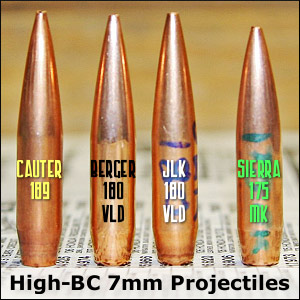 7mm (.284) remains the caliber to beat in F-Class Open Division (though some shooters have had success with .30-Cal short magnums.) With a standard .284 Winchester, or better yet, a .284 Improved, you can drive the high-BC Berger 180gr and 184gr bullets to competitive velocities.


