|
|
January 3rd, 2016
|

|
20 Pairs |
50 Pairs |
 Hearing loss is a terrible thing. Protect your hearing while you can. Permanent damage can occur in a single shooting session. For maximum protection, we recommend that you “Double up”, i.e. wear ear plugs under muffs. Between shooting, riding motorcycles, and working with gas-powered yard equipment, your Editor probably has foam plugs in his ears 8-12 hours a week. I’ve tried many different varieties of ear plugs, both the foam variety and the soft plastic flange-type plugs. Hearing loss is a terrible thing. Protect your hearing while you can. Permanent damage can occur in a single shooting session. For maximum protection, we recommend that you “Double up”, i.e. wear ear plugs under muffs. Between shooting, riding motorcycles, and working with gas-powered yard equipment, your Editor probably has foam plugs in his ears 8-12 hours a week. I’ve tried many different varieties of ear plugs, both the foam variety and the soft plastic flange-type plugs.
I now favor the Howard Leight MAX-1 plugs. Rated at NRR33, these are, quite simply, the best ear-plugs I’ve ever tried. No BS — these things really work. Among all disposable plugs I’ve tried, the MAX-1s are definitely the most effective at blocking noise, and they are also more comfortable than most other foam plugs I’ve used. In my experience at the range, these plugs block sound way better than most muffs (when worn without plugs underneath).
The first thing I noticed about these plugs is how much more effective they were than muffs alone. With muffs in place, a rifle report is still quite audible. With the red MAX-1 plugs, the noise from a shot is much, much quieter. Proof of the “real world” effectiveness of these plugs came when talking. The plugs work so well that I had trouble hearing words spoken by a colleague from just four feet away. With conventional (non-electronic) muffs I can hear a normal speaking voice from many yards away.
These MAX-1 plugs insert easily (if you roll them first), and the wide, flared outer bell makes them very easy to remove. Subjectively, these plugs seem more comfortable than most other foam plugs I have tried. They are certainly way more comfortable than the cheap, non-tapered ear plugs. MAX-1 plugs are available in both standard configuration and corded versions. These are cheap to buy — 20 pairs of non-corded MAX-1s cost just $4.85 on Amazon.com. I just bought another 20 pairs today.
I’m not the only one who likes the Leight MAX-1 plugs. Here are some comments from verified purchasers on Amazon.com:
 These ear plugs deserve all the raves they’ve received. They’re by far the best I’ve used and among the least expensive. They hold up very well when used repeatedly. This is the only brand I’ll buy from now on. — Joe These ear plugs deserve all the raves they’ve received. They’re by far the best I’ve used and among the least expensive. They hold up very well when used repeatedly. This is the only brand I’ll buy from now on. — Joe
These things are as soft and gentle as they come and they block the noise out very well. I highly recommend them[.] — Byron
They are the best ear plugs I’ve ever used — and I’ve used many over the years. These are the only ear plugs I will ever use in the future. — Rhoda
December 21st, 2015

Have Fun with Rifles and Equipment You Probably Already Have….
Forum member Rod Vigstol (aka Nodak7mm) has written a great Introduction to F-Class for shooters getting started in this rewarding discipline. Rod’s article, which originally appeared in the Rifleman’s Journal Blog, covers F-Class basics and addresses concerns that “newbies” may have when trying a new shooting sport. Rod stresses that most guys who own a varmint-hunting or tactical rig likely have nearly all the gear they need to give F-Class competition a try.
Rod explains: “If you’re reading this, you have more than just a general interest in the shooting sports and in the awesome rifles that shoot tiny groups at insane distances. You probably even have friends that enjoy shooting as much as you do. The quandary you may find yourself in is your friends haven’t quite jumped into it head-first like you have and they haven’t spent a lot of money and time obtaining the equipment you have to go shoot these matches. But you know what? Your prairie-dog shooting buddy or coyote-hunter friend can attend these matches and shoot alongside with you. He or she more than likely already has the basic equipment needed to shoot a match.” Most varmint shooters already have a suitable, accurate rifle and the following equipment:
• A variable-power scope in the 4.5-14x range or higher.
• A front bipod like the trusty old Harris 9″-13″, or maybe even a basic pedestal front rest.
• A rear sand-bag or similar sand-sock to rest the butt stock.
• A basic shooting mat from Midway or at least a piece of carpet or canvas to lay on.

Rod also provides a handy checklist of items to bring to the range. These include: Canvas or carpet strip (to set under bipod), Notebook, Kitchen Timer, Cleaning Rod, Camp Chair, Elbow Pads, Shooting Hat, and Open Bolt Indicator (OBI). Along with rifle, bipod (or front rest), rear bag, and ammo, that’s pretty much all you need.

Rod encourages all shooters to give F-Class a try — even novices. Rod explains: “We have all been rookies, newbies, new kids on the block or whatever. So we all have a good idea of what may be going on in your mind, the questions and concerns you may have. I’m telling you this sport is full of fantastic people who deep down find it far more fulfilling to help a new shooter get started than running a clean target. You just have to take the first step to get involved.”
December 19th, 2015

Doan Trevor is a master gunsmith and stock-maker who works in the old style. He still hand-crafts stocks from start to finish, and does all the metal-work on the custom rifles he builds. Starting with highly-figured woods, Doan carves and shapes his stocks largely by hand, with meticulous attention to detail. Each rifle he builds is optimized for its intended discipline, and custom-fitted for the customer.

With the help of his talented wife Sue (who does the photography and builds the web pages), Doan has created a wonderful website, DoanTrevor.com, that is a feast for the eyes. You can see beautiful wood-stocked rifles being hand-crafted. Doan also illustrates how he creates custom metal parts, and how he beds barreled actions into the finished stocks.


Set aside a few minutes and visit Doan’s website. Be sure to click on the site’s secondary pages: Rifle Building, Woodworking, and Metalworking. You’ll find dozens of high-quality photos and fascinating information on gun-building.

For more information, visit DoanTrevor.com, or call (505) 890-0368, 10am-5pm M-F.
Doan Trevor RifleBuilding
4119 Lanceleaf Ct NW
Albuquerque, NM 87114
505-890-0368
December 17th, 2015

Christmas Day is just a week away. Books have always been popular holiday gifts. If you haven’t completed your holiday shopping, here are some recommended titles that should please the serious shooters and firearms enthusiasts on your shopping list. For shooting clubs, books also make great end-of-season member awards. Most of us would rather have a useful book than one more piece of wood to toss in a box in the closet.
Here Are TEN TITLES Recommended for Serious Shooters:
 |
Modern Advancements in LR Shooting
by Bryan Litz, $27.99 (Kindle), $43.95 (Hardcover)
If you’re a serious long-range shooter, consider adding this book to your library. Relying on extensive ballistics testing, Modern Advancements contains some fascinating research results, including the effects of twist rate on muzzle velocity, BC, and precision. Other sections detail the evolution of modern rifle, bullet, and optics designs. And there is an important comparison test of chronographs. Laser rangefinders and wind measurement devices are explained in detail by contributing author Nick Vitalbo. This book is a valuable resource for anyone who wants to understand the current “state of the art” in today’s shooting world. There is a ton of “hard science” in this book — not just opinions. |
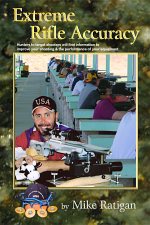 |
Extreme Rifle Accuracy
by Mike Ratigan, $35.65 (Softcover)
This book should be on the shelf of every short-range benchrest shooter. (Shooters in other disciplines will find the book helpful as well.) Butch Lambert says Mike’s book is “far and away the best Benchrest book written. Very comprehensive, it touches on every aspect of our game.” Mike’s 368-page book is dedicated to getting the most from modern rifle accuracy equipment with an emphasis on shooting 100-200-300 yard group benchrest tournaments. This book covers the most popular hardware plus new equipment offerings are covered, including external mount scopes, actions, triggers, stocks, wind flags, and more. Also covered are rifle handling techniques, note taking, tuning, bullet selection, goals, and match strategies. Mike provides many tips that will help active competitors update their own competitive program. |
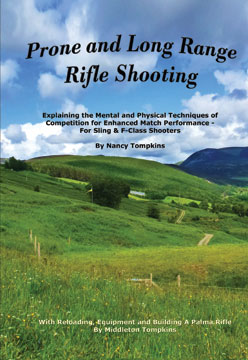 |
Prone and Long-Range Rifle Shooting
by Nancy Tompkins, $45.00, (Hardcover, 2d Edition).
Nancy Tompkins is one of the greatest long-range shooters in American history. She has won five National Long-range Championships. Tompkins’ treatise is a must-read for serious Palma, F-Class, and High Power shooters. The revised Second edition includes F-Class equipment and techniques, and newly updated information. Color pictures. Topics include Mental & Physical training, Reading Wind & Mirage Shooting Fundamentals, International Competition, and Loading for Long Range. Nancy Tompkins is a 4-time winner of the National Long Range Championships, and has won countless other major events. Nancy has been on six Palma Teams (as both a shooter and a coach). |
 |
The Book of Rifle Accuracy
by Tony Boyer, $34.50 (Softcover); $42.50 (Hardcover).
Tony Boyer, the most successful shooter in the history of short-range benchrest competition, shares many of his match-winning tips in this 323-page book. The book covers all aspect of the benchrest discipline: loading, windflags, rest set-up, addressing the rifle, and match strategies. This is a high-quality publication, filled with valuable insights. Every serious benchrest shooter should read Tony’s book. Boyer has dominated registered benchrest in a fashion that will never be duplicated, having amassed 142 U.S. Benchrest Hall of Fame points. The next closest shooter, Allie Euber, has 47 Hall of Fame points. This handsome, full-color book is 323 pages long, with color photos or color illustrations on nearly every page. |
 |
The Rifle Shooter
by G. David Tubb, $34.95 (Softcover)
This book by 11-time National High Power Champion David Tubb focuses on position shooting and High Power disciplines. Section One covers fundamentals: position points, natural point of aim, breathing, triggering mechanics and follow-through, sling selection and use, getting started, getting better, avoiding obstacles. Section Two covers mechanics of offhand, sitting, and prone positions. Section Three covers shooting skills, including wind reading and mental preparation. Section Four covers the technical side of shooting, with extensive disuctions of rifle design, load development, reloading barrel maintenance, and rifle fitting. We consider this book a “must-read” for any sling shooter, and there is plenty of good advice for F-Class shooters too. |
 |
The Wind Book for Rifle Shooters
by Linda Miller and Keith Cunningham, $21.58 (Softcover).
Many of our Forum members have recommended The Wind Book for Rifle Shooters by Linda Miller and Keith Cunningham. This 146-page book, published in 2007, is a very informative resource. But you don’t have to take our word for it. If you click this link, you can read book excerpts on Amazon.com. This lets you preview the first few chapters, and see some illustrations. Other books cover wind reading in a broader discussion of ballistics or long-range shooting. But the Miller & Cunningham book is ALL about wind reading from cover to cover, and that is its strength. The book focuses on real world skills that can help you accurately gauge wind angle, wind velocity, and wind cycles. |
 |
Rifle Accuracy Facts
by Harold R. Vaughn, (Softcover and Hardcover, Used Price Varies)
Decades after it was written, Vaughn’s work remains a seminal treatise on accuracy. Vaughn was a serious scientist, working for the Sandia National Laboratories. Many “gun writers” toss out hunches about rifle accuracy. Vaughn, by contrast, did serious empirical testing and statistical analysis. Vaughn wondered why some guns shot well while seemingly identical rifles did not. Rifle Accuracy Facts covers a wide variety of topics, including internal ballistics, chamber design, barrel vibration, bullet imbalance, external ballistics, scope design and more. Writer Boyd Allen notes: “If you are serious about precision shooting, Vaughn’s book belongs in your library.” |
 |
The Accurate Rifle
by Warren Page, $14.95 (Softcover), $20.99 (Hardcover)
We include this book in our list because it is an older classic that has been out of print for a while. Warren Page was the shooting Editor of Field & Stream magazine for 24 years. Long out of print, this seminal work on rifle accuracy was republished in 1996 with an updating chapter by Dave Brennan, long-time Editor of Precision Shooting magazine. If you are interested in the progress of rifle accuracy, it is worth reading this book to see how technology has developed over time (and what older methods still work today). This would make a great gift for an older shooter who grew up reading Warren Page articles in Field & Stream. |
 |
Rifleman’s Guide to Rimfire Ammunition
by Steven Boelter, $29.95 (Softcover)
Steven Boelter’s 352-page book is a comprehensive study of all types of rimfire ammunition (including 17s and 22 mags), with over 600 photos. In a remarkable undertaking, Steven Boelter fired every brand and sample of rimfire ammo he could acquire (including .22 LR, 17 Mach 2, 17 HMR and .22 WMR), and recorded all the results. In all, Steven tested 11 brands and 137 different rimfire rounds, firing over 32,000 test rounds. |
 |
The Art of Rimfire Accuracy
by Bill Calfee, $9.99 (Kindle), $41.82 (Softcover)
Always controversial, Bill Calfee is nonetheless a major player in the world of rimfire accuracy. Calfee-built rimfire rifles have set many records and won many titles. He harbors strong opinions about what works and what doesn’t, but if you are involved in rimfire competition you should read this book. This work covers all aspects of rimfire gunsmithing and accurizing: barrels, tuners, chambering, triggers, stock design, bedding, action design and much more. He examines each aspect of rimfire accuracy discussing all of the components and their contribution to the improved accuracy. We don’t agree with all of Calfee’s theories about accuracy, but this book still remains a “must-read” for those serious about precision rimfire shooting. |
December 14th, 2015

 Readers who have just recently discovered the Daily Bulletin may not realize that AccurateShooter.com has hundreds of reference articles in our archives. These authoritative articles are divided into mutiple categories, so you can easily view stories by topic (such as competition, tactical, rimfire, optics, shooting skills etc.). One of the most popular categories is our Technical Articles Collection. On a handy index page (with thumbnails for every story), you’ll find over 120 articles covering technical and gunsmithing topics. These articles can help you with major projects (such as stock painting), and they can also help you build more accurate ammo. Here are five popular selections from our Technical Articles archive. Readers who have just recently discovered the Daily Bulletin may not realize that AccurateShooter.com has hundreds of reference articles in our archives. These authoritative articles are divided into mutiple categories, so you can easily view stories by topic (such as competition, tactical, rimfire, optics, shooting skills etc.). One of the most popular categories is our Technical Articles Collection. On a handy index page (with thumbnails for every story), you’ll find over 120 articles covering technical and gunsmithing topics. These articles can help you with major projects (such as stock painting), and they can also help you build more accurate ammo. Here are five popular selections from our Technical Articles archive.
 |
Stress-Free Pillar Bedding. Richard Franklin explains how to do a top-quality bedding job, start to finish.
|
 |
OnTarget Software Review. Our Editors test free software that measures shot groups with great precision. We explain how to use the program and configure advanced features.
|
 |
Savage Action Tuning. Top F-TR shooter Stan Pate explains how to enhance the performance of your Savage rifle by optimizing the torque settings of the action screws.
|
 |
Complete Precision Case Prep. Jake Gottfredson covers the complete case prep process, including brass weight sorting, case trimming, primer pocket uniforming, neck-sizing, and, case-neck turning.
|
 |
Stock Painting Instructions. Step-by-step guide for stock painting by expert Mike Ricklefs. Mike shows both simple coverage and fancy effects.
|
December 6th, 2015

What a tale this rusty Colt could tell — this M1911 pistol is more than a vintage military side-arm. It is a symbol of courage, determination, and triumph over adversity. This pistol was carried on a 2,060-mile open-boat ocean crossing from the Philippines to Australia. In May of 1942, the skipper and 17 crewmen of the Minesweeper U.S.S. Quail courageously decided to sail from Manilla to Darwin, Australia rather than surrender to the Japanese. Lt. J.H. Morrill and his crew made that long ocean journey in a 36-foot launch, braving enemy air and sea forces and dangerous ocean conditions.
This pistol is part of the NRA Museum Collection in Fairfax, Virginia. Every day the NRA Museum shares one of their great pieces on its Facebook page. This historic Colt M1911 was featured earlier this week. We believe the remarkable story of this pistol deserved to be told here…
Colt M1911 Pistol — Escape from Corregidor
The minesweeper U.S.S. Quail was the last operational American naval vessel in the Philippines when Japan began its occupation of the country in May 1942. After his vessel was disabled at the strategically-important island of Corregidor near the entrance to Manilla Bay, Lt. Commander J. H. Morrill scuttled the ship and gave his crew a choice: either surrender to the Japanese or attempt to escape, by sea, to Allied territory thousands of miles away. Rather than surrender, 17 crew members elected to join Morrill on a dangerous passage in a 36-foot open launch/lifeboat. Gear was scavenged including this M1911 recovered from a dead serviceman. With few charts or navigational aids, Morrill and his men successfully completed an epic 58-day 2,060-mile journey to Australia and safety.
The Japanese bomb Corregidor in 1942:


Corregidor Island today, with War Memorial:

Credit NRA Museum, Corregidor.org, and U.S. Government photo from Wikipedia.
December 1st, 2015

Profile by Kyle Jillson for NRABlog
In the December 2013 issue of Shooting Sports USA, Barb Baird of Women’s Outdoor News sat down with Nancy Tompkins, one of the most accomplished shooters out there. A past World and National Champion, Nancy likes to reach out and touch targets at 1,000 yards with accurate rifles. She’s been competing in Palma (.308 caliber at 800, 900, and 1000 yards), Long Range (1000 yards) and Smallbore prone for 41 years. Thanks to her father, Nancy began competing in the seventh grade and now shares the love of shooting with her daughters Michelle and Sherri Gallagher, her husband Mid Tompkins, and her goddaughter, Danielle Makucevich. Nancy has competed on numerous international Palma teams, traveling from her home base in Prescott, Arizona.
“There is nothing better than traveling, making new friends and competing with the best shooters in the world,” said Nancy. And she only shoots with the best equipment. Her 2013-vintage Palma rifle featured a McGee stock, Stolle Panda action, Krieger barrel, Anschütz trigger, Warner rear sight and a Right Sight (front sight). Her .22 LR Smallbore rifle sports an Anschütz action and trigger with a Hart barrel, McGee stock, Right Sight (front sight), and Warner rear sight.
As always, interviewer Barb Baird had a key question for Nancy: “What’s in your range bag, Nancy Tompkins?” Actually, Nancy stores stuff in her Creedmoor shooting stool for High Power matches and in a large plastic box from Home Depot for her Smallbore matches. Here’s what Nancy keeps at the range:
- Sinclair timer
- Allen wrenches, small screwdriver, and grease
- SPF-15 lip balm
- Magnifying glass
- Two slings
- Creedmoor shooting glove
- Decot shooting glasses
- TLC Gunworks elbow pad
- Champions Choice shooting visor
- CeCe’s custom ear plugs
One More Item — Nancy’s Lucky Mouse
Nancy’s cat, Sierra, placed a toy mouse in one of her shooting stools a few years ago. Nancy now considers it her lucky charm. To learn more about Nancy’s recommended equipment, and glean great tips on Long Range marksmanship, get Nancy’s excellent book, Prone & Long Range Rifle Shooting.
Nancy Tompkins has been shooting competitively for over 38 years. She has won the National Long Range Championships 5 times (1986, 1997, 1999, 2003, and 2015), the across the course National Highpower Championships (1998), the Metric Smallbore Nationals (2012) and the Fullbore Nationals (2012). She has also been the Wimbledon Cup winner (1993) and a 7-time Leech Cup winner (1995, 1997, 1999, 2003, 2005, 2011 and 2012). She has won both team and individual medals in the World Championships and has been on eight Palma Teams (as both a shooter and a coach).
CLICK HERE for December 2013 SSUSA Issue with article about Nancy.
November 25th, 2015

Think you need a relatively long case-neck for good accuracy? Think again. Stan Ware broke all the “rules” with his radical Wolfpup cartridge, proving that a near-no-neck design can deliver super accuracy. Read on to learn how the Wolfpup works…
 Retired gunsmith Stan Ware is a talented shooter who’s not afraid to think “outside the box”. Stan competes in both Hunter Benchrest (HBR) and Varmint for Score (VFS) disciplines. In his quest to build the ultimate Hunter Benchrest cartridge, Stan created the radical “Wolfpup” wildcat, based on a 6mmBR parent case. Noting the dominance of 30 BRs in VFS matches, Stan wondered if a stretched 30 BR could work in HBR competition. The challenge was case capacity. Under HBR rules the cartridge must hold at least 45.0 grains of water, equal to the capacity of the classic 30/30 case. Retired gunsmith Stan Ware is a talented shooter who’s not afraid to think “outside the box”. Stan competes in both Hunter Benchrest (HBR) and Varmint for Score (VFS) disciplines. In his quest to build the ultimate Hunter Benchrest cartridge, Stan created the radical “Wolfpup” wildcat, based on a 6mmBR parent case. Noting the dominance of 30 BRs in VFS matches, Stan wondered if a stretched 30 BR could work in HBR competition. The challenge was case capacity. Under HBR rules the cartridge must hold at least 45.0 grains of water, equal to the capacity of the classic 30/30 case.
To get the requisite HBR case capacity, Stan figured he needed to boost the volume of a 30 BR case significantly, so he would have to move the shoulder forward — a lot. He did this by running a 30 BR reamer deeper and deeper, test-firing brass along the way. After three reamer passes, he ended up with the capacity he needed (the Wolfpup holds 45.3 grains of water). But then he looked at the finished product — a case with almost no neck, and he wondered “how could this possibly work?”.
 From Trashbin to Winner’s Circle From Trashbin to Winner’s Circle
Ware’s prototype Wolfpup ended up so short-necked, so unlike any “normal” cartridge, that Stan figured it was “dead on arrival”. Stan told us: “I said ‘this ain’t going to work’ and I threw the brass in the trash can. Honest. But later I thought I better shoot it and see what it does.” There was one problem — Stan didn’t have a seating die. He noticed the short neck provided a bit of tension after fire-forming, so he literally seated some bullets, BIB 118s and 125s, with his fingers. For powder he used H4198 and started with 35 grains, one grain more than a 30 BR load. Stan then did a pressure work-up: “I actually went up to 41.0 grains and didn’t have a sticky bolt. I ended up at 37.9 grains of Hodgdon 4198 — that gave 3150 fps, where the sweet spot is.” (Later testing revealed a second accuracy node at about 3020 fps, using 36.4 grains of H4198).
Stan’s radical short-necked Wolfpup shot great from the get-go. Once he found the right velocity node, the gun shot in the ones and zeros with both 7-ogive and 10-ogive bullets, both 118s and 125s. The Wolfpup proved easy to tune — it’s not finicky at all. And it’s a winner. Stan began shooting the Wolfpup in 2006 in both VFS and HBR matches and the ‘Pup’ started winning matches right away. In 2007, Stan won the Wisconsin State VFS Championship shooting the Wolfpup. In June 2010 at a Webster City, Iowa VFS match, Stan won the Grand Agg and posted high X-Count for the match, while placing first at 100 yards and second at 200 yards. How’s that for a cartridge that almost ended up in the trash bin?
Does Stan deserve an award for “most innovative benchrest cartridge design”? Stan chuckles at that notion: “I’m not a hero, not a genius. I really didn’t do anything. The fun part is thinking outside the box — for me anyway. Shooting is an age-old process of experimentation. You never learn it all.”

 Why Does It Work? Why Does It Work?
How can such a radical case design perform so well? “That’s a good question,” Stan admitted. He then explained: “The 30 BR is inherently accurate, so I figured something based on the 30 BR should be accurate too. My personal belief is that the short neck doesn’t hurt you. Plus if the throat in the barrel is straight, the bullet can self-align. If the chamber is good, the bullet will self-center in the throat. In a regular case there’s not much room to do that, so a bullet can start off-center, and you don’t get the same results every time. A bullet in a conventional case is stopped from self-centering by the stiffer neck, particularly in a tight-clearance BR gun.”
Reloading the .30 Wolfpup
Stan’s Wolfpup chamber has a neck dimension of 0.330″. He turns his necks for a 0.327″ loaded round. Bullets are jammed .020″ forward of first contact with the lands. When he closes the bolt it pushes the bullet back in the case — almost a soft seat. Stan notes: “To start with I normally bump the shoulder .0005-.001″ so they go in easy. Just by doing that I get a little neck tension. I also use a bushing. Right now I’m running a .322, but it’s not particularly sensitive. I’ve tried one-thousandths increments up to a .325 bushing and couldn’t tell a lot of difference.” For bullet seating, Stan uses a Wilson 30 BR seater die into which he ran the chamber reamer. This gives perfect case fit during seating operations.

About the Illustrated Gunstock
You’ll notice Stan’s stock contains scenes from Vietnam and a quotation. Here’s the story. A Vietnam combat veteran, Stan served “in-country” with the Army’s 509th Non-Divisional Combat Unit (out of Fort Riley) from 1965-1966. Shortly before he left Vietnam, Stan went to a shop to have a souvenir lighter engraved. He asked the vendor for an appropriate inscription. The shop’s metal-worker engraved: “War is a tragedy. It takes mans’ best to do mans’ worst.” That message, along with the combat scenes, were hand-painted on Stan’s rifle by his wife Susan, a talented artist. She spent more than 20 hours painting the rifle stock.
Photos courtesy Ryan Ware and Stan Ware.
November 24th, 2015

Creedmoor Sports is having a big sale on printed books. On sale now are many of the most popular training and competition books. If you are looking for some good reading material this winter, check out the Creedmoor Book Sale. Gun books also make great holiday gifts for your shooting buddies.
Among the discounted sale titles below, we strongly recommend the Competitive AR15 Builders Guide, and Mental Training in Shooting. While somewhat pricey, Air Rifle Training and Competition book is a “must-read” for three-position Airgun competitors.

October 31st, 2015

We like air rifles both for fun shooting and for competition. However, so many options are now available that is easy to get over-whelmed with the choices. Thankfully, there is a good book that helps air rifle shooters make informed decisions about air guns and gear. Steve Markwith’s new title, Air Rifles: A Buyer’s and Shooter’s Guide offers a wealth of useful information. This 154-page paperback book is now available for $12.95. The book is also offered as a FREE Kindle download for Amazon Prime and Kindle Unlimited members. Check it out — you may be able to get the book for free.
|
Read Free Sample Chapters Online
If you go to Amazon.com and click on the cover of this book, you can view a FREE preview with extensive samples from many chapters. The book covers all the most important types of air rifle systems, both pre-charged pneumatics and other self-charging guns. Markwith reviews the wide variety of pellets available, offering suggestions for particular applications. You’ll also find a useful discussion of Airgun Power, Range, and Accuracy. This will help you pick the right air rifle for your application.
Markwith explains the many attractions of airguns. They are not considered firearms (in most jurisdictions) so they can be purchased at local shops or mail-order outlets without FFL fees or background checks. You’ll find a huge online selection of airguns at PyramydAir.com that can ship direct to you — no FFL required. Air rifles are also quiet and very inexpensive to shoot. While .177 and .22 caliber air rifles are most common, there are also larger-caliber airguns offered for hunting or special applications. |
|

“This is a very informative book explaining the ins and outs of air rifles, their capabilities and limitations. I highly recommend this book to anyone considering purchasing an air rifle for marksmanship practice or small game hunting.” – L. Stanek, Verified Amazon Reviewer
|


