|
|
March 18th, 2015
Each Wednesday, the U.S. Army Marksmanship Unit publishes a reloading “how-to” article on the USAMU Facebook page. Today’s “Handloading Hump Day” post covers bore-cleaning, specifically the use of pull-through style bore snakes. Visit the USAMU Facebook page each Wednesday for helpful tips.

Today, we’ll shift from handloading to rifle bore cleaning and maintenance, with information courtesy of the USAMU’s Custom Firearms Shop. We recently had some inquiries about bore cleaning, and this seems a good opportunity to share. After all, even the best handloads won’t yield their full potential in a poorly-cleaned and maintained rifle.
1. BORE SNAKES: MIRACLE REPLACEMENT FOR THE CLEANING ROD?
The experiences of both our firearms test specialist and this writer have given no evidence that proper use of a clean bore-snake will damage a match barrel. Of course, one does not pull the bore-snake at an angle to the crown when removing it — pull it straight out, parallel to the bore’s direction, to prevent crown wear over time.
 Bore-snakes are very useful for some applications (primarily a hasty, interim wipe-down). In [my] experience they cannot replace a thorough cleaning with a proper rod and brushes. While the experiment cited here involves rimfire, it may help illustrate. Several years ago, the writer used his new, personal Anschutz to investigate the bore-snake issue. It had been fired ~350 rds with match ammo and had had 3 typical rod/brush cleanings. Bore-snakes are very useful for some applications (primarily a hasty, interim wipe-down). In [my] experience they cannot replace a thorough cleaning with a proper rod and brushes. While the experiment cited here involves rimfire, it may help illustrate. Several years ago, the writer used his new, personal Anschutz to investigate the bore-snake issue. It had been fired ~350 rds with match ammo and had had 3 typical rod/brush cleanings.
Next, starting with a clean bore, the writer fired 300 more rounds without cleaning in order to build up a “worst-case” fouling condition. Afterwards, the writer examined the bore with a Hawkeye bore scope. There was a uniform, grey film down the entire barrel, with some small, intermittent lead build-up at and just forward of the throat.
A new bore-snake was then wet with solvent and pulled through the bore. The Hawkeye revealed that the grey fouling was gone, and much of the visible fouling at the throat was reduced. However, nine more passes with the bore-snake, checking after each with the Hawkeye, revealed no further improvement in cleaning. The writer then cleaned with two wet patches, observed, then one stroke of a new, wet bronze brush, and one wet patch to clean out residue.

The Hawkeye showed a significant reduction in fouling at the throat; it was virtually gone. A second pass with a wet bronze brush and a wet patch removed the remaining fouling. Scrubbing the bore further, checking to see how much fouling was removed, revealed no significant improvement. The reason for this test was to learn what’s needed to get (and keep) this Anschutz clean with minimal cleaning rod use — and thus, minimal risk of bore damage/wear. Leaving fouling in the bore promotes corrosion over time.
Obviously, this applies to a nice, smooth rimfire match barrel, using good, well lubed ammo. It doesn’t apply directly to the use of copper-jacketed bullets, which leave a stubborn fouling all their own. However, it does suggest that while the bore-snake can be helpful and a useful field-expedient, to truly clean a rifle barrel one will still need a good quality rod, bronze brush and solvents. [Editor: Add a good-fitting cleaning rod bore guide
2. SO, WHAT ABOUT BORE SNAKES FOR BARREL BREAK-IN?
The goal of barrel break-in is to fire each shot through a clean barrel, preventing copper buildup and allowing the bullets their best chance at burnishing sharp edges. Thus, it seems this purpose would be best served by one’s usual rods, brushes and rod guides.
March 15th, 2015
Last month we showcased an Illustrated History of the Second Amendment by attorney Robert J. McWhirter. That fascinating article, published in Arizona Attorney magazine, explained the history and evolution of the Second Amendment in a novel way. McWhirter included dozens of annotations with images from old books, magazines, even stills from movies and television shows. This was certainly the most entertaining discussion of the Second Amendment ever published.

This month, Arizona Attorney released Part Two of McWhirter’s Illustrated History of the Second Amendment. Like Part One, this article is informative and chock full of fascinating historical footnotes. The footnotes are just as interesting as the main article, as they feature dozens of eye-catching graphics — everything from 18th century lithographs to modern movie posters. Click the Links below to read both Part Two and Part One:
Second Amendment History PART TWO | Second Amendment History PART ONE
Part Two of McWhirter’s illustrated history addresses interesting historical subtopics such as: Guns and Colonial Slavery, Militias and Minutemen, and the Founders’ concerns about Government Tyranny. If you have any interest in American history or Constitutional law, check out this article — it’s definitely worth a read. Part Two of McWhiter’s Illustrated History is available FREE online in digital, eZine Format.
 Story Tip from German Salazar. We welcome reader submissions.
March 13th, 2015
 Today is Friday the 13th. Oddly enough, this is the second month in a row with the 13th falling on a Friday. Does that mean double bad luck? For those of you who are superstitious — maybe you should avoid climbing ladders or using power tools today. Today is Friday the 13th. Oddly enough, this is the second month in a row with the 13th falling on a Friday. Does that mean double bad luck? For those of you who are superstitious — maybe you should avoid climbing ladders or using power tools today.
When it comes to shooting, there are many things that shooters chalk up to “bad luck”. In fact, most of these instances of “bad fortune” just come from a failure to anticipate problems. When you have a major, critical problem at a shooting match, i.e. a “train wreck”, this can be the end of your weekend. In this article, Ballistics Guru Bryan Litz talks about “train wrecks” and how to avoid them, even if you are shooting on Friday the 13th. As Bryan told us: “I don’t believe in superstition — we make our own luck!”
Urban Dictionary “Train Wreck” Definition: “A total @#$&! disaster … the kind that makes you want to shake your head.”
 Train Wrecks (and How to Avoid Them) Train Wrecks (and How to Avoid Them)
by Bryan Litz of Applied Ballistics LLC.
Success in long range competition depends on many things. Those who aspire to be competitive are usually detail-oriented, and focused on all the small things that might give them an edge. Unfortunately it’s common for shooters lose sight of the big picture — missing the forest for the trees, so to speak.
Consistency is one of the universal principles of successful shooting. The tournament champion is the shooter with the highest average performance over several days, often times not winning a single match. While you can win tournaments without an isolated stellar performance, you cannot win tournaments if you have a single train wreck performance. And this is why it’s important for the detail-oriented shooter to keep an eye out for potential “big picture” problems that can derail the train of success!
Train wrecks can be defined differently by shooters of various skill levels and categories. Anything from problems causing a miss, to problems causing a 3/4-MOA shift in wind zero can manifest as a train wreck, depending on the kind of shooting you’re doing.
Below is a list of common Shooting Match Train Wrecks, and suggestions for avoiding them.
1. Cross-Firing. The fastest and most common way to destroy your score (and any hopes of winning a tournament) is to cross-fire. The cure is obviously basic awareness of your target number on each shot, but you can stack the odds in your favor if you’re smart. For sling shooters, establish your Natural Point of Aim (NPA) and monitor that it doesn’t shift during your course of fire. If you’re doing this right, you’ll always come back on your target naturally, without deliberately checking each time. You should be doing this anyway, but avoiding cross-fires is another incentive for monitoring this important fundamental. In F-Class shooting, pay attention to how the rifle recoils, and where the crosshairs settle. If the crosshairs always settle to the right, either make an adjustment to your bipod, hold, or simply make sure to move back each shot. Also consider your scope. Running super high magnification can leave the number board out of the scope’s field view. That can really increase the risk of cross-firing.
2. Equipment Failure. There are a wide variety of equipment failures you may encounter at a match, from loose sight fasteners, to broken bipods, to high-round-count barrels that that suddenly “go south” (just to mention a few possibilities). Mechanical components can and do fail. The best policy is to put some thought into what the critical failure points are, monitor wear of these parts, and have spares ready. This is where an ounce of prevention can prevent a ton of train wreck. On this note, if you like running hot loads, consider whether that extra 20 fps is worth blowing up a bullet (10 points), sticking a bolt (DNF), or worse yet, causing injury to yourself or someone nearby.

3. Scoring/Pit Malfunction. Although not related to your shooting technique, doing things to insure you get at least fair treatment from your scorer and pit puller is a good idea. Try to meet the others on your target so they can associate a face with the shooter for whom they’re pulling. If you learn your scorer is a Democrat, it’s probably best not to tell Obama jokes before you go for record. If your pit puller is elderly, it may be unwise to shoot very rapidly and risk a shot being missed (by the pit worker), or having to call for a mark. Slowing down a second or two between shots might prevent a 5-minute delay and possibly an undeserved miss.
 4. Wind Issues. Tricky winds derail many trains. A lot can be written about wind strategies, but here’s a simple tip about how to take the edge off a worse case scenario. You don’t have to start blazing away on the command of “Commence fire”. If the wind is blowing like a bastard when your time starts, just wait! You’re allotted 30 minutes to fire your string in long range slow fire. With average pit service, it might take you 10 minutes if you hustle, less in F-Class. Point being, you have about three times longer than you need. So let everyone else shoot through the storm and look for a window (or windows) of time which are not so adverse. Of course this is a risk, conditions might get worse if you wait. This is where judgment comes in. Just know you have options for managing time and keep an eye on the clock. Saving rounds in a slow fire match is a costly and embarrassing train wreck. 4. Wind Issues. Tricky winds derail many trains. A lot can be written about wind strategies, but here’s a simple tip about how to take the edge off a worse case scenario. You don’t have to start blazing away on the command of “Commence fire”. If the wind is blowing like a bastard when your time starts, just wait! You’re allotted 30 minutes to fire your string in long range slow fire. With average pit service, it might take you 10 minutes if you hustle, less in F-Class. Point being, you have about three times longer than you need. So let everyone else shoot through the storm and look for a window (or windows) of time which are not so adverse. Of course this is a risk, conditions might get worse if you wait. This is where judgment comes in. Just know you have options for managing time and keep an eye on the clock. Saving rounds in a slow fire match is a costly and embarrassing train wreck.
5. Mind Your Physical Health. While traveling for shooting matches, most shooters break their normal patterns of diet, sleep, alcohol consumption, etc. These disruptions to the norm can have detrimental effects on your body and your ability to shoot and even think clearly. If you’re used to an indoor job and eating salads in air-conditioned break rooms and you travel to a week-long rifle match which keeps you on your feet all day in 90-degree heat and high humidity, while eating greasy restaurant food, drinking beer and getting little sleep, then you might as well plan on daily train wrecks. If the match is four hours away, rather than leaving at 3:00 am and drinking five cups of coffee on the morning drive, arrive the night before and get a good night’s sleep.”
Keep focused on the important stuff. You never want to lose sight of the big picture. Keep the important, common sense things in mind as well as the minutia of meplat trimming, weighing powder to the kernel, and cleaning your barrel ’til it’s squeaky clean. Remember, all the little enhancements can’t make up for one big train wreck!

March 4th, 2015
By Bryan Litz, Applied Ballistics
 Last month, in the Daily Bulletin, we talked about twist rate and muzzle velocity. That discussion was based on a detailed study published in Modern Advancements in Long Range Shooting. Last month, in the Daily Bulletin, we talked about twist rate and muzzle velocity. That discussion was based on a detailed study published in Modern Advancements in Long Range Shooting.
More Spin, Less Drag
In this article, we look at how twist rate and stability affect the Ballistic Coefficient (BC) of a bullet. Again, this topic is covered in detail in the Modern Advancements book. Through our testing, we’ve learned that adequate spin-stabilization is important to achieving the best BC (and lowest drag). In other words, if you don’t spin your bullets fast enough (with sufficient twist rate), the BC of your bullets may be less than optimal. That means, in practical terms, that your bullets drop more quickly and deflect more in the wind (other factors being equal). Spin your bullets faster, and you can optimize your BC for best performance.
Any test that’s designed to study BC effects has to be carefully controlled in the sense that the variables are isolated. To this end, barrels were ordered from a single barrel smith, chambered and headspaced to the same rifle, with the only difference being the twist rate of the barrels. In this test, 3 pairs of barrels were used. In .224 caliber, 1:9” and 1:7” twist. In .243 caliber it was 1:10” and 1:8”, and in .30 caliber it was 1:12” and 1:10”. Other than the twist rates, each pair of barrels was identical in length, contour, and had similar round counts. Here is a barrel rack at the Applied Ballistics Lab:
Applied Ballistics used multiple barrels to study how twist rate affects BC.
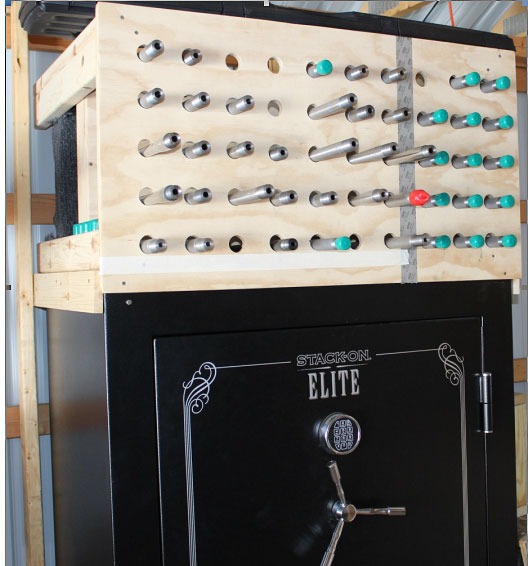
“The Modern Advancements series is basically a journal of the ongoing R&D efforts of the Applied Ballistics Laboratory. The goal of the series is to share what we’re learning about ballistics so others can benefit.” –Bryan Litz
Barrel twist rate along with velocity, atmospherics, and bullet design all combine to result in a Gyroscopic Stability Factor (SG). It’s the SG that actually correlates to BC. The testing revealed that if you get SG above 1.5, the BC may improve slightly with faster twist (higher SG), but it’s very difficult to see. However, BC drops off very quickly for SGs below 1.5. This can be seen in the figure below from Modern Advancements in Long Range Shooting.
The chart shows that when the Gyroscopic Stability Factor (SG) is above 1.5, BC is mostly constant. But if SG falls below 1.5, BC drops off dramatically.
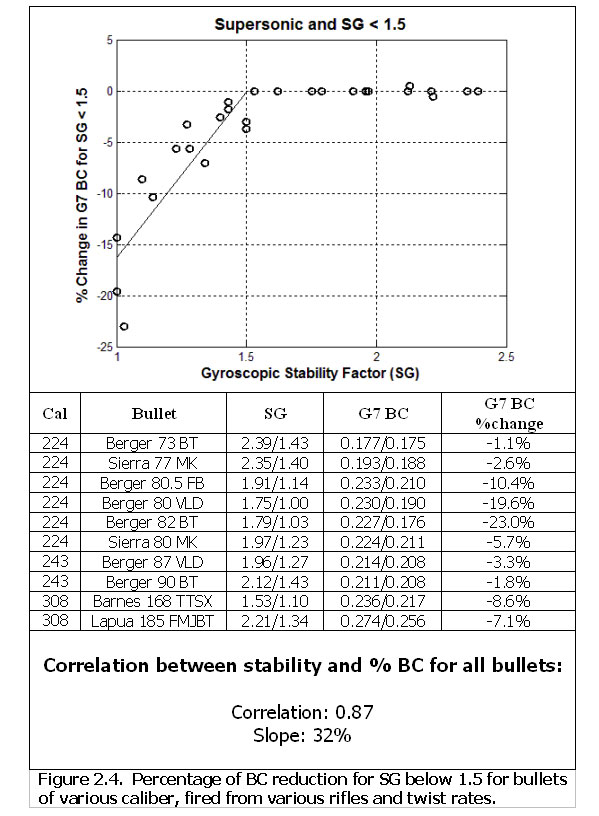
Note that the BC drops by about 3% for every 0.1 that SG falls below 1.5. The data supports a correlation coefficient of 0.87 for this relationship. That means the 3% per 0.1 unit of SG is an accurate trend, but isn’t necessarily exact for every scenario.
It’s a common assumption that if a shooter is seeing great groups and round holes, that he’s seeing the full potential BC of the bullets. These tests did not support that assumption. It’s quite common to shoot very tight groups and have round bullet holes while your BC is compromised by as much as 10% or more. This is probably the most practical and important take-away from this test.
To calculate the SG of your bullets in your rifle, visit the Berger Bullets online stability calculator. This FREE calculator will show you the SG of your bullets, as well as indicate if your BC will be compromised (and by how much) if the SG is below 1.5. With the stated twist rate of your barrel, if your selected bullet shows an SG of 1.5 (or less), the calculator will suggest alternate bullets that will fully stabilize in your rifle. This valuable online resource is based directly on live fire testing. You can use the SG Calculator for free on the web — you don’t need to download software.
Learn More About SG and BC
 This article is just a brief overview of the interrelated subjects of twist rate, Gyroscopic Stability, and BC. The coverage of twist rates in Modern Advancements in Long-Range Shooting is more detailed, with multiple live fire tests. This article is just a brief overview of the interrelated subjects of twist rate, Gyroscopic Stability, and BC. The coverage of twist rates in Modern Advancements in Long-Range Shooting is more detailed, with multiple live fire tests.
Other chapters in the book’s twist rate section include:
· Stability and Drag – Supersonic
· Stability and Drag – Transonic
· Spin Rate Decay
· Effect of Twist rate on Precision
Other sections of the book include: Modern Rifles, Scopes, and Bullets as well as Advancements in Predictive Modeling. This book is sold through the Applied Ballistics online store. Modern Advancements in Long Range Shooting is also available in eBook format in the Amazon Kindle store.
February 3rd, 2015
Guest Article By Michelle Gallagher, Berger Bullets
Let’s face it. In the world of firearms, there is something for everyone. Do you like to compete? Are you a hunter? Are you more of a shotgun shooter or rifle shooter? Do you enjoy running around between stages of a timed course, or does the thought of shooting one-hole groups appeal to you more? Even though many of us shoot several different firearms and disciplines, chances are very good that we all have a favorite. Are we spreading ourselves too thin by shooting different disciplines, or is it actually beneficial? I have found that participating in multiple disciplines can actually improve your performance. Every style of shooting is different; therefore, they each develop different skills that benefit each other.

How can cross-training in other disciplines help you? For example, I am most familiar with long-range prone shooting, so let’s start there. To be a successful long-range shooter, you must have a stable position, accurate ammunition, and good wind-reading skills. You can improve all of these areas through time and effort, but there are other ways to improve more efficiently. Spend some time practicing smallbore. Smallbore rifles and targets are much less forgiving when it comes to position and shot execution. Long-range targets are very large, so you can get away with accepting less than perfect shots. Shooting smallbore will make you focus more on shooting perfectly center shots every time. Another way to do this with your High Power rifle is to shoot on reduced targets at long ranges. This will also force you to accept nothing less than perfect. Shoot at an F-Class target with your iron sights. At 1000 yards, the X-Ring on a long range target is 10 inches; it is 5 inches on an F-Class target. Because of this, you will have to focus harder on sight alignment to hit a center shot. When you go back to the conventional target, you will be amazed at how large the ten ring looks.

Also, most prone rifles can be fitted with a bipod. Put a bipod and scope on your rifle, and shoot F-TR. Shooting with a scope and bipod eliminates position and eyesight factors, and will allow you to concentrate on learning how to more accurately read the wind. The smaller target will force you to be more aggressive on your wind calls. It will also help encourage you to use better loading techniques. Nothing is more frustrating than making a correct wind call on that tiny target, only to lose the point out the top or bottom due to inferior ammunition. If you put in the effort to shoot good scores on the F-Class target, you will be amazed how much easier the long-range target looks when you return to your sling and iron sights. By the same token, F-Class shooters sometimes prefer to shoot fast and chase the spotter. Shooting prone can help teach patience in choosing a wind condition to shoot in, and waiting for that condition to return if it changes.
Benchrest shooters are arguably among the most knowledgeable about reloading. If you want to learn better techniques about loading ammunition, you might want to spend some time at benchrest matches. You might not be in contention to win, but you will certainly learn a lot about reloading and gun handling. Shooting F-Open can also teach you these skills, as it is closely related to benchrest. Benchrest shooters may learn new wind-reading techniques by shooting mid- or long-range F-Class matches.
 Position shooters can also improve their skills by shooting different disciplines. High Power Across-the-Course shooters benefit from shooting smallbore and air rifle. Again, these targets are very small, which will encourage competitors to be more critical of their shot placement. Hunters may benefit from shooting silhouette matches, which will give them practice when shooting standing with a scoped rifle. Tactical matches may also be good, as tactical matches involve improvising shots from various positions and distances. [Editor: Many tactical matches also involve hiking or moving from position to position — this can motivate a shooter to maintain a good level of general fitness.] Position shooters can also improve their skills by shooting different disciplines. High Power Across-the-Course shooters benefit from shooting smallbore and air rifle. Again, these targets are very small, which will encourage competitors to be more critical of their shot placement. Hunters may benefit from shooting silhouette matches, which will give them practice when shooting standing with a scoped rifle. Tactical matches may also be good, as tactical matches involve improvising shots from various positions and distances. [Editor: Many tactical matches also involve hiking or moving from position to position — this can motivate a shooter to maintain a good level of general fitness.]
These are just a few ways that you can benefit from branching out into other shooting disciplines. Talk to the other shooters. There is a wealth of knowledge in every discipline, and the other shooters will be more than happy to share what they have learned. Try something new. You may be surprised what you get out of it. You will certainly learn new skills and improve the ones you already have. You might develop a deeper appreciation for the discipline you started off with, or you may just discover a new passion.
This article originally appeared in the Berger Bulletin. The Berger Bulletin blog contains the latest info on Berger products, along with informative articles on target shooting and hunting.
Article Find by EdLongrange.
February 2nd, 2015
 “A well regulated Militia, being necessary to the security of a Free State, the right of the people to keep and bear Arms, shall not be infringed.” “A well regulated Militia, being necessary to the security of a Free State, the right of the people to keep and bear Arms, shall not be infringed.”
If you’re reading this, you’re probably a firearm owner (most of our Daily Bulletin readers are). But how much do you really know about the history of the Second Amendment to the U.S. Constitution? The Second Amendment itself contains only 27 words (printed above), but those words have a rich history behind them.
To illuminate the origins of the Second Amendment, and to explain how its interpretations have evolved over the years, Arizona Attorney, the journal for the State Bar of Arizona, has published a detailed two-part “Illustrated History” of the Second Amendment by attorney Robert J. McWhirter, an expert on the Bill of Rights.* Part One was just released, and Part Two will be published next month.
CLICK HERE to launch eZine with Second Amendment Story.

We think all gun owners should read McWhirter’s article, which is both entertaining and insightful. Don’t worry — this is not a dull “law school” treatise. McWhirter’s article features dozens of illustrated footnotes (some fascinating, some merely amusing). Here are some sample footnotes — you can see this is a treasure trove of Second Amendment trivia.


*The American Bar Association has just published Mr. McWhirter’s book Bills, Quills, and Stills: An Annotated, Illustrated and Illuminated History of the Bill of Rights.
January 27th, 2015
Many of us dream about taking (and making) a one-mile shot someday. To accomplish this feat, you need a very accurate rifle, ultra-consistent ammo, good logistics, and, of course, the proper location. In their quest to make the mile shot, Kerry Stottlemyer and his uncle Ron headed to the California desert. There they would attempt to “reach out and touch” a target 1760 yards distant. Here is their story….
Shooting at a Mile with a .300 Win Mag (from Sierra Bullets Blog)
My uncle, Ron Stottlemyer, was serious about this trip and this mile shot. He was sparing no expense and assured me that everything would be ready in December to make this shot, the only thing left to risk was the weather. The area we were planning on has some unpredictable winds, but in December it’s pretty calm so we hoped for the best.
After a year of planing, my uncle arrived at the airport with his Remington Sendero in tow, a .300 Win Mag with a Leupold Mk4 LR scope on it. We went to my place to tear down the rifle, thread the barrel and install the muzzle brake I made for him. We worked hard to bed the scope base and remount and bore sight the scope before the weekend.

The rifle: a Remington Sendero in .300 Win Mag with a Leupold Mk4 8.5-24X LR TRM scope, on Talley rings and a badger base. I threaded the barrel and installed the brake that we designed and I made, bedded the action, and bedded the scope base. Bore sighted it, reassembled it and tested everything for function and safety. The powder, primers, brass and bullets (220 gr HPBT Sierra MatchKings #2240) were all purchased online.
With everything packed, we headed out to the California desert to some Bureau of Land Management (BLM) land that would give us enough room to safely stretch the Sendero’s legs (see the photo below). Friday was spent reloading a few rounds at a time to get his scope zeroed, then on to working up loads for the next day’s attempt at 1760 yards (1 mile) (See Photo below).

Photo shows the camp from the target, GPS-located 1.00 miles away. That’s 1760 yards.
Saturday morning arrived and it was time to make breakfast and coffee. Mountain man breakfast in a dutch oven cooked over a camp fire. Bacon, sausage, potatoes, green peepers, onions, eggs, and cheese. Better then any breakfast made at home.
I set up my spotting scope get it dialed in and could immediately see that the wind was going to be an issue. My uncle got the rifle up on the bench, got the bags positioned, dialed the magnification all the way up to 25X on the scope and asked me for the come-ups. I told him to come up 150 clicks and give me two mils right windage.
Walking in the Shots at One Mile
He got set while I watched the wind see it settle into a rhythm and say “send it.” He let one fly and it landed about ten feet left and about 100 yards short. I scratched my head, the wind was doing something funny. I said, “Give me two more mil elevation and another mil right windage.” He let another one fly and this time the bullet struck within feet of the target. Ok, we were getting there – a little more windage and 1/4 mil more elevation. He let another one fly but said he pulled that one.
We battled the wind for the next seventeen shots, getting within a few feet of the target each time. Turned out where the bullet was at its highest point of its path is where the worst of the wind was. He let go of the 19th shot and put that one right at the base of the target! Then he said, “I got this one.” (Meaning he needed no more corrections from me.)
The 20th shot (at a range that the .300 Win Mag has one hell of a time hitting) nailed the target just low and left of center! He did it! He nailed it at one mile with loads I built that day!
To say he jumped for joy is an understatement. He pushed that round further then anyone would have any good excuse to do so. Most would not attempt a shot like that without stepping up to the .338 Lapua, but no, he had it in his head he was going to do it, and he did.

Kerry Stottlemyer loading up the 220 gr boat tail Sierra MatchKings.

January 27th, 2015
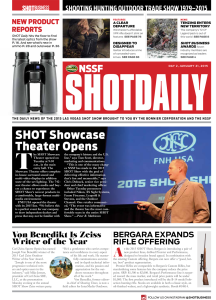
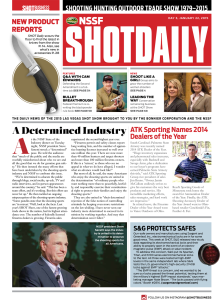
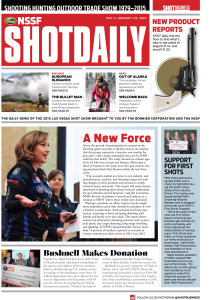
Digital editions of all four issues of SHOT Daily, the magazine printed each day of the SHOT Show, are available free in both Web eZine and downloadable PDF formats. You’ll find many product features plus articles that can benefit shooting club directors and range managers. SHOT Daily is produced for NSSF by Bonnier Corp., publishers of Outdoor Life, Field & Stream, and many other magazines.
|
Highlights Day 1: New Handguns Lead Story, Footwear, Legal Defense of Traditional Ammo, Women of Outdoor Channel, Midnight 3-Gun.
Highlights Day 2: New Optics Lead Story, New Ammunition, Outerwear, Christensen Arms, Volquartsen Custom, CZ Factory, SilencerCo. |
|
Highlights Day 3: New Knives Lead Story, Shooting Accessories, Hunting Rights, Women Shooters, Proof Research, Ultra Light Arms.
Highlights Day 4 eZine: Walt Berger Profile, Steyr Scout, Lena Miculek, Sara Palin Q&A, New Remingtons. |

SHOT Daily Digital Editions
January 23rd, 2015

Gear Report by Kip Staton
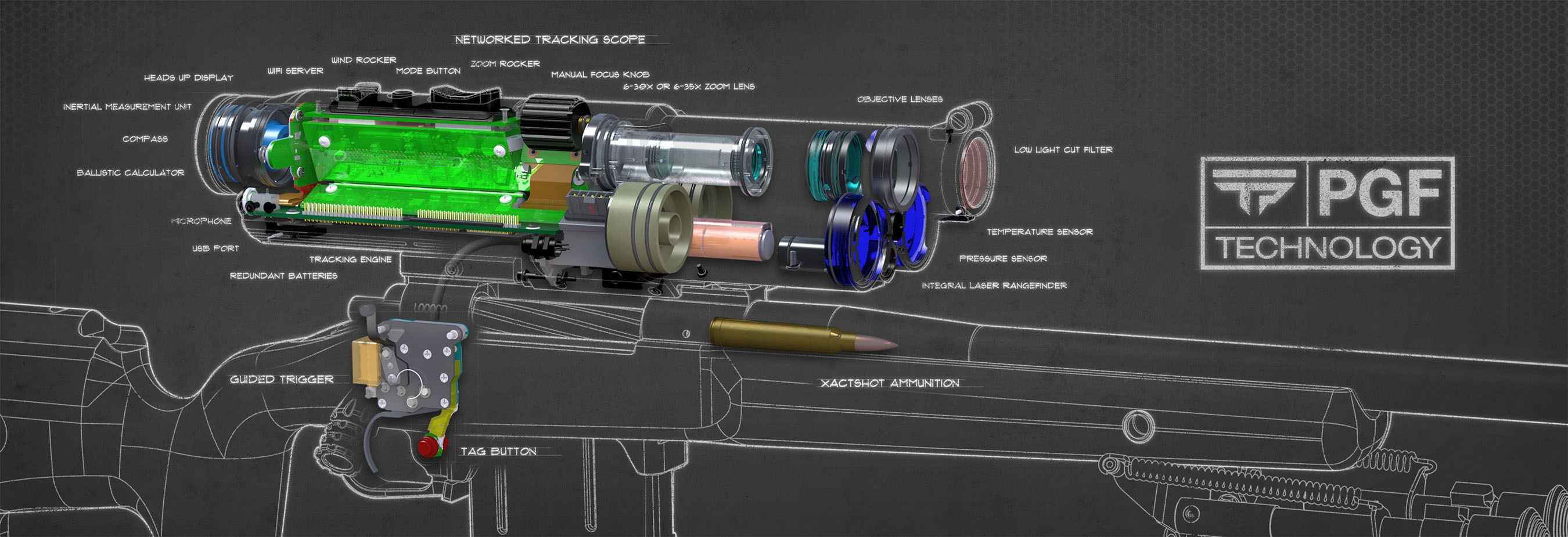
TrackingPoint’s innovative technology has been on the market for a number of years now, and has proven to be a valuable long-range shooting tool. TrackingPoint is a Texas-based, Austin-area applied technology company that developed a unique, precision-guided firearm (PGF) system in 2011. TrackingPoint’s ordinary rifles in common calibers, designated with the XS prefix, are equipped with high-tech “networked tracking” rifle scopes.
CLICK to view full-screen image:

These advanced optics are the heart of the company’s tag-and-shoot technology, and the entire setup is remarkably similar to the systems found in cutting-edge fighter jets. So, how does it work in the real world?
Pretty darn well, as it turns out. The shooter simply finds his or her target, centers his “X” reticle on it, and presses a “tag” button, which is usually integrated into the firearm’s trigger guard. This puts a digital “mark” on the target, and the optic remembers where that particular tag was placed for the duration of the shot. At this point, the system has already automatically performed all necessary distance and environmental calculations. The only other manual inputs needed on the shooter’s part are to enter the wind call, and press the trigger. And, the rifle even helps out with that part.

Because the tag was placed on a unique target, and is remembered by the system, the rifle won’t actually let the shot break until the shooter has lined up the crosshairs with the original tag. So the user may press the trigger, and nothing will happen… until the reticle is placed on the original tag. The rifle will then fire. For each Tracking Point shot, the elevation should be dead on. However the wind can still come into play — the TrackingPoint system does not sense the wind speed or direction. Wind values must be detected by the shooter and entered manually. Once wind speed/angle are entered, the TrackingPoint automatically calculates the needed windage correction (left or right).

The firing process (with the rifle’s brain doing the elevation calculation) can be somewhat disconcerting for shooters new to a PGF. But, this system holds promise, and can help shooters make difficult shots with greater confidence. In particular, the built-in ballistics solver means the trigger-puller no longer needs to worry about elevation clicks and/or hold-overs at any distance. The system calculates bullet drop at any rangeable distance and plots the correct point of aim. “X marks the spot”:

The TrackingPoint system does much more than make long range shots easier to accomplish. The networked tracking scope is also a WiFi server. This means that the image seen through the ocular lens (by the shooter) can be beamed to an Apple iPad, which is included with the rifle. Hunting guides can then see exactly what their clients are viewing through the optic, and make suggestions or provide pertinent advice to the shooter.
If that wasn’t enough, TrackingPoint recently integrated the high-tech Google Glass hardware into their shooting system. By using eyewear with built-in displays linked to the TrackingPoint optic, shooters can make successful shots without looking directly through a rifle-mounted scope. The eyewear has a small display that shows the target(s) “seen” by the rifle’s optic. The operator can then take the shot from any position. You can shoot around a corner, or keep your head and torso out of view. The possibilities for hunters, competitors and real-world tactical shooters are nearly endless.

TrackingPoint’s unique rifle systems are available in both semi-automatic and bolt-action formats, ranging in calibers from .223 (5.56 NATO) to a proprietary .338 of the company’s own design. What do these systems cost? Well high technology does not come cheap. Rifle systems range in price from $7,495 to a staggering $49,995. But, for the right client and the right mission, perhaps no price for this technology is too high. That’s what Tracking Point is counting on….

January 22nd, 2015
We’ll give you a break from SHOT Show coverage by taking you across the Atlantic to Great Britain. There Chris Parkin has been putting a Savage F-TR Rifle through its paces. Chris has reviewed this popular rifle in a field test just published by Target Shooter Magazine. Chris wrote a very detailed and thorough review. If you are considering any factory-based rifle for F-TR competition you should read this article. It is lengthy, but the text and photos are good and it is worth the investment of time.

CLICK HERE to Read Savage F-TR Rifle Review
CLICK HERE to Download Savage F-TR Review as PDF File

|