|
|
February 28th, 2012
German Salazar, a top prone shooter and “head honcho” of the fine RifllemansJournal.com website, has crafted an excellent new article on stock design. Writing for Precision Shooting magazine, German compares traditional stocks, such as the MasterClass Prone, with more modern, modular designs, such as the Eliseo TubeGun and Ross Precision stock. German, who shoots match rifles built with each type of stock, explains the pros and cons of the different designs, and explains how to optimize the stocks’ adjustments for best fit and function. German also explains the best methods to attach and bed an action to each of the designs.
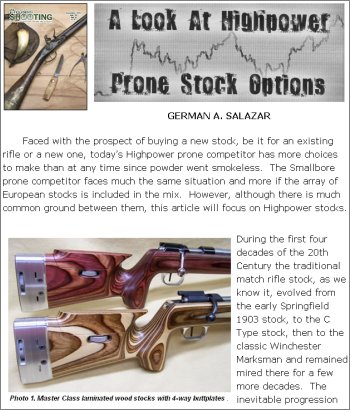

For a limited time, German’s excellent article is available online, courtesy of Precision Shooting Magazine. If you’re a High Power shooter, or you are interested in the design, construction, and engineering of modern competition stocks, this article is a “must-read”.
CLICK HERE to read FULL STORY

February 23rd, 2012
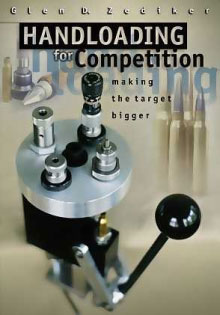 Forum member Danny Reever and this Editor recently discussed how novice reloaders can struggle with the fine points of reloading, making errors in seating depth, bushing choice, or sizing their cases. We agreed that a good resource covering more than “Reloading Basics” is sorely needed. Danny reminded me that Glen Zediker’s excellent Handloading for Competition book has been available since 2002. Danny says this may still be the best guide in print for those getting started in precision reloading, though the book is not without flaws. Forum member Danny Reever and this Editor recently discussed how novice reloaders can struggle with the fine points of reloading, making errors in seating depth, bushing choice, or sizing their cases. We agreed that a good resource covering more than “Reloading Basics” is sorely needed. Danny reminded me that Glen Zediker’s excellent Handloading for Competition book has been available since 2002. Danny says this may still be the best guide in print for those getting started in precision reloading, though the book is not without flaws.
Danny observed: “I consider this still the best book out there on the subject. I’ve bought a lot of other books only to be sorely disappointed after spending $30-$40 of my hard-earned cash. This book is not one of those! I’ve read and re-read Zediker’s treatise at least four times and refer to it often for advice while reloading. My number one suggestion for those who buy the book is to sit down with a highlighter and read it cover to cover. It’s well-written with a bit of humor and it is not boring.”
Extremely comprehensive, Zediker’s book covers nearly all of the key factors involved in accurate reloading: case sorting, brass prep, load development, neck-sizing, full-length sizing, bushing selection/use, tool selection, priming, powder measurement, and bullet seating. The book also explains how to test and evaluate your ammo, and how to monitor and interpret pressure signs.
There are many “must-read” sections in Zediker’s book, according to Danny: “The section beginning on page 161 dealing with concentricity (and how to achieve it) is excellent. Likewise the Load Limits section discussing pressures offers very valuable advice and info. You should also read Zediker’s commentaries about load testing, powders (burn characterics etc.), and the effects of temperature.”

February 13th, 2012
 Rodrigo Rosa is a rising star in the world of High Power shooting. Though he’s been shooting competitively for only four years, he is already a top contender at the national level. In 2011, the young marksman, who now lives and works in New Hampshire, was right up with the leaders at the NRA National High Power Championships. At Perry, Rodrigo finished second in the Across-the-Course phase and finished third in the Long Range National Championship. He was also on the winning 2d Amendment match team with Norm Houle. Over the last couple of years, Rodrigo has lead the field at New England High Power events. He was New Hampshire State Champ in 2010 and 2011, Massachusetts State Champ in 2011, and Mid-Range (and Across-The-Course) Vermont State Champion in 2009. Rosa is also a two-time NE Regional Across-the-Course Champion, winning titles in 2008 and 2011. That’s an impressive shooting resume for a young man who shot his first High Power match in 2008, and had to borrow money to get his first real match rifle. Rodrigo Rosa is a rising star in the world of High Power shooting. Though he’s been shooting competitively for only four years, he is already a top contender at the national level. In 2011, the young marksman, who now lives and works in New Hampshire, was right up with the leaders at the NRA National High Power Championships. At Perry, Rodrigo finished second in the Across-the-Course phase and finished third in the Long Range National Championship. He was also on the winning 2d Amendment match team with Norm Houle. Over the last couple of years, Rodrigo has lead the field at New England High Power events. He was New Hampshire State Champ in 2010 and 2011, Massachusetts State Champ in 2011, and Mid-Range (and Across-The-Course) Vermont State Champion in 2009. Rosa is also a two-time NE Regional Across-the-Course Champion, winning titles in 2008 and 2011. That’s an impressive shooting resume for a young man who shot his first High Power match in 2008, and had to borrow money to get his first real match rifle.
Rodrigo tells us: “I had a good year in Camp Perry in 2011. My goal was only to perform well in the across-the-course event, so taking second place after Carl Bernosky by only 3 points and taking third place in the Long Range event was a real treat.”
What was the “secret” of Rosa’s meteoric rise from rookie shooter to podium performer at Camp Perry? Rodrigo replied: “Key factors? I would have to say dry-fire practice, and working on consistency and the ‘mental game’. I spent many hours dry-firing last winter, particularly working on my off-hand position. Despite such training my technique was still flawed at the beginning of the year. I could dry-fire very well but the results did not show on target. I believe that my ability to finally build a mental sequence that allows me to perform the same movements time-and-time again, on demand, made the greatest difference on my results.”
Interview with Rodrigo Rosa — Born to Shoot
We had the opportunity to chat with Rodrigo. He told us how he got started in competitive shooting. He then discussed his shooting techniques and his reloading methods. At our request, Rodrigo offers some tips for new sling-shooters. Rosa also revealed his preferences in hardware and shooting gear.


AccurateShooter: Rodrigo, tell us about your background. How did you get involved in shooting?
Rosa: I grew up on a farm in Brazil. When I was about 11 years old my mom bought me an air rifle, and I later inherited my grandpa’s Winchester .22LR. I hunted many rabbits and ducks with that rifle until I was 17 years old when my studies became more important. I traveled to the USA in late 2004 to finish my Veterinary clinical training at Cornell University, where I met my wife-to-be. We got married in 2005 and moved to California for internships. It wasn’t until early 2007 when I decided to buy a rifle and join a gun club. All I could afford was a simple .308 hunting rifle. With the .308, I tried (with limited success) to hit small metal silhouettes at 600 yards. Despite my limited success I decided to educate myself about the shooting sports, predominantly by reading books by David Tubb and Nancy Tompkins, as well as foreign publications.
My wife Kate and I moved to New Hampshire in 2007, when I decided to take a personal loan to buy a better rifle, suited for High Power competition. I joined the Nashua NH Fish and Game Association and started to work on my skills. In late 2010 I met Norm Houle who became a good friend and gave me extra motivation to stay in the game.
AccurateShooter: What are your strengths and what are the areas where you need improvement. What training methods do you use to improve those weak points?
Rosa: My strengths are my ability to concentrate, attention to detail and perseverance. The areas I tend to work on the most are my mental systems. I know I am able to shoot a perfect score in any yard line and shooting position, so I spend most of my time coming up with ways to make my shooting sequence as meticulous and repetitive as possible. I believe I still have a lot of work to do….
AccurateShooter: What are the best and worst things about competing at Perry?
Rosa: 2011 was my second year competing in Perry (I also started the match in 2009 but had to leave early for a family issue). I had one of the best weeks of my life! Perry is a wonderfully beautiful and challenging range, and the friends I had the pleasure to share my time with were the highlight of the trip. From previous experience, I would say that the heat and humidity are the worst things
about Perry, but 2011 gifted the competitors with amazingly pleasant weather.

AccurateShooter: Rodrigo, do you have any tips for novice High Power shooters?
Rosa: Start by investing in good equipment — buy quality and you will buy it only once. Seek the advice of successful shooters. All truly good shooters will be glad to share their “secrets”, for it is only worth winning when all competitors can shoot their best. Develop a safe, reasonably good load for your cartridge and quit messing with it! If you already have an accurate rifle your time is much better spent working on your hold than on developing loads. Be ready! Develop checklists, plans, mental sequences. The less you can worry about, and the more prepared you are for adverse situations at the firing line, the better your chances will be.
AccurateShooter: Speaking of load development, tell us what load you shoot, and what methods you use to create accurate ammo.
Rosa: I shoot the 6mmXC cartridge Across-the-Course and Long-Range (except for Palma, of course). I use Federal 210M primers, Norma brass, Hodgdon 4350 powder, Sierra 70gr bullets for 200 yards and DTAC 115gr bullets from 300 to 1000 yards. My loads are: 39.5 grains H4350 with the Sierra 70gr; 37.5 grains H4350 with DTAC 115gr for 300 yards; and lastly, for Mid-Range and Long-Range, I use a stout H4350 load with the DTAC 115s. (Editor: Start at 37.0 grains H4350 and work up with the 115s; Rodrigo’s long-range load is near max).
The most important steps of my reloading are accurate load weighing (I weigh ALL loads) and bullet selection. I select all the bullets I shoot from 600 to 1000 yards by bearing surface and length. I do not spend any time doing elaborate load testing (and re-testing). All I care about is having a reasonably accurate load that functions smoothly in my rifle.

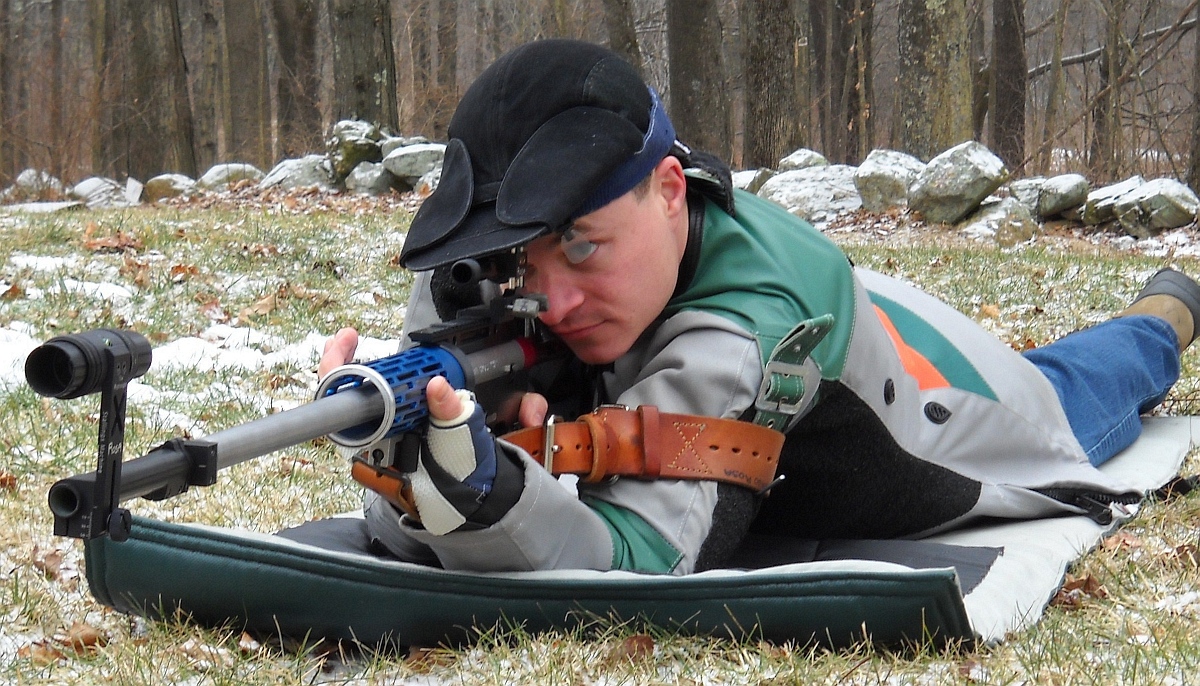
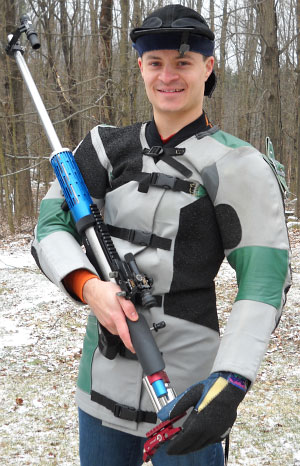 AccurateShooter: Tell us about your shooting coat and sling. Do you have any advice concerning coat fit and sling adjustment? AccurateShooter: Tell us about your shooting coat and sling. Do you have any advice concerning coat fit and sling adjustment?
Rosa: I currently wear a Monard shooting coat. Proper fit is fundamental for anyone who wishes to be competitive in any category of position rifle shooting, and the folks at Monard certainly have got that down. My advice to anyone who is going to invest hard-earned money in a coat is to make sure that the maker uses at least 15 different measurements of his/her body. Anything less than that is not acceptable in my opinion. I also prefer the stiffness and coolness of canvas over leather. Leather tends to mold better to ones body but softens and shrinks when wet. Since High Power shooters must often shoot in the rain I believe that canvas is a more durable and stable material. For a sling I always used the Superior Shooting Systems Heart Breaker Sling. This is an extremely well-made sling crafted to last many decades. It is important to cut the new sling to fit one’s arm diameter so that the “hinge” is located between the arm and the hand. I did not know this important “trick” for the longest time until David Tubb called my attention to it at Perry last year.

AccurateShooter: You shoot a Tubb 2000 match rifle. Tell us the features of the T2K you really like, and explain how you set up the sights and buttstock for different positions.
Rosa: The Tubb 2000 rifle is the only rifle I have ever shot Across-the-Course. It is an extremely user-friendly gun that truly allows the shooter to extract all that a competitive target rifle can offer. I used to have only one buttstock and was therefore forced to make adjustments between shooting positions. Now I have three buttstocks individually set up for each position — a major asset in my opinion. My off-hand buttstock is probably the least orthodox of the three. It has a good deal of added weight to help balance the gun and a very narrow buttplate. I like the narrow buttplate because it fits my small shoulder better. This plate is, however, kept mostly flat (very shallow curvature) in order to comply with NRA rules (less than 1/2 inch depth).
Canting — I truly enjoy the ability to cant the T2K rifle to fit my body. Anyone who watches me shooting seated will notice that I use a great amount of canting in that seated position. Canting is a major asset and can greatly improve most shooter’s position by increasing comfort. The key thing with canting is you must be consistent with the amount of cant you use (hint: learn how to use a bubble level).
Forearm — I have shortened the tubular handguard/fore-end of my rifle in order to improve balance as well. People occasionally ask me: Didn’t you get nervous about cutting such an expensive rifle? (I had taken a loan to buy the rifle and it wasn’t even paid for yet). My answer was “Not at all!” My philosophy is that if something does not fit you or does not do the job for which it was intended, then you MUST act on it. It is pointless to have a rather costly piece of machinery if it does not lead to 10s and Xs.
Sights — I use a Warner #1 rear sight and a “Right Sight” in the front. I currently use the “Houle Tube” sight extension tube (bloop tube) made by Norm Houle. This bloop tube has been a major improvement. It lets me have a short, balanced gun for off-hand and a long gun for sling-supported positions. I must admit that I did not believe these extension devices would repeat zero until I tried one. The Houle Tubes are incredible. These extensions come in 2″, 4″ and 6″ lengths and repeat zero flawlessly every time.
Gunsmithing — Dick Beaudoin from Derry, NH has done most of the customization work on my rifle. I want to give him credit. His patience and attention to detail has made all the difference.
Editor’s Comment: We thank Forum member Rodrigo Rosa for taking the time to share his knowledge with our readers. He is a very talented, yet humble young shooter who works diligently on his game. We have no doubt that one day we will see Rodrigo standing on top of the podium at Camp Perry. Boa sorte Rodrigo, we wish you 10s and Xs and continued success…
February 7th, 2012
 Past F-Open Class National Champion (and Forum Member) Larry Bartholome, has authored an authoritative article on the 2011 F-Class National Championship held last fall in Lodi, Wisconsin. Larry writes: “With a wind tunnel for a range, and rain that canceled the final team match, only the strongest stood on the winners’ podium when the Championships ended”. Larry provides a day-by-day guide to the match, with complete results for both F-Open and F-TR classes. You’ll find Larry’s article in the February 2012 edition of Shooting Sports USA. Past F-Open Class National Champion (and Forum Member) Larry Bartholome, has authored an authoritative article on the 2011 F-Class National Championship held last fall in Lodi, Wisconsin. Larry writes: “With a wind tunnel for a range, and rain that canceled the final team match, only the strongest stood on the winners’ podium when the Championships ended”. Larry provides a day-by-day guide to the match, with complete results for both F-Open and F-TR classes. You’ll find Larry’s article in the February 2012 edition of Shooting Sports USA.
You can read, for FREE, the digital version of Shooting Sports USA. CLICK HERE to read Larry’s article (pp. 20-22). Along with the report on the F-Class Nationals, there are many other items of interest in the February edition of Shooting Sports USA. You’ll find a 14-page 2012 Event Calendar that covers NRA competitions all across the country.

 In addition, this month’s edition features a well-written, 4-page Guide to Field Target Competition by Jock Elliot. Field Target is a form of outdoor silhouette shooting using high-tech PCP Air Rifles with high-magnification scope. Check out the special Marauder Hybrid bullpup used by Team Crosman member Ray Apelles in the photo below. These high-end rigs are not cheap. A “full-race” Open Class Field Target rifle can cost up to $3000.00 with another $1000.00-$3000.00 for optics. In addition, this month’s edition features a well-written, 4-page Guide to Field Target Competition by Jock Elliot. Field Target is a form of outdoor silhouette shooting using high-tech PCP Air Rifles with high-magnification scope. Check out the special Marauder Hybrid bullpup used by Team Crosman member Ray Apelles in the photo below. These high-end rigs are not cheap. A “full-race” Open Class Field Target rifle can cost up to $3000.00 with another $1000.00-$3000.00 for optics.

January 28th, 2012
Many readers will be driving across multiple states this spring and summer to attend competitions. Other shooters will be heading out of state for a game hunt or to spend a week in the prairie dog fields. For $13.95 you can purchase a state-by-state Traveler’s Guide to firearms laws. Written by a lawyer, this 68-page guide covers all firearms types and all 50 states. It even has info for Canada and Mexico. The latest edition of the Traveler’s guide, updated with 85 changes for 2012, has just been released.

CLICK HERE for Sample Page.
 The Traveler’s Guide to the Firearm Laws of the Fifty States has sold more than 900,000 copies since it was first released in 1996. The book’s author, Attorney J. Scott Kappas, has written numerous magazine articles and has appeared on television, explaining the unexpected pitfalls that shooters may encounter when traveling with firearms. Along with being an attorney, Mr. Kappas serves as a director on the Board of the Kentucky Firearms Foundation, and Kappas is a Class III firearms dealer. The Traveler’s Guide to the Firearm Laws of the Fifty States has sold more than 900,000 copies since it was first released in 1996. The book’s author, Attorney J. Scott Kappas, has written numerous magazine articles and has appeared on television, explaining the unexpected pitfalls that shooters may encounter when traveling with firearms. Along with being an attorney, Mr. Kappas serves as a director on the Board of the Kentucky Firearms Foundation, and Kappas is a Class III firearms dealer.
The Traveler’s Guide is especially useful for shooters traveling in RVs and motorhomes. The American Rifleman Magazine declared: “This book is a must-have for truck drivers, motor home enthusiasts, campers and other travelers…easy to read and understand, well-organized and concise….” One reader from Texas adds: “I used to think that my RV was the same as my home when it came to gun carry….the Traveler’s Guide set me straight. Now I know my motorhome is subject to the same laws as any vehicle when it comes to guns.”
January 5th, 2012
Americans of all walks of life are purchasing more pistols, rifles, and shotguns than ever before. Based on NSSF-adjusted FBI background check (NICS) records, American purchased 10,791,275 firearms in 2011. That’s an all-time record, and a 14% increase over 2010. Gun sales hit a new high in 2011 after a decade of steady increases (see chart). In 2002, ten years ago, slightly less than 7,000,000 firearms were sold. The 2011 sales figure represents a 54.1% increase over 2002 sales. And the NICS figures are conservative, because they do not report multiple gun sales made with a single background check.

Gun Ownership Becomes More Universal
The increase in gun sales over the last ten years reflects growth in the ranks of gun owners. A significant percentage of recent sales have been made to first-time gun owners. And more women are arming themselves. Gun ownership is becoming more universal, not limited to the traditional groups of male hunters and sportsmen. A recent Gallup Poll found that: “47 percent of American adults currently report that they have a gun in their home or on their property”.
 First-time buyers and women are driving the spike in gun sales. USA Today reports: “Some gun industry analysts attributed the unusual surge to a convergence of factors, including an increasing number of first-time buyers seeking firearms for protection and women who are being drawn to sport shooting and hunting.” Confirming that view, Bloomberg.com states that more women, liberals, and Democrats are buying guns. Multiple factors are at work according to CNBC.com: “Uncertainty in a presidential election year. Warriors returning from the battlefields. The comeback of the hunter. These are just some of the reasons… why firearms makers are ringing in 2012 like gangbusters.” First-time buyers and women are driving the spike in gun sales. USA Today reports: “Some gun industry analysts attributed the unusual surge to a convergence of factors, including an increasing number of first-time buyers seeking firearms for protection and women who are being drawn to sport shooting and hunting.” Confirming that view, Bloomberg.com states that more women, liberals, and Democrats are buying guns. Multiple factors are at work according to CNBC.com: “Uncertainty in a presidential election year. Warriors returning from the battlefields. The comeback of the hunter. These are just some of the reasons… why firearms makers are ringing in 2012 like gangbusters.”
Gallup Gun Ownership Poll Summary
“A clear societal change took place regarding gun ownership in the early 1990s, when the percentage of Americans saying there was a gun in their home or on their property dropped from the low to mid-50s into the low to mid-40s and remained at that level for the next 15 years. Whether this reflected a true decline in gun ownership or a cultural shift in Americans’ willingness to say they had guns is unclear. However, the new data suggest that attitudes may again be changing. At 47%, reported gun ownership is the highest it has been in nearly two decades — a finding that may be related to Americans’ dampened support for gun-control laws. However, to ensure that this year’s increase reflects a meaningful rebound in reported gun ownership, it will be important to see whether the uptick continues in future polling.”
The NSSF adjusts NICS data by subtracting out NICS purpose-code permit checks used by several states such as Kentucky, Iowa and Utah for CCW permit application checks as well as checks on active CCW permit databases. In addition to other purposes, NICS is used to check transactions of firearms sales and transfers on new and used handguns and long guns. For more NICS info visit the NICS website.
Photo by KapapCombative.com.
January 3rd, 2012
 Target Shooter Magazine has released its web-based January 2012 Issue. The FREE January Issue features handy reloading guides (written by Laurie Holland) for two very popular cartridges: 6mmBR Norma, and .308 Winchester. If you shoot either of these chamberings, you should read these latest installments of Laurie Holland’s Handloading Bench series. For the January issue, Laurie also authored Sorting a Savage Part 1 which covers the Savage-actioned .223 Rem that Laurie shot in the European F-Class Championship. Savage shooters will find useful tuning tips. Target Shooter Magazine has released its web-based January 2012 Issue. The FREE January Issue features handy reloading guides (written by Laurie Holland) for two very popular cartridges: 6mmBR Norma, and .308 Winchester. If you shoot either of these chamberings, you should read these latest installments of Laurie Holland’s Handloading Bench series. For the January issue, Laurie also authored Sorting a Savage Part 1 which covers the Savage-actioned .223 Rem that Laurie shot in the European F-Class Championship. Savage shooters will find useful tuning tips.
Gear and Optics Reviews
Other good articles in January’s Target Shooter Magazine include a comprehensive review of the Lyman DPS 1200 III powder dispenser, and an excellent article about riflescopes by Gwyn Roberts. Gwyn explains the many choices in reticle design, and he discusses the pros and cons of adjustable front objectives vs. side-focus scopes.

If you haven’t sampled Target Shooter Magazine yet, you should. The hardware photography is high quality and there is something for everyone — from Benchresters to Tactical shooters. You can view the 92-page December issue for FREE at www.targetshooter.co.uk. Target shooter also has an iPad/iPhone friendly version that can be downloaded.
January 1st, 2012
 We wish all our readers a happy, safe, and prosperous New Year. We hope that, in 2012, you’ll enjoy your precision rifles, spending “quality time” at the range with friends who share your “addiction to accuracy”. We’ve made major upgrades to our Shooters’ Forum this year, and our audience is bigger than ever. We hope you’ll continue to enjoy our feature articles, our Daily Bulletin, our match reports, and our Free Forum Classifieds. We wish all our readers a happy, safe, and prosperous New Year. We hope that, in 2012, you’ll enjoy your precision rifles, spending “quality time” at the range with friends who share your “addiction to accuracy”. We’ve made major upgrades to our Shooters’ Forum this year, and our audience is bigger than ever. We hope you’ll continue to enjoy our feature articles, our Daily Bulletin, our match reports, and our Free Forum Classifieds.
Forum Membership Grows 23%
We experienced big growth in our Forum this past year. Membership grew by 23% as member ranks swelled from just under 13,000 members to over 16,000 members! The Forum Classifieds section, with an effective seller/buyer feedback system, is more active than ever.

Rifle by Long Rifles Inc. (Chad Dixon), photo by Robert J Anderson.
Daily Bulletin Is a Big Hit
The AccurateShooter Daily Bulletin has become a “must read” for anyone interested in serious rifle accuracy. In the Bulletin you’ll find money-saving sale notices, timely match reports, and a host of reloading and accurizing tips. And the Bulletin has become THE source for exclusive “scoops” on new product and new shooting technologies. Eric Stecker of Berger Bullets says “You guys have become the ‘USA Today’ of the precision shooting market.” 365 days a year we offer a unique combination of shooting tips, gear reviews, industry news, and highlighted bargains and special sales.
Big Plans for 2012 — With Your Help…
In the months ahead we plan to release more Cartridge Guides, more Gun Profiles, and some major gear comparison tests. We also hope to do audio interviews (“podcasts”) with top shooters such as Carl Bernosky, Sam Hall, and John Whidden. And we’ll continue to offer serious field tests and inside “scoops” on the latest precision shooting products.

We need your support. For over seven years the site has relied largely on volunteer efforts by dedicated shooters. But as the site grows, adding new types of content and more sophisticated features, we need the assistance of professional gunsmiths, writers, and movie editors. Those guys don’t work for glory alone.
For the site to continue to deliver more cutting-edge content, we need to bring in paid helpers. Right now, the site reaches over 100,000 shooters every WEEK. If the majority of those users could provide a small donation every year, we could deliver more stories, more tests, more Gun of the Week features, and more videos.
 In the past quarter about 50 site users have generously donated to the site. I want to again thank all those who have contributed (at any time). But that still leaves tens of thousands of users who access the site regularly without contributing. In the past quarter about 50 site users have generously donated to the site. I want to again thank all those who have contributed (at any time). But that still leaves tens of thousands of users who access the site regularly without contributing.
Here’s our proposal. First, if you have used our FREE Classifieds to successfully sell your rifles or shooting gear, consider sending in a dollar or two from your sale proceeds. Second, for those who use the site regularly, consider donating One Dollar a Month. That’s less than the price of a cup of coffee and much less than many websites now charge for their “premium content areas”.
Consider this — what do you pay for a movie ticket these days? Probably $8.50 or more for 90 minutes of escapism. For a buck a month ($12 a year) you can help this site provide a YEAR’s worth of info, tests, and shooting news that you won’t find anywhere else.
| How to Contribute
Making a donation to the site is simple and easy. Just click on the “Donate Button” at right. If you have a credit card, you don’t need a Paypal account to contribute. Any sum is welcome — donations need not be large. |
Help Support this Site by Making a Secure Donation.
|
If you don’t like Paypal, you can send a check. Make the check payable to our Asst. Editor Jason Baney. Please list your Forum Log-In Name (if any), and mail the check to:
Jason Baney
P.O. Box 105
Montoursville, PA 17754
January 1st, 2012
Serious shooters spend lots of time in the reloading room. If you want to produce great ammo, start with a good, solid bench with a very rigid working surface and plenty of storage space. Here we present three sets of FREE workbench plans. Any one of these bench designs can be a good winter do-it-yourself project for those with basic word-working skills.
Easy-to-Build Basic Bench
Simpson, maker of Strong-Tie fasteners, offers FREE Workbench Plans for a sturdy, 48″-wide bench with a pegboard backing and both upper and lower shelves. A complete list of fasteners and cut lengths is provided. For use as a loading bench with mounted presses, double-up the bench-top for extra ridigity. Without much difficulty, the plans can be adapted to build a wider bench if you prefer. The same downloadable document also contains plans for an 80″-high 6-shelf unit, a 72″-high heavy-duty shelving unit (with 4 shelves), and a 48″-wide heavy-duty table.

FREE Strongtie Bench Plans (.pdf file).
Corner Bench with Swinging Doors
The next design is rather unique — a corner bench with swing-out cabinets. This reloading bench is based on plans by M. L. McPherson as published in the October 1993 American Rifleman. The compact footprint that makes good use of corner space that is usually poorly utilized. This set of plans originally came from Ray-Vin.com. The folks who started Ray-Vin have retired, but you can still purchase many Ray-Vin products at SB Sales & Distributing.
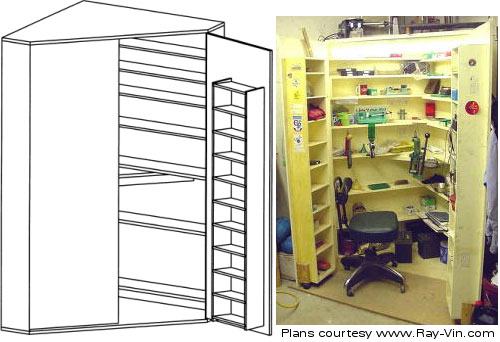
FREE Corner Bench Plans (330kb .pdf file)
Classic NRMA Bench with Cabinets
The last bench design is a large, versatile bench with a full set of enclosed overhead cabinets. A National Reloding Manufacturers Association (NRMA) design, this bench requires many hours to build, but it will house all your reloading gear and provide a very stable platform for your presses.This bench was designed to be as versatile as possible to meet the needs of most reloaders. However, the bench design can easily be customized. For instance, it can be made larger or smaller to meet space requirements or quantities of equipment and components. As it is currently designed, the work area is about waist-high for a 6’2″ person. This can be adjusted to fit your height simply by making the legs longer or shorter.

FREE NRMA Reloading Bench Plans (2.42 megabyte .pdf file).
December 28th, 2011
 Are factory rifles really more accurate than ever? This question is examined in the December issue of SHOT Business. In this issue you’ll also find a good discussion of modern bullet design. In his article Whatever Happened to Bad Bullets?, author David E. Petzal explores why and how bullet performance has improved in recent years. You’ll find plenty of other interesting content in SHOT Business magazine, including numerous gear reviews, retail selling advice, recent news briefs, ATF Q&A, and much more. Are factory rifles really more accurate than ever? This question is examined in the December issue of SHOT Business. In this issue you’ll also find a good discussion of modern bullet design. In his article Whatever Happened to Bad Bullets?, author David E. Petzal explores why and how bullet performance has improved in recent years. You’ll find plenty of other interesting content in SHOT Business magazine, including numerous gear reviews, retail selling advice, recent news briefs, ATF Q&A, and much more.
The latest issue of SHOT Business magazine is now available for FREE online. You can either read the feature stories in a conventional web layout at Shotbusiness.com, or view the magazine-style ePaper version. This takes longer to load, but you can see larger photos, and flip from page to page like a conventional print magazine.

|