|
|
May 29th, 2012
 The June Digital Edition of GUNS Magazine is now available for free online. Just click this link to view the June Edition. NOTE: When the log-in screen appears, simply click the “CONTINUE” button. You do NOT have to fill in your name or email address. You can also read previous monthly editions by clicking on the Archive Tab. The last three (3) years of GUNS Magazine can be accessed for FREE online. The June Digital Edition of GUNS Magazine is now available for free online. Just click this link to view the June Edition. NOTE: When the log-in screen appears, simply click the “CONTINUE” button. You do NOT have to fill in your name or email address. You can also read previous monthly editions by clicking on the Archive Tab. The last three (3) years of GUNS Magazine can be accessed for FREE online.
Articles by Jake Gottfredson in June Edition
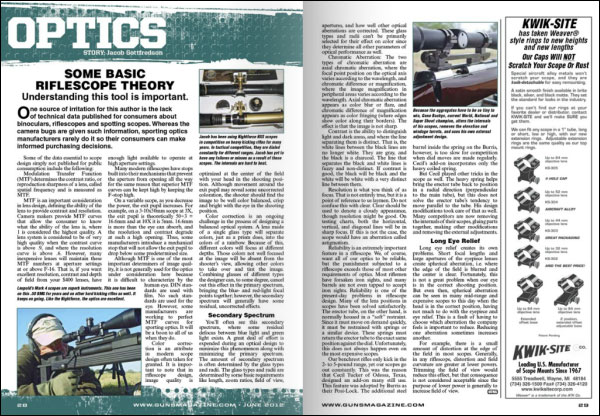
The June Edition of GUNS Magazine contains two interesting articles by our friend (and AccurateShooter contributing writer) Jacob (“Jake”) Gottfredson. In the first article, Some Basic Riflescope Theory, Gottfredson identifies key principles of optics and shows how they apply to riflescope design and construction. He explains the term “Modulation Transfer Function” (MTF), and how this can be used to quantify both contrast and resolution. The author also explores the topics of color correction, chromatic aberration, and color fringing. Jake notes how color correction and focus precision are directly related. Jake also explains the difference between “clarity” and “resolution”. You can have a scope with good clarity but poor resolution or vice-versa. If a scope shows cloudiness it lacks clarity. If the scope can’t show a test grid in sharp focus, it lacks resolution. There are many other important insights Jake provides in this well-written article. We recommend you read the article and perhaps event print it out for future reference. If you are shopping for an expensive scope, Jake provides specific criteria by which you can judge a scope’s quality and repeatability.
600-Yard Playing Card Shoot — Tiny Target, Far Away
The second offering by Gottfredson in the June issue of GUNS Magazine, is an entertaining report about a 600-yard fun shoot using playing cards. Regular-sized 2.5″ x 3.5″ playing cards with a 3/4″ red dot are placed in the center of an 8.5″ x 11″ target sheet. To help aiming, the target sheets have a black ring about 5″ in diameter. After a sighter session, shooters are allowed 10 shots in 7 minutes from 600 yards. That’s a pretty tough challenge, but with a very accurate rifle, multiple card hits are possible. Jake reports that, at his “card shoot”, the two top competitors, Gary Chaney and Andrew Smith, each hit the card six (6) times, with Gary breaking the tie by hitting the 3/4″ red dot. If this sounds like fun, read the full story, and perhaps you can set up a similar match at your shooting club. Gottfredson even includes “10 Tips for Success” such as: “7. Shoot fast, trying to get all rounds downrange in the same wind. Stop when it changes and wait for it to return or hold off if it does not….”

In addition to two Gottfredson articles, the June Edition of GUNS Magazine has a helpful feature on the .243 Winchester by John Barsness. This provides a short history of the cartridge and Barsness discusses 6mm bullet options for hunters using the .243 to harvest game.
May 14th, 2012
The May 2012 edition of Target Shooter Magazine is now available for online viewing. This issue is full of informative articles, with excellent photography. If you prefer the convenience of print magazines, you’ll like Target Shooter’s “eZine” format. Target Shooter displays like a print magazine — so you can enjoy large, wide-format photos, and you can flip pages just like a regular magazine. There is also a handy index (just like a print mag) so you can quickly access all the articles of interest. This month there is an excellent, detailed review of the March-FX 4-40x56mm First Focal Plane (FFP) riflescope. The reviewers were very impressed with this new optic: “It looks like it will set a new benchmark for FFP scopes[.]”

In his article “An Affordable F-TR Rifle?”, talented writer Laurie Holland examines a variety of entry-level F-TR solutions including Savages, Remingtons, and AR-platforms. Laurie explains how the F-TR shooter can get the most “bang for his buck”.

As with every issue of Target Shooter, you’ll find plenty of information on both Benchrest and ‘belly-benchrest’ competition. This month Les Holgate supplies a special report on F-Class shooting in the UK. This article has great photos from the scenic Diggle Ranges.

Tactical Shooters will be pleased to find a field test of the impressive, yet affordable Savage model 10 BA, chambered in .308 Winchester. Author Chris Parkin writes: “The Model 10 BA is a straightforward… bolt-action, magazine-fed rifle in the ‘Jack of All Trades’ .308 Win chambering. Its robust build shows great ergonomic adjustability.”

May 5th, 2012
The folks at the Civilian Marksmanship Program (CMP) say that Hatcher’s Book of the Garand is a must-read for M1 Garand shooters, historians, and collectors. Available in both paperback and hardback editions, this book was written by Maj. Gen. Julian Hatcher, Technical Editor for the American Rifleman magazine. The Book of the Garand is Hatcher’s first-hand account of the U.S. War Department’s search, testing, manufacturing, and distribution of the M1 Garand.

CLICK HERE for Paperback Edition, $17.99 | CLICK HERE for Hardback Edition, $24.99
If you purchase this book, you’ll be helping out the CMP. When ordering from the links above, which connect to the Canton Street Press website, CMP will receive 10% of book sale proceeds.
May 3rd, 2012


 Recently, an AccurateShooter team including contributing writer German Salazar visited the Nammo Talley facility in Mesa, Arizona. We were given access to the new Rimfire Service Center and the .338 Lapua Magnum loading facility. The Rimfire Service Center is a brand new facility dedicated to supporting top-level rimfire shooters in all disciplines, including Prone, 3-Position, Silhouette, Benchrest and more. Lapua has over 2 million rounds of various grades of match ammunition on hand for shooters to test and purchase. The RSC has a 100-meter test tunnel where groups are measured under ideal conditions with electronic sensor-equipped “paperless” target frames placed at 50 meters and 100 meters. Shooters can make appointments to visit the center and test ammo in their own rifles. A detailed report on the RSC has just been released on German’s Rifleman’s Journal website. Recently, an AccurateShooter team including contributing writer German Salazar visited the Nammo Talley facility in Mesa, Arizona. We were given access to the new Rimfire Service Center and the .338 Lapua Magnum loading facility. The Rimfire Service Center is a brand new facility dedicated to supporting top-level rimfire shooters in all disciplines, including Prone, 3-Position, Silhouette, Benchrest and more. Lapua has over 2 million rounds of various grades of match ammunition on hand for shooters to test and purchase. The RSC has a 100-meter test tunnel where groups are measured under ideal conditions with electronic sensor-equipped “paperless” target frames placed at 50 meters and 100 meters. Shooters can make appointments to visit the center and test ammo in their own rifles. A detailed report on the RSC has just been released on German’s Rifleman’s Journal website.
CLICK HERE for Rimfire TEST CENTER ARTICLE.
.338 Lapua Manufacturing and Testing
The .338 Lapua Magnum facility is a super-sized version of the rimfire facility. With a 300-meter tunnel and pressure testing equipment on hand, Nammo’s engineering and loading staff have the ability to develop perfect loads for government clients with a variety of specific requirements. The loading facility has equally impressive technology and is well worth reading about. CLICK HERE to read German’s article about the .338 LM facility.

AccurateShooter.com will have more information on these two state-of-the-art facilitites, including video footage in the coming weeks. So stay tuned!
March 28th, 2012
American Rifleman Magazine is now available in a web-friendly online version. The eZine version of American Rifleman navigates like a conventional print magazine — so you start with an index at the front and you can flip pages from front-to-back. You can also navigate with thumbnails (on the left) and zoom in and out if you find items of interest. Those who prefer reading articles in a magazine-style format should enjoy the American Rifleman digital eZine.

 Excellent Article about Norma Excellent Article about Norma
In the lastest April digital edition of American Rifleman (on page 122), you’ll find “A Century of Bullets and Brass”, a fascinating 20-page history of the Norma company. Founded by the Enger brothers from Norway, Norma started producing boat-tail 6.5mm bullets in 1902. Using once-fired brass, Norma began loading 6.5×55 ammunition in 1914, and the company started making its own Norma-headstamp cartridge brass in 1917.
Other highlights of the April 2012 edition include:
- Interviews with Top Shot Winners Dustin Ellermann and Chris Reed (p.144).
- Review of the new Sig Sauer 224 compact pistol by Field Editor Wiley Clapp (p. 94).
- Discussion of the “Castle Doctrine” which allows citizens to defend home and family (p. 30).
- Previews of new Guns, Optics, and Gear at NRA Annual Meetings and Exhibits in St. Louis.
March 20th, 2012
 The Sporting Arms and Ammunition Manufacturers’ Institute (SAAMI) issued the following statement: The Sporting Arms and Ammunition Manufacturers’ Institute (SAAMI) issued the following statement:
SAMMI, a registered United Nations non-governmental organization (NGO) with roster status, has taken the regrettable but necessary step of withdrawing any reference of SAAMI association from the U.N. agency project to create “International Small Arms Control Standards (ISACS).”
The goal of ISACS, as stated on the U.N. website is “To develop internationally accepted and validated standards that provide clear and comprehensive guidance to practitioners and policy-makers on small arms and light weapons control.”
SAAMI, being an accredited standards-setting organization, welcomed the opportunity to be part of a standards-setting process which requires rigorous adherence to facts.
“We saw the ISACS as a way to cut through the politics and rhetoric of this issue and get down to core actions that will reduce violence,” says Rick Patterson, Managing Director of SAAMI. “Regrettably, the process has been tainted, expert input has been ignored, and the resulting standards represent nothing more than the opinions of the authors — most of whom are affiliated with NGO’s supporting gun control.”
Because the U.N. has ignored contrary facts and opinions, and quelled debate, the U.N. has done itself — and everyone associated with ISACS — a disservice. They have negatively affected the credibility of all parties involved. For these reasons, SAAMI simply cannot allow its reputation for professionalism, integrity and factual expertise to be associated with the ISACS program.
SAMMI has also issued a lengthy “Minority Report in response to Draft International Small Arms Control Standards Promulgated by the U.N. Coordinating Action in Small Arms (CASA)”. This Minority Report is highly critical of the processes leading to the proposed United Nations International Small Arms Control Standards (ISACS). SAAMI’s Minority Report notes that there was a “refusal to consider opposing views” and an “editorial bias during the drafting process.” CLICK HERE to read full SAAMI Minority Report.
March 18th, 2012
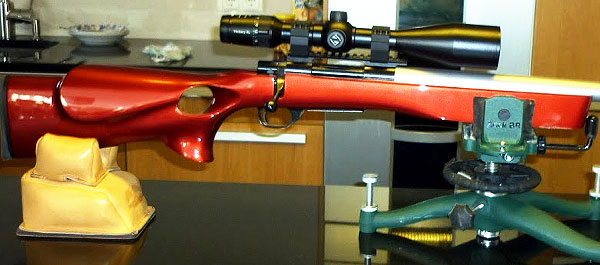
 Dansig’s Hot-Rod Howa – Forum member Dansig has been busy during the long, cold winter in his native Iceland. He transformed a homely-looking Howa m1500 Axiom into a beautiful candy-red thumbhole Varminter that shoots in the threes. This was truly a “labor of love” that required many dollars invested and dozens of hours of home-workshop labor. But the results speak for themselves. Dansig now owns what may be the best-looking Howa on the planet. And this rig isn’t just a beauty queen — it’s very accurate as well. With a new Krieger barrel chambered in 6mmBR Norma, the Howa shoots repeatable, five-shot groups in the threes, and Dansig has managed a few “wallet groups” in the low twos. Dansig’s Hot-Rod Howa – Forum member Dansig has been busy during the long, cold winter in his native Iceland. He transformed a homely-looking Howa m1500 Axiom into a beautiful candy-red thumbhole Varminter that shoots in the threes. This was truly a “labor of love” that required many dollars invested and dozens of hours of home-workshop labor. But the results speak for themselves. Dansig now owns what may be the best-looking Howa on the planet. And this rig isn’t just a beauty queen — it’s very accurate as well. With a new Krieger barrel chambered in 6mmBR Norma, the Howa shoots repeatable, five-shot groups in the threes, and Dansig has managed a few “wallet groups” in the low twos.
From this beast….

To this beauty … All it takes is imagination, hard work, and the right components….


Read Dansig’s account of the project from start to finish…
For this project I acquired a new Howa m1500 axiom. The transformation began with a $99.00 (USA retail) Boyds’ thumbhole stock.

When I got the stock, I found that even the standard barrel was too big for it, so I had to modify it quite a bit. To help ride the front bags, I added a wood block to make the fore-end wider, and to provide a flat section in the front. This required cutting the sides of the fore-end to mate with the wider block, which was glued in place. I also added an inch to the stock length.

Then I spent a few weeks sanding and filling…

Then it was time for the paintjob ($270). The multi-coat finish was applied by a professional, using car paint and clear coat so it’s very strong and scratch resistant. The color was a customized red with gold metal-flakes, and it looks awesome on a gun.
Bolt Sleeved, Trigger Tuned, and Krieger Barrel Fitted
While I was working on the stock I took the action to the local gunsmith. He fitted a new 1:13.5″-twist Krieger HV barrel and he put a sleeve in the action to make it tighter. He also tuned the trigger, taking it down from 56 ounces (ouch!) to just 14 ounces. Finally, my smith bedded the stock before I took it in for the paintwork.
Project Completed — Looks Great and Shoots Great
And this is the finished product of very hard labor. The project was a lot of work, mostly because it was all done by hand and not with machines. I may do a similar project again, but I would make the stock from oak or other strong wood. The wood I used is a bit soft for this kid of project.

 Hot-Rod Howa Shoots as Good as She Looks Hot-Rod Howa Shoots as Good as She Looks
Dansig reports: “How does my Hot-Rod Howa shoot? Repeatable 5-shot accuracy with me as a shooter is in the threes, but with a more experienced shooter, the gun could probably shoot even better. I say this because I just started shooting Benchrest for the first time when this project gun was completed. Here’s an exceptional (much better than average) ‘wallet group’ that shows what the gun can do ‘when the stars align’. This group, shot with VV N135 and Nosler Ballistic Tips, made my buddies really roll their eyes! I wish I had more groups like this one!”
Editor’s Note: Groups shown were shot on Caldwell “Tip-Top” laminated weatherproof targets, which display a distinctive punch — similar to a wad-cutter hole — as opposed to the standard gray donut smudge on a normal paper target. The holes appear black because the targets were placed over a black background sheet before being photographed.
March 9th, 2012
The March 2012 edition of Target Shooter Magazine is now available for online viewing. This issue is full of informative articles, with excellent photography. If you prefer the convenience of print magazines, you’ll like Target Shooter’s “eZine” format. Target Shooter displays like a print magazine — so you can enjoy large, wide-format photos, and you can flip pages just like a regular magazine. There is also a handy index (just like a print mag) so you can quickly access all the articles of interest.

This month, you’ll find many stories worth reading. Starting off, Laurie Holland hot-rods a Rem 700 SPS tactical rifle. After fitting the rifle with a new 26″ 1:7.9″-twist barrel and Manners Composite stock, Laurie shows that impressive accuracy can be achieved from the upgraded Remington SPS (chambered in .223 Rem). Laurie also continues his on-going series about reloading for the .308 Win. This month he tests Lapua small-flashhole brass with a variety of powders. Other highlights include a comparison test of air-splitters and tuners for airgun benchrest, and a guide to competition optics. Readers can download previous monthly editions plus a Shot Show supplement from the Target Shooter Magazine homepage, found at TargetShooter.co.uk.

March 9th, 2012
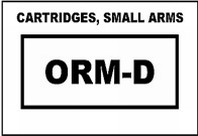
The days of the “ORM-D: Small Arms Cartridges” labels for ammo shipments are numbered. The Dept. of Transportation (DOT) is phasing out the current ORM-D ammo labels, replacing them with a larger striped diamond label that does not mention “Small Arms Cartridges”. This change is designed to harmonize U.S. shipping rules with United Nations standards. You can start using the new “Limited Quantity” diamond labels for ammo shipments immediately, but they are not mandatory — yet. You can continue to use the old ORM-D “Cartridges, Small Arms” labels until December 31, 2013. As of January 1, 2014 you MUST use the Striped Diamonds.
OFFICIAL UPS RULES — Elimination of ORM-D Classification
 In an attempt to harmonize and align with international standards, the DOT has amended the 49CFR regulations regarding the ORM-D classification. Effective January 19, 2011, with the publication of the HM-215K final rule, the hazard class of ORM-D is being eliminated. Those materials may still be shipped classified as a limited quantity (“Ltd Qty”). In conjunction with ORM-D hazard class elimination in HM-215K, limited quantity ground shipments will no longer require shipping papers when prepared under the new rule. This includes those materials previously classed as Ltd Qty that required shipping papers via ground transport. In an attempt to harmonize and align with international standards, the DOT has amended the 49CFR regulations regarding the ORM-D classification. Effective January 19, 2011, with the publication of the HM-215K final rule, the hazard class of ORM-D is being eliminated. Those materials may still be shipped classified as a limited quantity (“Ltd Qty”). In conjunction with ORM-D hazard class elimination in HM-215K, limited quantity ground shipments will no longer require shipping papers when prepared under the new rule. This includes those materials previously classed as Ltd Qty that required shipping papers via ground transport.
Ground Ltd Qty Marking

| Air Ltd Qty Marking
 |
NOTE: These illustrations are not true to scale. The actual default Ltd Qty Diamond label to be used for ammo shipments is much larger, about 5″ per side. A smaller 2″ per side version of the Ltd Qty striped diamond can be used on smaller packages. |
There is a transition period for shippers to comply with the new classification, marking and labeling requirements. Until December 31, 2013 a limited quantity package containing a consumer commodity as defined in 171.8 may be reclassed as ORM-D, or until December 31, 2012 for ORM-D-Air material. UPS began accepting materials with the new markings effective April 1, 2011. Note: To be in compliance with TDG, Standard (ground) Ltd Qty shipments to Canada prepared under HM-215K require the verbiage ‘Limited quantity’ or ‘Ltd qty’ to also be marked on the carton.
Download OLD and NEW Label Formats
On the Parallax Curio and Relic Forum, a thread includes PDF samples of both the new Diamond Ltd Qty Labels and the current ORM-D Labels. The thread explains: “The good news is the new label doesn’t have any indicator that the package contains ammunition. The bad news is the new label is gigantic compared to the old ORM-D label. You are required to use one of the larger labels on one side of any package containing ammunition. If the package is too small for one of the larger labels then you are permitted to use one of the smaller labels instead. Because of the size requirement in the regulations, you only get two of each label on standard piece of printer paper.”
CLICK HERE for PDF Template with Large and Small Striped Diamond Ground Shipping Labels
If you want to still use the ORM-D Small Arm Cartridges Labels until the new Diamond Labels are mandatory, here are links to PDF sheets of ORM-D labels. These PDFs have many rows of labels per page so you can save printer paper. The black version and blue version will use up more printer ink, so you might want to use the white version to be more economical.
March 2nd, 2012
 In today’s economy, Free is good. Here’s a list of older shooting books that can be downloaded for FREE from Google Books. This list, created by German Salazar, includes many classic treatises on marksmanship that still have value for today’s competitive shooters. In addition, we’ve included illustrated firearm histories, such as Townsend Whelen’s fascinating book, The American Rifle, and The Gun and its Development (9th Ed.), by William Wellington Greener. In today’s economy, Free is good. Here’s a list of older shooting books that can be downloaded for FREE from Google Books. This list, created by German Salazar, includes many classic treatises on marksmanship that still have value for today’s competitive shooters. In addition, we’ve included illustrated firearm histories, such as Townsend Whelen’s fascinating book, The American Rifle, and The Gun and its Development (9th Ed.), by William Wellington Greener.
In the list below, the title link will take you to the Google Books page for each book. You can read the entire book online, or you can download it to your computer as a PDF file* and save it (or print it). You can also create your own Google Library and save the books there for access from any computer.
The Bullet’s Flight From Powder to Target, Franklin W. Mann, 1909, 384 pages.
Irish Riflemen in America, Sir Arthur Blennerhassett Leech, 1875, 216 pages.
The American Rifle, Townsend Whelen, 1918, 637 pages.
Suggestions to Military Riflemen, Townsend Whelen, 1909, 243 pages.
Modern Rifle Shooting From the American Standpoint, W. G. Hudson, 1903, 155 pages.
 The Gun and its Development, William Wellington Greener, 1907 (9th Ed.) 846 pages. The Gun and its Development, William Wellington Greener, 1907 (9th Ed.) 846 pages.
Manual for Rifle Practice: Including Suggestions for Practice at Long Range, George Wood Wingate, 1879, 303 pages.
How I Became a Crack Shot — With Hints to Beginners, W. Milton Farrow, 1882, 204 pages.
Cartridge Manufacture, Douglas Thomas Hamilton, 1916, 167 pages.
Description and Rules for the Management of the United States Rifle, Caliber .30, Model of 1903, United States Army Ordnance Dept., 1904 (5th rev. 1914), 72 pages.

CLICK HERE for more FREE, downloadable Classic Shooting Titles.
*To download a book, first click the title from the list above. Then, once you’re at the Google book site, look for the icon that looks like a gear in the upper right-hand corner. Click that and a pull-down menu will appear. Select “Download PDF” from the menu — this will bring up a security question to make sure you are a human. Respond to the security question correctly and your normal download prompt will appear. Choose a location to hold your new e-book, and click “save”.
|