The Range Report, the NSSF’s “Magazine for Shooting Facilities” has been reborn as a digital eZine AND a full-featured website, RangeReport.org. This gives readers multiple ways to access information about range operations. If you prefer a conventional website format, with headlines, links, and thumbnail graphics for navigation, then visit RangeReport.org. In addition to hosting the latest Range Report feature articles, the new website also provides Range News, Q&A, and instant access to other features. The website also boasts a Digital Archive of all past Range Report issues in three, handy digital formats: eZine (flip-page), iPad, and PDF.
Read The Range Report in a Magazine-Style (Flip-Page) Format
If you favor a print magazine-style experience, which allows you to flip pages and view full two-page spreads, then visit the new Range Report Digital eZine. Just like a hard-copy magazine, the Range Report eZine begins with a index section and has feature articles placed sequentially, like chapters in a book. The Summer 2012 debut Range Report eZine is 51 pages long, with many interesting articles, including a report by Tom Carpenter on how to conduct shooter training classes, plus a feature by William Kendy on how to promote your range through Co-Op Advertising.
Anyone involved in range operations (whether commercially or as part of a shooting club) should find The Range Report a useful resource. Now that Range Report contents are available in multiple formats, it’s easier than ever to access hundreds of articles that can help your club run your range safely and profitably. Readers can also also Subscribe to the magazine’s monthly e-newsletter.
The 2012 Summer Olympics in London begin July 27 with shooting events starting the 28th and wrapping up August 5, 2012. NBC has already launched a full-featured website dedicated to the London Olympics at NBCOlympics.com.
We visited NBCOlympics.com this morning and were pleased to see that NBC has already launched a content-rich “homepage” dedicated to Olympic shooting. This includes Latest Shooting News, Tech Info, Event Schedules, Shooter Profiles, and Feature Stories with Video. There’s an excellent Video Interview with Sarah Scherer (10m Air Rifle), and you’ll even find a ‘Glamour’ Photo Shoot with Smallbore 3-P Shooter Amanda Furrer. In the NSSF video below, Amanda chats about the challenge of making the U.S. Olympic Team:
Fifteen (15) shooting events are featured at the 2012 London Olympic Games
Rifle
Pistol
Shotgun
Men's 10m Air Rifle
Men's 50m Rifle Prone
Men's 50m Rifle 3 Positions
Women's 10m Air Rifle
Women's 50m Rifle 3 Positions
Men's 10m Air Pistol
Men's 25m Rapid Fire Pistol
Men's 50m Pistol
Women's 10m Air Pistol
Women's 25m Pistol
Men's Trap
Men's Double Trap
Men's Skeet
Women's Trap
Women's Skeet
Olympic Television Broadcasts and Online Webcasts
NBC TV will broadcast many shooting events as part of its 2012 Olympics coverage. Supplementing that broadcast coverage will be Live Extra WebCasting. The Live Extra option provides real-time or delayed coverage of EVERY Olympic event. That’s right, you can watch every single Olympic event on the web. The Live Extra service does require viewers to register online for the service. In addition, you will need to verify that you subscribe to a cable, satellite, or telecom video tier that includes CNBC and MSNBC on the NBCOlympics.com website. CLICK HERE to learn more about Live Extra services.
History of Shooting in Modern Olympics
One of the original events featured at the first modern Olympic Games in Athens in 1896, the shooting sports have been present in all but the 1904 and 1928 games. The United States leads the field in shooting sports medals, having racked up 103 all-time, including 50 Gold. China is second with 42 total shooting medals and 19 Gold. The Chinese had the top showing at the 2008 Summer Olympics in Beijing, taking home eight shooting medals, five of which were Gold. (In Beijing Team USA garnered six shooting medals, including two Gold.)
Sinclair International regularly publishes Reloading Advice and Tech Tips in the Sinclair Reloading Press Blog. Mr. Bob Blaine, Sinclair Reloading Tech, has asked Sinclair’s customers to suggest ideas for future technical articles. Here’s your chance to pose questions to be answered and topics to be covered.
Suggestions Wanted by Sinclair Int’l:
As most of you have noticed, [Sinclair has] brought out some interesting items in our recent Sinclair Summer Catalog. Introducing new products generally causes a lot of questions, and we really do enjoy answering them for you. One of our upcoming articles will be about the new Stainless Steel Tumbling Media. We will explain how to best use the new tumbling media, and will include pictures to help show you how to work with it.
I want to know what other new products you would like us to showcase in future Reloading Press articles. We do enjoy hearing from all of you, and this is your chance to let us know what articles you would like to see from our Sinclair Reloading Tech Staff. We look forward to hearing from you! — Bob Blaine
Alan Bell, the “Chief Starter” for track events at the 2012 London Olympics, has been called one of the “world’s top race starters“. Over the past 36 years, using his trusty blank-firing starter pistols, Alan has started over 25,000 events, including Olympic and World Championship races. Bell, the current Chairman of the IAAF International Starters Panel, is widely recognized as one of the most capable (and knowledgeable) race starters on the planet.
However, the regional Council in West Dunbartonshire (Scotland) recently decided that Bell should not be allowed to start a running race at a local elementary school. Bell had originally been invited as an Olympic VIP for the benefit of the student athletes in this small community near Glasgow. Bell was even planning to start the school race by firing the same starter pistol which will be used to start the 100m Finals in the 2012 summer Olympic Games.
Why did the West Dunbartonshire Council send Bell home? It’s all about gun-phobia. Council members feared “that the sound of a pistol discharge would frighten the children and, perhaps, psychologically scar them forever”. (Source: Outdoor Life Blog).
As might be expected, some locals lambasted the Council’s action. One parent told The Scottish Sun: “It was ridiculous. We were told that the children would be distressed by Mr Bell firing his starting pistol. Anyone who believes they would be frightened by a starting pistol has never experienced the noise at a typical three-year-old’s birthday party.” So worried was the Council over the firing of a starter pistol (which shoots blanks with no projectile), that it tried to find a “politically correct” alternative. One proposed solution was to use an iPod to play a recording of a starting pistol. The school’s administrators eventually decided to start the race with a Klaxon horn noise instead of the crack of a starter’s pistol.
Score one more victory for the gunphobic Nanny State. One wonders if the West Dunbartonshire Council’s next move will be to ban local broadcasts of the actual Olympic Games, so the sound of a starter’s gun on television will not traumatize young viewers.
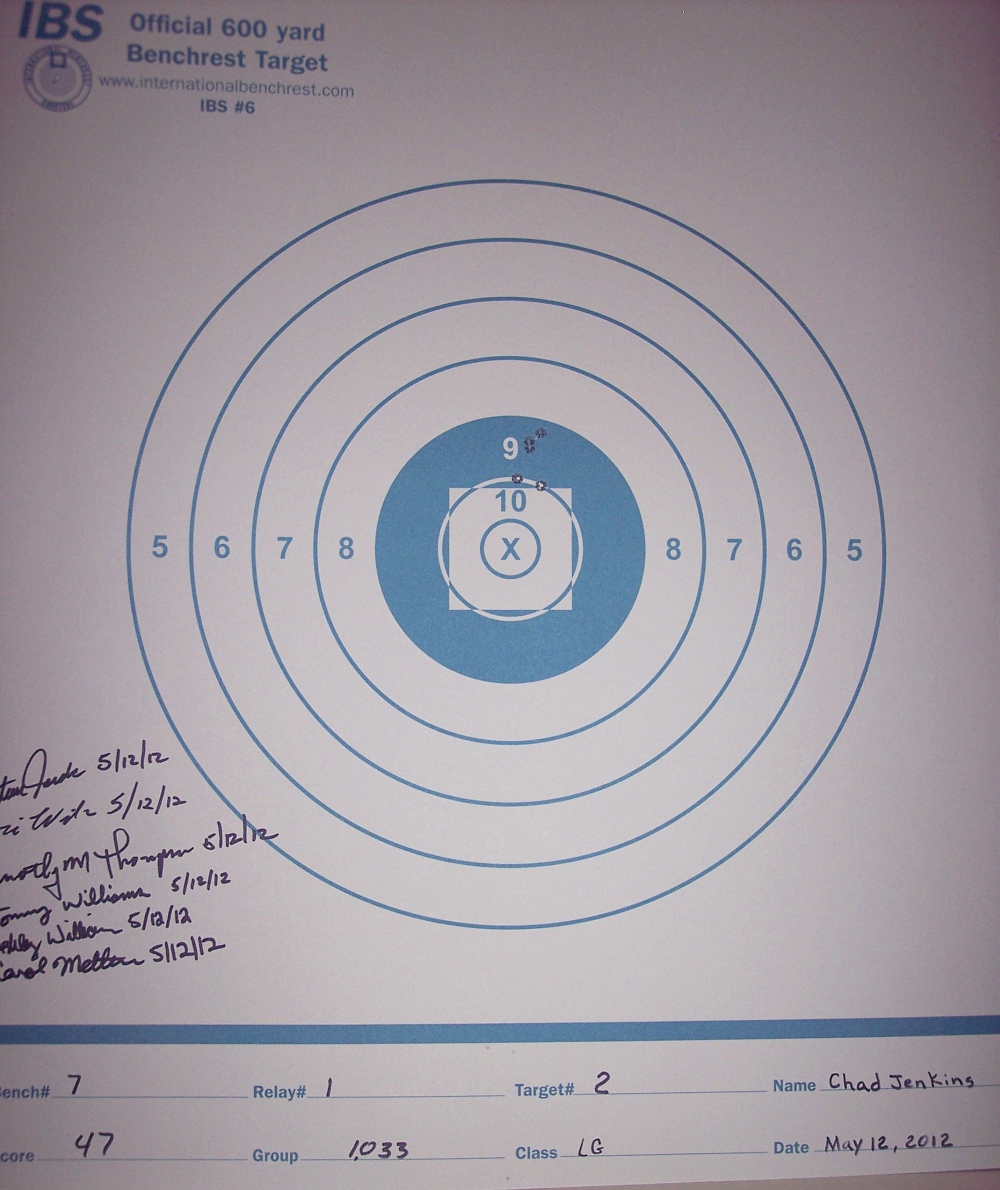
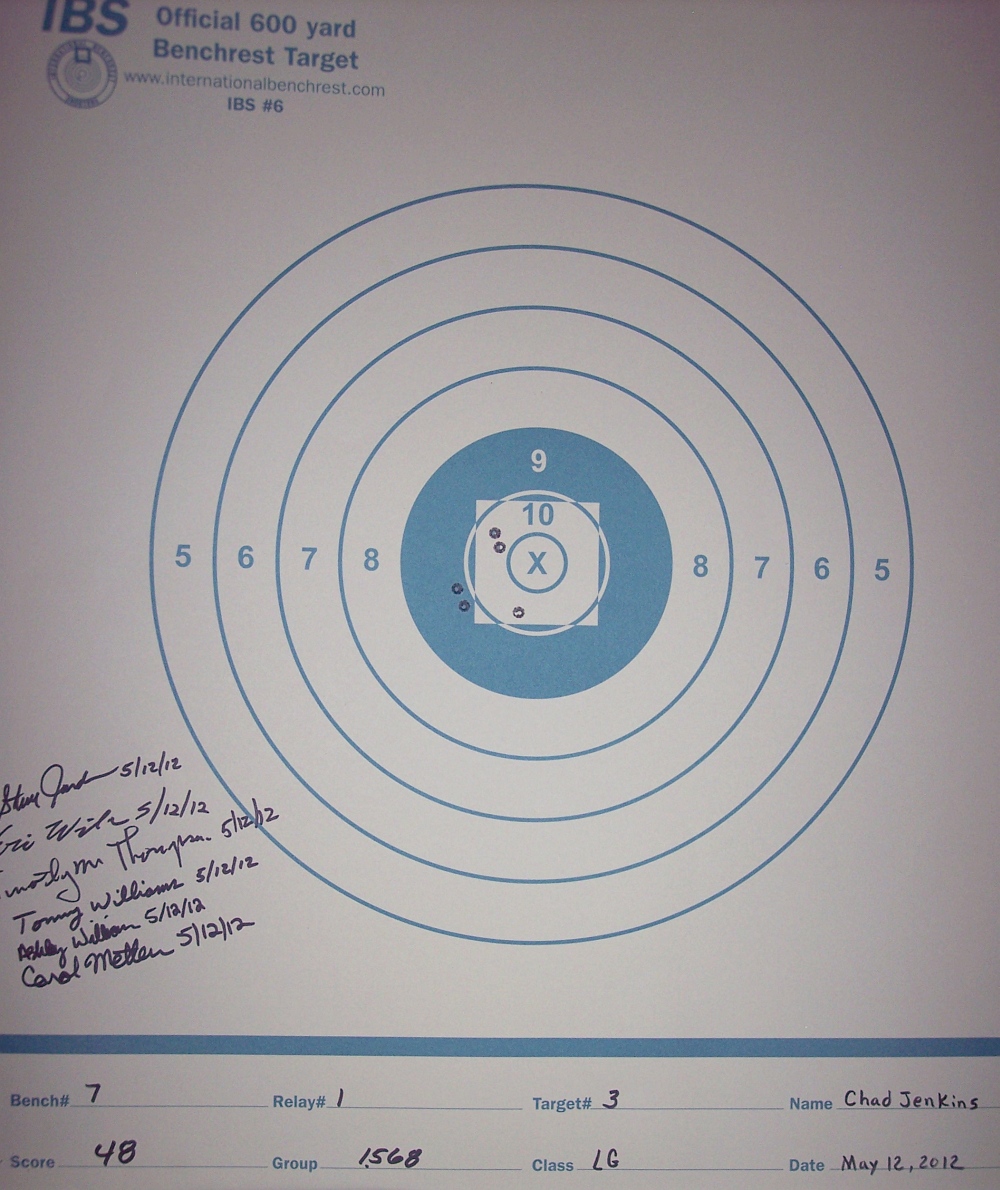
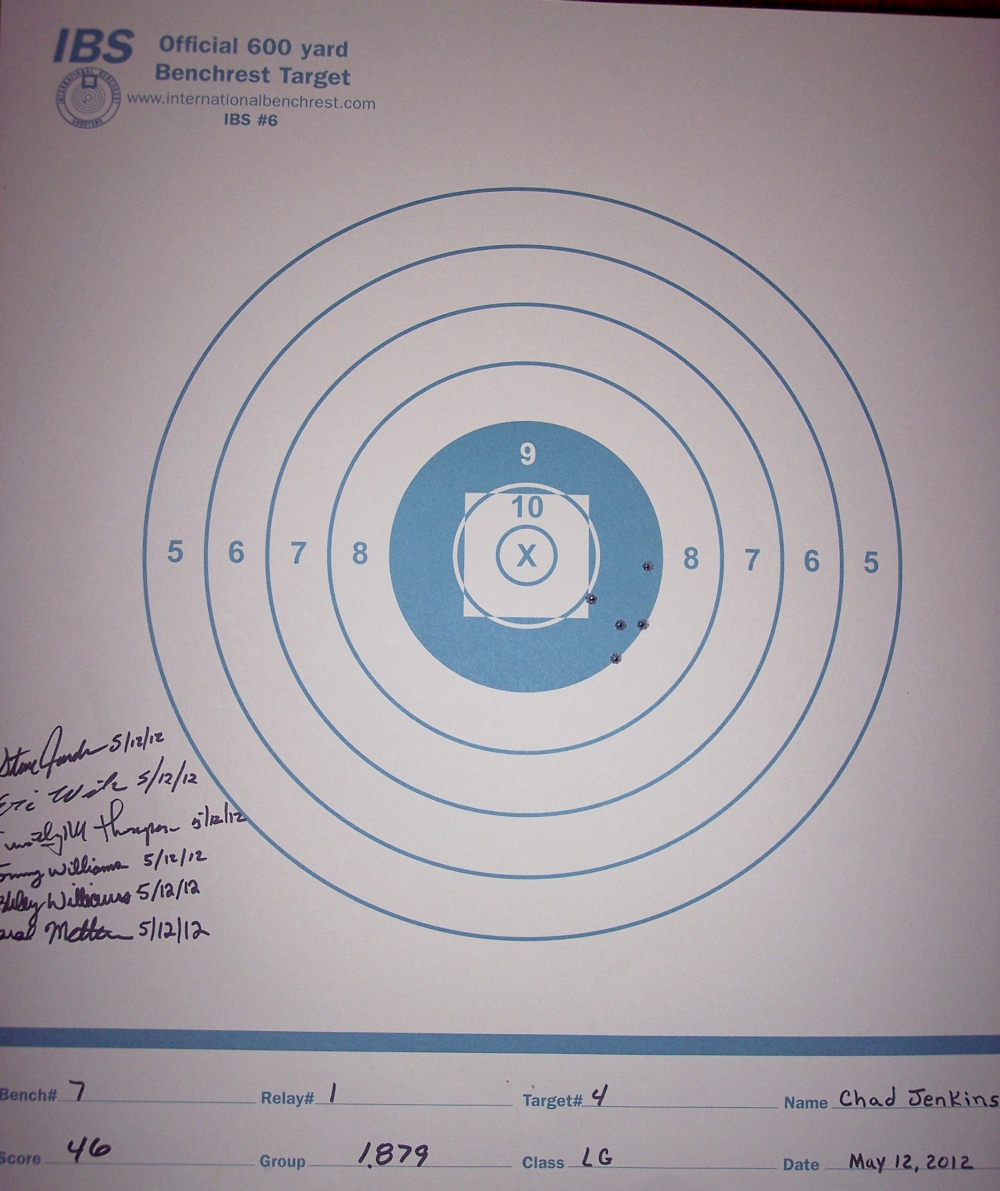
Last month, shooting at the Piedmont Gun Club, Chad Jenkins put together a stunning 1.495″ Aggregate at 600 yards. Once certified, that will be a new IBS 4-target Light Gun record. Chad’s smallest group was a 1.033″. Chad’s 1.495″ Agg breaks the existing 1.6068″ record set by Sam Hall in 2011. Chad was shooting a no-turn-neck 6mmBR featuring a BAT action, Krieger barrel, and Shehane ST-1000 fiberglass stock. We had the chance to talk with Chad and learn more about his record-setting rifle, and the methods he uses to achieve superior accuracy. Chad was kind enough to tell us about his equipment and what he does to build very, very accurate ammo. For starters, Chad wanted to “say thanks to Lewis Winkler, James Coffey, Mike Davis, and Larry Isenhour” all of whom provided invaluable help and support over the years.
The Record-Setting Rig
Chad credits much of his success to an “fantastic Krieger barrel that shot great right out of the gate”. It’s a 1:8″ twist, HV contour, finished at 28″ — nothing unusual there. Mike Davis did the chambering, barrel-fitting, and barrel crowning. One reason the gun shoots so well is that Chad’s friend James Coffey did the stock work and bedding, and also added weight to the Shehane ST-1000. Chad says “James really knows what he’s doing”. For optics, Chad uses a Leupold 45X competition scope, with fine cross-hair (FCH). Chad says he can “aim at the ‘X’ at 600 yards more precisely with the cross-hairs than with a target dot.”
$200 Front Rest Good Enough to Set Record
You may be surprised that Chad set his record with an inexpensive Caldwell Fire Control Joystick rest, that sells for about $203.00 on Amazon.com. The Caldwell isn’t fancy, but it did the job. Chad says: “I have a family and a young boy. I don’t have the money to pour into equipment like some other people. I will continue to use my Caldwell, but I have recently modified the base. The record though was set with an unmodified unit, just as it appears in the photo.”
Chad Shoots a “Classic” 6BR Load, But He Jumps his Berger VLDs
Chad gets great accuracy with a pretty “standard” 6mmBR match load: 30.5 grains Varget, CCI 450 primers, Berger 105gr VLDs, in Lapua “Blue Box” brass. (Editor’s Note: That load can be too hot in some guns in summer conditions). Chad loads his ammo with a Redding bushing full-length sizing die with an 0.266″ bushing. Chad says: “That’s a good size for the ‘Blue Box’ Lapua brass (I tried a 0.268″ and I could pull the bullets out with my fingers). I seat my bullets about 0.020″ OFF the lands with a Redding Comp seater die.” The brass that shot the record Agg had about 10-11 firings on it, and Chad has NOT annealed the cases yet. While Chad is a very exacting reloader, he believes in the KISS principle — he doesn’t ream flash holes or uniform primer pockets. While he weighs every load with an RCBS Chargemaster, he normally does not double-check charges with a second balance. Chad tells us: “I just get the Chargemaster to where where it is going consistently and run with it.”
Knowing that gun-handling and barrel maintenance are key elements of accuracy, we asked Chad about his shooting style, rest set-up, and his cleaning regimen:
Shooting style: “I try not to touch the gun, except with my thumb on the back of the triggerguard, and my index finger on the trigger. I use just a slight amount of pressure as the finger pulls the trigger. I don’t have any pressure on my shoulder. The buttplate is just barely touching my shirt.”
Rest position: “I usually let the gun run out to the stop. But there’s not much overhang. It hangs over an inch and a half. That’s where I always shot it. In the rear the ears are pretty much centered on the underside of the buttstock.”
Cleaning: “I use Montana X-Treme with patches and bronze brushes, and I clean every 35-45 rounds. I don’t brush a lot — I kind of go on feel, anywhere from 4-10 strokes. The gun shoots so incredibly well, I want to baby it, so I try not to over-clean.”
View Chad Jenkins’ Four (4) Targets
Common Sense Tips for New Shooters
Chad offered some advice for shooters starting out in the 600-Yard Benchrest game:
Reloading — I don’t claim to be an expert. But I will say that consistency is all-important. I learned this first from my friend Lewis Winkler (who passed away), and then James Coffey. Lewis always told me that the main thing is that you must be consistent in everything — when you’re sizing, when you’re weighing, when you’re seating bullets. You can’t be deviating and expect your loads to shoot.
Mental Game — I don’t go to a match to beat anybody, or to compete against anyone in particular. I shoot the best I can shoot and let the chips fall where they may. Even in practice, I basically compete against myself and I try to do the same thing in a match.
Focus (when to have it and when to relax) — I do try to stay focused when I’m shooting. But I also try to get away from the pressure between relays. A lot of the guys spend 15-20 minutes looking at everybody’s targets. I just look at my own targets and go back and sit down and relax. I don’t try to overthink things. When I was a teenager I was a successful competitive golfer. And in those days, I didn’t think about it … I just stepped up to the ball and hit it. I think, with some competitive activities, “thinking too much” can probably mess you up more than it helps.
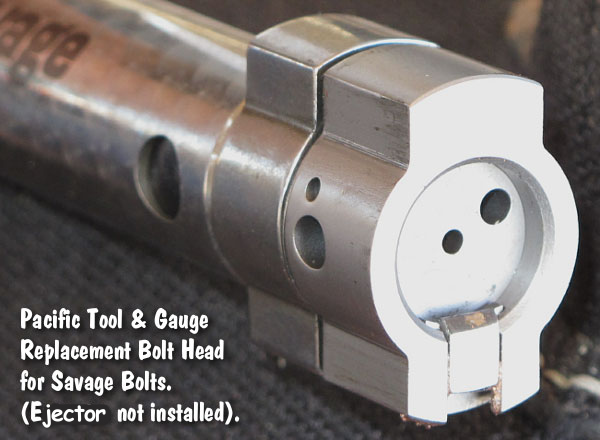
Pacific Tool & Gauge, has an outstanding new product, a precision-machined replacement bolt head for Savages. This product, available in a variety of bolt face sizes for $49.99 per unit, can benefit nearly everyone who shoots Savage bolt guns.
When visiting German Salazar’s excellent Rifleman’s Journal website, we were pleased to see a recent, in-depth review of the PT&G Replacement Bolt Head for Savage Bolts. Written by Norm Darnell, this detailed review explains the benefits of the PT&G replacements, compared to the standard Savage bolt heads. After polishing, the factory bolt head can become slightly dished. According to Darnell: “The area around the firing pin hole sometimes has an indentation deep enough to allow the primer to flow into this void. This makes an unsightly blemish on a fired primer and can lead to hard extraction or worse. One [Savage] rifle I inspected had a continuing problem with pierced primers despite reasonably mild loads[.]” Even after machining the factory bolt face to make it flat, Darnell encountered problems: “The firing pin hole seemed to wear excessively which was of some concern. Material strength of the investment-cast bolt head* appears to be the source of these recurring problems.”
After testing out PT&G replacement bolt heads, Darnell found that his problems were solved. With the PT&G replacement bolt head, “the cartridge case heads and primers indicated no case-head rounding or primer damage”. Darnell was convinced, so he proceeded to fit PT&B bolt heads “on all three of my 308 bolts and one 223 with one spare bolt of each.” It appears that PT&G has a winner here — a smart, affordable new product that remedies a commonly-observed problem with factory Savage bolt heads.
* In the article, author Darnell writes that Savage factory bolt heads are investment cast. Fred Moreo of Sharp Shooter Supply says this is not correct: “Savage bolt heads were NEVER investment cast. From the get-go they were machined from solid stock. In 1988 they went to special profiled 41L40 bar stock to save machining operations and heat treated to 35-42 RC.”
Scientists at the Oak Ridge National Laboratory (ORNL) have developed a system that uses lasers and fiber optics to measure very small changes (deflections) in a rifle barrel. These deflections are recorded with laser sensors, and then algorithms are used to compute the resultant changes in bullet trajectory. Using computer-calculated trajectories, the digital sighting system’s “virtual” reticle automatically adjusts to compensate for barrel deflection, as well as changing environmental conditions. The microprocessor-controlled digital reticle can adjust to 1/1000th of a Minute of Angle (MOA). That makes it far more precise than any conventional riflescope reticle.
ORNL Barrel Sensor with Compensating Reticle
Shown below is a laboratory prototype of Oak Ridge National Laboratory’s Reticle Compensating Rifle Barrel Reference Sensor. This system precisely measures the deflection of the barrel relative to the sight and then electronically makes the necessary corrections. The system was developed by a team led by Oak Ridge National Laboratory’s Slobodan Rajic, shown in the photo.
The Reticle Compensating Rifle Barrel Reference Sensor takes the guesswork out of shooting by shifting the burden of knowing the relative position between the barrel and the weapon sight axes from the shooter to an electronic sensor. The system precisely measures the deflection of the barrel relative to the sight and then electronically realigns the moving reticle, or crosshairs, with the true position of the barrel, or bore axis.
“When a weapon is sighted in, the aim point and bullet point of impact coincide,” Rajic said. “However, in the field, anything that comes into contact with the barrel can cause perturbation of the barrel and induce errors.”
With modern high-caliber rifles boasting ranges of up to two miles, even very small barrel disruptions can cause a shooter to miss by a wide margin. That makes this technology indispensable from a marksman’s perspective, Rajic said.
From a technological standpoint, the approach is straightforward. ORNL starts with fluted barrels (the flutes play a key role). With the ORNL technology, glass optical fibers are placed into the flutes. The sensor system contains a laser diode that sends a signal beam into the optical fibers parallel to the bore axis of the barrel.
“The optical fibers are designed to split the laser beam twice, sending one beam along the top of the rifle barrel and another light beam along the side of the barrel,” Rajic said. “Thus, we can measure both the vertical and horizontal barrel deflection.”
Through a combination of algorithms, optics and additional sensor inputs, the system can take into account distance and other factors affecting the bullet trajectory. Ultimately, the whole optical/laser/digital system provides the shooter with crosshairs that automatically adjust for conditions in real time.
A Compensating Reticle with 1/1000 MOA Precision
Skeptics of electronic sighting systems have complained that the resolution of a digital rifle-sight is too crude to allow precise aiming. There simply aren’t enough pixels on a viewscreen to allow ultra-precise aiming at long-range targets, shooters have said. In fairness, the existing commercially-available digital rifle sighting systems HAVE been crude — with a lo-rez screens like you might find in a portable GPS.
Well you can forget all that. ORCL has achieved a break-through in digital sighting. The bar has been raised — by an order of magnitude. The resolution of ORNL’s digital, sensor-informed Compensating Reticle is 125 times better than that of traditional target reticles, which can normally be adjusted by one-eighth Minute of Angle (MOA) (at best). Now get this — the ORNL sensor can sense angular displacement and shift the reticle by 1/1,000th of a minute of angle. While this system is expensive, and designed (at this point) for the military, this technology could eventually benefit sport shooters. A decade from now, we would not be surprised if long-range civilian shooters commonly use electronically-enhanced optics, with digital reticles that automatically compensate for bullet drop (and maybe even windage).
ORNL scientists are also working on technology that could yield much more precise and accurate plots of bullet trajectories. We will no longer have to rely on “guesstimated” data inputs, and certain assumptions about bullet drag factors. Rajic and colleagues are developing a laser-based, bullet tracking system that would record plot the bullet’s actual flight path while the bullet is in the air. In other words, this tracking system would be able to plot the bullet’s true trajectory from muzzle to target. That is much differerent than current ballistic “solvers” which merely draw a predicted arc based on muzzle velocity, wind and temp inputs, and a reference BC value.
Oak Ridge National Laboratory is a multi-program science and technology laboratory managed for the U.S. Department of Energy by UT-Battelle, LLC. Over 3000 scientists and engineers at ORNL conduct basic and applied research and development to create scientific knowledge and new technology in key areas of science, energy, the environment, and national security.
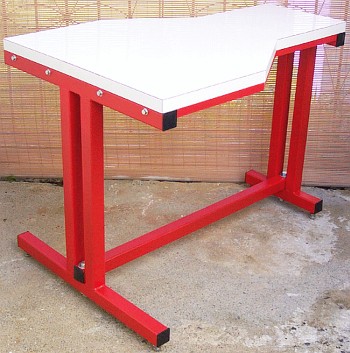
Building your own portable shooting bench is a great winter do-it-yourself project. You can build a sturdy bench for well under $100 in materials. Compare that to some deluxe factory-built benches which may cost $450.00 or more.
A wide assortment of home-built shooting bench designs have been featured on the internet. Renovation Headquarters has put together a web page with plans for eleven (11) different shooting benches. Each bench is illustrated with a photo and link to FREE Plans and building instructions. You’ll find all-wood designs as well as benches that combine a wood top with a metal sub-frame or legs.
A two-time NCAA Champion from TCU, and member of the 2012 U.S. Olympic Shooting Team, Sarah Scherer is profiled in the current USA Shooting News eZine. Her story makes compelling reading because Sarah had to overcome a family tragedy to achieve her goals in the shooting sports. Sarah’s older brother, Stephen, a member of the 2008 Olympic Shooting Team, took his own life in October, 2010. Brother and sister grew up shooting together. Early on, Stephen was her training partner and role model. Losing her brother was very tough, but she has not faltered in her drive to be the best, and honor Stephen’s memory.
Sarah’s coach, two-time World Champion Karen Monez, explains: “[Sarah] has the work ethic to accomplish just about anything she wants to. She doesn’t let adversity and the hardship she’s had define her. It really is more of an inspiration to others if you look at how humble she is with the success she has had, and what’s she’s had to deal with [after her brother’s death].”
We will be following Sarah’s peformance in London this July, where she is one of the favorites in air rifle shooting. She has “risen to the challenge” at every stage of her shooting career so far. She has won five National Junior Olympics Shooting Medals and won gold in her first-ever World Cup Match. An All-American in both smallbore rifle and air rifle, Sarah captured the individual smallbore National Championship in 2010, and she was a member of TCU’s NCAA Championship-Winning Team in 2010 and 2012. This past winter, Sarah set a new National Record with a perfect score of 400 in the 10m Air Rifle event. We wish Sarah success, and hope she can continue her winning ways.
In our Shooters’ Forum you’ll find a thread in which readers can post photos of their “pride and joy” — their favorite rifle. You’ll find a wide range of guns, from “big boomers” to .17-caliber varminters. Here are some of our favorite entries in the “Pride and Joy” Gallery.
Brad’s 6CM Long-Range Match Rifle
Chambered in the 6mm Competition match cartridge, this handsome rig features a Surgeon RSR Action, Bartlein Barrel, and LRB stock. Barrel work was done by Chad Dixon at LongRifles, Inc. and paint by AT Custom Painting. Brad says: “If you need a custom paint job, Adam is your man. His work is amazing and prices can’t be beat.”
The Bear’s Barbed-Wire Barnard
BarryO, aka ‘the Blue-eyed Bear’, posted his beautiful 6mm Dasher, with its unique barbed wire 3D finish. (There’s a story behind that design.) This rifle was smithed by John King in Montana, with stock bedding work by Leo Anderson. The gun features a Barnard ‘P’ action (with trigger), and 28″ Broughton 5C fluted barrel with VAIS muzzle brake. The Barnard sits in a Tom Manners carbon fiber BR stock decorated with amazing graphics by Mad Shadow Custom Paint.
Sebastian’s Radical Swallowtail 6PPC
Sebastian Lambang is the designer and builder of SEB Coaxial Rests. He’s a smart, creative guy, so you knew when he designed a short-range benchrest stock it would be something special. It needed to be lightweight, yet very rigid. Using “out of the box” thinking, Seb employs a truss-style structure to provide great strength with minimal weight. The rear section is equally radical. There are two splayed “keels” in the rear, forming what this Editor calls a “swallowtail” rear design. Others have called it a “catamaran buttstock.” Below is a side-view of the prototype SEB stock before painting.
Flaming PPC from Oz
ChrisT, a diesel fitter from Australia, submitted this image of his stunning flame-painted PPC. Whoever did those flames is a true artist — the gun really looks like it’s on fire. This rifle features a Stiller Viper action, Speedy (Robertson) BRX stock, and Maddco (Australian) 14-twist barrel chambered in 6PPC.
And here are a couple more cool BR rifles posted on the Forum. First, from Walter in Belguim, is the “Lion of Flanders”, an Anschutz BR 250, with Kelbly’s stock and matching SEB front rest. Walter did the paintwork himself:
And here is Mark Walker’s amazing Zebra-skin BR rifle. Now that will turn heads on any bench:


 The 2012 Summer Olympics in London begin July 27 with shooting events starting the 28th and wrapping up August 5, 2012. NBC has already launched a full-featured website dedicated to the London Olympics at
  As most of you have noticed, [Sinclair has] brought out some interesting items in our recent Sinclair Summer Catalog. Introducing new products generally causes a lot of questions, and we really do enjoy answering them for you. One of our upcoming articles will be about the new Stainless Steel Tumbling Media. We will explain how to best use the new tumbling media, and will include pictures to help show you how to work with it.
 Alan Bell, the “Chief Starter” for track events at the 2012 London Olympics, has been called one of the “
 As might be expected, some locals lambasted the Council’s action. One parent told The Scottish Sun: “It was ridiculous. We were told that the children would be distressed by Mr Bell firing his starting pistol. Anyone who believes they would be frightened by a starting pistol has never experienced the noise at a typical three-year-old’s birthday party.” So worried was the Council over the firing of a starter pistol (which shoots blanks with no projectile), that it tried to find a “politically correct” alternative. One proposed solution was to use an iPod to play a recording of a starting pistol. The school’s administrators eventually decided to start the race with a Klaxon horn noise instead of the crack of a starter’s pistol.



 The Reticle Compensating Rifle Barrel Reference Sensor takes the guesswork out of shooting by shifting the burden of knowing the relative position between the barrel and the weapon sight axes from the shooter to an electronic sensor. The system precisely measures the deflection of the barrel relative to the sight and then electronically realigns the moving reticle, or crosshairs, with the true position of the barrel, or bore axis.


 A two-time NCAA Champion from TCU, and member of the 2012 U.S. Olympic Shooting Team, Sarah Scherer is profiled in the current





