The September digital edition of Shooting Sports USA magazine (SSUSA) features an Expert Forum on Wind Shooting. This outstanding article on wind reading starts off with a section by Bryan Litz, ace Palma shooter, and author of Applied Ballistics for Long-Range Shooting. Then five of the greatest American shooters in history share their personal wind wisdom. Lanny Basham (Olympic Gold Medalist, author, Winning in the Wind), Nancy Tompkins (Past National HP Champion, author, Prone and Long-Range Rifle Shooting), David Tubb (11-Time Camp Perry National Champion), and Lones Wigger (Olympic Hall of Fame) all offer practical wind-reading lessons learned during their shooting careers.
Whether you shoot paper at Perry or prairie dogs in the Dakotas, this is a certified “must-read” resource on reading the wind. Here is a sample selection from the article:
You can sign up online to receive FREE digital editions of Shooting Sports USA every month. In addition to feature stories such as the wind-reading article, each monthly edition provides a comprehensive schedule of shooting events nationwide. CLICK HERE to SUBSCRIBE.
Following SGT Sherri Gallagher’s record-setting victory in the 2010 NRA High Power National Championship, many readers have asked what caliber (chambering) Sherri was shooting. Well, Sherri was shooting a .260 Remington at all yardages, as confirmed by SFC Emil Praslick, USAMU rifle coach. Runner-up Carl Bernosky was shooting a 6mm Hagar in an AR-platform rifle.
To capture her first High Power Championship, with a record 2396-161X score, Sheri used a Tubb 2000 bolt gun chambered in .260 Rem. According to Praslick: “[the rifle has] the same barrel as last year. I believe it has close to 2000 rounds on it.” To our surprise, Sherri’s ammo was loaded in relatively inexpensive Remington brass. Praslick explained: “We use Remington brass, Federal 210Ms, and Varget powder. For the 300/600 yard lines we use the Sierra 142gr bullet. Her 300RF load is around 2650 fps, the 600SF load approximately 2750 fps. At the 200 [yard line], we use a reduced recoil load using the Sierra 107gr MK.”
Accuracy Trumps Raw Velocity
Praslick noted that Sherri’s load, while not particularly fast, is ultra-accurate: “All these loads rely much more on accuracy than they do velocity. SGT Gallagher’s rifle has been tested repeatedly at 600 yards. It will easily shoot 3″ to 4″ groups all day long. This is evident by her X-count.” Praslick added: “I am a big believer in the .260 for High Power shooting. [It offers] easy load development, ballistic advantage, and long barrel life.”
.260 Rem Resources
To learn more about the .260 Rem, read Zak Smith’s article: 6.5mm Shootout: .260 Remington vs. 6.5×47 Lapua vs. 6.5 Creedmoor. Zak compares three popular 6.5mm cartridges, weighing the pros and cons of each. Zak himself shoots the Rem .260 loaded with 139gr Lapua Scenar bullets and Alliant Reloder 17.
Another great load for this cartridge is the 123gr Lapua Scenar pushed by Hodgdon H4350. That was the best overall performing load in this Editor’s .260 Rem. I was able to run the 123s at 2950 fps with great accuracy and extremely low ES and SD. Compare the 600-yard ballistics of the Scenar 123s at 2950 fps with Sherri’s 142gr SMKs launched at 2750 fps. You may be surprised. The 123s have less drop, and the 10 mph wind drift (at 600 yards) is very close: 23.9″ for the 123s vs. 22.8″ for the 142s. (Calculations done with JBM Online Ballistics Calculator using Lapua and Litz field-measured BCs, 59°, 500′ elevation.)
Government officials in the UK have banned blank-firing starter pistols, claiming they can be converted to fire live rounds. As of June 4, 2010, possession of an Italian-made, bright orange Olympic .380 BBM starter pistol is now a criminal offense (whether or not the pistol has been converted), with a mandatory 5-year jail term. Approximately 1500 of the Olympic starter pistols have been imported into the UK since 2006, and they are widely used in other countries.
UK officials announced an amnesty during which the starter pistols could be surrendered to police in Britain and Wales. But the amnesty has expired. Now, if prosecuted, those who did not give up their starter pistols will be locked up for five years. According to BBC Online: “After 4 June the weapon will be prohibited under the 1968 Firearms Act and anyone caught possessing it faces a mandatory prison sentence of five years.” Note that possession of the starter pistols is now illegal whether or not the pistols have been converted to fire live ammo. Imagine being jailed for FIVE YEARS for having a noise-making device, which is all an unmodified starter pistol really is.
The purported reason for the starter pistol ban is that a few of the pistols have been converted to fire live ammunition. Law enforcement officials in London claim that black-painted, converted starter pistols have been “linked” to a handful of serious crimes.
Sporting groups in Great Britain have protested the draconian ban on starter pistols. David Brown of UK Athletics equated the banning of starter pistols with taking whistles away from football [soccer] referees. As quoted in the Yorkshire Post, Brown said:
“The implications for our major Olympic sport in the lead-up to 2012 should not be underestimated. The guns are the only thing that give a dual signal, a flash and smoke, to the athletes in front of you and the timekeepers. There is nothing else [to use], except at the Olympic Games level where they have electronic guns.”
With modern benchrest guns capable of shooting “zero” groups in competition, one wonders what is next in the accuracy game. Perhaps laser rifles? Well, the U.S. Navy believes high-tech lasers may replace projectile weapons in the future — the very near future. In fact, the Navy has already successfully tested a deadly laser cannon.
U.S. Navy Blasts Drones Out of Sky with 32 Kilowatt Laser Cannon
The Naval Sea Systems Command (NAVSEA), with support from Naval Surface Warfare Center (NSWC), successfully tracked, engaged, and destroyed mock-threat Unmanned Aerial Vehicles (UAVs) flying over the ocean. The Navy’s new “Death Ray”, actually a high-intensity (32 Kw) laser, was aimed using a beam director on a KINETO Tracking Mount, controlled by a MK 15 Close In Weapon System (CIWS).
According to Scientific American: “During the test, the Navy’s Laser Weapon System (LaWS) … engaged and destroyed four UAV targets flying over water near the Navy’s weapons and training facility on San Nicolas Island in California’s Santa Barbara Channel, about 120 kilometers west of Los Angeles. The Phalanx — a rapid-fire, computer-controlled, radar-guided gun system — used electro-optical tracking and radio frequency sensors to provide range data to the LaWS, which is made up of six solid-state lasers with an output of 32 kilowatts that simultaneously focus on a target.”
According to Navy sources: “This marks the first detect-thru-engage laser shoot-down of a threat representative target in an over-the-water, combat representative scenario. Multiple UAV targets were engaged and destroyed in a maritime environment during the testing, the second series of successes for the U.S. Navy’s Laser Weapon System (LaWS) Program. This brings to a total of seven UAVs destroyed by the Surface Navy’s first tactical development for fielding a Directed Energy weapon system.”
Watch the video below to see delta-winged UAV “splashed” by the Navy’s new “Death Ray”.
According to Program Manager Capt. David Kiel: “Further development and integration of increasingly more powerful lasers into Surface Navy LaWS will increase both the engagement range and target sets that can be successfully engaged and destroyed.” As lasers and other directed-energy systems are perfected, the Navy expects to improve the speed of its responses to aerial threats, while reducing weapons costs: “Laser weapons that provide for speed-of-light engagements at tactically significant ranges [can achieve] cost savings by minimizing the use of defensive missiles and projectiles.”
When misguided legislators pass bad laws, sometimes the only thing to do is fight back — in court. We’re pleased to announce that two businesses and a USMC Veteran have filed suit in Federal District Court to strike down California’s AB 962. Passed last fall by California’s liberal-dominated Legislature, AB 962 would effectively ban mail-order sales of handgun ammunition in California. And, as the law is written, this restriction would include rifle ammunition that can be used in pistols. AB 962 would not only restrict the flow of ammunition into California from outside the state, but it would also prevent California ammunition-makers from selling their products to customers outside California.
The legal challenge to AB 962 relies primarily on the Commerce Clause of the U.S. Constitution. Article I, Section 8 of the Constitution delegates to the Congress the authority to regulate interstate commerce. Because Congress has been given power over interstate commerce, states cannot unduly burden interstate commerce. AB 962 runs afoul of the Commerce Clause because it effectively prohibits direct, intra-state shipment of ammunition to Californians. AB 962 also, arguably, blocks California ammo-makers from selling their goods to residents outside of California. Just imagine if New York passed a law barring Dell from shipping computers to New Yorkers, or if Florida blocked L.L. Bean from selling boots and clothing to Floridians. You can bet that Dell and L.L. Bean would unleash a battalion of lawyers to fight such legislation.
The two business plaintiffs, State Ammunition Inc. of Ventura, California, and A1Ammo of Minnesota, argue that AB 962 effectively prohibits them from conducting their business in interstate Commerce. State Ammunition alleges that: “StateAmmo.com will be unable to sell ammunition to purchasers in 49 other states, resulting in an immediate and devastating loss of income, business growth, good will and customers.” Likewise, A1Ammo asserts that it will “suffer irreparable harm” because AB 962 prohibits it from selling ammunition to customers in California. Plaintiffs also argue that AB 962 violates Equal Protection and Due Process rights by criminalizing sales of handgun ammunition to various prohibited persons without defining handgun ammunition, and without giving people to ability to know who is actually a prohibited purchaser.
Elimination of Mail-Order Sales Harms Organized Shooting Programs
A third plaintiff in the suit, retired Marine Corps Major Jim Russell of Fallbrook, California, asserts that AB 962 will interfere with legitimate shooting activities with no meaningful benefit to California. Russell, the Shooting Sports Director for the Paralyzed Veterans Association of America, claims that, as a result of AB962, he will be unable to purchase bulk handgun ammunition online which he uses to help disabled veterans with rehabilitative organized shooting activities.
Part of the new law is already operative — a requirement that pistol ammunition be keep behind counters rather than placed on open shelves. The more onerous parts of the law — the actual restrictions on sales — are slated to go into effect February 1, 2011. These provisions requires retail sellers to do background checks, take thumbprints, and check IDs of customers. This applies to “handgun ammunition” but that term is not clearly defined by AB 962. State Ammunition’s owner, Kevin Chaffin, who is also an attorney, explains that: “Vendors are required to guess what is or is not considered handgun ammunition, then after that guess is made, they are required to somehow determine the subjective intent of the ammunition purchaser.” Chaffin added that the law has already cut into his business, though all its provision are not yet effective: “Even the existence of the law is hampering business because so many people around the country have given up on California”.
In McDonald v. Chicago, the U.S. Supreme Court determined that the Second Amendment applies to State and Local goverment actions, not just to Federal laws and activities. In so ruling, the High Court established that State and municipal laws can be challenged on the grounds that they violate a citizen’s individual right to “keep and bear arms”.
This landmark decision was the focus of the July 4th edition of Gun Talk Radio, when host Tom Gresham interviewed Attorney Alan Gura, lead counsel for Otis McDonald and other plaintiffs. Gura was also the lawyer who successfully challenged the District of Columbia gun ban, in D.C. v. Heller.
If you missed the July 4th broadcast, you can still hear what Gura has to say about the Supreme Court rulings in the McDonald and Heller cases. Gun Talk Radio archives its past broadcasts. Just right click on the Podcast icon below and “Save As” to download an .mp3 file with the Alan Gura interview. This is a very thought-provoking interview. We strongly recommend you listen.
We recently tested some interesting “club benchrest” rifles created by MT Guns. Recognizing the demand for highly accurate “club-level” smallbore BR guns, Mac Tilton and his crew at MT Guns have started producing two new types of affordable rimfire benchrest rifles. One line of rifles employs Anschütz actions refitted with modern SS barrels and benchrest stocks. As its second line of rimfire BR guns, MT Guns is offering highly-modified BSA Martinis, tricked out with bag-riders and premium barrels fitted with tuners. With the hot-rod Anschütz running about $2000.00 and the modified BSA costing about $1500.00, these guns should provide an affordable alternative for club-level rimfire benchrest shooters. Plus you won’t have to wait months or years to get a “big-name” smith to build you a rifle.
Anschütz Modified for Serious Accuracy
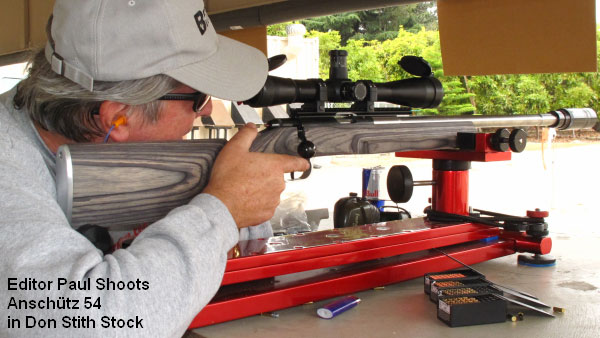
For Anschütz fans, MT Guns has fitted high grade Benchmark barrels to the legendary Model 54-type action. These re-barreled Anschütz actions are placed in Don Stith laminated benchrest stocks. With a modern low-profile, wide-forearm stock, MT Gun’s Anschütz BR guns track beautifully. So far, MT Guns has created two of these Anschütz-based bench guns, both built from model 19XX donor rifles — which also provided superb 5018 triggers. Barrels on both guns are Benchmark — one a 2-groove, the other a 3-groove. In the Stith stocks, complete with aluminum butt plates and weighted tuners, both rifles tip the scales at about 10 pounds. Price for the Anschütz bench guns is $1995.00 with unfinished Stith stock. A fitted Hoehn barrel tuner adds $200 to the price, while a Picatinny rail is a $125.00 option.
BSA Martini — Classic Design with 21st Century Upgrades
If you want to get noticed at your club’s next smallbore rimfire match, then a modified BSA Martini may be the gun for you. These rifles, originally built for prone target shooting, earned a well-deserved reputation for accuracy. MT Guns has done some basic modifications allowing the unique BSA Martinis to be surprisingly competitive in the benchrest game. The factory barrels were “retired” in favor of a 2-groove or 3-groove reverse taper Benchmark barrel — the type of tube that has won big matches and set records. To improve the rifle’s “bench manners” MT Guns fits a custom-made low-friction polymer sled in the front. Fitted with this 3″-wide bag-rider, the gun is extremely stable. An optional Hoehn tuner allows you to tune barrel harmonics for maximum accuracy.
Speaking of which, readers may be asking “How accurate can this BSA Frankengun really be?” Amazingly accurate. Watch the slide show below. In the last frame you’ll see two very impressive 5-shot groups shot by the BSA Martini Int’l Mark III at 50 yards. The ammo was Lapua X-Act.
In the video below, Bruce Duncan of MT Guns explains the distinctive mechanical design of the lever-activated, tilting-block BSA Martini. Bruce also discusses the history of the BSA Martini marque, reviewing the many BSA Martini models produced in the last century. The BSA Martini International MK III is perhaps the most desirable in the long evolution of target Martinis built by BSA from the Great War era to the early 80s. These MK IIIs, dating from the 1960s, feature Benchmark 28 3/4″ reverse-taper barrels, Hoehn barrel tuners, and special bolt-on Picatinny rails fabricated by MT Guns. Bruce noted: “The MT Guns bag rider attaches to the rifle’s fore-end rail. During testing, we noted that the fore-and-aft position of the bag rider on the rail affected the rifle’s tune.” For more info, visit MTGuns.com or call the shop at (805) 720-7720.
The July digital edition of Shooting Sports USA is now available for free online. In this latest edition of the popular “e-zine”, Managing Editor Chip Lohman reports on recent major collegiate matches, including the first ever Intercollegiate Rifle Club Championship.
This July issue also features an excellent article by Scott Pilkington on Airgun Maintenance. This is an important topic which needs more coverage. Pilkington is a respected air rifle expert who served as the official gunsmith for the U.S. Olympic air gun squad at the Sydney Olympic games. He also runs his own Tennessee-based business, Pilkington Competition Equipment, www.pilkguns.com.
16-year-old Kelsey Moral from Sharpsburg, Georgia looks like any other teenage precision air rifle shooter. But unlike most teen shooters, Kelsey has cerebral palsy. For Kelsey the pain has always been there, and therapy has always been a way of life. “I was born with a mild case of spastic cerebral palsy,” Kelsey says. About 80% of the approximately 800,000 CP sufferers in the US fall into Kelsey’s type, known as spastic diplegia, which primarily affects leg muscles.
Kelsey’s condition is characterized by having one or more tight muscle groups which limit movement. That’s why she walks with a limp and has difficulty getting into and out of shooting positions. “Prior to joining the [East Coweta HS JROTC] rifle team, she would never tell anyone what her disability was,” Kelsey’s mother Janice said. “By no means is CP going to get the best of me,” Kelsey said emphatically. “Thankfully, it only affects my legs,” Kelsey explained. “Because of my CP, I have had some hurdles to overcome. Some days my legs hurt so bad, I can hardly stand it – other days they’re okay.”
Kelsey’s first appearance in a big match came in February at the Marine Corps JROTC Championship at Camp Perry. Though she finished in the middle of the pack, she scored second highest on her high school team in the postal qualifier leading up to the Service Championship, scoring 277 out of a possible 300 in Three-Position Air Rifle (3PAR).
Kelsy Moral (center) with mother Janice (right) and USMC coach Msgt Joel Skinner (left).
Kneeling Position is a Challenge
The MCJROTC Service Championship marked the first time Kelsey was able to get into the kneeling position for an important match. Though she cannot completely flex her legs, Kelsey was able to achieve a stable position and fire the match. “Because of my muscle tone, I have not been able to kneel. So for about a year I shot standing twice. One day I decided that I really wanted to kneel like everyone else. Some days I can’t kneel at all; my legs just won’t let me. I’m in physical therapy and I work hard everyday with exercises to help me kneel more comfortably. Sometimes I worry that I’ll fall over because I feel unstable.”
Kelsey’s coach, USMC MSGT Joel Skinner, is proud of Kelsey’s remarkable progress: “She is a really determined young lady and continues to improve at every match.” Kelly explained: “Coach Skinner has helped me a lot to stabilize myself while kneeling – I have a long way to go, but I work everyday at it. I strive to shoot in every match possible as I know this only builds my experience and my strength. Being on the rifle team has been great, because it has built my confidence up – I like being part of a team.”
In the wake of a tragic, multiple shooting in Cumbria, England, there have been renewed calls for yet MORE gun bans in the UK. But it remains to be seen how much further the Brits can go without banning virtually all firearms. The Cumbria shooter was armed with an ordinary shotgun. Britain has already banned handguns and revolvers, banned self-loading and pump-action rifles, and banned most shotguns that hold more than two shells. The Brits have even banned Airsoft-type toy guns. The UK’s Violent Crime Reduction Act of 2006 made it a crime to manufacture, import or sell realistic imitation guns, and doubled the maximum sentence for carrying an imitation gun to 12 months. In Britain, it is even against the law to fire an air weapon beyond the boundary of any premises.
Can Britain prevent future mass shootings by banning yet more classes of firearms (whatever that might be)? Recent history suggests the answer is no. In Europe, some of the worst multiple-victim shootings occurred in those countries with the tightest restrictions on firearms. In the UK, to acquire a shotgun, one must go through a police interview, show “good reason” to own the shotgun, and then obtain a police-issued certificate. The police then visit the applicant’s home to verify the shotgun will be securely stored.
Lott Says More Gun Bans Won’t Solve Problem
Professor John Lott, author of More Guns, Less Crime, has written an interesting essay for the National Review Online. In that article, Lott analyzes the history of recent mass shootings in Europe. What he has found is that virtually all of these shootings have occurred in locations where it is illegal for private citizens to wield guns for self-protection. Lott suggests, therefore, that the problem of mass shootings will not be solved by more gun control… so long as potential victims are rendered defenseless by laws restricting the right to armed self-defense. Lott writes: “Look at recent history… all of the [multiple-victim public shootings in Western Europe] occurred in gun-free zones — places where guns in the hands of civilians are outlawed.” Here is Prof. Lott’s summary:
Contrary to public perception, Western Europe, most of whose countries have much tougher gun laws than the United States, has experienced many of the worst multiple-victim public shootings. Particularly telling, all the multiple-victim public shootings in Western Europe have occurred in places where civilians are not permitted to carry guns. The same is true in the United States: All the public shootings in which more than three people have been killed have occurred in places where civilians may not legally bring guns.
Large multiple-victim public shootings are exceedingly rare events, but they garner massive news attention, and the misperceptions they produce are hard to erase. When I have been interviewed by foreign journalists, even German ones, they usually start off by asking why multiple-victim public shootings are such an American problem. And of course, they are astonished when I remind them of the attacks in their own countries and point out that this is not an American problem, it is a universal problem, but with a common factor: The attacks occur in public places where civilians are banned from carrying guns. — John Lott


 Following SGT Sherri Gallagher’s record-setting victory in the 2010 NRA High Power National Championship, many readers have asked what caliber (chambering) Sherri was shooting. Well, Sherri was shooting a .260 Remington at all yardages, as confirmed by SFC Emil Praslick, USAMU rifle coach. Runner-up Carl Bernosky was shooting a 6mm Hagar in an AR-platform rifle.
 Accuracy Trumps Raw Velocity

 Government officials in the UK have banned blank-firing starter pistols, claiming they can be converted to fire live rounds. As of June 4, 2010, possession of an Italian-made, bright orange Olympic .380 BBM starter pistol is now a criminal offense (whether or not the pistol has been converted), with a mandatory 5-year jail term. Approximately 1500 of the Olympic starter pistols have been imported into the UK since 2006, and they are widely used in other countries.

 When misguided legislators pass bad laws, sometimes the only thing to do is fight back — in court. We’re pleased to announce that two businesses and a USMC Veteran have filed suit in Federal District Court to strike down California’s AB 962. Passed last fall by California’s liberal-dominated Legislature, AB 962 would effectively ban mail-order sales of handgun ammunition in California. And, as the law is written, this restriction would include rifle ammunition that can be used in pistols. AB 962 would not only restrict the flow of ammunition into California from outside the state, but it would also prevent California ammunition-makers from selling their products to customers outside California.
 The two business plaintiffs,
 Part of the new law is already operative — a requirement that pistol ammunition be keep behind counters rather than placed on open shelves. The more onerous parts of the law — the actual restrictions on sales — are slated to go into effect February 1, 2011. These provisions requires retail sellers to do background checks, take thumbprints, and check IDs of customers. This applies to “handgun ammunition” but that term is not clearly defined by AB 962. State Ammunition’s owner, Kevin Chaffin, who is also an attorney, explains that: “Vendors are required to guess what is or is not considered handgun ammunition, then after that guess is made, they are required to somehow determine the subjective intent of the ammunition purchaser.” Chaffin added that the law has already cut into his business, though all its provision are not yet effective: “Even the existence of the law is hampering business because so many people around the country have given up on California”.


 BSA Martini — Classic Design with 21st Century Upgrades
 The July digital edition of


 In the wake of a tragic, multiple


