This 6 PPC features a Nesika Extended ‘C’ action, Krieger 1:13.5″-twist LV barrel, Kelbly stock, and stunning paint by Mike Lavalle of killerpaint.com. For an eye-catching R-Rated paint surprise, Click HERE.
One of the most popular items in our Shooters’ Forum is the ongoing “Pride and Joy” thread. Since 2009, Forum members have posted photos and descriptions of their most prized firearms. Here are some of the most recent “Pride and Joy” rifles showcased in our Forum. Do you have a gun you’d like to see featured there? Register for the Forum and you can add your favorite gun to the list.
Click image to view large, full-screen photo!
For this week’s Sunday GunDay we’ve selected five fan favorites from the Pride and Joy archives. First up is this custom 30 BR brought to you by ANSHUTER2013 and built by Dave Bruno. We were captivated by the clean lines and handsome looks of the Roy Hunter Curly Maple stock. Nestled in that stock is a BAT B action fronted by a 1:17″-twist James Lederer 24″ HV barrel. A Jewell trigger with fixed 42x44mm Nightforce scope round out this beauty.
This state-of-the-art 6 PPC boasts all top-tier components. And owner Wes R. shoots it with a superb rest/bag/pad set-up that inspires envy. This “Bughole 6 PPC” features a Bat DS action, Bix’N Andy trigger, with Bartlein 1:13.75″-twist barrel. The stock is a super-low-profile Scoville with carbon strengthening. The front rest is a SEB NEO, while in the rear is the new Lenzi sandbag. Folks tell us the Lenzi is super stable, which improves tracking from shot to shot. Note the timer attached to the front rest as well as the nice Edgewood leather bench “blanket” and arm-rest pad.
Forum Member Killick attached PickleForks to his handsome blue Eliseo R1 TubeGun now chambered in .284 Winchester, a top choice for the F-Open discipline. Killick explains: “Behold! An Eliseo R1 F-Classer. This started out as an R1 Long Range sling rifle (6XC) with a Borden TubeGun action. It is now rebarreled in .284 Win with Gary’s PickleFork fore-end adaptor. Props to Gary Eliseo at Competition Machine LLC.”
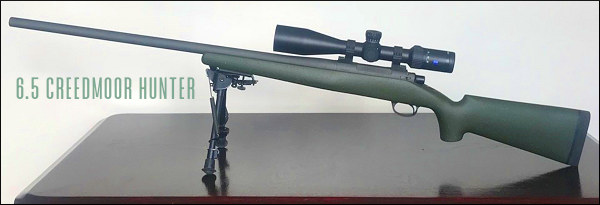
Sometimes clean and simple is the way to go — particularly with a hunting rifle. WEATHERBYFAN’s 6.5 Creedmoor is built around a Stiller Predator single-shot action in a texturd, green Wildcat Var-Tac stock. The 1:8″-twist Bartlein barrel is finished at 28″. That’s pretty long for a hunting rig, but it delivers added velocity. Finishing off this nice rigle is a Zeiss 6-24x50mm optic. Sometimes less is more and this is a perfect example of that.
Our final offering is from Forum member 300_WHISPER. Completed just months ago by gunsmith CALEB85, this .308 Win rifle features a Bighorn TL3 action with a Bartlein M40 26″ 1:10″-twist barrel, and Manners TA Elite stock. Other components include Trigger Tech Special, Area 419 self-timing muzzle brake, and a Weaver Tactical 3-15x50mm FFP mil/mil optic. When test-fired by Caleb with ammo using Berger 175gr OTM Tactical bullets, this nice .308 Win delivered a 1.6″ 5-shot group at 400 yards. The owner says “It’s my dream rifle. I couldn’t be happier”.
Today’s showcase shows how CCI, Federal, and Remington .22 LR rimfire ammunition types are produced in large American factories. CCI and Federal, until very recently, were part of the Vista Outdoor Kinetic Group. In December 2024 CCI and Federal along with other Vista ammo brands were sold to a Czech company, CSG.* Most CCI rimfire is produced in Idaho, while most Federal rimfire ammo is produced in Anoka, Minnesota. Here we feature videos from CCI, Federal, and Remington ammo plants. Watch and learn how rimfire ammo is made.
The Manufacturing Process for .22 LR Rimfire Ammunition Shooting Sports USA explains: “Rimfire cartridge cases are the oldest self-contained cartridge in existence, having been in continuous production since the mid-1850s. Rimfire cases are drawn from a thin piece of brass and formed with a hollow rim. A priming compound is then forced into the case using centrifugal force, where it is charged with powder and a bullet is seated in the mouth of the case. The case is then crimped around the bullet to ensure sufficient push and pull when the round is fired. When the firing pin strikes the thin brass rim of the case, the hollow rim is crushed and the primer is ignited.” Source: SSUSA.org 9/2/2017.
.22 LR Ammo Production at Federal Ammo Plant in Minnesota
Note to Viewers — After Starting Video, Click Speaker Icon to HEAR audio!
A while back a Field & Stream writer toured the Federal ammunition production facility in Anoka, Minnesota. This large plant produces both rimfire and centerfire ammunition. While touring the plant, the reporter was allowed to capture video showing the creation of .22 LR rounds from start to finish. This is a fascinating video, well worth watching. Click speaker icon for sound.
22Plinkster Tours CCI/Speer Idaho Factory
Trickshot artist and YouTube host 22Plinkster was able to tour the CCI/Speer production facility in Lewiston, Idaho. This large plant produces both rimfire and centerfire ammunition. While touring the plant, 22Plinkster was allowed to capture video showing the creation of .22 LR rounds from start to finish.
This revealing video shows all phases of .22 LR ammo production including cupping, drawing, annealing, washing, drying, head-stamping, priming, powder charging, bullet seating, crimping, waxing, inspection, and final packaging. We really recommend you watch the video from start to finish. Well worth watching, this excellent video has logged 3.2 million views on YouTube.
Remington Factory Produces Millions of Rounds of Rimfire Ammo
Billions of .22 Long Rifle rounds are produced every year, and Remington Ammunition in Lonoke, Arkansas produces a significant share of the rimfire ammunition used worldwide. This “American Rifleman Television” feature shows the full ammo production process. At the start, brass cups are stamped out of large sheets of brass, and the cups then move on to have the headstamps applied and rims formed. Next, the rounds move on to be annealed and rinsed. Then the cases move onto priming. A wet priming pellet is then pressed into each empty .22 case, and the case is spun rapidly, spreading the pellet mix into the inner cartridge rim. The primed cartridges are then sent to a drying house, where they’ll sit for several days to allow the priming mixture to dry. The Remington factory is very efficient, with “some of the fastest rimfire-making equipment on the planet”.
*In December 2024, Vista Outdoor completed the $2.23 billion sale of the company’s “Sporting Products” division — which is known as the Kinetic Group and includes American ammunition brands CCI, Federal Premium, Hevi-Shot, Remington, and Speer — to the Czechoslovak Group (CSG), a Czech conglomerate. READ Full Story of Vista Outdoor Kinetic Group ammo brands sale.
Do you often carry a concealed handgun? Then you should definitely read Beretta’s FREE 15-page eBook, Ten Essential Tips for CCW Holders. This eBook, in handy PDF format, helps gun owners select an appropriate handgun (and holster), understand legal obligations and responsibilities, and train effectively with the firearm. This short PDF eBook offers many useful tips to consider, in particular for gun owners who are contemplating the pros and cons of everyday carry for themselves.
As the Beretta CCW booklet says, “Carrying a concealed handgun requires a certain amount of confidence. You need to be confident in your knowledge of laws and regulations. You have to have confidence in your accuracy, and you need to trust that you can carry a gun effectively, securely and comfortably. If a gun is a burden for you to carry, you probably won’t.”
Surprising Facts About Actual Defensive Handgun Use
You may be surprised to learn when and how handguns are actually used for self-defense. Most defensive uses are at very short range and the incident only lasts a matter of seconds. You need to be prepared, and train to be proficient drawing and aiming your weapon. And remember, shooting is a last resort, when a safe retreat is not available.
55% of gunfights take place in 0-5 feet.
20% of gunfights take place in 5-10 feet.
20% of gunfights take place in 10-21 feet.
95% of gunfights take place in 0-21 feet. (Source: FBI)
The average man can cover 21 feet of ground in 1.5 seconds.
The average gunfight is over in 3-5 seconds.
3 to 4 shots are usually fired.
Most gunfights take place in low-light conditions.
On average, one shot in four strikes someone.
Here are two (2) sample pages from Beretta’s CCW eBook.
By Gary Anderson, DCM Emeritus
Rules that will govern CMP competitions in the next competition year are now posted on the CMP website where competitors and Match Officials can download them in preparation for the 2025 competition season. The CMP produces seven different competition rulebooks that have been revised for 2025 competitions. Electronic PDF versions of the new rulebooks are now available. The new CMP rulebooks are listed below.
Safety Rules and Procedures. All 2025 CMP Rulebooks now have separate 2.0 Safety Sections that include all range safety rules that are included in that rulebook. There aren’t any significant new safety rules, but safety procedures that were in various places in the rulebooks have been consolidated into one Rule 2.0 Safety Rules and Procedures section in each rulebook. This change reflects a CMP concern that all CMP range safety rules must be easy to find, readily accessible and well understood.
Three-Position Air Rifle Rules. The CMP supports the production of the rulebook that governs Three-Position Air Rifle competitions for school-age juniors. The National Standard Three-Position Air Rifle Rules are decided by National Three-Position Air Rifle Council member organizations through a process administered by the CMP. The 15th Edition 2024-2026 version of this rulebook was released at the end of September 2024.
Suppressors and Silencers. The use of silencers or suppressors is already widespread in some shooting sports disciplines. Their use is being promoted as a means of reducing range noise levels and mitigating the possibility of hearing loss. The CMP has made no decisions regarding whether to make them legal for use in CMP Highpower Rifle or Pistol events, but the CMP Rules Sub-Committee and Rules Advisors are seeking information and opinions on whether to take that step.
CMP Classification System. The CMP classification system is being expanded to include new Indoor Pistol, 22 Caliber Only Pistol and Mid-Range Highpower Rifle classifications.
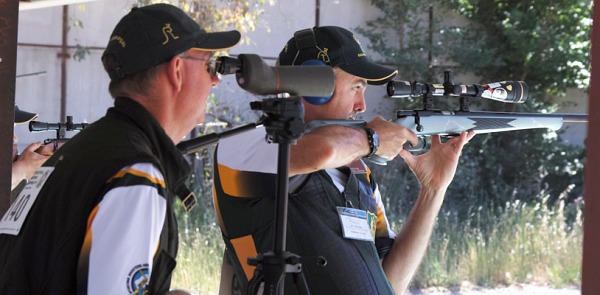
Long Range competitor shooting with scoped Eliseo Tubegun. Note viewing screen for electronic target.
SHOT Show 2025 in Las Vegas concludes today, January 24, 2025. This was an impressive show with thousands of vendors displaying products on 830,000 net square feet of floor space at Caesars Forum and The Venetian EXPO. There were many innovative new products, including new optics, chassis systems, barrels, “smart” guns and much more. For this Friday Day 4 of SHOT Show we offer a showcase of interesting product report videos.
Hodgdon Report — Availability of H4198, H4895 and ENDURON
At SHOT Show 2025, Chris Hodgdon took the time to talk about the availability of some Hodgdon powders for the months ahead. Regarding H4895 he said they hoped to have both powder in stores “Sometime this spring [2025]” so check the Hodgdon.com website for availability.
Regarding Enduron, Chris posted: “Big question here at SHOT show… where is the ENDURON? ENDURON has not been discontinued. We are working diligently with our supplier to get it back in stock. It may be a while before our supplier can produce it.”
Seekins Precision PH3 with Many New Features
In this video True Pearce, Editor of GunsAmerica Digest, reviews the new lightweight hunting rifle from Seekins Precision, the impressive model PH3. This boasts a modern composite chassis with adjustable comb and many notable new features.
Backfire Channel SHOT Show 2025 Highlights
The Backfire channel is one of our favorite gun-centric YouTube services. The host is smart and articulate and he does considerable real-world testing in the field. He has produced 294 videos and now has 961,000 subscribers — that’s impressive. This Backfire SHOT Show 2025 video runs 45 minutes and has already garnered 155,000+ views. It covers a host of products. Here are some highlights:
2:50 New Tikka T3X Ace
5:35 Aarken Outlier Precision Chassis
8:04 Shooters Global Smart Shooting Glasses
9:35 Seekins Precision H3 Rifle
11:24 Interview with Erik Cortina and F-Class John
17:12 MDT Chassis Systems and Bipods
20:18 Palmetto SA — New Hunting and AR-type Rifles
21:48 Interiew with Gavin Gear, Ultimate Reloader
25:45 Horizon Firearms Light Hunting Rifles
27:15 KRG Chassis for Ruger, Savage, Howa, Tikka etc.
31:30 Smith & Wesson — New Revolvers, Pistols, Rifles
33:08 Watchtower Rifle with Lattice Titanium barrel
33:40 RCBS Booth — New Reloading Equipment
35:10 Howa — New Pump-Action AR-style Rifle
36:05 Aero Precision — Tactical Lever-Action Rifle
New Chassis Options for Rem, Savage, Tikka, Ruger and more
The above video features an impressive new lightweight chassis from MDT. This will soon available for a variety of popular actions including Ruger, Remington, Savage and Tikka. This chassis is also featured in the vertical-format video on the right below.
Burris XTR PS Scope with Internal Ballistics Display
The new Burris XTS PS scope combines traditional glass lenses with an internal electronic display that shows hold-over and ballistic data to the shooter. Customizable “data zones” display dial-to-distance, wind hold, wind speed/direction, density altitude, angle compensation, and scope level. The scope features a unique new clickless turret with a digital position sensor for ultra-fast 1/30 MIL elevation adjustments.
MDT SEND-iT Electronic Level — Gen 2
Here’s a cool product that can benefit marksmen in many competitive rifle disciplines. The Generation 2 MDT LRA SEND iT – MV3 Electronic Level provides an instant “green light” visual signal showing that your rifle is level so your shot should land on target. Instead of waiting for a spirit (bubble) level to move, the SEND-iT LEDs are 3-5 seconds faster and are much easier to see.
Handgun Highlights — Walther, SIG, Canik, and HK Pistols
Walther Arms booth PDP Polymer and Steel Frames
SIG Sauer P226 X5 Steel Frame, single action only
NOTE: The SIG Sauer P226 X5 short video is incorrectly labeled “SIG Sauer 225″ — a typo by the creator.
Swarovski offers an impressive BTX Binocular Spotting Scope System. This is available with four different objective lens modules: 65mm, 85mm, 95mm, and 115mm. The image below shows the BTX with the 115mm objective. BTX price, as fitted with this huge 115mm objective, is a whopping $6648.00 MSRP!
On Day 2 of SHOT Show 2025 (Wednesday), six state governors attended a notable Forum. As you might expect, ALL the governors were Republicans from “Red” states. Topics included Second Amendment rights, the importance of the firearm industry, the legislative landscape, how and why special interests threatening the firearm and ammunition industry, and how states can help sustain Second Amendment rights. We commend these state leaders for attending SHOT Show and showing concern for the interests of shooters and hunters. We hope that more Governors, including Florida’s Re DeSantis, will attend next year. And perhaps even President Trump may even head to Las Vegas in 2026.
Present at the 2025 NSSF Governors’ Forum are (in alphabetical order of states):
➣ Idaho – Governor Brad Little (Republican)
➣ Montana – Governor Greg Gianforte (Republican)
➣ Nebraska – Governor Jim Pillen (Republican)
➣ Nevada – Governor Joe Lombardo (Republican)
➣ Oklahoma – Governor Kevin Stitt (Republican)
➣ Wyoming – Governor Mark Gordon (Republican)
Forum with State Attorneys General
Along with the Governors’ Forum there was also a moderated Forum with several Attorneys General of U.S. states. This 2nd Annual State Attorneys General Forum covered legal developments to protect Second Amendment rights and the firearm industry from antigun “lawfare” attacks. The forum focused on ongoing legal battles, legal questions, and the amicus briefs these attorneys general submitted opposing threats to the Second Amendment. Members also discussed dealing with the anti-gun policies pushed by the Biden administration, and the never-ending battle against politically-driven attacks on the firearm industry and Second Amendment rights.
Attorneys General Attending the Forum included (in alphabetical order of states):
Georgia – Attorney General Chris Carr
Kansas – Attorney General Kris Kobach
Missouri – Attorney General Andrew Bailey
Montana – Attorney General Austin Knudsen
Ohio – Attorney General Dave Yost
West Virginia – Attorney General J.B. McCuskey
“The firearm industry and gun owners have true courtroom champions in these attorneys general. They are the vanguard [who fought] four years of attacks by the Biden-Harris administration against our industry and our Second Amendment rights”, said Lawrence Keane, NSSF Sr. VP & General Counsel. These attorneys general, the leading law enforcement officials in their states, fight back against the wave of “lawfare” brought by gun control groups that weaponize courts against American civil liberties.
Sebastian (“Seb”) Lambang, the brilliant creator of SEB rests, joystick bipods, and rear bags, visited the USA two years ago to compete at the 2023 NRA F-Class National Championships at the Ben Avery shooting facility in Phoenix, Arizona. For that Fall 2023 event, Seb commissioned a very handsome, state-of-the-art F-Open rifle built by Blake Barrel and Rifle. Above is Seb’s F-Open rifle on the firing line at Ben Avery.
Seb Lambang’s impressive 7 FCP rig is chambered for the 7 FCP cartridge, an “improved” 6.5 PRC necked up to 7mm. This handsome rifle was crafted by Blake Barrel and Rifle using a 7mm, 1:8.5″-twist Blake barrel chambered in 7 FCP fitted to a Borden Accuracy BRMXD action. Mated to the Borden action is a Bix’N Andy Competition Benchrest trigger. On top is a March 10-60x56mm HM scope.
The handsome laminated wood XR stock is made by Cerus Rifleworks. The XR stock boasts a R.A.D. recoil reduction system in the rear, and a metal bag-rider system at the forward end of the stock. The rig employs an adjustable F-Class Products F-Open Barrel Tuner.
Seb Lambang is a talented shooter as well as a great craftsman. On the side of his March X scope it states: “Sebastian Lambang, QRA Queens 2022, F-Open Winner”.
Sebastian Lambang — Founder and Chief Designer of SEB Rests
When he is not competing, Seb works hard producing SEB Front Rests, SEB Neo-X Rests, SEB Mini-X tripod rests, and the class-leading SEB JoyPod-X joystick bipod, favored by F-TR shooters worldwide. Here are products at Seb’s warehouse, getting ready to be shipped out.
About the 7 FCP — New 7mm Cartridge Derived from 6.5 PRC
The 7 FCP was a cartridge designed from the ground up by F-Class Products out of Phoenix, Arizona in the fall of 2022. The developers believe it is the “ultimate cartridge” for the F-Class Open Division competition. F-Class Products notes: “We wanted a cartridge that [had] an efficient case capacity [matching] the 7mm Remington Short Action Ultra Magnum. The 7 RSAUM has proven to be the most winning cartridge in world F-Class competitions and many nationals and finale events. The problem with the RSAUM is brass availability. Remington stopped making brass for the RSAUM years ago and recently Norma has also stopped producing brass for it. The only option now is ADG. While the ADG brand of brass is good, it is quite expensive and also is only run in short runs and is hardly ever available.”
So the 7 FCP was developed from the 6.5 PRC, which has high-quality Lapua brass available. The 7 FCP was designed to shoot the 180 grain Berger Hybrid bullet at 2960 FPS out of a 30″ barrel without excessive pressure. SEE: 7 FCP Cartridge INFO FAQ Page.
7 FCP Cartridge — Wildcat Based on 6.5 PRC Necked up to 7mm
How Does the 7 FCP’s Case Capacity Compare?
F-Class Products states: “The parent case of the 7 FCP is a 6.5 PRC. The 6.5 PRC is a magnum case that has a head diameter of 0.532″ and has a overall length of 2.020″. It is the same overall length as the 7 RSAUM but with a smaller diameter body. Hence, without improving it, you will get not get the case capacity of a 7 RSAUM case, and therefore you will not get the velocities that the 7 RSAUM produces either.” F-Class Products has compared the capacity of cases commonly used in F-Open competition:
.284 Winchester = 63 grains of water capacity
.284 Shehane = 66.5 grains of water capacity
6.5 PRC = 65 grains of water capacity
7-6.5 PRC = 66.5 grains of water capacity
As you can see by the data above, the 6.5 PRC that is simply necked up to a 7mm does not provide more case capacity than the .284 Shehane. That is why the PRC has the shoulder moved forward.
What Powders Work Well in the 7mm FCP?
F-Class Products has tested many powders with the 7 FCP: “Any powders that work well in a .284 Win, a .284 variant or a 7 RSAUM and/or variant, can work well in the 7 FCP. We have tested many different powders and many show to work excellent. Here is a list of the powders we have tested that work well in our testing and in our customers’ testing:
Hodgdon H4350
Hodgdon H4831
Hodgdon H4831 SC
Alliant Reloder 16
Alliant Reloder 23
Vihtavuori N160
Vihtavuori N550
Vihtavuori N555
This is just a short list of what we believe are the core powders that will burn and work efficiently in the 7 FCP. There are plenty of other powders that also can work, yet they may be temperature sensitive and or not burn efficiently in the case.”
What Velocities Are Optimal?
F-Class products observes: “With the 180 grain Berger bullet we see accuracy from 2920-2980 FPS muzzle velocity. With the 190 grain Hornady A-Tip bullet we see accuracy from 2860-2900 FPS.”
What Twist Rates Do You Recommmend?
F-Class Products recommends a 1:8.5″-twist barrel. An 8-twist can work, yet the accuracy nodes may be narrower than the 8.5 twist. A 9-twist barrel can also work if you are shooting a 184 grain bullet or less. These twist rates are recommended for lead cored bullets. If you are planning on shooting a solid copper bullet, consult the bullet manufacture for recommended twist rates for that particular bullet.
What Is the Parent Case?
The parent case of the 7 FCP is a 6.5 PRC. The 6.5 PRC is a magnum case that has a head diameter of 0.532″ and has a overall length of 2.020″. It is the same overall length as the 7 RSAUM but with a smaller diameter body, hence without improving it, you will get not get the case capacity of a 7 RSAUM case, and therefore you will not get the velocities that the 7 RSAUM produces either.
Have you recently purchased a new scope? Then you should verify the actual click value of the turrets before you use the optic in competition (or on a long-range hunt). While a scope may have listed click values of 1/4-MOA, 1/8-MOA or 0.1 Mils, the reality may be slightly different. Many scopes have actual click values that are slightly higher or lower than the value claimed by the manufacturer. The small variance adds up when you click through a wide range of elevation.
In this video, Bryan Litz of Applied Ballistics shows how to verify your true click values using a “Tall Target Test”. The idea is to start at the bottom end of a vertical line, and then click up 30 MOA or so. Multiply the number of clicked MOA by 1.047 to get the claimed value in inches. For example, at 100 yards, 30 MOA is exactly 31.41 inches. Then measure the difference in your actual point of impact. If, for example, your point of impact is 33 inches, then you are getting more than the stated MOA with each click (assuming the target is positioned at exactly 100 yards).
How to Perform the Tall Target Test
The objective of the tall target test is to insure that your scope is giving you the proper amount of adjustment. For example, when you dial 30 MOA, are you really getting 30 MOA, or are you getting 28.5 or 31.2 MOA? The only way to be sure is to verify, don’t take it for granted! Knowing your scopes true click values insures that you can accurately apply a ballistic solution. In fact, many perceived inaccuracies of long range ballistics solutions are actually caused by the scopes not applying the intended adjustment. In order to verify your scope’s true movement and calculate a correction factor, follow the steps in the Tall Target Worksheet. This worksheet takes you thru the ‘calibration process’ including measuring true range to target and actual POI shift for a given scope adjustment. The goal is to calculate a correction factor that you can apply to a ballistic solution which accounts for the tracking error of your scope. For example, if you find your scope moves 7% more than it should, then you have to apply 7% less than the ballistic solution calls for to hit your target.
NOTE: When doing this test, don’t go for the maximum possible elevation. You don’t want to max out the elevation knob, running it to the top stop. Bryan Litz explains: “It’s good to avoid the extremes of adjustment when doing the tall target test.I don’t know how much different the clicks would be at the edges, but they’re not the same.”
Should You Perform a WIDE Target Test Too?
What about testing your windage clicks the same way, with a WIDE target test? Bryan Litz says that’s not really necessary: “The wide target test isn’t as important for a couple reasons. First, you typically don’t dial nearly as much wind as you do elevation. Second, your dialed windage is a guess to begin with; a moving average that’s different for every shot. Whereas you stand to gain a lot by nailing vertical down to the click, the same is not true of windage. If there’s a 5% error in your scope’s windage tracking, you’d never know it.”
Verifying Scope Level With Tall Target Test
Bryan says: “While setting up your Tall Target Test, you should also verify that your scope level is mounted and aligned properly. This is critical to insuring that you’ll have a long range horizontal zero when you dial on a bunch of elevation for long range shots. This is a requirement for all kinds of long range shooting. Without a properly-mounted scope level (verified on a Tall Target), you really can’t guarantee your horizontal zero at long range.”
NOTE: For ‘known-distance’ competition, this is the only mandatory part of the tall target test, since slight variations in elevation click-values are not that important once you’re centered “on target” at a known distance.
Creedmoor Sports has released a series of helpful “how-to” videos in its InfoZone web page. In one InfoZone video Bill Gravatt shows how to seat bullets using L.E. Wilson Hand Dies and an Arbor Press. The basic process is simple, particularly with a micrometer-top seating die. That makes it easy to adjust and set seating depth. Before you start seating bullets, you want to adjust the height of the arbor so the stroke is appropriate to the height of your die.
Bill Gravatt Shows How to Use Hand Seating Dies — Creedmoor INFOZONE
ARBOR PRESS TECHNIQUE: When using an arbor press, smooth is good. You don’t want to slam the handle down quickly. Try to repeat the same motion each time. You can also experiment by seating the bullet part way, then rotate the cartridge (in the die) and do the final seating with a second stroke. If your arbor press has a force gauge, note both the max value of the gauge needle and how it moves as you seat the bullet. If the needle spikes too rapidly, or bounces back and forth irregularly, set that cartridge aside and/or mark it. You could have neck tension issue with that case or some other fault. You might even have a bad bullet. That’s rare, but can happen. The key to success is moving the press arm in a smooth motion every time, maintaining the same down-pressure with each cartridge.
Here Bill Gravatt Offers a Simple Tip for Adjusting Wilson Seating Dies
One of our Forum readers asked “How can I get a custom in-line seater for my new rifle?”. First, we would say that, if you are not shooting an unusual Wildcat, check first to see if L.E. Wilson makes a stainless Micrometer Seater Die for your rifle. These dies are a joy to use, and we’ve found the fit to be exceptionally good with many calibers. Typically priced from $95-$120, Wilson stainless micrometer-top seaters are available for dozens of cartridge types: .204 Ruger, 20 BR, .222 Rem, .223 Rem, 22 PPC, 22 BR, .22-250, .223 WSSM, 6 PPC, 6mmBR, 6XC, 243 Win, .243 WSSM, 25 WSSM, 6.5×47 Lapua, 6.5 Creedmoor, 6.5-284, 26 Nosler, .270 WSM, 7mm-08, .284 Win, 28 Nosler, 7mm RUM, 30 BR, .308 Win, .300 WinMag, .338 Edge (and MORE).
If you do want a custom seater die, the process is relatively simple. Purchase a die blank from Wilson and have your gunsmith run the chambering reamer in. Forum member Gunamonth explains: “I start with a Wilson seating die blank. They’re available from Sinclair and other vendors. Just run the reamer in. For some of my rifles, where I wanted the stainless die with the micrometer adjustment, I bought a smaller die and had the smith ream it with the chamber reamer. That’s how I had my 6 Dasher and 6mm AI seaters made. With the Dasher I stared with a 6mmBR Micrometer die.”
SEATER STEM TIP: If, on your seated bullets, you are seeing a sharp line around the jacket near the ogive, you may want to smooth out the leading edge of the Wilson seater stem (see above left). Do this by putting a little lapping compound on one bullet and manually spin this around in the stem. Without much effort you’ll have a smooth bullet/stem interface.
Micrometer Top Add-on
We really like micrometer tops on a seating die. But what if Wilson doesn’t make a micrometer top seater for your chambering? Don’t despair, Brownells sells a $39.99 Sinclair Micrometer Top that can be added to Wilson standard seaters or to a custom seater die made from a Wilson die blank.
The NRA Blog ran an feature on Silhouette shooting by NRA Silhouette Program Coordinator Jonathan Leighton. Here are selections from Leighton’s story:
NRA Silhouette Shooting
The loud crack from the bullet exiting the muzzle followed by an even louder ‘clang’ as you watch your target fly off the railing is really a true addiction for most Silhouette shooters. There is nothing better than shooting a game where you actually get to see your target react to the bullet. In my opinion, this is truly what makes this game so much fun.
Metallic Silhouette — A Mexican Import
Silhouette shooting came to this country from Mexico in the 1960s. It is speculated that sport had its origins in shooting contests between Pancho Villa’s men around 1914. After the Mexican Revolution the sport spread quickly throughout Mexico. ‘Siluetas Metalicas’ uses steel silhouettes shaped like game animals. Chickens up front followed by rows of pigs, turkeys, and furthest away, rams. Being that ‘Siluetas Metalicas’ was originally a Mexican sport, it is common to hear the targets referred to by their Spanish names Gallina (chicken), Javelina (pig), Guajalote (turkey) and Borrego (ram). Depending on the discipline one is shooting, these animals are set at different distances from the firing line, but always in the same order.
Before Steel There Was… Barbeque
In the very beginnings of the sport, live farm animals were used as targets, and afterwards, the shooters would have a barbeque with all the livestock and/or game that was shot during the match. The first Silhouette match that used steel targets instead of livestock was conducted in 1948 in Mexico City, Mexico by Don Gonzalo Aguilar. [Some matches hosted by wealthy Mexicans included high-ranking politicians and military leaders].
As the sport spread and gained popularity during the 1950s, shooters from the Southwestern USA started crossing the Mexican border to compete. Silhouette shooting came into the US in 1968 at the Tucson Rifle Club in Arizona. The rules have stayed pretty much the same since the sport has been shot in the US. NRA officially recognized Silhouette as a shooting discipline in 1972, and conducted its first NRA Silhouette Nationals in November of 1972.
Great Video of Silhouette Shooting in Canada with Drone Footage
Now There Are Multiple Disciplines
The actual sport of Silhouette is broken into several different disciplines. High Power Rifle, Smallbore Rifle, Cowboy Lever Action Rifle, Black Powder Cartridge Rifle, Air Rifle, Air Pistol, and Hunter’s Pistol are the basic disciplines. Cowboy Lever Action is broken into three sub-categories to include Smallbore Cowboy Rifle, Pistol Cartridge Cowboy Lever Action, and regular Cowboy Lever Action. Black Powder Cartridge Rifle also has a ‘Scope’ class, and Hunter’s Pistol is broken into four sub-categories. Some clubs also offer Military Rifle Silhouette comps.
Where to Shoot Silhouette
NRA-Sanctioned matches are found at gun clubs nation-wide. There are also many State, Regional, and National matches across the country as well. You can find match listings on the Shooting Sports USA website or contact the NRA Silhouette Department at (703) 267-1465. For more info, visit SteelChickens.com, the #1 website dedicated to Silhouette shooting sports.




 2:50 New Tikka T3X Ace


 How Does the 7 FCP’s Case Capacity Compare?

 Verifying Scope Level With Tall Target Test
 One of our Forum readers asked “How can I get a custom in-line seater for my new rifle?”. First, we would say that, if you are not shooting an unusual Wildcat, check first to see if


 The
The 
 Metallic Silhouette — A Mexican Import
 Before Steel There Was… Barbeque