Ask 10 shooters about barrel cleaning and you’ll get 10 different opinions. This reflects that fact that different fouling problems demand different solutions. For example, solvents that work well for copper may not be the best for hard carbon (and vice-versa). To come up with the right solution, first you must understand the nature of the fouling in your barrel.
John Krieger Interview with AccurateShooter at SHOT Show:
The debate about the proper care of a match barrel is a hot one, spiked with folklore and old wives’ tales, Lohman said. He and his staff set out to set the record straight: “We tried to interject some science into the discussion of cleaning a match barrel,” he explained. In his article, Lohman writes:
Why worry about a little barrel fouling when the throat is subjected to a brutal 5,600° F volcano at 55,000 PSI? To investigate these and other questions about taking care of a match barrel, we spoke with a dozen experts and share their knowledge in this first of a series of articles.
After listening to folks who shoot, build barrels or manufacture cleaning solvents for a living, we concluded that even the experts each have their own unique recommendations on how to care for a match barrel. But they all agree on one thing — the gun will tell you what it likes best. Because the life expectancy of a match barrel is about 1,500 to 2,500 rounds, the objectives of cleaning one should include: preserve accuracy, slow the erosion, and remove fouling — all without damaging the gun. This article doesn’t claim that one cleaning method is better than the next. Rather, we set out to interject a little science into the discussion and to share some lessons learned from experts in the field.
For more Shooting Sports USA articles, visit www.ssusa.org.
We created this custom target in 5 minutes using PrintTargets.net. If you like it, DOWNLOAD HERE.
AccurateShooter.com has a HUGE collection of FREE downloadable PDF targets. We offer a very wide range of target designs: Load Development Grids, NRA Bullseye targets, Official-Size BR targets, Realistic Varmint Targets, Silhouette Shapes, Fun Plinking Targets, and even specialized tactical training targets. If our collection of free targets isn’t enough, or if you want to create a new kind of target — you’re in luck. The Australian-based interactive website, PrintTargets.net, allows you to create your own customized, printable PDF targets. Shown below are just a few of the target designs you can create in minutes:
CLICK Graphic to Create Your Own Targets.
Just follow the step-by-step instructions to set paper size, layout, bullseye color, line thickness, number of rings and diameter. You can even add Score Numbers to your target rings. PrintTargets.net is easy and fun to use. It’s much faster to create targets this way than to try to draw a series of circles with PowerPoint or MS Paint.
Power-User Tip: PrintTargets.net even offers a handy diamond-grid calibration diagram that you can add to your custom target designs. You’ll find the calibration grid as option #15 when you design your target — just scroll all the way down the PrintTargets.com home page.
Top to bottom: Remington firing pin assembly with ISS, Tubb SpeedLock alloy-composite system without ISS (current versions have dual, opposite-wound springs), and Remington short action firing pin assembly without ISS.
The U.S. Army Marksmanship Unit regularly publishes technical articles on the USAMU Facebook page. One informative USAMU article covered mechanical issues and related ignition irregularities that can cause vertical fliers even with good ammunition in an otherwise excellent rifle. We highly recommend you read this article, which offers some important tech tips.
Vertical Dispersion: Mechanical/Ignition Issues?
Poor or inconsistent ignition has long been known to be one of the “usual suspects” when one encounters vertical fliers that just shouldn’t be there. By having a sense of some of the basic principles involved, and a few basic areas to check, the shooter may avoid colsiderable frustration, not to mention time, expensive loading components and barrel wear.
Is your well-built rifle of high-quality components plagued with vertical fliers across more than 1-3 handload combinations? Consider the bedding, crown and scope/sight mounts. Are they correct? If so, then you might check for ignition issues before boldly undertaking an extensive, expensive, and quite possibly fruitless quest for the “magic handload”.
SEEING IS BELIEVING: While the author had been aware for many years that poor ignition should be considered and ruled out when dealing with vertical fliers in an otherwise-excellent rifle, actually seeing the problem and its almost instantaneous cure really drove the lesson home.
He was working with a “dot” rifle – a .22 LR match rifle that really stacked bullets into little piles at 50 yards and beyond. With one lot of ELEY Tenex, it produced consistent “bughole” groups at 50, but with another, selected lot of Tenex, similar groups were regularly ruined by single, vertical fliers that did not appear in other rifles. Rather than spending days burning up expensive, select ammunition looking for “magic lots”, he contacted a well-respected rimfire gunsmith and explained the situation.
Without so much as batting an eye, the highly-experienced ‘smith tore into the rifle’s action, and quickly found the cause(s) of the problem. He discovered a demonstrably weak firing pin spring, plus a chip out of the face of the firing pin where it contacted the cartridge rim.
After replacing and tuning the offending parts, the rifle immediately began shooting tiny, bughole groups with the previously “unacceptable” lot of Tenex. Centerfire rifles can also benefit from ensuring positive, consistent ignition. A wise riflesmith is literally worth his weight in gold!
So, what are some issues we as shooters can inspect in our rifles to help determine if ignition woes could be part of our problem? At the club level, ask yourself if that “experienced” Remington, Winchester 70, or even Springfield-based match bolt gun you’re using is still running its’ original 40-80 year-old factory striker spring? If so, a new replacement is cheap insurance against current or future problems. (And BTW, it might be best to stick to the normal, factory-spec spring weight. A super-powerful spring can cause vertical, just as a weak one one can.) Along with that, a routine check for proper firing-pin protrusion is a quick preventive measure that can rule out potential issues.
Other areas to consider are the centering and consistency of the firing pin’s operation in the bolt. Admittedly, with the increasing use of precision-machined custom actions, this is becoming less an issue every day. Below is the firing pin assembly from a custom BAT action:
However, particularly with factory actions, a very quick and easy check is to remove the bolt, let the firing pin go forward, and look at the firing pin tip through the firing pin hole. Is the tip off-center in the hole, and possibly striking it as it moves forward? Is the hole out-of-round or burred from being struck repeatedly? If so, a trip to the riflesmith is likely in order.
Similarly, machining issues in the bolt/firing pin system can lead to rough and erratic firing pin movement, in which the firing pin drags against an internal surface of the bolt. In high-quality rifles these issues are relatively rare, but not unheard-of, and it takes mere minutes to rule them out. It may be worthwhile to remove the cocking piece/firing pin/spring assembly and look for any unusual gouges, dings, peening, burrs or signs of abnormal wear.
This task is especially easy with Winchester 70s, Springfields, and the similar Mauser 98s, involving little more than the push of a button and unscrewing the cocking piece assembly. This is just one of the many reasons these tried-and-true actions have earned such a loyal following in the field, among hunters who must maintain their rifles away from a shop.
Particularly with older rifles, watch for and remove excess grease (or even Cosmoline!) from both the firing pin assembly and inside the bolt. This can help improve firing pin speed and consistency. Other bolt-action designs may need a take-down tool or other measures.
As part of this inspection, AFTER ENSURING THE RIFLE IS UNLOADED, slowly cock the rifle, dry-fire, and repeat several times. Listen carefully near the action for inconsistency in the sounds it generates. Does the striker falling make the same sound each time? Do you hear or feel grinding upon operation? If so, where?
Be sure to check the operation of the cocking piece (bolt shroud), firing pin within the bolt shroud, the cocking piece cam and the rear of the bolt body where the cocking piece cam operates. As with our examination for abnormal wear marks discussed above, look for marks indicating roughness or a possible need for light polishing. Then, clean and lightly grease the bearing surfaces while you’re at it.
Remington 700 bolt shroud and cocking cam
These are relatively easy checks that shooters can undertake to perform a preliminary inspection on their own. Other mechanical issues can also cause ignition issues, chiefly centered around the action of the trigger, sear and sear spring. If these are suspected, a trip to an experienced, qualified riflesmith for diagnosis is recommended. We hope you find this information helpful! Join us again next week, and in the meantime, enjoy the shooting sports safely!
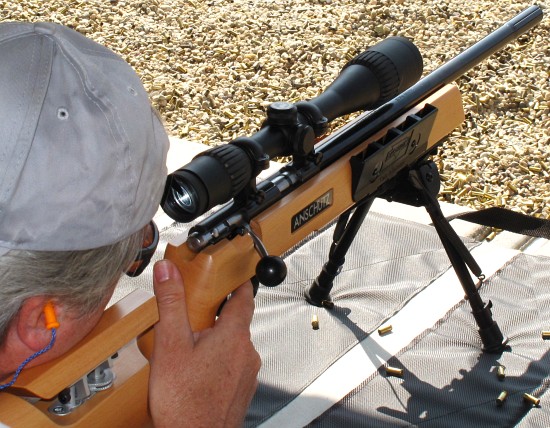
AccurateShooter’s Editor trains with .22 LR Anschutz model 64R back in 2008.
Rimfire Tactical Matches Aren’t Really New
NRL22 and PRS rimfire shooting disciplines are fun, affordable forms of competition. We’re pleased to see the rapid growth of NRL22 and PRS rimfire. However, the concept of a rimfire tactical/practical match is not new — at least on the West Coast. Way before anyone every heard of PRS, California shooting clubs conducted “Rimfire Tactical” matches. These matches were first fired nearly two decades ago. CLICK HERE to read our comprehensive Rimfire Tactical report from way back in 2008. That article includes free targets, ballistics charts, and a complete run-down on suitable rimfire rifles.
The Concept Behind the Rimfire Tactical Match by Bill Erwin
Many guys who shoot long-range tactical matches practice with .22 LR rifles of similar configuration. Rimfire ammo is way more affordable than centerfire, you do not need a big range facility, and shooting rimfire saves wear and tear on your centerfire rifle. Further, for learning how to read the wind, there really is no better training tool than a 22 LR, even as close as 50 yards. Check out this table showing how a .22 LR ballistics compare to .308 Win:
.22 LR vs. .308, Distances for Equal 10 MPH Wind Drift
This table shows the corresponding distances at which a 10 mph full-value crosswind pushes a .22 LR bullet and .308 projectile the same amount. Values are based on 0.130 BC for a 40gr .22 LR bullet, and 0.496 BC for 175gr .308 bullet.
22 LR 40gr 1050 fps
50 yd Wind 1.0″
75 yd Wind 2.2″
100 yd Wind 3.8″
125 yd Wind 5.8″
150 yd Wind 8.2″
175 yd Wind 11.0″
200 yd Wind 14.3″
.308 Win 175gr 2650 fps
130 yd Wind 1.07″
180 yd Wind 2.15″
230 yd Wind 3.68″
280 yd Wind 5.63″
330 yd Wind 7.98″
380 yd Wind 10.71″
440 yd Wind 14.56″
This table shows how the .22 LR can be an effective substitute for a .308 Win during training. Because the smaller bullet drifts more in the wind, a .22 LR rimfire shooter will experience roughly the same crosswind effects as if he was shooting a 175gr .308 Win twice as far out. So, rimfire work can teach you to dope the wind like a .308 Win, but at less than half the distance. Shooting a .22 LR at 100 yards is like shooting a .308 Win (with 175gr SMK) at 230 yards.
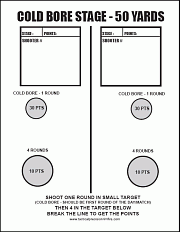
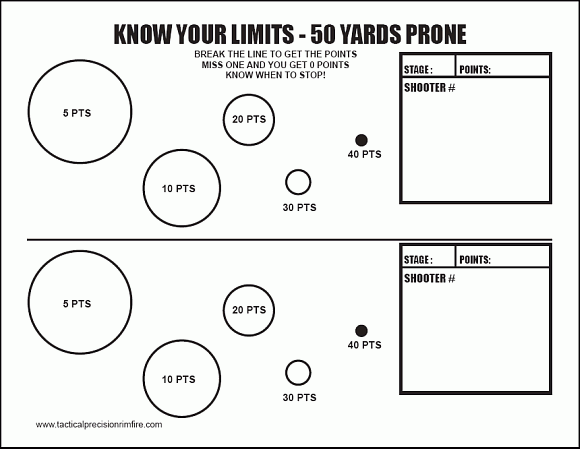
SPECIAL BONUS–Rimfire Tactical Precision Targets
These FREE targets by DesertFrog are offered in Adobe Acrobat format for easy printing. CLICK HERE to download all six targets as a .ZIP archive.
Rimfire Training Target for Fun Matches
Here’s a rimfire training target with “big to small” target circles. Start with the largest circles, then move to the smaller ones in sequence. This systematic drill provides increasing challenge shot-by-shot. Novices often are quite surprised to see their accuracy improve as they move from bigger to smaller aiming points. That provides positive feedback — always a good thing.
Right Click and “Save as” to download printable PDF versions of target.
So you’re thinking of buying a suppressor (aka “moderator”, “silencer”). You can’t just get one off the shelf at Walmart. Acquiring a suppressor requires filling out paperwork and paying a Federal $200 Tax Stamp. Plus there is typically a pretty long wait. However, the good news is that suppressor ownership is now legal in 42 of the 50 American states — that’s 84%! For most American adults, getting a suppressor is legal, provided the buyer passes the required background checks (explained below). The 42 “suppressor-friendly” states are shown as RED in the illustration below.
States Where Suppressor Ownership is Allowed
These 42 states allow private ownership of suppressors: AL, AK, AZ, AR, CO, CT, FL, GA, ID, IN, IA, KS, KY, LA, ME, MD, MI, MN, MS, MO, MT, NE, NV, NH, NM, NC, ND, OH, OK, OR, PA, SC, SD, TN, TX, UT, VT, VA, WA, WV, WI, WY. Note: Even if you live in one of the states listed, you should still verify that owning a suppressor is legal in your area. Some states may have municipal- or county-based restrictions.
“Suppressor ownership [has] boomed in the 21st century. Thanks in part to companies like Silencer Central that streamline the purchasing process, the number of registered suppressors has grown from 285,000 in 2010 to over 2.6 million in 2020.” — GunsAmerica Digest
States Which Prohibit Suppressor Ownership
The eight states which prohibit suppressor ownership are: California, Delaware, Hawaii, Illinois, Massachusetts, New Jersey, New York, and Rhode Island. These states are shown in GRAY in the map.
Qualifications to Obtain a Suppressor
To legally obtain a suppressor, you must fill out Federal Forms and pay a $200 fee to the ATF. You must also pass BATFE background checks and otherwise comply with Federal and state laws. States can regulate suppressor ownership or use, so be sure to check the laws in your area. On the federal level, the process to acquire a suppressor is regulated under the National Firearms Act of 1934. According to the American Suppressor Association, to own a suppressor in the United States you must:
1. Be at least 21 years of age to purchase a suppressor from a dealer.
2. Be at least 18 years of age to purchase a suppressor from an individual on a Form 4 to Form 4 transfer (contingent on state laws).
3. Be at least 18 years of age to possess a suppressor as a beneficiary of a trust or as a member of a corporation (contingent on state laws).
4. Be a resident of the United States.
5. Be legally eligible to purchase a firearm.
6. Pass a BATFE background check with a typical process time of 8 to 10 months.
7. Pay a one time $200 Transfer Tax.
That fifth requirement, “be legally eligible to purchase a firearm”, involves a list of factors. The prohibitions are set forth in the “prohibited person” list found on ATF Form 4473.*
The Second Amendment Foundation (SAF) has filed a federal lawsuit challenging restrictive gun control laws in Hawaii which discriminate against young adults, prohibiting them from acquiring, purchasing, and possessing firearms and ammunition, therefore violating their Second and Fourteenth Amendment rights. The lawsuit, which seeks injunctive relief, was filed in U.S. District Court for the District of Hawaii.
SAF is joined by Aloha Strategics LLC, JGB Arms LLC, and two private citizens, Juda Roache and Elijah Pinales. The case is known as Pinales v. Attorney General for the State of Hawaii. The defendant is Hawaii Attorney General Anne E. Lopez, named in her official capacity. SEE Court Filing HERE.
“Hawaii’s ban on the purchase and possession of firearms by adults in the 18- to 20-year age group makes it impossible for these citizens to exercise their constitutional right to keep and bear arms,” noted SAF Executive Director Adam Kraut. “Their rights have been assured by recent Supreme Court rulings, not to mention this nation’s history and tradition, and the Hawaii statutes clearly conflict with those decisions and the relevant history.”
“Hawaii has essentially decided the Second Amendment doesn’t apply in that state”, added SAF founder and Executive V.P. Alan M. Gottlieb. “Under the Fourteenth Amendment, no state shall make or enforce any law which abridges the rights guaranteed to citizens by the U.S. Constitution, and that includes young adults. These prohibitions simply cannot be allowed to stand.”
Hawaii Firearms Coalition Supports SAF Challenge
The Hawaii Firearms Coalition (HIFICO) supports the SAF lawsuit defending young adults’ rights to bear arms. On its Facebook Page HIFICO posted: “Let freedom ring — loud and clear! Hawaii Firearms Coalition has announced its support for the SAF’s groundbreaking lawsuit challenging Hawaii’s unfair ban on firearm ownership for adults under 21.”
HIFICO notes that: “This case takes aim at the state’s unconstitutional restrictions that stop responsible citizens from protecting themselves and exercising their rights. Imagine being old enough to serve in the military, vote, and pay taxes, but being told you can’t defend yourself or your family. Yeah, we don’t think so either! This lawsuit is about fairness, freedom, and upholding the Constitution. The Second Amendment doesn’t come with an age limit!
The lawsuit argues that Hawaii’s age-based restrictions on firearm ownership trample on the rights guaranteed by the Second and Fourteenth Amendments. This isn’t just about the plaintiffs — it’s about all of us. We stand with the young men and women who are fighting back. This case is about empowering law-abiding adults to exercise their rights. It’s about saying, ‘Hey, Hawaii! Follow the Constitution!'”
If the battery on your safe’s electronic lock is more than a year old, or if it is not giving you the right voltage, replace it today!
This time of year, many readers are putting their guns away in a safe for the winter. It’s easy to just tuck the guns away and forget about them. But there’s something you should do before you shut the safe door.
If you have a safe with an electronic keypad, you should replace the battery every year as a precautionary measure. Trust us, you don’t want to come back in a few months and find that the keypad memory is kaput, and you’re locked out. That can lead to an expensive locksmith visit.
Low Voltage Battery? You May Be Locked Out…
Here’s a true story. I have one safe with a Sargent & Greenleaf (S&G) keypad. A couple years back, in early December, I went to get into the safe. I punched in the correct combination, but all I got was a rapid “beep, beep, beep, beep” after I finished the last combination entry. I tried again to ensure I entered the combination correctly (I did). But again, the locking system responded with multiple rapid beeps indicating something was wrong. And the safe would not open. Now I was worried….
I popped out the battery holder (which slides in from the bottom of the keypad housing on the door). I removed the battery and tested it with a volt-meter. The 12-month-old Duracell 9-volt battery only registered 6.1 volts.
Low voltage was the problem. I went down to the store and got a couple new 9V batteries. I tested the new batteries and both measured 9.4 volts output. I slipped one of the new 9V batteries into the keypad housing, punched in the combination and everything worked OK again. Eureka.
Most electronic locks for safes WILL “remember” the combination for a period of time even when the battery is low (and the keypad’s “brain” should retain the combination when you remove the battery for replacement). However, a dead battery, or extended periods of low voltage can give you problems. Don’t rely on wishful thinking…
Will you be traveling (with firearms) to other states to celebrate Thanksgiving with friends and relatives? Are you concerned about the laws that might apply when you are transporting guns across state lines? Or are you puzzled about the requirements for obtaining a carry permit in your own state? If you have any of these questions, you should definitely get expert guidance on State statutes and regulations controlling firearms. To do that, you can purchase Attorney Scott Kappas’s Traveler’s Guide to the Firearms Laws of the 50 States for $15.94 on Amazon or $15.95 from the publisher. There is also an eBook version for $14.95 and a eBook/Print Combo for $22.90.
The latest edition of the Gun Law Guide includes multiple new and expanded sections for 2024. This valuable guide has 91% five-star reviews from book buyers on Amazon. Over 2,000,000 copies of this book have been sold since 1996.
If you don’t want to spend the money on the book, there is a FREE alternative. There’s a very helpful set of State Law Summaries on the web, presented by PewPewTactical.com. Despite the silly name, the PewPewTactical website has an abundance of information that is particularly beneficial for pistol shooters and CCW holders.
One of the best features of PewPewTactical.com is the Gun Laws by State online reference guide. We looked through four of these State Law Summaries and were impressed by the depth of the coverage. But we caution — if you have specific legal questions, particularly with recently-enacted statutes, you should consult a licensed attorney for your state (or the state to which you will travel). In addition, many of the State Law Summaries have not been updated for 3-5 YEARS! But they are still a good place to start. Below are links to state law articles from PewPewTactical.com. To access any State summary, simply click the State name below:
In discussions of ballistics, you’ll see references to “tangent”, “secant”, and “hybrid” bullet shapes. We know that, for many readers, these terms can be confusing. To add to the confusion, bullet makers don’t always identify their projectiles as secant or tangent designs. This article provides a basic explanation of tangent, secant, and hybrid ogive bullet designs, to help you understand the characteristics of these three basic bullet shapes.
Tangent vs. Secant vs. Hybrid
Most match bullets produced today use a tangent ogive profile, but the modern VLD-style bullets employ a secant profile. To further complicate matters, the latest generation of “Hybrid” projectiles from Berger Bullets feature a blended secant + tangent profile to combine the best qualities of both nose shapes. The secant section provides reduced drag, while the tangent section makes the bullet easier to tune, i.e. less sensitive to bullet seating depth position.
Berger Bullets ballistician Bryan Litz explains tangent and secant bullet ogive designs in a glossary section of his Applied Ballistics website, which we reprint below. Bryan then explains how tangent and secant profiles can be combined in a “hybrid” design.
How Bullet Ogive Curves are Defined
While the term “ogive” is often used to describe the particular point on the bullet where the curve reaches full bullet diameter, in fact the “ogive” properly refers to the entire curve of the bullet from the tip to the full-diameter straight section — the shank.
Understanding then, that the ogive is a curve, how is that curve described?
LITZ: The ogive of a bullet is usually characterized by the length of its radius. This radius is often given in calibers instead of inches. For example, an 8 ogive 6mm bullet has an ogive that is a segment of a circular arc with a radius of 8*.243 = 1.952”. A .30-caliber bullet with an 8 ogive will be proportionally the same as the 8 ogive 6mm bullet, but the actual radius will be 2.464” for the .30 caliber bullet.
For a given nose length, if an ogive is perfectly tangent, it will have a very specific radius. Any radius longer than that will cause the ogive to be secant. Secant ogives can range from very mild (short radius) to very aggressive (long radius). The drag of a secant ogive is minimized when its radius is twice as long as a tangent ogive radius. In other words, if a tangent ogive has an 8 caliber radius, then the longest practical secant ogive radius is 16 calibers long for a given nose length.”
Bryan Litz Explains Hybrid Design and Optimal Hybrid Seating Depths
Ogive Metrics and Rt/R Ratio
LITZ: There is a number that’s used to quantify how secant an ogive is. The metric is known as the Rt/R ratio and it’s the ratio of the tangent ogive radius to the actual ogive radius for a given bullet. In the above example, the 16 caliber ogive would have an Rt/R ratio of 0.5. The number 0.5 is therefore the lowest practical value for the Rt/R ratio, and represents the minimum drag ogive for a given length. An ogive that’s perfectly tangent will have an Rt/R ratio of 1.0. Most ogives are in between an Rt/R of 1.0 and 0.5. The dimensioned drawings at the end of my Applied Ballistics book provide the bullets ogive radius in calibers, as well as the Rt/R ratio. In short, the Rt/R ratio is simply a measure of how secant an ogive is. 1.0 is not secant at all, 0.5 is as secant as it gets.
Hybrid Bullet Design — Best of Both Worlds?
Bryan Litz has developed a number of modern “Hybrid” design bullets for Berger. The objective of Bryan’s design work has been to achieve a very low drag design that is also “not finicky”. Normal (non-hybrid) secant designs, such as the Berger 105gr VLD, deliver very impressive BC values, but the bullets can be sensitive to seating depth. Montana’s Tom Mousel has set world records with the Berger 105gr VLD in his 6mm Dasher, but he tells us “seating depth is critical to the best accuracy”. Tom says a mere .003″ seating depth change “makes a difference”. In an effort to produce more forgiving high-BC bullets, Bryan Litz developed the hybrid tangent/secant bullet shape.
NSSF, the Firearm Industry Trade Association, has launched a big auction with over 30 items up for bid — from one-of-a-kind firearms to exclusive hunting and shooting experiences. Running through January 24, 2025 at NSSF.org/auction, this Celebration of Freedom Auction features more than 30 items ranging from a 7-day dream safari in Africa to collectible firearms from respected gunmakers including Smith & Wesson, Colt, Browning, SIG Sauer, and Ruger. If you are looking for a special gun or a cool hunting holiday, you should check out the auction. We feature eight of the notable items below.
NOTE: Many of these auction items have high level starting bids set in place. For example the Ultimate Outback Elk Hunt has a $12,500 starting bid, and a Leupold Premium Optics Package has a $2500 starting bid. However, there ARE some affordable firearms up to bid such as a Ruger 10/22 Target and a nice Colt CBX precision rifle paired with Colt 44 magnum revolver (current bid $1800.00 for both).
All funds generated by the auction will support the NSSF’s #GUNVOTE voter registration, education, and get-out-the-vote campaign aimed at making sure gun owners continue to have their voices heard and ensuring a strong future for our American freedoms. The auction is open now through the conclusion of the NSSF SHOT Show on January 24, 2025.
Below are a partial sample of the items being auctioned — both trips and products. NOTE: There are over 30 items up for auction, including packages of multiple products.



 Is your well-built rifle of high-quality components plagued with vertical fliers across more than 1-3 handload combinations? Consider the bedding, crown and scope/sight mounts. Are they correct? If so, then you might check for ignition issues before boldly undertaking an extensive, expensive, and quite possibly fruitless quest for the “magic handload”.








 This time of year, many readers are putting their guns away in a safe for the winter. It’s easy to just tuck the guns away and forget about them. But there’s something you should do before you shut the safe door.


 Hybrid Bullet Design — Best of Both Worlds?


