This Saturday, September 24, 2022, is National Hunting and Fishing Day.
There are over 9.2 million hunters in the United States. The fees paid by hunters are essential to support conservation efforts and to protect/maintain habitats.
These infographics explain the vital role that American hunters play in protecting wild species in North America. Currently 60% of state Fish & Wildlife Agency funding comes from excise taxes and licensee fees paid by hunters and anglers. The system has provided billions of dollars for conservation over the past nine decades. Since the late 1930s, hunters, target shooters and the firearms industry have been the nation’s largest contributors to conservation, paying for programs that benefit America’s wildlife.
The Pittman-Robertson Act generates $700 million annually, which is distributed by the U.S. Fish and Wildlife Service to state fish and game agencies across America.
A novice long-range competitor is now the first-ever USA King of 1 Mile. Clay Rhoden, the talented head honcho of Longshot (target cameras), won the match with a superb performance. Clay hit every single shot, without a miss, for the first five targets, all the way out to 1699 yards. There were two additional targets beyond one mile — Target 6 at 1909 yards and Target 7 at 2391 yards. Clay went 4 for 10 at these longer distances, but his perfect shooting out to 1699 yards still gave him a comfortable margin of victory.
Amazing FACT: Clay Won the 2022 USA Ko1M in only his sixth shooting match ever!
In winning the 2022 Ko1M match, Clay beat some living legends, including David Tubb, a 6-time NRA Nat’l Long Range Champion and 2019 NRA ELR HG Champ. Clay’s remarkable victory is doubly impressive if you consider that Clay had previously shot only five other rifle matches (at any distance) in his whole life. This was truly a stellar win for a new shooter. Huge congrats to Clay and his Global Precision Group (GPG) team. Clay’s GPG teammate Ray Gross took second overall.
Clay earned his one-mile Ko1M title shooting a very accurate 33XC rifle with BAT action, Bartlein barrel, Manners ELR Light stock, Bix’N Andy trigger, and a Nightforce ATACR 7-35x56mm scope. The ammo, which was developed and loaded by Paul Phillips, featured Berger 300gr Hybrid OTM bullets in Peterson brass pushed by Vihtavuori N565 powder and Federal 215 primers.
2022 King of 1 Mile USA Championship — The Winning Formula
Report by Clay Rhoden, Longshot Target Cameras
The 2022 (first ever) USA King of 1 Mile event is a match I will not soon forget! Before going any further, I want to thank Jay Monych and Alex Cordesman for putting this match together and for opening each day with prayer and the Pledge of Allegiance.
This was only my sixth match ever to shoot and boy was it a blast! I had no expectations going into the match and my focus was on trying to stay calm and collected. I didn’t shoot until the second day, but my teammate, Ray Gross, shot on the first day. I thought we did OK during his qualification run, but I felt that I let him down as a spotter by under-doping the wind calls on the first two targets. Regardless, it was enough to get him into the finals and gave him another shot at the win.
When it was my turn to shoot, I did my best to keep my heart rate down and keep from getting excited. I also prayed throughout the day and prior to shooting, asking the Lord to help me win if it was His will, and to help me gracefully accept the loss if it wasn’t. Additionally, I asked that If I won, He use the win to His glory, and He has and is! My wife and I are going through the beginning stages of the domestic adoption process and the first bit of real money will be due soon and what do you know, it just so happens to be $4,000, the exact amount of money that I won in the match!
The top 19 shooters advanced to the Ko1M FINAL (Targets 5,6,7). In 20th, Paul Phillips just missed out.
My prayers were answered, and I was the only shooter to pull off a flawless run during the qualifier, going 3 for 3 on Targets 1-4. That secured us the top spot going into the finals and after randomizing the list, I remained at the top as 1st shooter in the finals and Ray as the 3rd. Conditions during the finals were worse as it was later in the day and the mirage had really come out to play. I was able to continue my flawless run onto T5 going 5 for 5, then I got 1st, 3rd, and 5th round impacts on T6, and a 4th round on T7. Thankfully, that was enough to secure the win.
Rifle, Scope, and Ammo
I was shooting a brand new 33XC rifle that had about 30 rounds through the barrel from practicing before the match. The gun has a BAT Machine left-hand feed, right-hand eject action, Bartlein barrel, sitting in a Manners F-Class stock with a modified custom TCS weight-tuning butt system. On top was a Nightforce ATACR 7-35x56mm FFP MOAR scope with NF high rings. The BAT action was bedded by Alex Sitman with machine work by GA Precision. The stock allowed me to add a good bit of weight to the back of the gun. That combined with a Tubb 5-star muzzle brake created a smooth and predictable recoil that allowed me to stay on target and help spot my impacts.
Team GPG Captain Paul Phillips loaded all the Ammo for Clay Rhoden and other Team GPG members.
Equally important if not more important than the rifle is the ammunition, and I have to give credit where credit is due. Paul Phillips loaded all the ammunition for the whole team and it shot lights out. We used Peterson Brass, Federal 215M primers, Vihtavuori N565 powder, and Berger 300gr Hybrid OTM bullets. During the match we observed that the guns and ammo performed so consistently shot after shot, that if we got an impact, we just need to run the same hold because the gun is going to put the next round in the exact same spot as the last one.
I was asked “What did your wife and kids say when you put on your crown?” The first thing my wife said when I put it on was, “You look like a whitewalker from Game of Thrones.” I’m not sure what to think of that but she did have a point. My kids thought it was cool and I tried tell them that I was a King now and that they were going to have to listen better, but they saw straight through that.
Preparation for the King of 1 Mile Match
I received my rifle a few weeks before the match and shot it for the first time only a couple of days before the match during a team practice at the Kaian Vista Ranch, a central Texas ranch owned by GPG teammate James Devoglaer. Upon arriving at his ranch, we zeroed the guns, confirmed velocities, and checked to make sure that everything was level. After that, we practiced team communication and spotting on the KVR’s long-range hunter course with 6.5 Creedmoors and then did a couple simulated matches with our competition rifles on the KVR’s ELR course. This allowed us to practice communication between shooter and spotter, as well as verify the predictions from our Kestrels. This practice significantly boosted my confidence going into the match!
Wind Calls and Spotting
In ELR, this is where the team really comes into play, and thankfully, Team GPG just happens to have some of the best wind callers in the world. I shot on the second day of the match and while I was doing my best to stay calm before shooting, my teammates were discussing the wind and the anomalies they had experienced when they shot and factoring all of that into our starting wind calls. Once our time began, it was up to Ray and I to get it right and Ray was on top of it! We were able to make first-round impacts on Targets 1 (1263 yards) through Target 6 (1909 yards). On T7 (2391 yards) our assumption about what the wind was wrong and cost us a couple impacts but thankfully, we were able to parlay those learnings and capitalize on them when it was Ray’s turn to shoot. Ray and I were shooters 3rd and 1st respectively in the finals, which was good from the perspective of applying what we had just learned from when I shot, but bad for me because I was the wind guinea pig for everyone in the finals.
Becoming Part of Team GPG
I lucked into being part of Team GPG last year when I went to help Paul run our Longshot cameras during a team practice. After the practice Paul asked if I wanted to shoot his .416 Barrett and of course I couldn’t say no to that, so I got behind the gun and shot a 4″ group at 2000 yards. A few weeks later, Paul asked if I wanted to join the team and the rest is history. I was just fortunate enough, as a completely inexperienced shooter, to get on a team with some of the best shooters in the world!
Being part of a team and trusting your teammates is such a critical part of ELR and I couldn’t ask for a better team. Each one of us comes from a different background and has different specialties, and we do an excellent job of leveraging all of that to perform at the highest level. Paul and Ray have years of experience shooting competitively. James has years of experience with competitive shooting, hunting, and training, while I have experience with cameras and technology that helps to verify our impacts. Additionally, we are all shooting clone rifles and can instantly leverage what we learn during the match from one shooter to the rest of the team. Paul Phillips even also helped design the new Manners ELR Light stock we used.
Big Prize Table and Major Cash Awards
The sponsors really stepped up for this match and donated $65,000 – $70,000 worth of prizes plus $5,500 in cash! It was an awesome experience being called up first, getting a trophy, belt buckle, and giant check for first place. I also got to walk the prize table first and got an amazing custom lightweight hunting rifle in .30 Nosler from Alamo Precision Rifles (see photo). At this point, I think it’s definitely fair to say that I’m hooked!
Now it’s time to prepare for our next match, the King of 2 Miles. Hopefully, Lord willing, Team GPG will be able to pull off more podium finishes at the end of September.
Conclusion: Philippians 4:13 states “I can do all things through Christ, who gives me strength.” There is no way I could have done this without my faith in God and without my team! I am so blessed and grateful to be able to say that I won the King of 1 Mile!
Longshot Products — How They Are Employed for ELR
There is no way that I would have been in this sport or even aware of the sport if it weren’t for the products we make at Longshot. Originally, rather than buying a spotting scope or binoculars, I developed our long-range camera system to solve the problem of seeing my shots at 100 yards to help zero my first rifle. Shortly thereafter, I was introduced to the idea of 1000-yard shooting. Then, not too long after, I was introduced to Extreme Long Range (ELR) shooting.
For all these disciplines, our Longshot target cameras solve the problem of being able to see and confirm impacts, no matter the condition. And the “reach” of the system is great. The current Longshot LR-3 UHD camera has a guaranteed 2-mile range with open terrain.
As a relatively new shooter and novice long-range and extreme long-range shooter, Longshot cameras have played a critical role in my development as a shooter. With our cameras, I’m able to instantly and precisely associate environmental conditions or a breakdown in fundamentals to a specific result on the target. I truly believe that this along with the people that I have met while running this business have helped me to achieve so much so quickly.
Longshot Hawk Spotting Scope Cameras Used During Ko1M Match
While our long range UHD targets cameras can only be used for scoring during a match, Team GPG uses Longshot’s Hawk Spotting Scope Camera to take pictures of the targets prior to the match and create plot books for each shooter. We then use these to take notes and call corrections during the match. This process helped me get a fourth round impact on T7 during the match. We were able to see a super small poof of dust, plot it on our sheet and call a precise correction to bring us on target.
Click Arrow to Watch Hawk Spotting Scope Camera Video
Background Report from Paul Phillips, Team GPG Captain
Team GPG approached the 2022 inaugural USA King of 1 Mile event the same as we approached the 2019 King of 2 Miles where we finished 1st, 3rd, and 4th out of 80 shooters. This year, at the Ko1M in Texas, we had the same amazing results with first-place and second-place finishes out of 94 Ko1M competitors.
Our team GPG approach begins with making sure our rifles and ammunition are producing half-MOA or better accuracy along with single-digit SDs. We then make sure we have very accurate 100-yard zeros and our optics are plumb and level.
We then utilize a custom PDM (Personalized Drag Model) from Applied Ballistics and verify all of our ballistics with multiple Kestrels and Applied Ballistics analytics.
Once this all matches up, then we simply input all of the distances and environmentals and we are ready for competition. For wind calling we use the Kestrel for wind speed and direction and use analytics to get the values. Just before we shoot we register any last second pick-ups or let-offs to start shooting.
For team communications and team work we spent the day at the KVR ranch located in Lometa, TX owned by Team GPG member James Deboglaer. James put us through his hunter course and we used this as a way to communicate and make sure we were on the same page.
With good elevations and wind along with great team work and communications we were able to produce our first- and second-place results.
Paul Phillips Crafted All the Ammunition and Did Load Development
Paul told us: “I’m doing all of the load development, loading ammo, ballistics and initial wind estimations for my shooters. I also did all the ballistics solutions using AB Analytics.”
Rifle Specifications and Components
All the team’s guns and ammo were GPG spec 33XC builds, with ammunition loaded by Paul Phillips. Clay’s 33XC round has the 300gr Bergers running 3250 FPS MV. GPG team rifles feature these components:
BAT actions
Bartlein barrels
Bix’N Andy triggers
Manners ELR Light stock
Nightforce ATACR scopes
Accutac bipod
GA Precision Gunsmithing
Paul Phillips Load Dev
Alex Sitman bedding
Manson Reamers
Hollands level
Tubb brakes
Berger 300gr Hybrid OTM .338 Cal bullet
Peterson cartridge brass
Vihtavouri N565 powder
Fed 215 primer
Hunting season is here. For hunters that means many hours may be spent searching for animals through spotting scopes and binoculars — “glassing” for game. And when the hunter does find a good buck or doe, he’ll need to know the animal’s precise distance, so that demands a good laser rangefinder. Being carried in the field, the scopes on hunting rifles need to be tough and durable, and every hunting scope should have good low-light performance. And when the hunter finally takes his shot, his scope better be properly zeroed. Today’s Saturday at the Movies showcase is all about Hunting Optics. We offer eight great videos that help you select the right riflescope, spotting scope, rangefinder, and binoculars for your next hunt.
Comparison of Seven Popular Deer Hunting Scopes
This is summary review of seven (7) popular hunting scopes, as available in 2020 (there may be newer variants). This video consist mostly of manufacturer-created marketing content with a few minutes of independent reviews. Consider this video a place to start when shopping for a new hunting optic. You’ll want to check independent reviews when you select a particular model. The seven riflescopes featured in the video are: Athlon Optics Argos BTR, Leupold VX-3i 3.5-10x50mm, Leupold VX-R 4-12x40mm, NightForce SHV 5-20x56mm, Nikon Buckmasters II, Vortex Crossfire II, Vortex Viper HS SFP.
Optics Selections for Mountain Hunts
Here’s a good video by an avid hunter who treks in remote, mountainous zones. The host has learned what works… and what’s worth the weight to carry: “I’ve found that the combination of 10×42 binoculars and a 27–60x80mm spotting scope is the sweet spot for mountain hunting. This pairing balances weight with reach, allowing me to keep moving but also reach out and see well-hidden animals. In some cases, I will make use of an 18×56 binocular, but this is reserved for non-backpack hunts. With 25 years of mountain hunting experience, I can whole-heartedly recommend my preferred binocular pair as a fantastic and versatile set-up for northern mountain hunts at the very least.”
Ultimate Spotter Test — 19 Spotting Scopes Reviewed
The producers of this remarkable 19-product spotting scope comparison state: “If you are looking at choosing the best spotting scope for hunting… you are in the right place! We tested these 19 spotting scopes to find the best compact spotting scope, best 65mm spotting scope, and best 85mm spotting scope out there. We also wanted to find the best values on the market, and I think we definitely did that. While we certainly couldn’t test them ALL, we were able to put together this incredible lineup of some of the best spotting scopes out there to help you find what is going to work for your specific needs.”
First Focal Plane vs. Second Focal Plane Scopes
For the last century, Second Focal Plane (SFP) scopes have been most common on hunting rifles. Now there are an increasing number of First Focal Plane (FFP) optics favored by hunters. The main reason is that the reticle mark values (in Mils or MOA) are constant relative to the target size at all magnification levels. That is handy for hold-offs and hold-overs. On the other hand, a SFP scope maintains a constant reticle size and line thickness at all zoom values. For most hunting shots, taken inside 300 yards, that really should be fine. Many hunters feel they can spot their prey more easily without a busy reticle that obscures small details at higher magnification. This video explains the pros and cons of both reticle types. The final decision is up to you — much will depend on the terrain you hunt and the distances you shoot.
The Complete Optics Selection for For Deer Hunting
In this video, Vortex optics techs explain the optics package deer hunters will want to take into the field. Along with a good medium-power zoom riflescope, you’ll want binoculars and (probably) a spotting scope. You’ll also want a Laser Rangefinder (LRF) or laser-equipped binoculars. As the team points out, the LRF is not just to range your prey right before you take a shot. A top-quality LRF can range a reflective object as far as 1500 yards away. That helps you decide whether you want to hike a mile to reach that buck you see way out on the next ridge.
MOA vs. MIL — What you Need to Know
These days, scope manufacturers offer a wide selection of both MIL (Milliradian) and MOA (Minute-of-Angle) based optics. We do think that MOA is still predominant in the lighter-weight, lower-cost (sub-$500) scopes marketed for hunters. There are pros and cons for both angular measurement systems. One MIL is 3.6″ at 100 yards, while one MOA is 1.047″ at 100 yards. If you grew up thinking in inches, a 1/4-MOA click-value hunting scope might work best. If you shoot PRS or have other MIL scopes you may prefer a MIL-value optic for your hunting rifle. Both choices will do the job.
Comparison of Eight Laser Rangefinders
The Backfire team purchased eight rangefinders and tested them in the field. Most of the products are under $500. This is a good review if you are looking for a compact LRF at a moderate price. Looking at performance for the price, for the hunting market, the reviewers favored the Leupold RX-1600 and the waterproof Vortex Ranger 1800. COMMENTARY: If you can afford it, we recommend that serious hunters consider top-end laser rangefinder-equipped binoculars such as the ZEISS Victory RF and Leica Geovid.
How to Zero Your Hunting Rifle Efficiently
Last but not least, here’s a great video from Vortex that shows you how to quickly and efficiently sight-in and zero your hunting rifle before heading out into the field. This video explains a simple procedure that lets you get a solid zero in just three shots. Of course you probably want to fire a few more rounds to confirm your zero before you head off to your hunting grounds, but this will let you get on-target with a minimum amount of time and ammo expended. This helpful video has over 3 million views on YouTube!
Fouling Shots and Cold Bore Condition
If you recently cleaned your rifle, you may want to fire two or three fouling shots before you start this procedure. But keep in mind that you want to duplicate the typical cold bore conditions that you’ll experience during the hunt. If you set your zero after three fouling shots, then make sure the bore is in a similar condition when you actually go out hunting.
Readers who have just recently discovered the Daily Bulletin may not realize that AccurateShooter.com has hundreds of reference articles in our archives. These authoritative articles are divided into multiple categories, so you can easily view stories by topic (such as competition, tactical, rimfire, optics, shooting skills etc.). One of the most popular categories is our Technical Articles Collection. On a handy index page (with thumbnails for every story), you’ll find over 120 articles covering technical and gunsmithing topics. These articles can help you with major projects (such as stock painting), and they can also help you build more accurate ammo. Here are six popular selections from our Technical Articles archive.
Stress-Free Pillar Bedding. Richard Franklin explains how to do a top-quality bedding job, start to finish.
Gun Safe Buyers Guide. Our comprehensive Safe Buyers Guide examines the key features to consider in a safe — Wall Thickness, Volume, Shelving, Fire Rating, Lighting, Weight and more. We also explain the Pros/Cons of Dial vs. Digital (Keypad) locking systems.
Savage Action Tuning. Top F-TR shooter Stan Pate explains how to enhance the performance of your Savage rifle by optimizing the torque settings of the action screws.
Complete Precision Case Prep. Jake Gottfredson covers the complete case prep process, including brass weight sorting, case trimming, primer pocket uniforming, neck-sizing, and, case-neck turning.
Stock Painting Instructions. Step-by-step guide for stock painting by expert Mike Ricklefs. Mike shows both simple coverage and fancy effects.
Ultrasonic Case Cleaning. This article reviews the recommended process for cleaning cartridge brass with ultrasonic cleaning machine. We cover the right liquid solutions, processing times, and case drying options.
Most bolt-action rifle shooters work the bolt with their trigger-pulling hand. This is because most rifles sold to right-handed shooters come with right-side bolts, while “lefty” rifles come with left-side bolts. This “standard” configuration requires the shooter to take his dominant, trigger-pulling hand off the stock to cycle the bolt, then re-position his hand on the stock, and “re-claim” the trigger. Often the shooter must lift or move his head to work the bolt, and that also requires him to re-establish his cheek weld after each and every shot. Not good.
This really doesn’t make much sense for precision shooting with fore-end support*. There is a better way. If you leave your trigger hand in position and work the bolt (and feed rounds) with the opposite hand, then you don’t need to shift grip and head position with each shot. All this requires is a weakside-placed bolt, i.e. a left bolt for a right-handed shooter or a right bolt for a left-handed shooter. The video below shows a “Lefty” working a right bolt. Note how efficient this is:
As our friend Boyd Allen explains: “If you think about it, if you are going to work with a factory action where your options are left bolt and left port or right bolt and right port, and you are building a rifle that will only be shot from a rest, using the left/left for a RH shooter or using a right/right for a LH shooter works better than the conventional configuration”.
Shoot Like a Champ and Work the Bolt with Your Weakside Hand
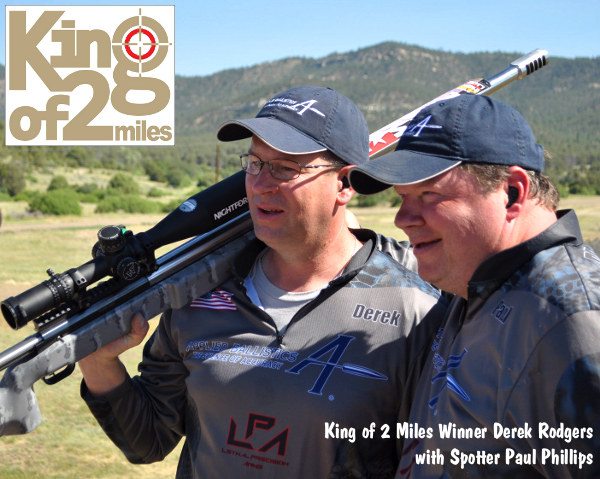
Derek Rodgers, the reigning F-TR World Champion and the only person to have won BOTH F-Open and F-TR U.S. National Championships plus the King of 2 Miles Match, runs this kind of “opposite” bolt set-up. Yep, Derek shoots right-handed with a left bolt. Though Derek is a right-hander, he shoots with a Left Bolt/Left Port (LBLP) action. He pulls the trigger with his right index finger, while working the left-side bolt with his left (weakside) hand. This allows him to stay in position, and maintain his cheekweld. He places his right hand on the grip, while manipulating the bolt (and feeding rounds) with his non-trigger-pulling hand.
Recent F-TR World Champion and King of 2 Miles Derek Rodgers
This is the rifle with which Derek won the 2013 F-TR National Championship.
*For true standing, off-hand shooting (whether in competition or on a hunt), a conventional strongside bolt placement makes sense, since the non-dominant arm must support the front of the rifle all the time. When shooting from bipod or rest, it’s a different story.
A Canadian F-Class shooter (who shall remain nameless) was surprised when he saw this “flat-line” target displayed from a ShotMarker system. That’s 30 shots with almost no vertical at all. So what gives? The ShotMarker uses acoustic sensors to plot shot location. It is normally accurate to within a few millimeters. The shooter posted: “I’ve never had this happen before with a waterline. This is myself and another shooter, 30 rounds total, including four sighters at 900 meters in super strong winds that twitched back and forth every minute.”
So what happened? It turns our that the system’s wires were not connected correctly. AccurateShooter IT expert (and top F-Class Shooter) Jay Christopherson posted: “The wires are connected incorrectly… you’ve got the sensors crossed”. This ShotMarker system error can be diagnosed by doing a “tap test” as explained by Cal Waldner: “Thats a crossed sensor wire! That’s why a tap test needs to be done every time you rig the equipment. If a wire is crossed then you will catch it on the tap test.”
Other folks who viewed this target photo on Facebook said that they have seen a similar problem, so this is NOT an uncommon fault:
“Yup, my club had the same issue (and results) in an early outing with one of our ShotMarker units. The system reads the target area as a horizontal rectangle not as a square.” — Laurie Holland.
“I have seen this exact same result with the sensors plugged incorrectly.” — Dino Christopoulos
“This happened to several people at one match early on. Sensors crossed.” — Jen Bondurant
“I thought I was shooting a great waterline once [but the] wires were crossed — [a mistake from] setting up in the dark.”– Jerry Stephenson
The ShotMarker System — Technology and Performance
The ShotMarker was invented by Adam McDonald, a brilliant young Canadian who also created the AutoTrickler. The ShotMarker is an advanced system for plotting shot impacts on targets using acoustic sensors placed in the four corners of the target frame. The central Sensor Hub at each target transmits to the Access Point at the firing line using LoRa, a low frequency RF protocol. Unlike Wifi, this power-efficient design works at over 2 miles and provides hassle-free connectivity even without direct line of sight.
The sensor unit in each corner of your frame contains two precision MEMS ultrasonic microphones which are capable of measuring a supersonic bullet within 1mm – when the frame is perfectly still.
Real-world accuracy will be limited by motion of the sensors and the air while shots are being detected. Typically, every shot will be reported within a few millimeters, with ideal performance being realized on a stable frame in calm conditions.
There’s a new premium First Focal Plane option for PRS/NRL competitors and long-range hunters. ZEISS has just introduced the all-new LRP S3 scope series, with 4-25X and 6-36X models, in both MRAD and MOA versions. These new scopes are impressive, with superb glass and best-in-class vertical elevation. And the prices are attractive, starting at $2199.99. You could pay a lot more for a top-tier FFP scope.
The new ZEISS LRP S3 optics for precision shooting and hunting boast impressive total elevation travel, advanced optics, daytime visible illuminated reticle, ballistic stop, and external locking windage turret. The product family consists of two models: ZEISS LRP S3 425-50 and LRP S3 636-56. Both are available in either Milliradian (MRAD) or minute-of-angle (MOA) configurations.
“With the LRP S3 we have expanded our successful long-range precision scope portfolio to provide more options for highly reliable and precise optics that are ready for competition”, stated Kyle Brown, Director of Marketing and Products for ZEISS Consumer Products USA. ZEISS LRP S3 first focal plane riflescopes are purpose-built for success in the world of long-range shooting and hunting.
While the concept of “buy once, cry once” is a long-held tradition in the competition optics market, ZEISS is trying to break that mold. PRS/NRL competitors and long-range hunters favor first focal plane scopes with large magnification ratios and crystal clear optics. Most of the “alpha” scopes in this arena have price-tags of $4000 or more, but ZEISS is wading in with a more budget-friendly option — the ZEISS LRP S3 series. These new FFP 4-25X and 6-36X scopes have an ample 6x zoom ratio with MOA or MIL reticles (and corresponding click values). MSRPs are reasonable: $2499.99 for the 6-36X and $2199.99 for the 4-25X.
These new first focal plane LRP S3 optics feature multiple lens elements of highest-quality, extra-low dispersion (ED) glass, making them contenders for the brightest, clearest sight picture available. ZEISS promises “90% light transmission for a noticeably brighter image.”
I chose to review the LRP S3 6-36X models in both MOA and MIL formats. Like any top quality scope, the ZEISS offering is well packaged and properly protected for shipment. Upon opening the package, one is immediately struck with the diameter of the turrets. They are large and easy to grasp, unlike many of the competitor’s designs. A truly shooter-friendly feature for PRS shooters and hunters alike is the repositioning of the index marks for both the windage and parallax adjustments to the upper side of the scope body. This is a welcome feature, making pre-stage windage setting much easier.
The turrets are 10 MIL or 25 MOA per rotation, making it unlikely that the shooter will get lost while adjusting. If more than one rotation is needed, a nicely visible micrometer scale rests below the turret, to keep things oriented. The elevation knob features a zero stop to get you back to the starting point reliably, and the windage knob features a lock to prevent accidental adjustment. The turrets themselves have large, unmistakable markings that are easy to read, even without one’s reading glasses.
The scopes were mounted in ZEISS ultralight rings and placed on a double mount side-by-side on a tripod with one of the best pieces of glass the author owns — a Nightforce Competition 15-55x52mm. Looking across the river at the adjacent city 3 miles away told the tale. The glass in the ZEISS was nearly identical in resolution and color to Nightforce’s Japanese glass. Moreover, the ZEISS collected more light, thanks to the larger 56mm objective and 34mm main tube. Through tough conditions on a hazy afternoon, the ZEISS had slightly better clarity than the Nightforce. A day later, looking into the evening sunset as a backdrop, they were identical to the author’s eye at both 36x and 15x respectively. Even the heavy mirage present didn’t seem to differentiate between the scopes.
With excellent HD quality glass, and good magnification options (4-25X and 6-36X), what is missing? Two things got my attention. The first was the lack of a sunshade as part of the scope. ZEISS offers sunshades separately at a reasonable cost, but they really should be offered as part of the scope package in my opinion. The second is the lack of range markings on the parallax knob. Setting parallax with range markings is not ideal, but can be quite helpful in shooting situations on the clock.
Impressive So Far, with More Testing to Come
The LRP S3 636-56 is an option-rich scope at a reasonable price for both PRS/NRL and hunting applications. Will it prove to rival the $4000 “alpha” scopes at a much lower and more affordable cost? We plan to answer that question with a detailed field test in the weeks ahead. Stay tuned. – Keith Glasscock
ZEISS LRP S3 Optics Key Features
Best-in-Class Total Elevation Travel
4-25x50mm: 46.5 MRAD / 160 MOA
6-36x56mm: 32.0 MRAD / 110 MOA
Advanced Optical Design — for a highly detailed and precise image
Ballistic Stop and External Locking Windage Turret for precise shot placement
Daylight Visible Illuminated Smart Reticle – quick and precise to read, with minimum target coverage and red or green illumination settings
Relatively Compact and Tested to Be Tough in Extreme Conditions
With its 34mm aluminum main tube mono-bloc housing, shock tested up to 1,500g-force, waterproofness up to 400 mbar, the LRP S3 is not only compact but also very robust. It is engineered for extreme usage in rough terrain. “The LRP S3 meets all requirements not only for long-range competitions but also for particularly demanding hunting situations over long distances”, notes Kyle Brown of ZEISS. And these scopes are covered by ZEISS’s Limited Lifetime Warranty and 5-Year No-Fault Policy.
Availability: All ZEISS LRP S3 models — LRP S3 425-50 and 636-56 both MRAD and MOA versions — will be available at authorized ZEISS retailers beginning early October 2022 for the North American markets. For more information about the ZEISS LRP S3 scopes, visit www.zeiss.com/lrp-s3.
Hunting season is coming soon. If you plan to travel across state lines with your hunting rifles, this book can really help. With over 100 changes from last year, the 2022 edition of Traveler’s Guide to the Firearm Laws of the Fifty States is a must-read for anyone planning to travel around the country with firearms. In addition, the book also covers the firearms travel laws for Canada and Mexico.
For $15.95 you can purchase a state-by-state Traveler’s Guide to firearms laws. This book can help ensure you comply with all state laws during your trip. Highways Magazine states: “If you carry a weapon in your rig, you need this book.” This 68-page guide covers all firearms types and all 50 states. It even has info for Canada and Mexico. The Traveler’s Guide to the Firearm Laws of the Fifty States has sold more than 1,000,000 copies since it was first released in 1996.
This 26th edition of the Traveler’s Guide covers important topics such as carry of firearms in a motor vehicle, concealed carry reciprocity, which states preempt local gun regulation, tips on handling a traffic stop, concealed carry in state and National Parks, vehicle carry and possession on college campuses and much more. Best of all, the text is in plain, easy-to-read English.
Written and researched by J. Scott Kappas, an attorney and Class III Firearms Dealer, the 2022 Traveler’s Guide has a preface that defines many key terms important for anyone traveling with a firearm across state lines. The latest edition also has new formatting for easier reading.
Purchase from GunLawGuide.com $15.95 with FREE shipping (3-4 weeks), or $19.95 with 1st Class Shipping (5-7 days). And as a special deal, you can also purchase the book from third party sellers on Amazon for $8.89 with free shipping (but act fast). The two vendors offering this deal are RGSellars and Anadorn.
The Traveler’s Guide is especially useful for shooters traveling in RVs and motorhomes. The American Rifleman Magazine declared: “This book is a must-have for truck drivers, motor home enthusiasts, campers and other travelers…easy to read and understand, well-organized and concise….” One reader from Texas adds: “I used to think that my RV was the same as my home when it came to gun carry….the Traveler’s Guide set me straight. Now I know my motorhome is subject to the same laws as any vehicle when it comes to guns.”
For today’s Saturday at the Movies feature, we spotlight seven product comparison videos from a variety of skilled sources. Gun buyers should check out the comparisons of Affordable Hunting Rifles, AR Platform Rifles, and .22 LR Handguns. Hunters will appreciate the detailed, comparison review of Hunting Scopes. We also feature informative comparison tests of Suppressors and Muzzle Brakes. And any handloader should check out Gavin Gear’s remarkable review of 14 different single-stage presses.
Hunting season is right around the corner. If you need a quality riflescope but have a limited budget, this video from the popular Backfire Channel can direct you to some of the best current hunting scope values. The reviewer looks at models starting at $200, examining the magnification levels, reticle types, and glass quality. He finds that it IS possible to get a very good scope at an affordable price. The video also explains First Focal Plane vs. Second Focal Plane considerations. NOTE: Backfire also recently released a video featuring scopes all under $500.00.
14 Single-Stage Reloading Presses Compared
Gavin Gear’s 14-Press comparison test for UltimateReloader.com is legendary. This detailed 41-minute video is the most comprehensive guide to single-stage reloading presses ever created. This remarkable 14-press review is the best place to start if you are in the market for a new press. Gavin notes the pros and cons of each press type, and explains which may be best suited for pistol loading vs. large rifle cartridges
Nine .30-Cal Muzzle Brakes Reviewed with Recoil Force Data
Here’s another great comparison test from Gavin Gear of UltimateReloader.com. Gavin measures the effectiveness of nine (9) different muzzle brakes. Using sophisticated electronic equipment, Gavin measures the recoil reduction of each brake. His equipment calculates the “peak force” as well as the recoil pulse (10:10 time-mark), with a chart of the total recoil impulse (10:40). Finally Gavin charts the total percentage reduction in recoil force (11:42). That last chart may be the best “quick reference” to decide which brake does the best job of reducing the load on your shoulder.
Affordable Hunting Rifles — Best Choices under $750.00
Here’s another good Backfire Channel video for hunters looking for a new rig. With hunting season starting soon, this video can save you time and help you get the most bang for your buck. The Backfire team review eight affordable under-$750 rifles: Bergara B-14, Howa 1500 Hogue, Kimber Hunter, Remington 700, Ruger American, Savage 110 Switchback, Tikka T3X Superlite, and Weatherby Vanguard. The Backfire reviewers tested all 8 rifles for function and accuracy (4-shot groups). These 8 rifles were chose for review based on input from Backfire channel viewers.
Best .22 LR Rimfire Handguns
We think every gun owner should have a .22 LR rimfire handgun. In this informative 25-minute video, a team from the Backfire Channel tests eight .22 LR handguns — seven semi-autos and one wheelgun (revolver). The guns tested are: Browning Buck Mark, Glock 44, Heritage Rough Rider 16″ revolver, Keltec CP33, Ruger MKIV Lite, Smith & Wesson SW22 Victory, Taurus TX22, and Walther PPQ. The test does a good job of showing feed reliablity and rapid-fire performance. Editor’s Comment: We have shot rimfire pistols for five decades for fun and in competition. We recommend the Smith & Wesson Model 617 revolver, and the Browning Buck Mark semi-auto.
Top Five AR-15 Platform Rifles
The donkey party politicians in Washington are up to no good again. The Democrats are seeking to ban and/or restrict mag-fed, semi-automatic rifles including popular AR-platform rifles. Because more gun bans may be coming out of Washington soon, you may want to get your own “Modern Sporting Rifle” while you can. This helpful Survival Channel video showcases five quality AR-15 type rifles: Daniel Defense DDM4V7, Daniel Defense DDM4V11, Ruger AR-556 MPR, Sig Sauer SIGM400 Tread, and Smith & Wesson M&P15T. In addition, the video reviews the Springfield Armory Saint Edge AR-15 Pistol.
Suppressors (Silencers) — How to Choose the Best Option
Suppressors are becoming increasingly popular with PRS/NRL shooters, pistol shooters, and hunters. Thankfully companies such as SilencerCo.com and Silencer Central are making it easier to comply with Federal rules on silencer acquisition. These vendors have made it much easier to prepare the paperwork needed to get the requisite ATF Tax Stamp and, if desired, set up a suppressor ownership trust.
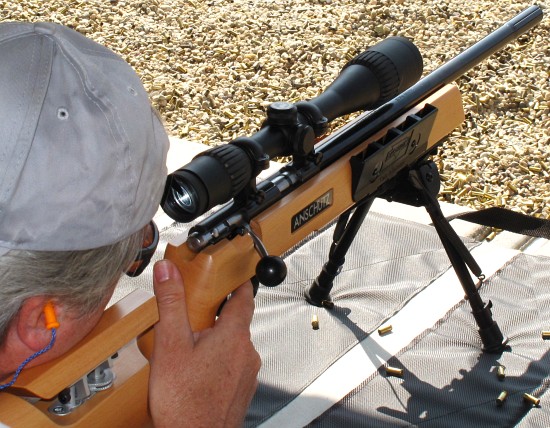
AccurateShooter’s Editor trains with .22 LR Anschutz model 64R back in 2008.
Rimfire Tactical Matches Aren’t Really New
NRL22 and PRS rimfire shooting disciplines are fun, affordable forms of competition. We’re pleased to see the rapid growth of NRL22 and PRS rimfire. However, the concept of a rimfire tactical/practical match is not new — at least on the West Coast. Way before anyone every heard of PRS, California shooting clubs conducted “Rimfire Tactical” matches. These matches were first fired nearly two decades ago. CLICK HERE to read our comprehensive Rimfire Tactical report from way back in 2008. That article includes free targets, ballistics charts, and a complete run-down on suitable rimfire rifles.
The Concept Behind the Rimfire Tactical Match by Bill Erwin
Many guys who shoot long-range tactical matches practice with .22 LR rifles of similar configuration. Rimfire ammo is way more affordable than centerfire, you do not need a big range facility, and shooting rimfire saves wear and tear on your centerfire rifle. Further, for learning how to read the wind, there really is no better training tool than a 22 LR, even as close as 50 yards. Check out this table showing how a .22 LR ballistics compare to .308 Win:
.22 LR vs. .308, Distances for Equal 10 MPH Wind Drift
This table shows the corresponding distances at which a 10 mph full-value crosswind pushes a .22 LR bullet and .308 projectile the same amount. Values are based on 0.130 BC for a 40gr .22 LR bullet, and 0.496 BC for 175gr .308 bullet.
22 LR 40gr 1050 fps
50 yd Wind 1.0″
75 yd Wind 2.2″
100 yd Wind 3.8″
125 yd Wind 5.8″
150 yd Wind 8.2″
175 yd Wind 11.0″
200 yd Wind 14.3″
.308 Win 175gr 2650 fps
130 yd Wind 1.07″
180 yd Wind 2.15″
230 yd Wind 3.68″
280 yd Wind 5.63″
330 yd Wind 7.98″
380 yd Wind 10.71″
440 yd Wind 14.56″
This table shows how the .22 LR can be an effective substitute for a .308 Win during training. Because the smaller bullet drifts more in the wind, a .22 LR rimfire shooter will experience roughly the same crosswind effects as if he was shooting a 175gr .308 Win twice as far out. So, rimfire work can teach you to dope the wind like a .308 Win, but at less than half the distance. Shooting a .22 LR at 100 yards is like shooting a .308 Win (with 175gr SMK) at 230 yards.
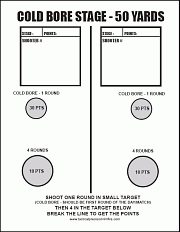
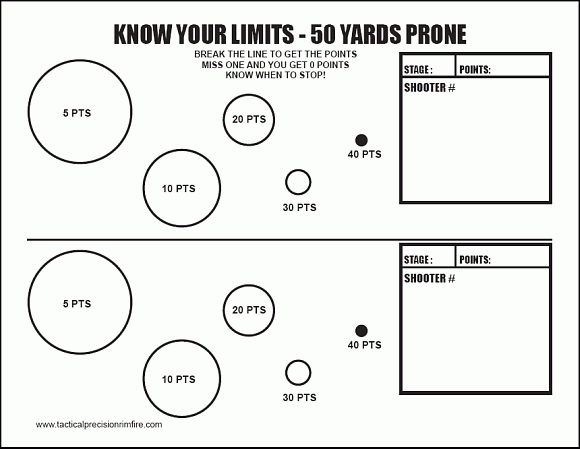
SPECIAL BONUS–Rimfire Tactical Precision Targets
These FREE targets by DesertFrog are offered in Adobe Acrobat format for easy printing. CLICK HERE to download all six targets as a .ZIP archive.
Rimfire Training Target for Fun Matches
Here’s a rimfire training target with “big to small” target circles. Start with the largest circles, then move to the smaller ones in sequence. This systematic drill provides increasing challenge shot-by-shot. Novices often are quite surprised to see their accuracy improve as they move from bigger to smaller aiming points. That provides positive feedback — always a good thing.
Right Click and “Save as” to download printable PDF versions of target.


 Being part of a team and trusting your teammates is such a critical part of ELR and I couldn’t ask for a better team. Each one of us comes from a different background and has different specialties, and we do an excellent job of leveraging all of that to perform at the highest level. Paul and Ray have years of experience shooting competitively. James has years of experience with competitive shooting, hunting, and training, while I have experience with cameras and technology that helps to verify our impacts. Additionally, we are all shooting clone rifles and can instantly leverage what we learn during the match from one shooter to the rest of the team. Paul Phillips even also helped design the new Manners ELR Light stock we used.




 Written and researched by J. Scott Kappas, an attorney and Class III Firearms Dealer, the 2022 Traveler’s Guide has a preface that defines many key terms important for anyone traveling with a firearm across state lines. The latest edition also has new formatting for easier reading.