In years past, one of our favorite features on the NRA Blog was the Friday Feast Recipe of the Week. In the past, the NRA Blog offered up a new delicious food recipe each Friday. Sadly the Friday Feast has not been updated for quite some time, but you can still see dozens of past Friday Feast recipes with this link:
Today’s featured Friday Feast combines two things we love — Italian pasta and Elk meat. Article author Emily Rupertus shares our passion for pasta: “I love pasta. I can’t get enough of it! So when I came across this Classic Elk Lasagna, I couldn’t resist sharing with you! You have to try this perfect twist on a classic comfort food.” After assembling your Lasagna in a big cast-iron skillet and covering with tin-foil, bake the Elk Lasagna in a 400° oven for 30 minutes. Then remove the foil, add more cheese and continue to bake uncovered for ten more minutes.
Ingredients
1/2 Package of Lasagna Noodles
1 lb Ground Elk Meat (you can substitute ground venison or antelope)
1 Medium Sweet Onion (chopped)
2 Cloves Garlic (chopped)
2 tablespoons Olive Oil
3 Cups Tomato Sauce
32 oz. Ricotta Cheese
1 Cup Parmesan Cheese
1 8 oz. Fresh Mozzarella Cheese (sliced)
2 eggs
Today we share some smart tips from a past F-Class and Sling Champion who is both a great shooter AND a ballistics wizard. In 2015, Bryan Litz won the F-TR Mid-Range AND Long-Range National Championships hosted at Ben Avery. And at the 2014 Berger SW Nationals (SWN), Bryan took top honors among all sling shooters. If you only know Bryan Litz from his Applied Ballistics Books and DVDs, you may not realize that this guy is a also great marksman along with being an actual rocket scientist!
Given his impressive track record in both F-Class and Palma (Fullbore) out to 1000 yards, we asked Bryan if he had any advice for other long-range competitors.
First Bryan provided three tips concerning Ballistics, his special area of expertise. Next Bryan offered three more general tips about long-range competition — how to analyze your shooting, how to choose your ‘wind strategy’, and how to avoid the most costly mistakes, i.e. how to avoid the “train-wrecks”.
Bryan Litz won the 2015 F-TR Mid-Range and Long-Range Championships with this sleek rig:
Litz Ballistics Tips
Ballistics TIP ONE. If you’re having trouble getting your ballistic software to match actual drops, you need to look at a number of possible reasons. Here are some common issues that can cause problems.
Click Values Are Not Exact. Scopes and iron sights don’t always produce accurate adjustments. In other words, if your ballistics program predicts 30 MOA of drop, and you dial 30 MOA but hit low, it might be that your sight actually only moved 28 MOA (for example). To see if your sight is adjusting accurately, shoot a tall target at 100 yards and measure group separation when dialing your sight.
Barometric vs. Station Pressure. This is a commonly misunderstood input to ballistics programs. You can avoid this pitfall by remembering the following: station pressure is the actual measured pressure at your location, and you don’t need to tell the program your altitude when using station pressure. Barometric pressure is corrected for sea level. If you’re using barometric pressure, you also have to input your altitude.
Muzzle Velocity. Chronographs are not always as accurate as shooters think they are — your true MV may be off by 10-20 fps (or more). If your drop is different than predicted at long range, it might be because your muzzle velocity input is wrong.
Mixing Up BC (G1 vs. G7). Knowledgeable long range shooters know that the G7 standard is a more representative standard for modern LR bullets. However, using G7 BCs isn’t just a matter of clicking the ‘G7′ option in the program. The numeric value of the BC is different for G1 and G7. For example, the G1 BC of the Berger 155.5 grain Fullbore bullet is .464 but the G7 BC is .237. If you were to enter .464 but click on G7, the results would be way off.
Ballistics TIP TWO. A properly installed level is absolutely essential for long range shooting. Without a good level reference, your long range wind zero will be off due to minor canting of the rifle from side to side. You can verify that your level is installed correctly on a 100-yard ‘tall target’. Draw a plumb line straight up the target and verify that your groups track straight up this line as you go up in elevation.
Ballistics TIP THREE. If your long range ballistic predictions aren’t tracking, always come back and verify your 100-yard zero. Sometimes a simple zero shift can be misconstrued as errors in long range ballistics predictions.
Litz Competition Shooting Tips
Competition TIP ONE. Improving your scores in long range competition is a constant process of self-assessment. After each match, carefully analyze how you lost points and make a plan to improve. Beginning shooters will lose a lot of points to fundamental things like sight alignment and trigger control. Veteran shooters will lose far fewer points to a smaller list of mistakes. At every step along the way, always ask yourself why you’re losing points and address the issues. Sometimes the weak links that you need to work on aren’t your favorite thing to do, and success will take work in these areas as well.
Competition TIP TWO. Select your wind shooting strategy carefully. For beginners and veterans, most points are typically lost to wind. Successful shooters put a lot of thought into their approach to wind shooting. Sometimes it’s best to shoot fast and minimize the changes you’ll have to navigate. Other times it’s best to wait out a condition which may take several minutes. Develop a comfortable rest position so you have an easier time waiting when you should be waiting.
Competition TIP THREE. Actively avoid major train wrecks. Sounds obvious but it happens a lot. Select equipment that is reliable, get comfortable with it and have back-ups for important things. Don’t load on the verge of max pressure, don’t go to an important match with a barrel that’s near shot out, physically check tightness of all important screws prior to shooting each string. Observe what train wrecks you and others experience, and put measures in place to avoid them.
Electronic High Power Targets for 2022 at Camp Atterbury
This year, for the first time, electronic targets will be used at Camp Atterbury during the NRA High Power National Championships. NRA Competitive Shooting Deputy Director Aaron Farmer posted: “We will have up to 40 targets using Silver Mountain electronic target systems. Competitors will be squadded on a target and then continue to shoot on the same target all week. The only thing that will change is the starting relay for the day. We will be running three relays. No pit duty!”
The following article by Tom Alves describes a very practical approach to physical training for those of us who are not as young and spry as we once were. Tom shows us how to give our bodies at least some of the maintenance we give our rifles. While we all realize that our rifles will outlive us, let’s see if we can’t narrow the margin a bit with some personal maintenance that just might help the shooting too!
This article originally appeared in German Salazar’s Rifleman’s Journal, and appears with permission. Sadly, German passed away last month. This was a very sad loss of a great, triple-distinguished shooter and a great shooting sports writer.
A Suggested Training Approach for Older Shooters
By Tom Alves Most articles and discussions regarding competitive shooting center around equipment. Now and then one will come across an article about physical training such as the USAMU piece on Physical Conditioning for Highpower Shooting. If you break the articles down they often discuss “core strength” and durability. The purpose of this paper is to elaborate on those points with a bit different perspective. Many of the articles you will read in books about position shooting and the one mentioned before are directed more toward the younger generation of shooters in their 20s. If you look down the line at a typical high power match these days you are likely to see quite a few folks who are in their middle 30’s and up. Many people in that age range have had broken bones and wear and tear on their joints so a training program needs to take that into account. For instance, while jogging for an extended period for heart and lung conditioning — often called cardio exercises — may be the recommended approach for younger folks, it may be totally inappropriate for older people. The procedure to repair meniscus tears in knees is one of the most frequently performed operations in this country. Another approach one often sees in training to improve core strength is the use of weight machines which isolate certain muscle groups in their operation. I would like to suggest an alternative approach that not only does not require special equipment but uses the body’s muscles in a coordinated fashion in the same way they are used in our natural movements. So, let’s set down some criteria:
1. The approach has to be low impact to conserve joints.
2. One goal is to improve the strength of the core muscles which are the muscles of our trunk that keep us erect and from where all movements initiate.
3. Along with core strength we need flexibility and full range of motion.
4. We want to improve our lung and heart function so we can have a good flow of oxygen going to our organs and muscles to reduce the rate at which we become fatigued during a competitive event.
Before I continue I believe it is appropriate for the reader to understand that I am a fellow shooter and this is a program I have designed for myself based on considerable reading and experience over a number of years. I am not a medical doctor, a formally trained exercise professional or any other type of specialist in the field. Consequently, this information is offered with the advice that you consult your medical advisor or similar authority before you embark on this or any similar regimen.
I will start with core strength and flexibility. Pilates exercises are resistance exercises that can incorporate the use of resistance bands, light weights and the weight of your body parts in order to strengthen the muscles in the abdomen, back, hips, chest and shoulders. The exercises can be performed alone but I recommend attending classes put on by a certified instructor who will ensure that you perform a balanced routine meaning you work on the front and back and both sides of your trunk. As to flexibility, yoga complements Pilates exercises and they are often taught together. In practical terms yoga strengthens through resistance using the weight of the body and increases flexibility by stretching the various muscle groups in a coordinated fashion. Some yoga exercises also work on balance which is helpful in position shooting and life in general. Again, I suggest attending formal yoga classes since an instructor can help you address such things as a joint misalignment. As an example, my right leg healed improperly after the femur was broken and my right foot splays out putting undue load on my left knee. There are a number of books available on Pilates and yoga and some of them get pretty involved; I leave that to the reader to explore. I will list some reference material at the end of the article that I have found useful.
Finally, heart and lung improvement. In order to exercise the heart and lungs while not abusing the joints, particularly the knees and hips, one has to resort to something other than jogging. Walking, bicycling, elliptical machines and swimming may be alternative methods you’d like to consider. Based on my reading, in order to get the most benefit it is important to exercise so that the pulse rate becomes elevated for periods of time rather than kept at a constant rate. The process I use, called PACE, is promoted by Al Sears, MD, http://www.alsearsmd.com/. It is interval training for the non-athlete. In simple terms one exercises, using whatever equipment one desires, to achieve a heart rate in which you are slightly above your ability to bring enough oxygen into your body to sustain the activity for an extended period. This is similar to wind sprints for a sprinter or a football player. After each episode you must rest until you have achieved recovery, meaning you can catch your breath easily. A series of three sets is recommended which covers a total time of about 20 minutes.
Report from the Author — Yes, Training Helps
As a result of this training program I have experienced increased strength in my legs and trunk, less joint stiffness, lower blood pressure, and lower resting pulse rate. The Pilates/yoga classes are usually attended 2 to 3 times a week and the interval training performed twice a week. [The author was 64 when this was first published. He is now 75, and still shooting Palma and Smallbore prone.]
Before I close I would like to touch briefly on two other related subjects: hydration and visual training. When one is exerting oneself, the body produces perspiration to keep the body’s temperature at an acceptable level. As one perspires the blood gets thicker and the ocular fluid in one’s eyes thickens as well. The heart has to work harder to supply oxygen and nutrients to the body so visual and cognitive functions degrade and fatigue sets in rapidly. Essential chemicals called electrolytes are also carried out of the body with the perspiration. As a result, it is necessary to replace moisture and electrolytes to maintain basic health and a competitive level of performance. If one goes on the Internet there is a multitude of articles on hydration. Due to the kindness of my lead Pilates/yoga instructor, Ms. Annette Garrison, I have a pretty comprehensive article on various aspects of hydration that I have included, http://www.ideafit.com/fitness-library/hyponatremia-other-side-hydration-story , for your information.
Last I want to mention visual performance training. The New Position Rifle Shooting, A How-To Guide for Shooters and Coaches by Bill Pullum and Frank Hanenkrat mentions sports vision training amongst other aspects of vision in competitive shooting. If one goes on the Internet you will find training programs directed at golfers, baseball and football players. There is one site that has a demo which, if one looks at it for long, it is obviously very similar to a shooting gallery video game. The training involves rapid recognition and hand-eye coordination. Another source of visual training exercises, along with a wealth of other information, is the book Prone And Long Range Rifle Shooting by Nancy Tompkins.
Hopefully, I have provided some information which will be helpful in improving shooting performance and extending the time you can participate at a competitive level. It is important that you proceed at your own pace. I have pushed myself too hard in the interval training and now have to back off a bit. In closing I would like to thank Annette Garrison and GS Arizona for their help, patience and encouragement.
Additional Reference Material
1. Framework by Nicholas A. DiNubile, MD This is required reading for anybody who has suffered an injury like a torn meniscus or has muscular skeletal issues. This is the book that led me to Pilates/yoga
2 P.A.C.E., The Twelve Minute Fitness Revolution by Al Sears, MD The approach I use to interval training. I am sure there are other sources.
SSG Greg Markowski of the USAMU at Camp Perry, Ohio.
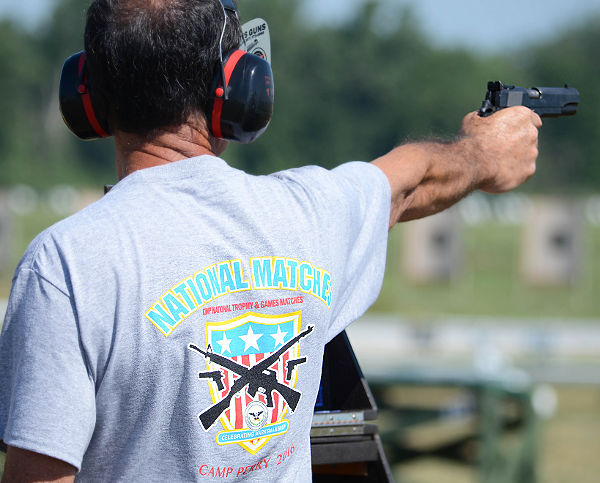
Today, July 12, 2022, pistol competition commences at the National Matches at Camp Perry. Many of the best pistol shooters in the country will be on the firing line, including members of the U.S. Army Marksmanship Unit Service Pistol team. After the last pistol match on Sunday, July 17th, trophies and awards will be presented to the top shooters.
If you want to compete in top competitions like this, you’ll need good ammo. The following USAMU article provides rock-solid reloading advice, explaining how to load accurate, reliable handgun ammo.
Camp Perry NM pistol firing line from CMP Photo Archives.
The U.S. Army Marksmanship Unit (USAMU) fields pistol teams as well as rifle and shotgun competition squads. Consequently the USAMU’s Reloading Shop loads tens of thousands of pistol rounds every year. In this article, the USAMU’s handgun experts talk about reloading for handguns — with smart tips on how to achieve superior accuracy with 100% reliability. This article, which offers important insights on COAL, primers, crimps and more.
Precision Pistol Reloading — Recommended Methods
Optimize the Taper Crimp
One often-overlooked aspect of handloading highly-accurate pistol ammunition is the amount of crimp and its effect on accuracy. Different amounts of taper crimp are used with various handloads to obtain best accuracy. The amount is based on bullet weight, powder burn rate and charge, plus other factors. It is not unusual for our Shop to vary a load’s crimp in degrees of 0.001″ and re-test for finest accuracy.
Use Consistent Brass
Brass is also important to pistol accuracy. While accurate ammunition can be loaded using brass of mixed parentage, that is not conducive to finest results, particularly at 50 yards. It is important for the serious competitor/handloader to use brass of the same headstamp and ideally one lot number, to maximize uniformity. Given the volumes of ammunition consumed by active pistol competitors, using inexpensive, mixed surplus brass for practice, particularly at the “short line” (25 yards), is understandable. However, for the “long line” (50 yards), purchasing and segregating a lot of high-quality brass to be used strictly for slow-fire is a wise idea.
Importance of Uniform COAL
Uniformity of the Case Overall Length (COAL) as it comes from the factory is also important to achieving utmost accuracy. More uniform case lengths (best measured after sizing) contribute to greater consistency of crimp, neck tension, ignition/burn of powder charge, and so on. Cartridge case-length consistency varies from lot to lot, as well as by maker. Some manufacturers are more consistent in this dimension than others. [Editor’s note: It is easy to trim pistol brass to uniform length. Doing this will make your taper crimps much more consistent.]
Primers and Powders — Comparison Test for Accuracy
Pay attention to primer brands, powder types and charges. Evaluating accuracy with a Ransom or other machine rest at 50 yards can quickly reveal the effect of changes made to handload recipes.
Bullet Selection — FMJ vs. JHP
Bullets are another vital issue. First, there is the question of FMJ vs. JHP. A friend of this writer spent decades making and accuracy-testing rifle and pistol bullets during QC for a major bullet manufacturer. In his experience, making highly-accurate FMJ bullets is much more difficult than making highly-accurate JHPs, in large part due to the way the jackets are formed. Small die changes could affect accuracy of FMJ lots dramatically.
The CMP now allows “safe, jacketed ammunition” in Excellence-in-Competition (EIC) Service Pistol matches, although wadcutter ammunition is prohibited. Thus, the option to use very accurate JHP designs simplifies the life of CMP Service Pistol shooters in pursuit of the prestigious Distinguished Pistol Shot badge.
Hopefully, these tips will be helpful to any pistol shooters interested in accurate handloads, not just “Bullseye” shooters. Small tweaks to one’s normal routine can pay big dividends in improved accuracy and make practice and competition more rewarding.
Stay safe, and good shooting!
TOP IMAGE: SSG Greg Markowski, a shooter/instructor with the U.S. Army Marksmanship Unit and native of Poland, fires his pistol during the 2018 Civilian Marksmanship Program’s National Pistol Matches at Camp Perry, Ohio July 13, 2018. At that event, Markowski claimed the General Mellon Trophy, General Patton Trophy and the General Custer Trophy. U.S. Army photo by Maj. Michelle Lunato/released by Defense Visual Information Distribution Service.
Bauer Power. Today’s Sunday Gunday story features Jim Bauer and Sally Bauer, a “power couple” in the International Benchrest Shooters (IBS) mid-range and long-range benchrest game. Jim and Sally both compete at 600 yards and 1000 yards, and both have been VERY successful. A decade ago, in 2012, Sally was the IBS 1000-yard Shooter of the Year. She had a great season, piloting her impressive Stars & Strips Heavy Gun (shown above). Sally now serves as the IBS Treasurer.
Jim Bauer has also been a top IBS performer shooting a similar, wide-forearm Maxi-Tracker Heavy Gun, with beautiful Eagle-on-black paint scheme. Jim Bauer won the IBS 2015 1000-Yard Nationals shooting a 6mm Dasher in both Light Gun and Heavy Gun classes. And Jim holds the IBS 1000-yard 20-Target Light Gun Aggregate Score Record. He set the record in 2021 with 47.15 Agg Score and 5.4171″ group average — that’s very close to half-MOA for 10-shot groups at 1000 yards!
Jim Bauer Wins 2015 1000-Yard Title with Duel Dashers
Jim Bauer won the IBS 2015 IBS 1000-Yard Nationals shooting a 6mm Dasher in both Light Gun and Heavy Gun Classes. Here’s his match-winning Heavy Gun. Smithed by Gordy Gritters, Bauer’s Heavy Gun featured a BAT action, Krieger barrel (in barrel block), Shehane HG stock, and Nightforce scope.
At the 2015 1000-Yard Nationals, Jim Bauer was both Two-Gun Champion and Overall winner. Bauer shot great in both Light Gun (LG) and Heavy Gun (HG) matches, posting Top 10 finishes in both classes. Bauer ran 6mm Dashers in both Divisions (LG and HG) with Vapor Trail bullets.
Sally Bauer Honored as 2012 IBS 1000-Yard Shooter of the Year
In 2012, Sally Bauer became the first (and only) lady to win the title of IBS 1000-yard Shooter of the Year. Sally earned that honor through hard work, dedication, and a burning desire to “be all she can be”. While helping her husband Jim rise to the top of the 1000-yard benchrest game, Sally was taking notes and working toward her turn at the top. Well friends, Sally took no prisoners in 2012 and earned Shooter of the Year honors. Sally’s handsome 67-lb Heavy Gun, “Stars & Stripes”, is painted with an American flag theme.
Sally Bauer and the IBS 1000-Yard Heavy Gun Record
A decade ago, in 2012 Sally Bauer set a then-pending International Benchrest Shooters (IBS) Score Heavy Gun (HG) record for 1000-yard competition. Her score was 100-5X with a 3.495″ tie-breaker group. Though that record has been surpassed (with a smaller tie-breaking group), Sally was the first lady ever to post a pending IBS 1000-yard benchrest record.
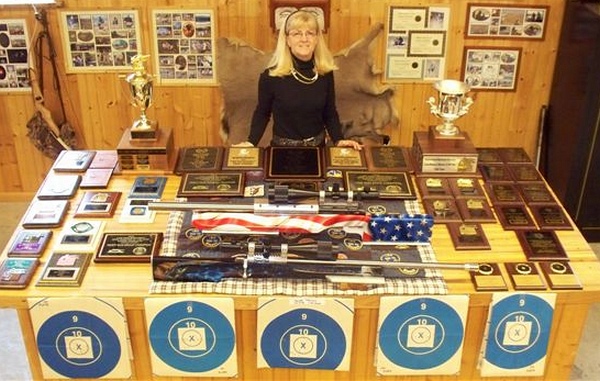
Sally’s Amazing 1K Group
At the end of the Heavy Gun match #10 Sally was directed by Range Officer Gordy Mitchell to leave all of her equipment and rifle setting on her bench. Sally was perplexed by Gordy Mitchell’s direction but he assured her “It is a good thing”. Rumors swirled and Dave Holland was summoned to the pits.
Dave and Gordy brought the target back to the scoring shed and had club officials and some respected competitors measure and sign the target. All agreed Sally had just shot an IBS record score. Sally’s rifle and equipment were measured and photographed and the target sent off to the IBS for final measurement and verification.
Sally’s Heavy Gun Specifications
Sally’s 67-lb Heavy Gun was originally purchased from Bill Shehane, and it uses Bill’s Maxi-Tracker stock. The gun was originally chambered for the 6-6.5×47 Lapua Improved. But the gun didn’t shoot like the Bauers wanted, so it was rechambered to 6mm Dasher by Gordy Gritters. The action is a 2″-diameter, round, chrome moly, 3-lug, 7 ½” BAT. The barrel is a 28″, 1:8″-twist Krieger, with 1.45″-diameter straight tube. The barreled action is secured in the stock with a 9″-long barrel block. The gun uses a 12-42x56mm Nightforce BR scope and a Jewel BR trigger. Gordy Gritters smithed the rifle. Jim Sauer states: “We have known Gordy for years now and trust every phase of our gun projects — all of them are mechanical works of art. When we get our guns from Gordy we know we can put our focus on brass prep and load development and don’t have to worry about the guns being right. That really helps save time.”
Editor’s NOTE: The following information was for the original 2012 load Sally ran in her IBS Heavy Gun. Load details and procedures may have changed now, a decade later.
Reloading Procedure for Sally’s “Stars & Stripes” Maxiby Jim Sauer
With every new rifle we start with new brass. The first step is to run them through a full length sizing die, then over an appropriate expander mandrel. Since we use a .270 neck on our 6 Dasher chambers, neck turning amounts to a 80% cleanup of the new Lapua brass necks. We do the normal primer pocket and flash-hole uniforming.
We fire-form two times to make sure we get nice sharp shoulder corners before competition. We then separate them according to weight using 1/10th of a grain differences for each box. Much of our loading process is geared around time savings. We look for easy-to-use, consistently good products and don’t vary from them unless we have a problem or results aren’t to our standards. We have chosen to shoot Clay Spencer’s 103gr 6mm bullets. We weight-sort and bearing-surface sort them and that’s it. I gave up trimming and tipping simply because it didn’t improve how Clay built them. We also use only one primer, the CCI 450.
We use one of four different powders. Our “go-to” powder is RL15, next we try Varget, then IMR 8208, and if that doesn’t work we try H4895. We have found that these bullets usually shoot best at 2970 fps. This is not an absolute, just what normally works best. We always try higher and lower velocities looking for that special load. Once we find the powder and quantity that works the best we play with the seating depth. Usually this is a fine-tune method and most of the time 15 thousandths into the rifling works the best. But don’t be afraid to jump the bullets as much as 0.100″. When we use this procedure we usually find a combination that will shoot nice, round ¾” groups at 400 yards.
Our reloading regimen starts with ultra-sonic cleaning our brass, then tumbling until shiny. We anneal the brass every time. We proceed to full-length resizing, repriming, and lubing the inside of the necks with graphite. We then charge with our selected powder and seat the bullets. We measure for concentricity, [shooting] the best ones for the record and the others for sighters. The load that Sally shot the record with is 33.0 grains of IMR 8208 XBR, CCI 450 primers, Spencer 103gr bullets, Lapua brass, bullet seated 15 thousandths into rifling, Velocity 2980 fps.
About Sally Bauer – In her “formative years” of competitive shooting, Sally listened to proper and basic instruction and learned at her pace. She developed her own style and discipline. Not wanting to be dependent on others Sally learned to set up her rests and carries Stars & Stripes to the bench by herself.
Jim Bauer reports: “Sally and I would like to thank the kind people we have met in this crazy frustrating game of shooting. For the most part fellow competitors have been helpful and giving of the time, experience and knowledge. Every range owner and operator we have come across has treated us like family and friend. I can think of no other sport where the participants give so freely.”
Bauer Power in Action at the 2017 IBS 600-Yard Nationals
Would you like to see this IBS “power couple” in action? Here are videos of Jim Bauer and Sally Bauer shooting at the 2017 IBS 600-yard Nationals in Memphis, Tennessee.
Jim Bauer sends 5 record rounds down range with his “Eagle” HG in Maxi-Tracker stock
Sally Bauer shoots sighter rounds with her Stars & Stripes HG in Maxi-Tracker stock
Transporting Big Heavy Guns in Style with Slide-out Carriers
The Bauers have created a very smart and clever system for transporting their rifles to matches. The Bauers have a great transport set-up, with custom, slide-out rifle carriers fitted to their van. You can see Jim’s and Sally’s Heavy Guns in the lower drawer.
And here is a close-up of the Light Gun in the Bauer’s second slide-out carrier (top in photo). The patriotic “We the People” message is welcome.
SSG Amanda Elsenboss, now with the Pennsylvania National Guard, is the 2021 NRA National High Power Champion. And Amanda also won the NRA Long Range National Championship in 2019. These two major titles place Amanda among the greatest American shooters and one of only three women in U.S. history to win the High Power title. Amanda combines a superb “mental game” with outstanding gun-handling and wind-reading skills.
In the archives of On The Mark magazine, DCM Emeritus Gary Anderson, an Olympic Gold medal-winning shooter in his younger years, offers sage advice for competitive shooters.
In his article Ten Lessons I Wished I Had Learned as a Young Shooter, Anderson provides ten important guidelines for everyone involved in competitive shooting. Here are the Ten Lessons, but you should read the full article. Anderson provides detailed explanations of each topic with examples from his shooting career.
LESSON 1 – NATURAL ABILITY WILL NOT MAKE YOU A SHOOTING CHAMPION.
(You also need hard work, training effort and perseverance.)
LESSON 2 – ANGER IS THE ENEMY OF GOOD SHOOTING.
(The key to recovering from a bad shot is to stay cool, no matter what happens.)
LESSON 3 – BAD SHOTS CAN TEACH YOU MORE THAN GOOD SHOTS.
(Today, error analysis is one of the most powerful tools for improving scores.)
LESSON 4 – NEVER GO WITHOUT A SHOT PLAN.
(A shot plan is a detailed breakdown of each of the steps involved in firing a shot.)
LESSON 5 – PRACTICE IN BAD CONDITIONS AS WELL AS GOOD CONDITIONS.
(Most competitions are fired in windy conditions or where there are plenty of distractions.)
LESSON 6 – CHAMPIONS ARE POSITIVE, OPTIMISTIC PEOPLE.
(Negative shooters expect bad results; positive shooters expect to train hard to change bad results.)
LESSON 7 – IT’S NOT ABOUT WHETHER YOU WIN OR LOSE.
(It’s about how hard you try to win.)
LESSON 8 – YOUR DOG WON’T BITE YOU AFTER SHOOTING A BAD SCORE.
(Hopefully your coach, parents and friends won’t bite you either.)
LESSON 9 – YOUR PRESS CLIPPINGS CAN HURT YOU OR HELP YOU.
(Winning can go to our heads. We start thinking we are so good we don’t have to work hard any more.)
LESSON 10 — YOU NEVER SHOT YOUR BEST SCORE.
(Great champions are always looking for ways to improve.)
USAMU shooters on the firing line at the Wa-Ke’-De outdoor range in Bristol, IN. Photo courtesy USAMU.
About Gary Anderson Gary Anderson served as the Director of the Civilian Marksmanship Program (CMP) from 1999-2009, and is now DCM Emeritus. As a Nebraska farmboy, Gary grew up hunting and shooting. Dreams of winning an Olympic Gold Medal in shooting led Gary to the U.S. Army. In 1959, he joined the elite U.S. Army Marksmanship Unit. Just two years later, he won his first national championship.
At the 1962 World Shooting Championships in Egypt, Anderson stunned the shooting world by winning four individual titles and setting three new world records. At the 1964 Tokyo Olympics, Gary won the 300m free-rifle Gold Medal, setting a new world record in the process. At the 1966 World Shooting Championships in Germany, Anderson won three additional world titles. At the 1968 Olympics, Gary won a second gold medal in the 300m free-rifle event.
After his “retirement” from international competition, Gary competed in the National High Power Championships, winning the President’s National Trophy in 1973, 1975 and 1976. Over his competitive career, Anderson won two Olympic Gold Medals, seven World Championships, and sixteen National Championships. He is unquestionably one of the greatest American marksmen ever.
Notably, over the past two decades, firearms production in the United States has tripled — from 2,911,346 in 2001, to 9,739,335 in 2020. In fact, peak production was reached in 2016, with 10,664,318 rifle, pistols, and shotguns produced. The annual production of shotguns has actually declined slightly over the past 20 years, but the production of handguns has soared. Check out this table:
In recent years, the U.S. firearms industry has been presented with unprecedented opportunities, as well as rising obstacles. Shooting Industry magazine’s annual U.S. Firearms Industry Today Report looks back to where it all began: 2020. Using the latest available data from ATF, this report delves into U.S. firearms production — revealing the top producers across all firearm categories — and includes analysis on historical NICS background check trends and the latest import/export figures.
“While 2020 represented the highest demand year, it was not … a record production year for the U.S. firearms industry”, observed SI Editor Jade Moldae. “Supply chain challenges, raw material sourcing issues, COVID-impacted shutdowns and labor shortages impacted business in 2020, to name a few.”
The firearms industry is a significant component of the U.S. national economy: “According to NSSF’s 2022 Firearm and Ammunition Industry Economic Impact Report, the industry’s total economic influence ballooned from $19.1 billion in 2008 to $70.52 billion in 2021, a 269% jump. Year-over-year, the industry’s economic impact rose 11.1% (from $63.5 billion in 2020).
Corresponding with a rising economic impact, the total number of full-time equivalent jobs in the industry increased from approximately 166,000 in 2008 to over 375,000 in 2020 (126% increase). From 2020 to 2021, total jobs grew from 342,330 to 375,819 (9.8%).
Highlights from the report:
• Total Firearms Production has TRIPLED since year 2001, boosted primarily with handgun sales (see chart).
• After hitting a near 10-year low in 2019, U.S. firearms production jumped 53.3% in 2020 (from 6,353,124 to 9,739,335 firearms). This was the biggest year-over-year jump since 1993, which recorded a 66.5% increase over 1992.
• A record 6,502,261 handguns were produced in the U.S. in 2020. 9mm pistol paced handgun production, with about three out of every five handguns produced in 2020 were chambered in the caliber.
• Smith & Wesson set a new benchmark in firearms production with 2,320,963 firearms, while Ruger (1,659,324) and SIG SAUER (1,077,019) passed the 1 million mark.
We love Smith & Wesson rimfire revolvers. We have put thousands of rounds through S&W Model 617 revolvers, with 4″ and 6″ barrels. These stainless .22 LR handguns are accurate, superbly reliable, and they hold their value. In general we’ve found that Smith & Wesson rimfire revolvers may be less fussy with ammo, and more trouble-free than typical semi-auto rimfires. Bottom line, we feel that everyone should have an S&W rimfire wheelgun in their collection.
Along with its .22 LR wheelguns, S&W now offers another very impressive Rimfire Revolver option — the “revived” Model 648 in .22 WMR (Winchester Magnum Rimfire). This stainless Model 648 brings a more powerful cartridge to S&W rimfire revolver fans.
Built on S&W’s medium K-frame, the 8-round Model 648 is designed for small game hunting and target shooting. The .22 WMR is definitely a much more potent varmint cartridge than the .22 LR. You have more downrange energy plus a flatter trajectory. While the 648 does not come with an integral scope rail, it is not difficult to mount red dot or optical sights to this wheelgun.
The Model 648 revolver is built on a stainless steel medium K-frame and includes black synthetic finger groove grips, a black patridge front sight, and adjustable rear sight. This impressive revolver features a full underlug six-inch barrel, eight-round capacity, and is available with an MSRP of $749.
Model 648 History and Features
According to Guns.com: “The K-frame .22 WMR-caliber Model 648 first appeared in Big Blue’s lineup in 1989 sporting a full-lug barrel and stainless steel construction. Retired since 2005, the newest generation of the Model still brings a 6-inch barrel to the party, which translates to a very commanding 11.1-inch overall length. Weight is 46.2-ounces in the eight-shot .22 Mag, making the gun attractive for both those looking to fill pots and smoke targets.” Shown below is a vintage Model 648.
Jan Mladek, General Manager of Smith & Wesson General Manager Jan Mladek reports: “The Model 648 is back in production to satisfy the needs of handgun owners who are looking to achieve greater distance while hunting or target shooting. With a full underlug, six-inch barrel and a patridge front sight, the Model 648 has been designed … to boost accuracy at longer distances. While we currently offer .22 Magnum revolvers in both our J-frame and Classics line, we are excited to add this new .22 Magnum revolver to the modern K-frame lineup.”
Bullet sorting station — quilted Maple with marble tile inlay, created by JVW2008.
We have a master woodworker in our Shooters’ Forum, Jerry from Colorado (aka JVW2008). In a Shooters’ Forum thread, Jerry showcases multiple examples of his handiwork — various wood projects for the reloading room. Beautifully made, these one-of-a-kind custom cabinets and tool stands deserve to be on display in a museum.
Jerry’s creations exhibit exquisite craftsmanship and some very clever design features. What is your favorite item among the Jerry’s wood wonders shown here? You can reveal your favorites in the comment section below.
Throne for a Sartorius Analytical Balance
Jerry built this “Throne” for his ultra-precise Sartorius Entris force restoration scale, which is linked to a V2 Auto-Trickler. This is a true state-of-the-art powder measuring system on a beautiful base unit.
Cabinet for Balance Beam Scale
Here is an oak balance beam scale cabinet and weighing surface. Note the mulitiple tiers, side wings, and other smart design features.
Custom Arbor Press Base
Below is a handsome, well-designed base for K&M Arbor Press and Wilson dies. Look at the fitted recesses for the hand dies — very nice!
Jumbo Walnut/Maple Loading Block
And here is a beautiful 100-cartridge reloading block, crafted from Walnut over Maple. It’s impressive to see 100 cartridges all lined up like that!
To see more impressive wood projects by our Shooters’ Forum members, visit the Wood Working Ideas Forum Thread. Along with Jerry’s reloading toom wonders, you’ll see cleaning cradles, shooting benches, transport boxes, and much more. Check out this amazing inlaid rifle case crafted by Forum member Nando-AS for his son.
Today, July 4th, we are celebrating a special birthday — the launching of a new nation that would become the world’s greatest exemplar of freedom and democracy. In our modern world, it is easy to lose sight of the challenges that faced our fore-fathers, and the continuing burdens we all share, as Americans, to maintain the struggle for freedom, both at home and abroad. It is more important than ever that we remember the ideals on which the nation was founded, and remember that our nation became great through the efforts and talents of a free citizenry, not through an all-powerful central government.
In the Beginning — Overcoming Great Odds
In a July 4th speech, Navy Lt. Ellen Connors wrote: “Our nation declared its independence in order for our families to live free –- not just for one generation but for future generations. And what odds [the founding fathers] faced. It must have seemed impossible. Our forefathers went up against the world’s most colossal empire since ancient Rome. No colony had ever successfully left a mother country to set up a self-governing state.”
The Price of Freedom… The Pride of A Nation
Here is a selection from Daniel Webster’s July 4th, 1851 Oration. His words ring true even now:
On the 4th of July, 1776, the assembled Representatives of the United States of America in Congress declared that these United Colonies are, and of right ought to be, FREE and INDEPENDENT States. This Declaration, made by most patriotic and resolute men, trusting in the justice of their cause and the protection of Heaven, and yet made not without deep solicitude and anxeity, has now stood for seventy-five years, and still stands. It was sealed in blood. It has met dangers, and overcome them; it has had enemies, and conquered them; it has had detractors, and abashed them all….
Every mans’ heart swells within him… as he remembers that seventy-five years have rolled away, and that the great inheritance of liberty is still his — his, undiminished and unimpaired, his in all its original glory; his to enjoy; his to protect; and his to transmit to future generations.


 The 2022 NRA


 Most articles and discussions regarding competitive shooting center around equipment. Now and then one will come across an article about physical training such as the USAMU piece on
 Last I want to mention visual performance training. The



 Use Consistent Brass


 Sally’s Amazing 1K Group


 In the archives of
 Gary Anderson served as the Director of the Civilian Marksmanship Program (CMP) from 1999-2009, and is now DCM Emeritus. As a Nebraska farmboy, Gary grew up hunting and shooting. Dreams of winning an Olympic Gold Medal in shooting led Gary to the U.S. Army. In 1959, he joined the elite U.S. Army Marksmanship Unit. Just two years later, he won his first national championship.


 Built on S&W’s medium K-frame, the 8-round Model 648 is designed for small game hunting and target shooting. The .22 WMR is definitely a much more potent varmint cartridge than the .22 LR. You have more downrange energy plus a flatter trajectory. While the 648 does not come with an integral scope rail, it is not difficult to mount red dot or optical sights to this wheelgun.


