Top to bottom – Remington firing pin assembly with ISS, Tubb SpeedLock alloy-composite system without ISS (current versions have dual, opposite-wound springs), and Remington short action firing pin assembly without ISS.
The U.S. Army Marksmanship Unit regularly publishes technical articles on the USAMU Facebook page. One informative USAMU article covered mechanical issues and related ignition irregularities that can cause vertical fliers even with good ammunition in an otherwise excellent rifle. We highly recommend you read this article, which offers some important tech tips.
Vertical Dispersion: Mechanical/Ignition Issues?
Poor or inconsistent ignition has long been known to be one of the “usual suspects” when one encounters vertical fliers that just shouldn’t be there. By having a sense of some of the basic principles involved, and a few basic areas to check, the shooter may avoid colsiderable frustration, not to mention time, expensive loading components and barrel wear.
Is your well-built rifle of high-quality components plagued with vertical fliers across more than 1-3 handload combinations? Consider the bedding, crown and scope/sight mounts. Are they correct? If so, then you might check for ignition issues before boldly undertaking an extensive, expensive, and quite possibly fruitless quest for the “magic handload”.
SEEING IS BELIEVING: While the author had been aware for many years that poor ignition should be considered and ruled out when dealing with vertical fliers in an otherwise-excellent rifle, actually seeing the problem and its almost instantaneous cure really drove the lesson home.
He was working with a “dot” rifle – a .22 LR match rifle that really stacked bullets into little piles at 50 yards and beyond. With one lot of ELEY Tenex, it produced consistent “bughole” groups at 50, but with another, selected lot of Tenex, similar groups were regularly ruined by single, vertical fliers that did not appear in other rifles. Rather than spending days burning up expensive, select ammunition looking for “magic lots”, he contacted a well-respected rimfire gunsmith and explained the situation.
Without so much as batting an eye, the highly-experienced ‘smith tore into the rifle’s action, and quickly found the cause(s) of the problem. He discovered a demonstrably weak firing pin spring, plus a chip out of the face of the firing pin where it contacted the cartridge rim.
After replacing and tuning the offending parts, the rifle immediately began shooting tiny, bughole groups with the previously “unacceptable” lot of Tenex. Centerfire rifles can also benefit from ensuring positive, consistent ignition. A wise riflesmith is literally worth his weight in gold!
So, what are some issues we as shooters can inspect in our rifles to help determine if ignition woes could be part of our problem? At the club level, ask yourself if that “experienced” Remington, Winchester 70, or even Springfield-based match bolt gun you’re using is still running its’ original 40-80 year-old factory striker spring? If so, a new replacement is cheap insurance against current or future problems. (And BTW, it might be best to stick to the normal, factory-spec spring weight. A super-powerful spring can cause vertical, just as a weak one one can.) Along with that, a routine check for proper firing-pin protrusion is a quick preventive measure that can rule out potential issues.
Other areas to consider are the centering and consistency of the firing pin’s operation in the bolt. Admittedly, with the increasing use of precision-machined custom actions, this is becoming less an issue every day. Below is the firing pin assembly from a custom BAT action:
However, particularly with factory actions, a very quick and easy check is to remove the bolt, let the firing pin go forward, and look at the firing pin tip through the firing pin hole. Is the tip off-center in the hole, and possibly striking it as it moves forward? Is the hole out-of-round or burred from being struck repeatedly? If so, a trip to the riflesmith is likely in order.
Similarly, machining issues in the bolt/firing pin system can lead to rough and erratic firing pin movement, in which the firing pin drags against an internal surface of the bolt. In high-quality rifles these issues are relatively rare, but not unheard-of, and it takes mere minutes to rule them out. It may be worthwhile to remove the cocking piece/firing pin/spring assembly and look for any unusual gouges, dings, peening, burrs or signs of abnormal wear.
This task is especially easy with Winchester 70s, Springfields, and the similar Mauser 98s, involving little more than the push of a button and unscrewing the cocking piece assembly. This is just one of the many reasons these tried-and-true actions have earned such a loyal following in the field, among hunters who must maintain their rifles away from a shop.
Particularly with older rifles, watch for and remove excess grease (or even Cosmoline!) from both the firing pin assembly and inside the bolt. This can help improve firing pin speed and consistency. Other bolt-action designs may need a take-down tool or other measures.
As part of this inspection, AFTER ENSURING THE RIFLE IS UNLOADED, slowly cock the rifle, dry-fire, and repeat several times. Listen carefully near the action for inconsistency in the sounds it generates. Does the striker falling make the same sound each time? Do you hear or feel grinding upon operation? If so, where?
Be sure to check the operation of the cocking piece (bolt shroud), firing pin within the bolt shroud, the cocking piece cam and the rear of the bolt body where the cocking piece cam operates. As with our examination for abnormal wear marks discussed above, look for marks indicating roughness or a possible need for light polishing. Then, clean and lightly grease the bearing surfaces while you’re at it.
Remington 700 bolt shroud and cocking cam
These are relatively easy checks that shooters can undertake to perform a preliminary inspection on their own. Other mechanical issues can also cause ignition issues, chiefly centered around the action of the trigger, sear and sear spring. If these are suspected, a trip to an experienced, qualified riflesmith for diagnosis is recommended. We hope you find this information helpful! Join us again next week, and in the meantime, enjoy the shooting sports safely!
Forest of Windflags at World Benchrest Championships in France in 2011
There’s a simple, inexpensive “miracle device” that can cut your groups in half. If you’re not using this device, you’re giving away accuracy. The “miracle device” to which we refer is a simple wind indicator aka “windflag”. Using windflags may actually improve your accuracy on target much more than weighing charges to the kernel, or spending your life savings on the “latest and greatest” hardware.
Remarkably, many shooters who spend $3000.00 or more on a precision rifle never bother to set up windflags, or even simple wood stakes with some ribbon to show the wind. Whether you’re a competitive shooter, a varminter, or someone who just likes to punch small groups, you should always take a set of windflags (or some kind of wind indicators) when you head to the range or the prairie dog fields. And yes, if you pay attention to your windflags, you can easily cut your group sizes in half. Here’s proof…
Miss a 5 mph Shift and You Could DOUBLE Your Group Size
The table below records the effect of a 5 mph crosswind at 100, 200, and 300 yards. You may be thinking, “well, I’d never miss a 5 mph let-off.” Consider this — if a gentle 2.5 mph breeze switches from 3 o’clock (R to L) to 9 o’clock (L to R), you’ve just missed a 5 mph net change. What will that do to your group? Look at the table to find out.
Values from Point Blank Ballistics software for 500′ elevation and 70° temperature.
Imagine you have a 6mm rifle that shoots half-MOA consistently in no-wind conditions. What happens if you miss a 5 mph shift (the equivalent of a full reversal of a 2.5 mph crosswind)? Well, if you’re shooting a 68gr flatbase bullet, your shot is going to move about 0.49″ at 100 yards, nearly doubling your group size. With a 105gr VLD, the bullet moves 0.28″ … not as much to be sure, but still enough to ruin a nice small group. What about an AR15, shooting 55-grainers at 3300 fps? Well, if you miss that same 5 mph shift, your low-BC bullet moves 0.68″. That pushes a half-inch group well past an inch. If you had a half-MOA capable AR, now it’s shooting worse than 1 MOA. And, as you might expect, the wind effects at 200 and 300 yards are even more dramatic. If you miss a 5 mph, full-value wind change, your 300-yard group could easily expand by 2.5″ or more.
If you’ve already invested in an accurate rifle with a good barrel, you are “throwing away” accuracy if you shoot without wind flags. You can spend a ton of money on fancy shooting accessories (such as expensive front rests and spotting scopes) but, dollar for dollar, nothing will potentially improve your shooting as much as a good set of windflags, used religiously.
Windflags Sources and Options
Which Windflag to buy? There are many vendors selling windflags of various types, some with daisy wheels others without. You may want to go to a match and see what types works best for you. CLICK HERE for the Benchrest Central Classifieds with multiple windflag types and accessories for sale. Here is a sample:
Today, November 8, 2022, is election day. Control of Congress is at stake, and many state Governorships are being decided. With oppressive inflation and record illegal immigration, the nation is at a crossroads. This is a very important juncture in our nation’s history. In many respects the future of individual American freedoms and the Second Amendment will turn on the results of this election. YOUR VOTE COUNTS.
If you have not already voted — either by mail or via early in-person voting, VOTE today.
— If you are set to vote in-person, drive to the polling place and VOTE.
— If you have a vote-by-mail ballot, be sure to fill it out, verify it (as required) and take it to the Post Office or official ballot pick-up location in your area.
There are many tight races in the nation — the Senate races in Pennsylvania and Georgia as examples. In many states, a few thousand votes could decide the outcomes. So your vote CAN make a difference.
Who Should You Vote For?
Every American should vote for the candidates he or she believes are best qualified to serve in the U.S. House of Representatives, the U.S. Senate, and state legislatures. In making that decision, VOTE for POLICIES not personalities. Who supports the Constitution? Who will defend the southern border? Who supports the Second Amendment? Who supports religious freedom? Who supports U.S. energy independence and lower fuel costs? Who supports the rights of parents of school kids? Who supports lower taxes? Who opposes the weaponization of the FBI and DHS?
Tomorrow, November 8, 2022, is the last day to vote in most states. Make sure to vote in person or by mail.
Let your voice be heard. These are challenging times for firearms owners. There are many groups and politicians in this country who want to ban most handguns, ban all semi-automatic rifles, and yes, even repeal the Second Amendment. If you believe in the Constitution, believe in the Second Amendment, it is vital that you get to the polls and cast your vote.
The NSSF’s Gunvote.org website makes it simple to find your polling place. Gunvote.org has helpful links that provide information on registration and voting in all 50 states. Use that site to find out WHERE and WHEN you can vote in your jurisdiction.
Your Vote Is Your Voice
The NRA Institute for Legislative Action states: “Our Second Amendment rights are being threatened by the anti-gun forces like never before. If you have been following the news, more than likely you have seen the fervor with which our opponents are pushing their agenda. We need America’s Second Amendment supporters to speak out by using their vote on Election Day to reject this anti-freedom agenda and elect lawmakers to office who support the Second Amendment.”
Firearms Rules at Polling Places
Do you carry a firearm? Are you concerned about carry restrictions at polling places? U.S. LawShield provides a helpful Guide for Firearms at Polling Places. This lists each state’s regulations in a dropdown menu. Be aware that some states, such as California, allow local jurisdictions to “enact carry laws that may be more restrictive than state law”. If you are not 100% sure about ALL local regulations, it is better to leave your firearm locked in your vehicle.
Do you have a hankering to shoot Extreme Long Range (ELR)? Then you’ll want a large-caliber cartridge with plenty of boiler room. Some of the most successful ELR cartridges have been based on the CheyTac family, including the .375 CheyTac (9.5×77) and .408 CheyTac (10.36 x 77). Now brass for both these jumbo cartridges is offered by Peterson Cartridge. This Peterson Cheytac brass has proven to be tough and long-lived. And it is capable of winning — Derek Rodgers won the 2017 King of 2 Miles (K02M) event shooting a .375 Cheytac with Peterson brass. Here’s a report on how Peterson developed and tested its tough CheyTac cartridge brass.
Developing and Testing CheyTac Brass
Report by Peterson Cartridge Co.
Our president, Derek Peterson, has live-tested our most recent iteration of the .375 CheyTac (aka 9.5 X 77). He started with five casings, and did a full-body resizing after each firing. He got 17 firings out of each before he started to notice the early signs of case head separation. [Editor: Theses were with extremely high pressure loads.] He then took another set of casings and after each firing he just bumped the shoulder back, like a typical reloader would. He got 20 firings out of those casings.
Note: CheyTac® is a registered trademark of CheyTac USA, LLC. Peterson Cartridge has no affiliation.
Low MV Extreme Spread
On the first two shots the muzzle velocities were within 12 feet per second of each other. On the 3rd and 4th shots the muzzle velocities were within 6 feet per second of each other. By the 5th shot the muzzle velocities were within 1 foot per second of each other. Now that is how you can put two bullets in the same hole down range.
No SAAMI Spec for CheyTac Cartridges
As many of you probably already know there is no SAAMI spec on these calibers. So, without a SAAMI spec there is no stated maximum pressure for a service load. However, there IS an international spec on the .408 [promulgated by the] CIP (Commission International Permanente). And the CIP max pressure for this round is extremely high. Our partner in Europe tells us it is probably unnecessarily high. Our partner loads these rounds and they have a standard load for the .375s which is also quite high. So that is the pressure we did our testing at. To even achieve that pressure, we had to use a compressed load. We are explaining all this to say that you [should not use] a load that hot, and therefor you will most likely get more reloads than we did[.]
Peterson Brass Goes Through 11 Dimensional Tests
With all the casings we make in any caliber, we perform a battery of in-process, real-time dimensional checks. [We test] 11 different dimensions continuously throughout each shift. Some of these are tube cylindricity, mouth to body concentricity, primer pocket diameter, length to shoulder, overall length, and more. These measurements are automatically fed into Statistical Process Control software. If a dimension begins to drift from nominal we can catch it immediately and correct it.
Peterson is Fully Committed to CheyTac Brass Production
Peterson Cartridge purchased additional manufacturing equipment designed specifically to produce these large casings. Our capacity is 5-million casings a year. We are committed to there not being a shortage of these calibers ever again.
Derek Rodgers is the 2017 King of 2 Miles. He is also the first-ever human to ever hit the maximum distance target target at 3368 yards (1.91 miles) in competition. His cartridge choice? The .375 CheyTac. Derek ran Cutting Edge Bullets in Peterson brass with Hodgdon H50BMG powder.
Q: Why did you choose the .375 CheyTac cartridge?
Derek: When I was asked to join the Applied Ballistics Team, I needed to get an ELR rifle built in a short period of time. I was under a very tight time schedule to get the project complete. In an effort to eliminate variables, I decided to keep things standard and as simple as possible. I chose the .375 CheyTac for the ease of getting components. The larger rifles are more difficult to get components quickly and I felt like the .375 CheyTac had enough attributes to be competitive at ELR distances.
Product Tip from EdLongrange. We welcome reader submissions.
NOTE: The above image (with time count-down) was captured Wednesday morning 11/2/22. But the clock is ticking. CLICK HERE for the current time remaining. Register now, and be sure to vote in this election.
Get out and vote people. It’s not too late to register to vote in many states — you can do so in person or remotely. It’s absolutely vital that all Americans who believe in the Second Amendment and personal freedom vote in this November election. The Biden administration is pushing for further restrictive gun control measures, and Blue State politicians wish to restrict CCW, limit your gun purchases, and ban many types of guns outright. For example, Ballot Measure 114 in Oregon would create a published, searchable database of gun members and require a special state permit to buy or sell a firearm.
The forces against freedom are relentless, and they will not be satisfied until gun rights are gone. Just look at what is happening in Canada. Prime Minister Trudeau recently imposed a complete ban on sale, transfer, and importation of handguns. Don’t want that to happen here in America? Then get out and VOTE.
The Gunvote.org site has helpful links that provide information on registration and voting in all 50 states. Use that site to find out WHERE and WHEN you can vote in your jurisdiction. Now more than ever it is vital for ALL American gun owners to make their voices heard.
REGISTER and VOTE People — DO IT!
The last day to vote in most states will be Tuesday, November 8, 2022.
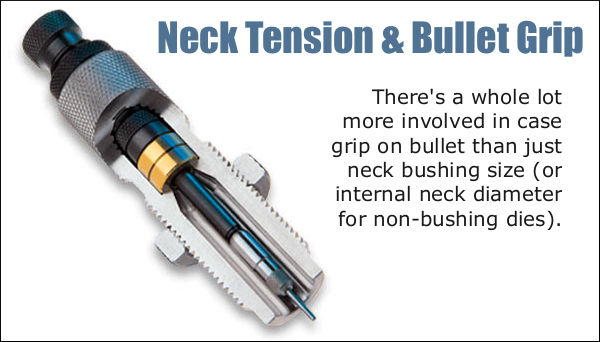
Many novice hand-loaders believe that neck bushing Inside Diameter (ID) size is the only important factor in neck tension. In fact, many different things will influence the grip on your bullet and its ability to release from the case neck. To learn more about neck tension and “case grip”, take the time to read this article carefully. We bet you’ll gain knowledge that will let you load more accurate ammo, with better ES/SD.
Editor: Guys, this is a VERY important article. You really should read it over carefully, twice. Variations in the force required to release a bullet can significantly affect accuracy and ES/SD. You really need to know how the grip on bullet can be altered by many different factors.
Neck Tension (i.e. Grip on Bullets) Is a Complex Phenomenon
While we certainly have considerable control over neck tension by using tighter or looser bushings (with smaller or bigger Inside Diameters), bushing size is only one factor at work. It’s important to understand the multiple factors that can increase or decrease the resistance to bullet release. Think in terms of overall brass-on-bullet “grip” instead of just bushing size (or the internal neck diameter in non-bushing full-length sizing dies).
Bullet grip is affected by many things, such as:
1. Neck-wall thickness.
2. Amount of bullet bearing surface (shank) in the neck.
3. Surface condition inside of neck (residual carbon can act as a lubricant; ultrasonic cleaning makes necks “grabby”).
4. Length of neck (e.g. 6mmBR neck vs. 6mm Dasher).
5. Whether or not the bullets have an anti-friction coating.
6.The springiness of the brass (which is related to degree of work-hardening; number of firings etc.)
7. The bullet jacket material.
8. The outside diameter of the bullet and whether it has a pressure ridge.
9. Time duration between bullet seating and firing (necks can stiffen with time).
10. How often the brass is annealed.
11. Amount (length) of neck sized (e.g. you can size only half the neck).
12. Interior diameter of bushing, or neck section of non-bushing die.
– and there are others…
One needs to understand that bushing size isn’t the beginning and end of neck tension questions, because, even if bushing size is held constant, the amount of bullet “grip” can change dramatically as the condition of your brass changes. Bullet “grip” can also change if you alter your seating depth, and it can even change if you ultrasonically clean your cases.
5-time U.S. National Long-Range Champion John Whidden adds: “Our tests show us that the condition of the necks in regards to lubed or not, carbon inside or not, squeaky clean or not, etc., matter even more than the size of the bushing used. An ultrasonically cleaned or brand new dry case neck make for some quite high seating force.”
In our Shooters’ Forum a reader recently asked: “How much neck tension should I use?” This prompted a Forum discussion in which other Forum members recommended a specific number based on their experience, such as .001″, .002″, or .003″. These numbers, as commonly used, correspond to the difference between case-neck OD after sizing and the neck OD of a loaded round, with bullet in place. In other words, the numbers refer to the nominal amount of interference fit (after sizing).
While these commonly-used “tension numbers” (of .001″, .002″ etc.) can be useful as starting points, neck tension is actually a fairly complex subject. The actual amount of “grip” on the bullet is a function of many factors, of which neck-OD reduction during sizing is just one. Understanding these many factors will help you maintain consistent neck tension as your brass “evolves” over the course of multiple reloadings.
Seating Depth Changes Can Increase or Decrease Grip on Bullet
You can do this simple experiment. Seat a boat-tail bullet in your sized neck with .150″ of bearing surface (shank) in the neck. Now remove the bullet with an impact hammer. Next, take another identical bullet and seat it with .300″ of bearing surface in another sized case (same bushing size/same nominal tension). You’ll find the deeper-seated bullet is gripped much harder.
Neck-Wall Thickness is Important Too
I have also found that thinner necks, particularly the very thin necks used by many PPC shooters, require more sizing to give equivalent “grip”. Again, do your own experiment. Seat a bullet in a case turned to .008″ neckwall thickness and sized down .003″. Now compare that to a case with .014″ neckwall thickness and sized down .0015″. You may find that the bullet in the thin necks actually pulls out easier, though it supposedly has more “neck tension”, if one were to consider bushing size alone.
In practical terms, because thick necks are less elastic than very thin necks, when you turn necks you may need to run tighter bushings to maintain the same amount of actual grip on the bullets (as compared to no-turn brass). Consequently, I suspect the guys using .0015″ “tension” on no-turn brass may be a lot closer to the guys using .003″ “tension” on turned necks than either group may realize.
Toward a Better Definition of Neck Tension
As a convenient short-cut, we tend to describe neck tension by bushing size alone. When a guy says, “I run .002 neck tension”, that normally means he is using a die/bushing that sizes the necks .002″ smaller than a loaded round. Well we know something about his post-sizing neck OD, but do we really have a reliable idea about how much force is required to release his bullets? Maybe not… This use of the term “neck tension” when we are really only describing the amount of neck diameter reduction with a die/bushing is really kind of incomplete.
My point here is that it is overly simplistic to ask, “should I load with .001 tension or .003?” In reality, an .001″ reduction (after springback) on a thick neck might provide MORE “grip” on a deep-seated bullet than an .003″ reduction on a very thin-walled neck holding a bullet with minimal bearing surface in the neck. Bushing ID is something we can easily measure and verify. We use bushing size as a descriptor of neck tension because it is convenient and because the other important factors are hard to quantify. But those factors shouldn’t be ignored if you want to maintain consistent neck tension for optimal accuracy.
Consistency and accuracy — that’s really what this all about isn’t it? We want to find the best neck tension for accuracy, and then maintain that amount of grip-on-bullet over time. To do that you need to look not only at your bushing size, but also at how your brass has changed (work-hardened) with time, and whether other variables (such as the amount of carbon in the neck) have changed. Ultimately, optimal neck tension must be ascertained experimentally. You have to go out and test empirically to see what works, in YOUR rifle, with YOUR bullets and YOUR brass. And you may have to change the nominal tension setting (i.e. bushing size) as your brass work-hardens or IF YOU CHANGE SEATING DEPTHS.
Remember that bushing size alone does not tell us all we need to know about the neck’s true “holding power” on a bullet, or the energy required for bullet release. True bullet grip is a more complicated phenomenon, one that is affected by numerous factors, some of which are very hard to quantify.
Today is Halloween (originally “All Hallows Eve”). With the slow return to post-Pandemic normalcy, there will be trick-or-treating in many locales across the country. U.S. LawShield has provided Halloween safety tips for homeowners and families with kids. These tips are designed to keep kids safe/secure and to help adults supervise the young ones and avoid potential liabilities as homeowners. READ Full Article HERE.
Halloween Safety Tips for Adults (Parents and Homeowners) Drive Carefully – Drive slowly and watch for people crossing the street. Avoid distractions like phones or food so you can be ready to stop quickly. (But it’s best to just avoid driving after dark on Halloween[.]) Clear the Way – Clear your front steps, driveway, and lawn of any potential safety hazards. If any injuries happen on your property, you could be held liable! Leave a Light On – If you leave the house, keep a few visible lights on inside to discourage criminals. However, leave your porch light off to let trick-or-treaters know you aren’t giving out candy! Verify Insurance – Are you turning your home into a neighborhood haunted house? Are you charging admission? Make sure to check your local laws and verify your homeowners insurance coverage! Something like this could be considered a business activity, and accidents or injuries typically are not covered. (You should also verify your self-defense insurance coverage!) Go Flameless – Use electric lights in your jack-o-lanterns and other décor. House fires are one of the more common accidents reported by homeowners on Halloween.
Halloween Safety Tips for Kids Adult Supervision – All children aged 13 and under should be accompanied by an adult when trick-or-treating. Older kids without an adult should be in groups of three or more. Create a Route – Only trick-or-treat in familiar neighborhoods and at houses with porch lights on. Be aware of and avoid the addresses of local sex offenders. Street Smart – Walk only on sidewalks, and cross streets only at crosswalks or corners. Make eye contact with drivers before crossing to help prevent accidents. Take extra caution with costume masks, as they greatly reduce a child’s ability to see their surroundings. High Visibility – Carry glow sticks or flashlights when out after dark, and avoid wearing costumes that are dark-colored or aren’t reflective. Treat Smart – Check your kids’ candy! The CDC Halloween Safety Guide highly recommends throwing away any unwrapped or unsealed pieces.
U.S. LawShield also strongly recommends not having toy guns — even Nerf guns or squirt guns — as part of costumes. At night toy guns can cause confusion, with potential bad reactions.
About U.S. LawShield
Founded in 2009, U.S. LawShield now has 700,000+ members and 6,000+ industry partners. The goals are to help members handle critical, life-threatening situations and prevent potential injustices in the legal system after acts of self-defense. For more information on U.S. LawShield visit USLawshield.com.
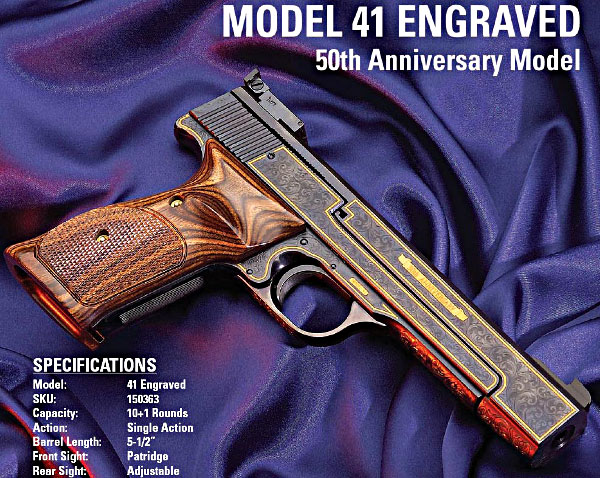
The Smith & Wesson Model 41 is a classic American rimfire target pistol. Beautifully crafted, the Model 41 boasts a superb trigger, comfortable grip, and excellent accuracy. New or used, a Model 41 is a fine addition to any firearms collection. We’ve shot a few Model 41s, and they will spoil you if you go back to a lesser rimfire pistol. First released commercially in in 1957, a special 50th Anniversary Model (shown above top) came out in 2007 (hitting the market in 2008). Perhaps it should have been named the 60th Anniversary edition, as the first prototypes of the Model 41 were crafted way back in 1947. READ American Rifleman article about Model 41.
The Model 41 is one of those classic American designs that has stood the test of time. Many feel the Model 41 represents the apex of American .22 LR pistol design, much like the Colt Python is the “crown jewel” of double-action revolvers. One YouTube poster noted: “After [65] years the Model 41 is still near the top of the game in precision .22s. Very few if any of the current day pistols can match the workmanship, fit, and balance that makes having a Model 41 so enjoyable to own. S&W blew the center out of the 10 Ring with this one when they introduced it and continue to do so today.”
The Stunning 50th Anniversary Edition Model 41
Probably the most sought-after Model 41 is the handsome, machine-engraved 50th Anniversary Model, released in 2007. This was offered in a hardwood, glass-covered case. This would be a prized addition to any gun collection:
The 50th Anniversary Model was machine-engraved with Class A+ coverage, 24 carat gold striping, and special serial number range FYA0001 – FYA0500.
Of course, if you want a superb trigger in a .22 LR semi-auto pistol, look no further than the S&W Model 41. For $2000.00 to $3700.00 you can find the fully engraved, 50th Anniversary Model 41 in presentation case on various auction sights. First released in 2007, the engraved model 41 combines superior accuracy with stunning appearance.
Smith & Wesson Model 41 — An American Classic Rimfire Pistol
The Smith & Wesson Model 41 is an American classic — one of the great, iconic .22 LR target pistols. Accurate, well-balanced and built-to-last, model 41s have been in production for over 50 years. The Model 41 remains one of the most accurate pistols ever produced by Smith & Wesson.
Model 41 photo by Mightymoo01, creative commons released CC BY-SA 3.0.
Beautifully crafted, the Model 41 boasts a superb trigger, comfortable grip, and excellent accuracy. Whether an older classic or a newer model, the S&W Model 41 is something every gun owner would prize for target shooting. And “like new” high-grade models are now appreciating in value!
Smith & Wesson historian Roy Jinks recounts the development of the Model 41: “It was a difficult task to develop a competitive pistol that would meet the various needs of the top shooters. The final design was decided upon in 1956 and the new .22 target pistol was announced in Smith & Wesson’s 1957 Annual Report, stating: ‘Its design includes many advanced features, such as stocks equally suitable for right or left-hand shooters- a clean, crisp, trigger pull that is adjustable to individual preferences. The distribution of weight, together with the angle of the stocks, permits extremely steady off-hand holding. The precise micrometer sights are rigidly mounted on a one piece forged barrel to avoid any possible misalignment even after long usage.’ The handgun featured a 7 3/8-inch barrel equipped with a muzzle brake to help control recoil. The underside of the barrel was grooved to allow the addition of adjustable Olympic Style Barrel Weights. The trigger pull could be adjusted to allow for a 2-pound pull to meet the NRA Gallery Course requirement or increased to 3 pounds to meet the needs of the ISU International rules.
Smith & Wesson Model 41 with two extra slide/barrel assemblies, plus custom holster and mag holders. This sold on Cowan’s Auctions for $2640.00 in 2019.
Sales began in December of 1957 and the Model 41 was first cataloged in 1958. The factory was soon heavily back-ordered and [the Model 41] became the most popular auto-loading pistol offered by the company. In May of 1959 Smith & Wesson introduced a 5-inch lightweight barrel for the handgun to meet the demand of hunters[.] The line of Model 41s was further expanded in September of 1960 with the introduction of the Model 41-1 which fired .22 shorts for the International Rapid Fire Shooters. [I]n August of 1963 the company introduced the 5.5 inch heavy barrel. The last of the major barrel changes occurred in 1965 when the company produced the 5.5-inch heavy barrel with an extendable front sight to provide the shooter a longer sight radius. During the last 50 years the Model 41 has … established many records around the world. Today it is one of the classic target handguns[.]” READ MORE Model 41 History.
Field Test of Current Generation S&W Model 41
So how do modern production Model 41s shoot? Very well indeed, based on the results from popular gun Vlogger 22plinkster. He took a new Model 41 to his test range and tested it for handling and accuracy. Watch the 22plinkster video below:
22plinkster runs of the most popular gun-centric YouTube channels. His videos have been watched by hundreds of thousands of firearms fans. Some of .22 Plinkster’s videos involve trick shots, but he’s actually a very competent marksman who has shot a vast collection of .22 LR/22 WMR pistols and rifles, making him a qualified rimfire expert.
Hickok45’s 30-Year-Old Model 41
Hickok45, a popular YouTube host, has been a fan of the S&W Model 41 since it was first released. In fact, back in 2020, Hickok45 celebrated his 30th year of ownership of this classic American rimfire. In this “Celebrating 30 Years” video, Hickok 45 demonstrates the qualities that have made the Model 41 so popular. He notes that it balances well, has an excellent trigger, and delivers superb accuracy. He observed: “What a great .22 LR pistol!”
Performance Center “Optics-Ready” Model 41
Do you prefer shooting pistols with a modern optic? Well check out the fully “Optics-Ready” S&W Performance Center Model 41. This modernized Model 41 PC has an integral Picatinny Rail mount for optics, plus adjustable target sights with a special skeletonized and removable front blade sight.
The Performance Center Model 41 sports an integral Picatinny-style equipment rail for easy installation of optics. Other standard features include an external thumb safety on the left side of the frame, custom wood target grips, and a blued finish. This full-size, 10-shot .22 LR pistol features a carbon steel frame and slide along with a 5.5-inch barrel. Measuring 10.5 inches in overall length, the Model 41 PC has an unloaded weight of 41 ounces. MSRP is $1763.00.
The S&W Model 41 History from Wikipedia
From Wikipedia: The Smith & Wesson Model 41 is a semi-automatic pistol developed by Smith & Wesson after World War II as a competitive target pistol. It was designed with a 105-degree grip angle, the same as the Colt M1911 pistol, to maintain a consistent grip angle.
Prototype and Production Models
In July 1947, two prototypes, numbered X-41 and X-42, were produced, tested, and improved for the next 10 years. In 1957, the Model 41 was made available to the public for sale when Smith & Wesson produced 679 units. At the end of 1958, they had built 9,875 Model 41 pistols. A lighter 5-inch (130 mm) barrel was offered in 1958 for field use. The Model 41-1 was introduced in 1960 and was chambered in .22 Short for International Rapid Fire competition. Only 1000 were made using light aluminum slides necessary for function with the lower powered .22 Short.
In August 1963, the 5-inch heavy barrel version came into the market. Stoeger’s Shooter’s Bible of 1964 shows a 7 3⁄8″ (190 mm) barrel grooved for Olympic center weights. The cocking indicator and 7 3⁄8″ barrel were dropped in 1978. The 7-inch (180 mm) barrel was introduced in 1978 with no provision for a muzzle brake. A 6-inch (150 mm) barrel was offered for a few months in 1991. In 1992, the Model 41 was dropped from production. In 1994, Smith & Wesson returned it to production as the Model 41 “New Model”.
The Model 41 Military Variant — S&W Model 46
In 1957, Smith & Wesson offered a “no frills” version of the Model 41, designated the Model 46. In 1959, it was selected by the U.S. Air Force for basic marksmanship training. About 4000 units were made in total: 2500 with a 7-inch barrel, 1000 with 5-inch barrels, and 500 with 5.5″ barrels. The pistol lacked the checkering, polished blue finish, and other refinements of the Model 41. It proved to be a commercial failure with consumers who preferred the more costly Model 41, and production ceased in 1966.
Evergreen Ballistics is a shooter-owned enterprise that sells a great selection of coated lead bullets, conventional cast bullets, plus copper-plated bullets. If you currently shoot cast and/or plated bullets in your pistols and/or rifles, you should definitely check out the Evergreen Ballistics offerings. The prices are very competitive and customer service is excellent.
Evergreen Ballistics (EB) was launched in April 2020. The company soon received many customer requests to produce coated bullets. Marc McAtee, owner of Evergreen Ballistics, set to work: “I ordered several different colors of Hi-Tek Supercoat [to test]. We launched the line of coated bullets in mid-2020 and they quickly became our most desired type of bullets.” A year later Evergreen launched a line of EB-branded plated pistol bullets produced by a major North American plated-bullet manufacturer.
“I have always tried to keep the mission of Evergreen Ballistics focused and simple. Provide quality projectiles to reloaders at the best price possible. In addition, we try to treat our customers as we would want to be treated. From fast, inexpensive shipping, to taking the time to answer every email, we do our best to do right by the customer.” — Marc McAtee, Evergreen Ballistics
Evergreen Ballistics Polymer-Coated Bullets
Evergreen Ballistics offers a selection of coated bullets in two styles: 1) NLG or “no lube groove” bullets; and 2) grooved bullets made from the same alloy and molds as its regular cast lead bullets. The NLG bullet molds were designed specifically to meet the increased demand for coated bullets. McAtee explains the coating process: “After casting and cooling, the bullets are weighed out onto individual wire trays. The coating is then mixed with a solvent, in our case acetone, and applied to the bullets. We apply the coating by adding it to a large mixing bowl and shaking the bullets vigorously. The bullets are then spread out on their wire trays to dry thoroughly. The bullets are then backed for approximately 10 minutes to set the coating. After cooling, we perform two tests to verify the integrity of the coating.”
This shows that the coating has cured. Next, we simply smash a bullet with a hammer. The coating should not flake off. This proves the coating is chemically bonded to the lead. We preform these tests on every tray that comes out of our ovens. After this, we repeat the process for the second coat. Once the bullets have cooled from their second coat, they are sized through carbide sizing dies. We use a small amount of fluoropolymer-based lubricant to aid in sizing the bullets. One of the questions I get asked all the time is, “Does the coating come off during sizing?”. No, it does not. If the coating is cured properly it will remain on the bullet during sizing. Just as it remains on the bullet as it travels down the barrel.
The coating is Hi-Tek Supercoat manufactured by J & M Specialized Products in Australia. This polymer coating has major advantages. The coating nearly eliminates barrel leading and significantly reduces airborne lead. In addition, with no greasy lube to vaporize, there is greatly reduced smoke.
Evergreen Ballistics Cast Lead Bullets
Along with its signature green-coated bullets, Evergreen Ballistics offers a full line of conventional lead bullets cast from an alloy containing 92% lead, 6% Antimony, and 2% Tin with a Brinell hardness (BHN) of approximately 16. This alloy delivers good performance at a range of velocities.
Marc McAtee notes: “Our molds were designed with this high-quality alloy in mind. Our lead arrives very clean, so there is minimal fluxing that we have to do, and we do not have a significant amount of dross to pull off the pot. Our lead bullets are sized using machined carbide dies and lubed with Commercial 160 from White Label Lube Company”.
Evergreen Ballistics Plated Bullets
Our plated bullets are manufactured by a leading North American bullet manufacture. The lead cores are swaged to ensure consistent starting weight. They are then electroplated which deposits a layer of copper that completely encapsulates the lead core. This copper layer is approximately 0.008″ in thickness. The bullets are then resized to ensure concentricity and appropriate diameter. The heavy plating on these bullets allows them to be pushed to higher velocity using FMJ load data.
Interview with Marc McAtee, Founder of Evergreen Bullets
Q. How and why did you start the company?
A: The idea to start the business originated in late 2018 after finding a commercial casting set-up at an estate sale. I acquired the automated casting and sizing machines along with a collection of molds. Over the next several months, I would cast and re-melt numerous batches of lead bullets to optimize the production process . In April of 2020 the Evergreen Ballistics business was formed, and I began selling cast lead bullets online. Around this time, I began to use Hi-Tek Supercoat on small batches of lead bullets, making polymer-coated bullets for myself. Shortly after I learned about the Supercoat product, customers asked if we could produce coated lead bullets. After experimenting with several colors and ratios of coating, I settled on the color and recipe we use now.
Q. What are the benefits of the polymer bullet coatings?
A. When compared to ordinary cast lead bullets you have no lead fouling and no smoke that would normally be created from burning lube. In addition, you do not get cast bullet lube on your reloading dies. Polymer coated bullets are cleaner to shoot and cleaner to load than plain lead bullets.
Q. What makes your bullets different/better than the competition?
A. In our coated bullets we use the same 92/6/2 alloy as our cast lead bullets. This keeps the cast weights consistent. Some coated bullet companies have switched to a 98/2 alloy. It’s a cheaper alloy, but the weights do not cast the same. For OUR plated bullets, the plating is 0.008″ thick. Many other plated bullets on the market range from 0.002-0.006″ in plating thickness. Our thicker plating allows the bullet to perform more like a FMJ and you have less chance of plate separation as the bullet travels down range.
Q. How are the jacketed bullets made?
A: Full disclosure: our jacketed bullets are not made in-house, they are manufactured by a contractor. With that being said, The cores of the plated bullets begin as chucks of 98% lead, 2% antimony lead wire. The cores are formed into the rough bullet shape then head into the plating process. This process involves several steps in various chemical baths. This results in strong adhesion of the copper plate to the lead core. The bullets are then reformed in a hydraulic press to ensure prefect dimensions and consistency from bullet to bullets. Finally, the bullets are polished and shipped to us in 50,000-piece crates. Upon arrival, from the contractor, several bullets from each batch are tested for weight and dimension consistency. In addition, we verify adhesion of the copper plating.
Q. Are you able to keep up with the high current bullet demand?
We are a small shop — we do not have big OEM customers or even wholesale customers. ALL the bullets we make and sell go to people who reload. This was very evident during the last big rush on ammo/bullets. While some manufactures were taking 4-6 weeks to ship orders, we were able to ship orders in less than a week. We were not backlogged with massive OEM bullet orders. All of our capacity goes to support the everyday reloader.
Q. Will any new calibers/bullet types be offered in the near future?
Our newest addition to our plated bullet line are our .458 diameter bullets. These include a 300gr and 405gr RNFP and a Spitzer design available in 350gr, 450gr, or 500gr sizes. We are currently working on a coated, 220gr .308-caliber bullet for the suppressed 300 BLK crowd.



 Is your well-built rifle of high-quality components plagued with vertical fliers across more than 1-3 handload combinations? Consider the bedding, crown and scope/sight mounts. Are they correct? If so, then you might check for ignition issues before boldly undertaking an extensive, expensive, and quite possibly fruitless quest for the “magic handload”.


 There’s a simple, inexpensive “miracle device” that can cut your groups in half. If you’re not using this device, you’re giving away accuracy. The “miracle device” to which we refer is a simple wind indicator aka “windflag”. Using windflags may actually improve your accuracy on target much more than weighing charges to the kernel, or spending your life savings on the “latest and greatest” hardware.


 Who Should You Vote For?


 In our
  Neck-Wall Thickness is Important Too


 Of course, if you want a superb trigger in a .22 LR semi-auto pistol, look no further than the S&W Model 41. For $2000.00 to $3700.00 you can find the fully engraved,


 The Performance Center Model 41 sports an integral Picatinny-style equipment rail for easy installation of optics. Other standard features include an external thumb safety on the left side of the frame, custom wood target grips, and a blued finish. This full-size, 10-shot .22 LR pistol features a carbon steel frame and slide along with a 5.5-inch barrel. Measuring 10.5 inches in overall length, the Model 41 PC has an unloaded weight of 41 ounces. MSRP is $1763.00.


