Here is the digital version of the SHOT Daily print magazine provided on site at SHOT Show by the NSSF. You can navigate page by page with the left/right white arrows in the gray box below. To quickly scan through the entire 64-page digital magazine, use the slide bar. When you find content you want to read, use the zoom control or click the FULL SCREEN brackets icon at lower right.
SHOT Daily Day 3 — 1/20/2022
CLICK Full Screen (brackets) icon to read.
There are two big feature articles you’ll want to read in this SHOT Daily Day 3 edition. On page 36 you’ll find a 6.5 Creedmoor Cartridge feature that covers the growth in popularity of this versatile mid-sized round. The 6.5 Creedmoor is now among the top three chamberings for new bolt-action rifles. On page 24 you’ll find a comprehensive guide to New Knives for 2022 from many manufacturers. There are some notable new ammo types being introduced this year including Hornady CX lead-free hunting ammunition. CCI is also offering new lead-free pistol ammo.
IMPORTANT: To read either story, click the full screen (brackets) icon in the gray box above and then zoom to the start page (page 36 for Optics, page 24 for Ammo).
Sometimes smaller is better — at least when a more compact cartridge than the 9mm Luger (9x19mm) still packs the punch of the larger round.
Brand New Pistol Cartridge for Carry Guns
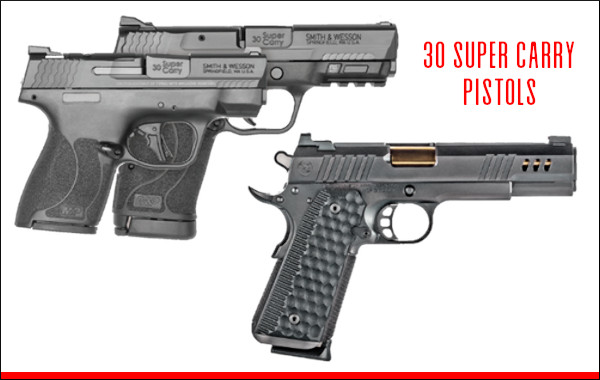
Federal has just released an all-new pistol cartridge, the 30 Super Carry. Designed expressly for CCW and personal defense applications, this new 30 Super Carry cartridge packs the punch of a 9mm Luger round (9x19mm), with a smaller casing, so you can fit more rounds in a magazine. A pistol that holds 10 rounds of 9mm Luger ammo can hold at least 12 rounds of 9mm Super Carry ammo. That’s a 20% increase in capacity.
In a defensive situation, that extra two rounds could make a difference. But importantly, the 30 Super Carry is not a weak round. You don’t give up stopping power or penetration when compared to the classic 9mm Luger cartridge. In Federal’s tests, penetration through heavy clothing was actually BETTER with the 30 Super Carry than the 9mm Luger (15.5″ vs. 14.5″). NOTE: The actual 30 Super Carry bullet diameter is 0.312″, slightly fatter than a “30 caliber” rifle bullet (0.308″).
Worthy Replacement to 9mm Luger?
Is this a useful alternative to the 9mm Luger? It depends. The new 30 Super Carry is definitely more effective than the .380 ACP so it beats that alternative. And velocity is actually higher than the 9mm Luger mainly because the 30 Super Carry shoots a lighter bullet — 100 grains vs. the typical 115-125 grain 9mm bullet. For many the key appeal of the new cartridge is the ability to carry more rounds OR carry the same number of rounds with a lower overall weight.
Federal’s New 30 Super Carry is 13% smaller than a 9x19mm, with very similar ballistics
Watch video for ballistics information and cartridge diagrams.
30 Super Carry Questions and Answers
How is the 30 Super Carry’s felt recoil compared to the 9mm Luger?
Recoil, flash and sound report provide a very similar shooting experience to 9mm Luger
How do the 30 Super Carry’s velocity and energy compare to 9mm Luger?
They are extremely similar. The 100-grain 30 Super Carry HST carries 347 foot-pounds of energy at the muzzle and has a velocity of 1250 fps; the 124-grain 9mm Luger HST has 364 foot-pounds of energy and a muzzle velocity of 1150 fps.
Do I need a different firearm to shoot the 30 Super Carry?
Yes, you need a firearm chambered for 30 Super Carry. Currently, Smith & Wesson and Nighthawk Custom offer these platforms.
How does the 30 Super Carry differ from older cartridges such as the 7.65×21 Parabellum, 7.65×20mm Longue, 32 Auto and others?
While there might be some coincidental similarities, the 30 Super Carry was fully developed from the ground up with no parent cartridge. Utilizing modern materials and designs, it provides vastly superior performance to seemingly similar historic cartridges.
What kind of accuracy can I expect from the 30 Super Carry?
The cartridge has proven to be an exceptionally accurate round, typically exceeding the accuracy of other popular carry cartridges.
NOTE: These answers are provided by Federal, the ammunition manufacturer.
Currently there are Smith & Wesson and Nighthawk Custom pistols factory-chambered for the new 30 Super Carry cartridge. If this round catches on, expect to see Glock, Ruger, and SIG offer this chambering.
Today we showcase five YouTube videos that explain basic reloading processes. This article primarily focuses on the .45 ACP cartridge because this a very good choice for hand-loaders getting started. The .45 ACP is one of the easier cartridges to reload, because it has a large case diameter and large primer pocket, and because it operates at relatively low pressures (compared to rifle rounds).
We recommend that new reloaders consider starting with the .45 ACP cartridge. There are many reasons why the .45 ACP is a good choice for those just getting started in hand-loading:
1. The case is fairly short but has a relatively large diameter (and minimal taper), so it is easy to see inside the case. That helps you quickly check powder levels.
2. Many good powders (for the .45 ACP) will fill the case over 60%, so you will have an obvious overflow if you double-charge by accident.
3. The .45 ACP round runs at relatively low pressures, but delivers excellent accuracy.
4. Good .45 ACP brass lasts a long time, is easy to size, and is good for many reloads.
5. Along with 1911s, there are fine .45 ACP revolvers that shoot the round with moon clips.
6. The vast majority of .45 ACP brass uses large pistol primers (although there ARE some small primer pocket varieties*). We find that large primers are easier to pick up and handle if you are using a single primer tool.
The .45 ACP (Automatic Colt Pistol) cartridge is a rimless straight-walled handgun cartridge originally developed in 1904 by John Moses Browning for use in his prototype Colt semi-automatic pistol. After successful military trials, it was adopted as the standard chambering for Colt’s M1911 pistol.
For reloading, there are many good powder choices. We recommend Vihtavuori N320. This is very accurate and burns cleaner than some otherwise good powders, such as Accurate (AA) No. 5 and Unique.
Basic Reloading for the .45 ACP Cartridge
This is the most-viewed .45 ACP reloading video on YouTube. It is directed primarily for the novice or prospective reloader. It covers the basic processes: case inspection, cleaning, trimming, sizing, priming, powder filling, bullet seating, and crimping. The video creator notes: “Trimming pistol/revolver brass is optional and usually not necessary. it was included because that is what I did when I first began reloading, before I found out that handgun brass does not stretch as much as bottleneck rifle brass.”
How To Reload .45 ACP Start to Finish — Tutorial for Newer Reloaders
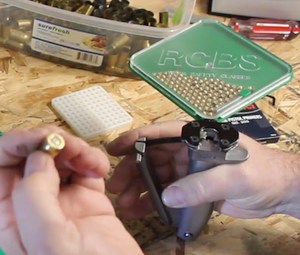
This is a detailed 20-minute video that shows the reloading process start to finish. The video shows how to clean the cases, deprime, and check them before loading.
In this video the cases are sized and bullets seated using a single-stage RCBS press. The cases are primed using an RCBS hand-priming tool which keeps multiple primers in a tray (see 8:55 time-mark). For efficiency, we recommend seating with a hand tool (or bench-mounted tool) vs. seating primers using the priming system on the press itself. The hand seating tool also gives you a better “feel” for setting the primers.
Safety First When Loading All Cartridges
Along with the first two instructional videos above, we include two important videos focused on reloading safety. In the first video, UltimateReloader’s Gavin Gear explains how to check your cartridge during the loading process to eliminate squib loads and other defects. In the second video, Starline Brass tech Hunter Pilant explains how to avoid double charges.
Load .45 ACP Safely — Avoid Squib Loads and Overcharges
You need to check the powder level of EVERY round you load. Do this visually BEFORE seating a bullet. (Or, with a progressive press, use a lock-out die that monitors powder levels). This is very important because a squib load (with little or no powder) can leave a bullet lodged in the barrel. A subsequent full, live round can cause a Kaboom with dire consequences.
Preventing Double Charges — Use a Case-filling Powder with .45 ACP
IMPORTANT TIP: Use a bulky powder that fills your case more than half way with a correct charge. “This will over-fill the case if it is double-charged, making it impossible to load. This is one safeguard that can keep you from making a big [mistake]” (Hunter Pilant, Starline). A bulky powder with high fill level will also be easier to see inside the case.
The Progressive Option — Loading .45 ACP on the Dillon 550B
Once you have mastered the basics of reloading for the .45 ACP, if you require large quantities of ammo, you may want to consider getting a progressive press. Progressive presses can significantly increase your ammo output, but there are also important safety considerations. You need to be careful about powder levels and priming. In this video, Gavin Gear explains how to reload safely with a Dillon 550B progressive press. The equivalent current model is the Dillon 550C.
.45 ACP Ammunition Loading Guide — Nosler Data
If you “roll your own” .45 ACP cartridges, there are many good powder choices. Our favorites are Vihtavuori N320, AA No. 5, and Hodgdon TiteGroup, but there are many other good choices. You’ll find these three recommended powders (plus many others) in the .45 ACP Load Data Charts from Nosler. Shown below are the Nosler Guides for 185gr bullets and 230gr bullets. Right-click each image below to access/download printable PDF files.
Click for PDF File
Click for PDF File
* However, be aware that CCI and other companies are now manufacturing .45 ACP brass with SMALL PRIMER POCKETS. Whenever you get new brass, be sure so check ALL the cases for primer size, and segregate large and small in two groups. Attempting to push a large primer into a small primer hole can lead to jams, or worse, dangerous detonation. Be CAREFUL!
Most shooters realize that significant changes in temperature will alter how powders perform. That’s why you want to keep your loaded ammo out of the hot sun, and keep rounds out of a hot chamber until you’re ready to fire. But there are other factors to be considered — HUMIDITY for one. This article explains why and how humidity can affect powder burn rates and performance.
We’ve all heard the old adage: “Keep your powder dry”. Well, tests by Norma have demonstrated that even normal environmental differences in humidity can affect the way powders burn, at least over the long term. In the Norma Reloading Manual, Sven-Eric Johansson, head of ballistics at Nexplo/Bofors, presents a very important discussion of water vapor absorption by powder. Johansson demonstrates that the same powder will burn at different rates depending on water content.
Powders Leave the Factory with 0.5 to 1.0% Water Content
Johansson explains that, as manufactured, most powders contain 0.5 to 1% of water by weight. (The relative humidity is “equilibrated” at 40-50% during the manufacturing process to maintain this 0.5-1% moisture content). Importantly, Johansson notes that powder exposed to moist air for a long time will absorb water, causing it to burn at a slower rate. On the other hand, long-term storage in a very dry environment reduces powder moisture content, so the powder burns at a faster rate. In addition, Johansson found that single-base powders are MORE sensitive to relative humidity than are double-base powders (which contain nitroglycerine).
Tests Show Burn Rates Vary with Water Content
In his review of the Norma Manual, Fred Barker notes: “Johansson gives twelve (eye-opening) plots of the velocities and pressures obtained on firing several popular cartridges with dehydrated, normal and hydrated Norma powders (from #200 to MRP). He also gives results on loaded .30-06 and .38 Special cartridges stored for 663 to 683 days in relative humidities of 20% and 86%. So Johansson’s advice is to keep powders tightly capped in their factory containers, and to minimize their exposure to dry or humid air.”
Confirming Johansson’s findings that storage conditions can alter burn rates, Barker observes: “I have about 10 pounds of WWII 4831 powder that has been stored in dry (about 20% RH) Colorado air for more than 60 years. It now burns about like IMR 3031.”
What does this teach us? First, all powders start out with a small, but chemically important, amount of water content. Second, a powder’s water content can change over time, depending on where and how the powder is stored. Third, the water content of your powder DOES make a difference in how it burns, particularly for single-base powders. For example, over a period of time, a powder used (and then recapped) in the hot, dry Southwest will probably behave differently than the same powder used in the humid Southeast.
Reloaders are advised to keep these things in mind. If you want to maintain your powders’ “as manufactured” burn rate, it is wise to head Johannson’s recommendation to keep your powders tightly capped when you’re not actually dispensing charges and avoid exposing your powder to very dry or very humid conditions. The Norma Reloading Manual is available from MidwayUSA for $24.99.
Real-World Example — “Dry” H4831sc Runs Hotter
Robert Whitley agrees that the burn rate of the powder varies with the humidity it absorbs. Robert writes: “I had an 8-lb. jug of H4831SC I kept in my detached garage (it can be humid there). 43.5-44.0 gr of this was superbly accurate with the 115 Bergers out of my 6mm Super X. I got tired of bringing it in and out of the garage to my house for reloading so I brought and kept the jug in my reloading room (a dehumidified room in my house) and after a few weeks I loaded up 43.5 gr, went to a match and it shot awful. I could not figure out what was going on until I put that load back over the chronograph and figured out it was going a good bit faster than before and the load was out of the “sweet spot” (42.5 – 43.0 gr was the max I could load and keep it accurate when it was stored in less humid air). I put the jug back in the garage for a few weeks and I now am back to loading 43.5 – 44.0 gr and it shoots great again. I have seen this with other powders too.”
If you have two jugs of the same powder, one kept in a room in your house and one somewhere else where it is drier or more humid, don’t expect the two jugs of the same lot of powder to chrono the same with the same charge weights unless and until they are both stored long enough in the same place to equalize again.
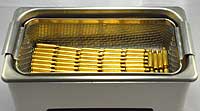
If you read our lengthy article on Ultrasonic Cleaning by Jason Baney, you’ve seen the remarkable results that can be achieved with this method, as shown by the photo above. Ultrasonic cleaning has many advantages over traditional tumbling methods of case cleaning. There is no dust or media residue to remove from the brass, and when done right, the cases come out clean and shiny, inside and out, even the primer pockets.
In its Benchtalk Archives, Brownell’s has an excellent article discussing Ultrasonic Case Cleaning. Brownell’s staff compares results, with measured dwell times from 5 to 75 minutes, using both Mpro-7 and HCS 200 cleaning solutions. Tests are performed with once-fired and 5X-fired Tactical 20 (Tac20) cases, as well as once-fired .260 Rem Cases. The article also compares the results from ultrasonic cleaning vs. tumbling in walnut media. Below are Brownell’s results for Tac20 cases with the HCS 200 (non-acidic solution). Go to Brownell’s article for MPro7 results and Rem 260 results.
HCS 200 Cleaning Solution Test
Procedure — Solution was de-gassed for 15 minutes, then 63 Tac20 cases were placed in a single layer, in stainless steel mesh basket. The temperature of the starting solution was 102° F. When the cases were removed the temperature was 110° F.
Once-Fired Tactical Twenty Cases (HCS 200) — Observations 5 minutes: The exterior of the cases are not significantly brighter/cleaner. The primer pockets and case interiors are still dirty. 10 minutes: Exterior of the cases are brighter. 70% of the cases show some degree of cleaning of the primer pockets. Little difference seen inside the case, but case mouths are cleaner. 15 minutes: Case brightness is about the same. Still only 70% of the primer pockets are clean, but a larger portion of each is cleaner. A Q-tip swabbed inside the cases shows that carbon/powder residues are loosening up. 20 minutes: Case exteriors are brightening up. 80-85% of the primer pockets are about 90% clean. The insides of the cases and case mouths are cleaner. 25 minutes: Cases are brighter/cleaner than even new brass. 80-85% of the cases have almost completely clean primer pockets. The inside of the cases are 80-90% clean. 30 minutes: The insides of the cases and case mouths appear to be completely clean. 87% of the primer pockets are virtually 100% clean. 13% of the cases had stubborn primer pocket residue that could not be completely removed. 60 minutes: Eight cases (13%) were placed in the tank for another 30 minutes to try to remove the remaining residue in their primer pockets. Six out of the eight cases were completely clean.
Five-Times Fired Tac20 Cases — Observations 30 minutes: Based on the above observations, I didn’t begin to observe these 5-time fired cases until after 30 minutes: The exterior cases are bright/clean. Brighter than new cases. The primer pockets on 75% of the cases are 75% clean. The remaining cases had primer pockets that were only 25% clean. The inside of the cases appear to be clean. 65 minutes: 25% of the primer pockets were 95% clean, 25% of the primer pockets were 90% clean, 25% of the primer pockets were 85% clean; and 25% were 80% clean. 75 minutes: 75% of the primer pockets were 90% clean.
How Does Ultrasonic Cleaning Work? The Brownell’s article explains: “Ultrasonic cleaning uses high-frequency sound waves (generally between 20-80 kHz) to remove a variety of contaminants from objects immersed in a liquid. The result of these high-frequency sound waves is a process called cavitation. These high frequency bursts of ultrasonic energy produce a three-dimensional wave of alternating positive and negative pressure areas as the sound wave passes through the solution. During negative pressure, microscopic cavitation bubbles form and will continue to grown until they reach resonant size. As the positive sound wave passes, the pressure rises rapidly and implodes these tiny bubbles. Before these minuscule bubbles implode they store a tremendous amount of energy. These bubbles can be as hot as 10,000 degrees and have as much as 50,000 lbs per square inch of pressure. This sounds alarming, but you have to remember that these bubbles are microscopic in nature and pose no harm to anything, unless you are a carbon /powder residue deposit on a cartridge case!
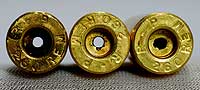
When this cavitation bubble implodes near your brass case, it transforms the bubble into a jet about 1/10th of its size. This jet of energy can travel as fast as 400 km/hour. At 43 kHz, as is the frequency for our L & R HCS 200 ultrasonic cleaner, this is happening 43,000 times per second. This micro-burst of extreme energy is responsible for removing contaminants from the surface of your cartridge brass. Ultrasonic cleaning can reach into crevices and inaccessible areas and remove surface debris that can’t be cleaned by any other process.”
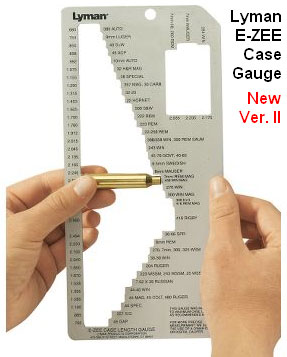
Lyman’s popular Case Length Gauge is now bigger and better. The enhanced version II of Lyman’s Case Length Gauge is much larger than the original version. The E-Zee Case Gauge II now measures more than 70 cartridge types — way more than before. This tool is a metal template with SAAMI-max-length slots for various cartridge types, including relatively new cartridges such as the .204 Ruger and Winchester Short Magnums. This tool allows you to quickly sort brass or check the dimensions. If you have a bucketful of mixed pistol brass this can save you hours of tedious work with calipers. You can also quickly check case lengths to see if it’s time to trim your fired brass.
If you load a wide variety of calibers, or do a lot of pistol shooting, we think you should pick up one of these Lyman Case Gauge templates. They are available for under $26.00 at Brownells ($24.99) and Amazon.com ($19.39). The E-Zee Case Gauge has long been a popular item for hand-loaders.
NOTE: For years the E-Zee Case Gauge had a silver finish with black lettering, as shown in the video. Some of the most recent production of E-Zee Case Gauges have a new “high contrast” look, with white lettering on a black frame. You may get either Case Gauge version when you order online (Brownells shows silver, Amazon shows black). We actually prefer the older, silver version.
Case Gauge Should Last a Lifetime
Easily measure the case length of over 70 popular rifle and pistol cases with Lyman’s new E-Zee Case Length Gauge II. This really is a “must-have” piece of kit for any gun owner who hand-loads numerous pistol and rifle calibers.
This rugged, precisely-made metal gauge makes sorting or identifying cases fast and accurate. The template is machined with SAAMI max recommended case lengths. Made from metal, with no moving parts, the E-Zee Case Gauge II should last a lifetime.
At the request of our readers, we provide select “Deals of the Week”. Every Sunday afternoon or Monday morning we offer our Best Bargain selections. Here are some of the best deals on firearms, hardware, reloading components, optics, and shooting accessories. Be aware that sale prices are subject to change, and once clearance inventory is sold, it’s gone for good. You snooze you lose.
⏺ Good price for everything you need — press, powder measure, scale etc.
For folks getting started with hand-loading, a great basic package is the RCBS Rebel Master Reloading Kit. On sale for $419.99 at Natchez, this RCBS Package features pretty much all you need to load rifle and pistol ammo: Rebel single-stage Press, Uniflow-III Powder Measure, 1500gr digital scale, hand priming tool, powder funnel, powder trickler, hex key set, accessory handle with case neck brushes, primer pocket brushes, deburring tool, loading block, and case lube. You even get a Speer Reloading Manual. NOTE: You can buy this same Rebel Master Kit for $429.99 at Cabelas.com.
⏺ Big savings on Showroom Demo Benelli SuperNova pump shotgun
Benelli makes some of the best shotguns in the world. Here’s your chance to get an excellent Benelli SuperNova Tactical 12ga pump shotgun at big savings. Set up for defensive use, this Benelli has a 18″ barrel and can handle up to 3.5″ shells. The shotgun is fitted with pistol grip stock, along with shielded, tactical-style adjustable sights front and rear. NOTE: This is a “like new” showroom demo model with full factory warranty.
3. Precision Reloading — Big Sale on Hornady Bullets
⏺ Major Savings on .224, 6mm, 6.5mm, .308 and pistol caliber bullets
Quality reloading components remain in short supply. But Precision Reloading has a large inventory of high-quality Hornady match, varmint, and hunting bullets. You’ll find .224 FMJ bullets for under $17.29/100 (that’s less than 18 cents each). There are also great deals on 6mm and 6.5mm ELD match bullets. Plus there are bulk packs of 2000, 5500, and 6000 bullets available at amazing prices. For example, you can get Six Thousand .224 55gr FMJ bullets for just $529.29 (under 9 cents each!).
4. Midsouth — Lyman Tac-Mat Shooting Mat, $56.31
⏺ Thick padded mat offers more comfort with good length and carry handle
Comfort counts when you’re on the ground for hours. We like this Lyman Tac-Mat 71″ x 36″ shooting mat. It has more padding than most mats on the market, providing better comfort. Now $56.31 in tan or $56.31 in black at Midsouth, this is a VERY good deal. This same Lyman shooting mat is $89.89 on Amazon.
5. Sportsman’s Warehouse — Winchester .22 LR Wildcat, $219.99
⏺ Removable lower receiver, Picatinny rails, good trigger, great price
Here is a fun little semi-auto .22 LR rifle at a crazy low price — $219.99 at Sportsman’s Warehouse. The Winchester Wildcat takes Ruger 10/22 mags, and has some great features, such as field-removable lower receiver, ambidextrous controls, integral Picatinny rails and rear barrel access. It has a good trigger and shoots well. In many respects the Wildcat beats the Ruger 10/22 while costing considerably less. The lower receiver assembly is easily removed from the upper assembly by pushing a button — no tools required.
6. Amazon — Mutt Muffs Hearing Protection for Dogs, $52.39
Do you take your dog(s) hunting, or to the shooting range? Well dogs need hearing protection too! Loud gunshots from pistols, rifles, or shotguns can cause permanent hearing damage to your canine. Prevent canine hearing loss with Mutt Muffs — protective earmuffs designed especially for dogs. Mutt Muffs are available in five sizes (XS, S, M, L, XL). These start at $52.39 on Amazon (price varies with size).
7. MidwayUSA 1008 1″-Diameter Hi-Viz Green Target Dots, $5.99
⏺ Get over 1000 Hi-Viz Target dots — great for pistol and rifle
These 1″-round Hi-Viz target spots from U.S. Ballistics stick on nearly any surface. Fluorescent, lime green in color, these targets are highly visible, and also contrast dark bullet holes well. Right now this target pack, with 1008 stick-on target circles, is just $5.99 at MidwayUSA, a 40% savings! We use these target dots for rimfire and centerfire practice.
8. Amazon — Motion-Sensor LED Interior Light, $14.99
⏺ Activates when door opens, Rechargeable, 3 LED Light Levels
Here’s a great accessory for your Gun Safe or closet. This rechargeable LED lamp turns itself on when you open the door, and off when you close the door. Select three brightness levels: 10LED, 20LED, 30LED. With the supplied 3M adhesive magnetic strip you can easily attach the light to the inner walls of your gun safe. And then quickly remove the unit for charging with a standard USB cord (no batteries to replace!). It works, it’s handy, and it’s inexpensive — just $14.99 on Amazon. These motion-sensor LED lamps can also be used in garages or stairwells. NOTE: this is Amazon’s choice for rechargeable LED Motion-Sensor lights.
9. Brownells — Wipe-Out Foam Cleaner, $10.99
⏺ Wipe-Out Foam is effective, particularly when used right after shooting
Walking the firing line at the Berger SW Nationals, one cleaning product was mentioned over and over again and for good reason. Sharp Shoot R Wipe-Out foaming bore cleaner is a no-nonsense, easy-to-use bore cleaner that does a great job. We get best results with two applications of Wipe-Out after some wet patches. If you’re tired of long brushing sessions, give Wipe-Out a try — it really reduces brushing required. This is a good deal. The same 5 oz. can is $24.95 on Amazon!
10. Cabela’s — Catch-All Gear Bag $12.99, Many Colors
⏺ Versatile, good capacity, buy two at this price
This versatile bag holds lots of gear, and you can’t beat the price — just $12.99. At 16″x10″x6″ it’s big enough to hold rifle ammo, muffs, a Kestrel, and other accessories. It can also serve as a general utility bag for car camping trips. Six exterior pockets, including zippered mesh pockets on top and side, provide multiple storage options. Sturdy 1-1⁄2″ nylon web carry straps can be joined by a hand-friendly wrap handle. Cabela’s Catch-All Gear Bag available in a variety of colors including True Timber Camo, 02 Octane Camo, Lt. Gray, Green, Tan, Orange Gold, and Dark Gray.
SHOT Show 2022 is one week away. The 2022 event kicks off with Media Day at the Range on Monday, January 17, 2022. Then the indoor event runs Tuesday the 18th through Friday the 21st. There will be over 2300 exhibitors from all 50 states and 78 nations. This year will see the biggest show ever in terms of floor space. SHOT Show occupies TWO large exhibit halls in 2022 — the Venetian Expo and the brand new Caesars Forum. Total exhibit space for the 2022 show in these two venues is more than 800,000 net square feet — equivalent to more than 18 acres (about 14 football field). And with these twin halls, SHOT Show boasts 13.9 miles of aisles!
SHOT Show FACTS AND FIGURES
– The “SHOT” in SHOT® Show stands for Shooting, Hunting, and Outdoor Trade.
— SHOT Show 2022 will have 800,000 square feet of Exhibit Space with 13.9 MILES of Aisles. The floor space is equivalent to 14 football fields.
— 2022 SHOT Show will have more than 2,300 exhibitors, including the Suppliers Showcase.
— More than 55,000 professionals in the shooting, hunting, outdoors and law enforcement industry are expected to attend, along with 2000+ media members.
— Firearms and ammunition are a $7.1 billion industry. The total economic impact of the gun/ammo/hunting industry is more than $63 billion, which supports more than 342,000 jobs.
— SHOT Show generates millions of dollars in revenue to fund NSSF programs including Firearms Training programs, Project ChildSafe, National Shooting Sports Month, and the +ONE mentoring initiative.
— This is the 44th Annual SHOT Show and the 23rd in Las Vegas. The first SHOT Show was in 1979 in St. Louis, Missouri. The 2021 show was virtual due to the pandemic. Las Vegas has been home to the show continuously since 2010.
Biggest SHOT Show Ever — 800,000 Square Feet of Products
Based on current bookings, SHOT Show 2022 will encompass over 800,000 net square feet. To put it into perspective, the largest SHOT Show on record, the 2008 event, encompassed 714,000 net square feet at the Las Vegas Convention Center. That year outdoor tents needed to be added to fill overflow exhibit space. You can view the 2022 SHOT Show layout here:
Click image for full floor-plan with Level 1, Level 2, and Supplier Showcase.
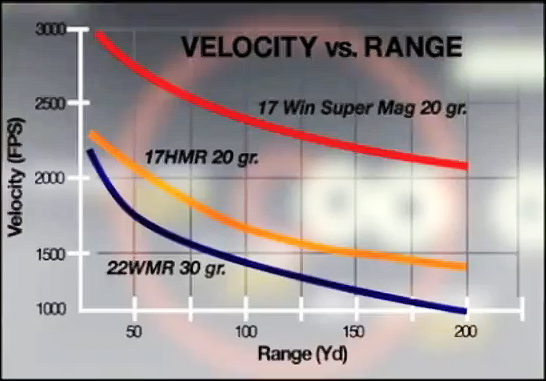
The .17 Winchester Super Magnum (aka .17 WSM) is the fastest, flattest-shooting rimfire cartridge ever created. The .17 WSM cartridge, as you can see below, is significantly larger than the .17 HMR, and can deliver a 3000-fps muzzle velocity with a 20gr bullet, compared to about 2375 fps for .17 HMR 20gr ammo. That’s 26% more speed, which translates to a much flatter trajectory — a big deal when you’re shooting small varmints out to 300 yards.
The .17 WSM has been around for a while, but there have been limited selections of rifles chambered for this speedy rimfire round. Savage is changing that. Savage just announced that it will offer its A17-series rifles chambered in .17 WSM. Currently choose from two models with laminated wood stocks: the A17 WSM Sporter and A17 WSM Target Thumbhole. Both rifles feature a delayed-blowback, semi-automatic action specifically designed for the 17 HMR and 17 WSM cartridges. And both rifles boast 22″ button-rifled barrels, user-adjustable AccuTriggers, and 10-round rotary-feed internal magazines.
Between the two, the Target Thumbhole model ($709 MSRP) would be our choice for varmint work, as the stock has nice ergonomics and shoots better off the bags, with a thicker, wider forearm. The A17 WSM Target Thumbhole model also has a 22″ fluted heavy target barrel. This is better for high-volume varmint sessions than the standard-contour barrel on the Sporter model ($619 MSRP).
Savage Action Should Work Well with the .17 WSM Cartridge
Savage is proud of its new .17 WSM rifles: “We are launching the A17 chambered for .17 WSM in two of our more popular configurations [with laminate stocks]. Both are designed for target shooting and varmint hunting applications[.] The new A17 WSM Sporter and A17 WSM Target Thumbhole pair the dynamic rimfire cartridge with Savage’s A Series semi-automatic action for exceptional accuracy and fast follow-up shots.”
“Savage has seen outstanding performance from the .17 WSM cartridge and felt it could be optimized in new platforms. The A Series rifles have a delayed blowback design that accommodates this caliber with limited modifications, making it an ideal action for the WSM cartridge.” — Jessica Treglia, Savage Arms Senior Brand Manager.
A17 WSM Target Thumbhole Features
Gray wood-laminate thumbhole stock
Delayed-blowback action
Hard chrome bolt with oversized bolt handle
Case-hardened receiver
Fluted 22″ heavy target button-rifled barrel
8-round rotary magazine
User-adjustable AccuTrigger™
$709.00 MSRP
Commentary — This Could be a Great Varmint Option, IF the Ammo Becomes Available
If we were in the market for a new rifle for serious, high-volume ground squirrel and prairie dog varmint safaris, we would seriously consider this new A17 in .17 WSM. With a rimfire cartridge you don’t have to bother with handloading. And you should enjoy significantly better barrel life than a larger centerfire cartridge burning much more powder — provided you don’t shoot too fast and over-heat your barrel. Also, you won’t struggle to find primers. However, unfortunately .17 WSM ammo is hard to find right now, as we explain below. Be aware of the ammo shortage issue.
Related Article Links for More .17 WSM Information
New 3000 FPS Rimfire Round
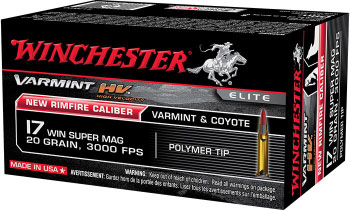
A few years back Winchester created a high-velocity 17-caliber rimfire cartridge, the .17 Winchester Super Magnum (aka .17 WSM). Winchester has offered .17 WSM ammo with a choice of three bullet types: 20gr plastic tip (Varmint HV), 25gr plastic tip (Varmint HE), and a 20gr JHP (Super-X). The 20-grain varieties boast a 3000 FPS muzzle velocity, earning honors as the fastest Rimfire ammo ever made.
.17 Winchester Super Mag Specifications
Symbol
Sub Brand
Bullet Weight
Muzzle Velocity
S17W20
Varmint HV
20-gr Plastic Tip
3,000 fps
S17W25
Varmint HE
25-gr Plastic Tip
2,600 fps
X17W20
Super-X
20-gr JHP
3,000 fps
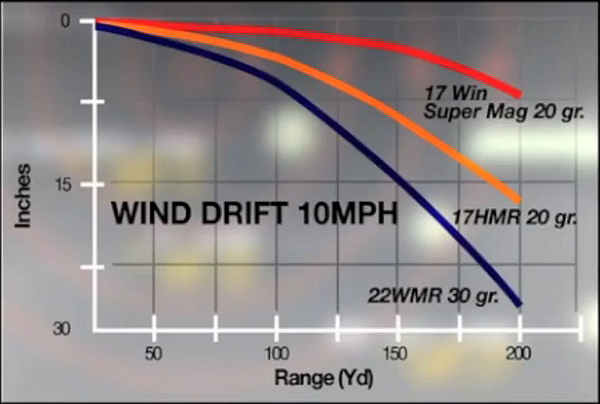
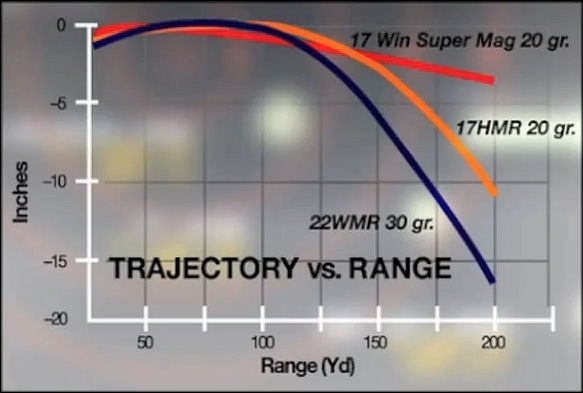
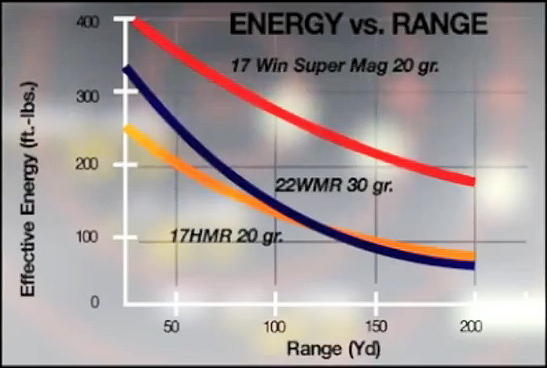
Winchester claims that all .17 WSM ammo types shoot much flatter than the .22 Win Mag and .17 HMR, while delivering 150 percent more energy than both. In addition, the .17 WSM “bucks the wind” better than any other rimfire ammo — exhibiting significant less horizontal drift at extended ranges.
Click Boxes to View Larger Charts
.17 WSM Ammunition is “Unobtanium” Right Now
Since its introduction, .17 WSM ammo has been sold by multiple companies including Browning, Federal (American Eagle), Hornady, and Winchester. Right now it is very hard to find ANY .17 WSM ammo. You have to look far and wide. On January 9, 2022 we checked with five major online vendors and found no .17 WSM ammunition in stock at Midsouth, MidwayUSA, Natchez, Precision Reloading, and Locked&Loaded. Every variety was listed as “Out of Stock” or “Temporarily Unavailable”. That’s discouraging. Hopefully more .17 WSM ammo will be appearing on dealer’s shelves in the months ahead.
The .375 EnABELR cartridge was developed to offer magazine-feeding capabilities with the highest-BC solid bullets available. The .375 EnABELR cartridge is slightly shorter than a .375 CheyTac so it allows the round to mag-feed. Applied Ballistics is currently using brass made by Peterson. The .375 EnABELR has achieved impressive velocities — 2990 FPS — with prototype Berger 379-grain solid bullets fired from a 1:7″-twist 30″ barrel. Applied Ballistics may also test 1:8″-twist and 1:9″-twist barrels. READ Bullet Testing Report.
The .375 EnABELR cartridge was designed to offer .375 CheyTac performance in a slightly shorter package: “The problem with the .375 CheyTac is that, when loaded with the highest performance .375 caliber bullets (379-407 gr Berger Solids, and the 400-425 grain Cutting Edge Lazers) the round is not magazine feed-able in any action that’s sized for CheyTac cartridges.
Here is Mitchell Fitzpatrick, shooting the 375 EnABELR in an ELR Competition.
“Knowing the .375 CheyTac produced substantial performance, and that it was just too long for magazine feeding, made it easy to converge on a design for the .375 EnABELR. We just had to make the case short enough to achieve magazine length with the desired bullets, while adding a little more diameter to keep the case capacity similar to the .375 CheyTac. The resulting basic shape is quite similar in proportions to the successful .338 Norma Magnum Cartridge which, interestingly, was selected as the cartridge for General Dynamics Lightweight Medium Machine Gun (LWMMG).”




 This is a detailed 20-minute video that shows the reloading process start to finish. The video shows how to clean the cases, deprime, and check them before loading.


 Tests Show Burn Rates Vary with Water Content
 If you read our lengthy article on
  The Brownell’s article explains: “Ultrasonic cleaning uses high-frequency sound waves (generally between 20-80 kHz) to remove a variety of contaminants from objects immersed in a liquid. The result of these high-frequency sound waves is a process called cavitation. These high frequency bursts of ultrasonic energy produce a three-dimensional wave of alternating positive and negative pressure areas as the sound wave passes through the solution. During negative pressure, microscopic cavitation bubbles form and will continue to grown until they reach resonant size. As the positive sound wave passes, the pressure rises rapidly and implodes these tiny bubbles. Before these minuscule bubbles implode they store a tremendous amount of energy. These bubbles can be as hot as 10,000 degrees and have as much as 50,000 lbs per square inch of pressure. This sounds alarming, but you have to remember that these bubbles are microscopic in nature and pose no harm to anything, unless you are a carbon /powder residue deposit on a cartridge case!
 When this cavitation bubble implodes near your brass case, it transforms the bubble into a jet about 1/10th of its size. This jet of energy can travel as fast as 400 km/hour. At 43 kHz, as is the frequency for our L & R HCS 200 ultrasonic cleaner, this is happening 43,000 times per second. This micro-burst of extreme energy is responsible for removing contaminants from the surface of your cartridge brass. Ultrasonic cleaning can reach into crevices and inaccessible areas and remove surface debris that can’t be cleaned by any other process.”
 Lyman’s popular




 – The “SHOT” in SHOT® Show stands for Shooting, Hunting, and Outdoor Trade.


 New 3000 FPS Rimfire Round