This is BIG news for the Extreme Long Range (ELR) game. Berger Bullets will offer a line of SOLID bullets in .375 caliber. You read that right — these will be the first-ever large diameter Berger projectiles manufactured from a solid copper alloy. Most conventional bullets feature a jacket over a metal core, typically lead alloy. These new Berger solids are lathe-turned from solid copper alloy — shaped with precision into perfect aerodynamic profiles. The new Berger ELR solids boast a long, VLD shape with ultra-high Ballistic Coefficients. The new .375 caliber Berger ELR solids will be offered in two bullet weights: 379 grains and 407 grains.
The prototype 400gr version of this solid bullet was extensively tested at 2400 yards (above). It remained supersonic at that distance, a remarkable 1.36 miles. Berger will now offer two production versions, 379gr and 407gr, based on this successful prototype, further optimized. Here is Berger’s official release:
Berger Bullets proudly announces the New Extreme Long Range (ELR) Match Solid Projectile line, beginning with .375 caliber 379 grain and 407 grain offerings.
Extreme Long-Range shooting to distances of two miles and beyond has taken the firearms community by storm. With much of its roots developed from elite military sniper and Special Forces rifle training, ELR enthusiasts are utilizing highly innovative rifle and ammunition technology to engage targets at distances previously unheard of. Berger has taken the lead pioneering ELR, similar to how it’s dominated all other long-range rifle disciplines.
Berger Bullets chief ballistician Bryan Litz states: “Our new ELR Solid Match Bullets provide both competition shooters and Mil/LE forces a long-range solid projectile like no other. Its highly-optimized VLD ogive design and lathe-turned solid copper construction provide a ballistic advantage that is unmatched by any conventional-style bullet.”
Berger .375 Caliber Bullet is a Winner
Berger’s .375 caliber solid bullet design has already been proven in competition. At the 2018 World Longest Shot Challenge (WLSC), Team Applied Ballistics used the prototype .375 Cal ELR solid with great results. The new .375 caliber monolithic Berger bullet designed by Bryan Litz was used by the first and second place finishers in the “above .338 caliber” class. The prototype .375 Cal solid performed great, and the ultra-high BC was confirmed. READ WLSC Story HERE.
Advanced Doppler Radar was used to confirm Ballistics Data for the new Berger .375-Caliber Solids:
The USAMU has published a “how-to” article about bullet sorting. While many of us may sort bullets by base-to-ogive length (and/or weight), the USAMU story explores the “how and why” of sorting bullets by Overall Length (OAL). Read the article highlights below, and make your own decision as to whether OAL sorting is worth the time and effort. Bryan Litz of Applied Ballistics says that sorting by OAL is not a bad idea, but base-to-ogive bullet sorting probably represents a better investment of your time.
Bullet Sorting by Overall Length
We’d like to share a specialized handloading technique which we’ve long found beneficial to our long-range (600 yards and beyond) accuracy. Sorting of bullets for extreme long range (LR) accuracy is not difficult to do, but some background in theory is needed.
Here at USAMU’s Handloading Shop, we only sort individual bullets for the most demanding Long-Range applications and important competitions. Only the most accurate rifles and shooters can fully exploit the benefits of this technique. The basic sorting process involves measuring the Overall Length (OAL) of the bullets, and grouping them in 0.001″ increments. It’s not unusual to find lots of match bullets that vary as much as 0.015″-0.020″ in length throughout the lot, although lots with much less variation are seen as well. Even in bullet lots with 0.015″ OAL variation, the bullet base-to-ogive length will show much less variation. Hence, our basic sort is by bullet OAL. One obvious benefit of sorting is easily seen in the attached photo. The few bullets that are VERY different from the average are culled out, reducing probable fliers.
How does one know what OAL increments to use when sorting? The answer is simple. As each lot of bullets is unique in its OAL distribution, it’s best to sample your bullet lot and see how they are distributed. In the attached photo, you will see a set of loading trays with a strip of masking tape running along the bottom. Each vertical row of holes is numbered in 0.001″ increments corresponding to the bullets’ OAL. A digital caliper makes this task much easier. As each bullet is measured, it is placed in the line of holes for its’ OAL, and gradually, a roughly bell-shaped curve begins to form.
Note that near the center, bullets are much more plentiful than near the edges. At the extreme edges, there are a few that differ markedly from the average, and these make great chronograph or sighting-in fodder. We recommend using a sample of 200 bullets from your lot, and 300 is even better. Some bullet lots are very consistent, with a tall, narrow band of highly-uniform bullets clustered together over just a few thousandths spread. Other lots will show a long, relatively flat curve (less uniform), and you may also see curves with 2 or more “spikes” separated by several 0.001″ OAL increments.
Bullet Sorting (OAL vs. Base-to-Ogive vs. Weight) — Litz Talks
I’m often asked what is a the best measure to sort bullets by, and the answer (to this and many other questions in ballistics) is: it depends.
Choosing to sort by overall length (OAL), base to ogive (BTO), bearing surface, weight, etc. can get overwhelming. Shooters typically look for something they can measure, which shows a variation and sort by that. It’s common for dimensional variations to correlate. For example, bullets which are longer in OAL are typically also shorter in BTO, and have longer noses. All these are symptoms of a bullet that was pushed a little further into the pointing die, or possibly had more than average lube while being swaged. So in essence, if you sort by BTO, you’re measuring one symptom which can indicate a pattern in the bullets shape.
So, the question still stands — what should you measure? You’ll always see more variation in OAL than BTO, so it’s easier to sort by OAL. But sometimes the bullet tips can be jagged and have small burrs which can be misleading. Measuring BTO will result in a lower spread, but is a more direct measure of bullet uniformity.
Then there’s the question of; how much variation is too much, or, how many bins should you sort into? Shooters who see 0.025” variation in BTO may choose to sort into 5 bins of 0.005”. But if you have only 0.005” variation in the box, you’ll still sort into 5 bins of 0.001”. What’s correct? You have to shoot to know. Live fire testing will answer more questions, and answer them more decisively than any amount of discussion on the subject. The test I recommend is to identify bullets on the extreme short end of the spectrum, and some on the extreme long end. Load at least 10 rounds of each, and take turns shooting 5-shot groups with them. If there is a difference, it will be evident. The results of the testing will answer your question of: should I sort based on X, Y, or Z?”
You can read more discussion on this and other similar subjects in the new Ballistics & Bullets board in the Accurateshooter.com forum. Here’s a link to the thread which is discussing bullet sorting: Bullet Sorting Thread
At the request of our readers, we provide select “Deals of the Week”. Every Monday morning we offer our Best Bargain selections. Here are some of the best deals on firearms, hardware, reloading components, optics, and shooting accessories. Be aware that sale prices are subject to change, and once clearance inventory is sold, it’s gone for good. You snooze you lose.
1. Brownells — Marlin 336Y .30-30 Lever Gun, $389.99 with Code
We think everyone should have a lever gun in their collection, and here’s an exceptional value — Marlin’s model 336Y for just $389.99. The 336Y (for “youth”) has a shorter stock that makes it suitable for younger hunters. The .30-30 Winchester chambering may seem dated, but plenty of bucks have been taken with the venerable .30-30 round. This lever-action rifle features 5-shot tubular magazine, side ejection, and Buckhorn sights. Just 34″ overall, with 16.25″ barrel and weighing only 6 pounds, Marlin’s 336Y can also be a very effective home defense arm. This gun lists for $399.99 with a $10.00 FFL handling fee. Use CODE M8Y to save $20 with FREE shipping, reducing your net cost to $389.99 delivered. NOTE: Brownells has other discount codes: Code LAV ($10 off $100 + free S/H) and Code NCS ($15 off $150 plus free S/H).
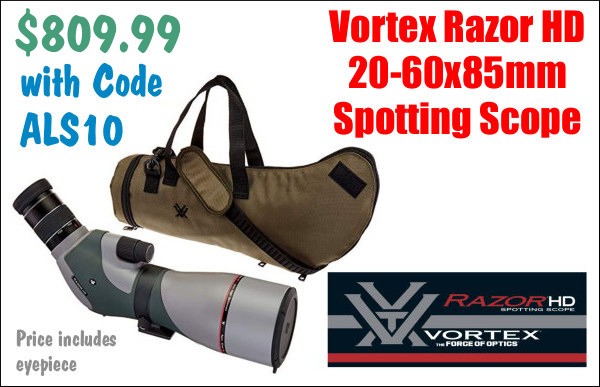
2. Al’s — Vortex Razor HD 20-60x85mm Spotting Scope, $809.99
AMAZING DEAL — save $390.00! Other vendors sell this very same Razor HD spotter for $1199.
Here’s a great deal on a high-quality spotting scope from a top optics maker. AL’s Sporting Goods has last year’s model Vortex Razor 20-60x85mm spotter for only $899.99, including eyepiece. This impressive HD-glass spotter sells elsewhere for $1200.00. But it gets better — use Code ALS10 for another 10% Off, bringing the final price down to $809.99. This is a very good spotter for the money and as Vortex will tell you, “buy a Razor now and we’ll always replace it with a Razor in the future”.
3. CCI and Federal .22 LR Rimfire Rebate — Save up to 20%
Get paid back when you buy Federal or CCI .22 LR rimfire ammunition. For every 5 boxes of Federal or CCI Rimfire Ammunition you buy, you will receive a rebate of the cost of one (1) box. The rebate amount will equal the purchase price of the LOWEST-cost box of the five. This rebate program is offered for most Federal and CCI .22 LR ammo. The maximum rebate is $200 per household. Print off your redemption form from links below. NOTE: This deal is good through the end of March, 3/31/2019. Purchase qualifying ammo from vendors including Bruno’s, Graf’s, Midsouth, Powder Valley, and Precision Reloading.
Everyone loves reactive targets, and hitting steel is particularly fun with a .22 LR rimfire — you can plink safely at relatively close range. Here is a nicely-designed, self-resetting target at a remarkably low price — just $19.88. Heck you could pay that much for a couple packs of paper targets, and this Range Ready .22 Popper target should last for years (just don’t shoot centerfire ammo at it!). These resetting popper targets are just plain fun to shoot. Plus they are cheap enough that your club could buy a half-dozen or more for use in rimfire tactical matches.
Note: You get one set of muffs (either gray or camo, NOT both) for $8.88 plus S/H.
Good muffs that offer 27 db Noise Reduction and won’t spoil your cheekweld — for under ten bucks? Can’t argue with that. Right now CDNN is offering a killer deal on Kryptek Sound Soldier 27 NRR muffs that sell elsewhere for around $24.00. Get these in either Highlander Camo or Typhon Grey for just $8.88. These passive muffs have low profile shells engineered to stay out of the way when shouldering your weapon. The ergonomic headband keeps the muffs aligned, in their proper position. Purchasers report the soft leatherette ear seals are surprisingly comfortable. These muffs provide a pretty high NRR considering the low profile design. And the price, just $8.88 on sale, is hard to beat! NOTE: Other vendors have a more conservative 25 NRR for these type of muffs. That’s still quite good.
6. Midsouth — Lyman Brass Smith Ideal Press, $69.99
Lyman’s new Ideal compact press works great as a second, lighter-duty press. It also is a good choice for loading at the range. It can easily be mounted to a range bench with C-clamps. With its cast-iron body, this C-Frame press is stronger than other presses in its price class. If you are looking for a secondary press for de-capping, bullet-seating and other tasks not requiring heavy leverage, this is an excellent choice. The Lyman Ideal costs just $69.99 at Midsouth Shooters Supply.
Still laying on the ground or using your wife’s yoga mat for shooting? For $24.99 now you can grab this NcStar Vism shooting mat and give your knees, belly, and elbows a break from the ground below. It opens wide and even has straps for pre-loading your bipod. This is a quality pad that helps put some space between you and your rocky position. When you’re done simply fold in the edges, roll it up and it takes up the same or less space as a sleeping bag. This is a good product tested and used by our staff.
8. Walmart — 46″ Workbench with LED light, $49.00
Are you looking for a solid workstation to reload or gunsmith on? This Walmart 46″ Workbench is solid, easy to assemble, and comes with an LED light, peg hooks, plus drawer liner. That’s a lot of bench for $49.00 especially considering how much you can store under it or in the drawer. The advantage of the LED light is that it won’t affect delicate electronic scales.
9. Amazon — Neiko Digital Calipers, $17.85
Even if you have a good set of calipers, you may want to get one of these Neiko 01407A Digital Calipers. The #1 best-selling digital caliper on Amazon.com, this Neiko tool features a large LCD Screen and measures up to 6.0 inches. With over 3800 customer reviews, this product has earned an overall rating of 4.4 out of 5 stars. It’s hard to go wrong for $17.85, even if you just use these as a spare set for measuring group sizes and case trim lengths.
Posted on June 21, 2017 by Sierra Bullets Written by Sierra Bullets Ballistic Technician Gary Prisendorf
I recently purchased 1,000 rounds of once-fired 5.56 LC brass that was fully processed and ready to load. The brass had been wet tumbled, using stainless steel pins and looked great inside and out, including the primer pockets.
I had always used a vibrating tumbler with either corn cob or walnut media and I always thought my brass looked pretty good until I saw what the wet tumbling and pin combination did.
Being the budget minded reloader that I am, I started looking for a cheap way to wet tumble my brass using stainless steel pins. Harbor Freight had recently opened a store nearby and I had received coupons in the mail, one of the coupons was 20% off any one item.
So I headed for the Harbor Freight store and after roaming around for 20 minutes or so I found a dual drum rotary rock tumbler for $55.00 and thought it would do just fine for what I was planning. The drums are rather small and only have a 3 pound maximum load limit each, but I figured that was big enough for around 150 .223 cases or maybe 300 9MM cases at a time.
I pulled the wrinkled up coupon out of my pocket, paid, and walked out with my new $47.00 brass cleaning machine. I didn’t have any stainless steel pins and couldn’t find any locally. At our local hardware store I picked up some brass plated ½” finishing brads that I thought might work until I could get some pins ordered.
I bought two small packages of the finishing brads (1.75 oz.), for $1.69 each then headed to my local Walmart to pick up some Dawn dish soap (.99 cents) and a bottle of Lemi Shine ($3.27). I had read online that is what a lot of people use for cleaning their brass.
I bought two small packages of the finishing brads (1.75 oz.), for $1.69 each then headed to my local Walmart to pick up some Dawn dish soap (.99 cents) and a bottle of Lemi Shine ($3.27). I had read online that is what a lot of people use for cleaning their brass.
When I got home, I started depriming .223 brass for my new toy, I mean brass tumbler. I deprimed 100 cases, put 50 in each drum, dropped a package of brads in each one, filled them ¾ of the way with water, gave each drum a small squirt of Dawn dish soap and a tablespoon of Lemi Shine. I sealed up the drums and fired up the tumbler.
After an hour and a half, I just couldn’t stand it any longer and had to see the results. The water was filthy but the cases were super clean, I couldn’t be happier. For a total investment of around $55.00, I can now get my cases looking almost new.
Here are the before and after pictures of my first run of brass:
I have since ordered two pounds of stainless steel pins, I put one pound in each drum. To be honest the brass really doesn’t look any better, but the pins don’t seem to get stuck inside of the cases near as bad as the brass-plated brads did.
Tip: Make sure to inspect your cases and look inside each case to ensure all of the brads/pins are removed.
Just lay the brass and brads/pins out on a towel and let them dry. Mine were dry after about 12 hours.
If you want your cases to look like new without breaking the bank, give it a try. You can’t clean 1000 at a time like the $200.00 tumbling machines that are made for specifically for brass, but this is a much cheaper alternative and the results speak for themselves. — Gary Prisendorf, Sierra Bullets
EDITOR: Actually you can get a machine for a whole lot less than $200.00! See the next paragraph.
Lyman Cylone Rotary Tumbler with Factory Rebate
Sierra’s Technician got his rotary tumbler and brass media for $55.00. For eighty bucks more that you can get a much better, higher-capacity system from Lyman. The Lyman Cyclone Rotary Tumbler features a large, polymer drum that holds up to 1000 .223 Rem cases. The kit includes media separation trays, plus five pounds of correct STAINLESS media. The Lyman Cyclone system costs $139.39 delivered from Amazon.
Yep you can get a complete Lyman Cyclone system WITH stainless media for under $140.00. To be honest we think that’s money well spent, compared to the “El Cheapo” Harbor Freight unit. The Lyman will run six times as many .223 Rem cases, be easier to operate, AND get the job done faster. We suspect long-term durability will be better with the Lyman tumbler as well.
Sometimes everything comes together — a great barrel, the right load, good bullets, and, of course, a gifted trigger-puller. Check out this target from Forum member Mike Ezell. That’s five (5) shots at 100 yards from Mike’s 30 Major benchrest rifle. When this group was shot a while back, Mike reported: “I fired a few groups in the great weather. No surprises — it did VERY well! My little wildcat, the 30 Major, has always been a shooter. That target was not a fluke — I shot a few groups today and Agg’d a high One.” Mike is a Kentucky gunsmith who builds his own rifles.
30 Major is Based on 6.5 Grendel
What’s a “30 Major” you ask? This is Mike’s own wildcat, a 6.5 Grendel necked up to .30 caliber. Mike writes: “The 30 Major is essentially a .070″-long 30 PPC. With the great 6.5 Grendel brass available from Lapua, all you need to do is neck-up and turn the necks to prep the brass.” Mike says it is very much like a 30 BR, but you just start with 6.5 Grendel brass instead of 6mmBR brass.
The cartridge has one major benefit — it utilizes a PPC-diameter bolt face. That makes it easy to convert your group-shooting 6 PPC to shoot score with .30-cal bullets. Mike explains: “If you have a PPC, to shoot score, all you have to do is chamber up a [.30 caliber] barrel and screw it on your PPC.”
From 7.62×39 Russian to 30 Major — Full Circle
Arms expert Neil Gibson has an interesting perspective on the lineage of the 30 Major. He reminds us that this wildcat has returned to its roots: “Start off with the 7.62×39 Russian [cartridge]. The Russians then modify it, necking it down to .223 for deer hunting. The U.S. benchrest guys then modify that, necking it up to 6mm and blowing the case out making the 6mm PPC. Someone takes that case, necks it out to 6.5 mm, making the 6.5 PPC. Alexander Arms takes that and makes the 6.5 Grendel. Then finally Mike Ezell takes the Grendel and necks it up to 30 caliber, making the 30 Major. From 30 caliber, back to 30 caliber. OK, the original uses .31 caliber bullets, but the bore is still .300. Talk about almost coming round full circle!”
7.62×39 Russian
v
.220 Russian
v
6mm PPC
v
6.5 PPC
v
6.5 Grendel
v
30 Major
The 7.62×39 Russian was the Grand-Daddy of the 30 Major…
Great Accuracy Restored after Solving Mystery Problem
To get his 30 Major rig shooting this well, Mike had to solve a mysterious problem that cropped up last year. Mike explains: “Two years running, I have finished in the top 15 in IBS points shooting [the 30 Major], but last year’s benchrest season was tough.” Mike was having some accuracy issues that defied explanation. But he figured it out: “The front action screw was bottoming out against the barrel extension – just barely. A simple fix brought the gun back to life. It’s a Stiller Viper Drop Port. The action is screwed and glued into the stock, so I was a bit surprised … especially after having checked for [that issue] while looking for the problem. I’m just glad to have found the trouble so I can begin to re-instill some confidence in the gun and myself, after last year.”
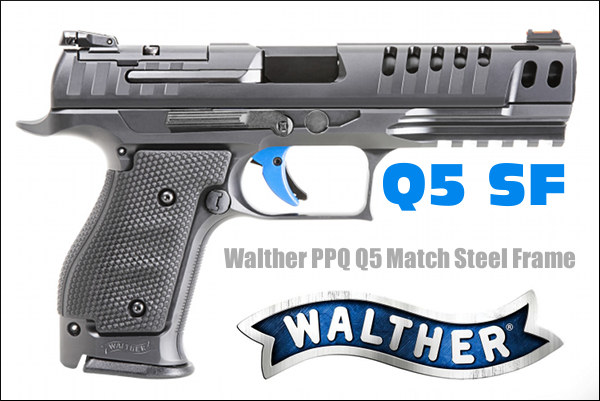
What was old is new again — metal pistol frames. Walther, which has focused on polymer-framed pistols in recent decades, has come out with a metal-framed version of its flagship Q5 model, chambered in 9x19mm (9mm Luger). We like this pistol, official called the Walther PPQ Q5 Match Steel Frame (SF). The metal frame adds mass to the gun, and lowers the center of gravity. That reduces muzzle flip somewhat, as you can see in the comparison video below. Ergonomics are very good, reports early tester Graham Baates, who tested the “optics ready” Q5 SF pistol with red dot sights.
It’s puzzling though — we wonder why Walther didn’t increase the slide weight too, by simply doing away with all the superfluous ports in the slide. That would increase gun weight, reduce muzzle flip (and perceived recoil) even more, and presumably the gun would be cheaper to produce. But maybe Walther thinks the slide cuts are a defining Q5 styling feature that needs to remain, like the Q5’s distinctive Blue Trigger. We guess styling trumps logic…
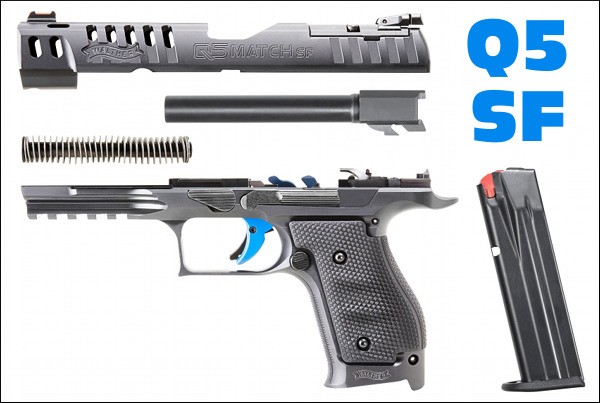
The Q5 Match SF features an optics ready slide that comes with a Trijicon RMR, Leupold Delta Point, and Docter Optics compatible mounting plate in addition to the standard competition iron sights. Along with a ported slide and the Carl Walther signature ergonomics, and a blue quick defense trigger, the Q5 SF is the flattest shooting model to date.
TECHNICAL DATA Walther PPQ Q5 Steel Frame Mod. 283001
All Steel Construction
Optics Mounting Plate
Extended Frame Rails
Ported Slide
Model: 2830001
Caliber: 9x19mm
Finish: Tenifer
Magazines Included: 3
Thousands of new products will be on display at SHOT Show 2019, the huge gun industry trade show held each January in Las Vegas. Some of the most highly-anticipated products have not yet been revealed, including new rifles, chassis systems, and state-of-the-art optics and LRFs. However, the SHOT Show Product Planner offers a “sneak peek” at 296 new-for-2019 products. More will come in the weeks ahead. For the time being, however, here are TEN interesting new products. Since most are completely new items, we haven’t been able to test them yet. Accordingly the product descriptions are provided by the manufacturers.
1. MDT Adjustable Core Competition (ACC) Chassis
The MDT ACC (Adjustable Core Competition) Chassis was designed around an integrated, modular weight system that allows shooters to fine tune chassis weight and balance point. A series of weights (up to 9 lbs. of steel) can be added to either the buttstock, interior fore-end or exterior fore-end. With action, barrel, scope and accessories, shooters can configure their rifles upwards of 25-30 lbs. in the ACC. The ACC weight management system allows shooters to rapidly adjust the feel and recoil characteristics of their rifle — at the range or during a competition. Other features include: full 17” ARCA/RRS fore-end, flared mag well, extended barricade stop, widened thumb shelf, and adjustable cheek riser/length of pull.
The new GRS Bifrost stock is made of glass fiber-reinforced composite material with tactile rubber surfaces on the grip and fore-end zones. The SpeedLock 2.0 system has LOP and Cheekpiece adjustment, like the original Speedlock system, but also includes a height-adjustable and cant-adjustable recoil pad. This allows for the perfect stock to shooter fit. Picatinny Rail mounts are located on the bottom and both sides of the fore-end, and the bottom of the buttstock. This allows easy attachment of lights, lasers, monopods, and bipods. Two Picatinny rails are included with the Bifrost stock, which retails for $730.00, as inletted for a variety of popular actions.
3. TargetVision Hawk WiFi Spotting Scope Camera
The Hawk Smart Scope is the next evolution of digiscoping. This TargetVision product turns any regular spotting scope into a smart scope in just minutes. Simply slide the Hawk over the spotting scope’s eyepiece, activate the signal, and open the Targetvision App on a smartphone or tablet. The Hawk camera connects to the mobile device via WiFi. Then you can view the camera feed (from the spotter) and unlock all of the App features. Basically this lets you position your spotting scope remotely and watch it through a digital screen. You’ll find more info (plus “how-to” videos) at TargetVisioncam.com. Price: $225.00 Pre-Order Special (Reg. $299.00)
4. Scope Comparison Platform from Rack’em Rack
This innovative Scope Comparer allows consumers to compare rifle scopes side-by-side. Simply slide the plate laterally to compare rifle scopes. This system ships with three different plates — One Plate for 30mm tube scopes, one for 1″ tube scopes, and a third (with rail) for red dot-type optics. An optional plate for 34mm-tube scopes is also available. All the sliding plates easily remove with the pull of a pin. Made by Rack ‘Em Racks, the novel Scope Comparer retails for $199.00.
5. Swagger Bipod — Telescoping Field Support for Hunters
The new Swagger bipod replaces a conventional bipod as well as shooting sticks. With a huge adjustment range from 6 3/4″ to 29″, the Swagger is ideal for western hunters, spot-and-stalk situations or anywhere long shots from the ground are likely. Notably, you can switch from a rigid attachment to a flexible attachment. And you can angle the legs forward, rearward, or to either side. When needed, remove the rubber footpads to use spiked feet for more “grip”. The Swagger’s telescoping legs fit inside a polymer housing mounted to your rifle’s forearm. Assembled weight is 23.6 oz, complete with Nitride finish springs/spring housing and reinforced bungee.
6. Vaultek Bio-Metric WiFi-Enabled Gun Safe
The WiFi-enabled RS500i is Vaultek’s newest and largest safe. Holding up to 4 four full-size rifles, this high-tech safe features full WiFi connectivity, providing quick access via oversized biometric scanner, Smart Key, backlit keypad, and standard backup keys. With WiFi connectivity you have complete remote management and live push notifications. With the all-new online dashboard or your smartphone you can securely monitor critical safe data from anywhere. A variety of modular accessories allow full customization of the LED-lit safe interior for magazines, handguns, and barrel mounts for rifles. Learn more at Vaulteksafe.com.
7. X Products Ambidextrous Side-Charging AR Upper
Here’s something we haven’t seen before — a side-charging AR upper that can be configured for either side — right port or left port. That’s clever. This exclusive X Products side-charging upper (SCU) boasts dual-side ejection ports with an off-side cover and interchangeable grip and off-hand slide handles, making it completely customizable to right- or left-handed shooter. The proprietary carrier introduces a new charging method that puts the force lower on the axis for smoother, more linear operation. The non-reciprocating charging handle can lock forward to prevent movement during operation. Price: $199.00
8. Breakthrough Carbon Fiber Cleaning Rods
Breakthrough® Clean Technologies’ carbon fiber cleaning rods offer a safe, effective way to clean the inside of your barrel. Featuring an ergonomic handle and two premium ball bearing sets, the rod can smoothly pass through the bore of your barrel without binding up under pressure. The lightweight yet durable carbon fiber construction is long lasting and won’t permanently bend or break under pressure. When kept free of debris, carbon fiber shafts are gentle on your barrel’s rifling. Available in the following sizes, all with standard 8-32 threads:
$29.95 5mm diameter, 12″ length .22 cal thru .50 cal handguns
$45.95 5mm diameter, 39″ length .22 cal thru .50 cal rifles
$49.95 7mm diameter, 45″ length .30 cal rifles thru 12 gauge shotguns
9. Kalispel Caseline Aluminum Gun Cases
Kalispel Caseline aluminum rifle cases are made in the USA from .080 marine-grade aluminum. They feature closed waterproof rivets, military spec hardware and stainless steel locking rod assemblies. These metal cases features Heliarc welds for strength and security, not fused joints like other lesser brands. Each case is hand-inspected for quality control. Kalispel has been making cases for many years, but there are new models for 2019. Powder coating and color options available. Prices range from $160 to $550.
10. RifleKuhl Barrel Cooling Unit from MagnetoSpeed
Tired of waiting for your rifle barrel to cool down? MagnetoSpeed’s new Riflekuhl barrel cooler, is designed to get barrel temperatures down to intended operating levels quickly. The turbocharger-inspired impeller produces great air flow in a small package. Powered by a single CR123A Lithium battery (included), ambient air is forced through the extendable nozzle down the bore of the rifle. This pushes air flow down the barrel where it’s needed to efficiently cool barrels, typically under 7 minutes. RifleKuhl doubles as a chamber flag and features an exclusive built-in air filter to prevent dust and dirt from being blown into your rifle. Price: $59.99
CREDIT EdLongRange for locating the 2019 New Product Showcase website.
Head over to Midsouth Shooters Supply for some of the best bargains of the year. Right now Midsouth is running a huge End of Year Clearance Sale. But this is no ordinary promotion. The deals get better every day until 2019 arrives. You see, every day, through December 31, 2017, prices drop. If you hold out ’til the end, you can score the best deals — up to 70% off the original price. However, if you wait too long, someone else may get the product(s) you want.
Nearly 1000 Clearance Items — Here are Examples:
Nearly 1000 items are on sale including tools, dies, reloading components, ammo, optics, holsters, gun books, and more. Above are just a few samples. You’ll find exceptional pricing on Norma brass and loaded ammo, Hornady loaded ammunition and reloading gear, Lapua Scenar bullets, and RCBS loading dies. Folks — you really should check out this Midsouth Sale. If you time it right you can get items at half-off or better. Here are just three of the Clearance Sale items … there are over 990 more at time of publication!
The U.S. Army Marksmanship Unit (USAMU) regulary publishes “how-to” articles on the USAMU Facebook page. One informative “Handloading Hump Day” article covers chronograph testing and statistical samples. We highly recommend you read this article, which offers some important tips that can benefit any hand-loader. Visit the USAMU Facebook page next Wednesday for the next installment.
Chronograph Testing — Set-Up, Sample Sizes, and Velocity Factors
Initial Chronograph Setup
A chronograph is an instrument designed to measure bullet velocity. Typically, the bullet casts a shadow as it passes over two electronic sensors placed a given distance apart. The first screen is the “start” screen, and it triggers an internal, high-speed counter. As the bullet passes the second, or “stop” screen, the counter is stopped. Then, appropriate math of time vs. distance traveled reveals the bullet’s velocity. Most home chronographs use either 2- or 4-foot spacing between sensors. Longer spacing can add some accuracy to the system, but with high-quality chronographs, 4-foot spacing is certainly adequate.
Laboratory chronographs usually have six feet or more between sensors. Depending upon the make and model of ones chronograph, it should come with instructions on how far the “start” screen should be placed from one’s muzzle. Other details include adequate light (indoors or outdoors), light diffusers over the sensors as needed, and protecting the start screen from blast and debris such as shotgun wads, etc. When assembling a sky-screen system, the spacing between sensors must be extremely accurate to allow correct velocity readings.
Statistics: Group Sizes, Distances and Sample Sizes
How many groups should we fire, and how many shots per group? These questions are matters of judgment, to a degree. First, to best assess how ones ammunition will perform in competition, it should be test-fired at the actual distance for which it will be used. [That means] 600-yard or 1000-yard ammo should be tested at 600 and 1000 yards, respectively, if possible. It is possible to work up very accurate ammunition at 100 or 200 yards that does not perform well as ranges increase. Sometimes, a change in powder type can correct this and produce a load that really shines at longer range.
The number of shots fired per group should be realistic for the course of fire. That is, if one will be firing 10-shot strings in competition then final accuracy testing, at least, should involve 10-shot strings. These will reflect the rifles’ true capability. Knowing this will help the shooter better decide in competition whether a shot requires a sight adjustment, or if it merely struck within the normal accuracy radius of his rifle.
How many groups are needed for a valid test? Here, much depends on the precision with which one can gather the accuracy data. If shooting from a machine rest in good weather conditions, two or three 10-shot groups at full distance may be very adequate. If it’s windy, the rifle or ammunition are marginal, or the shooter is not confident in his ability to consistently fire every shot accurately, then a few more groups may give a better picture of the rifle’s true average.
At the request of our readers, we provide select “Deals of the Week”. Every Monday morning we offer our Best Bargain selections. Here are some of the best deals on firearms, hardware, reloading components, optics, and shooting accessories. Be aware that sale prices are subject to change, and once clearance inventory is sold, it’s gone for good. You snooze you lose.
1. TargetVision — 10% Off All Camera Systems
As a holiday promo, you can now save 10% on all TargetVision Camera systems. We think these are some of the most sophisticated wireless target imaging systems you can buy. The popular LR-2 TargetCam System, with 1 Mile (ideal) range, normally $649.00, is now $584.10 with Promo Code SAVEME10. Or, for ultra-long-distance shooting, get the ELR model with 2-Mile (ideal) range. With the 10% off Code, the ELR is $809.10, reduced from $899.00. We like the Target Vision systems — the hardware is top quality, plus the software is reliable and will display your shots on your favorite mobile device. NOTE: Some items are out-of-stock but these can be back-ordered.
2. RCBS — 2018 Buy Green Get Green Rebate Program
Act quickly — RCBS’s best rebate program of 2018 runs out at 11:59 pm on December 31st. The Holiday 2018 Buy Green Get Green promo is simple — buy ANY RCBS product over $49.99 and you qualify. There’s no restricted list of “qualifying” products. The more you spend, the more you get back — up to $175.00 total. On a $300 purchase you can get a big $100.00 rebate. And on a $500 purchase you can get a whopping $175.00 rebate — that equates to HUGE 35% net cost reduction, lowering the $500.00 item to just $325.00. The $175.00 you save can get you a very nice digital scale/dispenser, 4-6 boxes of bullets, or some nice, new dies. Or just use the money saved for other household holiday expenses.
If you are considering purchasing a single-stage press, electronic powder dispenser, progressive press, or a full reloading kit, save big with this promotion. It is good for purchases made through the end of the year, December 31, 2017. Submit RCBS Rebate Forms HERE.
3. Whidden — 10% Off Click-Adjust Sizing Dies and Lock Rings
We love Whidden Gunworks’ Click-Adjustable Dies and die Lock Rings. The adjustability makes it easy to make precise changes in shoulder “bump”. Each click provides true 1 thousandths adjustment and has .100’’ total available travel. Those loading for rifles with different headspace can easily optimize the “bump” for each rifle. And the new, patent-pending Universal Click-Adjustable Lock Ring can turn your current sizing die into a Click-Adjustable die. The ring works with any brand of 7/8 OD sizing die with standard thread pitch — e.g. Whidden, RCBS, Redding, Lee, and Forster. Now through the end of December 2018, you can save 10% on Whidden Click-Adjustable Sizing Dies and Click-Adjustable Lock Rings. Use CODE CLICKSALE to save 10%. Act soon — this sale ends at 11:59 pm EST on December 25, 2018.
4. Gander Outdoors — MEGA SALE with 25% OFF
This is an incredible SALE, good through Christmas Day at 11:59 pm. Get 25% OFF purchases at Gander Outdoors, with no minimums. This applies to everything online, except: firearms, ammo, generators, marine electronics, trolling motors, augers, and certain clearance items. But that still leaves scopes, gun cases, hunting accessories, outdoor gear, reloading tools, and countless other items for shooters and outdoorsmen. Don’t dawdle, this 25% OFF Sale ends at 11:59 pm ET on December 25, 2018.
5. Midsouth — New Lyman Reloading Presses on Sale
Midsouth Shooters Supply is running a big sale right on Lyman’s impressive new Brass Smith line of reloading presses. There are three models, each offering great performance and value for its class. You can save quite a bit of cash with this Midsouth Lyman Press sale. If you haven’t tried orange yet, we think you’ll be impressed. The little C-Frame is a steal at $69.99. The sturdy O-Frame Singles stage press is $154.99. And if you’re looking for a Turret press, the new 8-station Lyman Turret press ($192.99 on sale) is very impressive — with more stations than the competition, and enhanced strength/rigidity.
6. Grafs.com — Magnetospeed Sporter $178.99
Good deal on a great chrono. Priced at just $178.99 at Grafs.com, the Magnetospeed Sporter model costs less than half as much as Magnetospeed’s V3 models. This chronograph attaches directly to your barrel so you don’t have to go downrange to position tripods and set up skyscreens. For most people the Sporter Model contains all the features they need. Using Magnetospeed’s XFR adapter (sold separately), data can be transferred easily from the display module to your mobile device. This is also available from Amazon for $183.99 with free shipping. READ Magnetospeed Sporter Review.
7. ARMorALLY.com — Nosler RDF Bullets, $23-$31 per 100
Nosler’s line of RDF (Reduced Drag Factor) bullets have high BCs for their weight. Precision shooters are reporting outstanding accuracy. Given their high performance and consistency, RDF bullets represent a superior value. At ARMorAlly you can get Nosler RDFs for under $26 per 100 for popular 6mm sizes. That’s up to $25 less per box than some other premium brands. And the .22-Caliber RDFs are even cheaper. ARMorAlly also has great pricing on Nosler Ballistic Tip, Custom Competition, Accubond, ABLR, and Lead Free bullets. All Nosler Bullets HERE.
8. CDNN — Ruger LCP .380 ACP, Just $169.99
If your carry gun is too big and bulky, you probably won’t carry it, which sort of defeats the whole purpose. The Ruger LCP is light (9.6 ounces) and compact (5.16″ OAL), so you’re more likely to carry it regularly. The little LCP is small enough to fit in a pocket. The .380 ACP cartridge is not as powerful as a 9x19mm or 40 S&W to be sure, but when your life is on the line, a small gun is certainly better than no gun. For those looking for a very light-weight, easy-to-conceal handgun, this little Ruger is a solid choice. Owner reviews have been positive and the $169.99 price is as cheap as you’ll ever find for a major manufacturer’s pistol. If you can live with the bright yellow frame, this is a steal.
A clean gun is a happy gun and since patches are the core of any cleaning regimen why not grab some great patches for a great price? Amazon sells 1000-count packs of Boosteady Professional Cleaning Patches starting at just $8.99 for 1″ square patches — a great bargain for 1000. Now you won’t feel so bad running a few extra patches every time you clean just make sure you got the last bit of crud out. Boosteady patches are very highly rated by purchasers and come in 1″ square ($8.99), 2″ square ($11.99), and 2.5″ square ($13.99) sizes, inside a convenient box.
10. Amazon — Two Rolls of 3″ Neon Target Stickers, $12.99
We like these bright, Neon EasyShot 3″ target stickers. They are big enough to see easily at 600 yards, giving you a 1/2 MOA target center at that distance. For $12.99 at Amazon.com, you get 250 3″-diameter self-adhesive centers (125 targets per roll) that stick to almost any surface The high-contrast fluorescent red/orange color provides an excellent HI-VIZ aiming point, along with good contrast for bullet holes that fall within the 3″ circle. To help line up your reticle cross-hairs, the target centers feature black markers at 3, 6, 9, and 12 0’Clock. NOTE: These stickers qualify for FREE Shipping.