What we now know as the “6mm Remington” was originally called the .244 Remington. The cartridge was renamed because it was not a commercial success initially, being eclipsed by the .243 Winchester. The .244 Remington and the 6mm Remington are identical — only the name was changed. Why was the .244 Remington an “also-ran” to the .243 Win? Sierra Bullets Ballistics Technician Paul Box provides some answers…
The year was 1955. A time of carhops, drive-in movies, and Buffalo Bob. It was also the year that Winchester introduced the .243 Win and Remington counter-punched with the .244 Remington (now more commonly known as the 6mm Remington). The .243 Win was based off the time-proven .308 Win case while Remington chose the old war horse, the 7×57.
We’ve all read countless times how Winchester chose the 1:10″ twist, while Remington adopted the 1:12″ twist for their .244 Rem rifles. The first complaint in the gun magazines of that era was how the faster twist Winchester could handle 100 grain bullets, while Remington’s [12-twist factory rifles were supposedly limited to 90 grain bullets].
The first complaint I remember reading was that the 100-grainer was better suited for deer-sized game and the 1:12″-twist wouldn’t stabilize bullets in this weight range. Now, let’s look at this a little closer. Anybody that thinks a 100-grainer is a deer bullet and a 95-grainer isn’t, has been drinking too much Kool-aid. In all honesty, it’s all about bullet construction and Remington had constructed the [90s] with light game in mind. In other words, Remington got it right, but due to a lack of knowledge at the time on both bullet construction and stability, the .244 never gained the popularity it deserved. At that time, Sierra had the 100gr SMP and Hornady offered a 100gr RN that would both stabilize in the slower 1-12″ twist. The .244 Remington provides another classic example of how the popularity of a cartridge suffered due to a lack of knowledge.
.244 Rem vs. .243 Win — What the Experts Say
Respected gun writer Chuck Hawks says the .244 Remington deserved greater acceptance: “The superb 6mm Remington started life in 1955, the same year as the .243 Winchester. It was originally named the .244 Remington. Although the 6mm lost the popularity contest to the .243, it is one of my favorite rifle cartridges, and much appreciated by reloaders generally. The .244 Rem and 6mm Rem cartridges are completely interchangeable, and anyone with a .244 Rem rifle can shoot [6mm Rem] ammunition in complete safety (or vice-versa). Remington .244 rifles made from 1958 on can stabilize all 6mm bullets, while those made in 1955 through 1957 are limited to loads using spitzer bullets not heavier than 90 grains for best accuracy.”
Nathan Foster, author of The Practical Guide to Long Range Hunting Cartridges, states: “In 1963 Remington attempted to regain ground by releasing .244 rifles with a new 1:9″ twist to handle heavier bullets. The cartridge was renamed the 6mm Remington and new ammunition was loaded giving the hunter the choice of either an 80gr bullet for varmints or a 100gr bullet for deer. In comparison to the .243 Win, factory loads for the .244/6mm Remington are slightly more powerful while hand loads increase this margin further.”
Was the .244 Remington Actually Better than the .243 Winchester?
The .244 Remington (aka “6mm Remington”) has a velocity advantage over the .243 Winchester due to a slightly larger case capacity. The longer case neck of the .244 Remington is considered desirable by handloaders. We like the added capacity and long neck of the original .244 Remington. As renamed the “6mm Remington”, the cartridge HAS developed a following, particularly with varmint hunters looking for a high-velocity 6mm option. But it never achieved the success of the .243 Winchester for many reasons. As a member of the .308 family of cartridges, the .243 Winchester has certain obvious advantages. First, you can simply neck down .308 Win brass, which was available at low cost from many sources. Moreover, a .308 Win or 7mm-08 full-length sizing die could be used for body sizing. Still the .244 Remington (6mm Remington) presents an interesting “what if?” story…
For many Americans, real incomes have stayed flat in recent years, while inflation increased the cost of living very significantly during the Biden presidency. The 2025 quarterly inflation rates are lower, yes, but prices are still rising. Accordingly, it’s important to save money whenever possible. Prices are going up, but wages aren’t following (for most of us). Here are six ways shooters can save money on gear purchases and other shooting-related expenses.
1. Watch for Our Deals of the Week. Every Monday, in our Daily Bulletin, AccurateShooter.com offers some of the best deals to be found. We search the web to find great deals on ammo, reloading components, optics, tools, firearms, gun safes, electronics and more. It’s not unusual to find savings of 20-35% through our Deals of the Week. And many of our vendors are now offering special deals just for AccurateShooter.com readers.
2. Check Out the Forum Classifieds. There are great deals to be found every day in the AccurateShooter Shooters’ Forum. The latest deals are displayed in the right column of every Forum page. To see all the listings, browse through the Forum MarketPlace section which has four main categories:
Guns, Actions, Stocks, & Barrels
Tools, Dies, Rests, Reloading Components & Misc
Scopes, Optics, Sights, Rings, Bases Etc.
Commercial Sales by Paid Sponsors
3. Share a Ride to Matches. Fuel prices are on the rise — Regular-grade gasoline is over $4.90 per gallon in California now and around $3.20+ per gallon nationwide. With many shooters living 30-100 miles from the nearest range, fuel remains a big part of a shooter’s hobby budget. We’d say 90% of shooters drive solo to matches, often in large, gas-guzzling trucks. If you drive 200 miles round-trip to attend a match in a 20-mpg vehicle, you’ll burn over $32.00 worth of gasoline on your trip. That adds up. By simply sharing the ride with one fellow shooter you cut your fuel expenditures in half. And, if you alternate vehicles with a buddy from one match to the next, you save on vehicle wear and tear. At $0.70/mile (overall operating costs) consider the savings.
4. Use Discount Codes to Save. It’s always smart to check for discount codes before you buy. In the Daily Bulletin, we feature “Deals of the Week” every Monday morning, and we provide discount Coupon Codes when available. These can reduce the price substantially or lower shipping costs. Search codes for Brownells, Creedmoor Sports, EuroOptic, Graf’s, Midsouth, Powder Valley, Sportsman’s Warehouse, KYGUNCO, MidwayUSA, and Precision Reloading. Check your email also — some discount codes are only announced in email newsletters. If you can’t find a Coupon Code for your preferred vendor, visit Gun.deals and/or RetailMeNot.com. Both those sites list current coupon codes, and RetailMeNot.com covers thousands of vendors.
5. Shop for “Demo” Optics. Modern high-quality optics can easily cost $2000.00 or more, often exceeding the value of the rifle on which they are mounted. However, you can often save 20-30% by purchasing demo optics. These are normally display units used at trade shows. They may have slight ringmarks, but otherwise they are “as new”, having never been carried in the field or used on a rifle that has fired live ammo. When purchasing demo scopes, you should always ask about the warranty before making the sale. However, most demo scopes from name-brand manufacturers come with full factory warranties. EuroOptic.com and Bruno Shooters Supply are two respected vendors that offer a good selection of demo optics.
6. Train with Rimfire Rifles. Good match-grade centerfire, hand-loaded ammo, counting premium bullets, powder, primers, and brass (figuring 10X loads), can now exceed $1.50 per round. And if your $600 (as chambered and fitted) competition barrel is toast after 1500 rounds, add $0.40 for barrel deprecation per shot. So you’re approaching two bucks a round total! By contrast, you can get quite good .22 LR target ammo for $0.16 per round. Good rimfire barrels last a long, long time, so you don’t have to be concerned about wearing out your barrel quickly. A quality rimfire barrel can retain its accuracy for 7,000 rounds or more. If you run the ballistics, a .22 LR round at 100 yards can emulate the wind drift experienced by a centerfire cartridge at long range. This allows for effective cross-training with much less expensive ammo.
When neck-turning cases, it’s a good idea to extend the cut slightly below the neck-shoulder junction. This helps keep neck tension more uniform after repeated firings, by preventing a build-up of brass where the neck meets the shoulder. One of our Forum members, Craig from Ireland, a self-declared “neck-turning novice”, was having some problems turning brass for his 20 Tactical cases. He was correctly attempting to continue the cut slightly past the neck-shoulder junction, but he was concerned that brass was being removed too far down the shoulder.
Craig writes: “Everywhere I have read about neck turning, [it says] you need to cut slightly into the neck/shoulder junction to stop doughnutting. I completely understand this but I cant seem to get my neck-turning tool set-up to just touch the neck/shoulder junction. It either just doesn’t touch [the shoulder] or cuts nearly the whole shoulder and that just looks very messy. No matter how I adjust the mandrel to set how far down the neck it cuts, it either doesn’t touch it or it cuts far too much. I think it may relate to the bevel on the cutter in my neck-turning tool…”
Looking at Craig’s pictures, we’d agree that he didn’t need to cut so far down into the shoulder. There is a simple solution for this situation. Craig is using a neck-turning tool with a rather shallow cutter bevel angle. This 20-degree angle is set up as “universal geometry” that will work with any shoulder angle. Unfortunately, as you work the cutter down the neck, a shallow angled-cutter tip such as this will remove brass fairly far down. You only want to extend the cut about 1/32 of an inch past the neck-shoulder junction. This is enough to eliminate brass build-up at the base of the neck that can cause doughnuts to form.
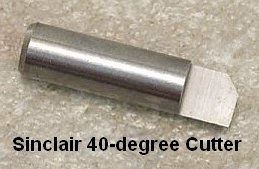
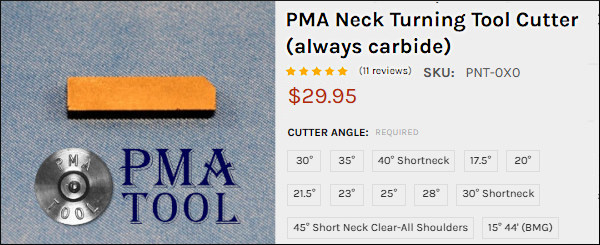
The answer here is simply to use a cutter tip with a wider angle — 30 to 40 degrees. The cutter for the K&M neck-turning tool (above) has a shorter bevel that better matches a 30° shoulder. There is also a 40° tip available. PMA Tool and 21st Century Shooting also offer carbide cutters with a variety of bevel angles to exactly match your case shoulder angle*. WalkerTexasRanger reports: “I went to a 40-degree cutter head just to address this same issue, and I have been much happier with the results. The 40-degree heads are available from Sinclair Int’l for $15 or so.” Forum Member CBonner concurs: “I had the same problem with my 7WSM… The 40-degree cutter was the answer.” Below is Sinclair’s 40° Cutter for its NT-series neck-turning tools. Item NT3140, this 40° Cutter sells for $14.99. For the same price, Sinclair also sells the conventional 30° Cutter, item NT3100.
Al Nyhus has another clever solution: “The best way I’ve found to get around this problem is to get an extra shell holder and face it off .020-.025 and then run the cases into the sizing die. This will push the shoulder back .020-.025. Then you neck turn down to the ‘new’ neck/shoulder junction and simply stop there. Fireforming the cases by seating the bullets hard into the lands will blow the shoulder forward and the extra neck length you turned by having the shoulder set back will now be blended perfectly into the shoulder. The results are a case that perfectly fits the chamber and zero donuts.”
Want to improve your understanding of Ballistics, Bullet Design, Bullet Pointing, and other shooting-related tech topics? Well here’s a treasure trove of gun expertise. Applied Ballistics offers dozens of FREE tech articles on its website. Curious about Coriolis? — You’ll find answers. Want to understand the difference between G1 and G7 BC? — There’s an article about that.
“Doc” Beech, technical support specialist at Applied Ballistics says these articles can help shooters working with ballistics programs: “One of the biggest issues I have seen is the misunderstanding… about a bullet’s ballistic coefficient (BC) and what it really means. Several papers on ballistic coefficient are available for shooters to review on the website.”
Credit Shooting Sports USA Editor John Parker for finding this great resource. John writes: “Our friends at Applied Ballistics have a real gold mine of articles on the science of accurate shooting on their website. This is a fantastic source for precision shooting information[.] Topics presented are wide-ranging — from ballistic coefficients to bullet analysis.”
Here are six (6) of our favorite Applied Ballistics articles, available for FREE to read online. There are dozens more, all available on the Applied Ballistics Education Webpage. After Clicking link, select Plus (+) Symbol for “White Papers”, then find the article(s) you want in the list. For each selection, then click “Download” in the right column. This will send a PDF version to your device.
At the request of our readers, we provide select “Deals of the Week”. Every Sunday afternoon or Monday morning we offer our Best Bargain selections. Here are some of the best deals on firearms, hardware, reloading components, optics, and shooting accessories. Be aware that sale prices are subject to change, and once clearance inventory is sold, it’s gone for good. You snooze you lose.
NOTE: All listed products are for sale to persons 18 years of age or older. No products are intended for use by minors.
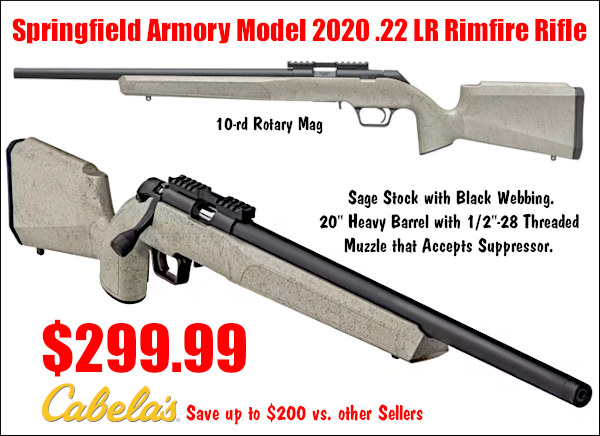
1. Cabela’s — Springfield Model 2020 .22 LR Rifle, $299.99
⏺️ » Great price on a versatile bolt-action rimfire rifle
Want an inexpensive rimfire rifle for plinking, steel matches, or NRL22 competition? Consider the Springfield Model 2020 .22LR Target rifle, now just $299.99 at Cabela’s. This rifle sells for up to $499.99 elsewhere, so you can save $200 with this deal. This rifle has a sage color stock with black webbing. This model features a 20″, heavy profile, straight taper barrel with a 1/2″ x 28 threaded muzzle. It is chambered in .22 LR and comes with a 10-round rotary magazine. The rifle is designed for accuracy, with a free-floated barrel and a Rem 700-style adjustable trigger.
2. EuroOptic — Bushnell Optics Closeout Sale
⏺️ » HUGE discounts on Bushnell scopes, rangefinders, binoculars
If you’re building a new rifle or planning a hunt, check out EuroOptic’s current Bushnell Closeout Sale. From red dots to scopes to rangefinders there’s something for everyone. Most sale items are discounted at least 25% with some discounted over 50%. Along with individual scopes, there are some binoculars/rangefinder combo kits now 46% off — a good option for hunters.
3. Graf & Sons — Rimfire Ammo Sale
⏺️ » Very good .22 LR, 22 WMR, 17 Mach2, and 17 HMR ammo prices
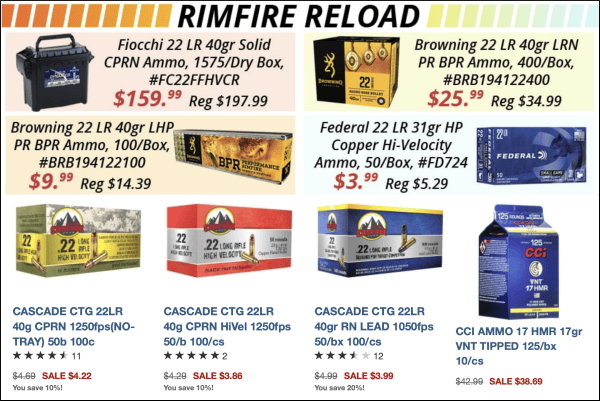
With low cost ammo and low recoil, shooting rimfire rifles is fun and popular. Modern rimfire ammo can also be very effective on varmints. Right now Graf’s is running a big Rimfire Ammo Sale. You’ll find the full selection of rimfire ammo types, both .17 and .22 calibers, on sale. Discounted brands include Aguila, Armscor, Browning, Cascade, CCI, and Federal — with deals from 50rd boxes to 1000rd packs.
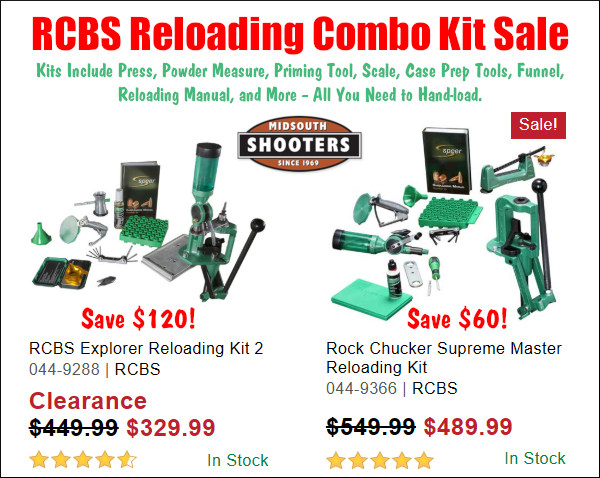
4. Midsouth — RCBS Reloading Combo Kit Sale
⏺️ » Save over $100 on popular RCBS press/gear combo kits
If you are getting started in reloading, consider the RCBS Explorer Reloading Kit 2 now $120 off the regular price at Midsouth. If you prefer a bigger press and want a manual scale, check out the RCBS Rock Chucker Supreme Master Reloading Kit now $60.00 off. Both kits include nearly all the essential equipment you need except dies and shell holders. Both systems represent very good values.
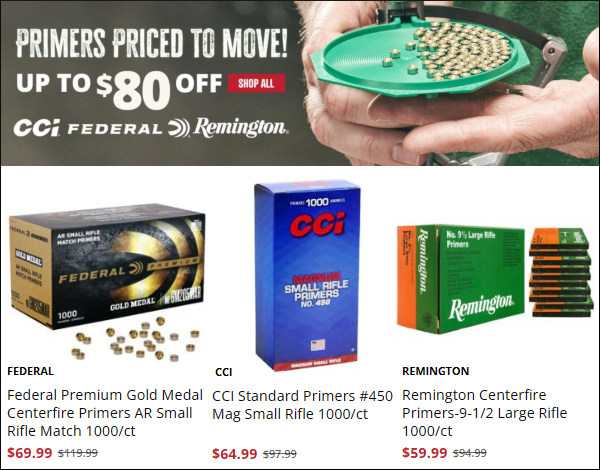
5. Natchez — CCI, Federal, Remington Primer Sale, Save 20-40%
⏺️ » Good opportunity — major discounts on rifle and pistol primers
Natchez is running a major primer sale with big discounts. You can save $25 to $60 per 1000 on CCI, Federal, and Remington, and Federal pistol and rifle primers. With this summer Primer Sale expect to save 20-40% on rifle, pistol, and shotgun primers. And yes, popular CCI BR2 and CCI 450 primers are in stock.
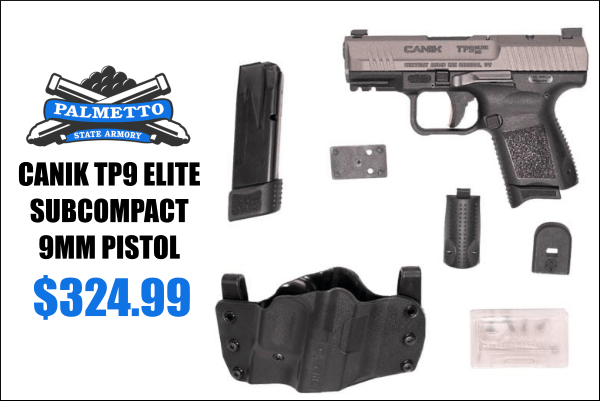
6. Palmetto SA — CANIK TP9 Elite 9mm Pistol, $324.99
⏺️ » Great deal on handy 9mm carry pistol with holster and REBATE
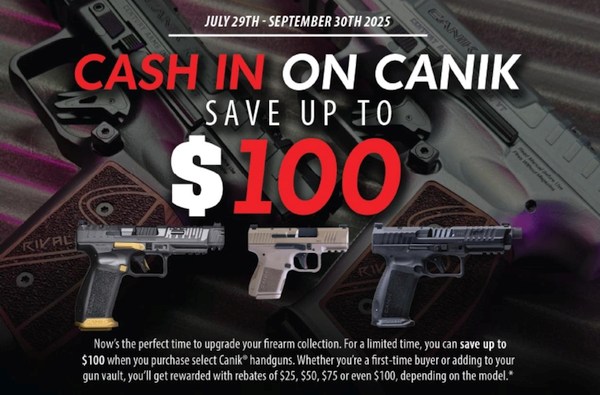
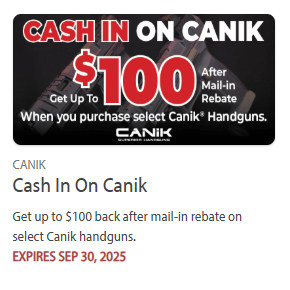
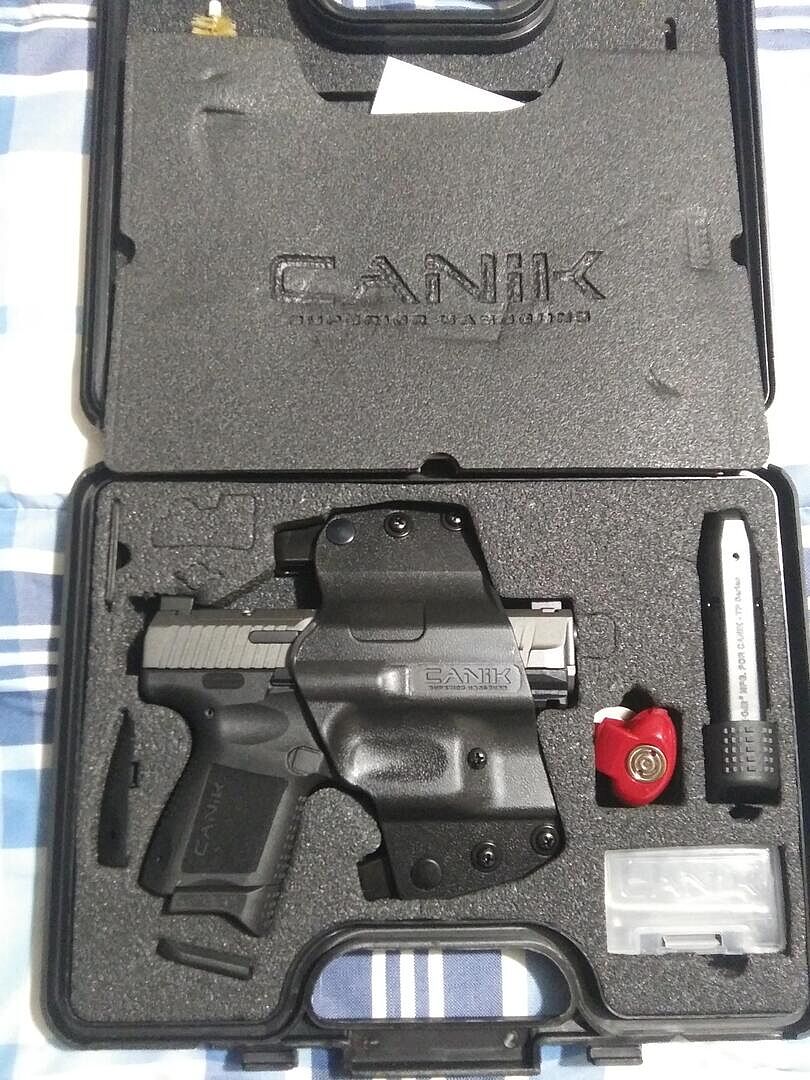
Here’s a good compact carry pistol at a great price. This CANIK TP9 Elite subcompact 9mm pistol boasts good ergonomics, a good trigger, an optics-ready slide, and a 12+1 magazine. Owner reviews have been very positive. The TP9 Elite ships with two interchangeable back straps for better hand fit plus a factory Kydex-style holster. With a tungsten cerakote slide finish this pistol is built to last. NOTE: Now through September 30, 2025, this pistol also qualifies for a CANIK Manufacturer’s Rebate, making this an even better deal.
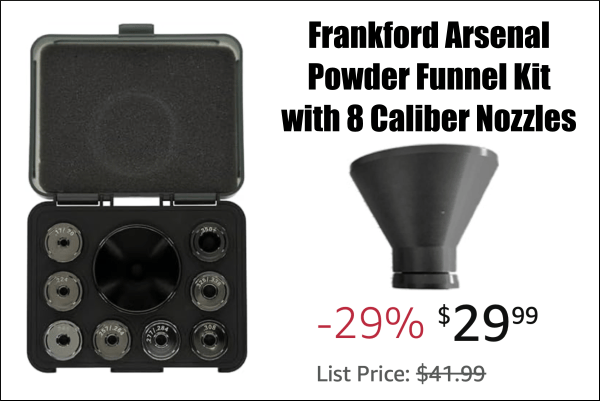
7. Amazon — Frankford Arsenal Powder Funnel Kit, $29.99
⏺️ » Good kit with 8 nozzles that fit brass necks precisely
This is a very worthwhile reloading tool. The Frankford Arsenal Aluminum Powder Funnel Kit (#ad) includes 8 interchangeable nozzles, eliminating the need for caliber-specific funnels. Each nozzle fits over the neck of your brass, providing a smooth surface for powder to flow while avoiding spills. Overall, this funnel kit allows you to dispense powder into your brass with greater efficiency and uniformity.
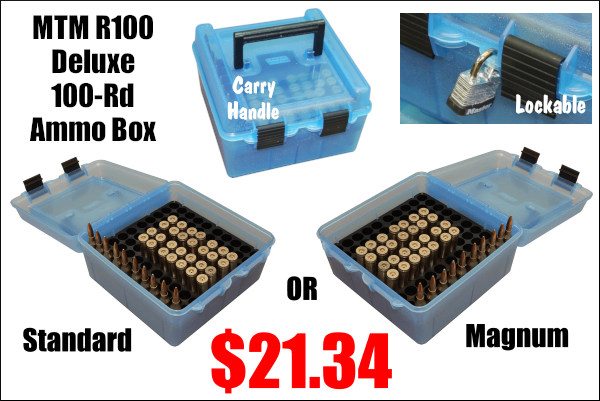
8. Amazon — MTM Large 100rd Ammo Box with Carry Handle
⏺️ » Secure, lockable 100rd ammo carrier with handle
Do you wish you could keep all 100 rounds of brass together in one box? We recommend the MTM R-100 series ammo case (#ad). Chose the version for standard size ammo or a model for magnum size cases. This is offered in rugged polypropylene in semi-translucent blue, or medium green. These stackable cases boast a large, strong handle plus a flange for locking. This is a great choice for shooting matches with multiple relays, or extended varmint adventures.
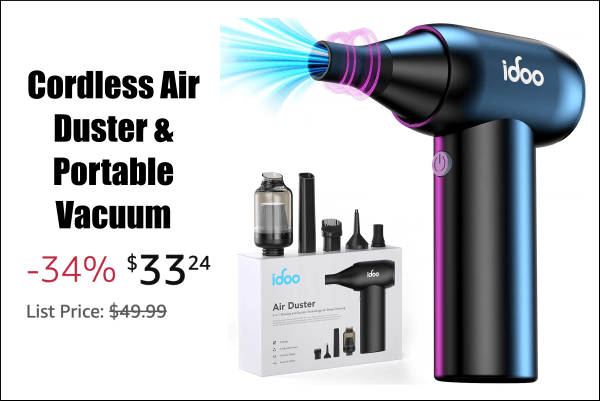
9. Amazon — Cordless Blower and Vacuum, $33.24
⏺️ » Handy, compact dual-function tool for reloading room
Made of aluminum alloy, the iDOO Cordless Duster & Vacuum (#ad) is a handy tool for your reloading room. This dual-function device works BOTH as a vacuum machine and as a fan, blowing away dust. With its powerful brushless motor, the iDOO compressed air duster can blow away dust and or use it as a vacuum to clean particles and case trimmer metal shavings.
10. Amazon — Portable Charger w/ Built-in Cables
⏺️ » Very handy battery pack with multiple cable types
With modern battery-powered shooting accessories needing power at the range, it’s wise to have a good charging source. We like this 20000mAh Fast Charging 22.5W Power Bank (#ad). This portable charger boasts 5 outputs and comes with multiple charging cables for various port types. This unit can charge up to 5 devices simultaneously ensuring your chronographs and other electronic gear are always ready to go.
As an Amazon affiliate, this site can earn revenues through sales commissions.
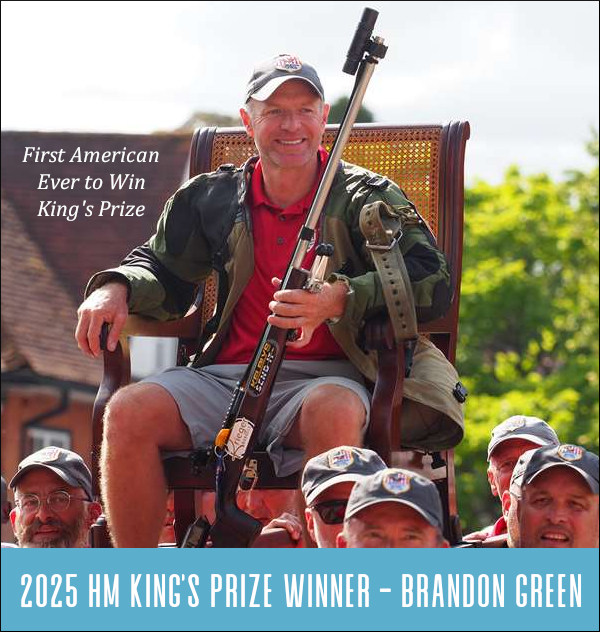
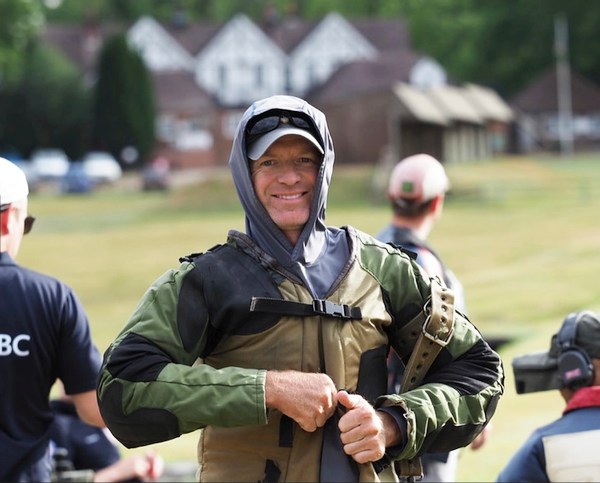
Brandon Green has established himself as one of the greatest marksmen on the planet with an historic victory at the Bisley Range in the United Kingdom last week. Brandon, U.S. Army veteran and past USAMU shooter, won the HM King’s Prize match, the first American in history to do so. Shooting Sports USA declared that: “Nothing comes close to the prestige of the King’s Prize at Bisley — and this year, it has a new champion: Brandon Green, the first American ever to win the event in its 156-year history.”
Brandon Green, a multi-time U.S. National Highpower and Long Range Champion, shows his form at Bisley.
Brandon won the King’s Prize on “V-Count”, the equivalent of “X-Count” in the USA. It was a remarkable come-from-behind victory. With 100 shooters in the final day of the King’s match, Brandon worked his way from 30th to First Place, finishing (as champion) with 299-41V. In second was Britain’s P.D. Sykes who finished with 299-37V. Sykes only dropped one point in this entire match and that was on his last and final shot! That one lost point at 1000 yards gave Brandon the win.
Shooting Sports USA explains: “It all came down to the final shot from Sykes, who had a chance to seal the win with a perfect score. But, after he fired a four just outside the five-ring, it meant the title would belong to Green.” READ Shooting Sports USA King’s Match Report.
Shooting Sports USA reports: “The format of the King’s Prize ensures no lead is safe: scores from the Second Stage carry over into the Final, while the First Stage is dropped. A dozen shooters entered the final round with a perfect 150, but high winds and mounting pressure began to thin the field almost immediately. Green methodically climbed the leaderboard — 13th by the halfway point at 900 yards, then fourth after a flawless 75-11V string. By 1000 yards, only one shooter, Britain’s P.D. Sykes, remained clean. The stage was set for a dramatic finish — and Green didn’t flinch. The final string of fire saw Green shoot another perfect 75-10V at 1,000 yards — something only two competitors in history had previously achieved in the King’s Final.”
We had a chance to talk to Brandon after his return to the USA. He told us that the match was really a transformation from disappointment to celebration. Days before in the Bisley Corporation match he finished in the bottom half, only scoring 39 out of 50 possible points. But he used that experience to learn about the range conditions, flag movement, and weather. He took that knowledge to the King’s Match, dropping only one point in three days, and shooting perfectly at 900 and 1000 yards on the Stickledown range on the final day. That performance secured his historic victory.
Brandon Green Rifle Components
Here are the key components of Brandon Green’s King’s Match-winning rifle:
Barrel: Krieger Barrels 32″, 1:12″-twist stainless barrel.
Action: Kelbly Kodiak Single Shot Action, aluminum with Picatinny rail.
Trigger: Bix’N Andy 2-Stage Competition modified with custom spring links to comply with 1.5 kg (3.3-lb) Imperial Meeting Bisley rules.
Rear Sight: Mudcats Precision Machine Mechanical Sight, 1/8-MOA click Elevation, 1/4-MOA click Windage.
Stock: Foundation Stocks custom special single shot version based on Foundation Exodus stock. Brandon installed a 3-way adjustable buttstock, and modified the cheek-piece with an offset plate to move the cheek-piece forward.
Rifle Load and Ammunition
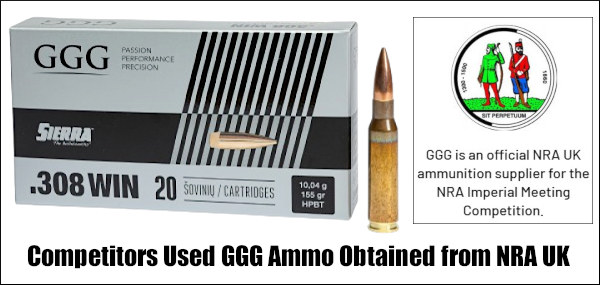
Brandon was shooting a .308 Win rifle with GGG 155gr .308 Win (7.62×51) ammo supplied by the match organizers. GGG, short for Giraitės Ginkluotės Gamykla, is the sole ammunition manufacturer in the Baltic states, and is the official ammo supplier to the NRA UK for the Bisley competitions. The bullets were believed to be Sierra 155-grain HPBT MatchKings. Brandon affirmed this was very good ammo — he opined that it is probably capable of 0.5 MOA accuracy at 100 yards. The powder used by GGG is not known, but some shooters observed it performed very much like Winchester StaBALL.
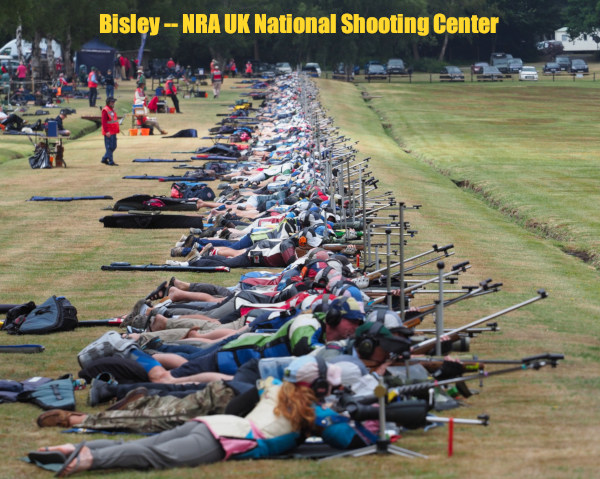
This competition was originally the “Queen’s Prize”, as it was first awarded in 1860 by Queen Victoria. Now that Charles III reigns over the United Kingdom, this championship is called the King’s Prize. The match was moved from Wimbledon Common to Bisley in 1890 and has drawn the best marksmen in the world ever since. The competition involves multiple days of .308 Win (Fullbore) target rifle shooting, a discipline demanding great “hard-holding” skills, an ultra-accurate rifle, and world-class wind-reading.
This is a match using .308 Win-chambered, iron-sighted rifles, shooting at multiple ranges out to 1000 yards. This year was challenging, with switchy wind conditions on the final day at the Bisley Stickeldown Range. Stickledown was “unforgiving” last week, but Brandon Green nailed an impressive 299-41V, dropping just one point overall to take the King’s Prize.
The internet was buzzing with praise for Brandon, and his fellow U.S. National Rifle Team members congratulated him. On his Facebook page, Brandon thanked his fans and team-mates: “Thanks guys, I really appreciate the kind words. I was talking to the 2015 world champion Ben Emms before we started and he said that all you have to do is keep yourself in it to the end and it will all sort itself out. That was the absolute best piece of advice that I could have gotten yesterday. Thanks again buddy!” In an interview on PrecisionRifleBlog.com, Brandon added: “Focus on shooting your match — don’t get wrapped up in what everyone else is freaking out about.”
NRA of the UK — 156th Imperial Meeting
This year’s 156th Imperial Meeting included a number of individual and team competitions. The individual events and overall match concluded with ceremonies for the King’s Prize winner, Brandon Green. After he was announced the King’s Prize winner, Brandon was carried from the range by chair, lifted by his competitors, accompanied by the marching band, Range Officers, fellow competitors and spectators.
Brandon’s superb performance made him the first American marksman to win the King’s Prize (and ride the chair) in the 156‑year history of the event. The NRA UK posted: “Precision, poise, and proof that hard work pays off. Congrats, Brandon!”
A good case trimmer is an essential tool for precision hand-loading. To ensure consistent loads, you want your cases to be the exact same length. Today’s Saturday Showcase features five trimming tools, both powered and manually operated, that can trim your sized brass with great precision. In addition, some of these tools will also chamfer case necks inside and out. The powered case trimmers will save you considerable time (and effort) when working will large batches of brass.
Lead photo shows the Henderson Gen 2 trimmer from Panhandle Precision video review.
Henderson Gen 3 Power Trimmer — Ultimate Reloader Review
Gavin Gear of UltimateReloader.com has tested the impressive Henderson Gen 3 (V3) Trimmer. You’ll find a full write-up on Gavin’s website, and you can watch Gavin’s 18.7-minute video review above.
Gavin states: “The Henderson Gen 3 case trimmer is built on an adjustable tri-trim 3-way cutter with different pilots to accommodate different case necks. Three-way cutters trim to length and chamfer the inside and outside all at once. This trimmer has a 1700 RPM spindle and a custom DC motor made in the USA. The Henderson trimmer works much like a milling machine. You do not need much torque because of the way the taper works. The Henderson Gen 3 trimmer delivered outstanding cartridge length consistency after trimming. This trimmer is fast and easy to use and most importantly, returns consistent results.”
CLICK HERE for Henderson Gen 2 Trimmer video review, which shows how to how to set trim length and change cutter heads, using 6.5×47 Lapua, .260 Remington, and .300 Winchester Magnum cases.
Giraud Power Case Trimmer — Full Review by Erik Cortina
In this video, Erik Cortina of CortinaPrecision.com offers some very clever and useful tips that will help you get the most from your Giraud powered case trimmer. The Giraud trimmer is very precise. When set up correctly, it can trim brass with amazing consistency.
In the video, Erik trims 5 pieces of brass in 15 seconds (6:32 mark). He then measures all five with precision calipers (7:00-8:08). All lengths are exact within .0005 (half a thousandth). Erik notes that the Giraud trimmer indexes off the case shoulder. As long as you have fire-formed brass with consistent base-to-shoulder dimensions, you should get very consistent trim lengths.
Lyman Powered Case Trimmer Review
The Lyman Case Trim Xpress is an efficient, precise unit that allows easy adjustment of trim length with a click-adjustable collar. The trimmer comes with a set of cartridge-specific bushings that index off the case shoulder. One nice feature is a variable speed control. For the price, $146.20 on Amazon, this trimmer delivers excellent performance. To see more details, check out F-Class John’s video review of the Lyman Case Trim Xpress which shows set-up and operation.
Frankford Arsenal Universal Case Trimmer (for Power Drills)
This video features a handy tool that attaches to a portable drill. Used with various diameter collets, this can trim most popular sizes of shouldered brass. The universal collet system indexes on case shoulders for precise and consistent trimming (this does NOT work with straight-walled cartridges). The built-in depth micrometer allows for quick and precise micro-adjustments. There is a handy brass shaving ejection port. The system works well, particularly if you can stabilize your power drill in one position. This Frankford Arsenal trimmer, under $65.00 on Amazon, is an affordable alternative to the top-end powered case trimmers. It comes with a handy plastic case that holds the trimmer and collets.
L.E. Wilson Manual Case Trimmer
L.E. Wilson, makers of hand dies, case trimmers and other precision reloading tools, makes a popular and precise stainless steel case trimmer with micrometer adjustment. The above video explains the operation of the Wilson trimmer and shows how to trim cases and use the micrometer case length control positioned opposite the hand crank. We definitely like the micrometer control. This feature allows you to set the cartridge overall trim length with great precision. If you are trimming a variety of different cartridge types, the micrometer cut length control comes in very handy.
If you own a L.E. Wilson case trimmer, you should watch the official Accessories Video from L.E. Wilson. This video shows accessories for the L.E. Wilson trimmer. These include: Power Adapter for trimming (replaces hand crank), Titanium Case Trimmer Cutter (longer life), Inside Case Neck Reamer, Primer Pocket Reamer (removes military crimps), Uniform De-Burring Tool, Neck Chamfer Tool (30° and 45°), and handheld inside/outside deburring tool (and power adapter).
BONUS Video: How Important is Consistent Case Length?
This Primal Rights video explains why it is important to maintain precise case lengths if you want best accuracy and most consistent ES/SD. You’ll want to size your cases BEFORE trimming if your trimmer indexes off the case shoulders.
This Gun Digest book has become a “go-to” resource for NRL22 and PRS Rimfire shooters. Key topics included in this 2021 Edition full-color Gun Digest book include: rimfire semi-autos and how they work; bolt-action accuracy; match shooting skills; DIY precision gunsmithing; hunting with rimfires; and the future of the rimfire market.
With the growth of rimfire tactical competition, the .22-Caliber rimfire rifle is more popular than ever. Every major gun manufacturer has brought at least one new .22 LR rimfire rifle to the market in the last two years. Gun Digest’s Rimfire Revolution has extensive coverage of new models from major manufacturers.
The .22 Long Rifle (.22 LR) is the planet’s most popular ammunition type and firearm chambering. The .22 LR is used in the Olympics by 3P marksmen, but it also serves benchrest competitors, NRL22 shooters, backyard plinkers, small-game hunters, and tactical trainers. With the expansion of NRL22 matches (and the PRS equivalent), the humble .22 LR is undergoing a major resurgence in the USA. And with centerfire reloading components being so costly and difficult to find, many folks are shooting less centerfire, but way more rimfire.
Plus Coverage of .17-Caliber Rimfire Rifles — 17 HM2, 17 HMR, 17 WSM
This 272-page book also covers .17-caliber rimfire cartridges: 17 HM2 (Mach 2), 17 HMR, and 17 WSM. These are all excellent varmint rounds, with the 17 WSM effective out to 250 yards. The 17 HM2 will run in a normal .22 LR action and feed from standard .22 LR magazines. So, for most rifles, all you need to do a .22 LR to 17 HM2 conversion is a barrel switch. That gives your rimfire rig twice the versatility. Shoot .22s and .17s with the same gun.
NRL22 — Challenging Practical Competition with .22 LR Rifles
The USA has seen a big growth in rimfire tactical matches over the last five years. Right now there are probably ten times as many rimfire tactical matches as sanctioned PRS and NRL centerfire matches. The reason is simple — rimfire ammo is much less costly, and clubs can run challenging rimfire tactical matches at nearly any outdoor gun range that allows shooting out to 200+ yards.
NRL22 Competition — Tactical Rimfire Matches
The NRL22 match format is a great shooting discipline. NRL22 offers a high fun factor at relatively low cost. You don’t have to reload match ammo. A couple of 50-round boxes of .22 LR ammo will get you through the match. While some people bring lots of gear to matches, that’s by choice and not by necessity. You can keep it simple and still be competitive (and win).
Tips for NRL22 Competitors by Jonathan Ocab
I am a match director at my gun club and run our local NRL22 matches. People often ask me for tips for competing in NRL22. First, I recommend getting the course of fire for the month in advance and practicing those stages at the range. Here are other specific tips that should help NRL22 competitors improve their gun-handling and match results.
1. Dry Fire Practice — If you are not able to do live fire practice at the range, I encourage shooters to practice their shooting positions at home via dry fire. Setup props or barricades with pasters or other faux targets on a wall in the garage or inside the house and run through each stage.
2. Scope Magnification Level — The most common issue I see with newer shooters in NRL22 is the tendency to maximize their scope magnification. The timer will start, and the shooter gets into position on a target, but the scope is set to 15x or higher and the shooter can’t find the target. The shooter lowers the magnification, locates the target, and then increases the magnification again, takes the shot, transitions to another target, and repeats the process of decreasing magnification, locating target, etc. Novice NRL22 shooters should try using the mid-range magnification. Try shooting 7x-12x and learn to balance field of view and target image.
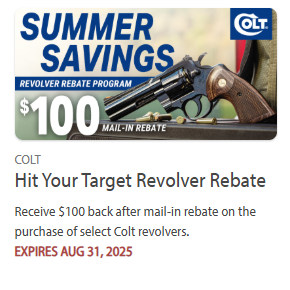
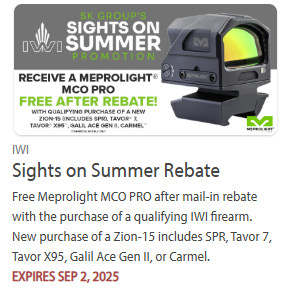
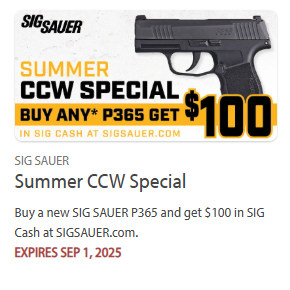
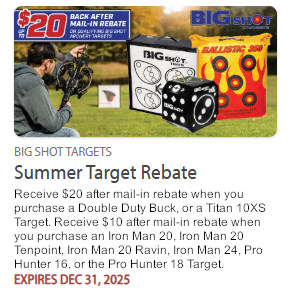
We’ve found eight great discount/rebate programs. These specials can save you big bucks on pistols, long guns, suppressors, optics, ammunition, targets and more. Some of these rebates are worth big bucks. For example you can Save $75 on a new Browning rifle or shotgun, Save $100 on a new Colt pistol, get a $100 Credit with a SIG Sauer pistol, or get Free Meprolight Optic with the purchase of an IWI firearm. Note: Quite a few of these rebate offers expire at the end of August or early September, so check the dates — you snooze, you lose.
Find More Rebates at Gundeals.com and Sportsman’s Outdoors. Note: There are Federal, Remington, and Speer Ammo Rebate Offers that expire at 11:59 pm today, July 31, 2025.
At the request of our readers, we provide select “Deals of the Week”. Every Sunday afternoon or Monday morning we offer our Best Bargain selections. Here are some of the best deals on firearms, hardware, reloading components, optics, and shooting accessories. Be aware that sale prices are subject to change, and once clearance inventory is sold, it’s gone for good. You snooze you lose.
NOTE: All listed products are for sale to persons 18 years of age or older. No products are intended for use by minors.
1. EuroOptic — Leupold Sale, up to 45% Off Blem Items
⏺️ » HUGE discounts on Leupold scopes, spotters, binoculars
This week, at EuroOptic, Leupold scopes with a slight blemish are on sale at huge discounts — up to 43%. These are not used — they are new optics with the full Leupold Lifetime warranty. If you need a scope for your hunting, varmint, or competition rifle, this is great savings opportunity. In addition, regular (non-blem) Spotting Scopes and Binoculars are on sale at big discounts. For example the Leupold 15-45x65mm SX-4 spotter is now $449.99, a 44% saving off the $779.99 list price.
⏺️ » Huge 43% discount on good quality 1911 handgun
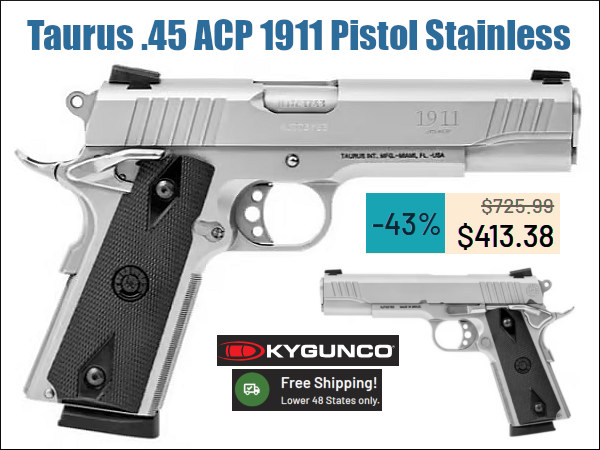
An American classic, the model 1911 pistol offers excellent accuracy, and a great single-action trigger. Right now at KYGUNCO you can save 43% on a Taurus stainless model 1911 pistol that ships with two 8-round magazines. A quality stainless 1911 is a great addition to any gun collection, both for target shooting and defensive use. With this 43% discount you are saving over $312.00 compared to regular list price.
3. Powder Valley — Varget Special 8.8-lb Cannister
⏺️ » Great super-size value for popular Varget powder
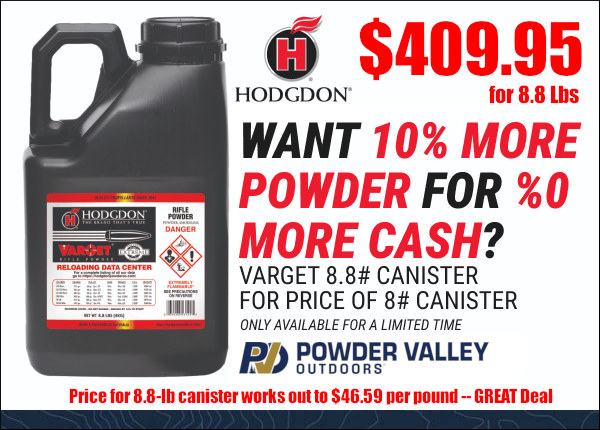
Varget is one of the very best powders for many popular cartridges including .223 Rem, 6mmBR, 6XC, 6mm Creedmoor, 6GT, .243 Win, .308 Win and others. Right now you can get an 8.8-lb cannister of Varget for $409.95. That works out to just $46.59 per pound — a great value. If you load a lot of Varget, we recommend this deal from Powder Valley Outdoors. NOTE: A single 1-lb container of Varget is $55.95 at Powder Valley. So the big 8.8-lb cannister offers considerable savings.
4. Amazon — Lyman 8-station Turret Press, $265.90
⏺️ » 8-station turret press is great for loading multiple cartridge types
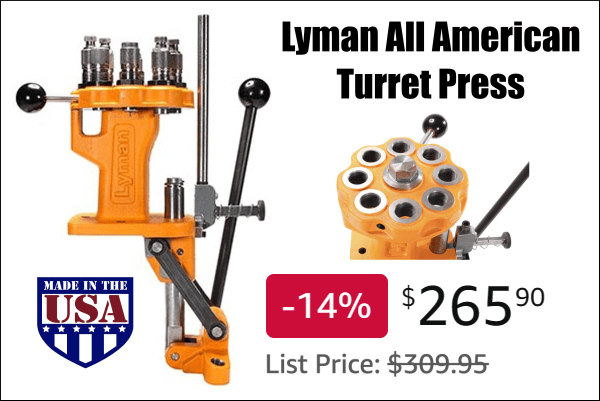
The 8-station Lyman Brass Smith All-American 8 Press (#ad) is an impressive product. This sturdy turret press is made from heavy-duty cast iron. The 8-die station turret will hold up to four 2-die sets. Below the turret is a rigid cast iron frame, housing a 1″-diameter ram and compound linkage. NOTE: With a $269.97 price on Amazon, the 8-station Lyman is $130 cheaper than the $399.99 7-station Redding T-7. No question, that’s a significant price advantage.
5. Amazon — Folding 4-Wheel Gear Cart, $44.99
⏺️ » Great deal on folding cart that can handle all your shooting equipment
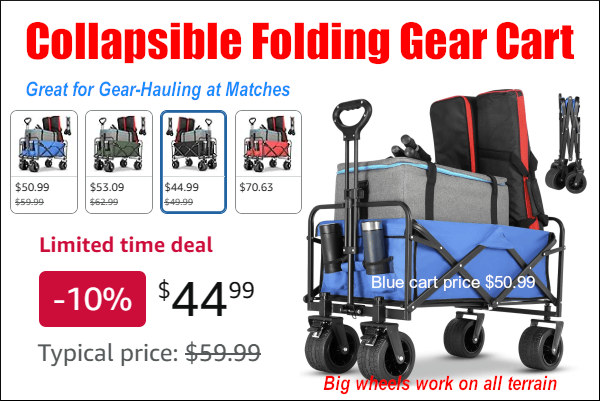
The F-Class Nationals starts next week in Wisconsin. Along with heavy rifles, competitors must haul rests, heavy rear bags, spotting scopes, ammo, shooting mats, and other gear. Moving all that gear could require multiple trips. But with this Collapsible Foldable Beach Wagon (#ad) you can haul your gear way more efficiently. Often used at matches to haul rifles, rests, mats, windflags, spotting scopes etc., these handy carts make life easier. The large oversized wheels traverse rough terrain and roll through sand with ease. This cart is offered in black for $44.99, or with blue color (as shown) for $50.99.
6. Precision Reloading — FREE HazMat on $149+ Orders
⏺️ » FREE HazMat through 7/31/25 on $149+ orders
Here’s a good way to save $20-$35 on your next order of Powder and/or primers. Now through Wednesday, July 31, 2025 Precision Reloading is offering FREE HazMat on powder and primer orders over $149.00 total. That can save you significant fees compared to other vendors. In addition, Precision Reloading has very competitive prices on popular powder and primer types.
7. Midway USA — Walker’s Electronic EarMuffs on Sale
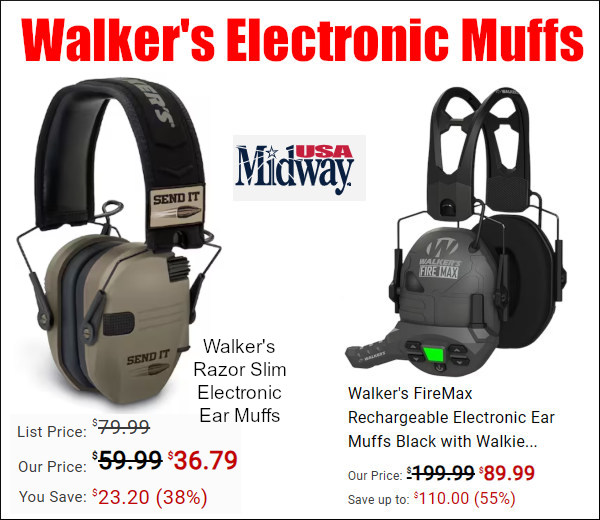
⏺️ Major savings on popular electronic hearing protection
8. Palmetto SA — PSA Bundle 9mm Ammo, Bag, Targets, $220.00
⏺️ » 500rds 9mm ammo plus targets, range bag, and more
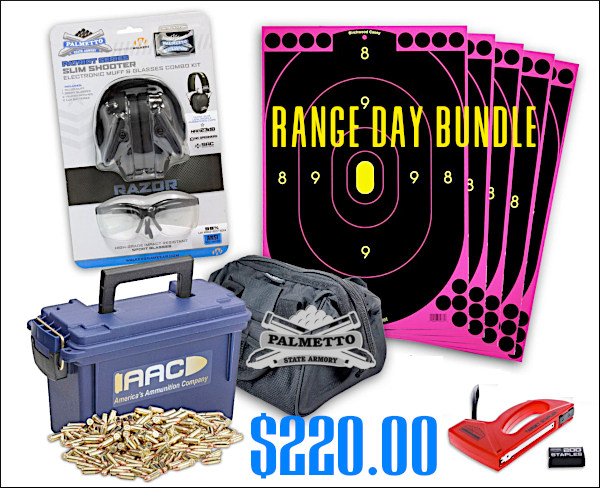
Here’s a great package for pistol shooters. The $220.00 PSA Range Day Bundle includes: 500 rounds of AAC 9mm 124gr Ammo in transport case; Walker’s PSA Electronic Muffs and Glasses Combo Kit; PSA Black Range Bag; Birchwood Casey Shoot-N-C 12″x18″ Silhouette Targets, 5 Pack; and Birchwood Casey Target Stapler (with staples). That’s all you need for fun days at the range — just bring your 9mm firearm(s).
9. Amazon — 52″ Double Rifle Case, $39.99
⏺️ » Good price for versatile case that can hold long-barrel rifles
Here’s a very affordable rifle case that can hold long competition rifles. The Huntsen 52″ Double Rifle Case features a removable divider that enables the carrying of one or two rifles up to 50″ OAL. This case includes a large zipper pocket, 3 magazine pouches, plus MOLLE straps for other accessories. For the same $39.99 sale price, this 52″ case is offered in black (#ad), green (#ad), or tan digital camo (#ad) colors.
As an Amazon affiliate, this site can earn revenues through sales commissions.


 2. Check Out the Forum Classifieds. There are great deals to be found every day in the AccurateShooter
  3. Share a Ride to Matches. Fuel prices are on the rise — Regular-grade gasoline is over $4.90 per gallon in California now and around $3.20+ per gallon nationwide. With many shooters living 30-100 miles from the nearest range, fuel remains a big part of a shooter’s hobby budget. We’d say 90% of shooters drive solo to matches, often in large, gas-guzzling trucks. If you drive 200 miles round-trip to attend a match in a 20-mpg vehicle, you’ll burn over $32.00 worth of gasoline on your trip. That adds up. By simply sharing the ride with one fellow shooter you cut your fuel expenditures in half. And, if you alternate vehicles with a buddy from one match to the next, you save on vehicle wear and tear. At $0.70/mile (overall operating costs) consider the savings.
 4. Use Discount Codes to Save. It’s always smart to check for discount codes before you buy. In the Daily Bulletin, we feature “Deals of the Week” every Monday morning, and we provide discount Coupon Codes when available. These can reduce the price substantially or lower shipping costs. Search codes for Brownells, Creedmoor Sports, EuroOptic, Graf’s, Midsouth, Powder Valley, Sportsman’s Warehouse, KYGUNCO, MidwayUSA, and Precision Reloading. Check your email also — some discount codes are only announced in email newsletters. If you can’t find a Coupon Code for your preferred vendor, visit
  5. Shop for “Demo” Optics. Modern high-quality optics can easily cost $2000.00 or more, often exceeding the value of the rifle on which they are mounted. However, you can often save 20-30% by purchasing demo optics. These are normally display units used at trade shows. They may have slight ringmarks, but otherwise they are “as new”, having never been carried in the field or used on a rifle that has fired live ammo. When purchasing demo scopes, you should always ask about the warranty before making the sale. However, most demo scopes from name-brand manufacturers come with full factory warranties.
  6. Train with Rimfire Rifles. Good match-grade centerfire, hand-loaded ammo, counting premium bullets, powder, primers, and brass (figuring 10X loads), can now exceed $1.50 per round. And if your $600 (as chambered and fitted) competition barrel is toast after 1500 rounds, add $0.40 for barrel deprecation per shot. So you’re approaching two bucks a round total! By contrast, you can get quite good .22 LR target ammo for $0.16 per round. Good rimfire barrels last a long, long time, so you don’t have to be concerned about wearing out your barrel quickly. A quality rimfire barrel can retain its accuracy for 7,000 rounds or more. If you run the ballistics, a .22 LR round at 100 yards can emulate the wind drift experienced by a centerfire cartridge at long range. This allows for effective cross-training with much less expensive ammo.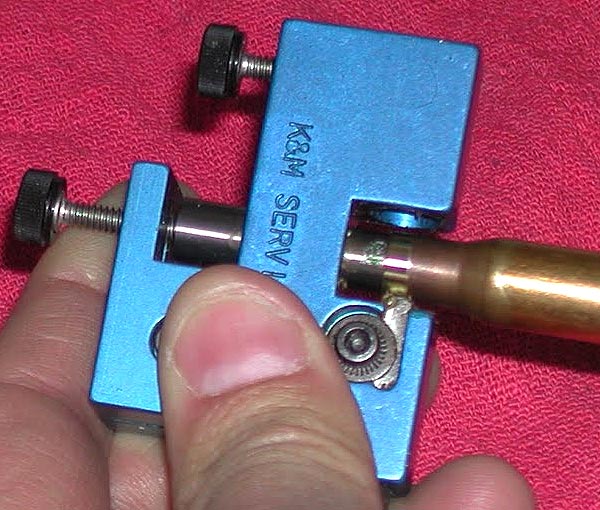
 When neck-turning cases, it’s a good idea to extend the cut slightly below the neck-shoulder junction. This helps keep neck tension more uniform after repeated firings, by preventing a build-up of brass where the neck meets the shoulder. One of our Forum members, Craig from Ireland, a self-declared “neck-turning novice”, was having some problems turning brass for his 20 Tactical cases. He was correctly attempting to continue the cut slightly past the neck-shoulder junction, but he was concerned that brass was being removed too far down the shoulder.