It’s not easy to place a first shot on target at 1500 yards. You must measure the wind speed with precision, know your exact muzzle velocity, and have a sophisticated ballistics solver. In this short video from Ryansrangereport.com, the shooter manages a first-round hit on a steel silhouette at 1500 yards. He used a Kestrel 4500 NV Weather Meter with Applied Ballistics software to figure out the trajectory for his 6.5 Creedmoor rounds.
The Kestrel recorded a wind velocity, and the internal software calculated a solution of 17 Mils elevation (that’s 928 inches of drop) with 2.5 Mils windage. “Bang” — the shooter sends it, and 2.6 seconds later “Clang” he had a hit (flight time was 2.6 seconds). Bryan Litz observes: “This is the science of accuracy (in the form of an Applied Ballistics Kestrel) being put to good use at 1500 yards”.
Later in the video (1:05-1:15) the shooter places three rounds on steel at 1000 yards in just 10 seconds. The three shots all fall within 10″ or so — pretty impressive for rapid fire. The shooter reports: “[In my 6.5 Creedmoor] I’m using a 136gr Lapua Scenar L. This bullet has impressed me. It screams out of my barrel at 2940 fps and holds on all the way out to 1,500 yards.”
The rifle was built by Aaron Roberts of Roberts Precision Rifles (RPRifles.com). Chambered for the 6.5 Creedmoor, it features a Leupold Mark VI 3-18x44mm scope.
Roberts Precision Rifles
19515 Wied Rd. Suite D
Spring, Texas 77388
Phone: 281-651-5593
Email: rprifles @ gmail.com
Californians Buy Bulk Ammo Online While They Still Can
Californians are buying more ammunition, and in bigger, bulk quantities, according to data from online ammo retailer Wideners.com. In the two months since 2016’s General Election, Wideners.com’s online traffic from California is up a full fifty percent (50%). Nationwide traffic to the site has remained relatively static for the same period. And Widener’s sales are up dramatically for the most popular ammo types: 9mm Luger, .223 Rem (5.56×45), and .308 Win (7.62×51).
IMPENDING BAN on Mail-Order Ammo — Starting January 1, 2018, California gun owners will no longer be able to buy ammunition online. Only face-to-face ammo purchases will be allowed inside the state. Per Proposition 63, California will also require a background check for ammunition purchases, and ammo buyers must obtain a four-year purchaser’s license from the CA Department of Justice.
“There’s been a massive influx of California hunters and sport shooters who are stocking up in the wake of California’s new laws”, reports Anne Taylor of Widener’s. “There’s not just increased interest, it’s clear the gun owners who are buying are buying in bulk. We’ve seen our average order weight go up in the past couple months. We expect this sort of rush will continue through the rest of the year.”
“We heard from a lot of customers in late December and early January who were confused about Prop 63,” Taylor said. “Many people seemed to think the background checks would start immediately.”
Percent Increase in Sales by Municipality:
Los Angeles Metro Area – 395%
San Francisco Metro Area – 417%
San Diego Metro Area – 161%
Sacramento Metro Area – 449%
Anaheim Metro Area – 264%
San Jose Metro Area – 233%
Note: Data based on IP Address of computer used to make purchase comparing the two-month period before and after 2016’s General Election. Municipalities such as San Francisco and Los Angeles already restrict online ammo purchases.
The biggest sales increase has been observed with .223 Rem/5.56×45 rifle ammunition, the most common cartridge type used in AR-platform rifles. In fact, .223/5.56 ammo sales in the eight weeks following the 2016 election were TWICE as great as in the preceding eight weeks.
Biggest jump in ammo sales has been for .223/5.56 ammo suitable for ARs.
9mm ammo and .308 rifle ammo are also experiencing large gains from California buyers with increases of 60-80%. That’s notable becauses sales remain static in those calibers in the rest of the country. Overall, Widener’s sales data shows the average quantity purchased by Californians is up 20% in the two months following the 2016 election compared to the same time period before.
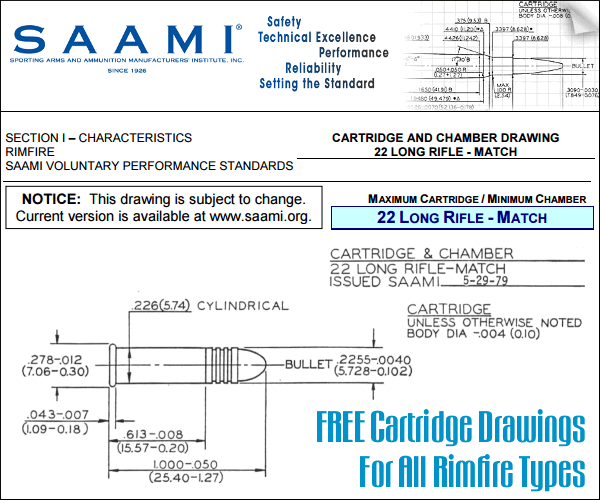
Planning a rimfire build in the future, or want to get the exact specifications for your 17 Mach 2, 17 HMR, 17 WSM, .22 LR, or .22 WMR rifle? Then we’ve got you covered. CLICK HERE to download an official SAAMI document with specs for all popular rimfire ammunition. This FREE 89-page PDF includes complete Cartridge and Chamber drawings and headspace specifications. The document even includes info on pressure terminology, headspace gauges, and test barrels.
SAAMI, the Sporting Arms and Ammunition Manufacturers’ Institute, is an association of the nation’s leading manufacturers of firearms, ammunition and components. Founded in 1926, SAAMI promulgates industry standards for firearms ammunition safety, interchangeability, reliability and quality.
SAAMI offers diagrams for ALL popular, modern rimfire cartridges:
Here’s the Official SAAMI Drawing for the 17 HMR Cartridge:
SAAMI Website Also Offers Centerfire Cartridge and Shotshell Diagrams
From the SAAMI website you can also access hundreds of FREE official cartridge diagrams and chamber drawings for all centerfire ammo types and Shotshells. Click on the Cartridge and Chamber Drawings link, then go to the SAAMI Standards Page. On the Standards Page, choose your ammo type: Rimfire (Z299.1), Shotshell (Z299.2), Pistol and Revolver (Z299.3), Rifle (Z299.4). This will then load large PDF files which include multiple cartridge diagrams.
Do you shoot a mid-sized match cartridge, such as the 6.5×47 Lapua, or 6.5 Creedmoor? Then here’s a great deal for you. Right now you can get 123gr Nosler HPBT match bullets for just $20.49 per hundred. These are on sale as “factory seconds” with cosmetic blemishes, such as water spots. But they are otherwise fine bullets, and your targets will never notice the blemishes.
We prefer bullets in the 120-130 grain weight range for the mid-sized 6.5mm cartridges. While you give up a little BC compared to the 140s, the lighter bullets seem to be easier to tune and often group tighter. You can also get significantly higher velocities with a 120-grainer compared to a 140-grainer. The extra velocity may allow you to reach a higher accuracy node. With our .260 Rem, we got consistently better inherent accuracy with 120gr bullets running at a high node, compared to the slower moving 140s. YMMV, but we think it’s worth trying these Noslers at just $20.49 per box — half the price of some other premium 130gr 6.5mm match bullets.
Bullets in the 120-grain range often shoot very well in all these cartridge types. And they may be easier to tune than 140-grain class 6.5mm projectiles.
Shooters contemplating purchase of a .338 LM rifle often ask: “What length barrel should I get?” Rifleshooter.com recently performed a test that provides interesting answers…
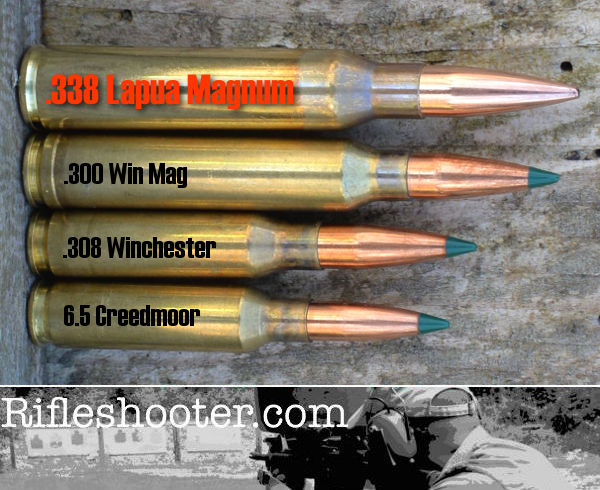
Our friends at RifleShooter.com like to slice and dice — barrels that is. They have done barrel length cut-down tests for popular calibers like the .223 Rem, 6.5 Creedmoor, and .308 Winchester. But now they’ve tackled something way bigger — the .338 Lapua Magnum, a true “Big Boomer”. Starting with a beefy 30″-long Pac-Nor Barrel, RifleShooter.com chopped the tube down in one-inch increments all the way down to 17 inches (that’s 14 different lengths). At each new (shorter) barrel length, velocity was measured with a MagnetoSpeed chronograph using two different loads, 250gr SMKs with H4831sc and 300gr SMKs with Retumbo. Four shots were fired at each length with each load, a total of 112 rounds.
Load #1: 250gr Sierra MK, Lapua brass, CCI #250 primer, H4831SC, OAL 3.720″.
Load #2: 300gr Sierra MK, Lapua brass, Win WLRM primer, Retumbo, OAL 3.720″.
The .338 Lapua Magnum is a jumbo-sized cartridge, that’s for sure…
Donor Barrel Sacrificed for Science
Rifleshooter.com’s Editor explains: “Brandon from Precision Addiction offered to send us his .338 barrel for our .338 Lapua Mag test. I took him up on his offer and he sent me his used Pac-Nor chrome-moly barrel with about 600 rounds though it. This thing was a beast! A heavy 1.350″ shank that ran straight for 6″, until tapering to 1″ at 30″ in length.”
Results Summary
.338 Lapua Magnum with 250gr Sierra MatchKings
After shortening the barrel from 30″ to 17″, total velocity reduction for the 250-grainers was 395 FPS, an average loss of 30.4 FPS per 1″ cut. The amount of velocity loss per inch rose as the barrel got shorter, with the biggest speed reduction, a loss of 55 FPS, coming with the cut from 18″ to 17″.
Start Velocity: 2942 FPS | End Velocity: 2547 FPS | Average Loss Per Inch: 30.4 FPS
.338 Lapua Magnum with 300gr Sierra MatchKings
Shooting the 300-grainers, total velocity reduction was 341 fps, an average of 26.2 FPS loss per 1″ cut (30″ down to 17″). However, the speed actually increased with the first cut from 30 inches to 29 inches. The tester noted: “The 300 SMK load showed a slight increase from 30″ to 29″. I’ve recorded this in other tests and it seems to be more common with a heavier load. I suspect it is primarily due to the small sample sizes being used along with the relative proximity of muzzle velocities in adjacent lengths.”
Start Velocity: 2833 FPS | End Velocity: 2492 FPS | Average Loss Per Inch: 26.2 FPS*
*Velocity rose with first cut. Velocities ranged from 2,871 FPS (29″) to 2,492 FPS (17″) for a total velocity loss of 341 FPS.
RifleShooter.com crunched the velocity numbers in some interesting ways. For example they analyzed rate of velocity loss, concluding that: “after the initial rate change, the rate of the change in velocity is fairly consistent.” (View Rate of Change Graph)
How Velocity Loss Alters Long-Range Ballistics
The testers wanted to determine how the velocity reductions “affect our ability to hit targets downrange”. So, Rifleshooter.com plotted changes in elevation and wind drift at all barrel lengths. This revealed something interesting — drift increased significantly below 26″ barrel length: “Above 26″ things look pretty good, below 22″ they change quickly.”
We highly recommend you read the whole story. Rifleshooter.com put in serious time and effort, resulting in solid, thought-provoking results. The data is presented in multiple tables and graphs, revealing inch-by-inch velocities, change “deltas”, and SDs at each length.
At the request of our readers, we provide select “Deals of the Week”. Every Monday morning we offer our Best Bargain selections. Here are some of the best deals on firearms, hardware, reloading components, and shooting accessories. Be aware that sale prices are subject to change, and once clearance inventory is sold, it’s gone for good. You snooze you lose.
Here’s a great deal on a versatile Vortex Viper 6.5-20x44mm scope that can be used for target work, varmint hunting, or even tactical games. This scope features XD (low dispersion) glass, side-focus parallax, and a 30mm maintube. It offers 1/4-MOA clicks with 65 MOA of elevation adjustment and side-focus parallax control. Two reticle choices are offered: 1) Dead-Hold BDC, and 2) Mil-DOT. Backed by Vortex’s VIP Unconditional Lifetime Warranty, this Viper is on sale for just $329.99 at MidwayUSA, with free shipping.
2. Cabela’s — Lyman T-Mag II Turret Press, $139.99 with CODE
This week, with Discount Code “17SPRING” you can get the rugged Lyman T-Mag II Press for just $139.99 at Cabelas.com. That’s $20 cheaper than the best price we’ve found elsewhere. Every serious reloader should have a good turret press. You can put a variety of seating dies on the turret and use your single-stage press for sizing duties. Or use the turret for bullet pointers or other specialized dies. The new six-station T-Mag II features a strong cast-iron frame and improved Turret Retention System for smooth indexing. The Turret head detaches so you can easily change calibers (or complete die sets). Included are priming arm, primer catcher, and turret handle. NOTE: We did walk through Cabela’s purchase process and confirmed the $20.00 Price reduction with CODE “17SPRING”.
3. Grafs.com — Hornady Ultrasonic Cleaner Plus Tumbler, $99.99
Here’s a great combo deal from Grafs.com. For just $99.99, you get BOTH the Hornady Lock N Load Sonic Case Cleaner (MSRP $99.99) AND the Hornady Vibratory M2 Tumbler (MSRP $49.99). That’s a 47% savings off normal retail. This combo give you the option to clean your brass ultrasonically or by using the traditional tumbling with media method. PLUS — with this bundle you get a free Hornady insulated Mug, a $12 value.
4. Midsouth — Lee Auto Bench Priming Tool, $25.96
This relatively new bench tool does the job very well, and its easy to change primer sizes and shell holders. The “feel” of this tool is very good (better than most other bench priming units). If you like to pre-prime cases before using a progressive — this tool gets the job done fast. The tool includes a new folding tray with built-in primer flipping feature that allows direct filling from common primer boxes. The tool mounting holes are spaced for the Lee Bench Plate system (#006-90251) or the device can be mounted directly to your workbench. NOTE: Reviews by verified purchasers have been very positive.
Here’s a great deal on Pacific Tool & Gauge-crafted Rem actions with PT&G bolts. These are new Remington-made actions, blueprinted, with PT&G bolts fitted. Sold by PT&G’s retail outlet Cabin Fever Sports, these are pretty much the same as PT&G’s $640 actions with special promo pricing. The prices for the Right Hand actions are $380.00 to $420.00 depending on bolt face. Cabin Fever Sports also has roughly 20 Left Hand (LH) Rem actions at $399.99. You can choose trigger type and add options, such as bolt fluting, for a few dollars more. Order online, or call in and ask for special pricing.
6. Natchez — Hornady 22-Cal Varmint Bullets, $9.99 Per 100
Headed out for a varmint safari soon? Need inexpensive bullets for your .223 Rem or 22-250? Then check out this deal on Hornady 55-grainers from Natchez. Get 100 Soft Point .224-Caliber FB bullets for just $9.99. At that price, it doesn’t hurt so much when you shoot 1000+ rounds over a weekend. With good expansion, these bullets work great on prairie dogs and other small critters. Note: These sale bullets ship in a bag, not the box as shown.
If you are serious about your precision firearms, you need one of these. We use the Lyman Electronic Trigger Pull Gauge to test the triggers on all our match and varmint rifles. The unit is precise and repeatable. Once you try one of these you won’t want to go back to crude spring trigger gauges. Amazon.com offers this unit for $47.99 with free shipping for Prime members. Walmart also has it for $51.95 with free shipping or free in-store pickup.
8. CDNN Sports — Taylor 3″ Semi-Serrated Lock-Blade Knife, $6.50
Amazing bargain — This Taylor Lock-Blade Knife features a 3″ stainless steel, titanium-coated blade. The semi-serrated blade works well on heavy straps/materials, making this Taylor knife more versatile. Weight is 9.5 ounces. Open the knife is 8″ long, closed 4.9″. The blade has a thumb knob for easy one-handed opening while the handle boasts a handy stainless steel pocket clip. A crazy-good deal at $6.50, this knife is covered by Taylor Brand’s limited lifetime warranty.
We like reactive targets. It’s fun to “ring steel” and see a target move instantly when hit. For just twenty bucks (including shipping), it’s hard to go wrong with this 8″ AR500 Steel Gong. The 8″-diameter size is big enough for zeroing at 200 yards, yet offers a nice challenge at 500 yards and beyond. There is also a 6″-diameter model for just $14.00. Both sizes currently ship for FREE.
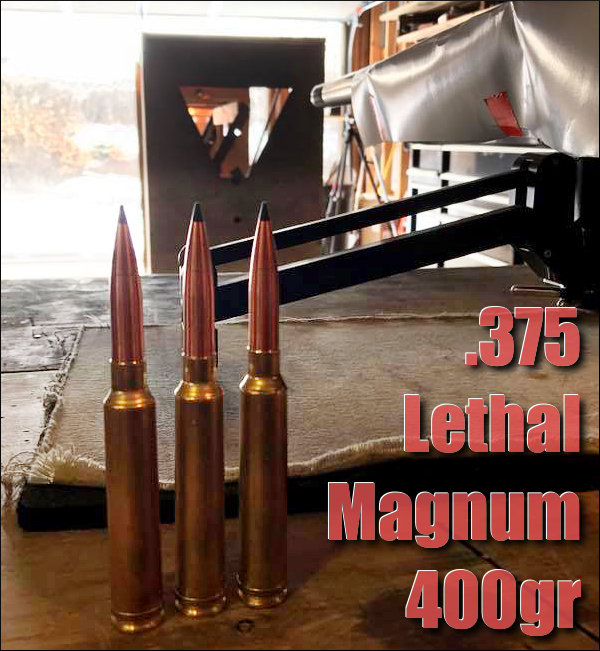
Serious ammo — .375 Lethal Magnum rounds loaded with 400gr Cutting Edge Lazer bullets. One wag posted “They look like SCUD missiles.”
In the Extreme Long Range (ELR) game, great ballistics are paramount, but you also need excellent accuracy. The top ELR shooters campaign large-caliber rifles that boast truly remarkable accuracy, considering the massive cartridges they’re shooting (with 160+ grains of powder). These big boomers, such as the .375 Lethal Magnum shown above, can really hammer.
The winner of the 2016 King of 2 Miles (KO2M) event was Mitchell Fitzpatrick, shooting a .375 Lethal Mag cartridge, as part of Team Applied Ballistics. Another member of that squad, Paul Phillips, is also campaigning a new rifle chambered for the .375 Lethal Magnum. Paul was recently doing load development for his new beast, which features a McMillan stock, Nightforce scope, and Phoenix Bipod. Among his barrels for this rig is a massive, 38″-long Bartlein.
“I had a great time today doing load development at Applied Ballistics LLC laboratory with Bryan Litz, Bill Litz, and Mitchell Fitzpatrick. I was testing loads for my .375 Lethal Mag built by Lethal Precision Arms LLC. The last several test groups were sub half-min at 300 yards. Next testing is at 1800 yards.” — Paul Phillips
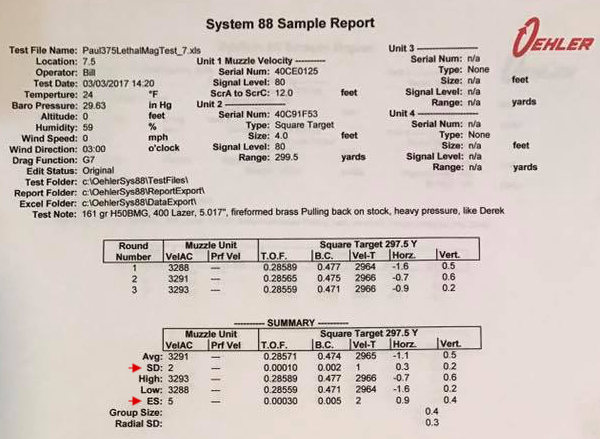
For this test, Paul’s load featured 400gr Cutting Edge Lazer bullets launched at a blistering 3290 FPS with Hodgdon H50BMG powder. Looks like Paul got his load dialed in “good and proper”. He fired a 0.9″ group at 300 yards, and the Oehler System 88 chronograph showed a very low Extreme Spread (ES) of just 5 FPS. That’s impressive even for just three shots.
A little snow on the ground can’t stop the Applied Ballistics testing team…
Look carefully and you’ll find the powder charge weight — a bit more than you’d load in a 6PPC…
Bryan Litz inspects the .375-caliber barrel with bore-scope.
by Gavin Gear, UltimateReloader.com
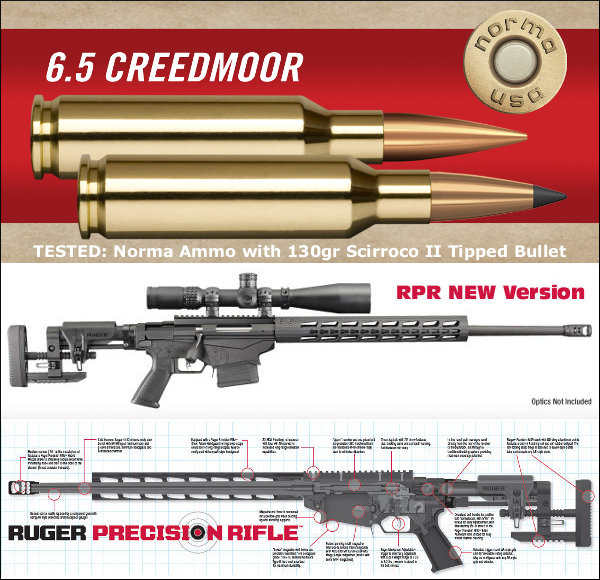
Norma is known for its high-quality brass and ammunition. I’ve used Norma brass for precision reloading in calibers like .30-06 with great results. Recently, I saw that Norma had announced a new addition to their Professional Hunter lineup of ammunition: in 6.5 Creedmoor! I thought I should try some out with the Ruger Precision Rifle, and that’s what I’ll cover in this post.
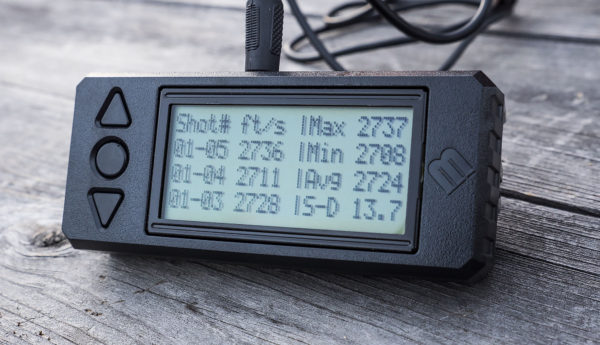
As you saw in the video, this ammunition behaves more like match ammunition than it does hunting ammunition — I really wish it was deer season! Here are the chronograph results:
This article comes from the Midsouth Shooters Blog. You’ll find other helpful gear reviews, reloading tips, and technical articles at www.MSSBlog.com.
With an SD of 13.7 FPS, this ammunition is very consistent in terms of velocity. It’s not surprising that the first four shots went into a .5″ group. This new ammunition is built around the Swift Scirocco II 6.5mm Bullet, and here’s more info about this precision-oriented hunting projectile:
Technical Information
Caliber: 264, 6.5mm
Bullet Diameter: 0.264
Bullet Weight: 130 Grains
Bullet Length: 1.350″
Bullet Style: Polymer Tip Spitzer Boat Tail
Bullet Coating: Non-Coated
Ballistics Information:
Sectional Density: .266
Ballistic Coefficient:.571
This is certainly a great choice of ammunition if you are hunting medium game with a rifle chambered in 6.5 Creedmoor. Can’t wait to sit down again with this ammunition to see if I can get that 3/8″ 5-shot group I know this ammo is capable of! If you want to try this Norma 6.5 Creedmoor Professional Hunter ammo yourself, you can purchase this excellent ammunition at Midsouth Shooters Supply.
Ever wondered what caused a particular bulge or marking on a case? And more importantly, does the issue make the case unsafe for further use? Sierra Bullets Ballistic Technician Duane Siercks offers some insight into various issues and their causes in this article from the Sierra Blog.
Incipient Case-Head Separation
This is a Winchester .308 Win case that has a real issue. This case has a very obvious incipient case head separation in the process of becoming a complete failure.
This is most commonly caused by over-sizing the case causing there to be excess headspace on the case. After a few firings and subsequent re-sizing, this case is just about ready to come completely apart. Proper die adjustment is certainly a requirement here. Of course this case is not safe to reuse.
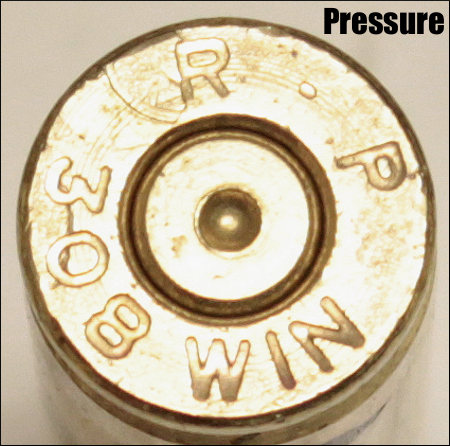
Excessive Pressure (Load Too Hot)
If you will notice in the picture of the case rim, there are two pressure signs to notice. First, look at the primer. It is basically flattened to about the max of what could be considered safe. If this was the only pressure sign noted, I would probably be fine with this load, but would constantly keep an eye on it especially if I was going to use this load in warmer temperatures. This load could easily cross into the “excess pressure” realm very quickly.
There is another sign of pressure that we cannot ignore. If you’ll notice, there is an ejector mark apparent that is located over the “R” of the R-P headstamp. This absolutely tells us that this load would not have been in the safe pressure range. If there were any of these rounds loaded, they should not be fired and should be dis-assembled. This case should not be reloaded.
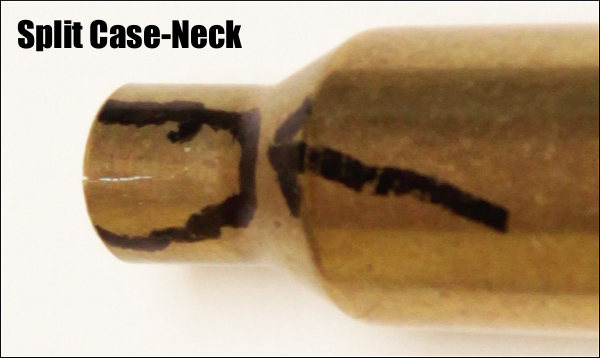
Split Case-Neck
Here we have an R-P .22-250 case that has died the death. Everything looks fine with this case except the neck is split. This case must be tossed.
A split neck is a normal occurrence that you must watch for. It is caused by work-hardening of the brass. Brass cases get harder with age and use. Brand new cases that are stored for a period of time can become hard enough that they will split like this case within one to two firings. I have had new factory loads do the same thing. Then as we resize and fire these cases repeatedly, they tend to get harder and harder. Eventually they will split. The life of the case can be extended by careful annealing practices. This is an issue that would need to be addressed in an article by itself. Of course this case is no longer usable.
In the classes that I teach, I try to use examples like this to let the students see what they should be looking for. As always, if we can assist you, whether you are new to reloading or very experienced, contact us here at Sierra Bullets by phone at 1-800-223-8799 or by email at sierra@sierrabullets.com.
Dented Case Body
Here we have a Lake City 7.62×51 (.308 Win.) case with two heavy marks/dents in the case body.
This one may be a bit of a mystery. It appears as if this case may have been caught in the action of a semi-auto rifle when the firearm jammed or the case failed to clear during the cycling process. I probably would not reload this case just to prevent any feeding problems. This also appeared to be a factory loaded round and I don’t really see any pressure issues or damage to the case.
It is very important to observe and inspect your cases before each reloading. After awhile it becomes second nature to notice the little things. Never get complacent as you become more familiar with the reloading process. If ever in doubt, call Sierra’s Techs at 1-800-223-8799.
When we first ran this story a while back, it spurred a hot debate, with strong opinions on both sides of the issue. Some guys argued vehemently that volumetric powder dispensing was best — citing the experience of short-range benchresters, most of whom still throw their charges. Others say weighing your charges is best, so long as you have a very precise, and very repeatable scale. We know some of the top 1000-yard shooters weigh their charges to the kernel.
Most competitive long-range shooters weigh powder charges for their handloads. Some even use ultra-precise magnetic force restoration scales to load to single-kernel tolerances. But is weight-based measuring always the best way to fill a case with powder? Another option is volumetric charging. This method fills a precisely-sized cavity with powder and then dumps the charge into the case. A Harrell’s rotary powder measure works this way, as does the sliding powder filler on a Dillon progressive press.
For long-range applications, most people believe that precise weighing of powder charges is the best way to achieve optimal accuracy and low ES/SD. However, those short-range Benchrest guys do pretty darn well with their thrown charges, at least at 100 and 200 yards.
Our friend Dennis Santiago recently observed something that made him scratch his head and wonder about weighing charges. His AR-15 match rifle shot better with volumetric (cavity-measured) charges than with weighed charges dispensed by an RCBS ChargeMaster. Here’s what he reports:
Cavity vs. Dribble (Dennis Santiago Report) I had the chance to compare nominally identical ammunition loaded two ways. These were all .223 Remington match loads using 77gr Sierra Match Kings over 23.4 grains of Hodgdon Varget. Same gun. However I loaded some ammo with charges dispensed with a Lee cavity-style powder measure while other rounds were loaded with powder weighed/dispensed by an RCBS Chargemaster. The cavity-drop ammo (with powder dropped from the Lee unit) was consistently better than the weighed-charge ammo. I have no idea why…
So, ladies and gentlemen — what do you think? Why did Mr. Santiago’s volumetrically-charged ammo shoot better than ammo filled with weighed charges? What’s your theory? Gary Eliseo suspects that Dennis’s Chargemaster might have been drifting. What do you think? Post your theories in the comments area below.


 It’s not easy to place a first shot on target at 1500 yards. You must measure the wind speed with precision, know your exact muzzle velocity, and have a sophisticated ballistics solver. In this short video from Ryansrangereport.com, the shooter manages a first-round hit on a steel silhouette at 1500 yards. He used a Kestrel 4500 NV Weather Meter with Applied Ballistics software to figure out the trajectory for his 6.5 Creedmoor rounds.













 Most competitive long-range shooters weigh powder charges for their handloads. Some even use ultra-precise magnetic force restoration scales to load to single-kernel tolerances. But is weight-based measuring always the best way to fill a case with powder? Another option is volumetric charging. This method fills a precisely-sized cavity with powder and then dumps the charge into the case. A Harrell’s rotary powder measure works this way, as does the sliding powder filler on a Dillon progressive press.


