|
|
July 31st, 2016
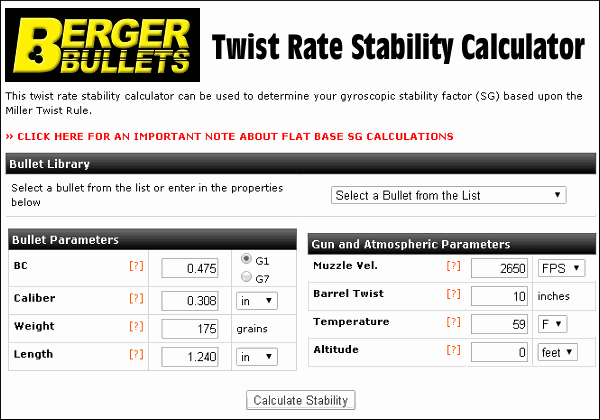
 Berger Twist-Rate Stability Calculator Berger Twist-Rate Stability Calculator
On the Berger Bullets website you’ll find a handy Twist-Rate Stability Calculator that predicts your gyroscopic stability factor (SG) based on mulitiple variables: velocity, bullet length, bullet weight, barrel twist rate, ambient temperature, and altitude. This cool tool tells you if your chosen bullet will really stabilize in your barrel.
How to Use Berger’s Twist Rate Calculator
Using the Twist Rate Calculator is simple. Just enter the bullet DIAMETER (e.g. .264), bullet WEIGHT (in grains), and bullet overall LENGTH (in inches). On its website, Berger conveniently provides this info for all its bullet types. For other brands, we suggest you weigh three examples of your chosen bullet, and also measure the length on three samples. Then use the average weight and length of the three. To calculate bullet stability, simply enter your bullet data (along with observed Muzzle Velocity, outside Temperature, and Altitude) and click “Calculate SG”. Try different twist rate numbers (and recalculate) until you get an SG value of 1.4 (or higher).
Gyroscopic Stability (SG) and Twist Rate
Berger’s Twist Rate Calculator provides a predicted stability value called “SG” (for “Gyroscopic Stability”). This indicates the Gyroscopic Stability applied to the bullet by spin. This number is derived from the basic equation: SG = (rigidity of the spinning mass)/(overturning aerodynamic torque).
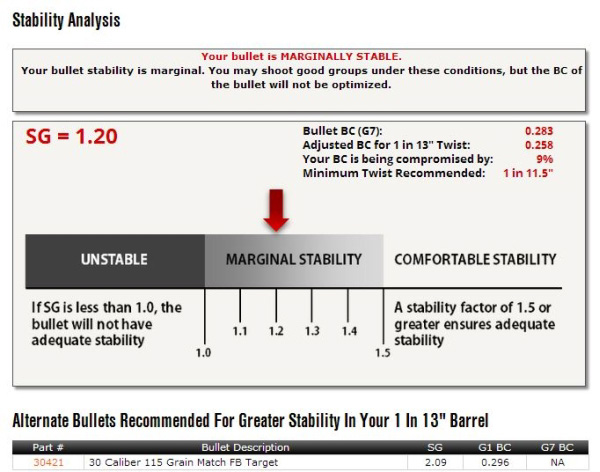
If you have an SG under 1.0, your bullet is predicted not to stabilize. If you have between 1.0 and 1.1 SG, your bullet may or may not stabilize. If you have an SG greater than 1.1, your bullet should stabilize under optimal conditions, but stabilization might not be adequate when temperature, altitude, or other variables are less-than-optimal. That’s why Berger normally recommends at least 1.5 SG to get out of the “Marginal Stability” zone.
In his book Applied Ballistics For Long-Range Shooting, Bryan Litz (Berger Ballistician) recommends at least a 1.4 SG rating when selecting a barrel twist for a particular bullet. This gives you a safety margin for shooting under various conditions, such as higher or lower altitudes or temperatures.
Story idea from EdLongrange. We welcome reader submissions.
July 28th, 2016

 If you haven’t checked out NormaUSA’s website, you should. There you’ll find Norma’s Cartridge of the Month Archive. This great resource provides a detailed history of popular cartridges, along with a discussion of these cartridges’ hunting and target-shooting uses. There are currently 26 Cartridge of the Month articles, the latest featuring the mighty .500/.416 Nitro Express cartridge. If you haven’t checked out NormaUSA’s website, you should. There you’ll find Norma’s Cartridge of the Month Archive. This great resource provides a detailed history of popular cartridges, along with a discussion of these cartridges’ hunting and target-shooting uses. There are currently 26 Cartridge of the Month articles, the latest featuring the mighty .500/.416 Nitro Express cartridge.
Also on Norma-USA.com you’ll find information on Norma cartridge brass, bullets, powder and factory ammo. The site also offers a video archive plus links to Norma Reloading Data.
Here is a selection from 6.5×55 Swede Cartridge of the Month Article:
History of the 6.5×55 Swedish
A mild cartridge by modern standards, the 6.5×55 has impressive credentials in both the hunting field and in competition. It was developed jointly by Sweden and Norway in 1894 – one of the very first smokeless, small-bore rounds for military rifles. When Sweden boosted 6.5×55 performance in Mausers, Norway stayed with original loads in the less robust Krag. The 6.5×55 defended Scandinavia for most of a century thereafter. In 1990 the National Rifle Association of Denmark, Norway and Sweden renamed this cartridge the 6.5×55 SKAN and standardized its specifications. Still hugely popular among moose hunters there, it has also excelled in 300-meter free-rifle competition.
The long tenure of this cartridge spanned the post-war wildcatting era. Unfortunately for shooters keen to make something new of the 6.5×55 hull, its head diameter is .01 greater than that of the 7×57 (and the .270 and .30-06). The rim is thicker too. At 2.16 inches, cases mike .15 longer than the .308’s and .08 shorter than those of the 7×57 – though as originally loaded, its overall length (3.15 inches) exceeds that of the 7×57. In fact, it falls just 0.1 inch shy of the finished length of the 7mm Remington Magnum! In my view, the 6.5×55 merits at least a mid-length action, such as on Melvin Forbes’s New Ultra Light rifles. Shorter (typical .308-length) actions require deep bullet seating that throttles performance.

You’ll look hard to find a better deer cartridge than the 6.5×55. Francis Sell, woodsman and rifle enthusiast whose book on blacktail deer hunting has no peer, favored the 6.5×55. Hunters coming of age in a magnum culture might question the round’s bona fides on animals as stout as elk and moose. But at modest ranges, with bullets like Norma’s factory-loaded 156-grain Oryx, it’s a sure killer. Modest recoil makes rifles pleasant to fire (read: accurate in hand!) and fast on follow-ups. In Africa the 6.5×55 – and similar 6.5×54 Mannlicher-Schoenauer – felled much bigger game than moose long before anyone necked down the .375 H&H! While its compact case won’t let the Swede match the likes of the .270 ballistically, it is a fine all-around choice for big game in the Lower 48.
July 27th, 2016

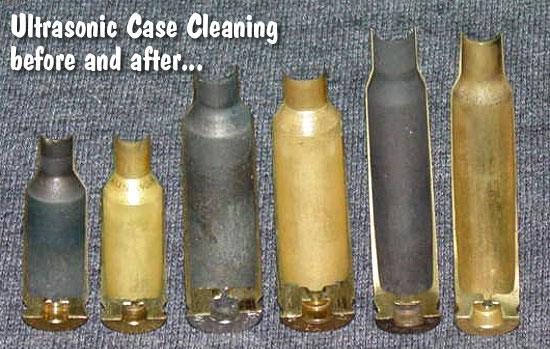
 With the price of premium brass topping $1.00 per case for popular match cartridges, it makes sense to consider annealing your brass to extend its useful life. You don’t want to chuck out brass that costs a buck a case (or more)! Forum member Darrell Jones offers a full range of brass prep, brass forming, and brass restoration (annealing, ultra-sonic cleaning) at very affordable prices. Starting at just $20 per 100 cases ($25/100 for magnum cases), Darrell’s company, DJ’s Brass, will anneal your used brass using state-of-the-art Bench-Source annealing machines. Annealing plus ultrasonic cleaning starts at $35 per 100 cases ($45 for magnum cases). For a bit more money Darrell can also uniform the primer pockets and chamfer the case necks. With the price of premium brass topping $1.00 per case for popular match cartridges, it makes sense to consider annealing your brass to extend its useful life. You don’t want to chuck out brass that costs a buck a case (or more)! Forum member Darrell Jones offers a full range of brass prep, brass forming, and brass restoration (annealing, ultra-sonic cleaning) at very affordable prices. Starting at just $20 per 100 cases ($25/100 for magnum cases), Darrell’s company, DJ’s Brass, will anneal your used brass using state-of-the-art Bench-Source annealing machines. Annealing plus ultrasonic cleaning starts at $35 per 100 cases ($45 for magnum cases). For a bit more money Darrell can also uniform the primer pockets and chamfer the case necks.
Custom Neck-Turning Services
Another great service DJ’s Brass provides is precision neck-turning. Darrell can neck-turn any size case to your specified neck-wall thickness. The price starts at $60.00 per hundred for standard cases or $75.00/100 for magnum size with a $25.00 minimum order. And if you’ve got a bucket of brass to neck-turn, that’s fine with Darrell — he recently neck-turned 1500 pieces of brass for one customer!
DJ’s Brass can process everything from .17 Fireball all the way up to the big magnum cases. And the job gets done quickly. Darrell normally offers a 10-day turn-around. For most jobs, Darrell tells us, he gets the processed brass to the Post Office within three business days. For more info, visit DJsBrass.com or call Darrell Jones at 205-461-4680. IMPORTANT: Contact Darrell for shipping instructions BEFORE sending any brass for processing. ALL BRASS MUST BE DE-PRIMED before you send it.

• Anneal Case Necks Only ($20.00/100 normal or $25.00/100 magnum)
• Ultrasonic Cleaning, Check Necks, and Annealing ($35.00/100 normal or $45.00/100 magnum)
• Full Service: Uniform primer pockets, Chamfer case mouths, Ultrasonic cleaning and Polishing, Anneal case necks (Starting at $50.00/100 call for quote)
• Neck Turning or trim-to-length Custom Order Service (Starting at $60.00/100 for standard cases and $75.00/100 for magnums)
• Hydro-Form Specialty cases (such as Dasher) $0.60 (sixty cents) each minimum of 100 pieces plus actual return shipping cost
• Expand Case Necks and Anneal brass (Call for Price)
• Create False Shoulder for Fire-Forming (Call for Price)
• Ultrasonic Cleaning of Muzzle Brake, $5.00 plus actual shipping |
Hydro-Forming Cartridge Brass
Hydro-forming by Darrell costs $0.60 per case with a minimum order of 100 pieces. After hydro-forming, Darrell can also neck-turn the case for an additional charge (call for combined quote). In addition to the 6mmBR-based cases shown below, Darrell can now hydro-form 6PPC cases from .220 Russian brass.

With Darrell’s hydro-forming service you don’t have to buy any special dies or other equipment. Darrell says: “Simply send me the brass you need or have it dropped-shipped to me along with a fired case that has not been sized. If you need formed brass for a new build (gun not yet fired), let me know and I will size the brass to fit within .001″ of a PT&G GO gauge.”
DJ’s Brass Offers Specialized Custom Services
Darrell tells us: “At DJ’s Brass, we can handle all your brass refurbishing needs. From ultrasonic cleaning to custom annealing for specific wildcat cartridges. We can expand your necks from .22 caliber to .30 caliber and anneal shoulders for consistent bump-back. We can turn your case-necks and trim the brass to your specs. For some cartridge types, I can pre-form cases to assist in fire-forming a wildcat cartridge. We also remove the carbon build-up in muzzle brakes. Don’t lose your accuracy by having carbon build up and close off the clearance required for the most accurate bullet release through a muzzle brake.” Note: Extra charges apply for neck-turning and neck expansion operations, or specialized cartridge-forming operations. Please call Darrell at 205-461-4680 for special services pricing.
July 22nd, 2016

Now there is a new type of “lead-free” rimfire ammo that can be used in areas where lead is prohibited. CCI’s new .22 LR Copper-22 ammunition features hollow-point bullets made from a compressed copper + polymer matrix. This is a speedy round — Muzzle Velocity (MV) is a blistering 1850 FPS, very fast for a .22 LR round. CCI claims accuracy is excellent. We look forward to testing this new Copper-22 rimfire ammo to confirm CCI’s speed and accuracy claims. Running at 1850 FPS, this looks like it could be a very effective varmint round.
Copper-22 Ammo Features & Benefits:
- Non-lead bullet suited for plinking, target-shooting and small game hunting.
- 21-grain hollow-point bullet, with compressed copper-polymer construction.
- Legal to use in California and other zones where lead is prohibited.
- 1,850 FPS muzzle velocity with excellent accuracy.
The Copper-22 projectile is constructed from a unique mix of copper particles and polymer compressed into a potent, 21-grain bullet. This non-lead bullet is suited for plinking, target-shooting and small game hunting. Shipments of this Copper-22 ammo (CCI part No. 925CC) are now being delivered to dealers. For more info, visit www.cci-ammunition.com.
July 13th, 2016

With the increased interest in the 6.5 Grendel cartridge and Grendel-based wildcats (such as the 6mmAR and 30 Major), today we’ve re-released a review by Robert Whitley.
Robert Whitley of AR-X Enterprises, LLC builds match-grade uppers for AR-platform rifles. Many of Robert’s favorite chamberings are based on the 6.5 Grendel case necked-down to 6mm. Until 2011, Lapua was the only source for 6.5 Grendel brass. As you’d expect, Lapua’s Grendel brass is truly excellent, but it is also pricey, and sometimes hard to find. Now Hornady is producing USA-made 6.5 Grendel brass. Robert Whitley has worked with the Hornady 6.5 Grendel brass for over a year now and he is able to assess its performance compared to the original Lapua version. Writing in our Shooters’ Forum, Robert reveals: “It’s decent brass but hot loads will loosen the primer pockets fast. With moderate loads you will get good case life and service from the brass and it can deliver excellent accuracy as well. Not Lapua but not bad either.”
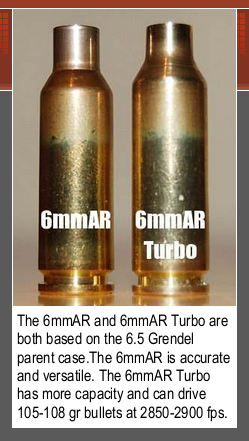 Robert reports: “I was able to get my hands on some of Hornady’s 6.5 Grendel brass. My big question was how it would measure up, particularly the loaded necks, and whether it would be compatible with our existing 6mmAR and Turbo 40 die sets. As it turns out, this brass looks like a perfect fit for our existing die sets (and obviously 6.5 Grendel die sets too). Accordingly, folks with existing die sets will be able to use the Hornady brass without any issues.” However, as the loaded neck on the Hornady brass is .001″ (one-thousandth) slimmer than Lapua brass, you may want to try a smaller bushing when sizing Hornady Grendel brass. Robert reports: “I was able to get my hands on some of Hornady’s 6.5 Grendel brass. My big question was how it would measure up, particularly the loaded necks, and whether it would be compatible with our existing 6mmAR and Turbo 40 die sets. As it turns out, this brass looks like a perfect fit for our existing die sets (and obviously 6.5 Grendel die sets too). Accordingly, folks with existing die sets will be able to use the Hornady brass without any issues.” However, as the loaded neck on the Hornady brass is .001″ (one-thousandth) slimmer than Lapua brass, you may want to try a smaller bushing when sizing Hornady Grendel brass.
The Hornady 6.5 Grendel brass has a LARGE Flash Hole, about .078″ versus .0591″ for Lapua brass. Dimensionally, the biggest difference is the shoulder diameter, with the Hornady brass measuring 0.428″ vs. 0.424″ for the Lapua brass. The Hornady is actually a better fit for 6mmAR chambers which are about 0.432″ at the shoulder. Interestingly, case H20 capacity is virtually identical. Water capacity of new, unfired Hornady 6.5 Grendel brass is 35.1 grains, while new, unfired Lapua Grendel brass holds 35.0 grains of H20. Both brands of Grendel brass increase to about 36.0 grains H20 capacity after firing and full-length sizing.
Here are some of the particulars of the Hornady cases:
| Hornady 6.5 Grendel Brass |
Lapua 6.5 Grendel Brass |
|
Flash hole diameter: ~ .078″
OAL of brass: Average 1.515″
Weight of cases: 111.7 to 113.0 grains
Web diameter, unfired: 0.4375″
Shoulder diameter, unfired: 0.428″
Loaded neck diameter: 0.2895″
6mmAR loaded neck: 0.270″ |
Flash hole diameter: 1.5mm (0.0591″)
OAL of brass: Average 1.515″
Weight of cases: 111.0 to 112.5 grains
Web diameter, unfired: 0.4385″
Shoulder diameter, unfired: 0.424″
Loaded neck diameter: 0.290″
6mmAR loaded neck: 0.271″ |
July 10th, 2016

Many Forum members have been looking for a good substitute for Hodgdon H4350 powder, which remains hard-to-find in many parts of the country. One of the best alternatives is IMR 4451, part of IMR’s new Enduron line of powders. Last year, top F-Class shooter Rick Jensen did a comparison between H4350 and IMR 4451, shooting the two powder in a wide range of temperatures. His data suggests that both powders show good temp stability.
Powder Comparison Test: H4350 vs. IMR 4451
Rick Jensen, Captain of the U.S. F-Open Rifle Team, has tested some of the new IMR 4451 powder. Rick and other team members were looking for a good powder that could replace Hodgdon 4350 which is difficult to obtain currently. The makers of IMR 4451 claim that it is not sensitive to temperature and that it delivers competitive accuracy. So far, Rick’s tests, done with a .284 Winchester and 180gr Berger Hybrids, appear to confirm those claims. Rick posts:
 “I did a little informal powder comparison of H4350 versus the new IMR 4451. Rifle used was a Kelbly Panda with a 30″, 1:8.75″ twist 5R Bartlein barrel [chambered in .284 Win]. All charge weights were 50.0 grains using CCI BR2 primers. I was very impressed with this new powder and I believe it to be equal to H4350 as far as temperature sensitivity. “I did a little informal powder comparison of H4350 versus the new IMR 4451. Rifle used was a Kelbly Panda with a 30″, 1:8.75″ twist 5R Bartlein barrel [chambered in .284 Win]. All charge weights were 50.0 grains using CCI BR2 primers. I was very impressed with this new powder and I believe it to be equal to H4350 as far as temperature sensitivity.
I did not test for accuracy but I will tell you my groups were pretty much equal between the two and all were in the .2-.3 MOA range. I will defiantly be shooting more of this powder in the weeks to come, assuming the supply chain will allow. It looks very encouraging to finally have a alternative to H4350 that we might actually be able to buy.”

Chronograph Results with Temps from 23° F to 101°
Here are chronograph results of a comparison test between IMR 4451 and H4350. Rick’s rifle was cleaned and allowed to cool between each test. Five fouling shots were fired before each test. Important: Note that for both Test #1 and Test #2, the powder order is reversed in the mid-temp fields (IMR 4451 first, then H4350). For the low and high temp entries, H4350 is listed first.

Here are the IMR 4451 fired cases, displayed Left to right, coldest to the hottest (in terms of case temp when fired). All charge weights were the same: 50.0 grains.

July 9th, 2016

Photo ©2016 by Dean Weingarten.
Are we seeing an end to the “desperate days” for .22 LR rimfire ammo? Are supplies finally starting to catch up to demand? At least one industry analyst thinks so. Gun journalist Dean Weingarten has been watching trends. Makers of .22 LR ammo have increased production by 20%. That’s a good thing. We are starting to see the effects, Dean observes, with increased supplies and falling prices for rimfire ammo. Here is Dean’s report from Arizona.
Report by Dean Weingarten, GunWatch.com:
I chanced to be at the local WalMart in Yuma, Arizona today (July 8, 2016). This is the store on the frontage road off of old Highway 8, East of town. Until Friday, June 24, 2016, I had not seen any .22 Long Rifle in the store for three years.
On that date, there were 2,300 rounds of CCI Mini-Mags and 1,000 rounds of CCI Standard Velocity. The Mini-Mags were in plastic 100-round boxes at $7.47 a box. The Standard Velocity were in paper, 50-round boxes at $3.47 a box.
Just 10 days later, on the 3rd of July, I was in the same store, and there were 1900 rounds of CCI Stinger, in 50-round boxes. It is premium .22 Long Rifle ammunition, and has always been pricey. The price was $6.47 for a box of 50, or a little under 13 cents a round. They also had CCI .22 Maxi-Mag, .22 magnum rimfire cartridges, for $13.47 a box of 50, or nearly 27 cents a cartridge. It has been scarce, but not as bad as the .22 Long Rifle.
Two sightings in 10 days after three years was remarkable.
.22 LR Ammo for 5.36 Cents Per Round
Today, the 8th of July, there were two cases of bulk pack Federal .22 Auto Match. That is 6,500 .22 Long Rifle cartridges.This is only five days after the previous sighting. The boxes contained 325 cartridges. [The clerk] was just opening the cases to stock the shelves when I showed up. She said there had been a couple of bricks of .22, but they had been purchased immediately.

Photo ©2016 by Dean Weingarten.
At $17.42 for 325 rounds of Auto Match .22, that is 5.36 cents per round. A little over two years ago, I wrote that the .22 ammunition bubble would be over when you saw .22 LR ammunition on sale below 4 cents a round:
“You will know that the bubble is close to the bottom when you see .22 LR on sale for below 4 cents per round. At the lowest, we might see .22 LR cartridges below $10 for 500.” Read Article from 6/7/2014.
Many dismissed my prediction. They said that we would never see .22 cartridges below 4 cents a round again. People said that I was crazy when gasoline was at $4 a gallon, and I wrote that we would see it below $2 in the future. It went below $2 a few months ago.
The .22 ammunition bubble is hanging on. The push for more Second Amendment infringements by the Obama administration keeps it inflated. But with only six months to go to the end of that administration, the bubble has become fragile. The .22 ammunition manufacturers have increased production by 20%. That puts a lot of strain on the bubble.
©2016 by Dean Weingarten. Permission to share is granted when this notice is included.
Link to GunWatch.com.
July 5th, 2016

Cartridge Choices for F-Class Competition
By Emil Kovan
Kovan Match Rifles LLC, www.matchrifles.com
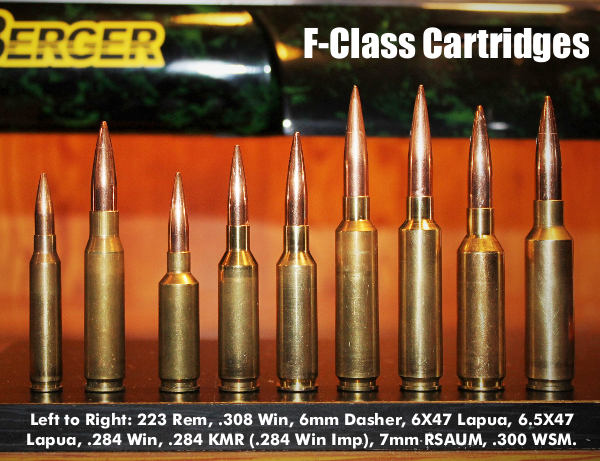
There are hundreds of cartridge types capable of winning in F-Open. For F-TR you can shoot either the .223 Rem or .308 Win, but you have many load options. This article will focus on proven choices, currently used by the top F-Class shooters in the world. Our discussion will analyze cartridge selection based on the four different F-Class sub-disciplines: Open Mid-Range, Open Long-Range, F-TR Mid-Range, and F-TR Long Range.
Click image to view full-screen photo.
Mid-Range F-Open Cartridges
For starters, a .300 WSM is certainly capable of winning mid-range matches but it is not ideal. So what is ideal, and why? F-Class Mid-Range matches usually are usually shot at 300, 500, or 600 yards — or all three. At those distances the 6mm and 6.5mm cartridges rule. In moderate conditions, the 6mm Dasher is unbeatable. Its low recoil along with its super grouping ability and good ballistics make it my number one choice for Mid-Range.
Best bullets for the 6mm Dasher are: Vapor Trail 103gr, Berger 105 Hybrid, 108 BT, and 105 VLD (hunting). Best powders are: Varget, H4895, and Reloder 15.
Choices for Mid-Range in Tougher Conditions:
We all know that conditions are not always “moderate” that’s why something a little bit bigger will save you a “Nine” or two. The 6.5X47 Lapua was designed for 300-meter competition, but as soon as it was released, it was adopted by F-Class, benchrest, and tactical shooters. It offers great ballistics with very low recoil and big “accuracy window”. Lapua makes great brass for it (no surprise there) and Berger makes great bullets: 130gr VLD, 140gr VLD, 140gr Hybrids. Best powders in most barrels are Varget and H4350, I don’t use double-based powders such as Reloder 17 and the Vihtavuori N500 series because of their unpredictable performance day to day (greater temp sensitivity).
The 6.5X47 Lapua necked down to 6mm is also a great option for mid range matches. I was able to easily get 3200 fps with 105 hybrids and H4350.
Choice for Long-Range F-Open Competition
In Long-Range F-Open Class (out to 1000 yards), the big, high-BC bullets rule. If I had to pick one cartridge for F-Class (both mid- and long-range) I would pick the .284 Winchester or one of its variants. The .284 Win is currently dominating in F-Open competition. It offers great barrel life, it is super-easy to tune and its recoil is very manageable. The best bullets for it by far (in my opinion), are the Berger 180 Hybrids. But Sierra’s new 183gr MK bullet (with factory-uniformed meplats) seems to perform very well as does the Berger 180 VLD. Best powders for the .284 Win are H4350 and H4831SC.

Long-Range Only F-Open Cartridge
As much as I like the .284 Win, for long-range competitions I like the .300 WSM even more. If you look at a .300 WSM and a 6mm Dasher side by side, they appear almost identical in geometry — the .300 WSM looks like an “super-sized” Dasher. Both cartridges are currently the “darlings” of long-range benchrest due to their extraordinary grouping ability and huge “node’’ windows. Big accuracy windows allow loads to perform well in different conditions and geographical locations. That’s obviously very important if you travel to compete. The .300 WSM loaded with Berger 215gr or 230gr Hybrids is very tough to beat at long range, and it is currently my number one choice.
The 7mm RSAUM is another outstanding long-range round. It resembles a 6BR on steroids and it is almost as easy to tune. Best bullets for it are Berger 180gr Hybrids, 195gr EOLs, and Sierra’s 183gr MatchKing. Best powders for the 7mm RSAUM are: H4350, H4831SC, and VV N160.
Top Caliber/Bullet Combos for F-TR
In F-TR competition, the choice is clear — a .308 Win throated for Berger 185gr BTLRs and 200gr Hybrids will win in mid-range AND long-range comps. Many championships have been won, and many records set with those two bullets in the .308 Win. To quote Danny Biggs (a two times FTR National Champion) “The 185 BTLR is the best bullet for .308 Win ever made”.
The Berger 215gr Hybrids have been used to win many competitions including recently the 2015 F-Class Nationals. Bryan Litz won both the Mid-Range and Long-Range 2015 Championships using 215s. Bryan’s rifle is shown below:

I recommend chambers throated for the 185/200 grain projectiles over the 215/230 grain bullets. The reason is that if you have your barrel throated out for the 215s or the 230s, you could have a “slow” barrel and max out on pressure before the desired velocity is reached. Optimum freebore for the 230s is too long for the 185/200s, so you would be limited to using only 215/230gr bullets in that barrel.Furthermore, the recoil increase with heavier bullets is substantial, causing the rifle to be more difficult to shoot.
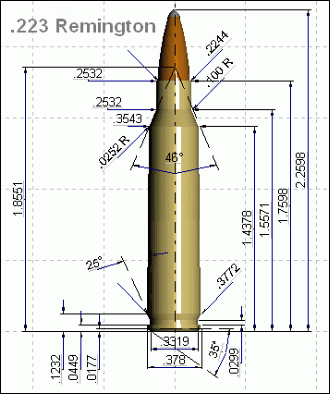 .223 Rem — Not A Competitive Option .223 Rem — Not A Competitive Option
I would stay away from the .223 Remington. On paper the 90gr VLD will shoot inside most .308 Win loads even at a 1000 yards. But in reality, on average, the .223 Rem, regardless of what powder/bullet combo is used, cannot compete with the .308 Win. [Editor: The equipment lists at major F-TR matches will confirm Kovan’s conclusion here.]
Conclusion (and Other Options)
This article covers only the (currently) most popular cartridge/bullet combos for F-Class (F-Open and F-TR). As I said in the beginning, many cartridge types are capable of winning but are not listed due to their low popularity, case design, or lack of quality components. All of the above information is based on my personal experience and it is meant to help new shooters choose the right cartridges for F-Class matches. Thanks for reading and good luck — Emil Kovan
 Emil Kovan Competition History: Emil Kovan Competition History:
– 2014 F-Class Open National Champion
– 2015 F-Class Open National Championship, Silver Medal
– F-Class Open National Championship Teams, 2015, 2014, 2013, Shooting Team Member
– Over 15 wins in Regional and State Championships in Palma, F-TR, F-Open
– 2013 U.S. National Team Member
– 2017 U.S. National Development Team Member
July 2nd, 2016

California Governor Jerry Brown just departed for a luxurious European vacation. But before he left the state, he savaged the Second Amendment rights of millions of California gun owners. Less than 24 hours after they arrived on his desk, Brown signed six anti-gun bills railroaded through the Democratic-controlled California Legislature. Among the bills signed by Brown was SB 1446 which will require Californians to forfeit, destroy, or ship out of the state ALL firearms magazines that can hold more than ten rounds. Owners of legally-obtained magazines, previously “grandfathered”, will receive no compensation though they must give up their property. Those who fail to comply will be fined and charged with an infraction, a low-level crime. This magazine restriction goes into effect July 1, 2017.
Gov. Brown also signed SB 1235 which will require background checks for the purchase of any and all ammunition. Ammo buyers’ names and personal information will be logged and tracked in a database.
Notice from NSSF RE California Legislation
The NSSF issued this statement: “The National Shooting Sports Foundation is extremely disappointed that Gov. Brown today chose to sign into law these highly restrictive and unneeded gun control measures, all of which will affect law-abiding Californians while doing nothing to stop the criminal misuse of firearms. By acting within 24 hours after being sent these bills, and not allowing the public to voice their opinions in order to depart for his European vacation, the governor compounded the miscarriage of legislative process and procedure while demonstrating disdain for Californians who now face laws that clearly infringe on their Constitutional rights.”
Gov. Brown SIGNED the following bills into law:
AB 1135 (Levine) and SB 880 (Hall) Firearms: Assault Weapons – Expands the definition of assault weapons based on whether a semiautomatic firearm has a detachable magazine, banning thousands of popular firearms.
SB 1235 (de Leon) Ammunition – Requires authorization to purchase ammunition and track what and how much ammunition each person buys, creating a database of ammunition purchasers.
SB 1446 (Hancock) Firearms: Magazine Capacity – Makes it illegal to possess magazines capable of holding more than 10 rounds no matter how long a person has owned them.
AB 1511 (Santiago) Firearms: Lending – Makes it illegal to loan a firearm to a person who is personally known to you (except for family members with restrictions).
AB 1695 (Bonta) Firearms: False Reports – Creates a 10-year prohibition on owning firearms for someone convicted of falsely reporting a lost or stolen firearm.
Gov. Brown VETOED the following bills:
SB 894 (Jackson) Firearms: Lost or Stolen: reports – Would have made it a crime not to report lost and stolen firearms to law enforcement within the arbitrary time limit.
AB 1673 (Gipson) Firearms: Unfinished frame or receiver – Would have expanded the definition of a firearm to include partially finished frames and receivers (no definition of what this means) and require their registration.
AB 1674 (Santiago) Firearms: Transfers – Would have made it illegal to buy or receive more than one firearm in any 30-day period.
If you wish to Contact Gov. Brown’s office to voice your concern about his signing of six anti-gun measures, here is the contact information:
|
Governor Jerry Brown
c/o State Capitol, Suite 1173
Sacramento, CA 95814 |
Phone: (916) 445-2841
Fax: (916) 558-3160
E-mail: https://govnews.ca.gov/gov39mail/mail.php |
July 2nd, 2016

Here’s a good deal — Creedmoor Sports is offering free ground shipping this weekend to celebrate Independence Day. Buy all you want from the Creedmoor Sports website, and ground shipping is FREE, from Friday, July 1 through Monday, July 4th, ending at midnight Pacific Daylight Time.
AUTOMATIC DISCOUNT: Creedmoor’s free shipping discount is automatic. You don’t need to enter a coupon or promo code during online checkout. Just make your purchases and the shipping will automatically be free. For more info, or to place an order, visit www.CreedmoorSports.com or www.CreedmoorAmmo.com.
This 4th of July weekend special applies to Creedmoor’s full line of shooting accessories — everything from range supplies and reloading components, to gloves, slings, gun cases and targets, and much more. Along with FREE Shipping (contiguous USA only) Creedmoor is offering 10% off shirts, 10% off Anschutz shooting coats, and 15% off books.
The Free Shipping offer also covers Creedmoor-brand ammo, which is very good stuff. Creedmoor rifle ammunition is offered in popular centerfire calibers from .223 Rem to .308 Win, with numerous load options. Creedmoor pistol ammunition is offered in .380 Auto through .45 ACP, with many bullet weight/type options.

Creedmoor Ammunition is made from all new, top-shelf components (no cheap or reclaimed components) and every round is hand-inspected. Creedmoor ammunition is loaded in state-of-the-art AmmoLoad machines that are typically run at half the recommended speed to produce a more uniform, consistent load.
|


