“The overturning moment MW tends to rotate the bullet about an axis, which goes through the CG (center of gravity) and which is perpendicular to the plane of drag….
Ruprecht Nennstiel, a forensic ballistics expert from Wiesbaden, Germany, has authored a great resource about bullet behavior in flight. Nennstiel’s comprehensive article, How Do Bullets Fly, explains all the forces which affect bullet flight including gravity, wind, gyroscopic effects, aerodynamic drag, and lift. Nennstiel even explains the rather arcane Magnus Force and Coriolis Effect which come into play at long ranges. Nennstiel’s remarkable resource contains many useful illustrations plus new experimental observations of bullets fired from small arms, both at short and at long ranges.
Shadowgraph of .308 Winchester Bullet
A convenient index is provided so you can study each particular force in sequence. Writing with clear, precise prose, Nennstiel explains each key factor that affects external ballistics. For starters, we all know that bullets spin when launched from a rifled barrel. But Nennstiel explains in greater detail how this spinning creates gyroscopic stability:
Sierra Bullets recently profiled Mike Walker, Remington engineer and first president of the National Benchrest Shooters Association (NBRSA). In the vintage photo above, Mike is shown with his Remington-actioned benchrest rifle at the 1994 Super Shoot. Mike had reason to smile — at that 1994 event, Walker set a 100-yard small group record with a phenomenal .046″ five-shot group. Mike was truly one of the “founding fathers” of modern benchrest shooting. As Sierra notes: “The field of rifle accuracy and the sport of benchrest shooting would be very different today, were it not for this man.”
Along with Remington Engineer Jim Stekl, Mike Walker helped develop a wildcat that became the 6mmBR cartridge. The original 6mm Benchrest Remington wildcat was a necked-down .308 x 1.5″ Barnes cartridge. That Barnes cartridge was derived from the .308 Winchester case, as shortened to 1.5 inches. The parent .308 Win case has a large primer pocket (though Remington did make a special run of small primer pocket .308 brass). Remington later made factory small primer pocket 6mm BR Rem brass. Compared to the original 6mm BR Remington case, the modern 6mmBR Norma cartridge has very slightly different dimensions, with a small primer pocket and a small 1.5mm (0.059″) flash-hole.
In the not-too-distant future, U.S. military snipers may be able to steer bullets right to the target, thanks to DARPA, the Defense Advance Research Projects Agency. Believe it or not, DARPA has developed a guided .50-caliber projectile fired from a conventional rifle action. DARPA’s Extreme Accuracy Tasked Ordnance (EXACTO) system combines a maneuverable bullet and a real-time guidance system to track and steer the projectile to the target. Inside EXACTO bullets are optical guidance systems, aero-actuation controls, and multiple sensors. The top-secret technology permits the trajectory of the bullet to be altered in flight, allowing the bullet to move left or right, or even fly in an arc around an obstacle.
Following Sierra’s introduction of Tipped MatchKing (TMK) bullets, Bryan Litz of Applied Ballistics LLC has received many requests to determine the Ballistic Coefficient (BC) of these bullets through testing. Below are Litz’s findings for four out of the six bullets he has able to acquire and test so far.
As you can see from the above table, when Sierra’s G1 BC is averaged for all speed ranges (which is representative of long range shooting) the results closely match the Applied Ballistics’ measurements of the same bullets, averaged from 3000 to 1500 FPS. The G7 BC doesn’t suffer nearly the velocity sensitivity as G1 and should be used for modern long range bullets when possible. Bryan tells us: “When I get the .22 caliber 77gr, and the .308 caliber 168gr tested, I’ll update the table.”
How do these Tipped MatchKings compare to standard MatchKings? According to Bryan’s measurements, here are some comparisons:
The 69gr TMK BC is +8% compared to the 69gr SMK
The 125gr TMK BC is -5% compared to the 125gr SMK (Litz believes this SMK was ‘pointed’)
The 155gr TMK BC is identical to that of the 155gr SMK (#2156, which is also pointed)
The 175gr TMK BC is +10% compared to the 175gr SMK
Bryan provided this additional advice for users of Ballistics programs: “Sierra’s stated BCs are measured by live fire, and are typically pretty accurate if the velocity bands are properly observed (7mm being the exception). A common error is to look at the BC that Sierra gives for your MV and just use that. Doing so overestimates the performance of the bullets over long range, and will cause you to hit low compared to your trajectory predictions.”
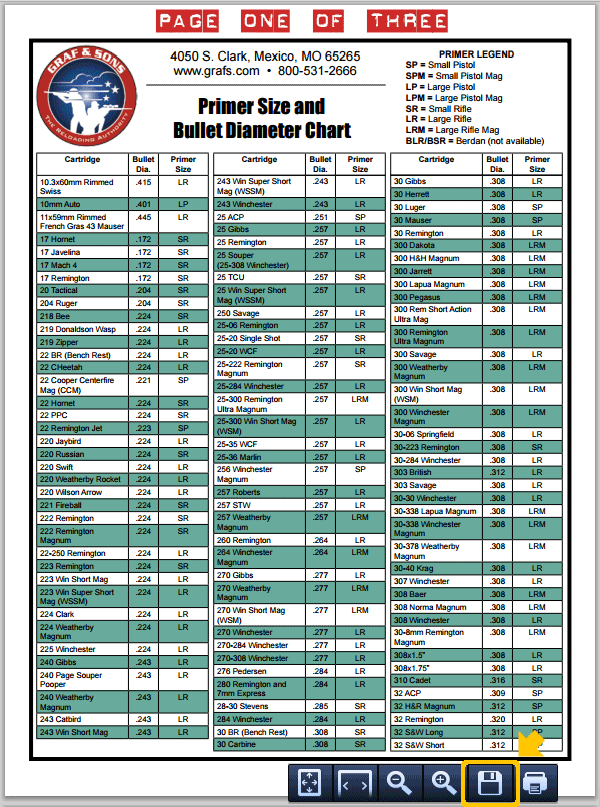
OK, guys, it’s time to practice your downloading skills. Here’s a very handy cartridge information sheet you will definitely want to save for future reference. Shown below is Page One of the Primer Size and Bullet Diameter Chart created by Graf & Sons. This chart shows the bullet diameter and primer size for more than 320 popular cartridges*. The full three-page chart is available in PDF format for easy printing.
NOTE: If you have the PDF reader installed in your browser, the Graf’s Chart may open in a new tab when you click on the image above. To save the three-page PDF file to your computer or device, click the Floppy Disc icon that appears in the lower right (after the PDF file opens). Here is the direct link:http://www.grafs.com/uploads/technical-resource-pdf-file/12.pdf.
Note: There are a few mistakes. If you are making 22 BR from Lapua brass, you’ll want a small rifle primer. Likewise with 25-20 WCF, you want a small primer.
Resource Tip from EdLongrange. We welcome reader submissions.
What cartridge would your chose to hit targets at long range … extremely long range, as in 2500 yards? Well, for ace competitive shooter Darrell Buell, the answer is the .338 Allen Magnum, a .408 Cheytac necked down to .338. This “super-sized” cartridge flings .338-caliber, 300-grain Berger Hybrid bullets at 3450 fps. That delivers some impressive ballistics at ultra-long range. Darrell got to “test-drive” a .338 Allen Magnum rifle at 2500 yards (1.42 miles) while teaching a Long-Range Seminar at the Legion Operator Training Group (OTG) Facility in Blakely, Georgia.* The rifle belonged to Christopher Sykes.
Shown below is the 338 Allen Magnum (AM) next to a .308 Winchester round loaded to an extremely long OAL. The .338 Allen Magnum is a wildcat based off the .408 Cheytac (Cheyenne Tactical) parent case. The cartridge’s inventor, Kirby Allen, states: “The .338 Allen Magnum, when loaded with a 300gr SMK, offers a legit 500 to 600 FPS velocity advantage over the 338 Lapua Magnum”.
Darrell says: “Yeah, it’s a beast [but] with that brake, it kicks less than my .308 competition rifle. It’s got more energy at 2500 yards than a .45 ACP has at the muzzle. The .338 Allen cartridges are standing next to the SEB Joy-pod, along with a standard .338 Lapua Magnum cartridge. With the excellent muzzle brake on the .338 Allen, I could spot my own hits with just the slightest twitch of the joystick. The rifle was not particularly heavy, consequently the pod would hold the crosshairs where you left them without a hand on the joystick.”
When you look at a loading manual with load data, you will usually see pressure ratings for stated load. Sometimes these are listed in PSI numbers, which most people correctly understand to be Pounds per Square Inch of pressure. However, powder-makers also commonly list pressure in CUP numbers. CUP stands for Copper Unit of Pressure. You may be asking — “What exactly is a CUP, and what is the origin of that unit of measurement?” You may also be wondering — “What’s the difference between CUP pressures and PSI pressures?” On Hodgdon’s Facebook Page, you’ll find answers to these questions.
Q: What is CUP?
A: Copper Unit of Pressure (CUP) is a measurement used in the ammunition industry to determine the chamber pressure created by a cartridge load. Originally, a precisely formed copper slug was placed in a fixture over the chamber. When the cartridge was fired, the amount of crushing measured on the slug allowed engineers to determine the pressure.
These days, modern electronic transducers provide faster, more accurate measurements of chamber pressures in pounds per square inch (PSI). CUP and PSI are measured to different scales and are NOT interchangeable.
Here’s a great video from German ammo-maker GECO (part of the Swiss RUAG group of companies). Employing advanced 3D rendering and computer graphics, this animation unveils the inside of a pistol cartridge, showing jacket, lead core, case, powder and primer. Next the video shows an X-ray view of ammo being loaded in a handgun, feeding from a magazine.
Then it really gets interesting. At 1:32 – 1:50 you’ll see the firing pin strike the primer cup, the primer’s hot jet streaming through the flash-hole, and the powder igniting. Finally you can see the bullet as it moves down the barrel and spins its way to a target. This is a very nicely-produced video. If you’ve ever wondered what happens inside a cartridge when you pull the trigger, this video shows all. They say “a picture’s worth a thousand words”… well a 3D video is even better.
For Best Viewing, Click Gear Symbol and Select HD Playback Mode
Shoot 101 Quiz
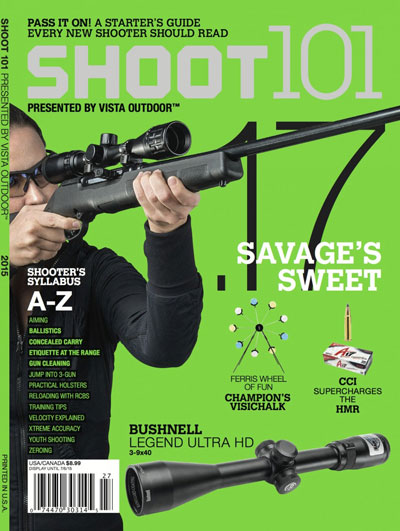
Vista Outdoors (formerly ATK Sporting Group) has launched a new multi-platform media campaign called Shoot 101. Combining print, web, and television, Shoot 101 provides “how to” information about shooting, optics, and outdoor gear.
On the Shoot 101 website, you’ll find a Ballistics Quiz. The questions are pretty basic, but it’s still fun to see if you get all the answers correct.
You don’t need a lot of technical knowledge. Roughly a third of the questions are about projectile types and bullet construction. Note, for some reason the layout doesn’t show all the possible answers at first. So, for each question, be sure to scroll down using the blue scroll bar on the right.
By Dennis Santiago Competition teaches you things. Compared to loading for benchrest bolt guns, producing ultra-reliable and accurate ammo for tight-chambered, semi-auto .308 target rifles requires a different approach to case prep. Smoothness of operation is much more important in a field course gun. Reliability trumps everything (even case life) for these types of guns.
In the photo below, there’s a Redding small base body die for bumping the shoulder and making sure the case body is at SAAMI minimum. This body die is not just nice to have. It is vital. There are also a full-length sizing die and a Lee Collet neck-sizer in that turret holder. One or the other gets used after the body size die depending on what rifle the ammo will be used in. The semi-auto rounds always go through the full-length sizing die. After that comes trimming and finally cleaning — then loading can begin. The cases are trimmed using a Gracey trimmer so everything’s the same each and every time. I use an RCBS Competition Seater Die to seat the bullets. One nice feature of this RCBS die is the open side slot that allows you to place bullets easily.
It’s a long path methodology but uniformity is accuracy. More important for safety, controlling “stack-up” errors in the system solution is how one achieves reliability. The chamber-hugging philosophies of benchrest bolt guns do not apply well to AR-10s. Like most things, the right answer is context-dependent. Success is about accepting and adapting.
Dennis Talks About Using a Semi-Auto in Tactical Competitions
I have succumbed to the Dark Side — deciding to put an AR-10 together. For tactical competitions you want a bolt gun most of the time but there are times the course of fire favors the use of a semi-auto. I was using an M1A that gives me 0.75 MOA performance but I heard people were getting almost bolt-gun-level, half-MOA accuracy out of their AR-10s — so I wanted to see if that was really achievable. A quarter-MOA difference in accuracy potential may seem tiny in practical terms but it will make a difference in competition. In a match, the difference between 3/4-MOA and 1/2-MOA can alter your hit probability on a small target by 20-30%.
The AR platform also lets you tinker with triggers, stock ergonomics and muzzle brakes that help in managing the dynamics of a long distance shot better. Well I found out you can get the incremental accuracy but there’s more work to do to get the same reliability. Being a curious sort, it’s worth it to me to explore it. It’s a far cry from as-issued M-1 shooting with whatever HXP is handy. This is definitely swimming in the deep end of the pool.




 When you look at a loading manual with load data, you will usually see pressure ratings for stated load. Sometimes these are listed in PSI numbers, which most people correctly understand to be Pounds per Square Inch of pressure. However, powder-makers also commonly list pressure in CUP numbers. CUP stands for Copper Unit of Pressure. You may be asking — “What exactly is a CUP, and what is the origin of that unit of measurement?” You may also be wondering — “What’s the difference between CUP pressures and PSI pressures?” On Hodgdon’s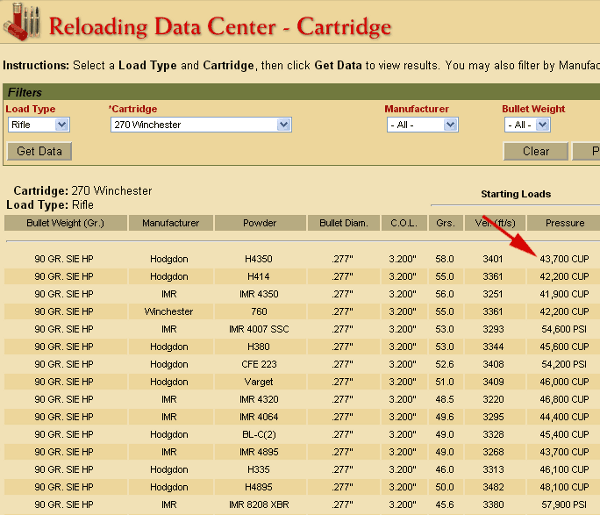
 Here’s a great video from German ammo-maker


 Shoot 101 Quiz
 Competition teaches you things. Compared to loading for benchrest bolt guns, producing ultra-reliable and accurate ammo for tight-chambered, semi-auto .308 target rifles requires a different approach to case prep. Smoothness of operation is much more important in a field course gun. Reliability trumps everything (even case life) for these types of guns.


