Ever wonders what the bar code (and all those numbers) mean on the side of a box of Sierra bullets? Well here’s the answer, thanks to something we uncovered in the archives of the Sierra Bullets Blog.
How to Decipher Sierra Bullets Barcodes
The Lot Number (indicated in green below) identifies a specific batch of bullets. The lot number remains the same for bullets made at the same time from the same material.
The Packaging Code (indicated in blue below) is an internal number representing the number assigned to the persons who inspected and packed the box of bullets.
The Serial Number (indicated in yellow below) is a computer generated number sequentially added to each box of bullets made.
The Bureau of Alcohol, Tobacco, Firearms and Explosives (ATF) is seeking to ban commonly-used 5.56 M855 “green tip” ball ammunition as “armor piercing ammunition” and is seeking public comment on the proposal. The National Shooting Sports Foundation (NSSF) urges target shooters and gun owners to contact ATF to oppose this proposed ban.
For decades, under the “sporting purposes” doctrine, commonly-available “green tip” M855 and SS109 rifle ammunition has been exempt from federal law banning armor-piercing ammunition. There is no question that this 5.56 ball ammo has been widely used by law-abiding American citizens for sporting purposes.
Winchester-brand 5.56X45 62gr NATO M855 FMJ Ammunition
The NSSF has an online form that makes it easy to voice your opinion on the proposed ban on 5.56 ball ammo. This form will direct your comments to Congress and/or the ATF. Click the button at right to navigate to the NSSF online form.
Commentary by Jim Shepherd, The Shooting Wire
Should the ATF reclassify surplus (and widely used) M855 and SS109 ammunition as armor-piercing, it would then be illegal for consumer consumption. This weekend, we received word that apparently many gun owners didn’t find this to be a compelling reason to record their objections with the federal government. With only a few days remaining in the ATF’s solicitation of comments, fewer than 6,000 shooters have registered their displeasure with the proposal.That, as one of my least-favorite instructors used to say, is simply unacceptable.”
Here’s something you don’t see every day — pistol-caliber Lapua brass. We shoot superior Lapua brass in our rifles, and now you can get the “good stuff” for your 9mm pistols too. It’s nice to know that Lapua 9mm brass is available for those guys who accept “nothing but the best”. Grafs.com received a special order of 9mm Luger (aka 9x19mm or 9mm NATO) pistol brass made by Lapua. It is available right now for $19.99 per 100-count bag or $179.99 per 1000-count box. That’s 38% off the regular 1K box price.
When It Pays to Shoot Premium Pistol Brass
Is this Lapua 9mm brass worth the price compared to the cheaper alternatives (such as once-fired police range pickups)? We think the answer depends on your application. If you shoot a 9mm pistol in Bullseye competition, yes it makes sense to get the Lapua. Or, if you have a 9mm revolver that carries the shells in a moon clip, the Lapua brass may be worth getting. With a 9mm revolver, your brass is not marred by an extractor claw and then ejected on to the ground. If we had the impressive new 8-shot, Miculek Edition Smith & Wesson model 929 9mm revolver (below), we’d definitely shoot Lapua brass.
Rick Jensen, Captain of the U.S. F-Open Rifle Team, recently tested some of the new IMR 4451 powder. Rick and other team members were looking for a good powder that could replace Hodgdon 4350 which is difficult to obtain currently. The makers of IMR 4451 claim that it is not sensitive to temperature and that it delivers competitive accuracy. So far, Rick’s tests, done with a .284 Winchester and 180gr Berger Hybrids, appear to confirm those claims. Rick posts:
“I did a little informal powder comparison of H4350 versus the new IMR 4451. Rifle used was a Kelbly Panda with a 30″, 1:8.75″ twist 5R Bartlein barrel [chambered in .284 Win]. All charge weights were 50.0 grains using CCI BR2 primers. I was very impressed with this new powder and I believe it to be equal to H4350 as far as temperature sensitivity.
I did not test for accuracy but I will tell you my groups were pretty much equal between the two and all were in the .2-.3 MOA range. I will defiantly be shooting more of this powder in the weeks to come, assuming the supply chain will allow. It looks very encouraging to finally have a alternative to H4350 that we might actually be able to buy.”
Chronograph Results with Temps from 23° F to 101°
Here are chronograph results of a comparison test between IMR 4451 and H4350. Rick’s rifle was cleaned and allowed to cool between each test. Five fouling shots were fired before each test. Important: Note that for both Test #1 and Test #2, the powder order is reversed in the mid-temp fields (IMR 4451 first, then H4350). For the low and high temp entries, H4350 is listed first.
Here are the IMR 4451 fired cases, displayed Left to right, coldest to the hottest (in terms of case temp when fired). All charge weights were the same: 50.0 grains.
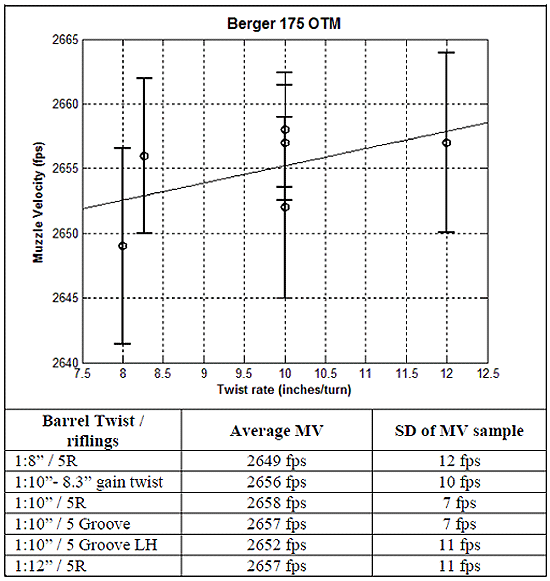
The Applied Ballistics team tested six (6) same-length/same-contour Bartlein barrels to observe how twist rate might affect muzzle velocity. This unique, multi-barrel test is featured in the book Modern Advancements in Long Range Shooting. That book includes many other fascinating field tests, including a comprehensive chronograph comparison.
Barrel Twist Rate vs. Velocity — What Tests Reveal by Bryan Litz
When considering barrel twist rates, it’s a common belief that faster twist rates will reduce muzzle velocity. The thinking is that the faster twist rate will resist forward motion of the bullet and slow it down. There are anecdotal accounts of this, such as when someone replaces a barrel of one brand/twist with a different brand and twist and observes a different muzzle velocity. But how do you know the twist rate is what affected muzzle velocity and not the barrel finish, or bore/groove dimensions? Did you use the same chronograph to measure velocity from both barrels? Do you really trust your chronograph?
Savage Test Rifle with Six Bartlein Barrels
Most shooters don’t have access to the equipment required to fully explore questions like this. These are exactly the kinds of things we examine in the book Modern Advancements in Long Range Shooting. In that book, we present experiments conducted in the Applied Ballistics lab. Some of those experiments took on a “Myth Buster” tone as we sought to confirm (or deny) popular pre-conceptions. For example, here’s how we approached the question of barrel twist and muzzle velocity.
Six .308 Win Barrels from Bartlein — All Shot from the Same Rifle
We acquired six (6) barrels from the same manufacturer (Bartlein), all the same length and contour, and all chambered with the same reamer (SAAMI spec .308 Winchester). All these barrels were fitted to the same Savage Precision Target action, and fired from the same stock, and bench set-up. Common ammo was fired from all six barrels having different twist rates and rifling configurations. In this way, we’re truly able to compare what effect the actual twist rate has on muzzle velocity with a reasonable degree of confidence.
Prior to live fire testing, we explored the theoretical basis of the project, doing the physics. In this case, an energy balance is presented which predicts how much velocity you should expect to lose for a bullet that’s got a little more rotational energy from the faster twist. In the case of the .30 caliber 175 grain bullets, the math predicts a loss of 1.25 fps per inch-unit of barrel twist (e.g. a 1:8″ twist is predicted to be 1.25 fps slower than a 1:9″ twist).
Above, data shows relationship between Twist Rate and Muzzle Velocity (MV) for various barrel twist rates and rifling types. From fast to slow, the three 1:10″ twist barrels are: 5R (canted land), 5 Groove, 5 Groove left-hand twist.
We proceeded with the testing in all 6 barrels from 1:8” to 1:12”. After all the smoke cleared, we found that muzzle velocity correlates to twist rate at the rate of approximately 1.33 fps per inch of twist. In other words, your velocity is reduced by about 5 fps if you go from a 1:12” twist to a 1:8” twist. [Editor: That’s a surprising number — much less than most folks would predict.] In this case the math prediction was pretty close, and we have to remember that there’s always uncertainty in the live fire results. Uncertainty is always considered in terms of what conclusions the results can actually support with confidence.
This is just a brief synopsis of a single test case. The coverage of twist rates in Modern Advancements in Long-Range Shooting is more detailed, with multiple live fire tests. Results are extrapolated for other calibers and bullet weights. Needless to say, the question of “how twist rate affects muzzle velocity” is fully answered.
Other chapters in the book’s twist rate section include: · Stability and Drag – Supersonic
· Stability and Drag – Transonic
· Spin Rate Decay
· Effect of Twist rate on Precision
Other sections of the book include: Modern Rifles, Scopes, and Bullets as well as Advancements in Predictive Modeling. This book is sold through the Applied Ballistics online store. Modern Advancements in Long Range Shooting is also available in eBook format in the Amazon Kindle store.
Need quality .22 LR rimfire ammo at an affordable price? Consider Norma. Most folks think Norma only produces centerfire ammo and cartridge brass. As a result, people haven’t been looking for Norma rimfire ammo. Their loss is your gain. Accurate, reliable Norma .22 LR ammunition is in-stock right now at leading online vendors. This is good quality ammo, made in Europe. Watch video review below.
Grafs.com has Norma Match-22 Ammo in-stock at $8.99 per 50-rd box (Item NA2318980). NOTE: Graf’s also has a wide selection of ELEY match ammo in stock, starting at $13.79 per 50-rd box.
Summary by .22 Plinkster (see 4:30 time mark): “I’m pretty impressed with it … I think it’s a really good deal. For six dollars and fifty cents [per box] you can’t go wrong with a box of this ammo. Out of a good bolt gun, this ammo will drive tacks.”
Here’s an important technology for ranges concerned with over-flight risks. Regular Bulletin readers will recall that we recently warned of the dangers of bullets launched with a high trajectory. (READ Article.) With a muzzle elevation of just 5°, a conventional bullet can fly over 3000 yards, retaining enough energy to kill. General Dynamics has come up with a solution for live-fire training programs that don’t require long-range target engagements. General Dynamics’ Short Stop® ammunition launches bullets that literally drop out of the air within 600 meters. What’s the secret to the short flight? Read on…
Short Stop 5.56x45mm and 7.62x51mm Ammunition Trajectory
This illustration shows the trajectories of 5.56 and 7.62 Short Stop bullets (yellow zone) compared to conventional rifle projectiles (black lines). You can see the “flight cycle” is completely different.
Short Stop ammunition employs advanced polymer/copper composite bullets with molded “fins”. The bullets sort of look like the end of a Phillips screwdriver (except the fins have a slight twist near their base). This “twisted fin” design causes the bullets to yaw, and that, in turn induces aerodynamic drag — a lot of drag. The molded bullets are also much lighter than conventional bullets (of the same caliber). The reduced weight/density gives them less momentum, so they lose velocity more readily than normal bullets. The combination of the low mass and high drag makes these bullets drop from the air within 600m or so, living up to their “Short Stop” designation.
In an interview with NRABlog.com, General Dynamics Bus. Dev. Manager Ruben Regalado explained how the Short Stop ammunition works. With this design, he says, “You can do a lot of the training you would do with a ball round with no fear of overflight. It’s the fin that does it. Due to the nature of its composition [the bullet] is lighter than the standard projectile, but the magic is in the fin.”
There are many potential applications for Short Stop rounds according to NRABlog Editor Lars Dalseide: “Where do these rounds come into play? Anywhere. Anywhere there’s military training, law enforcement training, or basic target shooting taking place. And with the encroachment of communities surrounding your favorite neighborhood range, [projectiles] that drop out of the air at 600 meters means the risk of overflight is significantly reduced.” The polymer-composite bullets are also frangible, so there is less penetration of objects and less chance of ricochet.
“Smurf” Bullets for .50 Caliber AA Rifles
Bryan Litz of Applied Ballistics has seen ammo similar to Short Stops used in .50-caliber rifles for training purposes. Bryan tells us: “Similar rounds have been available for .50 cal for many years. We find [the spent bullets] on the range at Camp Grayling (a Michigan National Guard training facility where we hold 1000-yard matches). The .50 cal rounds use blunt plastic things (we call them ‘Smurf’ bullets) and they use them for practicing anti-aircraft shooting. Instructors put up an RC target drone and the Guardsmen shoot at it with the .50s using the short range ammunition.”
Bryan says these “short flight” bullets have an important purpose, though the applications remain limited. “These kind of projectiles are a good tool for applications where an adequate SDZ (Surface Danger Zone) cannot be secured for the range location. I just hope the application remains confined to only those places where it’s necessary, i.e. where the SDZ presents a problem. I would hate to see our bullet options be limited to something like this under the guise of ‘range safety’, where the SDZ is properly secured.”
Our friend Anette Wachter, a member of the 2015 U.S. Palma Team, recently tested some .308 Win ammo from Eagle Eye Precision. We have heard good things about this ammunition, and Anette (aka 30 Cal Gal) confirms that it shoots great. Here is her impressive 200-yard test target. Anette posted: “Most amazing out of box ammo I have shot. First six rounds at 200 yards test [is shown at right].”
0.212 MOA at 200 yards
Using OnTarget group-measuring software, we measured Anette’s 6-shot group at 0.445″ (center-to-center). That’s 0.212 MOA. That’s right, Anette’s group measured under quarter-MOA at 200 yards. For reference, a dime is 0.705″ in diameter.
Anette’s Group was measured with On-Target Software.
Another U.S. Palma Team member, Top Shot competitor Kelly Bachand, has also tried Eagle Eye ammo. Kelly came away very impressed: “I’ve personally tested this ammunition and in my initial tests it was as consistent as anything I can hand-load myself. Eagle Eye Precision Ammunition is on the up and up, you’ll have to check it out.”
Eagle Eye Ammo is Verified to Shoot 1/2 Minute of Angle or Better
Remarkably, every lot of Eagle Eye ammunition is rifle-tested for accuracy. If it doesn’t shoot 1/2-MOA or better, it will not ship. Obviously Eagle Eye can’t guarantee its ammo will shoot this well in every customer’s rifle, but this is still an impressive standard. Eagle Eye states:
“At Eagle Eye Precision we guarantee every lot is tested to 1/2 minute of angle or better. One minute of angle equates to approximately 1 inch at 100 yards and 1/2 minute of angle is approximately 1/2 inch at 100 yards. For comparison, the diameter of a dime is approximately 0.7 inches. Therefore, Eagle Eye Precision 1/2 minute of angle (0.5 inch) groups are smaller than a dime at 100 yards. Eagle Eye Precision ammunition is test fired with real rifles (not accuracy barrels bolted to a bench) at 100 yards. If the group size from the test exceeds 1/2 inch we reject and scrap the lot. If we are not absolutely certain a lot of ammunition can shoot 1/2 minute of angle we do not ship it to customers.”
In her latest video, Kirsten Joy Weiss shows off the 300 AAC Blackout, a popular .30-caliber cartridge for AR-platform rifles. Kirsten explains the advantages for the 300 BLK for hunters as well as those using an AR for self-defense. The 300 BLK is popular with suppressor owners because it works well with heavy bullets launched at subsonic velocities.
Reasons to Shoot a 300 AAC Blackout:
— You can use your current AR Bolt, Bolt Carrier, Buffer, and Magazine. The only part you need to change is the barrel.
— 300 BLK conforms to state hunting regulations which may require a cartridge larger than .22 Caliber. The 300 BLK shoots .308 caliber bullets.
— Lapua now sells 300 AAC Blackout brass so no case-forming is required. Just load and shoot.
— You can shoot light bullets supersonic or heavier bullets subsonic. The subsonic capabilities of the 300 BLK make it ideal for use with a suppressed AR.
— With a .30-caliber bore and a modest powder charge, barrel life is outstanding with the 300 BLK.
— You can make 300 BLK cartridges from fired .223 Rem brass, which is plentiful and cheap.
— The .300 BLK performs well with some very accurate powders, such as Hodgdon H4198 and IMR 4227.
The 300 AAC Blackout was created by Advanced Armament Corp. and Remington primarily for the military as a way to shoot .30-caliber bullets from the M4/AR15 platform while using standard magazines. As explained by Robert Silvers, AAC’s R&D Director: “Now there is a way to shoot 30 caliber from your AR while still using normal magazines with full capacity. Even the bolt stays the same, and all that changes is the barrel.” For more information visit www.300aacblackout.com and download the 300 BLK Cartridge Information Guide (PDF).
SAAMI, the industry standards organization, adopted and standardized the AAC 300 Blackout in 2010. The SAAMI diagram for the 300 BLK is shown above. Lapua now makes 300 BLK cartridge brass.
300 BLK for 3-Gun Competition
The 300 AAC Blackout has been touted as an important new hunting round, but we see it more as a specialized “rule-beater” 30-cal option that lets 3-Gun competitors “make major” with a low-recoil cartridge that also offers long barrel life. For those who need to run a .30-caliber cartridge from a standard AR15 platform (as opposed to the AR10), the 300 AAC Blackout makes some sense. But for hunters using a bolt gun, there are any number of tried and true options, such as the 7.62×39, .30-30, and, of course, the .308 Winchester (7.62×51 NATO).
Nosler has just introduced a new cartridge, the 28 Nosler. This new 7mm hunting round delivers magnum-class velocities in a cartridge that fits a standard action. The 28 Nosler is capable of launching a 160gr Accubond at 3300 fps. The 28 Nosler uses the same parent case as the 26 Nosler, introduced in 2014. Designed for a maximum COAL of 3.340″, the 28 Nosler will operate in a standard action that is lighter (and more compact) than a magnum action.
The 28 Nosler offers serious knock-down power for the long-range hunter. The factory 185gr Accubond load retains over 2000 ft/lbs. of energy at 600 yards, and remains supersonic well past 1000 yards. Nosler factory ammo will be offered with 160gr and 185gr bullet-weight options.
Previewing the 28 Nosler:
For hand-loaders, Nosler will also offer 28 Nosler cartridge brass. It will be interesting to see whether some F-Class competition shooters experiment with the 28 Nosler (and heavy match bullets) as an alternative to the .284 Winchester or short magnums (WSM or RSAUM).


 The Bureau of Alcohol, Tobacco, Firearms and Explosives (ATF) is seeking to ban commonly-used 5.56 M855 “green tip” ball ammunition as “armor piercing ammunition” and is seeking public comment on the proposal. The National Shooting Sports Foundation (NSSF) urges target shooters and gun owners to contact ATF to oppose this proposed ban.


 “I did a little informal powder comparison of H4350 versus the new IMR 4451. Rifle used was a Kelbly Panda with a 30″, 1:8.75″ twist 5R Bartlein barrel [chambered in .284 Win]. All charge weights were 50.0 grains using CCI BR2 primers. I was very impressed with this new powder and I believe it to be equal to H4350 as far as temperature sensitivity.




 This illustration shows the trajectories of 5.56 and 7.62 Short Stop bullets (yellow zone) compared to conventional rifle projectiles (black lines). You can see the “flight cycle” is completely different.
 “Smurf” Bullets for .50 Caliber AA Rifles

 Our friend


 Nosler has just introduced a new cartridge, the


