|
|
March 15th, 2014
Now that Lapua is making very high-quality .221 Fireball brass, those of you who own an AR may be considering a 300 AAC Blackout project. For AR shooters, the 300 Blackout (300 BLK) offers the ability to fire a heavy-weight bullet from standard AR15 magazines. When loaded to supersonic velocities with heavy bullets, this little cartridge packs more punch than a 30-30 round. Alternatively, when loaded to sub-sonic velocities, the 300 Blackout is ultra-quiet when used with a suppressor.

Writing for the CTD Shooter’s Log, CTD Mike has authored a good Beginners’ Guide to the 300 AAC Blackout. This explains the basics of this interesting cartridge, which is a .30-caliber round that works with existing AR15 magazines and upper. You can purchase 300 Blackout factory ammunition or you can load your own. The easiest way to make 300 Blackout cartridges is to neck-up Lapua .221 Fireball brass. But if you have hordes of .223 Rem brass, you can also cut those cases down and reform them into 300 Blackout. But that is much more work. With Lapua .221 Fireball brass, you lube the inside of the necks, expand, and you’re good to go.

300 Blackout vs. 6.8 SPC
AR owners who have considered a dedicated upper in 6.8 SPC, should give serious consideration to 300 Blackout instead. First, with so much .223 Rem available, you have a virtually infinite supply of parent brass. 6.8 SPC brass is not so easy to find. Second, to function optimally, the 6.8 SPC requires dedicated magazines. CTD Mike says: “6.8 SPC II and 6.5 Grendel both require specific magazines [that are] different from the Standard NATO Agreement (STANAG) AR-15 magazine. These magazines are not nearly as common … and of course cost a bit more. On top of that, you lose capacity in those calibers, down to 25 rounds instead of 30, because their casings are fatter and take up more space[.]”
The Sound of Silence — Suppressed 300 Blackout Properties
The 300 AAC Blackout is a great option if you live in a jurisdiction that allows suppressor ownership. A suppressed 300 Blackout is ultra-quiet and very reliable. CTD Mike explains: “Unlike 5.56, subsonic [1000 FPS] loadings that still cycle the AR-15 action reliably are easy to make [with] a 220 grain .308 bullet. At close range, these 220 grain rounds really thump, and the real kicker is that using an AAC suppressor with them in a 9-inch barrel brings the sound level to only 125 decibels. That’s quieter than an MP5SD shooting 9mm rounds, and much quieter than a MK23 pistol shooting .45acp rounds. You have to be there and shoot one of these rifles with a ‘can’ attached to realize that this 220 grain bullet is nearly as quiet as a silenced .22 pistol.”
 AR15 Podcast Talks about 300 Blackout AR15 Podcast Talks about 300 Blackout
If you are intrigued by the 300 AAC Blackout, you should consider listening to an hour-long AR15Podcast hosted by Reed Snyder and co-Host Anthony Hardy. In this Podcast, Reed explains how to re-barrel an AR15 for the 300 Blackout. Step by step, he explains how to remove your .223-caliber barrel and install a .30-caliber barrel chambered for the 300 Blackout. Reed lists the tools you’ll need and he also explains how to tune adjustable gas blocks for best performance with a 300 Blackout upper.
|
AUDIO FILE: AR15 Podcast about 300 AAC Blackout (Warning Loud Volume) |
For those who are undecided about adapting their AR15s for the 300 Blackout, Reed weighs the pros and cons of having a dedicated .30 caliber in your AR arsenal. Here are some of the strong points of this interesting cartridge:
- 300 Blackout cartridges fit and feed in standard AR magazines.
- 300 Blackout rivals 7.62x39mm performance.
- Brass and Bullets are readily available.
- Barrel is only part that needs to be modified.
- Excellent Subsonic Performance — very quiet.
- .30 Caliber suppressors can be used with smaller calibers as well.

About the 300 AAC Blackout (300 BLK)
The 300 AAC Blackout cartridge shares case-head dimensions and body taper with the .223 Remington. Not only does this allow for compatibility with existing magazines and bolts, but it allows reloaders to form their own brass from cut-down 5.56×45 mm or .223 Rem cases. You can also form 300 Blackout cases by necking-up .221 Fireball brass. Take Note: Lapua has started producing .221 Fireball brass — this should be available in the USA by the end of April.

The 300 AAC Blackout is a similar concept to previous wildcats, such as the 30-221 and 300 Fireball, as well as the proprietary 300 Whisper®, except that 300 BLK was the first to be a SAAMI-approved cartridge and any company is free to make firearms or ammunition.
300 AAC Blackout is also finding use with hunters, who may not have been able to legally hunt with .223 in their state, and who prefer .30 caliber bullets for medium-sized game. It provides similar effectiveness to the 7.62×39 or the slightly more powerful .30-30 cartridges except works in the more up-to-date AR-platform rifles. Effective hunting range is about 150 yards. Some innovators, such as Dave Whitford, have also experimented with the 300 BLK for Across-the-Course competition. READ Whitford story in Rifleman’s Journal..
Related RESOURCES:
American Rifleman Article with 300 AAC Blackout AND 300 Whisper Reamer Prints.
.330 AAC Blackout Factory Ammunition Review.
March 14th, 2014
 Lapua has a very cool video — “eye candy” for any precision shooter. Definitely WATCH THIS VIDEO. This 12-minute video contains a surprising amount of “hard” info on Lapua products. As well, there are some amazing segments showing Lapua brass and rimfire ammo being produced. Watch carefully and you’ll see most of the processes used for forming and loading brass. Another short segment shows a Lapua technician inspecting a case for run-out. Neat. Lapua has a very cool video — “eye candy” for any precision shooter. Definitely WATCH THIS VIDEO. This 12-minute video contains a surprising amount of “hard” info on Lapua products. As well, there are some amazing segments showing Lapua brass and rimfire ammo being produced. Watch carefully and you’ll see most of the processes used for forming and loading brass. Another short segment shows a Lapua technician inspecting a case for run-out. Neat.
The video spotlights some of the important American and international records set with Lapua ammo. You’ll see top 300m and Olympic rifle shooters in action, and there are also short comments from many champions, including American Benchrest legend Tony Boyer.
NOTE: This is long video — you may need to let it buffer (pre-load) for 10-20 seconds before playback. If that doesn’t work, let the entire video load, then hit the replay button.
Please enable Javascript and Flash to view this VideoPress video.
Yes, this video is first and foremost a marketing tool, but that doesn’t lessen that fact that it is fascinating to watch. We suspect many of you will want to save the video to your computer for future viewing. That’s easy to do. Just click on the link below. (Note: After downloading, we suggest that PC users play it back through Windows Media Player. You can then drag the Media Player corners to expand the video viewing size.)
CLICK HERE to download 25mb Lapua Video (fast connection recommended).
March 9th, 2014
If you shoot Service Rifle, or use a .223 Rem at medium to long range, you should read J. Guthrie’s ShootingTimes.com review of Black Hills MK 262 Mod 1 ammunition. Originally developed for military applications, this very accurate ammo is now available for civilians to purchase. It uses a special Sierra 77gr MatchKing bullet with cannelure. Black Hills did extensive testing to develop this ammunition, shooting over 250,000 test rounds with various propellants and projectiles. Eventually, the Sierra 77gr MK bullet was chosen, with a powder that delivers 2750 fps MV (from a 20″ barrel).

READ Full Review of Black Hills MK 262 Mod 1 Ammunition
Sierra’s 77-grain bullet delivered great accuracy at long range. Guthrie explains: “Several bullets were used during the development process, including the 73-grain Berger, 77-grain Sierra MatchKing, and 77-grain Nosler HPBT. Black Hills finally settled on the MatchKing when Sierra agreed to put a cannelure on the bullet. In test fixtures Sierra’s bullet proved slightly more accurate. Accuracy was exceptional, certainly an improvement over M855 [military 5.56x45mm ammunition].”
Guthrie’s article explains that this ammo design started off as target ammunition developed for the USAMU. That was followed by a 1999 request from the Naval Surface Warfare Center, Crane Division for a round that would work with a suppressed, short-barrel M16 variant. Over the years, as Black Hills produced more ammo for the U.S. military, this ammunition continued to be improved. Guthrie notes: “The name changed with each modification. MK 262 Mod 0 was adopted in 2002, Mod 1 came along in 2003 with the cannelure, and an improvement to temperature sensitivity came along in 2005.”
According to Black Hills President James Hoffman, the MK 262 ammo “developed a cult following… so [in 2011] we started offering it to the public. The only difference is the packaging — it is the exact same ammunition as is delivered to the U.S. Military — loaded to the exact same specs”. The commercial version is sold in black/red 50-count boxes labeled “5.56mm 77 GR OTM”. The exact same ammo is issued to American war-fighters in 20-round, brown cardboard boxes labeled “5.56mm SPECIAL BALL, LR MK 262 MOD 1.”
Field Test of Black Hills MK 262 Mod 1 Ammunition
About J. Guthrie: Last April, at the much-too-young age of 37 years, outdoor writer J. Guthrie passed away in his sleep, leaving a wife and two young children. Field & Stream noted: “Guthrie was already a major player and a pro’s pro, but he wanted to be more. He wanted to be a Gun Writer in the old style. It’s a terrible loss for all of us that his run was cut so short.”
Story idea from Grant Guess. We welcome reader submissions.
March 8th, 2014
 In our article on Bullet Coating we covered the basic principles of applying dry lubricants to “naked” bullets. This article covered the three main coating options: Molybdenum Disulfide (Moly), Tungsten Disulfide (WS2 or “Danzac”), and Hexagonal Boron Nitride (HBN or “White Graphite”). All three compounds can be impact-plated on to bullets with relative ease, using inexpensive equipment. Moly is still the most popular choice, but many more shooters are considering HBN because it is ultra-slippery, it is less messy, and it offers some advantages over Moly or WS2. In our article on Bullet Coating we covered the basic principles of applying dry lubricants to “naked” bullets. This article covered the three main coating options: Molybdenum Disulfide (Moly), Tungsten Disulfide (WS2 or “Danzac”), and Hexagonal Boron Nitride (HBN or “White Graphite”). All three compounds can be impact-plated on to bullets with relative ease, using inexpensive equipment. Moly is still the most popular choice, but many more shooters are considering HBN because it is ultra-slippery, it is less messy, and it offers some advantages over Moly or WS2.
After we published our Bullet Coating feature, many readers asked for more info on HBN. Some current moly users had questions about switching over to Boron Nitride. Forum member Larry Medler has published an excellent web article discussing the process of applying 70nm HBN using plastic jars and a Thumler’s rotary tumbler. If you are working with HBN currently, or plan to experiment with Boron Nitride, you should read Medler’s HBN-Coating Article.
After coating some bullets for his 6XC, Medler seems “sold” on the merits of HBN. Larry writes: “The coating process is much better than Moly — no black mess. My coating process times are the same as for Moly. Three hours of tumbling in the corn cob and three hours of tumbling in the steel balls with 3.0 grains of hBN Powder. The bullets look something like sugar-coated donuts when I dump the jar of steel balls with the freshly coated bullets into my sieve to separate. The coated bullets wipe clean to the touch with a little towel rub down and remain very slippery. So far I am very pleased with my coated bullets’ smoothness and appearance.”

Field Tests Are Very Promising
Interestingly, Larry’s HBN-coated bullets are shooting flatter, with tighter vertical, than his moly-coated bullets. Since he has also pointed the tips of this batch of bullets, it’s not clear whether the reduced drop is due to the pointing or the HBN coating, but the results are certainly encouraging: “I have shot the HBN-coated bullets a couple of times now at 600 yards and everything seems to be okay or a lot like Moly. Funny thing is the HBN-coated bullets are shooting higher by 7/8 MOA. I have to check the speed and see if it has changed enough for that POI change. Good news is I had a string of 15 shots with less than 1.5 inches of vertical which is the best I have ever seen with my rifles. Is that due to the hBN or bullet pointing?”
Photos courtesy Larry Medler, All Rights Reserved
March 2nd, 2014
What is “Overbore”? That’s a question rifle shooters can debate to no end. This article from our archives proposes one way to identify “overbore cartridges”. We think the approach outlined here is quite useful, but we know that there are other ways to define cartridges with “overbore” properties. Whenever we run this article, it stimulates a healthy debate among our readers — and that is probably a good thing.
Forum Member John L. has been intrigued by the question of “overbore” cartridges. People generally agree that overbore designs can be “barrel burners”, but is there a way to predict barrel life based on how radically a case is “overbore”? John notes that there is no generally accepted definition of “overbore”. Based on analyses of a wide variety of cartridges, John hoped to create a comparative index to determine whether a cartridge is more or less “overbore”. This, in turn, might help us predict barrel life and maybe even predict the cartridge’s accuracy potential.
John tells us: “I have read countless discussions about overbore cartridges for years. There seemed to be some widely accepted, general rules of thumb as to what makes a case ‘overbore’. In the simplest terms, a very big case pushing a relatively small diameter bullet is acknowledged as the classic overbore design. But it’s not just large powder capacity that creates an overbore situation — it is the relationship between powder capacity and barrel bore diameter. Looking at those two factors, we can express the ‘Overbore Index’ as a mathematical formula — the case capacity in grains of water divided by the area (in square inches) of the bore cross-section. This gives us an Index which lets us compare various cartridge designs.”


OVERBORE INDEX Chart
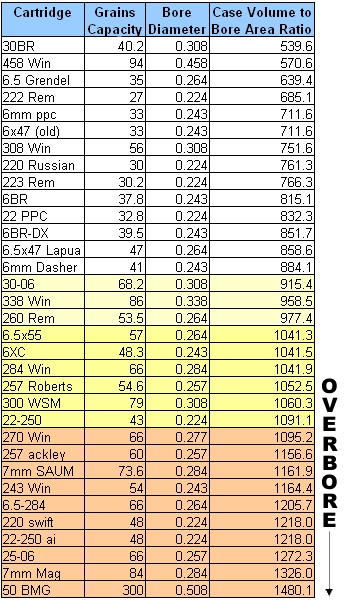
So what do these numbers mean? John says: “My own conclusion from much reading and analysis is that cartridges with case volume to bore area ratio less than 900 are most likely easy on barrels and those greater than 1000 are hard on barrels.” John acknowledges, however, that these numbers are just for comparison purposes. One can’t simply use the Index number, by itself, to predict barrel life. For example, one cannot conclude that a 600 Index number cartridge will necessarily give twice the barrel life of a 1200 Index cartridge. However, John says, a lower index number “seems to be a good predictor of barrel life”.
John’s system, while not perfect, does give us a benchmark to compare various cartridge designs. If, for example, you’re trying to decide between a 6.5-284 and a 260 Remington, it makes sense to compare the “Overbore Index” number for both cartridges. Then, of course, you have to consider other factors such as powder type, pressure, velocity, bullet weight, and barrel hardness.
Overbore Cases and Accuracy
Barrel life may not be the only thing predicted by the ratio of powder capacity to bore cross-section area. John thinks that if we look at our most accurate cartridges, such as the 6 PPC, and 30 BR, there’s some indication that lower Index numbers are associated with greater inherent accuracy. This is only a theory. John notes: “While I do not have the facilities to validate the hypothesis that the case capacity to bore area ratio is a good predictor of accuracy — along with other well-known factors — it seems to be one important factor.”
March 1st, 2014
Looking for quality, name-brand projectiles at a bargain price? Then check out the Hornady Bulk Bullets Specials at Grafs.com. Currently, Grafs.com has a variety of popular Hornady rifle and pistol bullets on sale. Get one hundred 75gr .224-caliber BTHP bullets for just $16.99 (Item #HRN2279B). If you favor .30-caliber cartridges, you can get one hundred 110gr FMJ bullets for $18.99 (Item #HRN3017B).
Your Editor just ordered some .45-caliber 185gr SWCs for his S&W 1911. These .451-diameter Hornady-made FMJ bullets are $19.89 per 100 bullets (Item #HRN45137B). Round-nose 230gr .45-caliber FMJ bullets are also offered for $22.39. If you shoot a 9mm pistol, you can order 147gr FMJ bulk bullets for just $15.99 per 100 (Item #HRN35597B). These prices are comparable with the cost of cast lead bullets from other vendors. When you consider that many indoor ranges no longer allow non-jacketed lead bullets, you may want to get some Hornady bulk bullets from Grafs.com while supplies last. NOTE: the stated prices include shipping after one flat handling fee of $7.95 per order.

Product tip from EdLongrange. We welcome reader submissions.
March 1st, 2014
Many of our Forum members shoot an “improved” 6mmBR cartridge. This might be a 30°-shoulder 6mm BRX, or a 40°-shoulder 6mm Dasher, or the 6mm BRDX, which is very similar to the Dasher, but with a slightly longer neck. This Editor shoots a 6mm BRDX and has found it very accurate, and maybe a bit easier to fire-form than a standard Dasher. Speaking of fire-forming, in our Shooters’ Forum, we often see questions about fire-forming BRX/Dasher brass. For those who need a large number of BRX or Dasher cases, one option to consider is using pistol powder in a dedicated fire-forming barrel. Here’s an explanation of how this process can work.
Forum member Skeeter has a 6mm Dasher falling block varmint rifle. The Dasher case is based on the 6mm BR Norma cartridge with the shoulder blown forward about 0.100″ and out to 40°. This gives the Dasher roughly 3.5 grains added capacity compared to the standard 6BR.
A few seasons back, Skeeter needed to form 300 cases for varmint holiday. Skeeter decided to fire-form his brass without bullets. This method avoids barrel wear and saves on components. There are various ways to do this, but Skeeter chose a method using pistol/shotgun powder, some tissue to hold the powder in place, Cream of Wheat filled to within an 1/8″ of top of the neck, and a “plug” of tissue paper to hold it all in place. Shown below are cases filled with a pistol/shotgun powder charge topped with Cream of Wheat and then a tissue paper plug.


To ensure the case headspaced firmly in his Dasher chamber, Skeeter created a “false shoulder” where the new neck-shoulder junction would be after fire-forming. After chamfering his case mouths, Skeeter necked up all his cases with a 0.257″ mandrel (one caliber oversized). Then he used a bushing neck-sizing die to bring the top half of the neck back down to 0.267″ to fit his 0.269″ chamber. The photo below shows how the false shoulder is created.

After creating the false shoulder, Skeeter chambered the cases in his rifle to ensure he could close the bolt and that he had a good “crush fit” on the false shoulder, ensuring proper headspace. All went well.

The next step was determining the optimal load of pistol powder. Among a variety of powders available, Skeeter chose Hodgdon Titewad as it is relatively inexpensive and burns clean. The goal was to find just the right amount of Titewad that would blow the shoulder forward sufficiently. Skeeter wanted to minimize the amount of powder used and work at a pressure that was safe for his falling block action.
Working incrementally, Skeeter started at 5.0 grains of Titewad, working up in 0.5 grain increments. As you can see, the 5.0 grain charge blew the shoulder forward, but left it a hemispherical shape. At about 7.0 grains of Titewad, the edge of the shoulder and case body was shaping up. Skeeter decided that 8.5 grains of Titewad was the “sweet spot”. He tried higher charges, but the shoulder didn’t really form up any better. It will take another firing or two, with a normal match load of rifle powder and a bullet seated, to really sharpen up the shoulders. Be sure to click on the “View Larger Image” link to get a good view of the cases.


The process proved to be a success. Skeeter now has hundreds of fire-formed Dasher cases and he hasn’t had to put one bullet through his nice, new match-grade barrel. The “bulletless” Cream of Wheat method allowed him to fire-form in a tight-necked barrel without neck-turning the brass first. The only step now remaining is to turn the newly Dasher-length necks down about .0025″ to fit his 0.269″ chamber. (To have no-turn necks he would need an 0.271″ or 0.272″ chamber).
Skeeter didn’t lose a single case: “As for the fire-forming loads, I had zero split cases and no signs of pressure in 325 cases fire-formed. Nor did I have any misfires or any that disbursed COW into the action of the firearm. So the COW method really worked out great for me and saved me a lot of money in powder and bullets.” To learn more about the COW fire-forming process, read this Dasher Fire-Forming Forum Thread.
Skeeter did have a fire-forming barrel, but it was reamed with a .269 chamber like his 10-twist Krieger “good” barrel. If he fire-formed with bullets, he would have to turn all 300 necks to .267″ BEFORE fire-forming so that loaded rounds would fit in the chamber. Judging just how far to turn is problematic. There’s no need to turn the lower part of the neck that will eventually become shoulder–but how far down the neck to turn is the issue. By fire-forming without bullets now he only has to turn about half the original neck length, and he knows exactly how far to go.
February 28th, 2014
 Federal Premium has a new online Ballistics Calculator. This free program can determine the trajectory for any rifle or handgun load, and even save your ballistics solutions for future reference. This is handy if you shoot Federal ammunition, because all Federal ammo types are included in the built-in database, with BCs and velocities. That makes it very easy to get a ballistics solution for Federal factory ammo — simply enter the caliber and bullet type/weight and the solver fills in the BC and velocity for you. Federal Premium has a new online Ballistics Calculator. This free program can determine the trajectory for any rifle or handgun load, and even save your ballistics solutions for future reference. This is handy if you shoot Federal ammunition, because all Federal ammo types are included in the built-in database, with BCs and velocities. That makes it very easy to get a ballistics solution for Federal factory ammo — simply enter the caliber and bullet type/weight and the solver fills in the BC and velocity for you.
Federal’s Ballistics Calculator can also be used for handloaded ammo with non-Federal components. However, you can only use a G1 BC and Federal’s solver is not as sophisticated as some others. We still recommend JBM Ballistics or the new Applied Ballistics Online Solver. These both offer both G1 and G7 and extensive databases of field-derived BCs for hundreds of bullets. The Federal Ballistics Calculator only has BC numbers for factory-made Federal ammunition.


February 15th, 2014
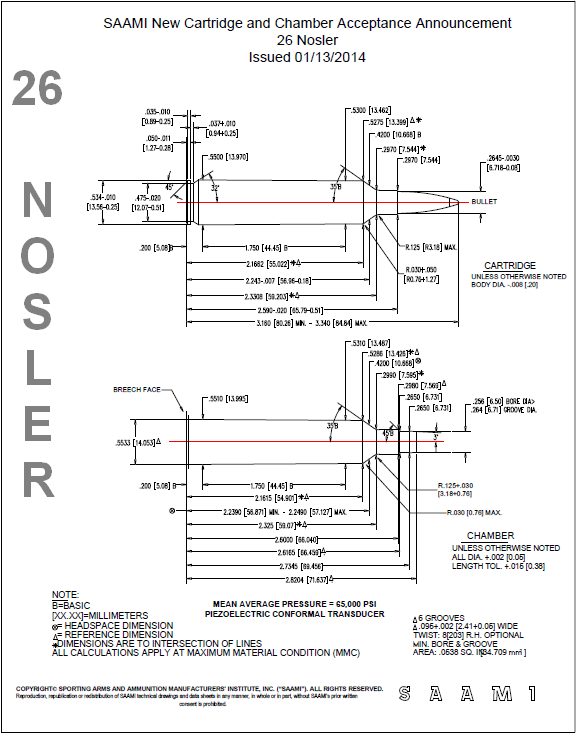
 Nosler has introduced a new 6.5mm (.264 caliber) hunting cartridge, the 26 Nosler. Nosler will initially offer 26 Nosler cartridge brass, and then, eventually, 26 Nosler loaded ammunition. Nosler has introduced a new 6.5mm (.264 caliber) hunting cartridge, the 26 Nosler. Nosler will initially offer 26 Nosler cartridge brass, and then, eventually, 26 Nosler loaded ammunition.
This new cartridge is designed to be a speedy, flat-shooting hunting cartridge, with performance exceeding a 6.5-284. This is possible because the 26 Nosler is a big, long cartridge with plenty of “boiler room”. Length from base to neck/shoulder junction is 2.33″ for the 26 Nosler, compared to 1.91″ for the 6.5-284 (and 2.04″ for a 7mm Rem Magnum). The 26 Nosler has a 35° shoulder angle and a magnum-size 0.534″ outside rim diameter.
The 26 Nosler cartridge can drive the Nosler 129 grain, AccuBond® LR bullet at 3400 fps. Zeroed at 350 yards, the 26 Nosler has a Point Blank Range of 0-415 yards. Loaded with the 129gr Accubond, the 26 Nosler retains as much velocity at 400 yards as a .260 Rem produces at the muzzle. This makes the 26 Nosler a “quintessential deer, antelope and long-range” cartridge according to company CEO/President Bob Nosler.
Nosler has just released the SAMMI print for this cartridge. CLICK HERE for SAMMI Print PDF.
 Credit Grant G. for story tip. We welcome reader submissions.
February 15th, 2014
Want to buy a bullet business? Montana Bullet Works (MBW) is now for sale. MBW, run by Dave Jennings, has been a leading “boutique” cast bullet-making shop for years. Dave is widely regarded as one of the best cast-bullet craftsmen in the country. He offered rifle bullets up to .50 caliber, and pistol bullets from .25 to .50 caliber. Forum member Grant G. says: “[Dave] made the very best hard-cast bullets with gas check for hunting. They were very accurate from the rifles I have used them in. My next elk will get thumped with one of his creations.”

Clint Smith, director of Thunder Ranch says: “Montana Bullet Works makes a great product. I was looking for a specific bullet and Dave & Marcie … got the mould and made excellent bullets[.] I highly recommend them.”
 MBW Business for Sale MBW Business for Sale
Unfortunately, health concerns now prevent Dave Jennings from continuing his trade: “I am sorry to report that due to a recent spinal fusion surgery and the resultant permanent limitations on lifting and other movements, I can no longer operate MBW. If you are interested in buying MBW … I can provide information on current assests, inventory, etc.”.
Dave Jenning’s Tips for Shooting Cast Bullets
Any gun that you plan to shoot cast bullets from has to be cleaned of all copper jacket fouling first. The copper fouling is much harder than any cast bullet and will act like sandpaper on the bullet as it travels down the barrel. Not only will this lead to poor accuracy but may also give you signs of leading that really isn’t occurring.
While testing cast bullets, it’s also important to keep your barrel free of leading. You may concoct a load that is a little too hot for the bullet/alloy you’re using and have a leading issue with that one load. If that leading isn’t removed before you fire your next test load, you won’t be able to tell which load gave you the problem. Moreover, leading is cumulative and will adversely affect the accuracy of subsequent shots.
But don’t despair. I’ve shot literally hundreds of thousands of cast bullets and have found a quick and inexpensive way to remove leading. I use Bronze Wool, available from Brownells, either in the fine or medium grade. Unlike Steel Wool, Bronze Wool is softer than steel and will not scratch your barrel. Also, Bronze Wool is not oiled, so it leaves your barrel absolutely clean. Simply pull some threads of the Bronze Wool off of the pad and wrap it tightly around a slightly undersized bronze barrel brush. The tighter the fit, the faster it will remove leading. Ten to twelve passes up and down the barrel will remove all but the most severe leading. If you do this regularly, you’ll never have severe leading to contend with. Bronze Wool has become an integral part of my shooting kit for years. I wouldn’t be without it!
~ Dave Jennings – Montana Bullet Works ~
|


