|
|
December 20th, 2013
 Here’s good news for target shooters and hunters — there’s a new supplier of quality, match-grade ammo. Creedmoor Sports will be manufacturing .30-06, .308 Win, and .223 Rem ammunition beginning in May of 2014. It will be sold as “Creedmoor Ammo”, with hunting and match versions. Here’s good news for target shooters and hunters — there’s a new supplier of quality, match-grade ammo. Creedmoor Sports will be manufacturing .30-06, .308 Win, and .223 Rem ammunition beginning in May of 2014. It will be sold as “Creedmoor Ammo”, with hunting and match versions.
Help Design the Box — Get a Free CASE of Ammunition
Creedmoor Sports is looking for help designing the packaging for its new ammo line. If you successfully come up with the best graphics to be printed on the box, you’ll receive a cases of ammunition. Dennis DeMille, Creedmoor’s General Manager explains: “The person whose artwork we use, or slight variation thereof, will receive their choice of the very first case of one of those three calibers of ammunition.” Dennis adds: “Look at these boxes as your blank canvas. The ammunition, all calibers, will be in boxes of 50, and in cases of 100 (two boxes of 50)”.

Creedmoor’s Box Design Goals (Things to Keep in Mind):
The packaging design needs to appeal to competitive shooters, recreational shooters, and hunters alike. While any one package might not appeal to all groups, we don’t want one group to look at the box and think “That’s not for me”.
The ammunition WILL be match quality (we don’t want to give away any more details just yet), but changing the projectile would make it a match quality hunting round. Ideally what we want is one box design that will be suited for all applications.
The name of the Ammo will be “CREEDMOOR AMMO”, however, we don’t want to use the Creedmoor bursting bomb logo. If you have ideas for a new logo, please share those concepts with us at Creedmoor.
Send your ideas directly to Dennis DeMille, at demille [at] creedmoorsports.com. Please put “NEW AMMO BOX DESIGN” in subject line so that it doesn’t get lost among the many emails.
December 19th, 2013
 On his Riflemans’ Journal blog, German Salazar wrote an excellent article about cartridge Case-Head Separation. We strongly recommend that you read this article. German examines the causes of this serious problem and he explains the ways you can inspect your brass to minimize the risk of a case-head separation. As cases get fired multiple times and then resized during reloading, the cases can stretch. Typically, there is a point in the lower section of the case where the case-walls thin out. This is your “danger zone” and you need to watch for tell-tale signs of weakening. On his Riflemans’ Journal blog, German Salazar wrote an excellent article about cartridge Case-Head Separation. We strongly recommend that you read this article. German examines the causes of this serious problem and he explains the ways you can inspect your brass to minimize the risk of a case-head separation. As cases get fired multiple times and then resized during reloading, the cases can stretch. Typically, there is a point in the lower section of the case where the case-walls thin out. This is your “danger zone” and you need to watch for tell-tale signs of weakening.
The photo below shows a case sectioned so that you can see where the case wall becomes thinner near the web. German scribed a little arrow into the soot inside the case pointing to the thinned area. This case hadn’t split yet, but it most likely would do so after one or two more firings.

One great tip offered by German Salazar involves using a bent paper clip to detect potential case wall problems. Slide the paper clip inside your case to check for thin spots. German explains: “This simple little tool (bent paper clip) will let you check the inside of cases before you reload them. The thin spot will be immediately apparent as you run the clip up the inside of the case. If you’re seeing a shiny line on the outside and the clip is really hitting a thin spot inside, it’s time to retire the case. If you do this every time you reload, on at least 15% of your cases, you’ll develop a good feel for what the thin spot feels like and how it gets worse as the case is reloaded more times. And if you’re loading the night before a match and feel pressured for time — don’t skip this step!”

December 19th, 2013
Since 2010, Lapua has shipped its quality cartridge brass in sturdy blue plastic boxes. Here’s a handy tip for you — don’t toss the plastic boxes when you load up your brass! These are double-duty containers. If you’re not familiar with “Blue Box” Lapua brass, you may not realize that the boxes are designed to serve as 50-round carriers for your loaded ammo and fired cases. (Yes we know some folks who’ve been tossing out their blue boxes without knowing how the boxes work as caddies.)
Snapped in place under the box lid is a rectangular plastic grid that fits in the bottom of the box. Pop the grid loose and slide it into the box with the smooth side facing up. Side supports molded into the lower section hold the grid in place.

Voilà, instant Ammo Box! Each grid contains holes for fifty (50) loaded rounds or empty cases. The convertible plastic container/ammo box is a great idea that Lapua executed very nicely. Now you have even more motivation to purchase your cartridge brass from Lapua.

December 14th, 2013
Lapua just dropped a bombshell — multiple bombshells, in fact. Lapua just announced that it will be producing .221 Fireball brass and .50 BMG brass starting early 2014. This will be the first truly match-grade brass ever offered for the .221 Fireball. That’s great news for varminters, who can use Lapua’s new .221 Fireball brass “as is” or neck it down to .20 Vartarg or 17 Fireball. Tactical shooters can also use the .221 Fireball brass to make the .300 Whisper and 300 Blackout sub-sonic cartridges. At the other end of the spectrum, ultra-long-range shooters now have a new ultra-premium brass source for the mighty .50 BMG. This is potentially a “game-changer” for fifty-cal shooters who have had to “make do” with military surplus brass for the most part. Lapua says the new brass, both .50 BMG and .221 Fireball, should be in the USA by early April, 2014. Sorry, no pricing info is yet available.
Here is the Lapua Product Announcement for .221 Fireball and .50 BMG Brass:

New 180-Grain and 150-Grain 7mm Scenar-L Bullets
The other big news from Lapua is the release of two new 7mm (.284 caliber) Scenar-L target bullets. Recognizing the popularity of 7mm cartridges among F-Class Open Division shooters, Lapua will offer a high-BC, 180-grain bullet. As part of the “L” series, this new 180-grainer bullet should exhibit extreme consistency in base-to-ogive measurements and bullet weight. We expect this new 180gr projectile to be extremely accurate in the .284 Winchester, .284 Shehane, 7mm WSM, and 7mm RSAUM — popular chamberings for F-Class and long-range benchrest shooters. No BC information has been released yet, but we expect the BC number to be quite high, giving this bullet great wind-bucking capability. In addition to the new 180gr 7mm Scenar-L, Lapua will offer a new 150gr 7mm bullet. This is optimized for medium range competition in Silhouette and Across-the-Course competition. It should offer great accuracy, but with less felt recoil than its 180-grain bigger brother.

December 13th, 2013
For many guys, a 17 HMR is their “go-to” rifle for squirrels and small varmints. The 17 HMR is a great little cartridge — speedy and accurate. However, in recent months, 17 HMR ammo has been hard to find. Take heart guys, we’ve learned that site sponsors Graf & Sons and Powder Valley Inc. both have Hornady 17gr 17 HMR ammo in stock right now. This ammo is loaded with plastic-tipped 17gr V-Max bullets. Traveling at roughly 2570 fps (from a 22″ barrel), this little 17-grainer is ultra-effective on pesky ground squirrels and other small critters. On our squirrel hunts, the 17gr V-Max did the job out to 200 yards, no problem. Grafs.com sells the 17gr Hornady 17 HMR ammo for $12.99 per box of 50 (item HRN83170). That price includes shipping (after a single $6.95 handling charge). Powder Valley currently offers Hornady’s 17gr V-Max 17 HMR ammo for $11.30 per box of 50 (item HOR83170, shipping extra).

If you want to learn more about the 17 HMR cartridge, read our Gun of the Week Article on the subject. This two-gun shoot-out compares the performance of a Volquartsen 17 HMR semi-auto and a Ruger 77/17 bolt-action. Glen Robinson, the owner of both rifles, has done some serious comparison testing with both rifles, trying out a half-dozen varieties of 17 HMR ammo. The overall results may surprise you. The semi-auto outshot the bolt gun by a significant margin, with all types of ammo tested.

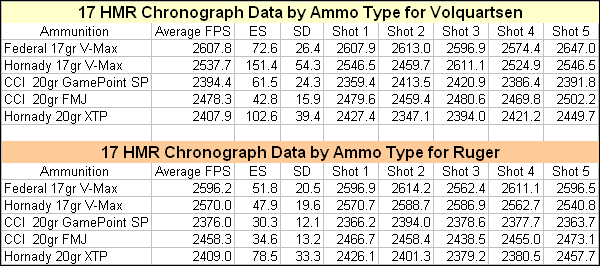
Comparing the Qualities of the Two 17 HMR Rifles
By Glen Robinson
While the Volquartsen proved to be the more accurate of my pair of 17 HMRs, I still enjoy owning both rifles. Each gun has its strong points and weak points.
 Ruger Strong Points: From any angle, the Ruger 77/17 is a nice-looking rifle with classic lines. I like the gray-finish stainless barrel — it goes well with the gray laminated stock. With the addition of the aftermarket sear, the trigger is crisp and the bolt function is smooth. The action is strong and dependable. The conventional “open rear” action allows you to clean “normally” with a bore guide, cleaning rod, and patches/brushes. I feel I can do a better job of cleaning with the Ruger than with the boresnake on the Volquartsen. Ergonomically, the Ruger is easier to get down on because the stock is lower. Ruger Strong Points: From any angle, the Ruger 77/17 is a nice-looking rifle with classic lines. I like the gray-finish stainless barrel — it goes well with the gray laminated stock. With the addition of the aftermarket sear, the trigger is crisp and the bolt function is smooth. The action is strong and dependable. The conventional “open rear” action allows you to clean “normally” with a bore guide, cleaning rod, and patches/brushes. I feel I can do a better job of cleaning with the Ruger than with the boresnake on the Volquartsen. Ergonomically, the Ruger is easier to get down on because the stock is lower.
Ruger Weak Points: Accuracy is somewhat disappointing. The best 100-yard group the Ruger has shot was about 0.82″ and the gun averages well over 1.25″ for 5 shots. In fairness, I haven’t done anything exotic in terms of bedding the action/barrel, and I would expect that an aftermarket barrel, perhaps combined with a barrel pre-load (up-pressure) pad, could improve the accuracy.
Volquartsen Strong Points: The Volquartsen is a well-made, accurate, dependable rifle. The gun cycles very reliably and requires very little maintenance. To clean it, just pull a boresnake through the bore. The gun exhibits very nice machining, and the VX-5000 stock rides steady on a front sand-bag, even though it’s only about 1.75″ wide. Even without any tweaking the trigger is very good, and the pull weight is fine for varminting.
Volquartsen Weak Points: The VX-5000 stock is not ideal for bench work — the comb is a bit too high, though I like the feel of the vertical grip. This stock profile is really more suited for silhouette shooting, but this stock seemed to be the best option offered by Volquartsen that could be used for both paper-punching and varminting. The receiver design limits your options for barrel cleaning.

Conclusion — The Volquartsen Takes the Prize
Having shot both rifles extensively, if I had to pick one gun, it would be the Volquartsen. The Volquartsen is much more accurate and it offers much faster follow-up shots. For varminting the Volquartsen would be superior, no question about it. I’m happy I bought the Volquartsen and the VX-5000 stock. It is a fun, versatile gun that lives up to the accuracy claims.
Read Full Article HERE.
December 11th, 2013
 We know many readers have been searching high and low for components and high-quality ammunition, particularly for popular chamberings such as the .308 Winchester. Well Santa delivered something nice for you .308 shooters. Bullets.com received a large shipment of Norma-brand Tac .308 ammo. This is good stuff — Norma brass loaded with a quality 150gr Norma FMJ bullet. This Tac-308 ammo is now in stock and On Sale for $53.50 for fifty (50) rounds at Bullets.com. If you can find this elsewhere, you’ll pay $65.00 or more per box. And remember, you’ve got quality Norma brass that will last for many reloadings after the ammo is fired. When you consider the value of the brass for reloading, this deal is even more attractive. We know many readers have been searching high and low for components and high-quality ammunition, particularly for popular chamberings such as the .308 Winchester. Well Santa delivered something nice for you .308 shooters. Bullets.com received a large shipment of Norma-brand Tac .308 ammo. This is good stuff — Norma brass loaded with a quality 150gr Norma FMJ bullet. This Tac-308 ammo is now in stock and On Sale for $53.50 for fifty (50) rounds at Bullets.com. If you can find this elsewhere, you’ll pay $65.00 or more per box. And remember, you’ve got quality Norma brass that will last for many reloadings after the ammo is fired. When you consider the value of the brass for reloading, this deal is even more attractive.

December 11th, 2013
For many cartridge types, Hornady Superformance ammunition provides enhanced velocity compared to some other types of factory-loaded ammo. However, Hornady has found that there may be issues when Superformance ammo is shot in gas-operated guns with barrels under 20″, or with barrels fitted with suppressors. This is because the gas returning from the barrel port may cause the bolt to begin unlocking prematurely. Hornady has published the following information concerning the uses of Superformance ammo in direct impingment and gas piston self-loading rifles.
| Internal Ballistics of Superformance Ammo in Semi-Auto Guns
Superformance™ ammunition is tested and is safely within SAAMI pressure guidelines. Gas operated (direct impingement or gas piston) firearms are perfectly safe to use with Superformance ammunition. However, Hornady ballisticians have conducted testing with a variety of guns (including guns equipped with suppressors), and our findings conclude that some systems work far better with Superformance ammunition than others.

It is recommended that to get the best functioning with Superformance ammunition in gas operated/gas piston semi-automatic or select fire guns, rifle length gas systems with 20 inch or longer barrel lengths are best for reliable firing and extraction. Any other configuration — particularly shorter barrels/gas systems — are best served with the installation of an adjustable gas system, ESPECIALLY if a suppressor is to be installed.
Due to the longer duration of peak pressure produced by Superformance, the post peak/declining port pressure at common carbine and mid-length gas port locations is still higher than that produced by standard propellant. This has a tendency to flood the system with a larger volume of gas, at a higher velocity, that tries to open the bolt of the gun too fast. It’s a timing issue. The cartridge case is still swollen from the application of pressure during firing while the gun is simultaneously trying to extract the cartridge case before it has had an opportunity to settle back to its original size, or more simply: the gun is still in the process or firing while it’s trying to extract the cartridge case.

If the firearm and the ammunition are not in sync, there can be what is commonly identified as “pressure signs” on the cartridge case. This is exhibited by the movement/marring of the head of the cartridge case, cratered primers, flat primers, ripped or ruptured cartridge cases, “popped primers”, and/or any combination of these effects. If any of these “pressure signs”; are apparent, stop firing immediately. If an adjustable gas system is installed, it is advisable to reduce the amount of gas flowing through the system by closing the gas port until the gun operates correctly.
With the installation of an adjustable gas system, gas pressure can be metered to a point that enough gas is applied to open the bolt, but at a slower rate to allow the cartridge case to return to its original diameter prior to the movement of the bolt, and thus allow for proper extraction.
Pressure VS Gas Port Location

Due to the longer duration of peak pressure produced by Superformance™, the post peak/declining pressure at common carbine and mid-length gas port locations is still higher than that produced by standard propellant. However, there is very little difference in port pressure between Superformance™ and standard propellants at the rifle length port location.
Superformance and Suppressors
The use of suppressors on rifles creates yet another dynamic in firearms design that is not commonly understood or communicated. Consider the suppressor on a firearm the same as a muffler on a car. The suppressor works as a filter for the gas (noise) that is escaping the barrel during firing. As a “filter”, it takes longer for the gas to leave the confines of the firearm, and thus, it creates back pressure. This back pressure, ESPECIALLY in a gas operated firearm forces an extensive amount of gas back through the firearm’s operating system that may create too much thrust too early during the firearm’s cycle of operation.
To counteract this back pressure, the use of an adjustable gas system is advised. By metering the gas system to ensure that it will cycle the firearm correctly and not flood the system with gas/pressure, the gun will work properly and will still benefit dramatically from the increased velocity potential of Superformance ammunition.
Back Pressure from Suppressor

Click here to download this as a PDF
|
December 2nd, 2013
 When neck-turning cases, it’s a good idea to extend the cut slightly below the neck-shoulder junction. This helps keep neck tension more uniform after repeated firings, by preventing a build-up of brass where the neck meets the shoulder. One of our Forum members, Craig from Ireland, a self-declared “neck-turning novice”, was having some problems turning brass for his 20 Tactical cases. He was correctly attempting to continue the cut slightly past the neck-shoulder junction, but he was concerned that brass was being removed too far down the shoulder. When neck-turning cases, it’s a good idea to extend the cut slightly below the neck-shoulder junction. This helps keep neck tension more uniform after repeated firings, by preventing a build-up of brass where the neck meets the shoulder. One of our Forum members, Craig from Ireland, a self-declared “neck-turning novice”, was having some problems turning brass for his 20 Tactical cases. He was correctly attempting to continue the cut slightly past the neck-shoulder junction, but he was concerned that brass was being removed too far down the shoulder.
Craig writes: “Everywhere I have read about neck turning, [it says] you need to cut slightly into the neck/shoulder junction to stop doughnutting. I completely understand this but I cant seem to get my neck-turning tool set-up to just touch the neck/shoulder junction. It either just doesn’t touch [the shoulder] or cuts nearly the whole shoulder and that just looks very messy. No matter how I adjust the mandrel to set how far down the neck it cuts, it either doesn’t touch it or it cuts far too much. I think it may relate to the bevel on the cutter in my neck-turning tool…”

Looking at Craig’s pictures, we’d agree that he didn’t need to cut so far down into the shoulder. There is a simple solution for this situation. Craig is using a neck-turning tool with a rather shallow cutter bevel angle. This 20-degree angle is set up as “universal geometry” that will work with any shoulder angle. Unfortunately, as you work the cutter down the neck, a shallow angled-cutter tip such as this will remove brass fairly far down. You only want to extend the cut about 1/32 of an inch past the neck-shoulder junction. This is enough to eliminate brass build-up at the base of the neck that can cause doughnuts to form.

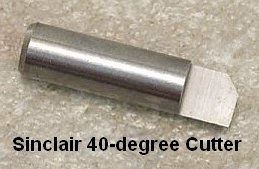
The answer here is simply to use a cutter tip with a wider angle — 30 to 40 degrees. The cutter for the K&M neck-turning tool (above) has a shorter bevel that better matches a 30° shoulder. There is also a 40° tip available. PMA Tool and 21st Century Shooting also offer carbide cutters with a variety of bevel angles to match your case shoulder angle*. WalkerTexasRanger reports: “I went to a 40-degree cutter head just to address this same issue, and I have been much happier with the results. The 40-degree heads are available from Sinclair Int’l for $13 or so.” Forum Member CBonner concurs: “I had the same problem with my 7WSM… The 40-degree cutter was the answer.” Below is Sinclair’s 40° cutter for its NT-1000, NT-1500, and NT-4000 neck-turning tools. Item NT-3140, it sells for $12.95. There is also a 40° cutter for the NT-3000 tool, item NT-3340 ($13.95).
Al Nyhus has another clever solution: “The best way I’ve found to get around this problem is to get an extra shell holder and face it off .020-.025 and then run the cases into the sizing die. This will push the shoulder back .020-.025. Then you neck turn down to the ‘new’ neck/shoulder junction and simply stop there. Fireforming the cases by seating the bullets hard into the lands will blow the shoulder forward and the extra neck length you turned by having the shoulder set back will now be blended perfectly into the shoulder. The results are a case that perfectly fits the chamber and zero donuts.”
* 21st Century sells carbide cutters in: 15, 20, 21.5, 23, 25, 28, 30, 35, 40, and 46 degrees. PMA Tool sells carbide cutters in: 17.5, 20, 23, 25, 28, 30, 35, and 40 degrees.
November 21st, 2013
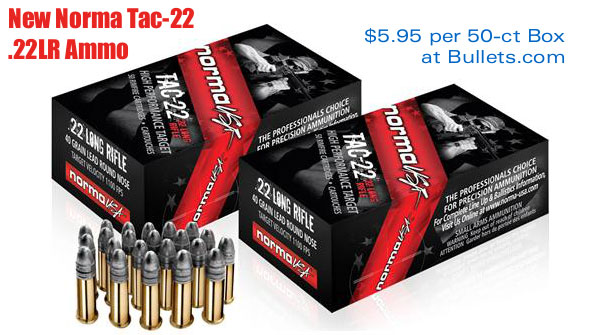
It’s a challenge these days to find affordable, general-purpose .22 LR rimfire ammunition. You can find the high-end, expensive stuff at various vendors, but sourcing quality rimfire ammo in the $4.00 to $6.50 per box price range is difficult. If you’re looking for good rimfire training ammo, here’s a new option. Bullets.com, the new shooting supplies vendor, has obtained quantities of Norma, SK, and Lapua rimfire ammo. Bullets.com is one of the few webstores that has the new Norma Tac-22 ammo. This .22 LR ammunition is loaded with a Lead Round Nose 40-grain bullet. It is rated at 1100 FPS with target energy of 110 foot/pounds.
Norma USA Tac-22, $5.95 per 50-rd box | SKU: BL7819
This is the new rimfire ammunition from Norma. We haven’t tested it yet, but based on Norma’s reputation we expect that it offers good performance for the price. It has a 40gr LRN bullet and is designed for all types of rimfire pistols and rifles.
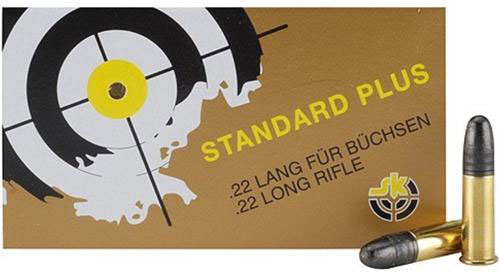
SK Standard Plus .22 LR, $5.95 per 50-rd box | SKU: BL11113
This is good LRN ammo made in Germany by SK. This “Standard Plus” ammo has shot well for us in Anschutz, H&R, Rem 40X, and Suhl rifles and has fed and functioned well in a variety of other rimfire pistols and rifles. We have found that, in most rifles, SK “Standard Plus” shoots much better than the “bulk box” Federal, Remington, or Winchester ammo.
SK Bulk .22LR Ammo, $44.95 per 500-rd Sealed Can | SKU: BL11115
This is SK-brand ammunition, with 500 rounds packed inside a sealed can. Readers who have purchased this ammo in the past say it is very similar to SK Standard Plus. One purchaser said it performed “as good, if not better, than any other sub-match-grade ammo out there.”

Please note, due to high demand of these products, quantity is limited to 1000 cartridges per customer.
NOTE: If you need match-grade ammo, Bullets.com also has Lapua Center-X at $11.95 per 50-rd box and Lapua Midas+ at $17.95 per 50-rd box.
November 20th, 2013
 NormaUSA recently rolled out a handsome new, easy-to-navigate website. On Norma-USA.com you’ll find information on Norma cartridge brass, bullets, powder and loaded ammunition. The site also offers a collection of videos plus links to Norma Reloading Data. NormaUSA recently rolled out a handsome new, easy-to-navigate website. On Norma-USA.com you’ll find information on Norma cartridge brass, bullets, powder and loaded ammunition. The site also offers a collection of videos plus links to Norma Reloading Data.
One highlight of the new Norma website is the new Cartridge of the Month section. This feature provides a detailed history of popular cartridges, along with a discussion of these cartridges’ hunting and target-shooting uses. There are currently five Cartridge of the Month articles, with more to come each month.
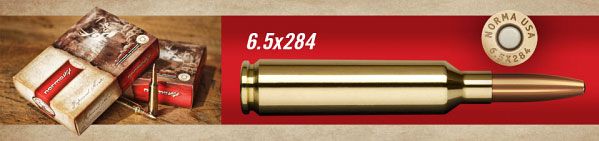
Here is a short selection from Aaron Carter’s 6.5×284 Norma Cartridge of the Month Article:
History of the 6.5×284 Norma
Among the few “wildcat” cartridges to ever be legitimized, the 6.5×284 Norma has the distinction of being the only one to succeed when the parent cartridge — the .284 Winchester — was a commercial failure. The 284 Win’s case had unique design features endearing it to wildcatters. Foremost, the non-belted case featured a rebated rim equal in width to that of the .30-06 Springfield. [B]ody diameter tapers from 0.500” ahead of the extractor to 0.475” rearward of the shoulder. The minimal body taper, when combined with a 35-degree shoulder angle, enabled greater propellant capacity. The latter would be particularly appealing to those individuals who, above all else, demanded ultra-high velocities; remember, this was during the period during which the .264 Win Mag, .300 Win Mag, and other “high-performance” cartridges were unveiled. Additionally, the propellant column was in the desirable short, fat column, which purportedly leads to increased accuracy. With this, the maximum average pressure (MAP) was set at an unusually high 56,000 copper units of pressure (C.U.P.); to handle such pressure, the case is obviously quite strong.
Long-range competitors are particularly fond of the 6.5×284 Norma. Why? Propelling bullets with high ballistic coefficients (BCs) to respectable velocities results in less time-to-target (and thus wind deflection), as well as reduced drop. Compared to proven performers of the past, such as the .300 Win. Mag., the 6.5-284 Norma’s recoil is quite mild—thanks to lighter bullet weights combined with smaller propellant charges. Fatigue from recoil negatively affects performance, so less abuse without sacrificing performance is a huge advantage on the firing line.
There are currently five Cartridge of the Month articles on the Norma-USA website:
6.5×284 Norma, by Aaron Carter
.300 Weatherby Magnum, by Wayne Van Zwoll
.300 Weatherby Magnum (Part 2), by Wayne Van Zwoll
.358 Norma Magnum, by Bryce M. Towsley
6.5×284 Norma, by Wayne Van Zwoll
|


