Brownells and Sinclair Int’l now offer a wide selection of rifle, handgun, and shotgun ammunition at competitive prices, backed by Brownells’ 100% satisfaction guarantee*. Brands include Winchester, Federal, Remington, CCI, Hornady, Fiocchi, Ultramax, Kent, Weatherby and more.
“For years, customers have told us, ‘I sure wish you had ammo,’ well, we listened. We are offering the highest quality product at competitive prices, all backed by the high level of service Brownells customers have come to expect,” said company President Pete Brownell.
Sinclair Int’l President and General Manager, Bill Gravatt told us, “When you don’t have the time to reload, you can count on Sinclair to offer you a wide selection of the highest-quality ammunition from the brands you know and trust.” The same Sinclair tech staffers who help customers with reloading questions are also available to help buyers select the right ammo.
Ammo Advisor Web Tool Speeds Ammo Selection Process
For their online customers, both Brownells and Sinclair Int’l offer the Ammo Advisor — an industry first. This interactive ammo database makes online shopping for ammunition quick and easy. Use any or all of the fields and the Ammo Advisor filters the selection based on the shopper’s criteria. The selection fields are populated with all the top brands in the calibers shooters use most. “65% of Brownells customers shoot more than 25 times per year. We are taking the ammo shopping experience to the next level by offering customers a tool that is user-friendly. It makes shopping for ammo quick, fun, easy and convenient,” continued Brownell. Of course, customers can always just head straight for their favorite brands without going through the Ammo Advisor.
*Brownells exclusive 100% guarantee applies to all purchases so customers can rest easy knowing that they can return anything they’re not happy with — no questions, no hassles.
Here’s a good deal for magnum shooters on a tight budget. If you need a quality, slow burn-rate powder suitable for large-capacity cartridges, check out Winchester WXR powder. Production of WXR has been discontinued, but quantities are still available. PrecisionReloading.com has 8-lb jugs of Winchester WXR for $104.49, which works out to just $13.06 per pound. Grafs.com has 1-lb containers of Winchester WXR for $13.99, on “close-out” pricing (limited quantities, no back-orders). Winchester WXR is a Swedish-made, double-base, slow-burning extruded propellant used in larger-size cartridges. WXR is an excellent choice for the .25-06, .270 Win, .30-06, 7mm Rem Mag, 300 Win Mag, 7mm WSM and 300 WSM cartridges. Some industry observers have suggested that Winchester WXR is virtually the same as Alliant Reloder 22. We can’t confirm that, but the load recipes are similar. Keep in mind that, at $13.06 per pound, WXR is nearly six bucks per pound cheaper than Reloder 22 (in 5-lb containers).
The Reload Bench’s Burn Rate Comparison Chart shows WXR having a burn rate very close to Vihtavuori N165 and IMR 7828. In tests with a .25-06, WXR delivered velocities 30 to 60 fps higher than Reloder 22, with equal loads grain for grain (see WXR vs. RL22 report). In the .25-06, the WXR was slightly more energetic than Reloder 22, so a max load with WXR proved to be about 1.0 grain lower than a RL22 max load. Another WXR user writes: “I’ve been using it for the last three years in my 7 STW, 7mm Mag, 300 WSM, 300 Win Mag, .30-06 and .270 Win. It chronographs nearly identical to Reloder 22, so keep that in mind when working up loads with it. From what I’ve researched about it, the company in Sweden who makes powder for Norma, also makes Reloder 22 and made Win WXR. Remember powder can vary slightly from lot to lot, so start low and work your way up.”
Dispelling Some 6mm BRX Myths, by Robert Whitley
I recently had an interesting and fact-filled conversation with Bob Crone (the inventor of the 6mm BRX) about his BRX. Bob actually called me because he was concerned that there are a lot of myths and about his 6mm BRX and he wanted to “set the record straight” on a few things. Here’s my summary of some topics we discussed:
Myth One:Bob made his 6mm BRX chamber by running a 6mm BR reamer in too deep.
Truth: There is no truth to Myth One. Bob said he specifically designed the BRX reamer and had it made with the head space he specified and a neck length appropriate for his newly designed 6mm BRX wildcat cartridge.
Myth Two:In the course of making up his 6mm BRX, Bob had a version with a .120″ longer head space than a 6mm BR Norma.
Truth: Bob was clear that his original design for the 6mm BRX always had a .100″ longer head space than a 6mm BR and that he never deviated from that. Right after Bob started working with his 6mm BRX, Bill Shehane came forward with a 6mm BRX version he made up that had a .120″ longer head space, and thus the confusion started. In truth, the original 6mm BRX always was (and still is) a chambering with a head space .100″ longer than a 6mm BR Norma.
Myth Three:The BRX was originally set up for 105-107gr bullets.
Truth: Bob said he set up his original reamer with a zero freebore and he has his gunsmith use a throater to throat whatever chamber was being made to where he wanted a particular bullet to touch the lands. Bob said he originally started with a 1:10″ twist barrel and shot a bunch of the 95gr VLDs and also 87gr bullets. Later he used an 8.5″ twist barrel for the heavier bullets.
Myth Four:The original BRX was set up also for use with Remington BR Brass.
Truth: Bob said he always used Lapua brass. He originally was an avid reader of Precision Shooting magazine and saw that the .262″ neck-turn neck was working real well with the 6 PPC and 6mm BR bench rest shooters and he decided to try to go with something that was already working well for 6mm shooters. He says his original reamer had a .262″ neck, but he also has a .272″ “no-neck-turn” version that he used on some of his rifles. He said the Lapua brass was so good and consistent, that for some rifles he just “didn’t want to mess with it” so he went with the “no-neck-turn” .272″ neck too.
Myth Five:The “false shoulder” method was used to make brass.
Truth: Bob said he never used the “false shoulder” method to make 6mm BRX brass, he just loaded 6mm BR brass with a bullet well into the lands of the BRX chamber and fire-formed brass that way. He noted that the accuracy with some of the fire-forming rounds was “outrageous” (i.e. outrageously good that is), so much so, they were shot in matches sometimes.
Myth Six:The 6mm BRX has a blown-out or straightened out body.
Truth: Bob said he kept the basic body taper of the 6mm BR cartridge. He wanted the cartridge to be an easy and inexpensive (but high performance) 6mm wildcat, and the original design was (and still is) set up to use readily available 6mm BR dies (up off the shell holder about .100″ from the normal position).
Author’s note: It was a most enjoyable experience to talk to Bob Crone. He is not only still passionate about his 6mm BRX, but he has a commanding knowledge of it as well.
Reamer Print provided by AR-X Enterprises LLC, www.6mmAR.com.
Natchez Shooters Supply is running a big sale on loaded ammo currently. If you shoot 9mm parabellum you’re in luck. Natchez has cut prices on a half-dozen types of 115gr FMJ 9mm ammo — and everything is $9.99 or $10.99 for 50 rounds. And this is all brand new, factory-fresh ammo — not commercial reloads. With new, quality 9mm ammo at such low prices, you may find there isn’t much of a financial advantage in loading your own. You can easily spend $11-$12 just for 100 FMJ 9mm bullets. So, loading fifty 9mm rounds could cost $6.00 in bullets, $1.25 in primers, and $0.80 worth of powder — you’re up to $8.05 per 50 rounds, not counting brass (and the value of your time).
Jackie Schmidt, posting on Benchrest Central, observed that there may have been some production changes with Lapua 220 Russian brass. This brass is commonly used as the parent case for fire-forming 6 PPC cases. The newer 220 Russian brass has slightly thicker neckwalls, and, according to Jackie, the new brass is more consistent in overall neckwall thickness.
Jackie writes: “I have not made any new PPC cases in a while. But I finally used up all of my older 220 Russian brass, and just bought 500 new cases, in the blue plastic boxes. The necks are thicker. By at least .0008 (eight ten-thousandths). That is right at .0015 on diameter. I am getting neck-wall thickness of .0142″ on the old cases, .0150″ on the new cases. I [fire-formed] two cases, and seated a Flat Base Ultra bullet in each. The old case, with a seated bullet and non-neck-turned case, measures .2708″ average. By contrast, the new case, with a seated bullet in an unturned neck, measures .2722″ average. That is, on average, about .0015 difference in the diameter of a seated round.”
“Anybody else notice this? I guess the main reason I did the measuring is that I am thinking of having a ‘no-neck turn’ reamer ground. With this new brass, .0274″ would be the minimum. The new brass is a tad better in overall [neck]-wall thickness variation.” — Jackie
What does Lapua say? We’ve sent inquiries to Lapua’s USA tech representatives. We hope to have a response soon.
Forum member Ron W. (aka FClassRon) let us know that Midsouth is offering some high-quality, polymer-tipped 6.5mm bullets at half the normal price. Ron told us: “Midsouth is running a great sale this weekend on 6.5mm bullets with polymer tips: $13.54 per 100! I ordered similar bullets in 7mm a few weeks ago and the only blem I saw was light staining on the jackets (as shown in Midsouth’s description).” The bullets, (item 285-26209B100), are listed as: “6.5MM .264 DIA 129GR BIG GAME BONDED 100 CT BLEM”. Current sale price is $13.54, marked down from $27.08 — That’s a full 50% off normal price.
If you shoot a 6.5×47 Lapua, a 6.5×55 Swede, Rem .260, or 6.5×284, this bullet should work well for you. Here’s a chance to get a versatile, high-BC bullet that can be used effectively for BOTH both hunting and paper-punching. These blem bullets have cosmetic defects only. If you don’t mind some staining on the bullet jackets you can save a bundle compaired to normal pricing.
Forum regular Al Nyhus has tried his hand at bullet making, producing custom 30-caliber projectiles for his 30 BR match rifles. With guidance from his “guru”, bullet-smith Randy Robinett of BIB Bullets, Al has produced some very impressive bullets. This demonstrates that with patience, determination, and the right tools and components, amazing results are possible, even for a novice bullet-maker.
Al writes: “Thought I’d post some updated info on my 30 Caliber bullet making adventure. It’s been a lot of fun and a real learning experience. I’d like to thank Randy Robinett for all his patient teaching and guidance. The bullets have been working well in competition, being used to win the Varmint for Score portion of the IBS Wisconsin State Two Gun Championship [in 2007].”
The Targets Don’t Lie — These Are Quality Bullets
Here are two photos from bullet testing. In the 100-yard, 15-round target, the wind velocity was purposely ignored and the group was fired only with the same flag angle, trying to determine how they worked in the wind. Winds were 12-18 mph from 4 o’clock.
This 200-yard group was fired in near perfect test conditions — overcast, early in the morning, with no mirage. We usually have a small window of what I call ‘Happy Hour’ before the winds crank up.”
NOTE: Al’s 30 BR rifle was smithed by Stan Ware of SGR Custom Rifles.
Measuring Group Size
Note how Al measures his groups. Look at the top photo. You’ll see Al starts with the extreme outside edge of the hole, including the gray edge or ring. Then Al subtracts .290″, the TRUE size of one bullet-hole in the paper, as opposed to .308″, the nominal bullet diameter. If you simply subtract a full bullet diameter you will get a smaller number for your group size. That’s good for your ego, but Al’s method is more accurate because a bullet normally cuts a hole that is smaller than the actual bullet diameter.
If you are looking for inexpensive, 6mm bullets for fire-forming chores (say if you have a Dasher, BRX, or .243 AI), Widener’s offers 100gr Speer Flatbase bullets at very low cost. Sold in 500-ct bulk packs, the Speer 100-grainers cost just $59.00 for five hundred bullets. That works out to just $11.80 per hundred, less than half the cost of most match bullets.
Varminters who load large quantities of ammo for prairie dog trips might also appreciate this value offering — although the bullets are a bit on the heavy side for prairie-dog size prey.
These soft-point bullets have a fairly long shank and a cannelure. CLICK HERE to order these bullets (item #SE75557) online via Wideners.com
Wilson Combat has come up with a new cartridge, dubbed the 7.62×40 WT (Wilson Tactical). Basically it is a .223 Remington necked up to .308 caliber, i.e. a .30-.223 Rem Wildcat. The cartridge is designed to give .30-cal capability to a standard AR15, using the normal bolt assembly and standard AR15 magazines. An AR15 can be converted to shoot the 7.62×40 WT with just a barrel swap. Note: Don’t confuse this new cartridge with the 7.62×39, the Eastern Bloc military cartridge that has been around for decades. The 7.62×40 WT is not derived from the 7.62×39 in any way. The 7.62×39 has a larger rim size, more body taper, and requires a different magazine and bolt. There have been 7.62×39 adaptations for ARs, but most didn’t function well (usually because of magazine issues). Wilson Combat claims the 7.62×40 WT offers the hitting power of the 7.62×39, but with a cartridge design that feeds and functions 100% in an AR15.
The 7.62×40 WT was designed around an optimal overall cartridge length of 2.250” which is a perfect fit for standard AR mags without shoving the bullet too far down in the case. Wilson says that its 7.62×40 WT barrels are optimally throated for the 2.250″ COAL. Therefore, Wilson claims, the “7.62×40 WT does not suffer from the same inconsistent accuracy issues in the AR platform often seen with the 300 Whisper and 300 BLACKOUT.”
Here are comparative Velocity and Energy numbers for the 7.62×40 WT vs. other cartridges with which it will compete.
7.62×40 WT (16″ Barrel)
110 gr: 2450 FPS Muzzle Velocity and 1466 Foot Pounds of Energy
125 gr: 2400 FPS Muzzle Velocity and 1599 Foot Pounds of Energy
150 gr: 2200 FPS Muzzle Velocity and 1612 Foot Pounds of Energy
5.56 NATO (.223 Rem) (16″ Barrel)
55 gr: 3150 FPS Muzzle Velocity and 1212 Foot Pounds of Energy
62 gr: 3000 FPS Muzzle Velocity and 1239 Foot Pounds of Energy
77 gr: 2750 FPS Muzzle Velocity and 1293 Foot Pounds of Energy
7.62×39 (16″ Barrel)
123 gr: 2320 FPS Muzzle Velocity and 1470 Foot Pounds of Energy
6.8 SPC (16″ Barrel)
110 gr: 2550 FPS Muzzle Velocity and 1594 Foot Pounds of Energy
At first it looks like the 7.62×40 WT has more energy than a 7.62×39 and outruns a 6.8 SPC handily. But Wilson omitted some key data for the 7.62×39. Taking load info straight from the Hodgdon Reloading Center, a 7.62×39 can be loaded to 2408 fps with a 125gr bullet, or to 2192 fps with a 150gr bullet at relatively moderate pressures (under 41,000 CUP, or roughly 44,250 psi). A 7.62×39 launching 150-grainers at 2192 fps generates 1601 foot-pounds, virtually the same as Wilson’s 150gr load. So, the 7.62×40 WT has no real advantage (over the 7.62×39).
Is This Cartridge Needed at All?
The “T” in 7.62×40 WT stands for “Tactical”, but we don’t think many police or military units will adopt this round. The 5.56x45mm is too well-established in the AR15/M16 platform and the 7.62×39 is the smart .30-Cal choice for an AK. So what, then, is the real “niche” for the 7.62×40 WT?
We think this round may prove popular with hunters who want to shoot a much heavier bullet out of a standard AR. A 150gr projectile is nearly twice as heavy as the biggest projectile you can shoot from a .223 Rem AR. The bigger bullet should work better on some kinds of game. Wilson Combat says: “Designed for tactical/defense applications as well as hunting for medium-sized game such as deer and feral hogs. For hunting the 7.62×40 WT vastly out performs the 5.56 and is on par with the 6.8 SPC at ranges out to 175-200 yards. The VERY mild recoil of the 7.62×40 WT also makes it ideal for female and younger shooters as well as anyone that’s recoil sensitive.”
Wilson says the 7.62×40 has proven itself as a good hunting cartridge: “A LOT of Texas feral hogs, whitetail deer and predators lost their lives testing the terminal performance of this cartridge! The 7.62×40 WT has proven to be a VERY efficient killer on medium sized game with the 110gr Barnes TTSX, 125gr Nosler Ballistic Hunter and the 125gr Sierra Pro Hunter. Any of these three bullets perform admirably on deer and hogs under 150 lbs. or so, but we recommend the 110gr Barnes TTSX for large hogs. The 110gr Sierra HP is a great bullet in the 7.62×40 WT for varmints and predators, and has proven to be one of the most accurate bullets.”
For home defense, it could be argued that the 7.62×40 WT is better than the .223 Rem because the larger, slower .30-Cal projectile has less penetration (through walls), but that would have to be demonstrated with real-world testing. Moreover, there are frangible .224-cal bullets that minimize the risk of over-penetration indoors.
Some benchresters might even tinker with the 7.62×40 WT in a bolt gun for score competition, but we doubt it would prove competitive with the 30 BR which can push a 120gr bullet at around 3000 fps. Wilson’s cartridge does give a paper-puncher the ability to shoot a .30-caliber bullet from a rifle with a .223 bolt face, and that might be attractive to club shooters in informal score matches.
Wilson Combat will be selling 7.62×40 WT loaded ammunition (with 110gr or 125gr bullets), but it is also supporting the reloading market. Wilson offers 7.62×40 WT brass, Hornady 7.62×40 WT dies, and you’ll find extensive load data on the Wilson Combat website. For those who want to put together a 7.62×40 WT AR, Wilson offers pre-chambered 7.62×40 WT barrels, as well as complete 7.62×40 WT uppers. Barrels start at $249.95, while the 7.62×40 WT uppers retail for $1024.95.
A dedicated iPad version of Ballistic (‘Ballistic’ App), a full-featured ballistics calculator for the iPhone, is available for the growing numbers of iPad users. As with the iPhone version, ‘Ballistic’ App for the iPad is “powered by JBM Ballistics” so it offers very precise solutions — typically, at 600 yards, JBM will get you within two or three clicks, provided you have good bullet BC data and reliable MV from your chronograph.
The ‘Ballistic’ App for the iPhone and iPad features a library of over 3,100 projectiles; the library includes the latest 2010 commercial data and G7 military coefficients from Aberdeen Proving Grounds. Along with calculating bullet trajectories, this software has many extra features. There are several different target cards so you can input shot placement and scoring is calculated automatically. There is also a range log (for recording shooting sessions), a mildot and MOA range estimator, and a convenient load database for storing your reloading recipes.
Special features in the iPad edition of ‘Ballistic’ App include: fully integrated split-screen ballistics, favorites, and range log; full-screen, hi-resolution charts; ballistics calculations update automatically as you edit; larger target sizes in range log; and screens can rotate. The iPad Ballistic App (release 2.3.7) costs $19.99. The standard version for iPhone and iTouch units, costs $9.99. To learn more about this software, visit ballistic.zdziarski.com.


 Dispelling Some 6mm BRX Myths, by
  Truth: Bob was clear that his original design for the 6mm BRX always had a .100″ longer head space than a 6mm BR and that he never deviated from that. Right after Bob started working with his 6mm BRX, Bill Shehane came forward with a 6mm BRX version he made up that had a .120″ longer head space, and thus the confusion started. In truth, the original 6mm BRX always was (and still is) a chambering with a head space .100″ longer than a 6mm BR Norma.
 Myth Five: The “false shoulder” method was used to make brass.

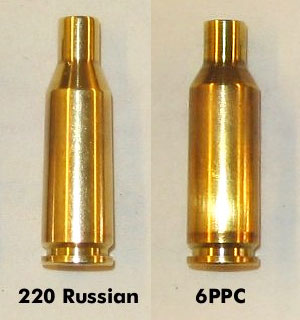 Jackie Schmidt, posting on
  Forum member Ron W. (aka FClassRon) let us know that Midsouth is offering some

 If you are looking for inexpensive, 6mm bullets for fire-forming chores (say if you have a Dasher, BRX, or .243 AI), Widener’s offers 100gr Speer Flatbase bullets at very low cost. Sold in 500-ct bulk packs, the Speer 100-grainers cost just $59.00 for five hundred bullets. That works out to just $11.80 per hundred, less than half the cost of most match bullets.

 At first it looks like the 7.62×40 WT has more energy than a 7.62×39 and outruns a 6.8 SPC handily. But Wilson omitted some key data for the 7.62×39. Taking load info straight from the
 For home defense, it could be argued that the 7.62×40 WT is better than the .223 Rem because the larger, slower .30-Cal projectile has less penetration (through walls), but that would have to be demonstrated with real-world testing. Moreover, there are frangible .224-cal bullets that minimize the risk of over-penetration indoors.
 A dedicated iPad version of


