|
|
January 7th, 2011
 New from Sierra Bullets for 2011 are two new heavyweight bullets. The first, the much-awaited 180gr 7mm MatchKing, boasts an impressive 0.660 G1 Ballistic Coefficient. This should be great for
F-Classers. Sierra explains: “In response to requests from top level F-Class shooters, Sierra has designed an all-new MatchKing to provide a higher weight/higher B.C. alternative in our 7mm line. This bullet’s 12-caliber secant ogive and lengthened boat tail make it the perfect choice for the discerning 7mm long range shooter. Sierra recommends at least a 1:8″ twist barrel to stabilize this bullet.”
This new MatchKing will compete with Berger’s vaunted 180gr 7mm VLD. It will be interesting to see how the two 180s perform head to head. If you are shooting a 7mm at long range, you should definitely try out the new .284-caliber Sierra MK (provided your barrel has a suitable twist rate).

A New 225-grain, .338 Bullet for Game-Hunting
The second new bullet from Sierra is a 225gr, soft-point, flat-base Pro-Hunter in .338 caliber. Sierra’s goal with this new bullet was to provide a lower-recoiling .338 projectile that still offers plenty of hitting power. Sierra tells us: “The newest member of our Pro-Hunter line is the .338-caliber 225gr SPT Pro-Hunter. The flat-based design and lighter weight of this projectile make it a great choice for medium and large game. This is a perfect choice for those hunters seeking a reduced recoil alternative where a heavier bullet is not required.”

January 1st, 2011
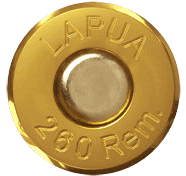 Here is great news for high-power shooters, tactical competitors, and hunters. Lapua will be producing .260 Remington brass starting in 2011. The official announcement will be made at SHOT Show 2011 in Las Vegas, and brass should start arriving in early spring. With Lapua’s introduction of .260 Rem brass, precision shooters now have a “no-brainer” first choice for cartridge brass in this popular chambering. No longer will you have to sort and cull (and re-sort) Rem-brand .260 brass. And you won’t have to fool around necking-up .243 brass or necking down .308 brass, with the problems that come with case-reforming operations.
The .260 Rem offers ballistics similar to the 6.5×55 with a cartridge size that fits short actions. For long range, the .260 Rem works great with 120gr to 142gr bullets, making it highly suitable for both hunting and target shooting. Here is what Lapua says about its new brass:
The .260 Rem was used to stunning effect at Camp Perry to win the 2010 Championships setting an incredible new national record in the process. .260 shooters have hammered their way into the winner’s circles of a wide variety of competitive disciplines, a real testament to the capability of this outstanding cartridge.
The .260 isn’t just a target round. It has also shown itself to be a fine performer in the field for medium game. Effectively duplicating the ballistic performance of the time-honored 6.5×55, the .260 has already developed a well-earned reputation for dependable stopping power on deer, antelope and similar game. Given the tremendous selection of bullets for every conceivable application, the 260 is an extraordinarily versatile cartridge. With such a solid history already established in such a short time, Lapua is proud to add the .260 to our line of premier components for the handloader.

[Editor’s Comment: I shot the .260 Rem extensively for 3 years, testing many powder/bullet/primer combinations. I tried both Remington-brand brass (very inconsistent), and necked-up Lapua and Norma .243 brass. If you want a reliable, accurate “go-to” load for the new Lapua .260 brass, I recommend Lapua 123gr Scenars with Hodgdon H4350 powder, running at about 2950 fps. Both Fed 210M and CCI large rifle primers work well. If you run the ballistics, you’ll find you give up little or nothing shooting the 123s vs. the 140gr class bullets because you can achieve significantly higher velocities with the lighter bullets, when using most powders. If you simply MUST shoot the 140s, try Reloder 17 to get higher velocities.]
December 31st, 2010
Graf & Sons is running an end-of-the-year “Blow-out Sale” with deep discounts on many products. Prices on many Close-Out items have been slashed by 50% or more. And, if you order $50.00 (or more) worth of merchandise, Grafs waves its customary $4.95 handling free. Grafs already gives free shipping on most products they sell (but hazmat fees and ‘heavy item’ fees may apply to some items).

Deals on Hornady Ammo, Components, and Gear
Graf’s has also knocked down the price on select Hornady items including the versatile Hornady Case Prep Center. You can get this at Grafs.com for just $279.99. Elsewhere the Case Prep Center sells for up to $100.00 more. Below are two good UltimateReloader.com videos showing the features and functions of the Hornady Case Prep Center. Note: Skip to the 1:30 minute mark of Part One if you’re in a hurry. The first minute or so is just spent depriming cases. After that, both Part One and Part Two Videos are well worth watching.
Hornady Case Prep Center DEMO Video (Part One)

Hornady Case Prep Center DEMO Video (Part Two)

Thanks to Forum member EdLongRange for spotting this special sale.
December 27th, 2010
 A legal challenge proceeds against a new California law (AB962) slated to go into effect February 1, 2011. As of that date, California will require buyers of handgun ammunition to provide personal information and a fingerprint with every ammo purchase. In addition, the new law would effectively ban mail-order and internet ammo sales, since AB962 requires that all “handgun ammunition” sales be conducted through “face-to-face” transactions. Right now it looks like “handgun ammunition” will be interpreted broadly, and this could include .223 Rem, .30-30, 7.62×39 — basically anything that has ever been shot in a handgun (even the single-shot variety).
Not surprisingly, the California Department of Justice has not created any regulations to better define what constitutes “handgun ammunition” under AB 962. Currently, the Department of Justice is involved in litigation challenging the constitutionality of AB 962. The case, Parker et al. v. State of California, et al., is expected to go to trial January 18, 2011. The judge has indicated he intends to render a ruling before February 1. Meanwhile, the California Department of Justice has refused to provide any practical guidance that would better enable industry members to comply with the law’s vaguely worded definition of “handgun ammunition.”
December 27th, 2010
Story by Larry Keane, NSSF
 Since the early 1970s, ammunition being shipped in the United States has been classified under “Other Regulated Materials” — class D (ORM-D) regulations. This precludes the need for hazardous material (HazMat) shipping charges and other expensive handling requirements. The savings to the industry has been estimated at more than $300 million per year.
The Sporting Arms and Ammunition Manufacturers Institute (SAAMI) recognized a potential risk of losing ORM-D status due to the emerging “global harmonization” of shipping regulations. Simply put, the U.S. was likely to adopt United Nations (UN) regulations in an attempt to help ease the global shipping process by adhering to one uniform policy. The problem with shifting to UN regulations is that there is no “ORM-D” status, so if/when this happened, ammunition would have to be shipped under the UN 1.4s category — a category that includes HazMat fees.
 SAAMI petitioned the world body to change its shipping regulations to allow for a Limited Quantity (LQ) exemption for class 1.4s products that meet certain testing criteria. Then, SAAMI proved that ammunition meets these criteria. The LQ exemption for loaded ammunition would allow countries to adopt regulations very similar to the current U.S. Department of Transportation (DOT) ORM-D classification, yet still be in alignment with global shipping regulations.
‘LQ’ Ammo Shipping Class Will Replace ‘ORM-D’
The UN has adopted SAAMI’s petition and the new international regulation have become final. In the meantime, the U.S. Dept. of Transportation (DOT) has announced sweeping changes to U.S. regulations that will harmonize them with the international regulations. Included in these upcoming changes are the elimination of ORM-D status and the addition of the LQ exemption for ammunition . The net result is that while the regulations will change, shipment of ammunition in the U.S will continue without additional fees and handling requirements. So you will still be able to ship loaded ammo with NO Haz-Mat Fees, but in the future, the ORM-D status will change to LQ exempt status.
December 23rd, 2010
 Starting February 1, 2011, a new law goes into effect in California that will block mail-order sales of any loaded ammo that can be used in a pistol. That, of course, includes .22LR, 30-30, .223 Remington, 6mmBR and other popular rifle rounds that have been adapted for pistols. In the fall of 2009, when AB962 was first passed by the California legislature, we reported on this restrictive new legislation. The new law IS being challenged in court, but it is still set to go into effect on February 1st, 2011.
CLICK HERE for Full Text of AB 962
In response to California’s imminent mail-order ammo ban, ammunition vendors are gearing up for a rush of ammo sales in the next five weeks. Here is Cabela’s Ammo Sale Notice:

Related Articles
California Legislature Passes AB 962
Schwarzenegger Terminates Mail-Order Ammo Sales in California
Lawsuit Challenges California Ammo Ban
December 16th, 2010
 Richard M. Hammett, Olin Corporation Vice President and President of Olin’s Winchester division, plans to retire effective February 28, 2011. Thomas J. O’Keefe assumes responsibilities as President of Winchester, effective January 1, 2011.
 Hammett spent 42 years with Olin Corporation in a variety of finance, marketing and senior management roles. He has served as President of Olin’s Winchester Division since September 2002. An active sportsman and industry leader, Hammett is a board member and treasurer for the National Shooting Sports Foundation (NSSF). He also serves on the board of the Small Arms and Ammunition Manufacturing Institute (SAAMI).
Incoming Winchester President Thomas J. O’Keefe, who holds Bachelor’s and Master’s Degrees in Metallurgical Engineering, has plenty of experience in ammunition production. O’Keefe held positions in the manufacturing and engineering organization of Olin’s Brass division, and was appointed VP, Manufacturing and Engineering for the division in 2001. In 2006, O’Keefe was appointed VP, Manufacturing Operations for Winchester and assumed additional responsibility for Business Planning in 2008. For more info about Winchester Ammunition and its complete line of products visit www.Winchester.com.
December 4th, 2010
 ARES Puškárska Dielňa, a Slovakian bullet-maker, has come up with a new colorized bullet coating for cast lead bullets. This coating provides a surface barrier so that the lead does not contact the rifling in the barrel. In addition, no bullet lube is required and the colored coating reduces friction. As explained on the Wieder-Lader.de website, “Please take into consideration that ARES Colored Bullets are more quick than copper plated/FMJ bullets. If you used to [shoot] copper plated/FMJ bullets, please start reloading Colored Bullets (CB) with approx. 5% less powder and adjust the final quantity of powder on basis of your own speed measurements. CBs keep the barrel clean. CBs are ready for reloading, i.e. it is not necessary to grease CBs.”

In the photo below, a .40-caliber bullet is shown before and after firing (the bullet was recovered from the target). You can see that the fired bullet (labeled “after”) has been engraved by the rifling, but very little, if any, lead was exposed.

No this is not a hoax — no Photoshop tricks here. ARES offers a a full line of colored pistol and rifle bullets from .25 caliber up to .58 caliber. Ares even offers colored shotgun slugs. We haven’t seen ARES bullets in the USA yet, but they are sold throughout Europe by ARES Distributors.

Don’t Snack on ARES Bullets
Though ARES colored bullets do look like Jelly Beans, they are most definitely NOT to be eaten. We will still have to wait a while for snack bullets, such as BIO-Bullets, the vitamin-enriched “Incredible Edibles” unveiled in our 2010 April Fool’s Edition.

Moly-Polymer Coated Bullets in USA
Precision Bullets in Texas sells cast lead bullets coated with a proprietary moly-polymer matrix. With this special coating, the moly does not rub off like most moly-coated pistol bullets. The coating is tough enough to survive heat that will melt the lead core (See Photo). This Editor has shot thousands of Precision Bullets’ coated bullets in my .45 ACP and .40SW pistols. These “Black Bullets” are extremely accurate and the leading in the barrel is dramatically reduced compared to normal cast lead bullets.
November 28th, 2010
If you’re wondering what to ask Santa to deliver this holiday season, how about a Quilted Maple 300 WSM Varminter? That’s what Santa brought Barry O. (aka TheBlueEyedBear) last December. Barry, a respected long-time member of our Shooters Forum, ordered a new 300 WSM Varminter in 2009 and it arrived just in time for Christmas. The beautiful rifle, smithed by Richard Franklin, features a BAT Action, Bartlein 30″ barrel, and a stunning Quilted Maple wood stock. Barry’s new 300 WSM is capable of delivering 125gr Ballistic Tips at over 4000 fps, with great accuracy.


Barry reports: “Here is my 300WSM Varminter built by Richard Franklin of Richards Custom Rifles. This is one awesome piece of work — And YES, it shoots! I expected a lot when I asked Richard to build this gun, and believe me; I got more than I expected. I am not a machinist, nor am I an engineer, but I can tell you for certain that this is the finest quality work you can expect from a gun builder.

As you can imagine, my reason for building this gun was for long range varminting. I had read articles about the flat-shooting 300 WSM Varminter on AccurateShooter.com, and how it could launch a projectile at over 4000 fps with great accuracy. I also read some of the brutal articles on other sites from the nay-sayers. So, I had to have one. Simply put: THE NAY-SAYERS ARE WRONG! You CAN launch a 125gr Ballistic Tip bullet over 4000 fps and terrorize those little fury creatures way far away. I love this thing… I think I’ll ask Richard to build me another!” [Editor’s Note: Anyone wanting Richard Franklin to build a custom rifle had better act quickly. Richard is retiring and he will not work on any orders submitted after January 1, 2011.]

Franklin 300 WSM Vaminter Specifications:
BAT Machine SS Model ‘B’ action, RB/RP, Diamond fluted bolt
BARTLEIN 30″ SS str. 1.25″-diam. barrel (polished) 1:16″ tw, .337 neck
BAT Machine polished aluminum trigger guard
HOLLAND recoil lug
JEWELL BR trigger set at 1.5 oz.
HARRELL’s muzzle brake
UNDERTAKER stock in Quilted Maple, clearcoated
RCR polished SS pillar bedding
LIMBSAVER recoil pad (I hate recoil)
BAT Machine SS 20moa scope base
NIGHTFORCE 30mm scope rings
NIGHTFORCE 8x32x56 NSX with NP-2DD reeticle
NIGHTFORCE angle meter
U.S OPTICS cant indicator
Richard Franklin To Retire — Final Order Deadline Announced
Richard Franklin, builder of the beautiful rifle shown above, has announced his retirement. He will be taking orders for custom rifles through January 1, 2011, but that’s it — he’s giving up the business. Orders received after January 1st will be built by Richard’s protégé Tommy Shurley. Read on…
| Richard Franklin Will Retire. Order Cut-Off Date is 1/1/2011
 I will be taking orders for custom rifles and muzzle loaders until the 1st of January, 2011. When these orders are completed by me in 2011 I will be officially retired from building rifles as a business. After Jan. 1st, 2011 Tommy Shurley of Shurley Bros. Custom Rifles will be taking over my business known as Richards Custom Rifles. I will retain my website and answer questions as usual. Any rifle orders coming in after Jan. 1st will be directed to Tommy Shurley. Tommy has been working with me for some time now here in my shop and I will continue to work with Tommy in his shop in Heber Springs, Arkansas until I am satisfied that Tommy can build rifles as I have been building them. Tommy will have a full service shop and be able to meet all your shooting needs. — Richard Franklin
|
November 22nd, 2010
 We recently had a chance to chat with Dave Emary, Hornady’s Chief Ballistics Scientist. Dave told us that varmint hunters should definitely check out two new .224-caliber bullets from Hornady, the 35gr NTX and the 53gr V-Max. Both bullets offer high-BCs for their weight class, along with excellent terminal performance.
New Lead-Free NTX “California-Legal” Bullet
First is the new 35gr NTX® BT plastic-tipped bullet. This is a lead-free California-compliant design. Designed with a boat-tail and extended ogive, the new 35gr NTX has better ballistics than most other bullets in its weight class. This bullet can be pushed to very high velocities by a standard .223 Remington cartridge. As you can see from the factory illustrations below, the new 35gr NTX bullet is far more streamlined that the previous 35gr flat-base V-MAX, and the NTX’s BC is much higher. So the NTX gives you a lead-free alternative, that has better ballistics to boot.

New High-BC, 53gr V-Max May Be a “Game-Changer” for .223 Rem Shooters
The second recently-released bullet is a new, High-BC, 53gr V-Max with a field-tested 0.290 G1 Ballistic Coefficient. That’s a very high BC for a .224-caliber bullet in this weight class. To demonstrate that point, the Berger 55gr BTHP Varmint bullet has a .210 G1 BC, while the Sierra 53gr FB MatchKing has a .224 G1 BC (above 2800 fps). How did Hornady achieve the higher BC? Emary tells us that this new bullet was designed with an extended ogive (nose section) to provide significantly better ballistics than other bullets in its weight class. Emary added: “With this .290 BC bullet and the higher velocities we get with the SuperFormance powder blends, the .223 Remington runs pretty darn close to a .22-250 with standard loads — you can run the ballistics numbers yourself.”

Taking Up Emary’s Challenge — Running the Balllistics
Given Dave’s challenge to “run the numbers” — we did just that. Hornady claims 3465 fps from its new SuperFormance .223 Rem factory ammo loaded with the 53gr V-Max. At 400 yards, this load will drop 20.8 inches from a 100-yard zero, and drift 15.6 inches in a 10 mph crosswind. (Figures calculated with JBM Ballistics, for 500′ altitude, 70° F.) To compare, Hodgdon’s Reloading Data Center says a .22-250 can deliver 3713 fps with a 55-grainer pushed by a max load of IMR 4064. So, for the .22-250, assuming a .220 BC for the 55gr bullet, the drop at 400 yards (from 100-yard zero) is 20.4 inches, while the 10 mph wind drift is 20.2 inches (again according to JBM). So, it looks like Emary is right, assuming his .223 Rem velocities are real. At 400 yards, the .223 Rem with the 53-grainer has nearly identical drop and much less wind drift than a .22-250 shooting a conventional 55-grainer. Here are the numbers:
| Cartridge |
Muzzle Vel |
Bullet BC |
Drop at 400 yds |
Drift at 400 yds |
| .223 Rem |
3465 fps |
0.290 BC (53gr) |
20.8 inches |
15.6 inches |
| .22-250 |
3713 fps |
0.220 BC (55gr) |
20.4 inches |
20.2 inches |
We asked Emary how the new 53-grainers hold up when driven at high velocities. Emary replied: “The 53-grainer has the tough V-Max jacket. You should be able to push it up to 4000 fps with no problems”.
|


