|
|
February 9th, 2008
Tired of spending $25 or $30 on a box of bullets only to find they don’t shoot well in your barrel? Wouldn’t it be great if you could just buy 10 or 20 bullets and test them out before buying a large quantity? Now you can do just that.

Tom Reddin of Oklahoma has launched a new service, BulletSamples.com that should prove popular with both target shooters and hunters. Tom has acquired a large inventory of Berger, Hornady, Nosler, and Sierra bullets in 22 through 30 calibers. He stocks hundreds of different bullet types, including match bullets, varmint bullets, and game-hunting bullets. You can create your own “variety pack” with different brands, weights, and designs. You can “Mix and Match” brands, with pricing on a per-bullet basis. Bullets range in price from $0.24 to $0.50 (the bigger bullets typically cost more), with most bullets $0.35 or less. Here are examples:
22 Caliber:
60gr Hornady V-Max $0.25
75gr Berger VLD $0.33
77gr Sierra MatchKing $0.34
6mm:
55gr Nosler Ballistic Tip $0.34
75gr Hornady V-Max $0.30
105gr Berger VLD $0.35
30 Caliber:
155gr Berger VLD $0.43
175gr Sierra MatchKing $0.38
180gr Nosler Ballistic Tip $0.39
(Price is per 1 bullet, s/h extra)
There is a 75-bullet minimum order, but that could be composed of Berger VLDs, Sierra MatchKings, some Nosler Ballistic Tips, and a selection of Hornady V-Maxs and A-Maxs. Tom carries most of the popular match bullets in .224, .243 (6mm), .264 (6.5mm), .284 (7mm), and 30 caliber. For more info, call Tom at (405) 387-4541 or visit BulletSamples.com.
February 3rd, 2008
David Tubb’s Superior Shooting Systems currently offers two high-BC bullets, both produced by Sierra Bullets to David’s specifications. The original DTAC is a 115-grainer with a normal match hollowpoint. The second bullet is a 117gr MJPT (Metal Jacket Plastic Tip), with a super-high 0.600 BC, confirmed by actual field tests.
We’ve just learned that DTAC plans, shortly after SHOT Show, to introduce a new, 110 or 111-grain 6mm bullet. Like the 117 MJPT, this will have a plastic tip. However, it should have a shorter base-to-ogive measurement than the 117-grainer. Hopefully the new bullet will be short enough to work in rifles throated for the 105s and 108s. David Tubb tells us that the bullet will be about .050″ shorter than the 117 and should need .020-.025 less throat. It should look like the 117 in the photo below, but with a shorter bearing surface, and a BC around 0.545:

David explained that the shot-to-shot BC variance of his bullets has been substantially reduced by the addition of the polymer bullet tip. With conventional bullets, true BC can vary from bullet to bullet because the meplats aren’t consistent. David tells us: “With the new bullet tip you no longer have to uniform the meplats to get a consistent BC shot-to-shot. As a bonus, the BC is higher overall due to improved aerodynamics. What we’ve seen in field testing is a spread of only 2% in actual bullet BC. This has reduced the measured shot-to-shot velocity spread at long range.”
Independent testing confirms many of David’s statements. A series of dual-chronograph tests done by Larry Bartholome and Ken Oehler showed that there IS significant bullet-to-bullet BC variance in most boxes of bullets. After testing over 30 brands of projectiles, Larry and Ken found the average extreme spread in BC was 0.019. On the other hand, plastic-tipped Hornady A-Max bullets showed the smallest BC variance of the samples tested. So maybe Tubb really is on to something here.
 Bullet pointing tests also suggest the importance of reducing bullet-to-bullet BC variance. Jason Baney’s recent work with the Whidden Pointing Die showed that the reduction of bullet meplat diameter (by pointing) produces a significant increase in effective BC–as demonstrated by less bullet drop at long range.
CLICK HERE to Read Jason’s Bullet Pointing Analysis.
January 29th, 2008
 Turning necks is widely, if not universally, done by short-range benchresters shooting 6 PPC and 22 PPC cartridges. On the other hand, many long-range shooters, using bigger cases with longer bullets, have had great success with sorted, but non-neck-turned Lapua brass. For example, Richard Schatz has set multiple world records, and won many major matches shooting his no-turn Dashers.
Turned necks still completely dominate the short-range benchrest game. But, do we have any hard evidence of how much of an advantage turned necks offer? And, is it fair to say that turning necks is less advantageous with longer, heavier bullets typically used for 600- and 1000-yard benchrest?
Lou Murdica is a very skilled benchrest shooter in California. This editor has personally seen Lou finish first in a short-range BR match competing against some of the best shooters on the West Coast. Lou does a lot of serious comparison testing of components, and he has access to an indoor tunnel. The tunnel allows Lou to eliminate (or at least minimize) wind effects when testing ammo. Over the past few months Lou has been testing turned vs. unturned necks, and he recently posted some interesting conclusions.

Lou writes: “I don’t want to say that what some people have done is wrong for them, but I have been testing for nine months, shooting three to four times a week. I have found that there IS a difference between turned brass and unturned brass. Turned brass has shot better every single time in my tests. However, I have also come to the conclusion that if you shoot with very, very light neck tension it is hard to tell the difference between turned brass or unturned brass. If you shoot with any neck tension, though, turning does make a difference and you can get flyers with unturned brass.
The benefits of neck-turning showed up more in the 22 calibers than the 6mm. Moreover, I shot thick necks in the 6mm better than the 22. I found that the 22 wanted more release that the 6mm. I could get the 6mm to shoot tight necks easier than the 22.
For what it’s worth, I think that everyone should at least clean up their brass with a turner. All these years people have tried to find short cuts in shooting benchrest and every time we always come back to the same steps and care in making brass as before. I think it’s a given that if you want to compete at the top you cannot take short cuts. You may get by once or twice, but in the long run it will hurt you.
Since 1991 when I was on the winning team at the 1st World Shoot in France, I started to experiment and shoot every weird thing I could find or build. I tried more crap, bought and built more guns and while doing this I tried to shoot every shoot I could across the country. I took Tony Boyer’s class three years back, and the first thing he told me was pick a couple of guns out of all of them and shoot 6 PPC and nothing else for the next couple years. He told me to spend my money on barrels for those guns. Well, I did as he suggested and boy, it made a difference in my shooting.
What I’m trying to say to all the guys that have been shooting benchrest for a while and are starting to travel to the bigger matches is, stick with proven goods that have dominated for years, like the 6 PPC, with turned necks. You can try the weird stuff in practice.”
Neck-Turning, Neck Tension, and Longer Bullets
–Does a Different Rule Apply?
Keep in mind that Lou is primarily talking about short-range PPC loads with short, flat-base bullets. Those who are shooting beyond 400 yards typically use longer boat-tail, high-BC bullets. These have a smaller, less pronounced pressure ring, a much longer bearing surface, and weigh two to three times as much as a 6mm PPC match bullet. The longer bullets are also propelled by slower powders, operating in a somewhat lower pressure range than is common for a competitive 6 PPC load. Notably, top 600-yard shooters like Terry Brady and Richard Schatz have found that these long bullets prefer relatively light neck tension, meaning the neck is sized to just .001-.002 under a loaded round.
 This takes us back to one of Lou Murdica’s observations. Lou said: “I have also come to the conclusion that if you shoot with very, very light neck tension it is hard to tell the difference between turned brass or unturned brass.” Though Lou was mostly working with the lighter bullets, perhaps his observations explain why unturned brass has worked surprisingly well with the heavier bullets with long bearing surfaces. Since those long bullets typically work best with relatively light tension, maybe the benefits of turning necks are not so great, and that’s why someone like Richard Schatz can win with no-turn Dasher brass. Richard was the 2007 IBS 600-yard Shooter of the Year.
This is not to say that turned necks can’t benefit the 600-yard shooter. Murdica also shoots 600 yards, and he believes neck-turning helps long-range accuracy. Don Nielson absolutely dominated the NBRSA 600-yard Nationals using brass that was carefully neck-turned with his Pumpkin neck turning tool. Don strongly believes that his turned necks helped with accuracy and shot-to-shot consistency. So the jury is still out on the merits of neck-turning with longer bullets in bigger cases, but we applaud Lou Murdica for doing some serious research and putting in the “tunnel time” to confirm the benefits of turned necks for the short-range PPC shooters.
January 26th, 2008
Now through the end of January, 2008, MidwayUSA has cut prices on Barnes, Hornady, Lapua, and Speer bullets. Savings range from 8% to 23%. For Barnes, the sale applies to Varmint Grenade bullets in .22 and .243 (6mm) calibers. Discounts are offered on all Hornady V-Max (varmint) bullets in .17, .20, .22, and .243 (6mm) calibers. (A-Max are NOT on sale.) For Lapua, 6mm, 6.5mm, and 30-caliber Scenars are on sale, both naked and moly. (However, you should check pricing with other vendors on an item by item basis–the 105gr 6mm Scenars still seemed pretty pricey at $32.99/100.) Lastly, the popular Speer TNT bullets are marked down on all these calibers: .243, .257, .264, .277, .284, and .308. The 70gr 6mm TNT hollowpoint looks like a particularly good deal at $17.99/100. (Note: TNTs are very good bullets, but not the best choice for use in one of Richard Franklin’s ultra-high-velocity 300 WSM varminters. The relatively thin TNT jackets won’t hold up to the 3900+ fps speeds the Franklin 300 WSM varminters will deliver.)
Barnes
Save up to 23% |
Hornady
Save up to 8% |
 |
 |
Lapua
Save up to 14% |
Speer
Save up to 10% |
 |
 |
Before you place your order, be sure to check with Powder Valley (PV) and Midsouth Shooters Supply. Sometimes the standard price from PV or Midsouth will beat MidwayUSA’s sale price. But you have to compare item to item.
January 19th, 2008
 Grafs.com has new .223 Remington brass made at the Lake City Army Ammunition Plant and marketed by Federal (item FDU223). Price is just $19.99 per hundred, or $94.95 per 500.
In our comparison measurements of .223 Rem Brass, various lots of Lake City brass have shown good weight uniformity, with an average case to case Standard Deviation of just .61 grains, compared to 0.85 for Remington, and 1.36 for PMC. Lake City ’06 Brass also has more case capacity than other brands–but to be fair, we haven’t measured the capacity of the brass currently on sale at Grafs. Traditionally, Lake City Brass has higher-than-average capacity.
| .223 Rem Case Weight vs. Capacity |
| Case Manufacturer |
Case Weight* |
H20 Capacity** |
| Lake City 06 |
92.0 |
30.6 |
| WCC99 |
95.5 |
30.5 |
| Sellier & Belloit |
92.3 |
30.5 |
| Remington |
92.3 |
30.4 |
| PMC |
93.5 |
30.4 |
| Hirtenberger |
93.7 |
30.4 |
| Lake City 04 |
93.0 |
30.4 |
| Federal |
96.3 |
30.2 |
| Hornady |
93.9 |
30.1 |
| IMG (Guatemalan) |
95.4 |
30.1 |
| Lapua (new lot) |
93.4 |
30.1 |
| Winchester |
93.9 |
30.1 |
| Olympic |
97.4 |
30.0 |
| Radway Arsenal |
96.1 |
30.0 |
| PMP |
104.5 |
29.9 |
| FNM 93-1 |
97.3 |
29.8 |
| Lapua (old lot) |
104.0 |
28.0 |
|
For more info on .223 Rem brass and reloading, see our 223 Rem Cartridge Guide.
January 17th, 2008
 We are currently hard at work on a new Cartridge Guide for the WSM series of cartridges. This will cover the 300 WSM, 7 WSM, and the 270 WSM or 300 WSM necked to 7mm. (Both the 270 WSM and 300 WSM have a slightly longer neck than the 7mm WSM).
If you shoot these cartridges in competition, or use them for hunting, and have developed a highly accurate load, please send us your load data. We are also interested in your comments about bullet selection–both for long-range target shooting and hunting. As with our other Cartridge Guides, we will discuss powder and primer choices. We welcome your comments on these reloading components.

One popular feature of our Cartridge Guides is a comparison line-up of premium bullets. Jason Baney, our 1000-yard Editor, has a good selection of 30-caliber bullets, but we need more 7mm bullet samples. If you can spare 1 or 2 sample bullets, send them in for our “line-up.” Be sure to mark the bullets or otherwise include information on the manufacturer and brand of bullet, such as Sierra 7mm 175gr MatchKing. IMPORTANT: DO NOT send loaded ammo or primed cases. Send only bullets by themselves. Samples will not be returned (we keep these “on file” for future reference).
Send bullet samples to:
Jason Baney
P.O. Box 308
Douglassville, PA 19518
January 12th, 2008
At many shooting clubs nationwide, “fun matches” are offered for surplus, iron-sight, military bolt-action rifles. These club-level competitions may be shot from the bench, prone, standing, or a combination of positions. It’s a rewarding, low-cost form of competition. You can find a decent-shooting rifle from the Civilian Marksmanship Program (CMP), or surplus rifle vendor for under $250, though “all-matching” collectible rifles can cost many times that amount.

Three of the most popular and competitive rifles used in these bolt-action matches are the 6.5×55 Swedish Mauser, 1903 Springfield in 30-06, and the 7.5×55 Swiss K-31. With its quality barrel, precision-machined action, and unique straight-pull bolt, a good Schmidt-Rubin K-31 can run with the best of the Springfields and Mausers. Until recently, however, finding quality loaded ammunition was difficult. Thanks to Graf & Sons, however, you can now purchase high-quality RUAG 7.5×55 ammo for under $0.60 per round. The RUAG 7.5×55 (GP-11) 174gr FMJ ammunition costs $5.99 for a ten-round box. This ammo features quality annealed brass, loaded with a non-corrosive Berdan primer. (NOTE: Berdan-primer brass can be reloaded, but it is generally not worth the effort compared to conventional Boxer-primed brass). RUAG ammo is good stuff, made in Switzerland to exacting standards. It is quite accurate in K-31s with a decent bore.

Other sources for 7.5×55 loaded ammo include Wideners.com and Ammoman.com. Wideners offers Wolf “Gold Line” Boxer-primed 7.5×55 ammo, loaded with either FMJ or Soft Point bullets. This features fully reloadable brass, with a non-corrosive Boxer primer, and all-copper jacketed bullet. The 174gr SP ammo costs $11.40 per box of 20, while the 174gr FMJ costs $11.20 per 20-count box.

January 11th, 2008
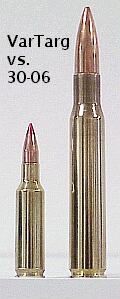 The 20 VarTarg is a popular wildcat based on the .221 Fireball case necked down to 20-caliber. Amazingly efficient, the little VarTarg will drive 32gr bullets at 3700 fps with just 18-19 grains of powder. This is an inherently accurate round that delivers impressive velocities with small powder charges. Burning less powder (compared to a .204 Ruger for example), translates to cooler barrels and longer barrel life.
In this FORUM THREAD, 20 VarTarg shooters list pet loads and praise the VarTarg’s performance:
“I’m using Hornady dies with Rem brass. 18.2 grains of H4198 gets me 3550 fps with a 32 V-Max. My rifle is a trued 700 with a Hart SS barrel and a Jewel trigger. This is one of the best shooting rifles I own. Less than 1/2-MOA is easy for my setup.” — BHodges
“The 20VT is a winner! I am now up to three Coopers in 20 VarTarg and they are all shooters. With 32gr V-Maxs and AA1680 I am getting great results. I am trying H4198 in one rifle. 20 VTs on Prairie Dogs are awesome!” — Claimbuster
“One of my buddies has a Cooper Phoenix in 20 VarTarg and he is shooting 32gr V-Max bullets using H4198 and N-120. He is getting consistant 3/8″ groups at 100 yards. Very easy to load for and I believe one of those inherently accurate cartridges.” — Phasor
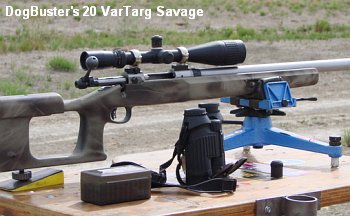
“I’ve gotta a 20 VT…cannot put it away…it’s a recycled 204 Pac-Nor barrel with 1:12″ twist and finished length of 24″ screwed into a single-shot Savage AccuTrigger action. [I get] 3636 fps with 40gr V-Max. I’ve tested the new 32 NBT, but the 40-grainer has more downrange effect. This little cartridge will pick p-dogs off the ground and flip them in the air, even at 400+ yards. I’ve run 500+ rounds down the VarTarg tube, so now this barrel is pushing 3000+ rounds. Load development using H4198 and H322 both produced .50″ or better for 5 shots @ 100 yards. But the weak link is the Rem 221 Fireball brass.” — Dogbuster (Rifle shown below).
Fireball Brass in Short Supply
Our Forum members report that .221 Fireball brass is very hard to find right now. This is related to Remington’s introduction of the 17 Fireball loaded ammunition. If you can find a stash of .221 Fireball brass, grab it while you can. It may be many more months before ample supplies of .221 Fireball brass make it to the retailers.
Trappst reports: “A quick look through the normal places to order (MidwayUSA, Cabelas, Bruno’s, Grafs etc.) shows everyone to be out of stock.” Claimshooter concurs: “221 brass is a problem. I’ve had 2000 pieces on back order at MidSouth since July. I had 1000 pieces on back order for 3 months at Cabela’s and they cancelled the order.”
To learn more about the 20 VarTarg, read our 20 Caliber Cartridge Guide.
December 26th, 2007
Quite a few novice reloaders have recently started visiting our site. One common question is “What should I watch out for when inspecting new brass?” First, always check the cases for obvious defects such as split necks, defective case heads, or dimpled shoulders. But don’t toss a case merely because the neck may be slightly out of round. We recommend you run an expander down the necks to straighten them out before loading, and reduce neck tension slightly. That will take care of minor neck dents.
If you’re using the brass for competition, you may want to weight-sort your cases. You can also benefit by sorting the brass using a Neck Wall Thickness Gauge. Even if your rifle has a “no-turn” neck chamber, you’ll get enhanced accuracy and more consistent velocities if you cull the brass with extremely non-uniform neck-wall thickness.

You’ll want to inspect the flash holes carefully. With domestic brass, you may find flash holes that are slightly off-center, or that are not consistent in diameter. Segregate the brass with off-center holes, and you can uniform the flash holes with a variety of tools. Normally Lapua and Norma brass have very consistent flash holes. However, in some recent lots, we’ve seen a little crescent-shaped sliver of brass around the edge of the flash hole (see photo). This can cause inconsistent ignition and should be removed. You can clean up the edge of the flash hole with a flash hole uniforming tool or a small bit fitted to a pin vise.
Note to newbies–Lapua 220 Russian and 6BR brass has a small flash hole, specified at 1.5mm, about .059″, in diameter. Select a tool that will clean up the flash hole without increasing the flash hole significantly. Some tools will ream the flash hole to .067″ or larger and that is too much. But the actual diameter of your flash holes (whether .059, .062, .067) after reaming is not that critical–so long as all your cases end up with the same hole diameter. Uniformity is the key. With many lots of Lapua brass we’ve found that flash hole reaming is not necessary for 95+ cases out of a box of 100. But you should inspect every case before you load.
December 21st, 2007
Our friends at Berger Bullets keep coming up with new, high-quality projectiles for precision shooters. Berger has just announced a new line-up of .270-caliber VLD bullets designed for long-range hunters as well as target shooters.
 
These bullets are available in 130gr VLD, 140gr VLD, and 150gr VLD. Berger. According to Berger: “The VLD design allows the bullet to penetrate 2″ to 3″ through tissue and bone before it starts to expand. Once it begins expansion, the bullet will distribute 60% to 90% of its weight as shrapnel into the surrounding tissue. The delayed expansion causes a massive wound … which puts the animal down fast.”
“The Berger 270 caliber VLD bullets bring match-grade precision and exceptional terminal performance to a very popular hunting caliber,” says Eric Stecker, Berger’s Master Bulletsmith. “I look forward to the day when we hear about a shooter winning a competition with the same rifle and bullet he used to get his buck.”
|


