Widener’s Reloading & Shooting Supply recently published a helpful introduction to reloading powders. Widener’s online Guide to Smokeless Powders shows the various types of powders, and explains how the differences in powder kernel/flake size and shape, and burn rate affect performance. We recommend you visit Widener’s website and read the Powder Guide in full.
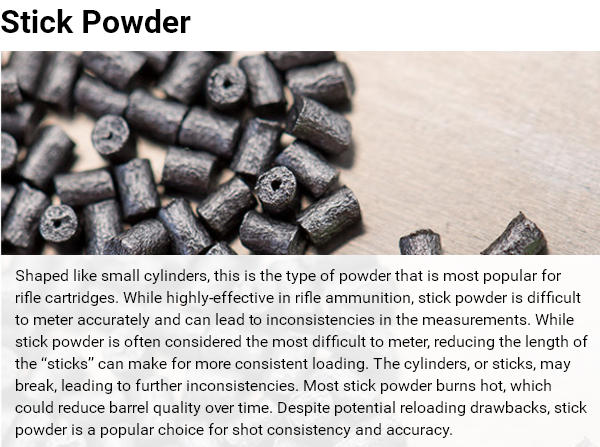
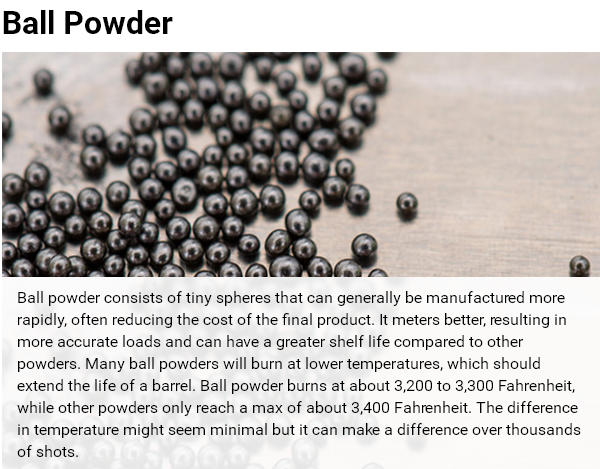
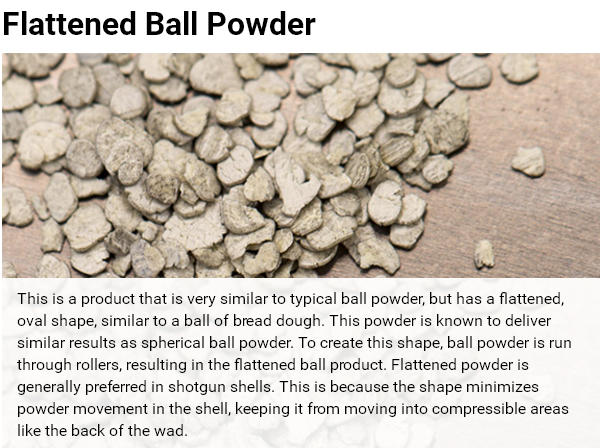
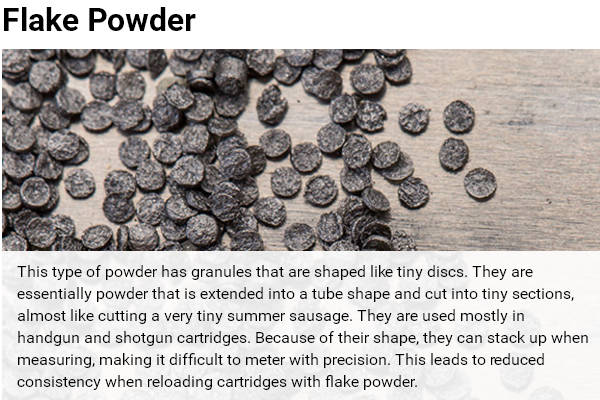
Take a close look at these illustrations which show the key differences between the four main powder types: extruded (stick) powder, ball (spherical) powder, flattened ball powder, and flake powder.
Burn Rate Basics
Widener’s Guide to Smokeless Powders also has a useful discussion of Burn Rate (a confusing topic for many hand-loaders). Wideners explains: “While a gun powder explosion in the cartridge seems instantaneous, if you slow it down you will actually find that each powder has a different ‘burn rate’, or speed at which it ignites.” This video shows powders with two very different burn rates. Watch closely.
Different burn rates suit different cartridge types notes Widener’s: “In general a fast-burning powder is used for light bullets and low-speed pistols and shotguns. Medium-rate powders are used for magnum pistols, while high-velocity, large bore rifle cartridges will need slow powders[.]
It should be noted that burn rate does not have a standardized unit of measurement. In fact, burn rate is really only discussed in comparison to other powders; there is no universal yardstick. Specifics will change by cartridge and bullet types[.]”
Yet another .300 Blackout disaster. Unfortunately, that .300 Blackout cartridge can fit in a .223 Rem chamber. Shooting a .308-caliber bullet in .223 bore is a recipe for disaster.
The .300 AAC Blackout aka “300 BLK”, is a compact 30-caliber cartridge designed to work in AR-15 rifles. It has a shorter cartridge case to accommodate the bigger 30-caliber bullet while still fitting in a standard AR-15 magazine. Unfortunately, that’s the danger. A careless shooter can toss a .300 Blackout cartridge in with .223 Rem rounds without noting. And because the case-head size is the same as the .223 Rem (5.56×45) the rifle’s bolt assembly will happily chamber and fire the .300 BLK round. Problem is, that forces a .308 diameter bullet down an undersized .223-caliber bore. Not good!
This images were provided by Tactical Rifle Shooters on Facebook. The message was clear: “Don’t try to run 300 Blackout in your .223/5.56mm. It won’t end well. The problem is identical rifles and identical magazines but different calibers.”
Image from Accurate Shooter Forum. Cutaway shows the jammed .30-Cal bullet:
For those who MUST have a .300 Blackout, here are some things you can do:
1. Use different colored magazines for .300 Blackout vs. .223 Rem.
2. Fit all your uppers with caliber-labeled ejection port covers.
3. Mark .223 Rem upper handguards with the caliber in bright paint.
4. Mark all .300 BLK Rounds with heavy black marker.
Comments by Folks Who Viewed these .300 Blackout Disaster Photos:
“The .300 Blackout is simply a badly-designed round. A properly-designed round would have had a feature in the shape that would have prevented cross loading in the first place.” — D. Santiago
“I almost made that mistake… I had a magazine of 300 BLK inserted in my .223/5.56 all night. Fortunately, I never pulled the trigger. Once I realized the mistake, I almost got ill. [After that incident] I no longer own a 300 BLK.” — B. Welch
“Happened to me hog hunting from a helo. Gun exploded in my face.” — B. Hood
“Fire-forming projectiles [is] so wrong in centerfire!” — M. Stres
“Had some dude come into the store the other day wanting .300 Blackout ammo to shoot in his 5.56 AR. It took 15 minutes of explaining for him to understand you got to have a .300 Blackout Upper!” — R. Williams
The Tactical Rifle Shooters Facebook Group recently showcased tools used to measure case headspace before and after “bumping” the shoulder. After a case is fired, hand-loaders who full-length size their cases will typically bump the shoulders back anywhere from .001″ to .0035″, depending on the rifle and application. With our 6mmBR and Dasher cases we like about .0015″ bump.
You want the amount of case sizing and bump to be the same for all your brass. To ensure uniformity, it makes sense to measure your cases before and after the FL sizing process. When we have time, we check every case. Other folks will simply check the first 3-4 cases coming out of the FL sizing die to ensure the FL die setting is correct and delivering desired headspace/bump.
1. Whidden Gunworks Shoulder Bump Gauge
There are a variety of tools that can be used to measure shoulder bump. Our favorite is a special cartridge-specific bushing made by Whidden Gunworks. The Whidden Shoulder Bump Gauge enables you to adjust your sizing die to the desired measurement. The bump gauge is attached to your calipers with a set screw and determines the measurement from the base to the shoulder of the case. The photo below, from Tactical Rifle Shooters, shows the Whidden Bump Gauge for the .375 CheyTac cartridge.
2. Dave Manson Vertical Comparator with Dial Read-Out
Dave Manson states: “This tool was designed to make life easier for the advanced shooter and re-loader by allowing precise measurement of ammunition, case, and chamber headspace. With this information, the re-loader will be able to fine-tune clearances and fits between his ammunition and chamber, with resultant improvements in accuracy and case life.” The functions of the Manson Comparator are:
1. Measure headspace of factory or reloaded ammunition
2. Quantify chamber headspace by measuring headspace of a fired case
3. Ensure minimal shoulder set-back when setting up re-loading dies
4. Compare base-to-ogive length to ensure consistent bullet-to-rifling relationship.
Hornady’s Lock-N-Load Headspace Comparator system is easy-to-use and handy. You can get a kit with Red bushing-holder body and 5 bushings for $43.43 at Midsouth. Hornady explains: “The Lock-N-Load® Headspace Comparator… gauge measures variations in brass before and after firing or re-sizing. It allows for headspace comparison between fire-formed brass and re-sized brass.” IMPORTANT: Hornady states: “To determine the proper bushing diameter for your cartridge, simply add the neck diameter and the shoulder diameter and divide that number by two. Use the bushing closest to that number.” Hornady offers five: .330″, .350″, .375″, .400″, and .420″.
One tip — We have found the Hornady gauges may vary a little from unit to unit even with the same nominal size. If you have more than one gauge for the same cartridge, test each on your brass — you may then note a slight difference in your bump measurements. Mark one and use that consistently. There is also an Anvil Base Kit that mounts to the opposite blade on the caliper. This provides a more stable surface for the base of your case.
4. L.E. Wilson Case Gage Depth Micrometer
If you are looking for precise “bump” measurements without having to mess with calipers and clamp-on gauge blocks, you may want to consider the L.E. Wilson Case Gage Depth Micrometer (currently $130.00). This takes very precise, repeatable measurements, but you need to know your starting point. The manufacturer explains: “Every reloader should know exactly how much your Full Length Sizing Die is pushing back the shoulder. With the NEW Case Gage Depth Micrometer you can do just that! It has never been easier to measure you cases headspace before and after sizing. The Depth Mic allows you to slip the micrometer perfectly over the top of the Gage with your case inserted into the Gage and take a measurement. Micrometer has graduations of .001″. The Case Gage Depth Micrometer is set to a zero of .100″ on the scale at our factory. Because of differences in ‘feel’ and temperature, we include a the Gage Block for you to test Zero and to adjust if necessary.”
5. Pistol Brass Case DIY Bump Gauge
Last is a “field expedient” set-up if you do not have any of the comparator tools shown above. A sized .45 ACP case (or other suitable pistol case) can be used to measure shoulder bump. The mouth of the pistol case sits on the shoulder of your rifle cartridge brass.
Make sure the .45 ACP case is trimmed square and that it is round. We recommend you first run it through an expander, then size it, trim it and chamfer. Next, take the .45 ACP case and slip it over the neck of a fired, unsized rifle case with the primer removed. Align the two cases between the jaws of your calipers and note the length from rim to rim (See left photo below).
OK, now you have the length for a fired rifle case BEFORE sizing. Next, take a full-length sized rifle case (without primer) and do the same thing, placing the .45 ACP case over the neck of the FL-sized case (Right Photo). The difference between the two numbers is the amount of “bump” or set-back you are applying to the shoulder. Here the difference is .0015″. The amount of bump you need varies with your chamber and your load, but .0015-.002″ is a good initial setting.
At the request of our readers, we provide select “Deals of the Week”. Every Sunday afternoon or Monday morning we offer our Best Bargain selections. Here are some of the best deals on firearms, hardware, reloading components, optics, and shooting accessories. Be aware that sale prices are subject to change, and once clearance inventory is sold, it’s gone for good. You snooze you lose.
NOTE: All listed products are for sale to persons 18 years of age or older. No products are intended for use by minors.
1. Sportsman’s Warehouse — Vortex Optics Sale
⏺ Major discounts on Vortex scopes — plus gift cards and package deals
Vortex Optics makes some of the best scopes on the market and they come with a solid lifetime guarantee. If you need a new optic, check out the Vortex Scope Sale at Sportsman’s Warehouse. NOTE: Along with the discounted prices, you can receive Sportsman’s Gift Cards worth up to $200 with Select Vortex Purchases. Plus there are package deals when you purchase another product, such as a Weatherby rifle or Springfield Hellcat pistol. For example save $200 on a Vortex Razor HD LHT with the purchase of a Weatherby Vanguard rifle. (SEE Combo Deals Offer).
2. Creedmoor Sports — Hornady A-Tip Sale
⏺ Popular bullets for PRS/NRL, varminting, and target shooting
Good, highly consistent bullets are key to successful rifle competition and hunting. Hornady A-Tip bullets feature an advanced tip design resulting in improved accuracy and more consistent BCs. Right now these A-Tips are on sale at Creedmoor Sports. You can save 10-15% on already attractive prices. These bullets have very uniform tip length, base to ogive length, and bearing surface.
3. Natchez — Burris Scope Sale
⏺ Great deals on large selection of Burris riflescopes
If you’re looking to pick up a new scope check out the Burris scope sale at Natchez. There are numerous scope types deeply discounted now — hunting scopes, target scopes, ballistics calculating optics, Red Dots, spotters, and even crossbow scopes.
4. Graf’s — Hornady L-N-L Iron and LEE Presses, 18%-23% Off
⏺ Major savings on two good reloading presses
Hornady’s Lock-N-Load Iron press is one of our favorites. We like the open front design and the ability to store tools on top of the press. Now just $235.00 at Grafs.com, this is a great deal. The same press is currently $297.60 on Amazon, over $62 more! The compact LEE Breech Lock press is a nice secondary press for your reloading room. Easily transported, this little press works great for bullet-seating chores when loading at the range. The $39.99 price at Graf’s is a steal.
5. Midway — Winchester Ammo Sale PLUS rebates
⏺ Big 20% rebate on large selection of Winchester ammunition
With hunting season around the corner it’s time to grab some high-quality rifle ammunition. You can find a wide range of Winchester Hunting Ammo on sale PLUS up to 20% rebate on top of the sale prices. This is quality ammo to help you make your next hunt successful.
6. Palmetto SA (PSA) — AR-15 Lower with Buttstock, $99.99
⏺ Killer deal on good AR-15 lower — under $100
This PSA Classic Stealth Lower, complete with adjustable buttstock, is now just $99.99. Great deal — you can pay $250 or more for a complete lower from a different vendor. NOTE: Palmetto has offered multiple versions of this basic AR lower. Choose black, gray, OD green, or FDE stocks (price may vary with color). If this particular lower model sells out, go to the PSA Lower Sale Page, and you should find another PSA AR lower priced from $99.99 to $109.99.
7. Amazon — Eylar 48″ Hard Travel Case, $159.99
If you travel by car or plane you need a good hard case to keep your rifle safe from damage. One excellent option is theEylar 44″ TSA-approved case. This has a strong external shell. Inside the case features a customizable, cubed “pull and pluck” foam layer above a foam base layer, with egg-crate foam padding on the upper side. This Eylar rifle case meets TSA requirements, with two padlock fittings for secure storage at home or on the go.
8. Cheaper Than Dirt — HK VP9 9mm, $519.00
⏺ Very good 9mm pistol with excellent trigger and ergonomics
The HK VP9 9mm pistol is an excellent defensive handgun. It features a 4.09″ barrel and 17-rd magazine. The VP’s trigger is very good, with a short, light take-up, crisp break, and a short, positive reset. Interchangeable back straps and side grip panels help mold the VP pistol to your hand. This pistol features a Picatinny rail up front plus ambidextrous controls. NOTE: This is a good price –the same pistol is $635.99 at KYGUNCO.
9. Amazon — RCBS Auto Priming Tool, $115.99
⏺ Durable, reliable bench-mounted priming tool
Seating your primers consistently is critical to accuracy. A quality tool that gets priming duties done very well is the RCBS Automatic Priming Tool. The bench-mounted Automatic Priming Tool is fast and consistent due to a long seating arm with plenty of leverage. Primers feed through a vertical feed tube one by one, preventing potential contamination by oily fingers.
10. Graf’s — Blue Book of AR-15s, $10.00 (57% Off)
⏺ Save 57% on the definitive guide to AR Modern Sporting Rifles
If you own an AR-platform “modern sporting rifle”, we recommend you get this detailed print resource. With 384 pages of information, The Blue Book of AR-15s & Variations is the definitive guide to ARs. Packed with diagrams and technical information, this book provides vital maintenance tips along with guides for starting an AR project. Regularly $22.99, this book is now just $10.00 at Grafs.com — a real steal.
11. Amazon — 10-Pack of Loading Blocks, $9.99
⏺ Great, low-cost loading blocks for high-volume reloaders
Reloading blocks are important for anyone who reloads. If you don’t need a large-format, case-specific loading block, consider this 10 Pack of 50-round loading blocks. These will fit most small-caliber cartridges. These stackable ammo blocks provide a stable base plus a compact storage footprint.
Report based on story by Sheri Trusty, CMP Feature Writer
Major smallbore (rimfire) prone rifle competitions took place July 8-12, 2023 at the Camp Perry National matches. This year, CMP competitors had the added benefit of scoring with Kongsberg Target System (KTS) technology which employs electronic acoustic sensors to determine shot location. Scoring is instantly displayed on user-friendly, touch-screen monitors at the shooter’s side. Mark Del Cotto, a two-time NRA Smallbore Prone Champion, observed: “This is a really nice setup for electronic targets. It’s much easier to shoot the match. It’s quicker, it saves money on paper targets, and there are no rain delays. This is an absolute treat to get to shoot like this.”
The 4-Day Smallbore compeition at the Petrarca range included two days of Iron Sight Championship Matches and two days of Any Sight Matches (scope optional). “Each day, competitors shoot 160 record shots, all fired from prone position”, noted CMP Smallbore Program Manager Brad Donoho. “They do a 40-shot match at 50 meters, a 60-shot match at 50 yards, and a 60-shot match at 100 yards.”
Competitor Mark Del Cotto said marksmen were disappointed when the NRA moved the National Smallbore Rifle Championship to Bristol, Indiana, so many of them asked CMP to create its own smallbore competition. “It was like moving the Masters from Augusta,” said Del Cotto. “Ninety percent of competitors wanted to come back to Camp Perry. When [the NRA] moved it, the level of participation went down and down.” Del Cotto has also shot High Power (centerfire) matches, but he prefers rimfire: “I didn’t have time to do Highpower and Smallbore, so I picked Smallbore Prone. Smallbore is a better experience for me. You get to shoot more shots in a day.”
The competitors are vying for the top score of 6,400 possible points. Due to a USCG search, the last day of the Smallbore Prone Matches was cut short and the match was condensed to a 5,200 points aggregate. “This is a big prone match”, Donoho said. “It’s like a marathon.”
Scopes were allowed for the two-day Any Sights phase of the competition.
Camp Perry’s proximity to Lake Erie can create challenging, variable wind and weather conditions. CMP Smallbore Manager Donoho noted: “We had classic Camp Perry conditions [on Day One]. It started out a little overcast, nice and warm, and then a thunderstorm rolled in. We had pretty blustery conditions and a downpour. Here at Camp Perry, we’re accustomed to 60s and chilly and 90-degree days.”
Ace marksman Kevin Nevius brought 30 years of shooting experience and six national titles to CMP’s Smallbore Prone Matches. He said Smallbore Prone competition has its own unique appeal: “The course of fire is longer. You shoot more shots per day… there’s an element of endurance.” Nevius placed second in the Smallbore Iron Sight Prone Championship and the Overall Prone Aggregate, and he had fun doing it.
Top CMP Camp Perry Smallbore Prone Match Shooters
Smallbore Prone – 5200 Aggregate Championship
Open Class Winner: SFC Shane Barnhart, 5188 – 401X
Ladies Class Winner: Abigail Donovan, 5167 – 340X
Senior Class Winner: Philip Latzgo, 5174 – 331X
Junior Class Winner: Joseph Hahn, 5159 – 289X
F-Class Winner: Daniel Pagliari, 5129 – 313X
Smallbore Team Champions
Open Team Champion: Misfit Love, 1592 – 99X
Team Members: SFC Brandon Green (USAMU), Lewis Makison, PO2 Philip Latzgo (USN), and Thomas McManus [NOTE: SFC Green (green shirt top row of podium) is a multi-time High Power Nat’l Champion and 2022 NRA Long Range Nat’l Champion. Brandon delivered the First Shot at the 2023 Camp Perry National Matches opening ceremony]. Club Team Champion: Rochester Rifle Club Team A, 1591 – 108X
Team Members: Abigail Donovan, Antonio Gross, Joseph Hahn, and Edward Hahn State Association Champion: Ohio Rifle & Pistol Assn., 1591 – 100X
Team Members: Jeffrey Perry, Paul Gideon, Garald Wise, and Michael Naylon
For today’s Saturday at the Movies special, we provide a selection of videos showcasing rifle and pistol cartridge types — from tiny .17 caliber cases to huge 20mm cases. Two of the videos use advance computer animation to provide 3D views of dozens of cartridge types. Then there are some expert commentaries by Jerry Miculek and Ron Spomer discussing the characteristics and performance of various cartridge types. Finally, we provide two videos that discuss rimfire cartridges and show how .22 LR rounds are produced in a modern CCI factory.
90 Different Rifle Cartridge Types in Computer Animation
In this rifle ammunition comparison animation there are 90 different cartridge types, from very small (.22 Flobert) to very, very big (20mm Vulcan). This video employs sophisticated, 3D CAD animation to showcase 90 different rifle cartridges, one after the other, in sequence. It covers from .17 Caliber up to 20mm. Obviously a lot of time and effort went into this video, but it really is cool to see so many different cartridge types in one 3.5-minute video.
After the full line-up is complete at 1:41, the video then provides other smaller comparison, such as multiple large hunting cartridges (2:15) and .22 Caliber cartridges (2:45, see above). All the cartridge models are made using Autodesk Inventor software, and then the “line-up” animation was completed with Autodesk Showcase.
Cartridge Types Included (in Caliber Order, then Metric Order):
1) .17 HM2
2) .17 HMR
3) .204 Ruger
4) .218 Bee
5) .22 Flobert
6) .22 Hornet
7) .22 LR
8) .22 Magnum
9) .22 PPC
10) .22 Short
11) .220 Jaybird
12) .223 Rem/5.56x45mm
13) .223 WSSM
14) .224 Weatherby Magnum
15) .225 Winchester
16) .240 Weatherby Magnum
17) .243 Winchester
18) .25 Remington Auto
19) .250 Savage
20) .25-06 Remington
21) .256 Winchester Magnum
22) .257 Roberts
23) .260 Remington
24) .264 Winchester Magnum
25) .270 Weatherby Magnum
26) .270 Winchester
27) .280 British
28) .280 Remington
29) .284 Winchester
30) .30 Carbine
31) .300 H&H Magnum
32) .300 Rem Ultra Magnum
33) .300 Savage
34) .300 Winchester Magnum
35) .300 Win Short Mag (WSM)
36) .30-06 Springfield
37) .303 British
38) .30-30
39) .308 Norma Magnum
40) .308 Winchester
41) .32 Winchester Special
42) .325 WSM
43) .338 Lapua Magnum
44) .35 Whelen
45) .350 Remington Magnum
46) .375 H&H Magnum
47) .376 Steyr
48) .408 Cheyenne
49) .416 Remington Magnum
50) .416 Weatherby Magnum
51) .444 Marlin
52) .450 Marlin
53) .450 Nitro Express
54) .458 Win Magnum
55) .45×70
56) .460 Weatherby Magnum
57) .465 H&H Magnum
58) .470 Nitro Express
59) .50 BMG / 12.7×99 NATO
60) .500 jeffery
61) .505 Gibbs
62) .577 Nitro Express
63) .577 Tyrannosaur
64) .600 Nitro Express
65) .700 Nitro Express
66) .950 JDJ
67) 4.6×30 mm
68) 4.6x30mm
69) 5.6×50 Magnum
70) 5.7x28mm
71) 5mm/SMc
72) 6mm LEE
73) 6.5×55 Swedish
74) 6.5×6 mm Schuler
75) 6.8mm Remington SPC
76) 6mm PPC
77) 6×45 mm
78) 7mm Weatherby Magnum
79) 7mm Remington Magnum
80) 7mm Rem Ultra Magnum
81) 7.62×39 mm FMJ
82) 7.7×58 Arisaka
83) 7.95×57 Mauser
84) 8mm Remington Magnum
85) 9.3×62 mm
86) 9.3×64 Brenneke
87) 14.5×114 mm
88) 20mm Vulcan
89) 25mmx137mm
90) 30mmx173 mm
Ammunition Size Line-Up — from Tiny to Massive
This animation video shows the size comparison of ammunition from a 2.34mm rimfire caliber to the massive 800mm caliber shell of the Schwerer Gustav railway cannon used by German forces in World War II. This video includes many common rifle and pistol cartridges/calibers, but also includes large artillery ammunition. This video has very good CGI Graphics. Below is part of the line-up from the .17 Remington Fireball (far left) to the famed .50 BMG (far right):
Ammunition Types Showcased in this video:
2.34mm rimfire
2.7mm Kolibri
3mm Kolibri
4.25 mm Liliput
.17 Hornady Mach 2
.17 Remington Fireball
.17 Hornady Magnum Rimfire
.22 Long Rifle
.22 Winchester Magnum Rimfire
HK 4.6×30mm
4.6×36 Loffelspitz
5.45mmx18 MPTs
5.7×28mm SS190
.280 British 7×43
.297/230 Morris Short
.297/230 Morris Long
.30 Pedersen 7.65×20mm
7.92×33mm Kurz
.300 Winchester Short Magnum
8×50mmR Mannlicher
.499 LWR
.577/450 Martini–Henry
.600 Nitro Express
.470 Nitro Express
.50 Beowulf
.50 BMG
20×102 M55A3
25×137 M793
Popular Cartridges/Calibers for Self-Defense and Hunting
This video focuses on popular calibers/cartridges used for self-defense and hunting. It provides a quick but informative overview of the capabilities (and intended uses) of many types of pistol, rifle, and shotgun ammunition. The video discusses the pros/cons of various cartridge types and explains how you would select ammo for a particular purposes (e.g. skeet loads vs. defense shotshells). If you are considering buying a carry pistol and are undecided about caliber choice, this is a good video to watch.
Flattest-Shooting Cartridges by Caliber (Ron Spomer)
In this 15-minute video, hunting expert Ron Spomer examines a variety of standard and wildcat cartridges from .17 caliber all the way to .338 caliber. For each caliber, Ron picks a flat-shooting “winner” and provides some ballistics comparison tables. This video is quite popular, with over 550,000 views on YouTube.
Ammo Types and Calibers — Jerry Miculek Explains the Basics
In this video, legendary shooter Jerry Miculek talks about popular types of pistol and rifle ammunition and the various bullet options used for plinking, competition, and self-defense. Jerry, one of the greatest pistol shooters on the planet, provides useful insights on cartridge selection and bullet choices. Jerry notes: “There are a TON of different types of ammunition” so he explains the basics. And Jerry answers common questions such as: “What is the difference between ball and hollow-point bullets?” and “What type of gun takes rimmed cartridge versus rimless?”.
.22 Caliber Rimfire Cartridges — Some Key Facts Revealed
We recommend all .22 rimfire shooters watch this video from Old English Outfitters. It explains some important facts and clarifies some common misconceptions about to .22 caliber ammunition. To learn more about modern .22 LR rimfire ammo, we also recommend the video below, which shows how CCI .22 LR ammunition is manufactured, start to finish.
BONUS Video — How .22 LR Ammunition Is Made
YouTube host 22Plinkster toured the CCI/Speer production facility in Lewiston, Idaho. While touring the plant, 22Plinkster was allowed to capture video showing the creation of .22 LR rounds from start to finish. This is a fascinating video, well worth watching.
This revealing video shows all phases of .22 LR ammo production including cupping, drawing, annealing, washing, drying, head-stamping, priming, powder charging, bullet seating, crimping, waxing, inspection, and final packaging. If you’ve got ten minutes to spare, we really recommend you watch the video from start to finish. You’ll definitely learn some new things about rimfire ammo.
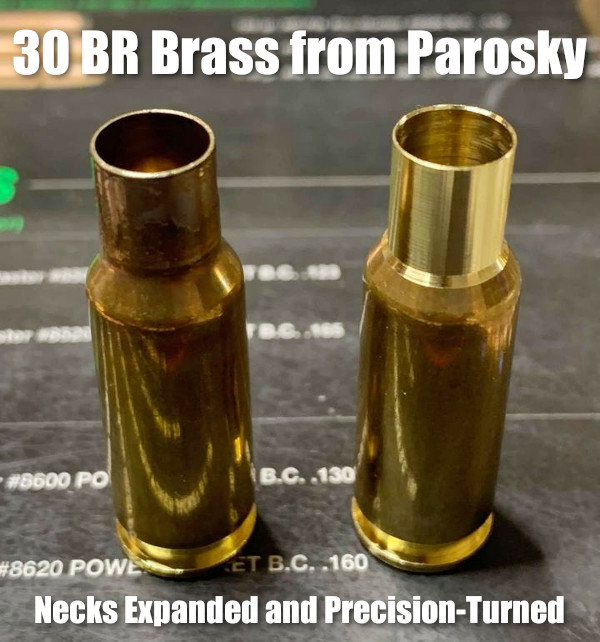
Here’s good news for 30BR shooters. Paul Parosky, maker of the excellent PRP Custom Bullets, is now offering 30BR neck-turned brass. This can save you considerable time and effort forming 30BR cases from Lapua 6mmBR brass. And the neck-turning is superb, again representing time savings (and no tools to buy). You can order this 30BR brass from PRPbullets.com. If you communicate with the PRP team, Paul may be able to neck-turn to your specific thickness. Paul notes: “Here are necks turned for a 0.330 neck. I’ll try my best to accommodate anyone’s neck dimensions as they wish. Just contact us through our website PRPBullets.com.”
About this Neck-Turning set-up — Paul Parosky notes: “For neck-turning I’m using an old drill press that has been re-worked. The cutter and spindle are all indicated before neck turning to ensure no runout. The RPM is around 520. The lube I use is a mixture of royal and mystery oil.”
Why the 30 BR Dominates 100/200 Benchrest for Score Competition
The 30BR, along with some wildcat variants, remains the dominant cartridge in short-range (100/200) benchrest-for-score competition. The 30BR’s .308″-diameter bullets are larger than the 6mm bullets used by the 6PPC (which rules group BR competition). The bigger 30-Cal diameter has an advantage in touching scoring rings. In addition, the 30BR is also relatively easy to tune, and barrel life is considerably better than with smaller-caliber benchrest cartridges. For more information, see our AccurateShooter 30BR Cartridge Guide.
Cases are Expanded, Then Neck-Turned
To produce his 30BR brass, Parosky first uses a series of expander mandrels. Then he neck-turns with power using a converted drill press. Paul tells us: “This is done the old school way, I use three different tapered expander mandrels, then neck-turn it to the proper neck chamber, then run them up through a FL expander mandrel to ensure necks are straight. Then I clean all the cases.”
Paul Parosky Can Also Neck-Turn 6PPC Brass
Paul Parosky also expands and neck-turns 6PPC cases that are made from parent Lapua .220 Russian cartridge brass. Here, illustrating his 6PPC neck-turning operation, is a Paul Parosky post on the USA Benchrest & Extreme Precision Shooters Facebook page.
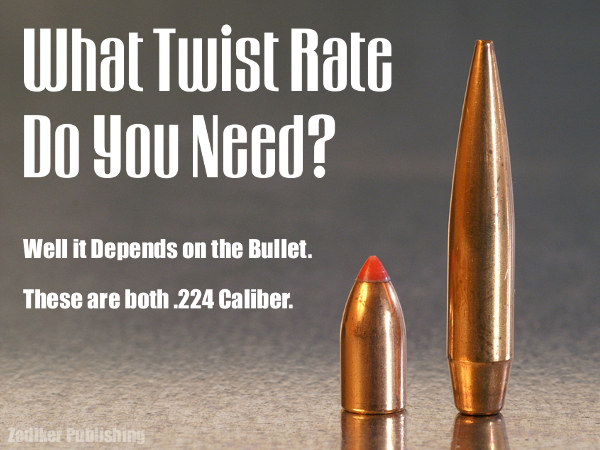
Here’s an extreme range of .224-Caliber bullets: 35gr varmint bullet and 90gr match bullet. Of course, along with bullet length/design, you need to consider MV when choosing twist rate.
Even with the same caliber (and same bullet weight), different bullet types may require different rates of spin to stabilize properly. The bullet’s initial spin rate (RPM) is a function of the bullet’s muzzle velocity and the spin imparted by the rifling in the barrel. You want to ensure your bullet is stable throughout flight. It is better to have too much spin than too little, according to many ballistics experts, including Bryan Litz of Applied Ballistics. The late Glen Zediker put together some basic tips concerning barrel twist rates and bullet stability. These come from Glen’s book, Top Grade Ammo.
Choosing the Right Twist Rate
I’d always rather have a twist too fast than not fast enough. Generally… I recommend erring toward the faster side of a barrel twist decision. 1:8″ twist is becoming a “new standard” for .224 caliber, replacing 1:9″ in the process. The reason is that new bullets tend to be bigger rather than smaller. Don’t let a too-slow twist limit your capacity to [achieve] better long-range performance.
Base your next barrel twist rate decision on the longest, heaviest bullets you choose to use, and at the same time realize that the rate you choose will in turn limit your bullet choices. If the longest, heaviest bullet you’ll shoot (ever) is a 55-grain .224, then there’s honestly no reason not to use a 1:12″. Likewise true for .308-caliber: unless you’re going over 200-grain bullet weight, a 1:10″ will perform perfectly well.
Bullet Length is More Critical than Weight
Bullet length, not weight, [primarily] determines how much rotation is necessary for stability. Twist rate suggestions, though, are most usually given with respect to bullet weight, but that’s more of a generality for convenience’s sake, I think. The reason is that with the introduction of higher-ballistic-coefficient bullet designs, which are longer than conventional forms, it is easily possible to have two same-weight bullets that won’t both stabilize from the same twist rate.
Evidence of Instability
The tell-tale for an unstable (wobbling or tumbling) bullet is an oblong hole in the target paper, a “keyhole,” and that means the bullet contacted the target at some attitude other than nose-first.
Increasing Barrel Length Can Deliver More Velocity, But That May Still Not Provide Enough Stability if the Twist Rate Is Too Slow
Bullet speed and barrel length have an influence on bullet stability, and a higher muzzle velocity through a longer tube will bring on more effect from the twist, but it’s a little too edgy if a particular bullet stabilizes only when running maximum velocity.
My failed 90-grain .224 experiment is a good example of that: I could get them asleep in a 1:7″ twist, 25-inch barrel, which was chambered in .22 PPC, but could not get them stabilized in a 20-inch 1:7″ .223 Rem. The answer always is to get a twist that’s correct.
These tips were adapted from Glen’s popular 2016 book, Top-Grade Ammo That work has numerous helpful articles on technical topics. Berger Bullets also has a FREE online Twist Rate Stability Calculator, developed by Applied Ballistics.
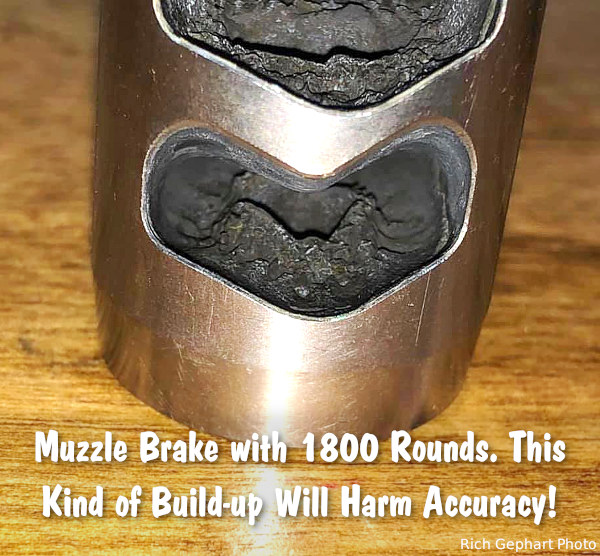
Many hunters and precision rifle competitors use muzzle brakes because these ported devices reduce felt recoil significantly. That makes a real difference getting back on target for quick follow-up shots. While many rifle owners appreciate the benefits of muzzle brakes, they may also neglect their brakes, allowing hard carbon and powder residue to build up. Not good. You should regularly clean your muzzle brake to remove fouling and carbon build-up.
As Mark Edgreen posted: “Carbon build up on the crown and in the brake is a recipe for poor accuracy.” And another gunsmith reported that customers complained about guns that “shot out way too early” but they only needed to have the brakes cleaned.
Gunsmith and PRS/NRL competitor Jim See recently reminded his Facebook Fans about the importance of cleaning muzzle brakes: “How many times do I have to say it? You need to maintain your rifles. Clean your muzzle brakes people!”. Jim, who runs Elite Accuracy LLC, notes that hard carbon build-up in brakes can definitely harm accuracy. Look at this example:
Muzzle Brake Cleaning Methods
There are various methods for cleaning a brake, we list a variety of techniques, but we would start with NON-corrosive ultrasound. You’ll want to remove the muzzle device before doing these tasks.
1. Use Ultrasonic Cleaning Machine with cleaning solution. This may be the most efficient method: “I place my brake in the ultrasonic cleaner. Shiney as new.” (Jim Moseley).
2. Spray with commercial Carb Cleaner and brush. Then apply anti-corrosion coating.
3. Soak in half hydrogen peroxide and half vinegar. Suggestion: “Let sit over night and carbon melts off. Brush remaining carbon off, rinse and put the brake back on.” Apply anti-corrosive before mounting.
4. Soak in 50/50 solution of water and white vinegar and brush. (Be sure to apply anti-corrosion coating, such as Eezox, after soaking).
5. Tumble in liquid solution with stainless pins. Comment: “Comes out slightly faded, but perfectly clean on stainless, non-painted brakes though.” Warning — do NOT do this with threaded brakes — tumbling could affect threads of screw-on brakes. Also, tumbling can harm painted or Cerakote finishes.
Gunsmithing Tip: By fitting the muzzle brake so that the barrel crown is slightly forward, it is easier to wipe carbon fouling off the end of the barrel. See photo:
Over the past 12 months, this article was one of the TOP TEN most-read Daily Bulletin features. We’re reprising it today for those who may have missed it the first time. The above diagram comes from a TiborasurasRex YouTube Video comparing G1 and G7 BC models. CLICK HERE to watch the video.
The better, up-to-date ballistics programs let you select either G1 or G7 Ballistic Coefficient (BC) values when calculating a trajectory. The ballistic coefficient (BC) of a body is a measure of its ability to overcome air resistance in flight. You’ve probably seen that G7 values are numerically lower than G1 values for the same bullet (typically). But that doesn’t mean you should select a G1 value simply because it is higher.
Some readers are not quite sure about the difference between G1 and G7 models. One forum member wrote us: “I went on the JBM Ballistics website to use the web-based Trajectory Calculator and when I got to the part that gives you a choice to choose between G1 and G7 BC, I was stumped. What determines how, or which one to use?”
The simple answer is the G1 value normally works better for shorter flat-based bullets, while the G7 value should work better for longer, boat-tailed bullets.
G1 vs. G7 Ballistic Coefficients — Which Is Right for You?
G1 and G7 refer both refer to aerodynamic drag models based on particular “standard projectile” shapes. The G1 shape looks like a flat-based bullet. The G7 shape is quite different, and better approximates the geometry of a modern long-range bullet. So, when choosing your drag model, G1 is preferable for flat-based bullets, while G7 is ordinarily a “better fit” for longer, boat-tailed bullets.
Drag Models — G7 is better than G1 for Long-Range Bullets
Many ballistics programs still offer only the default G1 drag model. Bryan Litz, author of Applied Ballistics for Long Range Shooting, believes the G7 standard is preferable for long-range, low-drag bullets: “Part of the reason there is so much ‘slop’ in advertised BCs is because they’re referenced to the G1 standard which is very speed sensitive. The G7 standard is more appropriate for long range bullets. Here’s the results of my testing on two low-drag, long-range boat-tail bullets, so you can see how the G1 and G7 Ballistic coefficients compare:
G1 BCs, averaged between 1500 fps and 3000 fps:
Berger 180 VLD: 0.659 lb/in²
JLK 180: 0.645 lb/in²
The reason the BC for the JLK is less is mostly because the meplat was significantly larger on the particular lot that I tested (0.075″ vs 0.059″; see attached drawings).
For bullets like these, it’s much better to use the G7 standard. The following BCs are referenced to the G7 standard, and are constant for all speeds.
Many modern ballistics programs, including the free online JBM Ballistics Program, are able to use BCs referenced to G7 standards. When available, these BCs are more appropriate for long range bullets, according to Bryan.
[Editor’s NOTE: BCs are normally reported simply as an 0.XXX number. The lb/in² tag applies to all BCs, but is commonly left off for simplicity.]




 The
The 


 Competitor Mark Del Cotto said marksmen were disappointed when the NRA moved the National Smallbore Rifle Championship to Bristol, Indiana, so many of them asked CMP to create its own smallbore competition. “It was like moving the Masters from Augusta,” said Del Cotto. “Ninety percent of competitors wanted to come back to Camp Perry. When [the NRA] moved it, the level of participation went down and down.” Del Cotto has also shot High Power (centerfire) matches, but he prefers rimfire: “I didn’t have time to do Highpower and Smallbore, so I picked Smallbore Prone. Smallbore is a better experience for me. You get to shoot more shots in a day.”





 Increasing Barrel Length Can Deliver More Velocity, But That May Still Not Provide Enough Stability if the Twist Rate Is Too Slow


 The better, up-to-date ballistics programs let you select either G1 or G7 Ballistic Coefficient (BC) values when calculating a trajectory. The ballistic coefficient (BC) of a body is a measure of its ability to overcome air resistance in flight. You’ve probably seen that G7 values are numerically lower than G1 values for the same bullet (typically). But that doesn’t mean you should select a G1 value simply because it is higher.
 Drag Models — G7 is better than G1 for Long-Range Bullets


