Important news for 1000-yard benchrest competitors! The 2020 IBS 1000-yard National Championships will be held September 5 and 6, 2020 at the Vapor Trail Valley Range in Missouri. Take note — the IBS 1K Nationals were originally going to be held at the Hawks Ridge Range in North Carolina. So the event has moved from NC to Missouri, and will be held later in the year. This change was done because of uncertainties over COVID-19 public health policies/retrictions in North Carolina. Also, moving the Nationals to early fall gives more time to organizers to plan the event.
Forum member David 0306 from North Carolina observed: “As many of you have probably already heard, the 2020 1000-yard IBS Nationals has been cancelled for Hawks Ridge Gun Club in North Carolina. [Due to] uncertainty of what phase the NC Governor will have the state in, and the possibilities of going back into a stay-at-home order, the board at Hawks Ridge decided it was in the best interest of the shooters to cancel and allow another club to host the Nationals if possible. This will also help with travel plans, and getting time off from work. What I do know is Vapor Trail Valley has stepped up to the plate and has agreed to host the Nationals. Thank You Vapor Trail Valley and IBS shooters for your help and support through these difficult times.”
This site is for and about accurate shooters. So today we feature the short-range group Benchrest game, where it’s all about shooting tiny groups in the ones and even “zeros”. Seeing the tiny groups 6 PPC aces produce, it’s easy to think the precision is all about the equipment. But there is a lot more involved. A talented human still has to watch the flags, run the gun properly, and tune his loads for the conditions. Here are some tips from one of the world’s best benchresters, Charles Huckeba.
Texan Charles Huckeba was the top individual shooter at the 2013 World Benchrest Championships (WBC) held near Sydney Australia in October 2013. In this video, 2013 WBC Two-Gun Overall winner Charles shoots a 1/8th MOA group at 200 yards — “a little bitty dot” as a fellow Team USA shooter observes. That’s impressive. If you can describe Huckeba’s style in a nutshell it would be “smooth, consistent, and rapid but not hurried”.
Charles also employed some unusual hardware. In the video, take a close look at the joystick on the Farley Coaxial front rest. There’s no knob at the end. In its place is a small, wood ammo caddy. Charles removed the standard knob from the handle of his Farley rest and replaced it with a home-made wood block that holds cartridges for the record target. The 10.5-lb Light Varmint rifle is chambered in 6PPC with a BAT Machine Action and a composite wood and carbon-fiber stock.
Watch Charles Huckeba Shoot 1/8 MOA, 200-yard group at World Benchrest Championships
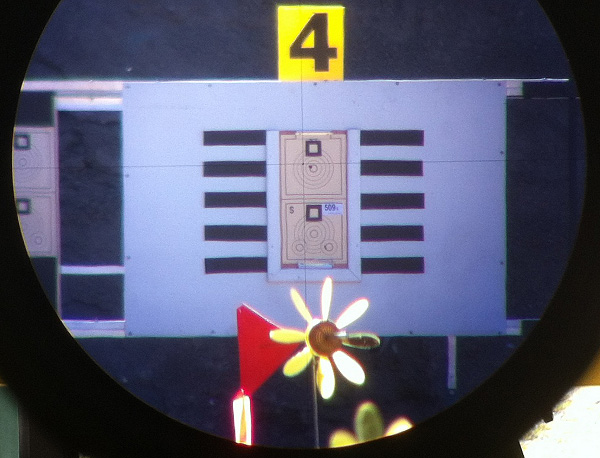
Here is the actual 200-yard, 5-shot group Charles shot in the video. Photo (by Stuart Elliot) taken through the lens of Huckeba’s 50X March scope (reticle has 1/16th MOA Dot).
Analyzing the Fine Points — What Makes Huckeba So Good
Short-range benchrest shooter Boyd Allen saw some interesting things in Huckeba’s WBC performance, as captured on video. Boyd noticed Huckeba’s smooth gun-handling and efficient loading. But Boyd also spied some interesting equipment, including an innovative joystick “handle-caddy”.
1. Low Friction Bags — When Huckeba slid his rifle, there was very little apparent friction. The front bag features the new 3M material (ScotchLite) on the sliding surfaces. The rear Protektor bag has ears of the same low-friction material.
2. Pause Before Chambering — While he was watching the flags and deciding when to start firing, Charles kept his first round in the action, but out of the barrel’s chamber, probably so as not to heat the cartridge and change the round’s point of impact.
3. Ammo Caddy on Joystick Arm – Charles shoots a Right Bolt/Left Port action, so he pulls his rounds with his left hand. Note that Huckeba’s record rounds rest in a small, wood ammo caddy attached to the end of the joystick shaft. Look carefully, you’ll see the wood ammo block in place of the normal black ball at the end of the joystick. That allows Charles to pull shots with the absolute minimum of hand movement. Ingenious! Huckeba is very fast, with a great economy of motion. I believe that because his ammo was literally at hand, Charles was better able to keep his focus on aiming and the flags.
4. Smooth-Cycling BAT Action — Note how smoothly Huckeba’s action operates. When Charles lifts the bolt handle (to extract a round and cock the firing pin), this does not disturb the rifle. Likewise, as he closes the bolt, the gun doesn’t wobble. The smooth action allows Charles to hold point of aim even when shooting relatively quickly. Huckeba’s BAT action is chrome-moly steel. Some shooters believe this metal makes for a smoother action than stainless steel or aluminum.
5. Long-Wheelbase Stock — The wood and carbon fiber stock is light, long, and stiff. Yet, importantly, the stock is also well-damped. The longer-than-average stock length (with extended forearm) seems to help the gun track well without jumping or rocking. The longer forearm allows a longer “wheelbase”, effectively shifting the weight distribution rearward (less weight on the front, more weight on the rear). This places a greater share of the gun’s weight on the rear bag, as compared to a more conventional benchrest stock. Huckeba’s stock, built by Bob Scoville, is at the cutting edge of short-range benchrest design. Its light-weight balsa wood and carbon fiber construction provides a combination of stiffness and vibration damping that allows its relatively long fore-end to be fully utilized to increase the weight on the rear bag (always an issue with 10.5-pound rifles).
To learn more about this benchrest stock design, read the comments by stock-builder Bob Scoville in our PPC with Pedigree story in our Gun of the Week Archives. Bob observed:
“There is a lot more to the structure of the stocks than meets the eye. The carbon fiber skin with which I cover the stocks creates a light, tough exterior surface. However, this contributes very little to the overall performance of the stocks. The real strength and stiffness is the result of an internal beam utilizing balsa core/carbon fiber technology.
This type construction can be found in aircraft, race cars, powerboats, and sailboats. It is interesting to note, balsa has the highest strength to weight ratio of all woods and carbon fiber is one of the lowest stretch (modulus of elasticity) relative to weight of all materials. The marriage of these two materials is common in the high-performance world. Additionally, balsa is used commercially for vibration dampening and sound reduction.”
Video find by Boyd Allen. Video by Stuart Elliot of BRT Shooters Supply, Brisbane, Australia.
Kirsten Weiss knows a thing about accuracy. She won the 2012 NRA Three-Position Women’s Smallbore Championship, while finishing as the National Overall Woman Champion. She used to shoot with the American team in top-level World Cup competition. Kirsten started shooting fairly late — at age 16. Despite her relatively late start, she earned a place on the University of Nebraska shooting team. That literally opened up a new world for Kirsten: “During the course of my career, I’ve had a lot of success. I’ve gone to World Cups… in Zagreb, Croatia, in Munich, Germany. I’ve won National Championships, and got on to the U.S. Olympic short list, so it’s been a good career.”
In these three videos, Kirsten offers key tips on accurate shooting. In the first video she explains how to get and maintain the proper cheek weld on your rifle. In the second, Kirsten talks about canting error — how having inconsistent side-to-side tilt on your rifle. In the third video, Kirsten explains the importance of proper trigger placement.
Proper Cheek Weld
No matter what your discipline — smallbore, silhouette, High Power, F-Class, or even PRS — it’s vital to have a consistent cheek weld for every shot. You want your head to be in the same position on the stock each time.
In this video, Kirsten explains how to find the best position for your head on the stock, which may require adjusting the cheekpiece and/or length of pull. Then Kirsten demonstrates how to maintain consistent cheek weld shot after shot.
Consistent Rifle Cant (Tilt from Centerline)
Kirsten says most training manuals don’t explain rifle cant: “You won’t find this shooting technique just anywhere. Most shooters don’t even think about it — and they’re missing out. Proper Rifle Cant or Gun Cant (also known as cant error or even scope cant) is a complicated topic, but I’ll explain it simply — and how to simply avoid cant error.”
Want to know how to actually aim a gun right? This accuracy tip covers a crucial aspect of marksmanship. If you cant your rifle inconsistently from shot to shot, the point of impact will change, even with “perfect aim”. This is another episode in Kirsten’s How to Shoot Awesomely video series.
Proper Trigger Finger Technique
Kirsten tells us: “Finger placement on the trigger might not seem like a big deal, but it actually is. The reason for this is because, depending on where your index finger is placed on the trigger, [this] translates to different muscle interactions with the gun.” Watch this video to see Kirsten demonstrate proper finger placement (and explain problems caused by improper finger positioning).
When you pull the trigger, you only want to engage the last section of your finger, in order to avoid unwanted muscle engagement and to achieve a smooth shot. Remember there is a “sweet spot” between the crease (first joint) and the tip of the finger. If you position the trigger in that “sweet spot”, you should see an increase in your accuracy. Don’t make the mistake of putting the trigger in the crease of your finger, as shown below.
Modern F-Class and Palma Rifles are long. With barrels up to 32″ in length these big rigs won’t fit in your average gun case — either fabric covered or hard shell. Likewise, it seems like PRS rifle are getting longer each season, as competitors find longer barrels provide greater velocity and heavier rifles have more stability, allowing shooters to see hits better.
So, if you have a rifle that measures over 48″ in length, you have two options for transport — first separate the stock from the barreled action, or get a very large carry case that allows extended length rifles to be transported. This article reviews hard and soft rifle cases options for long-barreled rifles.
Large Hard Shell Rifle Cases (at least 50″ Interior)
What to Look For in Hard Rifle Carry Cases
When you are considering a large rifle case you, first measure your rifle and make sure it will fit within the INTERIOR dimensions. With some rifles you can make more clearance by removing or adjusting the buttplate system. Then consider the duties. If you will be traveling by commercial airline, you definitely need a hard case — no way around that. Will you be carrying one rifle or two — that will dictate the case you buy. For max flexibility you’ll want foam like the SKB so you can have various rifles. For max security during transport, however, it makes sense to have dense foam that is customized to fit your rifle.
SKB Double Rifle Case, 56″
Expensive but built like a tank — that describes SKB Cases. These high-quality hard sided cases are ideal for airline transport, with very tough exteriors, great padding, and strong hinges. The SKB model 2SKB5009 Double Rifle Case is an excellent choice for carrying two rifles long distances. This has a very tough exterior with a metal middle frame for extra strength. Priced at $304.99, this case has exterior dimensions: 56″ L x 16.5″ W x 9.5″ H. This photo shows the case carrying both an M1A and an M1 Garand. NOTE: The foam is not really customizable. This is not the best choice if you plan to carry a single rifle and a spotting scope and a second barrel.
Pelican Vault Series Rifle Cases
Pelican Products, known for premium hard-shell transport cases also offers a more affordable VAULT series of cases. Pelican’s VAULT cases offer durability and security at a lower price point. VAULT cases range in price from $39.99 to $199.95 and are backed by a 1-year guarantee. The VAULT rifle cases all feature wheels, easy-to-use push-button latches, and four stainless steel lock hasps for security. There is also a brightly colored Hi-Viz strip on the front of Pelican’s VAULT cases. This will make it easier to spot your case at airport baggage areas. At around $200.00, the model V800 double-rifle case features a 53″ x 16″ x 6″ interior. That’s long enough for F-Class rifles and tactical rigs with brakes. The model V770 single-rifle case is 50″ × 10″ × 6″ inside. That’s still big enough for most hunting, varmint, and benchrest rifles.
Plano Two-Gun Tactical Case
This Plano two-gun case is Amazon’s #1 Best Seller in wheeled, heavy-duty firearms cases. This is offered in three sizes: 36″, 42″, and 52″. We like the biggest 52″ version, ($115.99 on Amazon), as it is long enough inside to fit most scoped match rifles. Alternatively, if you have a really long F-Class, ELR, or Palma rig, you can detach the barreled action from the stock, and run the two sections in the shorter 42″ case. The big case lets you easily carry TWO scoped hunting rifles. That’s great because this case is strong enough for airline travel, meeting FAA requirements for checked baggage. This Plano case offers a good balance between strength and weight, all for a reasonable cost.
Large Soft Rifle Cases (at Least 50″ Interior)
What to Look For in Soft Rifle Carry Cases
With soft cases, look at the quality of zippers, slings, and shoulder straps. It’s nice to have pockets, but remember most of your accessories (spotting scopes, stands, bipods, rear bags etc.) will be carried separately, so the pockets may not really be that critical. Consider the fabric — is it waterproof? That’s important if you live in a wet region such as Oregon or Washington.
Champions Choice Deluxe 58″ Rifle Case, $72.00
Many of our readers shoot Palma, F-Class, and ELR rifles with long barrels (up to 35″). It’s difficult to find high-quality, well-padded cases that fit very long rifles. Champion’s Choice offers just such a product, the 58″ Deluxe Soft Rifle Case. With thick 1″ padding on each side, big pockets, and backpack straps, this black/blue/white gun case has earned rave reviews from our Forum members. There’s plenty of room for big scopes, and it even comes with an internal tube to hold your cleaning rod.
Bulldog 54″ Long Range Rifle Case, $106.99
Highly rated by buyers, Bulldog Long Range Rifle Case fits rifles up to 52.5″ long. Priced at $106.99 at Guncases.com, the Bulldog LR has many impressive features, and is one of the best soft cases you can buy for long match rifles. This versatile case boasts a tough 600-dernier water-resistent outer shell, plus quilted inner lining with Velcro tie downs. There are two zippered center pockets plus an external zippered pocket at front for suppressor storage. The main compartment zippers are lockable.
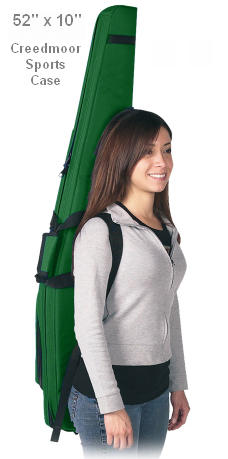
Creedmoor Sports 52″ Nylon Case for Match Rifles, $76.95
52″ Creedmoor Sports Soft Case
At the request of many High Power shooters, Creedmoor Sports has created a high-grade 52″x10″ softcase. That’s tall and long enough to fit a Tubb 2000, or AR-based spacegun with long barrel. The Creedmoor case is one quality offering, with nice 1″ thick close-cell foam padding plus tough Cordura nylon on the outside and nylon pack cloth on the inside. Both materials are urethane-coated for water proofing. Another nice feature are the integral backpack straps (see photo left). These free your hands to carry rests, spotting scopes or other gear.
Savior double rifle cases come in sizes from 36″ to 55″ in an assortment of colors. A great choice for long PRS and match rifles, the biggest Savior Gun Case (55″ model) can hold two rifles up to about 53.5″ OAL. Multiple colors and five lengths are available: 36″, 42″, 46″, 51″, 55″. The big 55″ case is $96.99 at Amazon while the 51″ version is $91.99. With comfortable shoulder straps, these cases can hold TWO rifles and just about all the accessories you’d want to pack.
Extreme 52″ Midsouth Gun Case (Budget Option)
For those on a tight budget, Midsouth Shooters Supply offers an Extreme 52″ padded gun case for just $30.16. This thickly-padded case is high enough in the center to fit most scoped rifles — even with big Nightforce scopes. Made by Bulldog Cases, the all-black Extreme 52″ case features a soft faux-fur inner lining, an external accessory pocket, and a removable shoulder strap.
In an article for the CMP Online Magazine, SSG Tobie Tomlinson of the USAMU Service Rifle Team explains the various sight alignments employed by iron sights shooters. Tobie writes: “There are a myriad of sight picture options that shooters have used to great effect over the years. The sight picture that allows you to consistently shoot the smallest group, with a minimal shift in zeros, is the correct one. Remember, for any shooter to be successful, consistent sight picture must be complemented by front sight focus and sight alignment.” CLICK HERE to read FULL ARTICLE
Center Hold
The front sight is placed directly in the center of the target. A center hold is great in different light conditions. On a bright day the target appears small. On a dark day the target appears large. In [any] light conditions the center of the target is always in the center. A shooter who has problems with elevation shots in various light conditions may benefit from a center hold.
6 O’Clock Hold
With the 6 O’Clock hold the front sight is placed at the bottom of the aiming black. For many shooters, this hold allows precision placement of the front sight. The ability to accurately call your shots will come with time and experience. Light changes, which alter the appearance of the target, may affect shooters who utilize the 6 O’Clock hold.
Sub 6 Hold
The sub 6 is just like the 6 O’Clock hold, only there is a small line of white between the front sight and the aiming black. Many shooters have a problem determining the exact 6 O’Clock position with their front sight, but by using a sub 6 or line of white they may be able to better estimate their hold.
Frame Hold
With the frame hold, just like with the other holds, the front sight is in the center of the rear sight. The front sight can then be placed at the 6 or 12 O’Clock position on the frame when there is no visible aiming point. This hold is typically reserved for foul weather and poor light conditions. By placing the front sight at the top or bottom of the frame, a shooter may hold better when there is little target to see. It can be difficult to hold a tight group this way, but it may add more hits in bad conditions. This technique is normally applied when shooting longer ranges such 600 or 1000 yards.
How accurate can a .45 ACP pistol be, in the hands of an expert marksman? Take a look at that target. This was shot off-hand (no rest) with ONE HAND at FIFTY (50) Yards. That’s TEN shots at 50 yards all inside the 3.36″ 10-Ring with eight shots in the 1.695″ diameter X-Ring.* We bet most folks would have trouble matching that with a scoped rifle shot standing.
Amazing Handgun Accuracy at 50 yards
This remarkable feat of precision pistol shooting — a 100-8X group at 50 yards — was accomplished this week by PFC Jason Gregoire, a talented young USAMU pistol marksman. And yes, that was done shooting one-handed!
On its Facebook Page the USAMU posted: “Check out this impressive target by PFC Jason Gregoire of the USAMU Service Pistol Team! This was shot one-handed, with a .45 pistol, and at 50 yards during the Centerfire Match in Columbus, Ohio [on 7/1/2020]. The score was 100-8X. Now that is some marksmanship!”.
How to Improve Your Pistol Skills
Want to improve your bullseye pistol shooting skills? Then watch a series of videos hosted by Brian “Gunny” Zins, a 12-time National Pistol champion, and retired U.S.M.C. Gunnery Sergeant. Here is one the Fundamentals of Bullseye Pistol Shooting videos that Zins produced with the NRA and Shooting Sports USA.
12-time National Pistol Champion Brian Zins Explains Aiming and Trigger Control.
Pistol Competitors (.45 ACP) at 2019 NTT Match at Camp Perry, Ohio.
* This 10-shot group was shot on the NRA B-6 50-yard Pistol Target. Here are the ring dimensions as stated in the NRA Precision Pistol Rules (p. 15):
Shooting USA will broadcast a great episode today, January 15, 2020. There are three segments worth watching. First the TV show spotlights the popular GAP Grind, a Pro-Am PRS event at the K&M Precision complex in Tennessee. Then this episode covers the NRA World Shooting Championship (WSC) in Virginia. This unique Pro-Am event challenges shooters with a dozen stages, employing a wide variety of pistols, rifles, and shotguns supplied by the manufacturers. The WSC offers huge rewards — over $250,000 in cash and prizes! Finally, there is a historical feature on the Spencer Rifle this week.
SHOW TIMES: This Shooting USA Episode airs July 1, 2020 (Wednesday) at 9:00 PM Eastern and Pacific; 8:00 PM Central.
PART ONE– 2019 GAP Grind Feature on Shooting USA
Lots of Action, with 20+ Stages
The GAP Grind is a challenging, “high tempo” match with minimal down-time between stages. Over the course of 20+ stages, competitors will fire 200+ shots at a variety of steel, paper, moving, and reactive targets out to 1,200 yards. Targets vary in size/difficulty based on the shooter’s position, distance, and time allotted. Most stages include “stressors” — i.e. time limits or required movement(s).
The GAP Grind is held at the impressive K&M Shooting Complex:
The GAP Grind attracts over 300 competitors — half experienced shooters and the other half newcomers to the sport. The key to growing the shooting sports is attracting new shooters. The best way to bring in “new blood” seems to be the Pro-Am type format. At the GAP Grind, experienced shooters share their knowledge and guide the new shooters through the competition.
Josh Temnnen Facebook photo.
GAP Grind Hardware
You’ll find the latest and greatest PRS hardware at the GAP Grind. Notable in 2019 was the fact that many top competitors “stepped down” from the 6.5/6mm Creedmoor to the smaller, more efficient 6mm Dasher, 6BRA and other 6mm cartridges. The Dasher offers excellent accuracy with less recoil than the 6.5 Creedmoor. Also, many top shooters are now running Kahles optics. Photo by Shelley Giddings.
PART TWO — NRA World Shooting Championship
In 2019, its sixth consecutive year, the NRA World Shooting Championship (WSC) returned to the Peacemaker National Training Center in Glengary, West Virginia. One of the nation’s biggest Pro-Am events, the WSC attracted many of the USA’s top professional shooters, along with talented amateurs. [NOTE: This year’s 2020 WSC has been cancelled due to COVID-19.]
This unique 3-day multi-gun match, held Sept. 18-21, 2019 tested competitors’ skills across twelve challenging stages involving nearly every major shooting discipline for rifles, shotguns, and pistols. Stages included fan favorites like 3-Gun, High-Power Silhouette, Cowboy Action, and more. For more information on the match, check out wsc.nra.org or email NRAhighpower@nrahq.org.
Way back in 2008 we shot rimfire tactical events in California. These 22 LR Tactical Precision Matches were fun, with affordable rifles and low-cost ammo. And since you don’t have to spend long hours loading ammo, rimfire tactical matches are also great for people with limited free time. You experience the fun of shooting tactical comps with much lower cost and WAY less prep time.
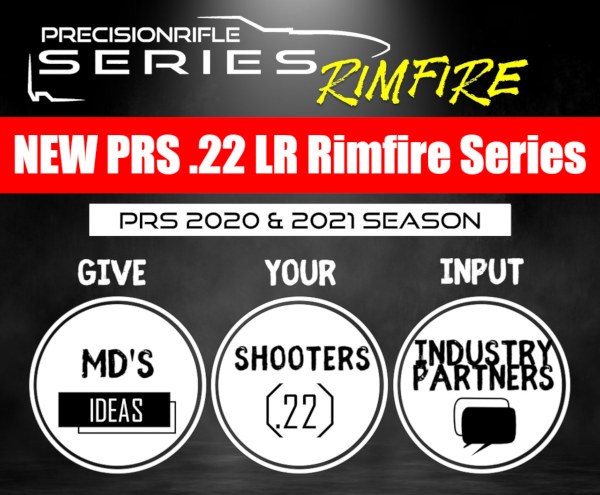
Over the past few seasons, NRL22 competitions have become popular nationwide. Now the leaders of the Precision Rifle Series (PRS) are planning to join the rimfire tactical game. Earlier this month, PRS organizers announced that the PRS will launch a new PRS Rimfire Series for 2020-2021:
The 2020-2021 PRS Rimfire Series is Launching Soon!
The PRS has been inundated with requests to put the PRS engine, national infrastructure, and outstanding partnerships behind the launch of a brand new PRS Rimfire Series for the 2020 and 2021 season. Over the last few months match directors, regional directors, our shooters, and PRS industry partners have communicated loud and clear that you want a Rimfire Series done the PRS way — and done right.
The Ruger Precision Rimfire should be a popular Factory Class option for PRS Rimfire
Rimfire tactical shooting offers outstanding “bang for the buck” compared to centerfire PRS. Rifles cost less, and .22 LR ammo costs a fraction of centerfire rounds. You don’t have to spend hours hand-loading your ammo. Travel time is reduced because you only need a range with targets out to 200 yards or so.
John Parker, Editor of Shooting Sports USA, explains the appeal of a rimfire PRS series: “PRS … has evolved into a top-tier shooting league, complete with a slick website and leaderboard rankings with data gathered from regional matches held across the country. The group plans to take the same approach with the proposed rimfire series[.] By throwing its hat into precision rimfire competition, PRS joins established .22 LR long-range games like the Lapua Practical Rimfire Challenge and NRL22[.]”
With ergonomics identical to a full-size centerfire fire, the .22 LR Bergara B-14 could become a popular choice for the future PRS Rimfire series. Photo by UltimateReloader.com.
PRS Seeks Input from Match Directors and Competitors
The PRS leadership is excited about its new national rimfire series: “Match Directors, shooters, and our partners appreciate that nothing that comes close to the PRS national level organization, leadership, experience and unrivaled website capabilities. Our series score tracking capabilities from the individual club level to the national level are simply unmatched.
We know that the rimfire community is primarily at your local club level and we have ensured that clubs will be able to provide their shooters with a PRS series that is easy to be a part of and provides loads of PRS benefits. Every PRS Rimfire club will have [its] own club page on our website that automatically calculates and tracks internal club rimfire series scores using the same simple upload system you have all come to love. Scores from each Rimfire Club will populate the corresponding Regional PRS Rimfire Series, modeled after the booming PRS Regional Series. Rimfire shooters will compete for standings at their local club level and also within their region… all rimfire shooters will receive a PRS Rimfire profile that tracks all of their scores, highlights their equipment, and celebrates their achievements.
Over the next few weeks, we will be gathering more of your input. We are forming a PRS Rimfire Committee composed of shooters, industry partners, and match directors. If you are a shooter, sponsor, or MD and would like to be a part of this conversation, email info@precisionrifleseries.com.”
PRS Rimfire Preview — .22 LR Long Range Precision Match in Minnesota
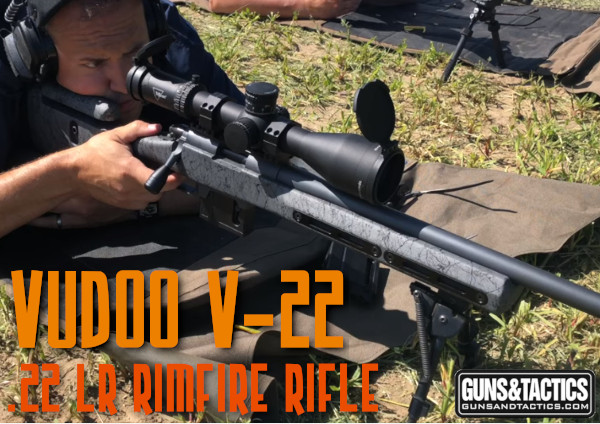
Want a preview of PRS Rimfire competition? In this video, Dave Timm of GunsandTactics.com shoots a Vudoo V-22 bolt gun in the Minnesota .22 LR Long Range Precision Rimfire Match at the Rush Lake Range. This PRS-style match had targets out to 300 yards during the main match, followed by a long range challenge out to 465 yards. Dave’s Vudoo Gunworks V-22 rifle features a Grayboe Ridgeback stock and Trijicon Accupower 4.5-30x56mm FFP scope. Dave was shooting Lapua Center-X .22 LR ammunition.
Are you looking to get started in PRS and NRL practical precision rifle competition? Or perhaps you’d like to advance your skill set so you can place higher in big matches (and get your hands on some of those prize table items)? Of course there is no substitute for trigger time in the field, but there ARE some great print resources. These four books can help you select the right equipment, improve your shooting skills, make better wind calls, increase your fitness level, and develop a more efficient between-match training program.
1. IMPACT! — Training and Preparing for Precision Rifle Matches
Rodney Maze, $19.99 Paperback, $4.99 Kindle
Impact!, by PRS competitor Rodney Maze, is an entry/intermediate level guide to preparing yourself and your equipment to compete in precision rifle type matches. It will also benefit anyone looking to learn about practical-style long range and precision shooting. We recommend you check it out for yourself — there are 20 Pages of free sample content on Amazon. Topics covered include:
— Rifle, optic, and equipment selection
— Setting up your rifle, bags, tripods for PRS/NRL matches
— Understanding ballistics and how to record and use ballistic data
— Techniques for using holdovers for multi-target stages
— Gun skills, rapid fire techniques, clearing malfunctions
— Shooting off of barricades, and specialty stages
— Effects of wind and how to improve your wind calls
— Tips for live fire and dry fire practice
— Preparing yourself and your equipment for a match
— Mental strategies and techniques
Impact! is illustrated with plenty of photographs. Topics are divided logically, and concepts are explained in clear language. Also included is an extensive glossary of terms used in precision shooting and a list of additional resources you can use to further pursue your precision shooting knowledge. This book also includes a handy Appendix with formatted pages for recording data about your rifle, scope, and ammunition. There is also a Wind table for recording your rifle “dope” and wind hold-offs. Lastly, Impact! has a useful table of unit conversions.
2. Practical Shooter’s Guide
Marcus Blanchard, $19.99 Paperback, $9.99 Kindle
Thinking of getting started in the Practical/Tactical shooting game? Looking for ways to be more stable when shooting from unconventional positions? Then you may want to read Marcus Blanchard’s Practical Shooter’s Guide (A How-To Approach for Unconventional Firing Positions and Training). Unlike almost every “how to shoot” book on the market, Blanchard’s work focuses on the shooting skills and positions you need to succeed in PRS matches and similar tactical competitions. Blanchard provides clear advice on shooting from barricades, from roof-tops, from steep angles. Blanchard says you need to train for these types of challenges: “I believe the largest factor in the improvement of the average shooter isn’t necessarily the gear; it’s the way the shooter approaches obstacles and how they properly train for them.”
3. Long Range Shooting Handbook
Ryan Cleckner, $19.85 Paperback, $9.99 Kindle
Ryan Cleckner’s Long Range Shooting Handbook is the best-selling modern book on practical rifle skills. A former U.S. Army sniper instructor, Cleckner is knowledgeable, and his text is well-organized and chock full of good information. You can view Sample Chapters on Amazon.com.
Ryan Cleckner’s highly-regarded Long Range Shooting Handbook is designed as an intro to important fundamental concepts such as MOA vs. Mils, External Ballistics, and Environmental Effects. Included are personal tips and advice based on Cleckner’s years of experience as a sniper instructor and special operations sniper.
The Long Range Shooting Handbook is divided into three main categories: What It Is/How It Works, Fundamentals, and How to Use It. “What It Is/How It Works” covers equipment, terminology, and basic principles. “Fundamentals” covers the theory of long range shooting. “How to Use It” gives practical advice on implementing what you’ve learned, so you can progress as a skilled, long range shooter. This book will benefit any long-range shooter, not just PRS/NRL competitors.
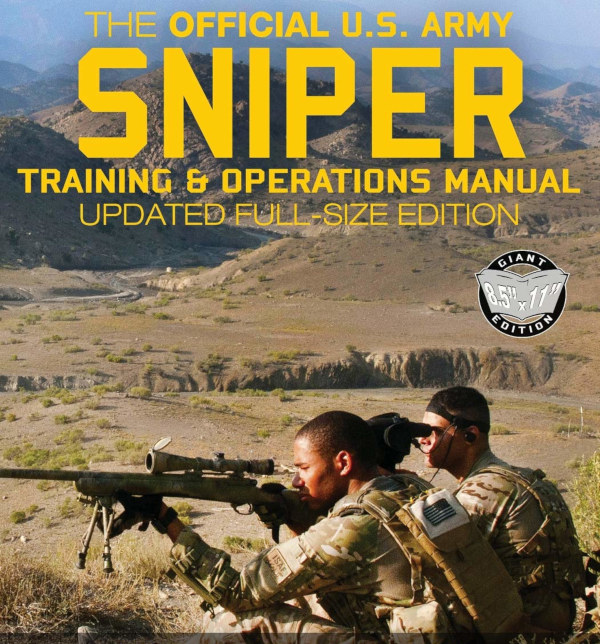
4. Official U.S. Army Sniper Training and Operations Manual
From U.S. Army Sources, $17.59 paperback.
This U.S. Army Sniper Training Manual is a very comprehensive resource, with over 450 pages of information in a large 8.5″x11″ format. NOTE: Unlike other editions on Amazon, this is NOT the basic, outdated FM 23-10. This is the completely-overhauled 450+ page edition (FM 3-22.10). Heavily illustrated, this is a very useful resource for tactical/practical precision shooter. Employed as the “textbook” for the U.S. Army Sniper School at Fort Benning, GA, this big manual explains ranging methods, rifle handling, optics selection and operation, and rifle maintenance.
There is also extensive discussion of ballistics, wind reading, and weather effects. Practical competitors will appreciate the discussions of moving targets, range estimation, and range safety procedures. One reviewer explains: “This book contains the distilled wisdom of the Sniper School’s instructors and expert marksmen, giving you over 450 pages of unique insight into the long range combat shooter’s art.”
Serious riflemen know that Krieger makes outstanding centerfire barrels that hold world records and have won many National Championships. But did you know that Krieger makes great rimfire barrels too? Well, Krieger does make outstanding .22 LR rimfire match barrels that can deliver impressive accuracy.
Sniper’s Hide moderator “Padom” recently tested a variety of rimfire ammo types, employing five different barrels: Krieger, Bartlein, Benchmark, Lilja, and Green Mountain. He tested at both 50 yards and 100 yards. FULL Rimfire TEST REPORT HERE.
Reporting on the 50-yard test, Padom posted: “Had a virtually dead calm day today for 50-yard RimX testing (Keystone Accuracy RimX barreled action with 1:16″ Krieger 20″ barrel). A few infrequent 3 mph gusts but pretty dead [calm] and the target showed. This Krieger just barely edged out the Bartlein by 0.003″ with a 0.177″ 6×5 with SK Rifle Match. The 10×5 was 0.198″. The best lots of Center-X weren’t far behind either. This is the first Krieger rimfire [barrel] I’ve shot and it didn’t disappoint.”
Padom noted: “Winds were much calmer tonight than this morning so the 100-yard Krieger test was a success. Winds were pretty consistent [at] 3-5 mph.”
Test Results at 100 Yards
Padom then tested ammo at 100 yards, again using his Krieger rimfire barrel: “To recap, the Krieger shot the best 50-yard results of the barrels tested so far, just barely beating the Bartlein but it was so close you can call the 50-yard results equal (.005). Well the Krieger beat all the barrels tested to date at 100 yards by a pretty good margin with Center-X. The 10×5 was incredible as well at just barely over 0.6″ showing the results were very consistent. A second lot of Center-X was right there with the previous 100-yard 6×5 best results just barely over 0.6. The third lot of Center-X shot a respectable 0.75″ 6×5. This Krieger sure is shooting very nicely. I’m really looking forward to shooting it at 300 and 400 yards[.]”
Components Tested: 20″ Krieger M24 barrel, .22 LR Match Eachus chamber 0.046 headspace, Zermatt RimX Action, Bix’N Andy TacSport Pro 2-Stage Trigger, RimX 10rd magazine, XLR Envy Pro Folding Chassis, Athlon Cronus BTR 4.5-29x56mm MIL scope.
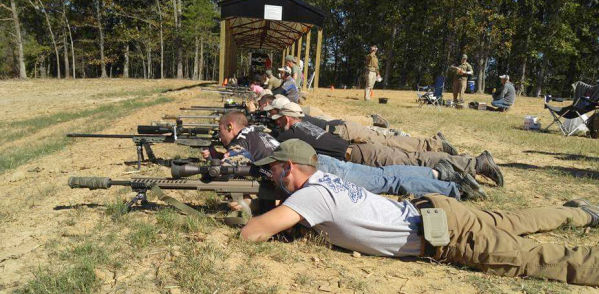
Shooting Set-up: 100 Yards Prone with Bipod and Rear Bag.



 3. Ammo Caddy on Joystick Arm – Charles shoots a Right Bolt/Left Port action, so he pulls his rounds with his left hand. Note that Huckeba’s record rounds rest in a small, wood ammo caddy attached to the end of the joystick shaft. Look carefully, you’ll see the wood ammo block in place of the normal black ball at the end of the joystick. That allows Charles to pull shots with the absolute minimum of hand movement. Ingenious! Huckeba is very fast, with a great economy of motion. I believe that because his ammo was literally at hand, Charles was better able to keep his focus on aiming and the flags.


 52″ Creedmoor Sports Soft Case

 In an article for the
  Center Hold
 6 O’Clock Hold
 Sub 6 Hold
 Frame Hold
 Amazing Handgun Accuracy at 50 yards










 Test Results at 100 Yards


