In 2020, Lapua will again be the title sponsor for the Lapua Practical Rimfire Challenge (LPRC). Modeled after PRS competition, the LPRC features practical-style matches shot with .22 LR bolt-action and self-loading rimfire rifles with optics. There will be four series matches, leading up to the series Finale in October 2020. Shooters will compete for glory plus an impressive table of prizes.
The Lapua Practical Rimfire Challenge Series (LPRC) will be held at the Peacemaker National Training Center in Glengary, WV. The LPRC is designed to test the .22 LR rifle shooter, ammunition, and optics out to 300 yards. While most stages involve long-range positional shooting, shooters will encounter stages set in natural terrain, stages with movement, Olympic stages of fire, and/or smallbore-style stages. Shooters can select from the semi-auto or bolt action division.
Registration for the LRPC is now open, with matches starting in March 2020. For more information on the LPRC visit Peacemakernational.com/prc.
LPRC Match Dates
Match 1: March 21-22
Match 2: May 25-26
Match 3: June 22 – 23
Match 4: July 27- 28
Series Finale: October 5
LPRC Matches Will Feature Multiple Positions and Movement
LPRC series matches are positional shooting events in field conditions out to 300 yards. You can use either a bolt-action or semi-auto .22 LR rimfire rifle. Much like PRS (Precision Rifle Series), competitors will shoot from a variety of positions: prone, strong/weak shoulders, standing, sitting, and kneeling. There will be shots from barricades, and movement from position to position during stages.
LPRC rules will, to a large degree, mirror PRS rules. However, shooters will see some different type of stages than what is normally seen at a PRS match. For example, there may be unsupported standing or unsupported kneeling shots in some stages. Peacemaker’s goal is not to replicate PRS in Rimfire, but rather to create the ultimate challenge for shooters on the rimfire rifle platform.
Rimfire Tactical Matches Aren’t Really New
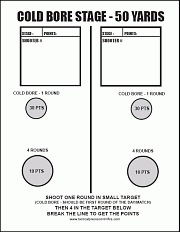
We’re pleased to see this LPRC shooting discipline — it sounds like fun. However, the concept of a rimfire tactical/practical match is not new — at least on the West Coast. California shooting clubs have been running “Rimfire Tactical” matches for more than a decade. CLICK HERE to read our comprehensive Rimfire Tactical report from way back in 2008. This article includes free targets, ballistics charts, and a complete run-down on suitable rimfire rifles.
The Concept Behind the Rimfire Tactical Match by Bill Erwin
Many guys who shoot long-range tactical matches practice with .22 LR rifles of similar configuration. Rimfire ammo is way more affordable than centerfire, you do not need a big range facility, and shooting rimfire saves wear and tear on your centerfire rifle. Further, for learning how to read the wind, there really is no better training tool than a 22 LR, even as close as 50 yards. Check out this table showing how a .22 LR ballistics compare to .308 Win:
22 LR vs. .308, Distances for Equal 10 MPH Wind Drift
This table shows the corresponding distances at which a 10 mph full-value crosswind pushes a .22 LR bullet and .308 projectile the same amount. Values are based on 0.130 BC for a 40gr .22 LR bullet, and 0.496 BC for 175gr .308 bullet.
22 LR 40gr 1050 fps
50 yd Wind 1.0″
75 yd Wind 2.2″
100 yd Wind 3.8″
125 yd Wind 5.8″
150 yd Wind 8.2″
175 yd Wind 11.0″
200 yd Wind 14.3″
.308 Win 175gr 2650 fps
130 yd Wind 1.07″
180 yd Wind 2.15″
230 yd Wind 3.68″
280 yd Wind 5.63″
330 yd Wind 7.98″
380 yd Wind 10.71″
440 yd Wind 14.56″
This table shows how the .22 LR can be an effective substitute for a .308 Win during training. Because the smaller bullet drifts more in the wind, a 22 rimfire shooter will experience roughly the same crosswind effects as if he was shooting a 175gr .308 twice as far out. So, rimfire work can teach you to dope the wind like a .308, but at less than half the distance. Shooting a .22 LR at 100 yards is like shooting a .308 (with 175 SMK) at 230 yards
SPECIAL BONUS–Rimfire Tactical Precision Targets
These FREE targets by DesertFrog are offered in Adobe Acrobat format for easy printing. CLICK HERE to download all six targets as a .ZIP archive.
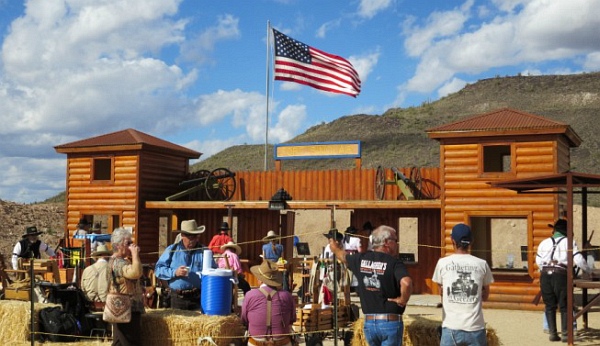
Earlier this month the Ben Avery Range in Phoenix hosted America’s top long-range shooters at the Berger SW Nationals. This week, Feb. 24 – March 1, 2020, over 1000 cowboys and cowgirls take over Ben Avery during Winter Range, the SASS National Championship for Cowboy Action Shooting. Winter Range is the second largest Cowboy Action event of the year, after End of Trail, the Single Action Shooting Society World Championship held each year in Edgewood, New Mexico.
If you want to check out the action at Winter Range, admission is free. The Ben Avery Shooting Facility is located on Carefree Highway, west of Interstate 17. For more information, visit WinterRange.com.
This video, produced by the Arizona Fish and Game Commission, covers the full Winter Range experience, including the main shooting competitions, the side matches, the Western costumes, the socializing, and more. Worth watching if you like action shooting or are a fan of the Wild West.
Hundreds of cowboy action shooters, ages 12-80, will compete in multiple classifications based on age, and type/caliber of firearms. In addition, this year the Cowboy Mounted Shooting Association and the SASS Mounted Shooters will hold a two-day mounted shooting event February 29 through March 1, in nearby Queen Creek, Arizona.
Cowboy Action Shooting requires that contestants compete with firearms typical of those used in the taming of the Old West: single-action revolvers, lever-action rifles, and period shotguns. Participants each have a registered cowboy shooting alias (such as “Deadeye Dave”), used in SASS events. Competitors, organized in “Posses”, shoot a series of multi-gun stages. In addition to the primary competitions, Winter Range 2020 will feature displays of period militaria, exhibitions of western skills and crafts, a fast-draw contest, and nearly 100 vendors selling vintage-style clothing and “sundries”.
Do you have a talented high school student in your family or community who needs help with future college expenses? Then here is an opportunity.
SSSF to Award $1,000 and $500 Scholarships To High School Senior Athletes
The Scholastic Shooting Sports Foundation (SSSF), is offering financial awards to deserving, graduating High School seniors in the Scholastic Clay Target Program (SCTP) and Scholastic Action Shooting Program (SASP). The main objective is to award as many scholarships as possible to qualifying SCTP/SASP graduating seniors. This is a one-time, non-renewable scholarship for college tuition.
NOTE: Application Deadline (for the entire application packet) is Midnight, April 19th, 2020. All materials must be received together as one packet by deadline — No Exceptions!
Since 2013, the SSSF has awarded over $450,000 in scholarship funds benefiting over 450 student-athletes in the Scholastic Clay Target and Scholastic Action Shooting programs. In 2019, the Scholarship Program awarded over $100,000 to qualifying applicants in $500 or $1,000 amounts.
Applicants must be a current and paid member of the SCTP or SASP national organization at the time of application submission and a graduating senior within the year of the awarded scholarship. Awardees must be registered for college before the scholarship is awarded.
Program Requirements for NSSF Scholarship:
Shooting Sports Athlete — Applicants must have participated during 2019-2020 in one of their SCTP / SASP State Championships, National Championships, or regional events in Trap, Skeet, Sporting Clays, Olympic Bunker, Olympic Skeet Championships, Pistol, or Rifle.
Good Academic Standing — Applicant must have a minimum 3.0 cumulative Grade Point Average through the most recent grading period ending on or before April 1, 2020.
Pursuing Full-time College Education — Each prospective recipient must be registered as a full-time college student before the scholarship is awarded.
Needs-Based Eligibility — Applicants may not already have secured any “full” scholarship support (e.g. athletics, military academy, academic, etc.).
Ian Klemm won back-to-back 2017/2018 USA F-TR National Championships. His next big challenge will be the 2021 World Championships, where his father Ken Klemm will be one of his teammates on Team USA.
Over the last 30 years, a family saga has been playing out in rural Wisconsin: a father fosters within his son the joy of competitive target shooting. It started in a basement shooting range of a small-town elementary school, shooting single-shot rimfire target rifles while cementing the fundamentals of sight alignment, breathing, trigger control, and safety. With a background of competitive smallbore shooting in school and the U.S. Navy, Ken Klemm coached his son, Ian, in a father/son indoor winter shooting league. Ian was determined to shoot as well or better than his Dad and would pursue that goal for the next 30 years. Even after his engineering career took him to the Washington DC area for defense-related work, Ian continued to compete with his Dad by mailing “postal match” targets back and forth for many years.
Ian and Ken Klemm have shot successfully together as members of Team X-Men.
Ken even came to visit Ian out east, with rifle in tow, where they entered the Virginia State 1000-yard Benchrest Championship on a whim with their entry-level (factory) F-Class rifles. Ken’s record target measured 0.003″ smaller than his son’s but Ian was getting closer to matching his Dad. Ian eventually moved back to Wisconsin after taking a design job with Vortex Optics, only a few miles from his hometown, and now he and his Dad could compete in earnest, both against each other and as teammates on the X-Men F-Class club team.
Ian’s trigger time increased significantly with his new vocation and he was lucky enough to design a new competition scope, the Vortex Golden Eagle, for both to use. Armed with two nearly identical new rifles and their new optics, Ian and Ken began traveling cross-country together to compete alongside their X-Men teammates, winning multiple National F-Class Championships together.
Matched F-TR Rifles with Kelbly Actions, McMillan X-It Stocks, Bartlein Barrels
Both Ken’s and Ian’s match rifles are built using the same winning hardware — Kelbly actions, McMillan X-It stocks, and Bartlein barrels. Also, Ian and Ken both run similar loads: Lapua .308 Win Palma brass, Vihtavuori N150 Powder, and Berger 200-20X bullets. In addition to the components listed below, they use some special equipment: bipod lowering kits from FClassProducts.com, large rear bigfoot bags from Seb Lambang (SebRests.com), and “Dri-Gun” rain protection from BarrelCool.com.
Gun Specifications
Vortex Golden Eagle 15-60x52mm scopes
Kelbly Panda actions
McMillan X-It stocks
Bartlein 1:10″-twist, 30″ barrels
Phoenix Precision Bipods
Father and Son Share their Winning Strategies
Having each other to share tips and techniques and confirm winning strategies with has certainly helped Ken and Ian compete successfully together over the last few years. Common between them are the strategies of bracketing wind conditions with sighters as well as using the Golden Eagle’s aperture stop ring (ASR) to more effectively observe mirage and ultimately quantify wind value. They both try to shoot in a building wind condition as it more slowly increases in velocity while challenging each other to stop during a string at the first sign of a potential “let off” or sudden decrease in wind velocity.
Ian and Ken competed successfully as teammates on Team X-Men. They shared winning strategies, such as bracketing wind conditions with sighters.
The only significant difference in how each of them wins is in their gun handling. Ken maintains the most consistent form and smallest groups by assuming very light shoulder pressure and virtually no grip contact with his rifle. In contrast, Ian is most competitive with a medium-firm pressure on both the grip and forearm of the McMillan X-It stock as well as medium shoulder pressure. Both techniques have proven themselves during competition when employed consistently.
Unlike many F-TR shooters, two-time F-TR National Champion Ian Klemm grips the fore-end of this rifle when he shoots. Ian explains:
“I use a piece of Kydex thermoplastic (commonly used in holsters) that I formed around the forearm (see photo above). I index off it when gripping the stock with my weak hand to ensure that I’m always contacting [the stock] in the same spot. I grip this while shooting, for every shot. It was quickly assigned to my subconscious since I was so used to gripping the fore-end after years of hunting. It felt unnatural to me to not be doing anything with my off-hand. By letting my subconscious do what comes naturally, I am able to achieve a higher level of consistency that if my conscious mind was ‘trying’ to accomplish something with that other hand. The relatively stiff McMillan X-IT stock feels like it benefits from more contact in terms of vibration during the shot as well.”
Father and Son Will Shoot for Team USA in 2021 World Championships
The United States F-Class Rifle team has just completed a 2-year tryout period consisting of multiple tests and scored drills designed to determine which developmental candidates would be named to the final travel team ultimately representing our country against the rest of the world during the next quadrennial World F-Class Championship in South Africa, April 2021. Ken and Ian were just recently informed that they had both been named as shooters on that Final Team USA Selection. This is the first time, to our knowledge, that a father and son have shared that honor as teammates on a USA Rifle Team.
Here are Ken and Ian on the 2019 FCNC Team. Both father and son have been selected to shoot with the 2021 USA National F-TR Team which will compete at the World F-Class Championships South Africa.
The level of competition from the leading countries around the world is expected to be even stronger this cycle than in previous ones, with correspondingly slimmer margins of victory. Along with the rest of their US teammates and coaches, they will practice and prepare as a dedicated team over the next year to build a sense of confidence and trust in one another. Ken and Ian are thankful for the opportunity to share this experience of a lifetime together and for the 30-year long practice session leading up to it.
Ian Klemm and Ken Klemm at 2017 Berger SW Nationals.
A few good men (and women) — that’s what the shooting sports need these days. We need skilled, trained personnel to serve as Range Safety Officers (RS0s). Without RSOs, there would be no shooting matches — no F-Class, no High Power, no Smallbore Matches — you get the idea. Thankfully there are now ways to get requisite RSO training without costly travel far from home.
The NRA now offers an online training course for its Range Safety Officer (RSO) program. The online course teaches the skills needs to conduct and supervise safe shooting activities and range operations. Online RSO Course students can access the electronic course materials for 90 days. You can complete the course in multiple sessions. The program will save your progress so you can return later.
• Introduction to the NRA Basic Range Safety Officer Course
• The Role of the NRA Range Safety Officer and Range Standard Operating Procedures
• Range Inspection and Range Rules
• Range Safety Briefing
• Emergency Procedures
• Firearm Stoppages and Malfunctions
Who Can Take the Course?: The Online RSO Course is available to anyone who currently possess a valid NRA Firearms Instructor certification or NRA Coach appointment. Course cost is $125.00. Individuals without a trainer rating must attend the in-person Range Safety Officer course consisting of both classroom time and practical exercises on a range.
Certification Procedure: Students must complete all six lessons and a short electronically administered test in order to become a certified Range Safety Officer. Once the test has been passed, newly certified Range Safety Officers will receive an electronic completion certificate that can be printed or saved to a computer.
The NRA RSO program was developed in response to the demand for a nationally-recognized range safety officer certification. More than 54,000 NRA Range Safety Officers are involved in aspects of target shooting, training, and range supervision around the USA.
Range Safety Officer supervises the line at Berger SW Nationals. Without dedicated RSOs, we could not have matches like these.
The Civilian Marksmanship Program (CMP) will offer hands-on rifle and pistol training programs in 2020 at locations around the nation. Marksmanship 101, formerly known as the Small Arms Firing School (SAFS) On The Road, is designed to train beginners on rifle or pistol essentials and competition basics in a closely monitored setting, utilizing the talents of qualified CMP staff, trainers, and members of the U.S. Army Marksmanship Unit (USAMU).
Participants learn through classroom work and active training on the range. Near the conclusion of training, students participate in a true M16 rifle or M9 pistol match, fired under close supervision of trainers on the line. Registration opened February 19, 2020. Classes are limited, so you should sign up well ahead of time. No walk-ins will be permitted in PA, IN or IL. CLICK HERE to REGISTER.
No previous knowledge in marksmanship is required for the course. All experience levels are welcome to attend. Rifles and ammo are provided. Personal shooting jackets and gloves are permitted. Hearing protection and eye protection is also required.
Courses on the Marksmanship 101 2020 schedule include:
RIFLE Marksmanship 101 Training Programs 2020:
March 14, 2020: Western CMP Games – Ben Avery Shooting Facility, Phoenix, AZ
April 24, 2020: Eastern CMP Games – Camp Butner, Butner, NC
May 16-17, 2020: Ridgway Rifle Club – Ridgway, PA
May 29, 2020: Camp Atterbury – Edinburgh, IN
July 25-26, 2020: National Matches, RIFLE SAFS – Camp Perry, Port Clinton, OH
September 24, 2020: New England CMP Games – Camp Ethan Allen, Jericho, VT
September 25-26, 2020: Illinois State Rifle Association – Bonfield, IL
Oct. 15, 2020: Oklahoma CMP Games – Oklahoma City Gun Club, Oklahoma City, OK
November 17, 2020: Talladega 600 Matches – CMP Talladega Marksmanship Park, AL
CMP Marksmanship 101 Programs utilize the Small Arms Firing School format.
PISTOL Marksmanship 101 Training Programs 2020:
July 7, 2020: National Matches, PISTOL SAFS – Camp Perry, Port Clinton, OH
September 18, 2020: New England CMP Games – Camp Ethan Allen, Jericho, VT
How to Register for CMP Marksmanship Training Programs
Visit the CMP Marksmanship 101 website for Registration Links and other information. Once on the website, click your desired date and location to be sent to the CMP Competition Tracker page to complete registration. Questions regarding Marksmanship 101 may be directed to Amy Cantu at 419-635-2141 ext. 602 or acantu@thecmp.org.
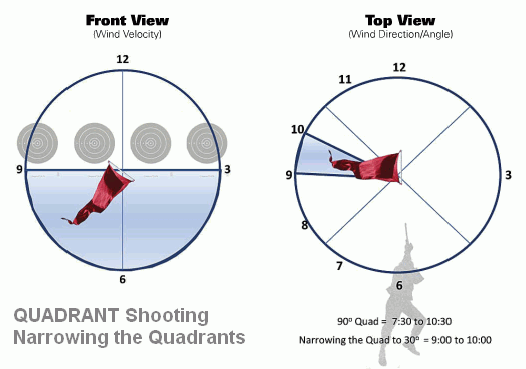
In the digital archives of Shooting Sports USA, we’ve found some great features that deserve a second look. A few years back, Shooting Sports USA published Sights, Wind and Mirage, an outstanding article that explains how to judge wind speed/direction and adjust your sights accordingly. Authored by highly respected shooter Ernest (Ernie) Vande Zande, this article is a definite “must-read” for all competitive rifle shooters — even those who shoot with a scope rather than irons. Vande Zande’s discussion of mirage alone makes the article well worth reading. Highly recommended.
Invaluable Insights from a World-Class Shooter
The article covers a wide variety of topics including Wind Reading, Mirage, Effects of Sight Canting, Quadrant Shooting, and Sight Adjustment Sequencing. Vande Zande offers many jewels of insight from his decades of experience shooting and coaching in top level tournaments. U.S. Shooting Team Leader at the 1996 Olympics, Vande Zande has set more than 200 records in National and International competition. He was the Smallbore Rifle Prone Champion at Camp Perry in 1980. An International Distinguished shooter, Ernie has been on nine Dewar teams and he was a member of the USAR Shooting Team from 1982. No matter what your discipline, if you are a competitive rifle shooter, you should CLICK HERE to read Sights, Wind, and Mirage.
F-Class shooting (both F-Open and F-TR) is one of the fastest-growing forms of rifle competition. Each season many new shooters hit the line and attendance at the major F-Class matches increases every year. But if you’re new to the game, you may ask “Where can I shoot an F-Class match?”. Well, Forum member Rod V. (aka Nodak7mm) has compiled a useful list of 112 ranges throughout the USA where F-Class matches are held. With venues from Alabama to Wyoming — you should find an F-Class program not too far from home. The list, in Excel spreadsheet format, provides range locations and weblinks (where available). Click the link below to download the F-Class Range List (.xls file):
Note — this list, now in its 20th Revision, is augmented regularly, but info is still being gathered. No claim is made that the list is comprehensive. But it still covers the the lion’s share of the important F-Class venues nationwide. If you know of a range that should be added to the list, please post the location on our F-Class Range List Forum thread. Rod will update the list as new range info is received. Rod writes: “Range information is wanted and welcomed. I would like your help on collecting specific info on Clubs/Ranges where known F-Class matches are held.” Here’s a partial sample from Rod’s list:
Dominators — that’s what these blue-shirted guys were at the 2020 Berger Southwest Nationals (SWN). For the third straight year, Team Lapua-Brux-Borden won the coveted F-Open Team Grand Aggregate award at the Berger Southwest Nationals, finishing with a score of 2584-160X (out of a possible 2600). And Team Member Jay Christopherson (AccurateShooter’s System Admin) won the F-Open Overall title, while Team Member Tod Hendricks won the 600-yard Mid-Range Event. Mighty impressive…
Team members are Jay Christopherson, David Christian, Tod Hendricks, Pat Scully, and Jeremy Smith (alternate), with Bob Sebold serving as Coach and Erik Cortina as Captain. Remarkably Jay (1247-83X), Pat (1247-72X), and Tod (1245-81X) placed first, second, and third respectively in the F-Open Grand Aggregate individual awards. That’s right, three team-mates secured ALL the podium places. And all three were separated by only two points!
Record-Setting Performances by Team
Notably Team Lapua-Brux-Borden established a new Ben Avery range record along the way to winning the Palma Team Match with a score of 1791-113 (out of a possible 1800). We’re told that the Team’s 793-47X LR score was also a new match record. Jay set a LR Aggregate Record with 799-50X, while Tod set a LR individual relay record of 200-18X.
Photo by Sherri Jo Gallagher.
Team Lapua-Brux-Borden — Winning “Team First” Philosophy Commentary by Jay Christopherson
For Team Lapua-Borden-Brux, winning gold is the entire focus. To that end, ego is the only enemy. Sure, we all have egos as individual shooters, but as a team, ego is subsumed into that one overriding goal. If you can’t do that, then you can’t shoot on Lapua-Borden-Brux. No matter how good you think your rifle is or how well you are shooting individually, the coach is the only arbiter — no exceptions. Every job on the team is focused towards that single goal of gold and no job is more or less important than another. Our plotter saves points by spotting high or low trends and calling that out, and ensuring we don’t lose points when a scorer misses a shot. Our back-coach saves points by spotting upcoming condition changes or making observations. Our target-puller strives to provide an example of the best possible target service. And our scorer focuses on providing attentive service to the team next to us. A failure in one job is a failure in all and we either win or lose together as a team. That is only possible when each individual understands that there is only one goal.
The Berger Southwest Nationals, hosted by the Desert Sharpshooters Rifle Club, took place February 5-9, 2020 at the Ben Avery Shooting Facility in Phoenix, AZ with a sold-out roster of 400 competitors. America’s biggest rifle match west of the Mississippi, the Southwest Nationals is a “must-attend” event for long-range shooters competing in F-Open, F-TR, and Sling disciplines. Competitors from at least nine different countries were in attendance. The Grand Aggregate is the total score from firing points of 600, 800, 900, and 1,000 yards.
Praise from Team Captain
“I am very proud of the team”, stated Team Captain, Erik Cortina: “From setting a new range record to placing first in the F-Open Grand Aggregate, our success is directly attributed to Lapua’s premium components.”
About Lapua — Premium Brass, Bullets, and Ammunition
Lapua produces the highest-quality small caliber cartridges and components for civilian and professional use. Lapua is a part of the Capstone Precision Group, exclusive U.S. distributor for Berger, Lapua, Vihtavuori, and SK-Rimfire products. For more information, visit Lapua.com.
Sometimes simpler is better when it comes to targets for fun shooting and load testing. While we normally use test targets from our Downloadable Target Page, it’s sometimes easier to just use brightly-colored “Hi-Viz” adhesive target dots.
Hi-Viz Stick-On Dots in Assorted Colors and Diameters
You can order 1″ target dots in bulk from Labeloutfitters.com. Many colors are available including fluorescent (hi-viz) Red, Green, Orange, and Yellow. These are bright and easy to see even in fading afternoon light. A pack of twenty (20) sheets (1260 dots total) costs just $5.97 (that works out to $4.74 per thousand). For the 1″-diameter stick-on dots you get 63 dots per sheet. Larger, 1.5″-diameter fluorescent dots are also available in 20-sheet packs for $5.97, with 24 large dots per sheet (480 dots total). If you want even bigger, 2″-diameter dots, sheets with 20 Hi-Viz dots per sheet are on sale for $5.97 per 20-pack (400 dots total).
Our friend Danny Reever really likes the bright dots from Label-Outfitters: “Ordered some of the 1″ dots from LabelOutfitters.com and received them in two days Priority Mail! Bought the fluorescent red,green, and yellow and they are really nice — especially for the price.”
If you prefer smaller, 3/4″-diameter circles, Amazon.com sells Avery packs with 1008 adhesive dots for just $4 to $7 per pack. Colors include Neon Red/Orange (item 5467), Neon Yellow (item 5470), Neon Green (item 5468), and Bright Blue (item 5461). We recommend the Neon Red/Orange for most uses, or the Neon Yellow dots for use on a black background. There is even a dispenser-box option with 1000 3/4″ dots on a roll in a box. Amazon.com also offers 3/4″ and 1″-diameter target pasters in 1000-dot rolls for $7-$10 per roll.
Half-Inch Fluorescent Dots for 100-200 Yards
For close-range work, you may prefer 1/2″-diameter dots. Forum member Steve found a source for very small 1/2″ dots: Uline.com. The 1/2″ dots are available in a wide variety of colors including fluorescent Red, Pink, Yellow, and Green. Price is $12 for a roll of 1000 dots (item S-2063). Steve notes: “A 1/2″ circle at 300 yards is not quite entirely covered by Nightforce crosshairs at 42-power (I’d say 70% coverage). I.e., it seems easier to line up repeatedly than with the bigger (3/4″) circles, which I used to use. Note that, for me, neon green and neon orange work best on brown cardboard targets. Neon orange works well on white paper.”






 The
The 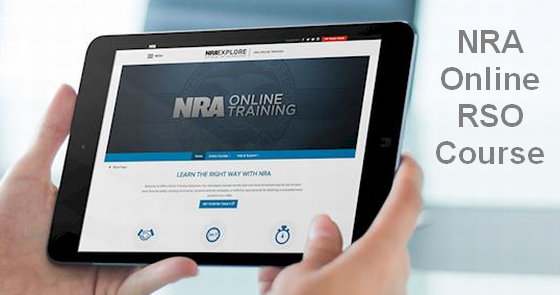
 Certification Procedure: Students must complete all six lessons and a short electronically administered test in order to become a certified Range Safety Officer. Once the test has been passed, newly certified Range Safety Officers will receive an electronic completion certificate that can be printed or saved to a computer.


 In the digital archives of Shooting Sports USA, we’ve found some great features that deserve a second look. A few years back,


 Praise from Team Captain
 Hi-Viz Stick-On Dots in Assorted Colors and Diameters


