The 2020 Berger Southwest Nationals kicks off 2/5/2020 at the Ben Avery Range outside Phoenix, AZ. The big event starts with a 600-yard Mid-Range Match. Many of the nation’s most talented F-Class and sling shooters will be there. But no matter what your skill level, it is still possible to make major mistakes that can spoil the day and/or put you out of the running for the entire match. This article aims to help competitors avoid the big errors/oversights/failures, aka “train wrecks”, that can ruin a match.
Photo by Sherri Jo Gallagher.
In any shooting competition, you must try to avoid major screw-ups that can ruin your day (or your match). In this article, past F-TR National Mid-Range and Long Range Champion Bryan Litz talks about “Train Wrecks”, i.e. those big disasters (such as equipment failures) that can ruin a whole match. Bryan illustrates the types of “train wrecks” that commonly befall competitors, and he explains how to avoid these “unmitigated disasters”.
Urban Dictionary “Train Wreck” Definition: “A total @#$&! disaster … the kind that makes you want to shake your head.”
Success in long range competition depends on many things. Those who aspire to be competitive are usually detail-oriented, and focused on all the small things that might give them an edge. Unfortunately it’s common for shooters lose sight of the big picture — missing the forest for the trees, so to speak.
Consistency is one of the universal principles of successful shooting. The tournament champion is the shooter with the highest average performance over several days, often times not winning a single match. While you can win tournaments without an isolated stellar performance, you cannot win tournaments if you have a single train wreck performance. And this is why it’s important for the detail-oriented shooter to keep an eye out for potential “big picture” problems that can derail the train of success!
Train wrecks can be defined differently by shooters of various skill levels and categories. Anything from problems causing a miss, to problems causing a 3/4-MOA shift in wind zero can manifest as a train wreck, depending on the kind of shooting you’re doing.
Below is a list of common Shooting Match Train Wrecks, and suggestions for avoiding them.
1. Cross-Firing. The fastest and most common way to destroy your score (and any hopes of winning a tournament) is to cross-fire. The cure is obviously basic awareness of your target number on each shot, but you can stack the odds in your favor if you’re smart. For sling shooters, establish your Natural Point of Aim (NPA) and monitor that it doesn’t shift during your course of fire. If you’re doing this right, you’ll always come back on your target naturally, without deliberately checking each time. You should be doing this anyway, but avoiding cross-fires is another incentive for monitoring this important fundamental. In F-Class shooting, pay attention to how the rifle recoils, and where the crosshairs settle. If the crosshairs always settle to the right, either make an adjustment to your bipod, hold, or simply make sure to move back each shot. Also consider your scope. Running super high magnification can leave the number board out of the scope’s field view. That can really increase the risk of cross-firing.
2. Equipment Failure. There are a wide variety of equipment failures you may encounter at a match, from loose sight fasteners, to broken bipods, to high-round-count barrels that that suddenly “go south” (just to mention a few possibilities). Mechanical components can and do fail. The best policy is to put some thought into what the critical failure points are, monitor wear of these parts, and have spares ready. This is where an ounce of prevention can prevent a ton of train wreck. On this note, if you like running hot loads, consider whether that extra 20 fps is worth blowing up a bullet (10 points), sticking a bolt (DNF), or worse yet, causing injury to yourself or someone nearby.
3. Scoring/Pit Malfunction. Although not related to your shooting technique, doing things to insure you get at least fair treatment from your scorer and pit puller is a good idea. Try to meet the others on your target so they can associate a face with the shooter for whom they’re pulling. If you learn your scorer is a Democrat, it’s probably best not to tell Obama jokes before you go for record. If your pit puller is elderly, it may be unwise to shoot very rapidly and risk a shot being missed (by the pit worker), or having to call for a mark. Slowing down a second or two between shots might prevent a 5-minute delay and possibly an undeserved miss.
Photo by Sherri Jo Gallagher.
4. Wind Issues. Tricky winds derail many trains. A lot can be written about wind strategies, but here’s a simple tip about how to take the edge off a worse case scenario. You don’t have to start blazing away on the command of “Commence fire”. If the wind is blowing like a bastard when your time starts, just wait! You’re allotted 30 minutes to fire your string in long range slow fire. With average pit service, it might take you 10 minutes if you hustle, less in F-Class. Point being, you have about three times longer than you need. So let everyone else shoot through the storm and look for a window (or windows) of time which are not so adverse. Of course this is a risk, conditions might get worse if you wait. This is where judgment comes in. Just know you have options for managing time and keep an eye on the clock. Saving rounds in a slow fire match is a costly and embarrassing train wreck.
5. Mind Your Physical Health. While traveling for shooting matches, most shooters break their normal patterns of diet, sleep, alcohol consumption, etc. These disruptions to the norm can have detrimental effects on your body and your ability to shoot and even think clearly. If you’re used to an indoor job and eating salads in air-conditioned break rooms and you travel to a week-long rifle match which keeps you on your feet all day in 90-degree heat and high humidity, while eating greasy restaurant food, drinking beer and getting little sleep, then you might as well plan on daily train wrecks. If the match is four hours away, rather than leaving at 3:00 am and drinking five cups of coffee on the morning drive, arrive the night before and get a good night’s sleep.”
Keep focused on the important stuff. You never want to lose sight of the big picture. Keep the important, common sense things in mind as well as the minutia of meplat trimming, weighing powder to the kernel, and cleaning your barrel ’til it’s squeaky clean. Remember, all the little enhancements can’t make up for one big train wreck!
Forum members are lamenting that they can’t find Hodgdon H4350 at local gunstores or through major online Vendors. There ARE a few shops that do have H4350 (and Varget) on the shelves. But the nearest H4350 may be in another state, far away. Therefore, you may want to consider using Alliant Reloder 16 (RL16). We highly recommend Reloder 16 for shooters who can’t find H4350. RL16 has a very similar burn rate, excellent accuracy, and is VERY temp stable. Some ace F-Class shooters (among Top 10 at Nationals) tell us that, with hot ambient temps (80-100+° F), RL16 is even more temp stable than H4350.
Powder Availability at Online Vendors — H4350, Reloder 16, Varget
*This is available in-store only at a few locations. You need to search store locations near you for availability. For example, H4350 8-pounders are available in a couple locations including Show Low, AZ and Midvale, UT. Varget 8-pounders are available in AZ, NM, and WY and a couple other states.
Do You Like H4350? Then You Should Try Reloder 16 — It Is Accurate and Temp Stable
Alliant Reloder 16 is used now by many top shooters for cartridges that work well with Hodgdon H4350. In fact, we’d say that Reloder 16 is the best substitute for H4350 on the market. Alliant’s RL 16 is very temp stable, offers good velocity, and the accuracy is top tier. Some guys report slightly better accuracy than H4350 in the .284 Win, .260 Rem, 6.5 Creedmoor, 6mm Creedmoor, and 6XC cartridges. If you currently use H4350, you should definitely give Alliant Reloder 16 a try. The powder also boasts excellent lot-to-lot consistency and contains a proprietary de-coppering additive.
This is NOT just a slower version of Alliant’s double-based Reloder 15 (which words great in the 6mmBR and Dasher cartridges). Reloder 16 is a completely new formulation, produced in Sweden by Bofors for Alliant. Reloder 16 utilizes TZ technology, which manipulates the response of the propellant and resists the natural tendency to generate more pressure at higher temperatures and less pressure at lower temperatures. As a result, Alliant’s Reloder 16 offers truly outstanding temperature stability.
With the Berger Southwest Nationals (SWN) taking place this week in Phoenix, we are reprising this discussing of rear bag designs and fill levels. By “tuning” your rear bag you can reduce hop on shot-firing and help your rifle track better. All that can translate to better scores, particularly with large-caliber rifles.
Tuning Your Rear Sand Bags
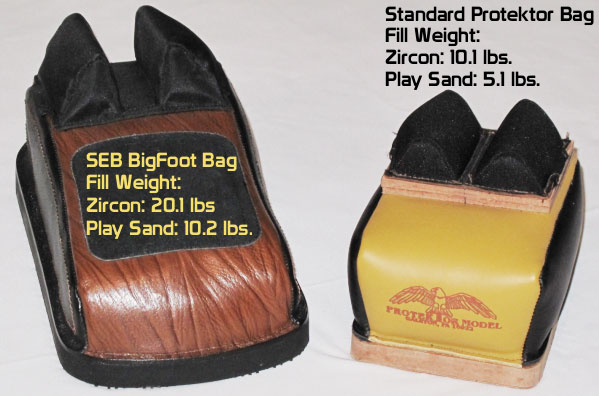
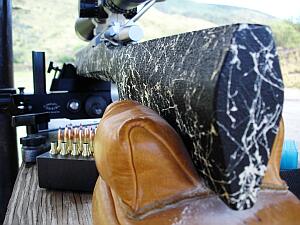
Over the years, noted gunsmith and a Benchrest Hall-of-Fame inductee Thomas ‘Speedy’ Gonzalez has learned a few things about “tuning” rear sandbags for best performance. On his Facebook page, Speedy recently discussed how sand bag fill levels (hard vs. soft) can affect accuracy. Speedy says you don’t want to have both your front and rear sandbags filled up ultra-hard. One or the other bag needs to have some “give” to provide a shock-absorbing function (and prevent stock jump). And you want to tune your fill arrangements to match your shooting style. Free recoil shooters may need a different fill levels than bag squeezers (who a softer bag but harder ears).
SAND BAGS & HOW TO FILL THEMby Speedy Gonzalez
I was asked several times by competitors at the S.O.A. Matches and F-Class Nationals as to how I fill my sand bags for benchrest competition. Here is a copy of a reply I gave several years ago:
Back in the old days, Pat McMillan told me: “You can not have two bags filled so hard that you gun bounces on them in the process of firing round at your target, especially if you have a rig with a very flexible stock. The bags must be set up in a manner for them to absorb the initial shock of the firing pin moving forward and igniting the primer.
Then [they must] maintain their shape and absorb the second shock wave as well the rearward thrust and torque of the rifle. What happens to the rifle when this is not done? Well let me tell you. The rifles have a very bad tendency to jump and roll in the bags. This causes many of those wild, lost shots that one can’t explain.”
Here’s some Good General Advice for Bag Set-up:
1. You should not have TWO hard bags [i.e. both front AND rear] in your set-up.
2. Heavy sand magnifies these phenomena.
3. If you are a bag squeezer, pack ears hard and leave bag pliable enough to squeeze for the movement required. You may pack front bag as hard as rules permit.
4. Free recoil shooters pack both bags firm, but not so hard as to allow stock jump. Especially if you have a stock with a very flexible forearm.
5. We use play-ground sand, also know as silica sand. I sift mine to get any large impurities out then mix it with 25% to 50% with Harts parakeet gravel to the desired hardness that I am looking for. The bird gravel keeps the sand from packing itself into that solid as a brick state.
Speaking of bricks — another thing that happens when shooters employ that heavy zircon sand is the ears form a low spot under them from recoil and then tend to rock back and forth with the rifle causing many low shots to crop up. Edgewood makes an Edgewood/Speedy rear bag specially reinforced under the ears to eliminate this scenario.
General Thoughts about Bag Construction and Ear Materials
I do not like the solid double-stitched leather bottoms. While this seems like a good idea, I see more shooters have problems because of them. They tend to slide around the bench and or slide with the rifle on recoil. The standard Protektor with Cordura rabbit ears and an Otto ring bag with a Cordura front would be what I would suggest to the new shooter or one of the Edgewood / Speedy rear bags, these mimic the “Donut” and feature a ring of leather around the bottom circumference that keep the bottom from rocking on the bench or ground[.]
One last note –If you use the Cordura bags, keep them sprayed with a good silicon spray or “Rain-Ex”. This keeps them from getting sticky. — Speedy
With the Berger Southwest Nationals commencing this week, we thought our readers would appreciate a showcase of two impressive, state-of-the-art F-Open match rifles. The first, show above, is the .284 RAHM (40° .284 Win Imp) with which Brian Bowling captured the 2019 F-Class Open Division Long Range National Championship. The second rifle belongs to barrel-maker Bryan Blake. Like Bowling’s rifle, Blake’s rig features a low-profile Cerus stock, but with purple highlights. Both rifles have 6-groove, cut-rifled barrels from Blake Barrel & Rifle and both sport Nightforce scopes.
Twin World-Class F-Open Rifles
Report from Bryan Blake of Blake Barrel & Rifle
We had been producing gun barrels for about 1.5 years prior to the 2019 NRA Long Range F-Class Nationals. Brian Bowling started shooting our 7mm barrels in May of 2019. Bowling and I are both on the Rutland team, Team Cerus, which has seven members. Bowling and I received the first Cerus XL stocks from Cerus Rifleworks in August of 2018. The stock was a very straight design.
With our barrels, these F-Open rigs can shoot! In 2018, Brian Bowling and I had the only two clean scores for the first match at the 1000-yard team NRA Nationals. In spring of 2019, I worked with Will of Cerus Rifleworks to see if we could come up with a lower center of gravity design to enhance what was already the straightest stock out there. We developed the Cerus XR stock which features stepped metal rails on the fore-end. I cut my XL Cerus stock and designed the rail system attached to the sides of the fore-end. Bowling’s stock (with black rails) was the second XR in the shooting world. On his very first weekend match at 600 yards he shot a 200-20X with the new XR stock and Blake 7mm 1:8.5″-twist barrel. He was using Berger 184gr 7mm bullets.
In 2019, at the NRA F-Class Long-Range Nationals, Brian Bowling won the F-Open National Championsship with a strong performance. He finished with a ton of Xs, three points ahead of the second place competitor. Before Brian’s impressive victory, we were told by many top shooters that a 6-groove barrel has never won any F-Class Mational event, and hypothetically never would. Well with Brian Bowling’s excellent shooting and reloading capabilities, we achieved a feat many said couldn’t be done.
Bowling’s Championship-winning rifle features a Bat Model B action in the Cerus XR stock. His Blake barrel is chambered for the .284 RAHM wildcat cartridge. This is a 40-degree (40°) version of the .284 Winchester. The .284 RAHM has a straighter case body compared to the original .284 Win.
We built Bowling’s rifle, doing everything except the final clear finish. We can do that work, but were short on time for the Nationals last year. We are proud of the chambering work we do and the quality of our bedding jobs.
Bryan Blake’s F-Open Rifle — the Purple XR
The Purple XR-stocked gun I shoot was built in August of 2019, right before the 2019 NRA F-Class Nationals. The natural wood is complimented by highlights finished with a bright purple metallic epoxy resin that Will from Cerus dreamed up. For this rifle we mated a BAT 3LL action with Blake barrels (switch-barrel configuration). Up front the fore-end rails are painted purple “plum crazy” to match the purple resin. The purple XR is finished with automotive “high solids” clear-coat, and block-sanded for a smooth, flawless look.
Blake’s Rifle is a Switch Barrel — 7mm and .30 Caliber
This Purple XR was set up to be a switch barrel rig, with both a 7mm BBM and a .30 BBM*. These BBM wildcats are based on shortened and straightened .300 WSM with a 40-degree shoulder. On my purple XR rifle as well as Bowling’s rifle, we employ Nightforce optics and load Berger bullets. These are the only glass and projectiles we use in our rifles.
The Purple XR is extremely accurate. Check out this 2.6″ group, shot at 1000 yards during a club match at the Ben Avery Range in Arizona. Yes, that is 1/4-MOA at 1K! Many folks would be very happy with that group at 600 yards. At 1000 yards it is remarkable. No, the rifle can’t do that every time. But this does demonstrate that the Purple XR is a tack-driver. CLICK HERE to see a 3.9 inch, 15-shot group at 1000 yards on the F-Class target (150-15X).
About Blake Barrel and Rifle — History and Barrel-Making Process
Blake Barrel and Rifle was re-launched in 2018. The business was actually started by my grandfather, Robert Blake, in 1966. In 1969 my grandfather stopped doing gunsmithing and making single-point cut-rifled barrels. He transitioned to doing industrial work, and less work for the public. After all those years he and my father, Dave Blake, kept the barrel-making equipment in storage. They kept the gun-drilling machines in the shop as they used them to drill long, deep holes in anything from aircraft parts to electric motor rotors.
In 2012 we got the diamond single-point, sine-bar rifling machine out of storage, along with the Pratt and Whitney double-spindle reaming machine. We then completely rebuilt and updated the equipment. We modified the gun-drill to be a counter-rotating drilling system. What that means is the drill spins at about 20% of the rotational speed, and the barrel at 80%. The counter-rotation keeps the drill on the center axis of the barrel more precisely than just rotating the barrel, or just rotating the drill. We are able to consistently drill holes in our barrel steel (primarily 416R) that at the end of a 33.25″ blank that is only .005″ off of center axis.
We then ream the barrels to be .0004″ below desired finish bore size. After the reaming process we mandrel-hone the bores to be .0001″ below finish bore size. This process eliminates reamer marks in the barrel bore. Therefore very minimal lapping is needed after rifling to remove any tooling marks. We then rifle the barrel to any twist rate we like. With a fine lap after rifling, the barrel has no tooling marks and all surface metal is flowing in the direction of the twist of the rifling.
* 7mm BBM stands for “Blake Bramley Magnum”. Dan Bramley and I developed that cartridge together in October of 2017. The .30 BBM is the “Blake Barrel Magnum”, which I developed in May of 2018.
M1 Garand Springfield Armory July 1941 production. Facebook photo by Shinnosuke Tanaka.
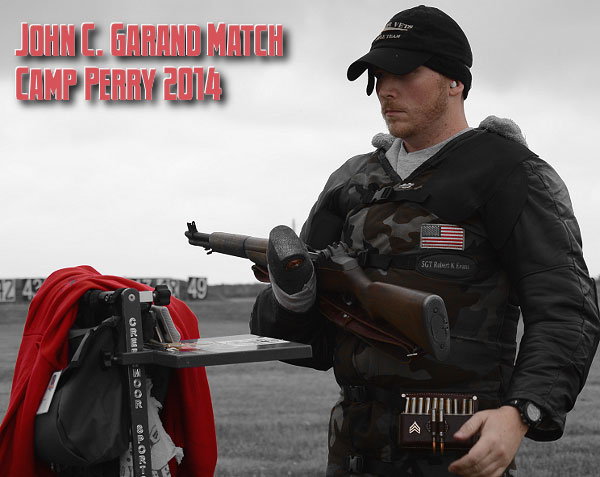
My father carried a Garand in WWII. That was reason enough for me to want one. But I also loved the look, feel, and heft of this classic American battle rifle. And the unique “Ping” of the ejected en-bloc clip is music to the ears of Garand fans. Some folks own a Garand for the history, while others enjoy competing with this old war-horse. Around the country there are regular competition series for Garand shooters, and the CMP’s John C. Garand Match is one of the most popular events at Camp Perry every year. This year’s Garand Match will be held Saturday, August 1, 2020. SEE CMP 2020 NM Calendar.
The CMP also has a John C. Garand Match each June as part of the D-Day Competition at the Talladega Marksmanship Park. Here’s a video from the inaugural Talladega D-Day Event in 2015. This year’s Talladega D-Day Matches run June 3-7, 2020.
Watch Prone Stage from the Inaugural Talladega D-Day Match in 2015
M1 Garand Manual
Recommended M1 Garand Manual
Among the many M1 Garand manuals available, we recommend the CMP’s U.S. Rifle, Caliber .30, M1: ‘Read This First’ Manual. This booklet covers take-down, reassembly, cleaning, lubrication, and operation. The manual, included with CMP rifles, is available for $3.25 from the CMP eStore. The author of Garand Tips & Tricks says: “It’s one of the best firearms manuals I’ve seen. I highly recommend it.”
M1 Garand Slow-Motion Shooting Video
What really happens when an M1 Garand fires the final round and the En-Bloc clip ejects with the distinctive “Ping”? Well thanks to ForgottenWeapons.com, you can see for yourself in super-slow-motion. The entire cycling process of a Garand has been captured using a high-speed camera running at 2000 frames per second (about sixty times normal rate). Watch the clip eject at the 00:27 time-mark. It makes an acrobatic exit, spinning 90° counter-clockwise and then tumbling end over end.
2000 frame per second video shows M1 Garand ejecting spent cartridges and En-bloc clip.
M1 Garand History
Jean Cantius Garand, also known as John C. Garand, was a Canadian designer of firearms who created the M1 Garand, a semi-automatic rifle that was widely used by the U.S. Army and U.S. Marine Corps during World War II and the Korean War. The U.S. government employed Garand as an engineer with the Springfield Armory from 1919 until he retired in 1953. At Springfield Armory Garand was tasked with designing a basic gas-actuated self-loading infantry rifle and carbine that would eject the spent cartridge and reload a new round. It took fifteen years to perfect the M1 prototype model to meet all the U.S. Army specifications. The resulting Semiautomatic, Caliber .30, M1 Rifle was patented by Garand in 1932, approved by the U.S. Army on January 9, 1936, and went into mass production in 1940. It replaced the bolt-action M1903 Springfield and became the standard infantry rifle known as the Garand Rifle. During the World War II, over four million M1 rifles were manufactured.
Precision Rifle fans should watch Shooting USA this week. On Wednesday, January 29th, Shooting USA offers a special full-hour edition devoted to the inaugural Armageddon Gear AG Cup Invitational. The first-ever AG Cup showcased an all-star line-up of tactical talent. Twenty of the nation’s top PRS/NRL marksmen were invited to a two-day event at the Arena Training Facility in Georgia. $41,000 in prize money was up for grabs, with the overall match winner guaranteed twenty thousand ($20,000) in cash!
Shooting USA runs on the Outdoor Channel Wednesdays 9:00 PM Eastern and Pacific, 8:00 PM Central.
No Outdoor Channel on cable? Then you can subscribe to Stream the Broadcast on the internet.
During this week’s Shooting USA special, John Scoutten and Armageddon Gear’s Tom Fuller report the action and interview top precision rifle shooters. The Grand Prize of $20,000 was awarded for the best overall score, based on accuracy and time. In addition, the winner of each of the 20 stages received a $1000 cash prize — serious money. During the show, you can watch the competitors adapt to challenging stage set-ups and weather conditions. With $1000 at stake for each stage, a single miss can cost big money on the firing line.
Side Match with TN Twister Target
At the inaugural AG Cup, there was a side match with a $500 prize for the competitor who hit all five TN Twister Target plates in the shortest time. The side-match employed a modular target system from Innovative Target. This system can mount TN Twister or TN Revolver multi-plate rigs, which bolt on to the IRT Head. This provides interesting challenges quite different from a static PRS plate target.
Arena Training Facility — 2300 Acres
The 2300-acre Arena Training Facility is a premier shooting facility with multiple shooting ranges from 50m to 2100m. Arena’s 1000-yard covered Known Distance range offers multiple benches, steel and paper targets out to 1000 yards. On Arena’s UKD (unknown distance) range shooters can engage steel out to 2300 yards. This 2100m UKD range boasts a 3-Story Shooting Tower, Air-Conditioned Shoot House, and multiple Positional Challenges.space.
Armaggedon Gear — Tactical Accessories Armageddon Gear, founded by former U.S. Army Ranger Tom Fuller, sells support bags, gun cases, slings, suppressor covers, scope covers, and a wide variety of other accessories popular with the PRS/NRL crowd. Armageddon Gear now provides products to the U.S. Military, Law Enforcement, as well as PRS/NRL competitors.
We created the above target a decade ago. Since then it has been used by tens of thousands of shooters. It has proven very popular as a load development target, since all your load data fits neatly in the boxes under each target. In fact this target is being employed by both rifle-makers and barrel-makers (including Criterion) to test their products. The target was designed for aiming efficiency. The diamonds have 1/2″ sides and you can align your cross-hairs on the horizontal and vertical lines. It is a clean design that is easy to see even at 200 yards with a 20X scope. When we test, we usually crank in a little elevation, setting the point-of-impact higher, so that our shots fall in the gray circles. That way you leave the squares intact for precise aiming.
We also use these two targets for load development and precision practice. The circle dot target can also be used for informal rimfire competition at 50 yards.
Right-Click Each Target to Download Printable PDFs.
How to Print Your Targets
Most of us have access to a printer at home or at work. That means you can print your own targets. You’ll find hundreds of free target designs online, including dozens of downloadable targets on our AccurateShooter.com Target Page. If you’re feeling creative, you can design your own target with a computer drawing program such as MS Paint.
Paper Stock Is Important
If you want your self-printed targets to show shots cleanly (and not rip when it gets windy), you should use quality paper stock. We recommend card stock — the kind of thick paper used for business cards. Card stock is available in both 65-lb and 110-lb weights in a variety of colors. We generally print black on white. But you might experiment with bright orange or yellow sheets. Forum Member ShootDots report: “They sell cardstock at Fed-Ex Kinko! I use either Orange or Yellow. That makes it easy to see the bullet holes clearly.” On some printers, with the heavier 110-lb card stock, you will need to have the paper exit through the rear for a straighter run.
Here are some Target-Printing Tips from our Forum members:
“Staples sells a 67-lb heavy stock that I have settled on. I use the light grey or light blue, either of these are easy on the eyes on bright days. I have used the 110-lb card stock as well and it works fine. It’s just a little easier to print the lighter stuff.” (JBarnwell)
“Cardstock, as mentioned, works great for showing bullet holes as it doesn’t tear or rip like the thin, lightweight 20-lb paper. I’ve never had a problem with cardstock feeding in the printer, just don’t stick too many sheets in there. If I need three targets, I load only three card stock sheets”. (MEMilanuk)
“20-lb bond works pretty well for me if I use a spray adhesive and stick the entire back of the paper’s surface to the backer board.” (Lapua40X)
The next time a shooter comes up to you at the range, and says: “My rifle shoots one-third MOA all day long”, challenge him to put a first-round hit on a 1/2 MOA plate at 1000 yards. There’s a difference between shooting small groups at close range (Precision) and “on-target” Accuracy at long range.
Article by Applied Ballistics, LLC
Just how much better is a 0.5 MOA rifle vs. a 1 MOA rifle? Is it worth chasing quarter-MOA if you have half-MOA rifle? This is an important question. If you look across Facebook you will find scores of shooters posting 1/3-MOA or 1/4-MOA shot groups [usually at 100 yards]. Some of those guys are spending countless hours trying to chase that golden quarter-MOA group.
Don’t take this statement the wrong way, having a good, consistent rifle is a key to success. But accuracy is extremely important to long range shooting. Having a precision (0.5 MOA) rifle, but not having put the time in to practice accuracy (hitting a 0.5 MOA plate first shot at 1000 yards) is counter-productive. [Editor: By this, we mean that you can have a rifle capable of shooting small groups at 100 yards, but you won’t see that gun’s full potential unless you can practice and perfect the skills of long-range shooting. Successful long range shooting demands more than precision alone.]
What if, your goal was to produce 5-shot, sub-half-MOA groups at 1000 yards instead of 100 yards? Think about how much more you would be including in the learning process, especially that all-important factor: managing the wind! Here is a good article that talks about Precision vs. Accuracy: Hitting Targets at Long Range.
This is not intended to say that precision is not important; rather it is intended to show that balance is important. You can use WEZ to do your own studies on this very subject, and it might be surprising to the shooter just how much you don’t gain by chasing precision over accuracy. Two books which cover this subject really well are Accuracy and Precision for Long Range Shooting and Modern Advancements in Long Range Shooting Vol 2.
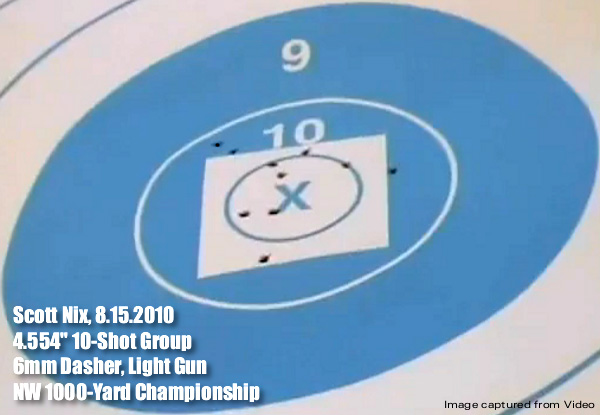
Here’s a stunning combination of Precision (small group) WITH accuracy (centered on target). Yep that’s ten shots at 1000 yards, all in the middle of the target:
Video Demonstrates Amazing 1000-Yard Accuracy AND Precision
Watch the video. You can see the group form up, shot by shot. It’s pretty amazing. Scott’s first shot (at the 45-second mark of the video) was right in the X-Ring, and four of Scott’s first five shots were Xs. That’s drilling them!
Comments
“Accuracy with precision is the route for me. It is not an either/or game. If I have a precision rifle (0.25 MOA or less) and I practice to be accurate, then high scores will be the result — Jim Borden
“I would agree for PRS, hunting, and to a certain extent F-Class. However, for 1000-yard IBS benchrest competition, 0.5 MOA groups in good conditions will almost always loose the relay.” — James B
“Another thought is that [at 1000 yards] a 1 MOA gun with single-digit standard deviations [may] out shoot a 0.5 MOA rifle with standard deviations of 20+ fps.” — Beard Owens
“Both… you need both: Accuracy AND Precision. I competed in varmint matches — we shot small silhouettes at 600 yards. I started with a factory .260 Rem rifle that was 0.8 MOA on a good day. I typically hit 8-9 of 20 targets, but rarely nailed the small chickens — which had a hit zone just 4″ in diameter. I then started using a semi-custom 6mmBR rifle that could reliably deliver 1/4 MOA at 100 yards (honest). My hit count on the silhouettes zoomed to 15-18, and suddenly the chickens were going down. In that game — small targets at 600 yards — there was no substitute for precision.” — Paul McM
Buell’s Beast with Massive 35 Inch Barrel
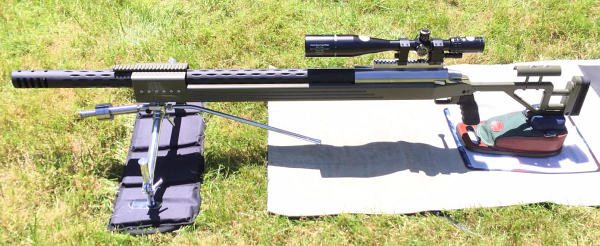
A few seasons back, Our friend Darrell Buell built a new Beast — a monster 64-inch-long .375 CheyTac that weighs more than 70 pounds! Designed for ultra-long-range shooting (two miles and beyond), this beast represents the state-of-the-art in extreme long-range rifles. NOTE: to see more details, click the two images above to open Full-Screen Photos.
Darrell reports: “This rifle is pretty much purpose-built to shoot 2+ miles extremely accurately. It is a .375 CheyTac (lengthened) built on a BAT 2.5″ action. The custom 35″, 1:10″-twist Brux barrel is a fat, 2″-diameter ‘straight taper’ with fluting. A custom 5″-long muzzle brake is fitted at the end. All barreled action work was done by R.W. Snyder Custom Rifles. The stock was created to fit the build by PDC Custom, and the massive muzzle brake as well.” The “bridge” at the end may look like a barrel block, but it’s not — the barrel completely free-floats. (The Picatinny rail on top of the bridge allows use of an overhanging bipod as an alternative to the JoyPod).
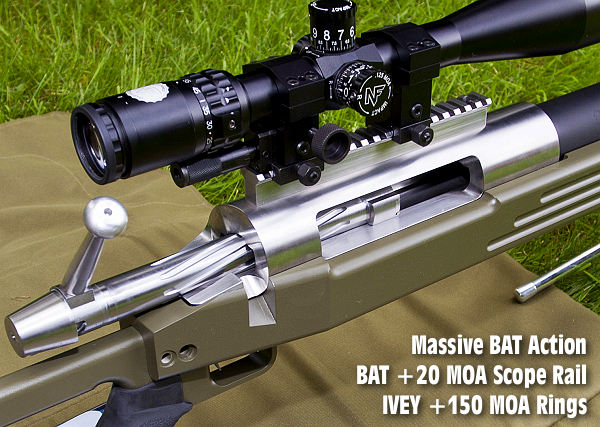
Darrell has lots of elevation on tap: “With 150 MOA in the Ivey rings, another 20 MOA in the scope rail, 55 MOA in the Nightforce Competition scope, and 10 MOA in the FCR-1 reticle, there’s an impressive +235 MOA available.”
Counter-Weighted SEB Joy-Pod Up Front
The bipod Darrell will be using for his ELR sessions and the ‘King of 2 Miles’ match is a custom counter-weighted JoyPod crafted by Seb Lambang. With the counter-weight, Darrell says his monster 70-lb gun “adjusts as smoothly as an F-T/R rig”. The glass is a Nightforce 15-55x52mm Competition scope carried in Ivey +150 MOA rings, which in turn are mounted to a +20 MOA BAT scope rail. Darrell says: “It’s been a heck of a couple months, getting this monster built in time, thanks particularly to Southern Cerakote, which turned it around in less than 24 hours.”
Buell’s Beast runs 350gr solid bullets at approximately 3250 fps. Check out the massive .375 CheyTac cartridge compared to a .308 Winchester:
This one-of-a-kind “JoyPod” was produced by Seb Lambang specifically for Buell’s big .375 CheyTac rifle. Darrell needed a JoyPod that wouldn’t sink under a heavy load. Seb explains: “This is the world’s first JoyPod equipped with an adjustable counterweight, to balance his 75-lb gun. I did some experiments and put some weights ranging up to 60+ lbs on the top, and I found that the joystick action works like a regular one….it’s smooth, light, and precise. In addition, the counterweight can be bent down to not interfere with the bottom of the barrel. The counterweight is secured into the front center shaft by a thumb screw, and there is a tightly fitted pivotal joint on the counterweight to allow angle adjustment.”
Darrell is happy with his customized coaxial bipod: “In addition to the adjustable counterweight system on the front, this JoyPod comes with a longer, solid joystick. These additions will make for extremely smooth, precise adjustments, even if the rifle weighs in at 75 pounds or more. Not including the counterweight, the actual structure of this bipod weighs in at a mere 1.09 pounds — exactly what the standard JoyPod weighs. It is extremely strong, however. Seb has pictures of himself standing on the pod … and he weighs 150 pounds!”
The Civilian Marksmanship Program (CMP) has issued important rule changes for 2020. These cover Highpower Rifle (Centerfire), Smallbore Rifle (Rimfire), and Pistol. In addition, there are CMP Games rules changes. READ RULE CHANGES HERE.
The big news is that Eye and Hearing Protection are now MANDATORY for Highpower Rifle competitors and Pistol shooters in all CMP-affiliated matches. The 2020 CMP Highpower Rifle, Pistol, and CMP Games Rulebooks all contain the following rule:
“All competitors and competition officials are required to wear appropriate eye and hearing protection when on shooting range firing lines during highpower rifle or pistol firing. All competitors must comply with this requirement before they can participate in a CMP sponsored or sanctioned competition. Competitors are responsible for selecting their eyewear and hearing protection.”
Let there be no confusion, the CMP’s rule change notice adds: “The CMP and its sanctioned match sponsors will actively enforce this rule in 2020″.
In 2020, all CMP centerfire rifle and pistol shooters must employ Eye Protection and Hearing Protection.
Other important Rules Changes include:
1. Expansion of CMP Pistol Program rules for 3-Gun Match Pistol events.
2. Establishment of Smallbore Rifle Distinguished Badges.
3. Substantial reworking of rules for electronic scoring targets.
4. Rule Regarding “Resting” Magazine on Arm during Prone.
No More Mag Resting in Prone Position
Of note to Service Rifle and M1A shooters is a new rule that attempts to restrict a common practice of using the rifle magazine to support the gun on the arm while shooting prone. A few competitors were resting M1A or M16/AR magazines on their sling arms or shooting jacket sleeves. The prone position rule has been strengthened to state that while “a magazine may touch the shooting jacket sleeve … it may not rest on the jacket sleeve, jacket elbow pad, arm or ground. Competitors must control their prone positions to make they are not using the magazine to support the rifle in prone. Competitors can make sure their prone positions are not questioned by keeping the bottoms of rifle magazines visibly clear of sleeves or arms.
Smallbore Rifle Distinguished Badges
The Distinguished Rifleman Badge has been a treasured honor among highpower rifle shooters. Now this important award will be available to smallbore shooters as well. The Distinguished Badge Program, which dates back to the first Distinguished Marksman Badges awarded by the Army in 1884, is being expanded in 2020 to award two new badges for excellence in Smallbore Rifle competitions.
CMP 2020 Rules: Highpower, Smallbore, Pistol, CMP Games
Report based on article by Gary Anderson, DCM Emeritus
The CMP Competition Rulebooks that will govern CMP sponsored and sanctioned Highpower Rifle, Pistol, CMP Games and Smallbore Rifle competitions in 2020 have been approved by the CMP Rules Committee and are now posted on the CMP website. The 2020 rulebooks went into effect on the 1st of January. All four rulebooks can be downloaded from the CMP Competition Rulebooks webpage.
The most important changes in the 2020 Rules include a major expansion of CMP Pistol Program rules that now provide for 3-Gun Match Pistol events, the establishment of Smallbore Rifle Distinguished Badges, a change in eye and hearing protection use in Highpower Rifle and Pistol Matches from “strongly urged” to “required”, a substantial reworking of rules for electronic scoring targets and several rule clarifications in each of the four disciplines. All changes from the 2019 Rules can easily be identified in the new rulebooks because they are shown in underlined, red text (printed Rulebooks will have underlined text). A detailed summary of 2020 Rule Changes is presented at the end of this article.
Here are some 2020 CMP Rulebook changes that merit further explanation:


 Train Wrecks (and How to Avoid Them)


 4. Wind Issues. Tricky winds derail many trains. A lot can be written about wind strategies, but here’s a simple tip about how to take the edge off a worse case scenario. You don’t have to start blazing away on the command of “Commence fire”. If the wind is blowing like a bastard when your time starts, just wait! You’re allotted 30 minutes to fire your string in long range slow fire. With average pit service, it might take you 10 minutes if you hustle, less in F-Class. Point being, you have about three times longer than you need. So let everyone else shoot through the storm and look for a window (or windows) of time which are not so adverse. Of course this is a risk, conditions might get worse if you wait. This is where judgment comes in. Just know you have options for managing time and keep an eye on the clock. Saving rounds in a slow fire match is a costly and embarrassing train wreck.


 Back in the old days, Pat McMillan told me: “You can not have two bags filled so hard that you gun bounces on them in the process of firing round at your target, especially if you have a rig with a very flexible stock. The bags must be set up in a manner for them to absorb the initial shock of the firing pin moving forward and igniting the primer.




 How to Print Your Targets