You may want to tune in to Shooting USA tonight. There are three interesting topics covered in the one-hour cable TV broadcast. Hornady’s A-Tip Bullets are featured in a product spotlight. Next the ultimate speed-shooting contest, the USPSA Steel Challenge, is covered. And for the tactical/PRS crowd, Shooting USA interviews Tom Fuller of Armageddon Gear. The hour-long Shooting USA show runs on the Outdoor Channel Wednesday nights at 9:00 PM Eastern and Pacific time, 8:00 PM Central time.
1. Hornady A-Tip Bullets — Worth the Very High Price?
This week Shooting USA reviews Hornady’s new A-Tip bullets. These A-Tips generated a lot of buzz because of their high price and unusual packaging. These expensive ($75-$85/box) aluminum-tipped projectiles have very consistent bullet BCs according to Hornady. They are sold in sequential order for consistency, and shipped in clear plastic egg-crate style packaging to protect the tips. The jury is still out on these bullets, as we haven’t seen them used much in competition outside the PRS realm. But if you are curious, check out this report.
2. Steel Challenge — Fun and Fast Steel Plate Competitions
For fans of steel shooting, Shooting USA will cover the famous Steel Challenge, a speed shooting competition with eight standardized steel plate stages. It’s all about speed — the top guns can nail all five targets in under three seconds. Run by the Steel Challenge Shooting Association (SCSA) a division of the USPSA, the Steel Challenge is fast and exciting. Regional matches are held at affiliated clubs through the USA, with a large annual World Speed Shooting Championships (WSSC) that attracts competitors from around the world. In 2018 and 2019 the WSSC was held in Talladega, Alabama. LEARN MORE HERE
3. Armaggedon Gear — Tactical Accessories
Finally, this week’s Shooting USA episode visits Armageddon Gear in Georgia. This company, founded by former U.S. Army Ranger Tom Fuller, sells support bags, gun cases, slings, suppressor covers, scope covers, and a wide variety of other accessories popular with the PRS/NRL crowd. With a 22-year Military career behind him, Tom Fuller is creating and selling what he knows, shooting gear. Fuller’s company is an American success story, as Armageddon Gear now provides products to the U.S. Military, Law Enforcement, as well as PRS/NRL competitors.
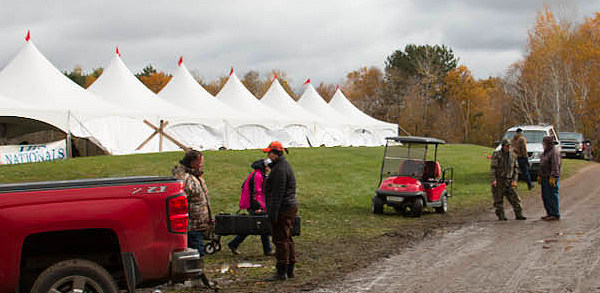
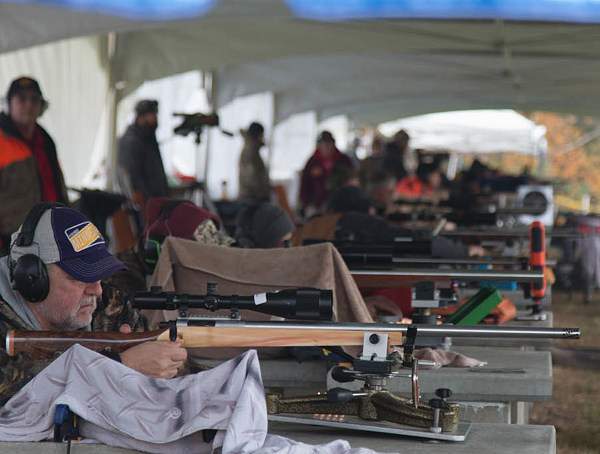
The 2019 IBS 600-Yard Nationals took place October 12-13th at the Gopher Rifle and Revolver Club (GRRC.org) in Harris, Minnesota. It was a challenging event, given the cold and stormy conditions. Nonetheless many of the nation’s top shooters shot very well, and some young newcomers had strong showings. The real star of the match was new 600-Yard National Champion Jason Wolf. He delivered a masterful performance, winning the 2-Gun Overall, Light Gun Overall, and Heavy Gun Overall.
Dave Holland, past GRRC Bench Director and Host of 2010 IBS 1000-Yard Nationals.
Match Report by Kent Bratten
MD, IBS 2nd Vice President and Awards Chairman
There was some scrambling before and during the Nationals due to the weather. Gopher Rifle and Revolver Club is a large, multi-discipline range set among marshes and woods just off I-35, about 40 miles north of a large metropolitan area in Minnesota. Because of the topography, winds and mirage can often be tricky.
Due to the forecasted poor weather, a large circus-tent style cover was rented in place of the usual canvas/pole type temporary structure (see AcccurateShooter’s article on the 2010 1000-yard Nationals at Harris). It is likely the clean-up crew would still be picking up the pieces if that structure had been used.
Course of Fire for IBS 600-Yard Nationals
The event was run with the same format as the 2018 IBS 600-Yard Nationals in St. Louis. The course of fire was Light Gun (total weight 17 lbs. max) on Saturday and Heavy Gun (no weight limits) on Sunday. Each of the 63 competitors shot eight (8) targets daily in four relays. Saturday evening Vapor Trail Bullets hosted a banquet, at which time the Light Gun titles were awarded, along with a large prize table drawing afterwards. Sunday was Heavy Gun and had 61 shooters (two dropping out due to a family emergency). Despite no further snow and no ferocious winds, conditions were hardly ideal as it was still cold in the morning with swirling winds throughout the day. Hence on neither day did the group averages drop below two inches and there were only a handful of perfect scores.
Formidable Performances Even in Tough Conditions
Despite the conditions and several DQs on Day One, the top guns still put on a very good performance. Scotty Powell of North Carolina won the Light Gun Group and Chris Nichols, also from North Carolina, won the Heavy Gun Group award. Jason Wolf of South Dakota was the big winner, taking home the Light Gun Score, Light Gun Overall, Heavy Gun Overall, and the 2-Gun Overall titles. Jason’s performance was superb. Along with his LG, HG, and 2-Gun titles, Jason shot the smallest group of the match, a stunning 0.673″ in Heavy Gun. He also placed second in Heavy Gun Group Agg, just 0.166″ off the best, while finishing third in Light Gun Group Agg, .340″ from the top. All in all, it was a dominant showing by the South Dakotan.
Robby Vick smiling despite the cold. But did you really need the fan Robby?
Snow Flurries and Other Shooting Challenges
After the match, we interviewed most of the Top Ten shooters. We covered topics such as as strategies for bad conditions and their previous shooting experience. Several mentioned having trouble seeing the marks on the white-painted steel sighting plates. And, because of snow flurries, some could only see the last round hit (last sighter), about 5-10 seconds before their record target came up. Accordingly, many competitors depended on the tracking ability of their rifles and maintaining their point of aim throughout the record period. As for shooting backgrounds, many of the Top 10 enjoyed long range hunting and varminting — especially prairie dog adventures. Some had started out with rimfire bench competition, some began with short range IBS matches, while others already shoot long distance (1000-Yard) IBS matches and F-Class. For all those interviewed, the result was pretty much the same. After starting in competitive shooting, they had gotten hooked on precision, and sought to push their skills to the limit.
Possible New Trends in Equipment — Wider Stocks
The Top 10 Equipment Lists show the favorite actions (BAT), bullets (Vapor Trail and Bart’s) and scopes (Nightforce) with a sprinkling of different barrels and stocks. We note there does seem to be a trend towards wider stocks. When we reviewed the Top 20 List (about 30% of the pool) we noted a growing number of stocks with wider fore-ends (4 inches or more), especially the Wheeler/McMillan Tracker. As for chamberings, the 6 BRA (6mmBR Ackley Improved) seems to be very popular, but is not dominant over the 6 Dasher yet.
Junior Champ Andrew Powers, setting up. Beside him is his grandfather, Johnny.
COMMENTARY from Match Director Doc Bratten
It was a somewhat hair-raising experience leading up to the Nationals, with the bad forecast followed by a two-day period before the match when high winds made practice difficult. A major concern was that the weather would worsen and cause a major delay or cancellation. But, like the D-Day invasion of 1944, prayers for a break in the weather were answered. We also had an unexpected shortening of staff. But the Nationals team still did a wonderful job of running the line and everyone chipped in with putting up the “mess tent”, line cover, and helping in the target review area. Also hats off to the target crew and scorers in the Red Shed. With the snow and wind, it could not have been easy working with those targets and drying them after.
Into the quagmire to look at targets…
We are very grateful to all our IBS sponsors, whose generosity ensured rich prize tables for both the Hawk’s Ridge 1000-Yard Nationals and here in Minnesota. I would especially like to thank Sally and Jim Bauer of Vapor Trail Bullets for sponsoring the Awards Banquet. We very much appreciated the Grand Prizes supplied by Alex and Matt Findley of AMP Annealing, David Dorris (and Ms. Krag) of BenchSource, Alex Wheeler of Wheeler Accuracy and Bart Sauter of Bart’s Bullets. The full list of IBS 600-yard and 1000-yard Nationals sponsors can be found on the IBS Website.
Finally, we extend a very special thanks to our friends at Gunstop Reloading and Gunstop of Minnetonka gun sales for their trophy donations. We also thank Dave Newell, Past President at GRRC, current Club newsletter editor, and exceptional wedding photographer, for his great photos of the match.
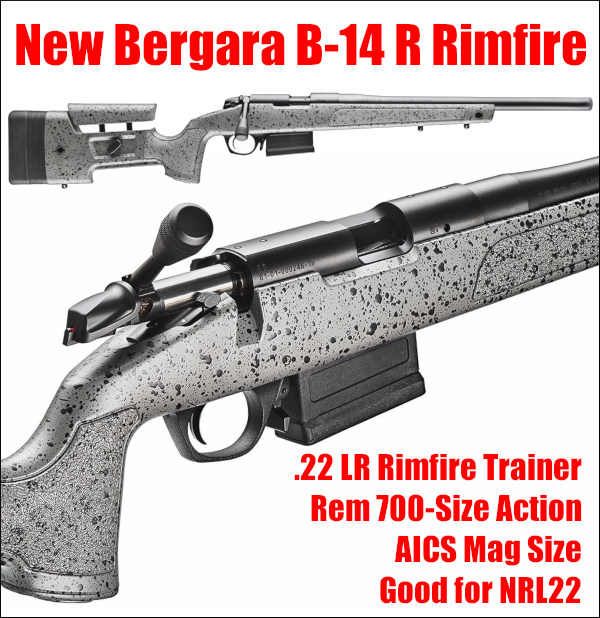
Looking for a nice .22 LR rimfire training rifle that works well with rear bags and bipods? Then check out the new B-14 R from Bergara. It is set up for rimfire training and tactical-style competitions. The action and magazine are full centerfire dimensions, so that you can train with a rimfire rifle offering centerfire-style “feel” and ergonomics. MSRP is $1150.00 so expect street price to be around $1000.00.
We think this would be a good choice for the NRL22 tactical competition for shooters preferring a conventional-style stock. It has an adjustable cheekpiece and LOP adjusts with spacers. The toe of the buttstock is straight so this will work well with bags. And if you want to later swap to a metal or composite chassis, the B-14 R barreled action will fit stocks and chassis systems designed for Rem 700s. In fact you can even use aftermarket Rem 700-compatible triggers.
B-14R Bolt Action .22 LR
The Bergara B-14 R Bolt Action Rifle in .22 LR is the latest offering in Bergara’s popular B-14 series of rifles. The company states: “The Bergara B-14 R has been a product that our customers and enthusiast have been requesting for quite some time, and with the growing NRL22 and PRS .22 competition matches, we believed that the time was right to introduce a rifle of this nature.”
This rifle is designed as a true rimfire trainer with the feel of a Rem 700 centerfire rig. The action shares dimensions of a Rem 700 receiver so you can upgrade to Rem 700-compatible stocks, and triggers. The single-stack .22 LR magazine has the same external dimensions as the commonly-used short action AICS mag for centerfires. So even your mag swaps will duplicate the “feel” of your centerfire rifle.
Bergara B-14 R Specifications
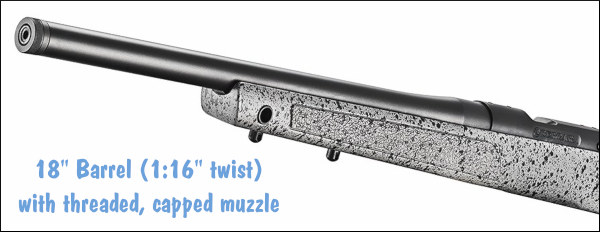
Barrel: 1:16″-twist 4140 Bergara, 18″ free-floated
Muzzle Thread: 1/2-28
Rifle Weight: 9.25 lbs. (without optics)
Rifle Length: 38″ with all spacers
Magazine Capacity: 10 rounds
Scope Mounts: 6-48 screws, Rem 700 compatible
Stock: Bergara HMR stock molded with full-length integrated mini-chassisinternal mini-chassis, integrated OD flush cup sling mounts and swivel mounts, adjustable cheek piece and length-of-pull.
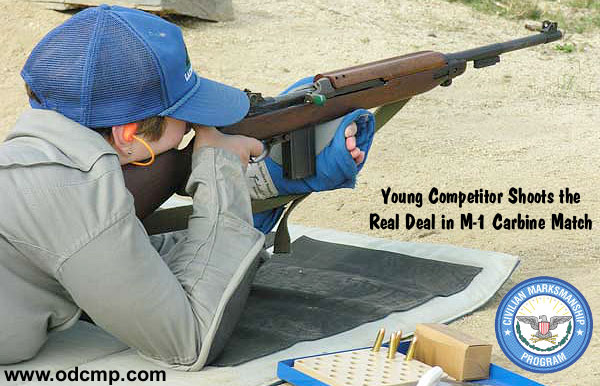
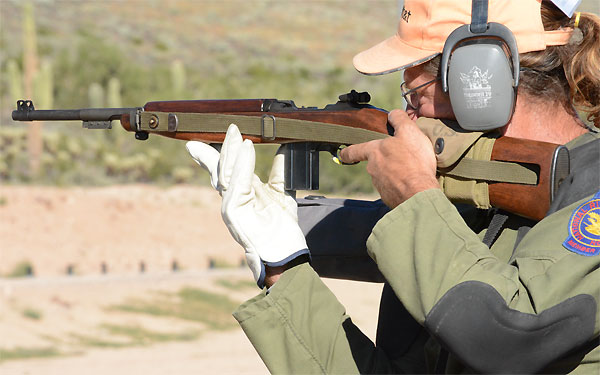
One of the CMP’s most popular competitions is the M1 Carbine Match. The little carbines are easy to hold and easy to shoot, with relatively low recoil compared to an M1 Garand or M1903 shooting the full-power .30-06 cartridge. Unfortunately, genuine GI-issue M1 Carbines are now hard to find at affordable prices. The CMP has announced: “CMP’S Carbine Inventory has been exhausted and we do not expect to receive any additional shipments.” Authentic, “all-original” M1 Carbines are going for $1500 to $1800.00 these days on Gunbroker.com.
CMP M1 Carbine Matches — Growing in Popularity
The CMP M1 Carbine Match is part of the CMP Games program that already includes Garand, Springfield and Vintage Military Rifle Matches. “As-issued” U. S. Military M1 Carbines are fired over a 45-shot course of fire at 100 yards on either the old military “A” target or the “SR” target. The course includes 5 sighters and 10 shots for record prone slow fire in 15 minutes, a 10-shot rapid fire prone series in 60 seconds, a 10-shot rapid fire sitting series in 60 seconds and 10 shots slow fire standing in 10 minutes.
CMP M1 Carbine Match at Western CMP Games
New Production M1 Carbines
Thankfully, you don’t need to source a real WWII-era M1 to enjoy CMP M1 Matches. You can now get a brand new, American-made M1 Carbine clone for HALF the price of old CMP rifle. Brownells is now offering American-made Auto Ordnance brand .30-Caliber M1 Carbines that look, feel, and shoot just like the originals, for a lot less money. There are two versions:
Another producer of M1 Carbine replica rifles is Inland Manufacturing, a modern company which shares the name of a leading WWII M1 Carbine maker. These made-in-the-USA, newly manufactured M1 Carbines are very authentic copies of the original carbines from the World War II era. With a $1139.00 starting MSRP, they feature authentic 1944-type adjustable sights, push button safety, round bolt, “low wood” walnut stock, and a 10–round or 15-round magazine. There are three (3) versions: M1 1944 style, M1 1945 style, and M1A1 Paratrooper model.
GunsAmerica.com report compares new Inland M1 Carbines side-by-side with original vintage M1 Carbines: “We had to get in close to tell the difference. Overall, the two examples we were able to handle looked great and held up when next to the originals. The stampings are even close to correct with a few minor differences that were chosen to stop the new Inlands from being mistaken for originals. Take a look at the photos and see for yourself.” READ M1 Carbine Review.
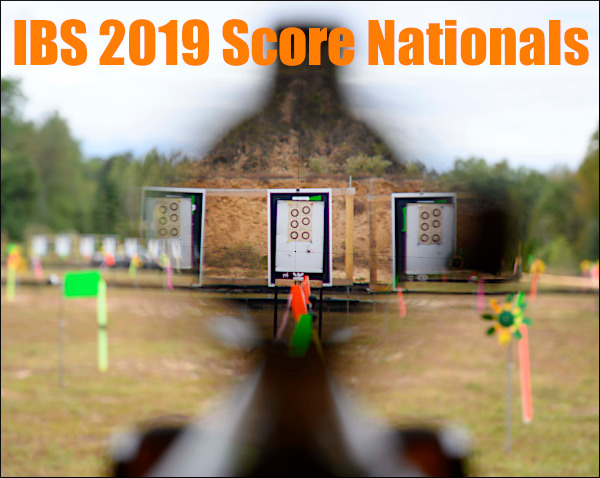
View through 6X scope at 2019 Metric Score Nationals in South Carolina. This is exactly what Jeff Stover’s camera recorded — it is not a Photoshop job.
Match Report by Jeff Stover, IBS President
“You need to come shoot with us” said Jim Cline at the January 2019 meeting of the IBS. Jim is both a Match Director at Mid-Carolina and an IBS Vice-President. I, as IBS President, considered it for a few seconds. Virtually all of my shooting is short-range group, but I wanted to see why IBS Score Benchrest was so hot — and growing — in the Southeast. “I will be down in October for the Score Nationals” was my response. Bottom line — The event was great, and I should have made the trip years earlier.
The Mid-Carolina Rifle Club is located about 35 miles southeast of Columbia, South Carolina. It sports 20 solid and well-designed concrete benches. A nice feature is the very deep, behind-the-firing-line roof for cleaning rifles, and chatting with fellow shooters.
The main competition at the Score Nationals is for the “Varmint for Score” 13.5-pound rifles. The cartridge of choice is the 30 BR (6mmBR parent cartridge). The extra .065″ bullet diameter over a 6mm helps with the Best Edge Scoring, but the 30 BR gives nothing away to the 6PPC in the accuracy department. As any score shooter can tell you, the 30 BR is an inherently accurate cartridge that is relatively easy to tune.
Firing Line at Mid-Carolina Rifle Club with ample behind-the-Line roof coverage.
It was a dream shoot for me. I don’t have a VFS 30 in my gun cabinet, but that was all taken care of. Both rifle and ammo came courtesy of Mike Clayton, one of the circuit’s top shooters. All I needed to bring were my rests! Mike’s rifle was a laser which I did not fully exploit. Mike showed true Southern Hospitality.
Mike Clayton ready to pull the trigger on his 30 BR rifle.
About 70 shooters made their way to Orangeburg. More had preregistered but the threat of Tropical Storm Nestor kept a few away. The storm was projected to bring 25+ mph gusts and heavy rain on Saturday. Those dire predictions did not materialize. We had somewhat light, but quickly switching, winds and mostly light rain. It was a dreary day for 100 meter competition but the mood along the firing line was convivial.
Tropical Storm Nestor delivered only rain and switchy breezes instead of the predicted gales.
At 100 meters, Brud Sheats led the way with a very nice 250-23X. On his heels were Ronnie Milford and Jim Cline with 22 and 21 Xs respectively. Jim and Ron are leading the Score Shooter of the Year standings. In 6-power class, Jim Cline’s had a good 250-14X for high score with Dewey Hancock 3 Xs behind.
Young Lady Shines at Her First Registered Match
Above is young competitor Emmalee McMurry (from eastern Tennessee) with her 6 PPC Heavy Varmint rifle. This was her very FIRST registered match. Her father Bill is her coach and mentor. Using her 6 PPC she shot two really good targets, a 50-5X and 50-4X. I shot next to her, and was impressed — she has composure and was very comfortable shooting a bench gun. If she stays with it, she could be a future force in Score Benchrest competition. — Jeff Stover, IBS President
Sunday, the targets and stationary backers were moved to the 200 meter butts. The weather started as Saturday had finished — light misty rain with some fog and 10 mph switchy wind. By mid-morning, however, the rain stopped and around lunchtime things brightened. After lunch the sun started to make more frequent appearances and the Orangeburg mirage returned. At the conclusion of the 200 meter stage only three of 65 shooters shot “clean” — i.e. a 250 score, with a 50 on every target.
Jim Cline aligning rifle. The multiple bolts are for his Light and Heavy VFS rifles and 6X Hunter Class rifle.
Mid-Carolina Rifle Club Extends the Red Carpet with Fine Food
All shooters were treated to a free grilled chicken and macaroni and cheese luncheon. In the evening, for a small charge, the Mid-Carolina club hosted a catered prime rib dinner. It was the “real deal” — premium beef carved to order. We had hoped for a pleasant Carolina evening instead of poor weather, but the great food made up for it.
At 200 meters, Brud Sheats lost none of his score-shooting mastery from Saturday. He won VFS 200 with a 250-5X. Ken Habadank followed with a Creedmoored 5X and Miles Gibby was 3rd with a 250-2X. The golden rule of score shooting is “stay clean”. That is, shoot a 50 on every target (five tens). The Xs are gravy, especially at 200. Anthony Isner shot a really nice 12 Xs in those conditions. But a wayward shot cost him a point on one target. A 250 beats a 249 despite the X counts. Having won both yardages Mr. Sheats won the 100-200 Grand aggregate with a 500-28X. Ken Habadank’s second place was six Xs behind. Miles Gibby, the only other 500 shooter, had 17 Xs to complete the podium.
See Complete 2019 100m/200m IBS Score Nationals Match Results HERE on IBS Website.
So what about the 6-power-max optics rifles? Shooting a 6-power scope at 100 meters is tough enough. At 200, well, it is twice as difficult, especially in Sunday’s conditions. Anthony Isner’s 243-4X won the day followed by Maine’s Orland Bunker at 242-3X. In the 6X Grand Agg, Dewey Hancock took the title with a 491-16X, closely followed by Brian Fitch with a 490-16X.
After Cease Fire is called, competitors show detached bolts to ensure safety.
Great Match — With Many Fine Shooters Returning to the Ranks
This was a fine, well-run match by any standard. I did not embarrass myself with a score rifle, so that was a plus! I made the trip to see “what’s what”, and was delighted to find a range full of enthusiastic and fun competitors. And these fellows really know how to shoot. I talked to several shooters who have come back to the sport after years, if not decades, of being away from benchrest. The PR efforts of Jim Cline, Ronnie Milford and other stalwarts in the region are beating the drum and many are answering the call.
Score Benchrest rifles racked and ready for the next relay.
Before your head to the range for some late-season practice, run through a checklist so you won’t forget essential items. Springfield Armory, maker of the M1A series of rifles and many popular handguns, has published a thorough Range Day Checklist. While this is oriented more for pistol shooters, many suggestions will help rifle shooters as well.
Packing the essentials, a few extras and having a plan will help you make the most of your day at the range. Here are highlights from Springfield Armory’s Range Day Checklist. Read the full article for more details including a flow-chart showing target options.
You need a range bag that works for you and all of your equipment. We suggest getting one with several compartments to keep your range items organized. Some shooters prefer one large bag, many like the new backpack style, still others want multiple smaller bags – either way, you will need plenty of room.
Before you head to the range, pack your Range Bag(s) with these basic requirements:
Hearing Protection
Make sure you have ear protection. You may want to also throw in a spare set in case you misplace one, or a friend needs to borrow a pair. Basic ear plugs or earmuffs do the job, but high-quality electronic headsets are a worthwhile investment for both safety and convenience. They amplify voices (safe noise levels), compress harmful noise levels – and you don’t have to remove your earmuffs to hear someone speak. Backup batteries are a must with electronic headsets.
Eye Protection (Ballistic Glasses)
Quality eye protection is another must-have, but it doesn’t have to be fancy (or expensive). Your eyewear should however be performance rated by ANSI Z87.1. This standard protects your eyes from high velocity and high mass impact. Grab a pair of safety glasses you’d wear in the shop, or you can opt for something more stylish from Oakley or ESS.
Magazines & Mag Loader
You can’t shoot if you forget your magazines. Many shooting bags have specific compartments that hold mags individually. Also… always number your magazines. This helps to identify and separate any magazines that are not properly functioning or need to be cleaned. It’s also nice to have a magazine loader. They’re inexpensive and easy on the thumbs. Our SME’s favorite manufacturer is MagLULA.
Cleaning & Tool Kit
Toss in a portable cleaning kit designed for your firearm, along with any other maintenance tools you might find handy. You don’t need anything elaborate — just enough to make sure your gun and magazines stays in good working condition.
Cleaning Cloth(s)
Cleaning solution
Screw driver
Bore snake or barrel brush
Gun-specific take down tool
Gun oil
Allen wrenches
Flashlight
Pocket knife
Squib rod
Hand sanitizer or better yet D-Lead wipes
Miscellaneous Items
AMMO & AMMO CAN
An ammo can is good to have — either the new, polymer-style varieties or military surplus steel cans. You will also need a container for your spent brass. Any sort of receptacle with a lid works, from an empty cardboard box or military steel can, to a 5-gallon bucket. One of my favorites is old freezer storage bags.
BE PREPARED — First Aid Kit
Plan for the best, prepare for the worst. A small first aid and trauma kit should be a part of everyone’s range bag. Hopefully you will never need the plastic gloves and quick clotting agent, but sterile wipes and bandaids are more likely to occasionally come in handy. Also, don’t forget the sun protection: Sunscreen, Hat, lip blam, and of course plenty of water for Hydration.
PRACTICE LOG
Practice makes perfect … so keep a practice log. Keeping a log is beneficial, as you can revisit old drills to continually re-test your skill level and compare results. If you’re old school, a physical paper training book / log works fine. Put it in your range bag. More of a smart phone junkie? Try the RangeLog app.
MAKE YOUR MARK — Put Your Name on Your Gear
It’s also not a bad idea to put your name on your gear. It greatly increases your chance of getting misplaced items back. A lot of equipment looks alike; shooting bags, earmuffs, magazines, etc. I’m betting I’m not the only one who has come home from the range without my earmuffs [more than once].
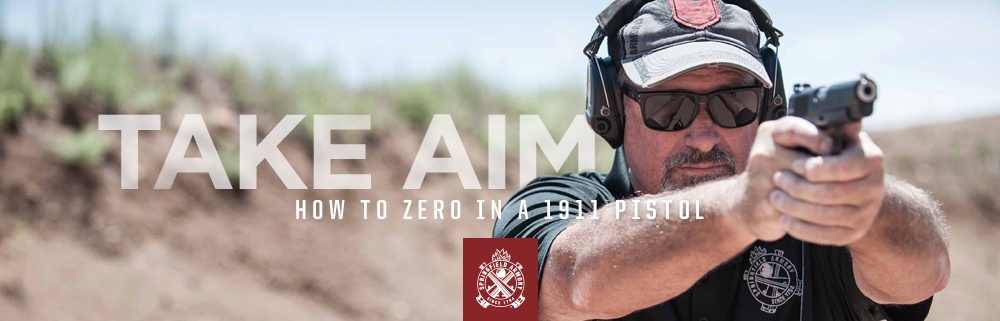
Here are some tips on shooting a 1911 pistol from handgun ace Rob Leatham: Not sure how best to zero your new 1911? Who better to learn from than Team Springfield’s championship shooter Rob Leatham.
We love the NRL22 rimfire tactical series. When you consider the amount of fun you experience per dollar expended, NRL22 .22LR rimfire competition is hard to beat. You enjoy the challenge of PRS-type shooting at reduced distances, and much reduced cost. In the NRL22 series you can be completely competitive with .22 LR ammo costing 15 cents a round. That’s a fraction of what you’d spend making your own centerfire handloads, or buying match-grade, factory-loaded centerfire ammo.
There’s a new option for NRL22 competitors competing in the Open Class. Modular Driven Technologies (MDT) now offers its ACC Chassis for the popular CZ 457 series of rimfire rifles. There are nine different CZ 457 variants currently offered. You can get the CZ 457 Training Rifle for around $400 (MSRP is $449.00). Simply install your CZ 457 barreled action in the MDT ACC chassis and you’re got a high-quality rimfire system with ergonomics that duplicate a full-size centerfire ring. NOTE: MDT also offers an ACC chassis that fits the CZ 455 series, predecessor to the CZ 457. The ACC CZ 457/455 chassis systems cost $999.00 — too expensive we think, but then quality ain’t cheap. Purchase from MDTTAC.com.
MDT ACC Chassis System (Shown with Centerfire Actions)
The MDT ACC (Adjustable Core Competition) Chassis was designed around an integrated, modular weight system that allows shooters to fine tune chassis weight and balance point. A series of weights (up to 9 lbs. of steel) can be added to either the buttstock, interior fore-end or exterior fore-end. With action, barrel, scope and accessories, shooters can configure their rifles upwards of 25-30 lbs. in the ACC. Other features include: full 17” ARCA/RRS fore-end, flared mag well, extended barricade stop, widened thumb shelf, and adjustable cheek riser/length of pull.
ARs in PRS? Yes PRS has a “Gas Gun” division. And frankly, shooting a PRS match is one of the most fun and challenging things you can do with your Black Rifle (Beto O’Rourke notwithstanding). Since the early days of the PRS, Gas Gun shooters have wanted to play. Recognizing the interest among semi-auto shooters, the PRS now offers a Gas Gun Series for semi-auto rifles such as AR15s and AR10s. The Gas Gun Series started in 2017, and has quickly become quite popular.
Photo Credit Michael Cage.
Gas Guns to 800 yards — Yes there are targets down there somewhere.
PRS Gas Gun Series Rules
For the new PRS “Gasser” Competition, the PRS developed rules on gun types, scoring, match timing, penalties, safety and other key topics. CLICK HERE for Full PRS Gas Gun Series Rules.
Open Division: Open Division rifles will not exceed a caliber of .30 or a velocity of 3,200fps. A match DQ will result any rounds over the speed limit of 3,200 fps (+/- 32 fps for environmental factors and equipment discrepancies). Match Officials may request at any point during a match that a competitor fire their rifle through chronograph. If the bullet exceeds the 3,200 fps speed limit, the shooter will receive an automatic match DQ. [“For Ammo in Open Class, 6mm and 6.5mm Creedmoor are popular.” — John Parker, SSUSA]
Tactical Division: Tactical Division: Intended to allow competitors the opportunity tocompete using traditional military and law enforcement caliber. This promotesActive Duty military and law enforcement competitors use of their Service and Department issued rifles. Tactical Light Division rifles are restricted to 5.56 NATO/.223 Remington and 7.62 NATO/.308 Winchester calibers only. .223 Bullet weight cannot exceed 77 grains and muzzle velocity cannot exceed 3,000 fps, .308 bullet weight cannot exceed 178 grains and muzzle velocity cannot exceed 2,800 fps. No modified wildcat rounds permitted to shoot in the Tactical Divisions. Tactical Division shooters will shoot the exact same COF as Open Division shooters. [NOTE: This division now replaces the previous Tactical Light and Tactical Heavy divisions.]
Scoring and Penalties
The Gas Gun Series utilizes a time plus penalty based scoring system for all match scoring. This means your score is your total combined time on all stages plus any penalties you may have accrued.
Stage Course of Fire and Targets
No more than 50% of the stages at a match can utilize an unlimited round count. At least 25% of the targets in Gas Gun Series match must be 2 MOA or smaller. Maximum distance is 800 yards.
The preferred rifle color choice at the first PRS “Gasser” Match was definitely black…
Gas Gun Match Loads — Short Range vs. Long Range
“The .223/5.56 [Tactical Light] guns had some lag time waiting on shot impacts. I believe the long-term solution may be to find a light and fast load for closer stages for near-instant reaction time and use a heavy load for the long shots to see splash and get the target to move a little more.” — Sean Murphy, Nightforce
Gear Options for PRS Gas Guns
There are many buttstock options for ARs. For the PRS game, we like the Magpul PRS stock. This features a quick-adjustable cheek-piece and butt-plate — allowing you to easily adapt head position and LOP for your discipline of the day. (You may want a different LOP for prone shooting vs. bench shooting). The Magpul stock works well in a rear bag.
We recommend something like the Blackhawk grip which is more comfortable than the typical grips supplied by most black rifle makers. Up front, you’ll want a handguard with adaptability. Shown is a handguard with Picatinny rails on top and on both sides, affording lots of options. We might move one of the rails to the bottom, however, so it could be used for a bipod mount.
Add Your Favorite Premium Barrel:
PRS with a Gas Gun — Gavin Gear’s Experience
Thinking of trying out the Precision Rifle Series, starting off with a gas gun? Well Gavin Gear of UltimateReloader.com did just that, competing in his first-ever PRS match up in Washington State. With its timed stages (some just 90 seconds long), Gavin learned that PRS is about speed as well as accuracy. As a PRS newbie, Gavin found the competition fun but challenging. Gavin’s account of his experiences, set forth in two articles with accompanying videos, will help other novice PRS competitors prepare for PRS-type matches and assemble the right equipment.
This video has cool Aerial Drone footage, and in-depth explanation of stages:
Gavin enjoyed his first match: “Overall, the match was more fun and more laid back than I thought it would be. The guys in our squad were all really helpful, and even loaned me gear to try out when they noticed my gear wasn’t right for a particular shooting activity. One such case was when Ken Gustafson (of KYL Gear) offered to loan me one of the bags he had made. Below you can see me shooting off the infamous unstable tippy tank trap with a KYL Gear bag, and I’ll have to say [the bag] was amazing. It helped me lock down my rifle and get on target. What a great feeling!”
Each Wednesday, the U.S. Army Marksmanship Unit publishes a reloading “how-to” article on the USAMU Facebook page. A recent “Handloading Hump Day” post covered preparation of once-fired 5.56x45mm brass. This article, the first in a 3-part series, has many useful tips. If you shoot a rifle chambered in .223 Rem or 5.56x45mm, this article is worth reading.
This week, Handloading Hump-Day will answer a special request from several competitive shooters who asked about procedures for morphing once-fired GI 5.56mm brass into accurate match brass for NRA High Power Rifle use. The USAMU has used virgin Lake City (LC) 5.56 brass to win National Championships and set National Records for many years. In this 3-part series, we’ll share techniques proven to wring match-winning accuracy from combat-grade brass.
GI brass has an excellent attribute, worth noting — it is virtually indestructible. Due to its NATO-spec hardness, the primer pockets last much longer than most commercial brass when using loads at appropriate pressures.
Preparing Once-Fired GI 5.56 Brass for Reloading (Part 1 of 3)
Assuming our readers will be getting brass once-fired as received from surplus dealers, the following steps can help process the low-cost raw material into reliably accurate components.
1. Clean the Brass
First, clean the brass of any dirt/mud/debris, if applicable. Depending on the brass’s condition, washing it in a soap solution followed by a thorough rinsing may help. [This step also extends the life of the tumbling media.] Approaches range from low-tech, using gallon jugs 1/2 full of water/dish soap plus brass and shaking vigorously, to more high-tech, expensive and time-consuming methods.
2. Wet-Tumbling Options (Be Sure to Dry the Brass)
When applying the final cleaning/polish, some use tumblers with liquid cleaning media and stainless steel pins for a brilliant shine inside and out, while others take the traditional vibratory tumbler/ground media approach. Degree of case shine is purely personal preference, but the key issue is simple cleanliness to avoid scratching ones’ dies.
If a liquid cleaner is used, be SURE to dry the cases thoroughly to preclude corrosion inside. One method is to dump the wet brass into an old pillow case, then tilt it left/right so the cases re-orient themselves while shifting from corner to corner. Several repetitions, pausing at each corner until water stops draining, will remove most water. They can then be left to air-dry on a towel, or can be dried in a warm (150° F-200° F max) oven for a few minutes to speed evaporation.
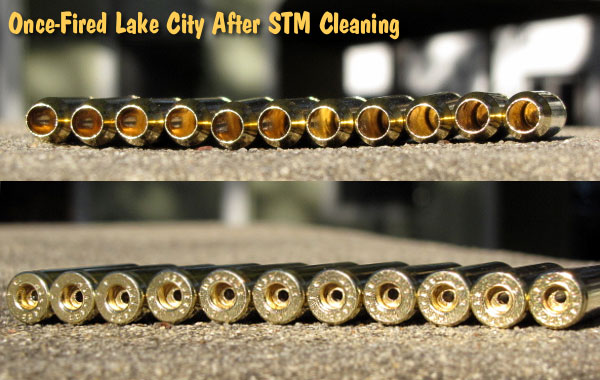
Shown below are Lake City cases after cleaning with Stainless Media (STM). Note: STM Case cleaning was done by a third party, not the USAMU, which does not endorse any particular cleaning method.
3. Inspect Every Case
Once dry, inspect each case for significant deformation (i.e., someone stepped on it), damaged mouths/necks and case head/rim damage. Some rifles’ ejectors actually dig small chunks of brass out of the case head — obviously, not ideal for precision shooting. Similarly, some extractors can bend the case rims so badly that distortion is visible when spinning them in one’s fingers. These can be used for plinking, but our match brass should have straight, undamaged rims.
Dented case mouths are common, and these can easily be rounded using a conical, tapered tool, [such as a .223 expander mandrel. A dummy 7.62 or .30-06 cartridge with a FMJ spitzer can also work.] If most of your brass is of one headstamp, this is a good time to cull out any odd cases.
4. Check the Primers Before Decapping
Your clean, dry and inspected brass is now ready for full-length sizing, decapping and re-priming. Historically, primer crimps on GI brass have caused some head-scratching (and vile language) among handloaders. Our next installment will detail efficient, easy and practical methods to remove primer crimp, plus other useful handloading tips. Until next week, Good Shooting!
NOTE: The USAMU Handloading (HL) Shop does not RE-load fired 5.56 brass. We use virgin LC brass with our chosen primer already staked in place. However, our staff has extensive personal experience reloading GI brass for competition, which will supplement the Shop’s customary steps. In handloading, as in life, there are many ways to accomplish any given task. Our suggestions are note presented as the “only way,” by any means. Time for loading/practicing is always at a premium. Readers who have more efficient, alternative methods that maintain top accuracy are invited to share them here.
Accuracy Potential of Mil-Surp 5.56×45 Brass
So, how accurate can previously-fired GI surplus brass be in a good National Match AR-15? Well, here’s a data point from many years ago that might be of interest. A High Power shooter who wrote for the late Precision Shooting magazine took a Bill Wylde-built AR match rifle to a registered Benchrest match. His first 5-round group ever fired in a BR match was officially measured at 0.231″ at 200 hundred yards. This was fired in front of witnesses, while using a moving target backer that confirmed all five rounds were fired.
He recounted that his ammo was loaded progressively with factory 52gr match bullets and a spherical powder using mixed years of LC brass with no special preparation whatsoever. Obviously, this was “exceptional”. However, he had no difficulty obtaining consistent 0.5-0.6 MOA accuracy at 200 yards using LC brass and a generic “practice” load that was not tuned to his rifle.
Saving Money by Using GI Brass
So, with good commercial brass readily available, why would one go to all the extra steps necessary to process fired GI brass? [Editor: It’s about saving money.]
Economically, it makes great sense. When the author was actively practicing and competing with the service rifle, he had ~3,000 rounds of 5.56mm brass, which allowed him to load during winter and spend most time in the summer practicing. If one were wealthy and wanted to shoot nothing but the finest imported brass, the current cost of 3,000 is ~$1920 (plus shipping.)
Dropping down to good, but less-expensive new, U.S. commercial brass brings the price to a much more realistic ~$720. However, at current rates, the same amount of surplus GI once-fired brass costs between $120 — $150, leaving lots of room in the budget for other expenses. [Editor: that’s less than 10% of the cost of the best imported brass.]
The International Defensive Pistol Association (IDPA) World Championship comes to Alabama this month. The main portion of the 2019 SIG SAUER IDPA World Championship will take place October 23-26 at the Talladega Marksmanship Park, drawing competitors from around the world. CMP staff began constructing stages on October 14. Ppreliminary firing begins at the end of this week. The 4-Day IDPA Worlds are expected to draw 350+ pistol shooters from 20+ countries.
Realistic Competition — What Makes the IDPA So Popular
Among the many action pistol disciplines, IDPA competition is probably the most “realistic” — the closest to actual defensive handgun use. Competitors use off-the-shelf pistols, suitable for carry. No exotic race-guns are allowed. Match stages simulate self-defense scenarios and real life encounters. An IDPA match is more than just a trigger-pulling contest. Shooters must use cover when available, and employ the same defensive strategies they would use in a real gunfight.
The IDPA’s founders developed the sport so that practical gear and practical guns may be used competitively. Shooters can spend a minimal amount on equipment and still be competitive. The main goal is to test the skill and ability of the individual, not equipment or gamesmanship.
In IDPA competition, firearms are grouped into five divisions: 1) Custom Defensive Pistol (.45 ACP semi-autos); 2) Enhanced Service Pistol (9mm or larger semi-automatics); 3) Stock Service Pistol (9mm or larger caliber double action, double action only, or safe action semi-automatics); 4) Enhanced Service Revolver (.38 caliber or larger double action revolvers); and 5) Stock Service Revolver (.38 caliber or larger double action revolvers). All classes have a minimum power factor. Scores are based on time and shot placement on the IDPA target.
IDPA Scoring System
The official IDPA Target (right) has multiple scoring zones. If you don’t hit the target’s center mass zone or head zone (both appear green in illustration), you drop one or three points. Here’s the formula: Score (in seconds) = Time + Points Down + Penalties. In IDPA, “points down” (and penalties) are added to your time. If you hit the outer edge of the target, you get 3 points down. Nearer center can be 1 point down. Center hit or head shot is 0 points down. See IDPA Scoring for Dummies.
About the IDPA — Fast, Fun, and Popular Worldwide
Held virtually every week of the year, IDPA matches attract over 25,000 members from the United States and over 70 other countries. Scores are classified by a number of divisions in a 1- to 3-stage Course of Fire. These events are held regularly throughout the country. Learn more at IDPA.com.











 Match Report by Jeff Stover, IBS President







 In IDPA competition, firearms are grouped into five divisions: 1) Custom Defensive Pistol (.45 ACP semi-autos); 2) Enhanced Service Pistol (9mm or larger semi-automatics); 3) Stock Service Pistol (9mm or larger caliber double action, double action only, or safe action semi-automatics); 4) Enhanced Service Revolver (.38 caliber or larger double action revolvers); and 5) Stock Service Revolver (.38 caliber or larger double action revolvers). All classes have a minimum power factor. Scores are based on time and shot placement on the IDPA target.


