Former Army Ranger sniper instructor Ryan Cleckner is the author of the best-selling Long Range Shooting Handbook. Cleckner hosts a series of videos that cover shooting techniques appropriate for tactical and PRS-type disciplines. Here are five short videos that cover various aspects of shooting techniques and rifle set-up. We think PRS/NRL competitors (and long-range hunters) can benefit from these videos.
“Consistency is the key to accuracy.
You need to think about a system of how you’re going to shoot that is not only comfortable, but [is] repeatable when you’re shooting.” — Ryan Cleckner
In this first video, Cleckner explains proper scope position. Ryan finds that some shooters place the scope too far forward or too far rearward. If the scope is too far back you may have issues with eye relief and stock reach to shoulder. If it is too far forward, you may have cheek-weld problems or get neck strain.
Cleckner offers a simple method to check your scope position: “To see if your scope is set up properly … close your eyes, lay your head on your gun, get completely comfortable, and only when you are set-up, then open your eyes. If you can’t see clearly through your scope, CHANGE something [such as comb height or scope position]”. “When you open your eyes, if you see some scope shadow [i.e. the black ring around the edge of the scope picture], figure out which way you need to move your head to get rid of that shadow, and then make adjustments to either your position, the rifle, or the scope.”
Cleckner prefers shooting off a bag when in the prone position, when that is practical. The bag provides a more stable support than a small Harris-type bipod, doesn’t require pre-loading the rifle, and there is less bounce or hop on recoil.
Former Army Ranger sniper team leader Ryan Cleckner explains how important it is to keep your rifle straight up and down when long-range precision shooting. Cleckner demonstrates with an AR-10 modern sporting rifle how slight cant to your rifle can cause a miss over long distances.
Here Cleckner covers some of the basic points of trigger control on tactical-style rifles. These basic principles apply to both single-stage and two-stage triggers. NOTE: For benchrest rigs, with ultra-light pull weights, more refined techniques may be appropriate.
In tactical events, when you’re shooting on the clock and loading from a detachable magazine, you should manipulate the bolt smoothly but strongly. Here Cleckner demonstrates how to cycle a tactical-type rifle. He says, “You should be running the bolt on your rifle with authority. Run it like you mean it!” NOTE: Completely different techniques are appropriate for custom benchrest rifles that manually feed.
Long Range Shooting Handbook — A Good Resource
Cleckner’s Long Range Shooting Handbook covers a wide range of topics important for precision marksmanship — both shooting skills and technical matters. You can view Sample Chapters from Ryan’s Book on Amazon.com. Cleckner’s book is designed as an intro to key concepts such as MOA vs. Mils, External Ballistics, and Environmental Effects. Included are personal tips and advice based on Cleckner’s years of experience as a sniper instructor and special operations sniper.
The Long Range Shooting Handbook is divided into three main categories: What It Is/How It Works, Fundamentals, and How to Use It. “What It Is/How It Works” covers equipment, terminology, and basic principles. “Fundamentals” covers the theory of long range shooting. “How to Use It” gives practical advice on implementing what you’ve learned, so you can progress as a skilled, long range shooter.
Looking downrange at the 600-yard targets. All Camp Perry photos courtesy Dennis Santiago.
Shooting USA TV has an excellent episode this week, with some great features for competitive shooters and fans of historic military rifles. Shooting USA covers the President’s 100 Match at Camp Perry, one of the most prestigious shooting competitions held each summer. In addition, Shooting USA spotlights the M1 Garand rifle. A legendary firearm that helped win WWII, the .30-06 Springfield M1 Garand remains popular in vintage military matches. There is also a major Garand Match each summer at Camp Perry. You can watch Shooting USA Wednesday nights on the Outdoor Channel at 8:00 pm Eastern/Pacific, 9:00 pm Central. Or, you can view each episode the following Thursday (and thereafter) on Vimeo.com
SHOOTING USA Covers the President’s 100 Match
The historic National President’s 100 Match is a huge event. In recent years, there have been over 1000 competitors, making this one of the biggest rifle events of the year. First held in 1878, the President’s 100 match is richly steeped in history. The top 100 competitors overall are designated as the President’s 100. They receive President’s 100 medallions and certificates.
Origins of the President’s Match The National Rifle Association’s President’s Match was instituted in 1878, as the American Military Rifle Championship Match. In 1884, the name was changed to the President’s Match for the Military Rifle Championship of the United States. It was fired at Creedmoor, New York until 1891. In 1895, it was reintroduced at Sea Girt, New Jersey. Today, the match is held at Camp Perry, Ohio.
The President’s Match was patterned after the Queen’s Match for British Volunteers. That British competition was started in 1860 by Queen Victoria and the NRA of Great Britain to increase the ability of Britain’s marksmen following the Crimean War.
The tradition of making a letter from the President of the United States the first prize began in 1904 when President Theodore Roosevelt personally wrote a letter of congratulations to the winner, Private Howard Gensch of the New Jersey National Guard.
After a hiatus in the 1930s and 1940s, The President’s Match was reinstated in 1957 at the National Matches as “The President’s Hundred.” The 100 top-scoring competitors in the President’s Match were singled out for special recognition.
Shooting USA Features the M1 Garand Vintage Military Rifle
This week’s Shooting USA episode tracks the origins and history of the Garand. An M1 Garand is a great addition to anyone’s personal firearms collection. It is a piece of living history — plus it can be used in Vintage Military rifle matches. Here are some resources for M1 Garand owners.
M1 Garand Maintenance Manuals
Among the many M1 Garand manuals available, we recommend the CMP’s U.S. Rifle, Caliber .30, M1: ‘Read This First’ Manual. This booklet covers take-down, reassembly, cleaning, lubrication, and operation. The manual comes with CMP rifles or can be purchased for $3.50 from the CMP eStore. The author of Garand Tips & Tricks says: “It’s one of the best firearms manuals I’ve seen and I highly recommend it.” The CMP also offers many other M1 Garand print resources including:
Jean Cantius Garand, also known as John C. Garand, was a Canadian designer of firearms who created the M1 Garand, a semi-automatic rifle that was widely used by the U.S. Army and U.S. Marine Corps during World War II and the Korean War. The U.S. government employed Garand as an engineer with the Springfield Armory from 1919 until he retired in 1953. At Springfield Armory Garand was tasked with designing a basic gas-actuated self-loading infantry rifle and carbine that would eject the spent cartridge and reload a new round. It took fifteen years to perfect the M1 prototype model to meet all the U.S. Army specifications. The resulting Semiautomatic, Caliber .30, M1 Rifle was patented by Garand in 1932, approved by the U.S. Army on January 9, 1936, and went into mass production in 1940. It replaced the bolt-action M1903 Springfield and became the standard infantry rifle known as the Garand Rifle. During the World War II, over four million M1 rifles were manufactured.
Watch Shooting USA Shows Any Time with Video on Demand
Don’t get the Outdoor Channel? No problem. Shooting USA is now available on Demand, streamed online for Smart TVs, Computers, Tablets, and Phones with high speed connections. Weekly episodes are posted in full on Vimeo.com. You can watch a single episode for $0.99, or get a full-month subscription for $e.99 and watch as many shows as you like. Each show is High Definition with Limited Commercial Interruption.
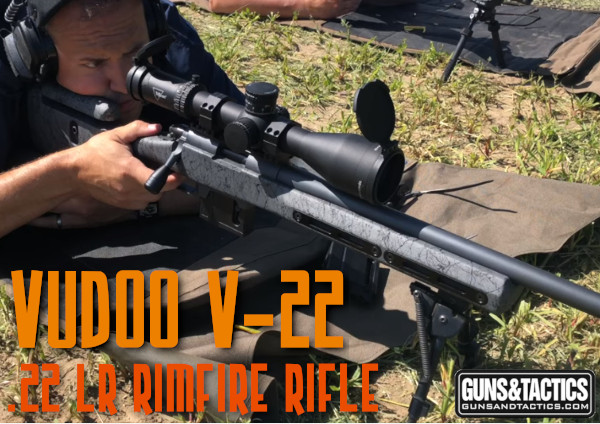
This Sunday GunDay story features a .22 LR rifle built around a Vudoo Gun Works V-22 rimfire repeater action. The V-22 action, arguably one of the best tactical rimfire actions available, owes its lineage to the respected Remington 40X action. Many rimfire matches have been won with 40X actions, so we understand why Vudoo chose that design for a starting point. Vudoo then added some important enhancements, including a controlled-feed design. This makes the Vudoo a great choice for rimfire cross-training, rimfire tactical matches, and NRL22 competition. In the video below you can see the Vudoo Gun Works rifle used an a PRS-style, long-range precision rimfire match in Minnesota.
As it has the same footprint as a Remington 700, the Vudoo Gun Works V-22 action is 100% compatible with a wide variety of Rem 700 chassis, triggers, and rifle accessories. This allows you to have a rimfire trainer with near-identical ergonomics as a centerfire match rifle. Rimfire training provides valuable trigger time with dramatically lower ammo costs. Along with actions, Vudoo sells barreled actions, and complete rifles through its website: VudooGunworks.com.
In this video, Dave Timm of GunsandTactics.com employs a Vudoo V-22 in the Minnesota .22 LR Long Range Precision Rimfire Match at the Rush Lake Range. This PRS-style match had targets out to 300 yards during the main match, followed by a long range challenge out to 465 yards. Dave’s Vudoo Gunworks V-22 rifle features a Grayboe Ridgeback stock, Harris bipod, and Trijicon Accupower 4.5-30x56mm FFP scope. Dave was shooting Lapua Center-X .22 LR ammunition.
This course of fire was challenging. Dave explains: “Stages included barricades and barrels and props to shoot out to targets at 100, 169, and 214 yards. So we’re shooting a 6″ piece of steel at 214 yards with an awkward position and a .22! It’s a good challenge and it really forced you to get all your fundamentals together. You’d be surprised at how much movement [there is]. You feel that you’re steady but all of a sudden that reticle just doesn’t want to stop moving.”
This Minnesota Match is similar to a PRS-style competition, but for rimfire rigs. Dave said “This match was an absolute blast and pushed out the .22 LR round out to some distance.”
About the V-22 Action — Controlled-Feed Design
Vudoo Gun Works states: “Our V-22 runs a full-size short action bottom metal (DBM) and our V-2210 magazine has a [full-size] AICS form factor. The V-22 is the only controlled-round-feed .22 LR receiver out there. The bolt has full capture control of the cartridge from the time it leaves the magazine until it ejects the spent round out the ejection port. That means the round never touches anything during feed travel so the bullets won’t be nicked/dented during rapid cycling.”
V-22 Product Description from Vudoo Gun Works:
The V-22 has been designed from the ground up as a true-to-scale Rimfire receiver that fits the Rem 700 footprint [for] stocks and chassis[.]. It also runs a full size short action bottom metal (DBM) and our V-2210 magazine has an AICS form factor[.]
The V-22 has a very unique control-round-feed protocol. The bolt has full-capture control of the cartridge from the time it leaves the magazine until it ejects the spent round out the ejection port. The significance of that is two-fold. Great feed and extraction reliability and…equally as important, the cartridge is controlled in a way that it never touches anything on its entrance into the bore. There is no feed ramp, nor does the projectile go in at an angle that would damage it in any way. We all know how susceptible the soft lead of the .22 LR is to accuracy-degrading damage and minor nicks during the chambering process. [That kind of bullet damage] is eliminated in the V-22 geometry.
About Dave Timm — Dave is a police officer serving his community on night patrol. Dave serves as his agency’s lead firearms and use of force instructor. He also owns and operates the Learning Firearms training operation in Baxter, Minnesota. Dave’s company offers realistic practical training solutions.
Our friends, Ed Mobley and Steve Lawrence, aka the “6.5 Guys”, have written an excellent article on getting started in practical/tactical competition. If you are new to the game, these tips can help you save money, progress faster, and have more fun. Here are article highlights, but we recommend you read the full story,5 Tips for Attending Your First Precision Rifle Match, onwww.65guys.com.
We often meet people who are new to long range precision shooting, and want to improve their knowledge and skill level. However, they aren’t sure if they are ready to sign up to compete in a match. They often ask, “What knowledge or skills are necessary to compete in a match?” Others may state, “I need to purchase this gear or that gear before I can attend a match”. For those guys who have a strong interest in precision rifle shooting, and who wish to chec out a precision rifle match, below are Five Tips to make it a positive experience.
TIP ONE: Make Plans and Commit to Go
First you need to start by finding a match to attend. This may entail a little bit of research and investigative work on your part to find what matches are scheduled in the next few months. We recommend starting with any match that may be within a reasonable driving distance. This may likely be a local “club” match, many of which are held on a regular basis. These make great venues because it will provide an opportunity to meet some of the regular attendees as well as shooters that are from your geographic area. Additionally, most of the smaller matches are a little more relaxed in terms of level of competitiveness.
Once you decide on the match you want to attend, do your homework. This means finding out if you need to pre-register or pre-pay the match fee. Commit to going by registering for the match and putting it on your schedule. Be sure to find other useful information for questions such as:
— What time should I arrive?
— Is there a mandatory safety briefing for new shooters at that venue?
— What is the travel time required to get to the match site?
— How many stages will there be?
— Is there a description of the stages available before the match?
— How many rounds should you bring?
— Are there special equipment requirements? (E.g. do you need chamber flags, is there a pistol stage?)
TIP TWO: Bring What You Have
(Don’t Spend a Fortune at the Start)
Some new shooters often assume they need a custom match rifle or all of the miscellaneous shooting gear associated with long range precision shooting to compete in match. While having a Kestrel weather meter and a high quality laser range finder and other shooting accoutrements are invaluable kit, you will find other shooters at your first match that will provide you with the information and coaching you need to get on target.
In fact, the only gear you really need to bring is a scoped rifle with a bipod and ammo capable of consistently shooting within one MOA. Also, be sure to know the ballistic drops or have a ballistic drop table prepared for your rifle/ammo to dial the correct DOPE on your scope for different target ranges. Many of the other participants at the match will be willing to let you borrow a support bag, bipod, tripod or other gear if you need one — just ask. Don’t use the excuse of not having the right gear to delay getting out to a match!
One reason not to make a big initial investment in a new rifle and assorted gear before competing, is we’ve seen a number of people come into the sport and try it for a year and then make the decision to move on to something else.
TIP THREE: Be Prepared to Learn
As a new shooter at a match, there is no better opportunity to learn. We often look to our local club matches as a group ‘training’ session to prepare for the bigger matches. You will find competitors at all levels of skill and many of your fellow shooters will enthusiastically provide helpful advice once they learn you are new to the sport. Take advantage of the opportunity to ask questions if you would like ideas for how to engage a stage, but also be sure to do more listening than talking as you receive guidance and tips from more experienced competitors.
Watch and observe other shooters and how they approach and ‘game’ a specific stage or course of fire. You’ll begin to recognize which shooting positions work best for different scenarios, and maybe even come up with some new ones that no one has thought of before.
Seeing what the better shooters do is an invaluable instructional tool. You can use your smart phone’s video camera to record other shooters (with their permission). When you’re ready to shoot, ask another shooter to record your performance. Watching yourself will point out needed areas of improvement.
After each match conduct an informal after action review and summarize for yourself the things that went well and what you should continue to do. You should also identify the specific shooting skills you should develop and make a plan to integrate the appropriate practice drills into your practice sessions. Finally, if you maintain a shooter’s data book or journal you’ll want to note things such as:
After Action Review – How you did, what went well, things you need to work on in practice. Stage Observations – Successful methods used for specific courses of fire. Note barricades, positions used, specific gear used for stages. Gear Observations – How your rifle/gear performed, what new items you should add to your “buy list”.
TIP FOUR: Be Safe and Have Fun
You’ve all heard a parent or teacher say, “It’s all fun and games until someone loses an eye.” The same can be said of the shooting sports. Safe handling of firearms is the number one rule at any match, and comes before the FUN part in terms of importance.
Before all matches start there will always be some form of a mandatory safety briefing. Make sure you know, understand, and follow any unique safety protocols for the match you attend. Some matches require all rifles have chamber flags inserted and are stowed in bags/cases while not on the firing line — other matches may not. If you run afoul of any safety rules, you risk the chance of being disqualified from a stage or worse, the entire match.
The second rule is simply have fun. This starts with having a good attitude throughout the day. Keep in mind that as a new competitor you should think of a match as a solid day of practice and training. If you blow a stage, use it as an opportunity to diagnose what you could have done differently or what you need to improve on — then smile and drive on.
Any day at the range or shooting is a good day. A match is an opportunity to hang out with like-minded people who are passionate about shooting and impacting targets far-far away. Life is great when you are doing what you enjoy!
TIP FIVE: Make Friends
There is no better way to meet lots of precision rifle shooters and make friends than at a match. The people that attend the tactical precision matches on a regular basis are those that have ‘fallen into the deep end of the pool’ and are really into the sport. As a result, they have become part of the local precision shooting community. As you strike up conversations at the match, find out if your new-found friends visit specific forum boards or social media outlets, or if there are other matches they attend.
Precision shooters tend to congregate and share information in different corners of the Internet. It will serve you well to meet some of the guys in person at matches and be able to connect a face to a screen name. As you develop your friendships and develop a level of trust, you will find opportunities become available to shoot with others in your local area, or get ‘read-in’ on a secret honey-hole of a spot to shoot long distance. Additionally, the local shooting community will often find it more convenient to sell or trade gear and equipment locally than deal with buyers/sellers that are out of state.
Can you really make a silk purse from a sow’s ear? Would you believe a winning benchrest rifle could be constructed with a stock fashioned from a cast-off log-splitter? Well it can.
Anyone who has attended an IBS benchrest match knows that this brotherhood of shooters includes some “backyard engineers” who can build amazing things with low-cost components. Consider Steve Jordan. He has built a winning Heavy Gun with a gunstock made out of a wood splitter. Check out the photo. The butt section is in the shape of a “V” like an ax. The “V” sits on an adjustable, flat rear sandbag. The flat shaft of the wood-splitter, running horizontally, serves as the main chassis and fore-end. The barrel block sits on top (with the action floated), while the flat, forward section of the shaft rides the front bag. Not only does this “log-splitter” stock work, but Jordan has won IBS matches with it! Sometimes simple and cheap beats expensive and fancy.
Sam Hall Says the Log-Splitter Has Been “Kicking Our Tails”
Sam Hall (multi-time IBS 600-yard champion) reports: “I was not at the first match (years ago) where Steve Jordan debuted his barrel-blocked, Heavy Gun stock made out of a wood splitter. From what I heard he cleaned house with it that day. When I first heard about this log-splitter rig, I thought guys were pulling my leg. But the log-splitter Heavy Gun really exists. In fact, over the past two years at Piedmont, Steve’s home-built log-splitter HG has won numerous Heavy Gun matches, out-performing nearly all the other Heavy Guns on the line, even those that cost thousands more to build.
Steve made the rifle as economical as possible. Steve’s entire stock is made from a metal wood splitter. From what I understand, Ray Lowman gave him the barrel block. This rides on the shaft of the wood splitter. With this inexpensive, simple rig Steve has kicked our tails at times! By the way, Steve’s Heavy Gun is chambered as a 6mm Dasher.”
Good news — the NRA and the CMP are coordinating the schedules of their respective pistol and rifle National Match and Championship events at Camp Perry (CMP) and Camp Atterbury (NRA) in 2020. This should allow competitors to shoot ALL their favorite events, without conflict. Coordinating CMP/NRA event schedules will also help competitors save on travel time and expense.
CMP’s Programs Chief, Christie Sewell and NRA’s Cole McCulloch, Director of Competitive Shooting, said jointly: “It’s important that competitors of both organizations have the opportunity to shoot matches of their choice without conflicting dates, by event.”
Key 2020 National Matches Dates:
NRA National Matches First Shot Ceremony — July 1, 2020
NRA National Matches Pistol Championships — July 1-5, 2020
CMP National Matches First Shot Ceremony — July 7, 2020
CMP National Matches Pistol Championships — July 7-12, 2020
CMP Smallbore Championships — July 14-22, 2020
CMP High Power Rifle Championships — July 21-31, 2020
CMP National Games Events — July 30 – August 3, 2020
CMP Long Range Matches Camp Perry — August 4-8, 2020
NRA Smallbore Championships — July 23 – August 5, 2020
NRA High Power Rifle Championships — August 9-15, 2020
NRA Mid-Range Rifle Championships — August 16-20, 2020
NRA Long Range Rifle Championships — August 21-25, 2020
CMP National Matches Program 2020 at Camp Perry
The CMP will open the National Matches at Camp Perry with its First Shot Ceremony and pistol matches on Tuesday, July 7. CMP pistol events will run through Sunday, July 12. CMP Smallbore rifle check-in and practice will commence on Tuesday, July 14 and matches will run for a week with championships and prone awards on Wednesday, July 22. CMP’s Rimfire Sporter Match and CMP Junior Smallbore camp will also be completed during that period.
CMP Cup High Power Rifle matches begin Tuesday, July 21 and will conclude with a CMP Cup awards ceremony on July 23. CMP Rifle Clinics will begin July 24 and conclude July 26. CMP’s National Trophy Rifle Matches will begin July 27 – July 31, with CMP National Games Events July 30 – August 3. CMP Long Range matches open on Tuesday, August 4 and conclude with the CMP Palma Rifle match and Long Range awards on Saturday, August 8. All CMP events will continue to be held at Camp Perry in Port Clinton, Ohio.
NRA National Matches Program 2020 at Camp Atterbury
The NRA Pistol Championships run July 1-5, 2020. NRA Smallbore 3P Rifle begins on Thursday, July 23 and concludes Tuesday, August 4 with a final awards ceremony. NRA High Power Rifle commences on Monday, August 9 and concludes with an awards ceremony on Saturday, August 15. NRA Mid-Range Rifle opens on Sunday, August 16 and closes on Thursday, August 20 with an awards ceremony. NRA Long Range Rifle begins Friday, August 21 and concludes Tuesday, August 25 with the final awards ceremony.
This November, many readers will be traveling nationwide on holiday. It might be fun to visit shooting ranges near your holiday destination(s). Or perhaps you’ve recently relocated and want to join a shooting club near your new residence. Or maybe you’re just looking for a facility close to home that offers instruction or specialized programs for women or juniors. You can quickly find exactly what you want via the WhereToShoot.org website.
A service of the NSSF (Nat’l Shooting Sports Foundation), WhereToShoot.org offers a Searchable Database of pistol, rifle, and shotgun ranges around the country. You can search by state, or select a particular distance from any zip code. The database is very complete. The individual range pages also include web addresses, phone numbers, and map links. The example below shows the results of a search for shooting ranges near Boulder, Colorado:
Where to Shoot Mobile App
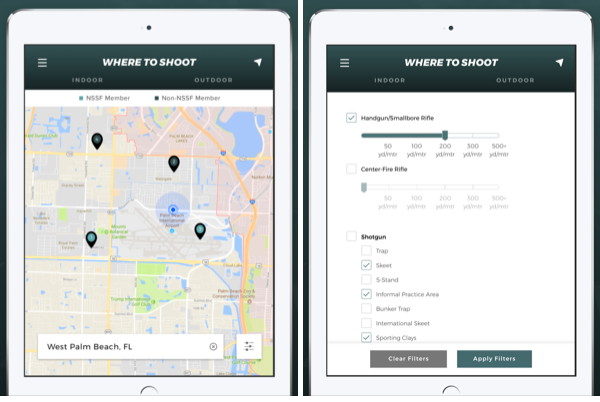
To complement Wheretoshoot.org, the NSSF also offers a Where To Shoot Mobile App. This App quickly locates shooting ranges near you, drawing on North America’s most comprehensive range directory. Users can search by current location, state, or zip code. Once you locate a range, you can view activities offered along with a summary of range facilities. You can even get driving directions.
The app is modeled after NSSF’s popular WhereToShoot.org® website and is updated frequently with range information for every U.S. state and Canadian province. Once you’ve located a place to shoot, the App can provide directions to the range. The App also includes video tips for shooters, news, and firearm-safety information.
You may want to tune in to Shooting USA tonight. There are three interesting topics covered in the one-hour cable TV broadcast. Hornady’s A-Tip Bullets are featured in a product spotlight. Next the ultimate speed-shooting contest, the USPSA Steel Challenge, is covered. And for the tactical/PRS crowd, Shooting USA interviews Tom Fuller of Armageddon Gear. The hour-long Shooting USA show runs on the Outdoor Channel Wednesday nights at 9:00 PM Eastern and Pacific time, 8:00 PM Central time.
1. Hornady A-Tip Bullets — Worth the Very High Price?
This week Shooting USA reviews Hornady’s new A-Tip bullets. These A-Tips generated a lot of buzz because of their high price and unusual packaging. These expensive ($75-$85/box) aluminum-tipped projectiles have very consistent bullet BCs according to Hornady. They are sold in sequential order for consistency, and shipped in clear plastic egg-crate style packaging to protect the tips. The jury is still out on these bullets, as we haven’t seen them used much in competition outside the PRS realm. But if you are curious, check out this report.
2. Steel Challenge — Fun and Fast Steel Plate Competitions
For fans of steel shooting, Shooting USA will cover the famous Steel Challenge, a speed shooting competition with eight standardized steel plate stages. It’s all about speed — the top guns can nail all five targets in under three seconds. Run by the Steel Challenge Shooting Association (SCSA) a division of the USPSA, the Steel Challenge is fast and exciting. Regional matches are held at affiliated clubs through the USA, with a large annual World Speed Shooting Championships (WSSC) that attracts competitors from around the world. In 2018 and 2019 the WSSC was held in Talladega, Alabama. LEARN MORE HERE
3. Armaggedon Gear — Tactical Accessories
Finally, this week’s Shooting USA episode visits Armageddon Gear in Georgia. This company, founded by former U.S. Army Ranger Tom Fuller, sells support bags, gun cases, slings, suppressor covers, scope covers, and a wide variety of other accessories popular with the PRS/NRL crowd. With a 22-year Military career behind him, Tom Fuller is creating and selling what he knows, shooting gear. Fuller’s company is an American success story, as Armageddon Gear now provides products to the U.S. Military, Law Enforcement, as well as PRS/NRL competitors.
The 2019 IBS 600-Yard Nationals took place October 12-13th at the Gopher Rifle and Revolver Club (GRRC.org) in Harris, Minnesota. It was a challenging event, given the cold and stormy conditions. Nonetheless many of the nation’s top shooters shot very well, and some young newcomers had strong showings. The real star of the match was new 600-Yard National Champion Jason Wolf. He delivered a masterful performance, winning the 2-Gun Overall, Light Gun Overall, and Heavy Gun Overall.
Dave Holland, past GRRC Bench Director and Host of 2010 IBS 1000-Yard Nationals.
Match Report by Kent Bratten
MD, IBS 2nd Vice President and Awards Chairman
There was some scrambling before and during the Nationals due to the weather. Gopher Rifle and Revolver Club is a large, multi-discipline range set among marshes and woods just off I-35, about 40 miles north of a large metropolitan area in Minnesota. Because of the topography, winds and mirage can often be tricky.
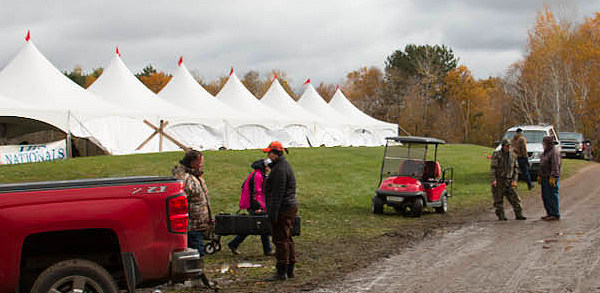
Due to the forecasted poor weather, a large circus-tent style cover was rented in place of the usual canvas/pole type temporary structure (see AcccurateShooter’s article on the 2010 1000-yard Nationals at Harris). It is likely the clean-up crew would still be picking up the pieces if that structure had been used.
Course of Fire for IBS 600-Yard Nationals
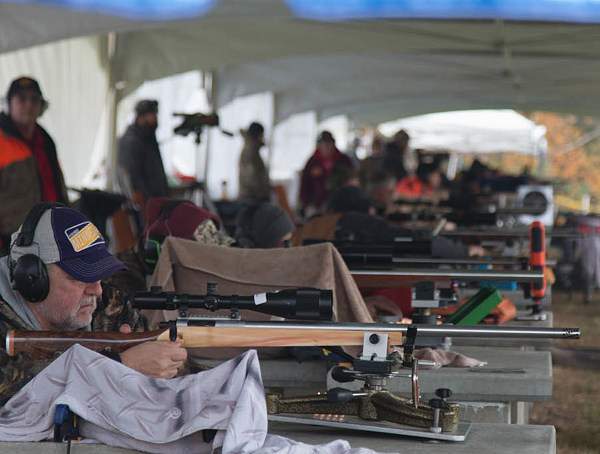
The event was run with the same format as the 2018 IBS 600-Yard Nationals in St. Louis. The course of fire was Light Gun (total weight 17 lbs. max) on Saturday and Heavy Gun (no weight limits) on Sunday. Each of the 63 competitors shot eight (8) targets daily in four relays. Saturday evening Vapor Trail Bullets hosted a banquet, at which time the Light Gun titles were awarded, along with a large prize table drawing afterwards. Sunday was Heavy Gun and had 61 shooters (two dropping out due to a family emergency). Despite no further snow and no ferocious winds, conditions were hardly ideal as it was still cold in the morning with swirling winds throughout the day. Hence on neither day did the group averages drop below two inches and there were only a handful of perfect scores.
Formidable Performances Even in Tough Conditions
Despite the conditions and several DQs on Day One, the top guns still put on a very good performance. Scotty Powell of North Carolina won the Light Gun Group and Chris Nichols, also from North Carolina, won the Heavy Gun Group award. Jason Wolf of South Dakota was the big winner, taking home the Light Gun Score, Light Gun Overall, Heavy Gun Overall, and the 2-Gun Overall titles. Jason’s performance was superb. Along with his LG, HG, and 2-Gun titles, Jason shot the smallest group of the match, a stunning 0.673″ in Heavy Gun. He also placed second in Heavy Gun Group Agg, just 0.166″ off the best, while finishing third in Light Gun Group Agg, .340″ from the top. All in all, it was a dominant showing by the South Dakotan.
Robby Vick smiling despite the cold. But did you really need the fan Robby?
Snow Flurries and Other Shooting Challenges
After the match, we interviewed most of the Top Ten shooters. We covered topics such as as strategies for bad conditions and their previous shooting experience. Several mentioned having trouble seeing the marks on the white-painted steel sighting plates. And, because of snow flurries, some could only see the last round hit (last sighter), about 5-10 seconds before their record target came up. Accordingly, many competitors depended on the tracking ability of their rifles and maintaining their point of aim throughout the record period. As for shooting backgrounds, many of the Top 10 enjoyed long range hunting and varminting — especially prairie dog adventures. Some had started out with rimfire bench competition, some began with short range IBS matches, while others already shoot long distance (1000-Yard) IBS matches and F-Class. For all those interviewed, the result was pretty much the same. After starting in competitive shooting, they had gotten hooked on precision, and sought to push their skills to the limit.
Possible New Trends in Equipment — Wider Stocks
The Top 10 Equipment Lists show the favorite actions (BAT), bullets (Vapor Trail and Bart’s) and scopes (Nightforce) with a sprinkling of different barrels and stocks. We note there does seem to be a trend towards wider stocks. When we reviewed the Top 20 List (about 30% of the pool) we noted a growing number of stocks with wider fore-ends (4 inches or more), especially the Wheeler/McMillan Tracker. As for chamberings, the 6 BRA (6mmBR Ackley Improved) seems to be very popular, but is not dominant over the 6 Dasher yet.
Junior Champ Andrew Powers, setting up. Beside him is his grandfather, Johnny.
COMMENTARY from Match Director Doc Bratten
It was a somewhat hair-raising experience leading up to the Nationals, with the bad forecast followed by a two-day period before the match when high winds made practice difficult. A major concern was that the weather would worsen and cause a major delay or cancellation. But, like the D-Day invasion of 1944, prayers for a break in the weather were answered. We also had an unexpected shortening of staff. But the Nationals team still did a wonderful job of running the line and everyone chipped in with putting up the “mess tent”, line cover, and helping in the target review area. Also hats off to the target crew and scorers in the Red Shed. With the snow and wind, it could not have been easy working with those targets and drying them after.
Into the quagmire to look at targets…
We are very grateful to all our IBS sponsors, whose generosity ensured rich prize tables for both the Hawk’s Ridge 1000-Yard Nationals and here in Minnesota. I would especially like to thank Sally and Jim Bauer of Vapor Trail Bullets for sponsoring the Awards Banquet. We very much appreciated the Grand Prizes supplied by Alex and Matt Findley of AMP Annealing, David Dorris (and Ms. Krag) of BenchSource, Alex Wheeler of Wheeler Accuracy and Bart Sauter of Bart’s Bullets. The full list of IBS 600-yard and 1000-yard Nationals sponsors can be found on the IBS Website.
Finally, we extend a very special thanks to our friends at Gunstop Reloading and Gunstop of Minnetonka gun sales for their trophy donations. We also thank Dave Newell, Past President at GRRC, current Club newsletter editor, and exceptional wedding photographer, for his great photos of the match.
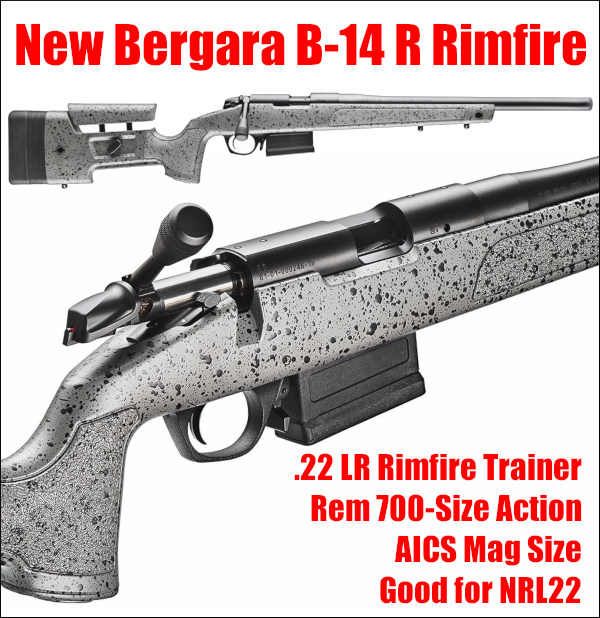
Looking for a nice .22 LR rimfire training rifle that works well with rear bags and bipods? Then check out the new B-14 R from Bergara. It is set up for rimfire training and tactical-style competitions. The action and magazine are full centerfire dimensions, so that you can train with a rimfire rifle offering centerfire-style “feel” and ergonomics. MSRP is $1150.00 so expect street price to be around $1000.00.
We think this would be a good choice for the NRL22 tactical competition for shooters preferring a conventional-style stock. It has an adjustable cheekpiece and LOP adjusts with spacers. The toe of the buttstock is straight so this will work well with bags. And if you want to later swap to a metal or composite chassis, the B-14 R barreled action will fit stocks and chassis systems designed for Rem 700s. In fact you can even use aftermarket Rem 700-compatible triggers.
B-14R Bolt Action .22 LR
The Bergara B-14 R Bolt Action Rifle in .22 LR is the latest offering in Bergara’s popular B-14 series of rifles. The company states: “The Bergara B-14 R has been a product that our customers and enthusiast have been requesting for quite some time, and with the growing NRL22 and PRS .22 competition matches, we believed that the time was right to introduce a rifle of this nature.”
This rifle is designed as a true rimfire trainer with the feel of a Rem 700 centerfire rig. The action shares dimensions of a Rem 700 receiver so you can upgrade to Rem 700-compatible stocks, and triggers. The single-stack .22 LR magazine has the same external dimensions as the commonly-used short action AICS mag for centerfires. So even your mag swaps will duplicate the “feel” of your centerfire rifle.
Bergara B-14 R Specifications
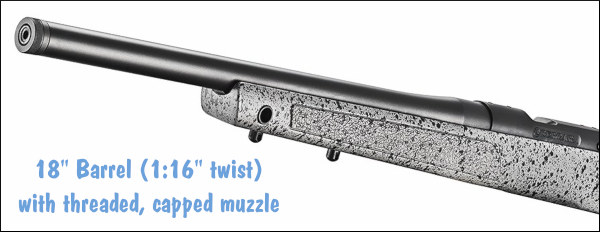
Barrel: 1:16″-twist 4140 Bergara, 18″ free-floated
Muzzle Thread: 1/2-28
Rifle Weight: 9.25 lbs. (without optics)
Rifle Length: 38″ with all spacers
Magazine Capacity: 10 rounds
Scope Mounts: 6-48 screws, Rem 700 compatible
Stock: Bergara HMR stock molded with full-length integrated mini-chassisinternal mini-chassis, integrated OD flush cup sling mounts and swivel mounts, adjustable cheek piece and length-of-pull.


 The National Rifle Association’s President’s Match was instituted in 1878, as the American Military Rifle Championship Match. In 1884, the name was changed to the President’s Match for the Military Rifle Championship of the United States. It was fired at Creedmoor, New York until 1891. In 1895, it was reintroduced at Sea Girt, New Jersey. Today, the match is held at Camp Perry, Ohio.