There are hundreds of cartridge types capable of winning in F-Open. For F-TR you can shoot either the .223 Rem or .308 Win, but you have many load options. This article will focus on proven choices, currently used by the top F-Class shooters in the world. Our discussion will analyze cartridge selection based on the four different F-Class sub-disciplines: Open Mid-Range, Open Long-Range, F-TR Mid-Range, and F-TR Long Range.
Click image to view full-screen photo.
Mid-Range F-Open Cartridges
For starters, a .300 WSM is certainly capable of winning mid-range matches but it is not ideal. So what is ideal, and why? F-Class Mid-Range matches usually are usually shot at 300, 500, or 600 yards — or all three. At those distances the 6mm and 6.5mm cartridges rule. In moderate conditions, the 6mm Dasher is unbeatable. Its low recoil along with its super grouping ability and good ballistics make it my number one choice for Mid-Range.
Best bullets for the 6mm Dasher are: Vapor Trail 103gr, Berger 105 Hybrid, 108 BT, and 105 VLD (hunting). Best powders are: Varget, H4895, and Reloder 15.
Choices for Mid-Range in Tougher Conditions:
We all know that conditions are not always “moderate” that’s why something a little bit bigger will save you a “Nine” or two. The 6.5X47 Lapua was designed for 300-meter competition, but as soon as it was released, it was adopted by F-Class, benchrest, and tactical shooters. It offers great ballistics with very low recoil and big “accuracy window”. Lapua makes great brass for it (no surprise there) and Berger makes great bullets: 130gr VLD, 140gr VLD, 140gr Hybrids. Best powders in most barrels are Varget and H4350, I don’t use double-based powders such as Reloder 17 and the Vihtavuori N500 series because of their unpredictable performance day to day (greater temp sensitivity).
The 6.5X47 Lapua necked down to 6mm is also a great option for mid range matches. I was able to easily get 3200 fps with 105 hybrids and H4350.
Choice for Long-Range F-Open Competition
In Long-Range F-Open Class (out to 1000 yards), the big, high-BC bullets rule. If I had to pick one cartridge for F-Class (both mid- and long-range) I would pick the .284 Winchester or one of its variants. The .284 Win is currently dominating in F-Open competition. It offers great barrel life, it is super-easy to tune and its recoil is very manageable. The best bullets for it by far (in my opinion), are the Berger 180 Hybrids. But Sierra’s new 183gr MK bullet (with factory-uniformed meplats) seems to perform very well as does the Berger 180 VLD. Best powders for the .284 Win are H4350 and H4831SC.
Long-Range Only F-Open Cartridge
As much as I like the .284 Win, for long-range competitions I like the .300 WSM even more. If you look at a .300 WSM and a 6mm Dasher side by side, they appear almost identical in geometry — the .300 WSM looks like an “super-sized” Dasher. Both cartridges are currently the “darlings” of long-range benchrest due to their extraordinary grouping ability and huge “node’’ windows. Big accuracy windows allow loads to perform well in different conditions and geographical locations. That’s obviously very important if you travel to compete. The .300 WSM loaded with Berger 215gr or 230gr Hybrids is very tough to beat at long range, and it is currently my number one choice.
The 7mm RSAUM is another outstanding long-range round. It resembles a 6BR on steroids and it is almost as easy to tune. Best bullets for it are Berger 180gr Hybrids, 195gr EOLs, and Sierra’s 183gr MatchKing. Best powders for the 7mm RSAUM are: H4350, H4831SC, and VV N160.
Top Caliber/Bullet Combos for F-TR
In F-TR competition, the choice is clear — a .308 Win throated for Berger 185gr BTLRs and 200gr Hybrids will win in mid-range AND long-range comps. Many championships have been won, and many records set with those two bullets in the .308 Win. To quote Danny Biggs (a two times FTR National Champion) “The 185 BTLR is the best bullet for .308 Win ever made”.
The Berger 215gr Hybrids have been used to win many competitions including recently the 2015 F-Class Nationals. Bryan Litz won both the Mid-Range and Long-Range 2015 Championships using 215s. Bryan’s rifle is shown below:
I recommend chambers throated for the 185/200 grain projectiles over the 215/230 grain bullets. The reason is that if you have your barrel throated out for the 215s or the 230s, you could have a “slow” barrel and max out on pressure before the desired velocity is reached. Optimum freebore for the 230s is too long for the 185/200s, so you would be limited to using only 215/230gr bullets in that barrel.Furthermore, the recoil increase with heavier bullets is substantial, causing the rifle to be more difficult to shoot.
.223 Rem — Not A Competitive Option
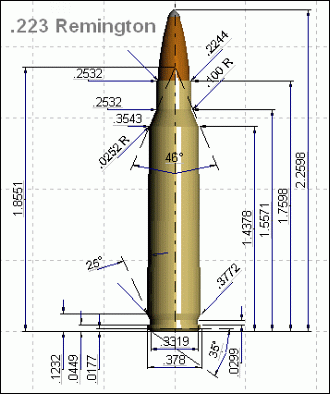
I would stay away from the .223 Remington. On paper the 90gr VLD will shoot inside most .308 Win loads even at a 1000 yards. But in reality, on average, the .223 Rem, regardless of what powder/bullet combo is used, cannot compete with the .308 Win. [Editor: The equipment lists at major F-TR matches will confirm Kovan’s conclusion here.]
Conclusion (and Other Options)
This article covers only the (currently) most popular cartridge/bullet combos for F-Class (F-Open and F-TR). As I said in the beginning, many cartridge types are capable of winning but are not listed due to their low popularity, case design, or lack of quality components. All of the above information is based on my personal experience and it is meant to help new shooters choose the right cartridges for F-Class matches. Thanks for reading and good luck — Emil Kovan
Emil Kovan Competition History:
– 2014 F-Class Open National Champion
– 2015 F-Class Open National Championship, Silver Medal
– F-Class Open National Championship Teams, 2015, 2014, 2013, Shooting Team Member
– Over 15 wins in Regional and State Championships in Palma, F-TR, F-Open
Above and below — the world’s best female Action Pistol shooter, Jessie Harrison.
The shooting sports are not a “man’s game” these days. Far from it. More and more women have taken up target shooting. A recent survey showed an 80% increase in the number of women target shooters from 2001 to 2016. In total, six million American ladies participated in target shooting in 2016. Likewise hunting has become more popular with American women. Female hunters in the USA numbered 1.1 million in 2016. That represents a 104% increase from 2001.
Recognizing that ladies are an ever-increasing part of the shooting sports, Shooting Industry Magazine published its first-ever Woman’s Issue dedicated to female shooters and huntresses. This 2019 special issue can be accessed for FREE online. CLICK HERE to READ.
While the issue is focused primarily on SELLING products to women, there is some very useful information that can help match directors and club officials. The magazine interviews many business owners and range directors who have developed female-focused shooting and training programs.
Female Participation in Shooting Sports and Hunting
The Shooting Industry Woman’s Issue spotlights female participation in target shooting and hunting. One key article summarizes a nationwide survey conducted by Southwick Associates. One interesting finding was that much of the increase in female participation can be tracked to younger ladies: “Female participation in both hunting and shooting may be highest among younger women[.]” Notably, 16% of respondents among target shooters in the 16-24 age category were female. Southwick concludes: “Future generations of hunters and shooters will contain more women than ever before”.
Doug Koenig’s Championship Season returns to the Pursuit Channel for its ninth season. On this week’s episode, Koenig shoots the Zombies in the Heartland multi-gun match in Nebraska. Sponsored by Hornady, the Zombies Match is one of the biggest 3-gun matches in the nation. Later in the episode Koenig visits Hornady’s bullet-making factory in Nebraska.
Doug Koenig’s Championship Season airs on the Pursuit Channel three times each week. NOTE: If you don’t have cable, you can view shows online on your computer or mobile device at Pursuituptv.com. Weekly Cable TV broadcast times are:
Wednesday at 5:30 pm (EST) | Friday at 9:00 pm (EST) | Saturday at 1:00 am (EST)
Koenig Competes in Zombies Match in Nebraska
Teaming up with Jason Hornady and his son, Doug travels to Nebraska to shoot the popular annual 3-Gun Zombies in the Heartland match. Using pistol, rifle, and shotgun, Doug’s team shoots the Open Division Industry Match and runs six challenging stages using zombie-themed props.
This “Pandemic” 3-Gun fun match, one of the biggest three-gun shoots in the nation, takes place each summer at the Heartland Public Shooting Park in Grand Island, Nebraska. The Pandemic features a rich prize table worth over $150,000. Prizes include pistols, rifles, shotguns, scopes, AR uppers, gun parts, and gear of all kinds.
See A-Tip Bullets Crafted at Hornady Factory
In the second part of the episode, Doug visits the Hornady production facility to see how the new, sequentially-packaged A-Tip match bullets are made. These feature a very uniform aluminum tip for consistent BCs. Doug views 6mm 110 grain A-Tips as they roll off the manufacturing line. Doug plans to use this 6mm bullet in his future PRS competitions.
Hard work and tenacity do pay off. Smallbore/Air Rifle ace Katie Ezell is proof.
Story based on article by Serena Juchnowski, CMP Feature Writer
Hailing from Denver, North Carolina, Katie Ezell, 18, is a rising talent. Katie graduated Summa Cum Laude from High School in 2019 and now attends Ohio State University, where she competes on the OSU Rifle Team. At the age of 10, Katie’s parents introduced her to marksmanship, wanting their daughter to have hands-on instruction in firearm safety. Thus began a love affair that has only evolved since then.
“The first time I ever went shooting, I knew this was something that I would want to continue to do.”
One of Katie’s match rifles is a Walther LG400 Alutec Competition Air Rifle:
Since she was so young and unable to join the teenage pistol team at her club, Katie applied to the women’s team, which had no specific age restrictions, and proceeded to compete with those far older and more experienced. Katie accredits much of her competitive drive and how she handles match pressure to pursuing the competition venture at such a young age.
After pistol came skeet, in which Katie traveled to national and international competitions. Thinking about the future, Katie soon realized that a shooting scholarship would allow her to continue in the shooting sports while funding her education. Precision rifle appeared to be the best avenue for this, leading Ezell to move into rimfire sporter for four months before making the jump into precision air rifle.
Ezell cites her greatest accomplishment as “getting accepted to be on The Ohio State [University’s] rifle team after shooting for a year and a half”. While Ezell had been shooting for eight years, she had only been training and competing in precision rifle for 18 months when she was accepted onto the team, where she made her dream a reality.
After joining the Ohio State team, Katie’s first competition was the Junior Olympics, which added some extra pressure to the already prestigious event. This was not the only special part of the occasion. Katie’s father, a deployed military member, was in town, and this was the first time he could watch her compete in person, since his deployment makes attending matches difficult.
Katie Ezell at the Colorado Springs Olympic Training Center in 2018 for Winter Air Gun.
Katie notes that after she set the nervousness aside, she found herself excited and shot a personal best in smallbore. She had hoped to shoot better with her air rifle, but she knows that being part of a college team will help her to improve her skills.
Katie excels at Smallbore. Here she aims a .22 LR Walther rifle at the 2018 Nationals at Fort Benning, GA. She shot a personal best at the Junior Olympics.
With Coaching, Katie Has Achieved Personal Bests in Both Ari Rifle and Smallbore
Katie is nearing the end of her first semester at Ohio State and has surpassed her previous bests in Smallbore and Air Rifle. Her coach has changed some of Katie’s positions, and she is improving.
“Marksmanship has taught me a lot about self-control. If the shot does not look right, then I reject it and try again. I have learned that failure is okay….” Katie recognizes that failure can inspire one to do better and to learn. She advises competitors “to not be afraid to fail”. Katie started into precision shooting at a much later age than most, especially those who end up with a college shooting career. Though it took time, she learned to appreciate the experience and to not bury herself in expectations.
Walther LG400-E Expert with Electronic Trigger
The E-trigger ensures wear-free operation and exact trigger settings for many shots. The LED-indicator and the installed rechargeable battery ensure readiness to fire as well as easy and quick loading.
· Trigger pull weight can be reduced to 15 grams
· Wear-free operation and exact trigger settings over many years
· Choice between two-stage mode and direct trigger mode
· Realistic dry-firing conditions (dry-firing trigger)
· Rechargeable battery via mini-USB
· LED indicators for system readiness and battery charge level
· Automatic e-trigger turnoff when not in use
Credit The First Shot CMP Newsletter, story by Serena Juchnowski, CMP Feature Writer.
We love shooting reactive targets — the instant gratification of hearing the “clang” and seeing the target fall or spin is addictive. However, there are some significant downsides of steel targets. They are heavy/cumbersome to move around. With steel targets you must be careful with ricochets and bullet splatter. Finally, to keep them looking good, you have to re-apply surface paint time after time.
Newbold Targets sells self-sealing reactive polymer targets that work like steel, but have none of the major disadvantages. Seven times lighter than steel, they are easy to transport and set-up. Though they can “react” like steel, bullets pass right the self-sealing polymer, so you don’t have to worry about ricochets or bullet “splashback”. Finally, you never have to paint them.
Newbold polymer targets come in bright colors that last the life of the target. They are affordable — small auto-reset polymer targets start at $1.49, KD-Pivot Silhouettes run $3.99 – $8.99, 3″ Rifle targets run $8.99 while the larger competition series Knock-Down “plates” (shown below) are $18.99 each. Dozens of different polymer targets are available. There are standing targets, hanging targets, and pivoting targets.
Newbold’s KD Competition Series targets can be reset with a simple string.
Newbold offers a variety of self-sealing reactive targets, such as the KD-Pivot plate rack targets above, hanging targets, 3-Gun targets, and the 42″ popper targets shown in the video below. Many of the Newbold targets have reset systems — simply pull a lanyard and the targets pop back up.
Gunwriter Tom McHale has tested Newbold Polymer Targets and likes them: “There’s one more significant advantage over steel. You can shoot them at any distance, including point-blank range. Since the bullets pass through… there’s no fragmentation or splash as there is with steel targets.”
Former Army Ranger sniper instructor Ryan Cleckner is the author of the best-selling Long Range Shooting Handbook. Cleckner hosts a series of videos that cover shooting techniques appropriate for tactical and PRS-type disciplines. Here are five short videos that cover various aspects of shooting techniques and rifle set-up. We think PRS/NRL competitors (and long-range hunters) can benefit from these videos.
“Consistency is the key to accuracy.
You need to think about a system of how you’re going to shoot that is not only comfortable, but [is] repeatable when you’re shooting.” — Ryan Cleckner
In this first video, Cleckner explains proper scope position. Ryan finds that some shooters place the scope too far forward or too far rearward. If the scope is too far back you may have issues with eye relief and stock reach to shoulder. If it is too far forward, you may have cheek-weld problems or get neck strain.
Cleckner offers a simple method to check your scope position: “To see if your scope is set up properly … close your eyes, lay your head on your gun, get completely comfortable, and only when you are set-up, then open your eyes. If you can’t see clearly through your scope, CHANGE something [such as comb height or scope position]”. “When you open your eyes, if you see some scope shadow [i.e. the black ring around the edge of the scope picture], figure out which way you need to move your head to get rid of that shadow, and then make adjustments to either your position, the rifle, or the scope.”
Cleckner prefers shooting off a bag when in the prone position, when that is practical. The bag provides a more stable support than a small Harris-type bipod, doesn’t require pre-loading the rifle, and there is less bounce or hop on recoil.
Former Army Ranger sniper team leader Ryan Cleckner explains how important it is to keep your rifle straight up and down when long-range precision shooting. Cleckner demonstrates with an AR-10 modern sporting rifle how slight cant to your rifle can cause a miss over long distances.
Here Cleckner covers some of the basic points of trigger control on tactical-style rifles. These basic principles apply to both single-stage and two-stage triggers. NOTE: For benchrest rigs, with ultra-light pull weights, more refined techniques may be appropriate.
In tactical events, when you’re shooting on the clock and loading from a detachable magazine, you should manipulate the bolt smoothly but strongly. Here Cleckner demonstrates how to cycle a tactical-type rifle. He says, “You should be running the bolt on your rifle with authority. Run it like you mean it!” NOTE: Completely different techniques are appropriate for custom benchrest rifles that manually feed.
Long Range Shooting Handbook — A Good Resource
Cleckner’s Long Range Shooting Handbook covers a wide range of topics important for precision marksmanship — both shooting skills and technical matters. You can view Sample Chapters from Ryan’s Book on Amazon.com. Cleckner’s book is designed as an intro to key concepts such as MOA vs. Mils, External Ballistics, and Environmental Effects. Included are personal tips and advice based on Cleckner’s years of experience as a sniper instructor and special operations sniper.
The Long Range Shooting Handbook is divided into three main categories: What It Is/How It Works, Fundamentals, and How to Use It. “What It Is/How It Works” covers equipment, terminology, and basic principles. “Fundamentals” covers the theory of long range shooting. “How to Use It” gives practical advice on implementing what you’ve learned, so you can progress as a skilled, long range shooter.
Looking downrange at the 600-yard targets. All Camp Perry photos courtesy Dennis Santiago.
Shooting USA TV has an excellent episode this week, with some great features for competitive shooters and fans of historic military rifles. Shooting USA covers the President’s 100 Match at Camp Perry, one of the most prestigious shooting competitions held each summer. In addition, Shooting USA spotlights the M1 Garand rifle. A legendary firearm that helped win WWII, the .30-06 Springfield M1 Garand remains popular in vintage military matches. There is also a major Garand Match each summer at Camp Perry. You can watch Shooting USA Wednesday nights on the Outdoor Channel at 8:00 pm Eastern/Pacific, 9:00 pm Central. Or, you can view each episode the following Thursday (and thereafter) on Vimeo.com
SHOOTING USA Covers the President’s 100 Match
The historic National President’s 100 Match is a huge event. In recent years, there have been over 1000 competitors, making this one of the biggest rifle events of the year. First held in 1878, the President’s 100 match is richly steeped in history. The top 100 competitors overall are designated as the President’s 100. They receive President’s 100 medallions and certificates.
Origins of the President’s Match The National Rifle Association’s President’s Match was instituted in 1878, as the American Military Rifle Championship Match. In 1884, the name was changed to the President’s Match for the Military Rifle Championship of the United States. It was fired at Creedmoor, New York until 1891. In 1895, it was reintroduced at Sea Girt, New Jersey. Today, the match is held at Camp Perry, Ohio.
The President’s Match was patterned after the Queen’s Match for British Volunteers. That British competition was started in 1860 by Queen Victoria and the NRA of Great Britain to increase the ability of Britain’s marksmen following the Crimean War.
The tradition of making a letter from the President of the United States the first prize began in 1904 when President Theodore Roosevelt personally wrote a letter of congratulations to the winner, Private Howard Gensch of the New Jersey National Guard.
After a hiatus in the 1930s and 1940s, The President’s Match was reinstated in 1957 at the National Matches as “The President’s Hundred.” The 100 top-scoring competitors in the President’s Match were singled out for special recognition.
Shooting USA Features the M1 Garand Vintage Military Rifle
This week’s Shooting USA episode tracks the origins and history of the Garand. An M1 Garand is a great addition to anyone’s personal firearms collection. It is a piece of living history — plus it can be used in Vintage Military rifle matches. Here are some resources for M1 Garand owners.
M1 Garand Maintenance Manuals
Among the many M1 Garand manuals available, we recommend the CMP’s U.S. Rifle, Caliber .30, M1: ‘Read This First’ Manual. This booklet covers take-down, reassembly, cleaning, lubrication, and operation. The manual comes with CMP rifles or can be purchased for $3.50 from the CMP eStore. The author of Garand Tips & Tricks says: “It’s one of the best firearms manuals I’ve seen and I highly recommend it.” The CMP also offers many other M1 Garand print resources including:
Jean Cantius Garand, also known as John C. Garand, was a Canadian designer of firearms who created the M1 Garand, a semi-automatic rifle that was widely used by the U.S. Army and U.S. Marine Corps during World War II and the Korean War. The U.S. government employed Garand as an engineer with the Springfield Armory from 1919 until he retired in 1953. At Springfield Armory Garand was tasked with designing a basic gas-actuated self-loading infantry rifle and carbine that would eject the spent cartridge and reload a new round. It took fifteen years to perfect the M1 prototype model to meet all the U.S. Army specifications. The resulting Semiautomatic, Caliber .30, M1 Rifle was patented by Garand in 1932, approved by the U.S. Army on January 9, 1936, and went into mass production in 1940. It replaced the bolt-action M1903 Springfield and became the standard infantry rifle known as the Garand Rifle. During the World War II, over four million M1 rifles were manufactured.
Watch Shooting USA Shows Any Time with Video on Demand
Don’t get the Outdoor Channel? No problem. Shooting USA is now available on Demand, streamed online for Smart TVs, Computers, Tablets, and Phones with high speed connections. Weekly episodes are posted in full on Vimeo.com. You can watch a single episode for $0.99, or get a full-month subscription for $e.99 and watch as many shows as you like. Each show is High Definition with Limited Commercial Interruption.
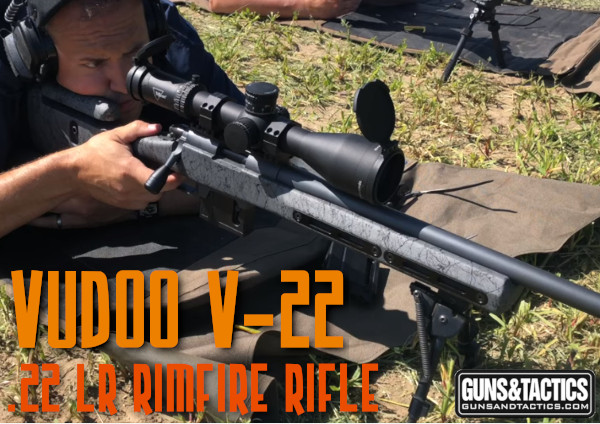
This Sunday GunDay story features a .22 LR rifle built around a Vudoo Gun Works V-22 rimfire repeater action. The V-22 action, arguably one of the best tactical rimfire actions available, owes its lineage to the respected Remington 40X action. Many rimfire matches have been won with 40X actions, so we understand why Vudoo chose that design for a starting point. Vudoo then added some important enhancements, including a controlled-feed design. This makes the Vudoo a great choice for rimfire cross-training, rimfire tactical matches, and NRL22 competition. In the video below you can see the Vudoo Gun Works rifle used an a PRS-style, long-range precision rimfire match in Minnesota.
As it has the same footprint as a Remington 700, the Vudoo Gun Works V-22 action is 100% compatible with a wide variety of Rem 700 chassis, triggers, and rifle accessories. This allows you to have a rimfire trainer with near-identical ergonomics as a centerfire match rifle. Rimfire training provides valuable trigger time with dramatically lower ammo costs. Along with actions, Vudoo sells barreled actions, and complete rifles through its website: VudooGunworks.com.
In this video, Dave Timm of GunsandTactics.com employs a Vudoo V-22 in the Minnesota .22 LR Long Range Precision Rimfire Match at the Rush Lake Range. This PRS-style match had targets out to 300 yards during the main match, followed by a long range challenge out to 465 yards. Dave’s Vudoo Gunworks V-22 rifle features a Grayboe Ridgeback stock, Harris bipod, and Trijicon Accupower 4.5-30x56mm FFP scope. Dave was shooting Lapua Center-X .22 LR ammunition.
This course of fire was challenging. Dave explains: “Stages included barricades and barrels and props to shoot out to targets at 100, 169, and 214 yards. So we’re shooting a 6″ piece of steel at 214 yards with an awkward position and a .22! It’s a good challenge and it really forced you to get all your fundamentals together. You’d be surprised at how much movement [there is]. You feel that you’re steady but all of a sudden that reticle just doesn’t want to stop moving.”
This Minnesota Match is similar to a PRS-style competition, but for rimfire rigs. Dave said “This match was an absolute blast and pushed out the .22 LR round out to some distance.”
About the V-22 Action — Controlled-Feed Design
Vudoo Gun Works states: “Our V-22 runs a full-size short action bottom metal (DBM) and our V-2210 magazine has a [full-size] AICS form factor. The V-22 is the only controlled-round-feed .22 LR receiver out there. The bolt has full capture control of the cartridge from the time it leaves the magazine until it ejects the spent round out the ejection port. That means the round never touches anything during feed travel so the bullets won’t be nicked/dented during rapid cycling.”
V-22 Product Description from Vudoo Gun Works:
The V-22 has been designed from the ground up as a true-to-scale Rimfire receiver that fits the Rem 700 footprint [for] stocks and chassis[.]. It also runs a full size short action bottom metal (DBM) and our V-2210 magazine has an AICS form factor[.]
The V-22 has a very unique control-round-feed protocol. The bolt has full-capture control of the cartridge from the time it leaves the magazine until it ejects the spent round out the ejection port. The significance of that is two-fold. Great feed and extraction reliability and…equally as important, the cartridge is controlled in a way that it never touches anything on its entrance into the bore. There is no feed ramp, nor does the projectile go in at an angle that would damage it in any way. We all know how susceptible the soft lead of the .22 LR is to accuracy-degrading damage and minor nicks during the chambering process. [That kind of bullet damage] is eliminated in the V-22 geometry.
About Dave Timm — Dave is a police officer serving his community on night patrol. Dave serves as his agency’s lead firearms and use of force instructor. He also owns and operates the Learning Firearms training operation in Baxter, Minnesota. Dave’s company offers realistic practical training solutions.
Our friends, Ed Mobley and Steve Lawrence, aka the “6.5 Guys”, have written an excellent article on getting started in practical/tactical competition. If you are new to the game, these tips can help you save money, progress faster, and have more fun. Here are article highlights, but we recommend you read the full story,5 Tips for Attending Your First Precision Rifle Match, onwww.65guys.com.
We often meet people who are new to long range precision shooting, and want to improve their knowledge and skill level. However, they aren’t sure if they are ready to sign up to compete in a match. They often ask, “What knowledge or skills are necessary to compete in a match?” Others may state, “I need to purchase this gear or that gear before I can attend a match”. For those guys who have a strong interest in precision rifle shooting, and who wish to chec out a precision rifle match, below are Five Tips to make it a positive experience.
TIP ONE: Make Plans and Commit to Go
First you need to start by finding a match to attend. This may entail a little bit of research and investigative work on your part to find what matches are scheduled in the next few months. We recommend starting with any match that may be within a reasonable driving distance. This may likely be a local “club” match, many of which are held on a regular basis. These make great venues because it will provide an opportunity to meet some of the regular attendees as well as shooters that are from your geographic area. Additionally, most of the smaller matches are a little more relaxed in terms of level of competitiveness.
Once you decide on the match you want to attend, do your homework. This means finding out if you need to pre-register or pre-pay the match fee. Commit to going by registering for the match and putting it on your schedule. Be sure to find other useful information for questions such as:
— What time should I arrive?
— Is there a mandatory safety briefing for new shooters at that venue?
— What is the travel time required to get to the match site?
— How many stages will there be?
— Is there a description of the stages available before the match?
— How many rounds should you bring?
— Are there special equipment requirements? (E.g. do you need chamber flags, is there a pistol stage?)
TIP TWO: Bring What You Have
(Don’t Spend a Fortune at the Start)
Some new shooters often assume they need a custom match rifle or all of the miscellaneous shooting gear associated with long range precision shooting to compete in match. While having a Kestrel weather meter and a high quality laser range finder and other shooting accoutrements are invaluable kit, you will find other shooters at your first match that will provide you with the information and coaching you need to get on target.
In fact, the only gear you really need to bring is a scoped rifle with a bipod and ammo capable of consistently shooting within one MOA. Also, be sure to know the ballistic drops or have a ballistic drop table prepared for your rifle/ammo to dial the correct DOPE on your scope for different target ranges. Many of the other participants at the match will be willing to let you borrow a support bag, bipod, tripod or other gear if you need one — just ask. Don’t use the excuse of not having the right gear to delay getting out to a match!
One reason not to make a big initial investment in a new rifle and assorted gear before competing, is we’ve seen a number of people come into the sport and try it for a year and then make the decision to move on to something else.
TIP THREE: Be Prepared to Learn
As a new shooter at a match, there is no better opportunity to learn. We often look to our local club matches as a group ‘training’ session to prepare for the bigger matches. You will find competitors at all levels of skill and many of your fellow shooters will enthusiastically provide helpful advice once they learn you are new to the sport. Take advantage of the opportunity to ask questions if you would like ideas for how to engage a stage, but also be sure to do more listening than talking as you receive guidance and tips from more experienced competitors.
Watch and observe other shooters and how they approach and ‘game’ a specific stage or course of fire. You’ll begin to recognize which shooting positions work best for different scenarios, and maybe even come up with some new ones that no one has thought of before.
Seeing what the better shooters do is an invaluable instructional tool. You can use your smart phone’s video camera to record other shooters (with their permission). When you’re ready to shoot, ask another shooter to record your performance. Watching yourself will point out needed areas of improvement.
After each match conduct an informal after action review and summarize for yourself the things that went well and what you should continue to do. You should also identify the specific shooting skills you should develop and make a plan to integrate the appropriate practice drills into your practice sessions. Finally, if you maintain a shooter’s data book or journal you’ll want to note things such as:
After Action Review – How you did, what went well, things you need to work on in practice. Stage Observations – Successful methods used for specific courses of fire. Note barricades, positions used, specific gear used for stages. Gear Observations – How your rifle/gear performed, what new items you should add to your “buy list”.
TIP FOUR: Be Safe and Have Fun
You’ve all heard a parent or teacher say, “It’s all fun and games until someone loses an eye.” The same can be said of the shooting sports. Safe handling of firearms is the number one rule at any match, and comes before the FUN part in terms of importance.
Before all matches start there will always be some form of a mandatory safety briefing. Make sure you know, understand, and follow any unique safety protocols for the match you attend. Some matches require all rifles have chamber flags inserted and are stowed in bags/cases while not on the firing line — other matches may not. If you run afoul of any safety rules, you risk the chance of being disqualified from a stage or worse, the entire match.
The second rule is simply have fun. This starts with having a good attitude throughout the day. Keep in mind that as a new competitor you should think of a match as a solid day of practice and training. If you blow a stage, use it as an opportunity to diagnose what you could have done differently or what you need to improve on — then smile and drive on.
Any day at the range or shooting is a good day. A match is an opportunity to hang out with like-minded people who are passionate about shooting and impacting targets far-far away. Life is great when you are doing what you enjoy!
TIP FIVE: Make Friends
There is no better way to meet lots of precision rifle shooters and make friends than at a match. The people that attend the tactical precision matches on a regular basis are those that have ‘fallen into the deep end of the pool’ and are really into the sport. As a result, they have become part of the local precision shooting community. As you strike up conversations at the match, find out if your new-found friends visit specific forum boards or social media outlets, or if there are other matches they attend.
Precision shooters tend to congregate and share information in different corners of the Internet. It will serve you well to meet some of the guys in person at matches and be able to connect a face to a screen name. As you develop your friendships and develop a level of trust, you will find opportunities become available to shoot with others in your local area, or get ‘read-in’ on a secret honey-hole of a spot to shoot long distance. Additionally, the local shooting community will often find it more convenient to sell or trade gear and equipment locally than deal with buyers/sellers that are out of state.
Can you really make a silk purse from a sow’s ear? Would you believe a winning benchrest rifle could be constructed with a stock fashioned from a cast-off log-splitter? Well it can.
Anyone who has attended an IBS benchrest match knows that this brotherhood of shooters includes some “backyard engineers” who can build amazing things with low-cost components. Consider Steve Jordan. He has built a winning Heavy Gun with a gunstock made out of a wood splitter. Check out the photo. The butt section is in the shape of a “V” like an ax. The “V” sits on an adjustable, flat rear sandbag. The flat shaft of the wood-splitter, running horizontally, serves as the main chassis and fore-end. The barrel block sits on top (with the action floated), while the flat, forward section of the shaft rides the front bag. Not only does this “log-splitter” stock work, but Jordan has won IBS matches with it! Sometimes simple and cheap beats expensive and fancy.
Sam Hall Says the Log-Splitter Has Been “Kicking Our Tails”
Sam Hall (multi-time IBS 600-yard champion) reports: “I was not at the first match (years ago) where Steve Jordan debuted his barrel-blocked, Heavy Gun stock made out of a wood splitter. From what I heard he cleaned house with it that day. When I first heard about this log-splitter rig, I thought guys were pulling my leg. But the log-splitter Heavy Gun really exists. In fact, over the past two years at Piedmont, Steve’s home-built log-splitter HG has won numerous Heavy Gun matches, out-performing nearly all the other Heavy Guns on the line, even those that cost thousands more to build.
Steve made the rifle as economical as possible. Steve’s entire stock is made from a metal wood splitter. From what I understand, Ray Lowman gave him the barrel block. This rides on the shaft of the wood splitter. With this inexpensive, simple rig Steve has kicked our tails at times! By the way, Steve’s Heavy Gun is chambered as a 6mm Dasher.”


 .223 Rem — Not A Competitive Option
Emil Kovan Competition History:




 The National Rifle Association’s President’s Match was instituted in 1878, as the American Military Rifle Championship Match. In 1884, the name was changed to the President’s Match for the Military Rifle Championship of the United States. It was fired at Creedmoor, New York until 1891. In 1895, it was reintroduced at Sea Girt, New Jersey. Today, the match is held at Camp Perry, Ohio.