Story based on report by Sam Hall
Look at that target by Mike Wilson. This is one of the most remarkable displays of accuracy (and precision) in the history of long range shooting. This past weekend, Mike (aka “GA. Dawg” in our Forum) drilled a truly spectacular 1.068-inch, 5-shot group at 1000 yards, all centered up in the X-Ring. Yes, you read that right, a group barely over an inch at 1000, shot in competition at an official IBS benchrest match on July 21, 2018.
How small is that in angular measurement? Well 1 MOA at 1000 yards is 10.47 inches, so Mike’s 50-5X masterpiece is 0.102 MOA! Yes that will be pending IBS group size (and score) World Records. This best-ever 1K group* was shot at an IBS registered 1000-yard match at Hawks Ridge Gun Club in North Carolina. Other records have been shot at Hawks Ridge in the past, but this is the most jaw-dropping.
Sam Hall, past IBS National Champion and IBS 600-Yard Shooter of the Year, was stunned by Wilson’s accomplishment: “This is a truely awesome marksmanship feat — one of the best in history. I think I would trade all 14 of my 600-yard records for that one!”. Mike’s amazing target will be submitted for approval as new Group Size and Score IBS World Records. Official approval is pretty much a certainty. The previous 5-shot, 1000-yard IBS record is 1.397″ (50 score) by Tom Sarver in 2007. (The NBRSA 1000-Yard 5-shot LG record is 1.473″ by Bill Schrader in 2002.)
Posting on our Shooters’ Forum, Mike wrote: “Thanks everyone for the kind words. As humbling as this game is, when it comes together makes it all worthwhile! A very special THANK YOU to my traveling buddy, my son, Blake, and my wife Debra for allowing me to enjoy this crazy game.” Mike also wanted to thank his smiths and component suppliers.
Mike Wilson IBS 1000-Yard Light Gun Specifications
Action: BAT ‘B’ 1.550 Melonited Action with Jewell Trigger
Barrel: Brux HV 28″ Finished Length, 1:8″ Twist Rate
Chambering: 6BRAW (6mmBR Ackley Improved Wilson), Chambered by Darrell Jones
Chamber Specs: 0.272″ No-turn Neck with 0.135″ Freebore
Stock: Shehane ST 1000 Fiberglass Stock (with stock work by Larry “Bullet” Archer)
Optics: Nightforce 12-42x56mm Benchrest NP-2 DD
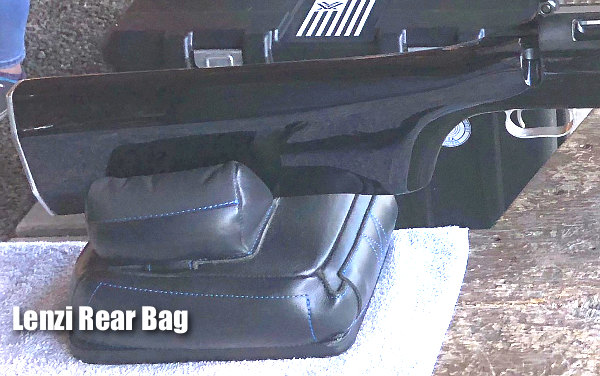
Leonard Baity front rest with Protektor Bag. Italian Lenzi bag in rear.
World Record-Setting Cartridge and Load
Mike was shooting a 40-degree Improved version of the 6mmBR Norma cartridge. Long popular with Benchrest and 300M shooters, the 6mmBR was the original inspiration for this website. Yep, we started as www.6mmBR.com. The Improved version has extra capacity, allowing about 100 FPS more velocity when chambered with a long throat. For his record group, Mike shot Vapor Trail 103-grain bullets in Lapua brass. He loaded Hodgdon H4895 powder with CCI 450 (small rifle magnum) primers.
Praise from Fellow Competitors
Here are some reactions to Mike’s amazing group by our Forum members:
“Amazing target Mike Wilson! Your group might last forever as ‘the goal’ of 1000-yard Benchrest! Heck that’s a great target even at 600 yards.” — Mike J.
“Unbelievable!! Doing that under chosen prime conditions is an amazing feat but to do that in competition and to have everything to come together is just unbelievable. Amazing how far skill, precision, knowledge, and the products of this sport have come. Never thought we would see a group this small and well placed especially in the hills of North Carolina where the wind always blows. Congratulations. A true lifetime achievement.” — Yote Hunter
“I think that one will stand for a while. Hard work does pay off, but it don’t hurt to be one of the givers in the sport. Mike, you are ‘The Man’!” — Bill Shehane
“Awesome, awesome, awesome. Now the goal is to shoot UNDER an inch!” — Alex Wheeler
The 6mmBR Ackley Improved
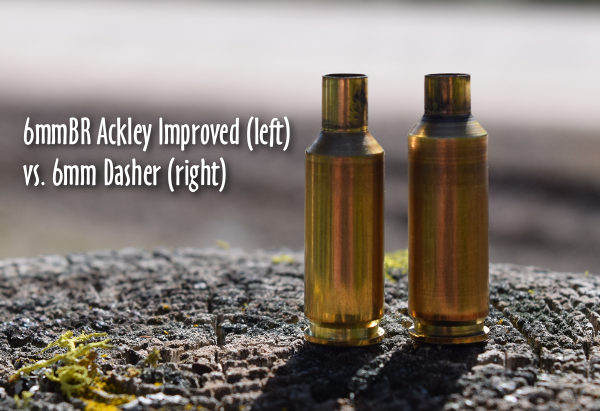
Mike Wilson shot his spectacular group with a 40° Improved version of the 6mmBR cartridge with less body taper than a standard 6BR — the design is 0.463 at the body/shoulder junction (vs. 0.460 for standard 6BR). Mike calls his version of the 6BR Ackley a 6BRAW (“W” for Wilson). Sam Hall explained: “The 6BRAW is pretty much the same as a 6BRA or 6BR-AI (Ackley Improved). I sold the reamer to Mike last year. This has a 0.272 ‘No-Turn’ chamber with a 0.135 Freebore”.
This photo shows a 40° 6mmBR Ackley Improved (6BRA), as used by Tom Mousel in Deep Creek, Montana. Mike Wilson’s 6BRAW may be very slightly different. For Mousel’s 6BRA with 28″ Krieger barrel, the accuracy node is about 2980-2990 fps, so this gives up only 30-50 fps compared to typical Dasher velocities. Mike Wilson’s load runs about 2980 fps also.
In the past couple of years, the 6BR Ackley-type cartridges have been hugely successful in 600-yard and 1000-yard Benchrest. Sam Hall notes: “This year the little 6BR-AI has shot the smallest groups ever fired in 600-yard and 1000-yard competition. Back in April 2018, Bart Sauter, using a 6BRA, shot a 0.282″ 5-Shot group at 600 yards.” Bart’s stunning 0.04 MOA group is a pending 600-yard IBS World Record. (Read Sauter Story). Now Mike Wilson has a pending 1000-yard World Record with his 6BRAW.
Mike used an Italian Lenzi rear bag. Mike says the super-slick nylon on the ears of this high quality rear bag make for better tracking. The ears provide support but don’t “grab” the stock, reports Mike.
* There are two North American sanctioning bodies for 1000-Yard Benchrest, the IBS and the NBRSA. The previous 5-shot, 1000-yard IBS record is 1.397″ (50 score) by Tom Sarver in 2007. The existing NBRSA 1000-Yard 5-shot Light Gun record is 1.473″, shot by Bill Schrader in 2002.
Today, July 22, 2018, the CMP hosts the popular Rimfire Sporter Match at Camp Perry. A great event for shooters of all ages and skill levels, the Rimfire Sporter Match will attract hundreds of shooters. This year a special smart-phone App will be used to speed up scoring.
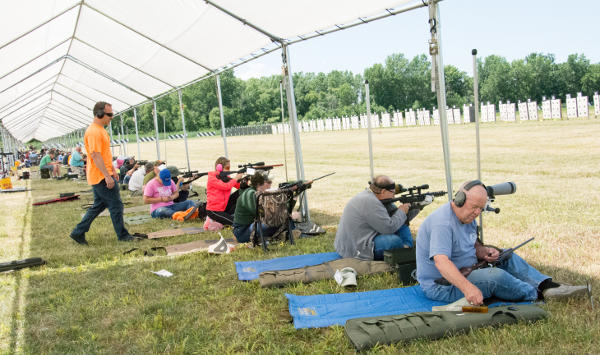
Hundreds of shooters will compete in the Rimfire Sporter Match today at Camp Perry.
Rimfire Sporter Course of Fire
Competitors will complete slow fire prone, rapid fire prone, slow fire sitting or kneeling, rapid fire sitting or kneeling, slow fire standing, and rapid fire standing shot sequences. To learn more about the National Rimfire Sporter Match, CLICK HERE.
Rimfire Sporter Classes
Three different classifications of rifles can be used in Rimfire Sporter competition: “O Class” for open-sighted rifles, “T Class” for telescope-sighted rifles, and the recently-added “Tactical Rimfire” class. Awards are offered to High Juniors, High Seniors, High Women as well as Overall winners are named for each class.
Do you want to see more match photos? CLICK HERE to view the CMP Zenfolio Archive with 500+ photos from 2016 National Rimfire Sporter Match.
Our friend Kevin Nevius, best known for his smallbore skills, went head to head against the nation’s top long-range aces this past week, and emerged on top. Besting the likes of past multi-time Long Range Champions David Tubb and John Whidden, Kevin Nevius shot superbly at Camp Atterbury to win his first NRA National Long Range Championship. Kevin finished with 1245-64X, one point ahead of Phillip Crowe, 1244-74X. Bob Gill, shooting a .223 Rem with iron sights, was third on X-Count, with 1244-68X. Kevin built his own rifles for the match, using Kelbly centerfire actions in a Grunig & Elmiger smallbore stock. Here is Kevin’s first-hand report of his 2018 LR Championship victory.
2018 NRA Long Range Championship — Rising to the Challenge
by Kevin Nevius This was my first opportunity to shoot the NRA Long Range Nationals since its relocation to Camp Atterbury, and it was great to see everyone and get back to the matches. It is always so humbling walking onto the range and seeing all of the people I read about and admire so much. I can’t think of another sport where people so accomplished will share so much and be so helpful.
Regarding the weather, we had generally great conditions with very mild winds in the mornings, building gradually as the days progressed. By the afternoon hours, there were certainly challenges as the air started moving. Obstructions to the wind on either side of this range vary, so you needed to pay attention for sure — it may be calm at the targets or firing line, only to show something to worry about on the mid-range flags. Mirage is my primary indicator shooting smallbore, but mirage over 5/8ths of a mile is a little less telling (and a lot more confusing, at least for me!). I think most competitors, including me, use some combination of mirage and flags to make corrections. At the start of the string, I try to gauge a predominant condition, and more importantly which indicator is the most reliable to look at to determine that condition.
Smallbore shooting is where I learned to build a good position, and so much of that carries forward to Long Range High Power. It was a huge shock though, the first time I looked at a 44” aiming black through aperture sights at 1000 yards! Smallbore aiming blacks are twice as big, at one tenth the distance — the fact that we can hit something at 1000 yards with that sight picture still amazes me!
Kevin’s Arsenal — 6.5×47 Lapua and .308 Win Barreled Actions in Smallbore Stock
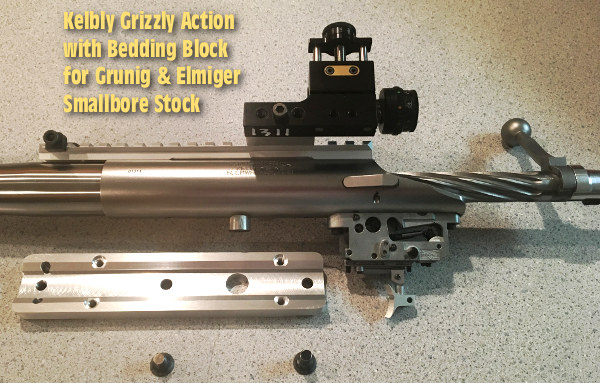
I have always build my own rifles, and always struggled to get the individual rifles you need for the LR aggregate (Any and Palma) and smallbore to feel, balance and fit identically. This year for the first time, I machined bedding blocks that allowed me to put almost identical centefire barreled actions into my smallbore prone stock – effectively making the position and fit of all the rifles for all disciplines identical (it is, after all the same stock used for everything).
I used two modified Kelbly Grizzly actions (one barreled in 6.5×47 for the any rifle matches, and one barreled in 308 for Palma) fitted to two identical aluminum bedding blocks. The bedding block footprint matches my smallbore barreled action – a Grunig & Elmiger Racer WC. The stock is a Grunig & Elmiger Hybrid, which is a composite aluminum skeleton and carbon fiber skin.
Championship-Winning 6.5×47 Lapua and .308 Win Loads
I was using a 6.5×47 Lapua in the “Any Rifle” matches. The barrel is a 1:8″-twist Benchmark medium Palma contour finished at 35 inches, throated +0.060″. My 6.5×47 load was Lapua brass, CCI 450 primers, VV N160 powder, and 140 grain Berger Hybrid bullets. For the Palma match, a .308 Win barreled action was fitted in the same Grunig & Elmiger smallbore stock. The .308 barrel was another Benchmark 35″ medium Palma, using the current Fullbore chamber throated +0.120″. I was using Lapua .308 Palma small primer brass, Federal 205M primers, VV N140, and 155 grain Lapua Scenar L bullets.
Shooting Between Champions — Tubb on the Left, Whidden on the Right
On the final day (the Palma Individual), we were squadded based on seed position, so David Tubb was on my left, and John Whidden on my right. I am not sure if a more intimidating position on the firing line exists, but it was so clear to me especially on that last day how blessed I was to be there. In every match, there is an element of luck — regarding weather, squadding assignment, target service, firing point condition, even equipment malfunction. A host of things can go wrong…
I lost my very first shot at 900 mostly due to elevation (I was coming a little unhinged with the realization I might be in the lead – just being completely honest!), and settled down to clean the remainder of the string. The wind had built by then, and would run both right and left with the small boils in between. At 1000 I lost two, and was pretty happy with that. It was getting pretty dicey, and I resigned myself to the fact that it was becoming one of those days where 10s were enough (and Xs were pure luxury!). John shot well at 1000, but he always does — I don’t think there is a better long range shooter in the country and it’s been that way for a bunch of years. I can’t say enough about him – he is a dear friend and everything a champion should be. (Editor: Whidden finished fourth overall, at 1243-78X, with high X-count for the event.)
To put it all together takes so many things — preparation, tuning, load development, position practice. And yes, it takes some divine intervention for sure. I will never forget this experience, and am so grateful to have been successful this year.
John Whidden of Whidden Gunworks congratulated Kevin: “I was really proud of my friend Kevin Nevius and his fine shooting over the match. Kevin is respected both for his shooting and his character. The match went well and a number of improvements were made over last year. The targets were better, the number boards better, and the match ran very efficiently. Kudos to those who made these positive changes happen.”
Tough Time for Tubb on Last Day
Kevin noted that it was intimidating to be squadded between David Tubb and John Whidden, two multi-time Champions. Unfortunately Tubb, who had shot brilliantly (800-50X) throughout the Long Range event, had issues with his .308 Palma rifle on the final day. Kevin noted: “Yes David had some problems with his .308. When we arrived at the range on the last day, for the Palma Individual, David was in the lead with 800-50X, having shot ‘clean’ (not dropping a point). Bob Gill was second with 798-43X, and I was in third place with 798-42X. As we started the 800-yard string, there was some commotion going on to my left, and all I know is that as we finished and started moving to 900 yards, David was not happy. I believe he had lost 4 points at 800. We went to the pits, and he said his rifle was not shooting well, and he was pretty unhappy to say the least. He tried to adjust the seating depth of his ammunition before heading back out to the 900-yard line, in the hopes the gun would shoot better”. But it ended up a very tough day for David, as his chances for another LR Championship vanished.
Editor: With a 800-50X total, David Tubb was the Winner of the Canadian Cup Trophy, earned before the last day.
Bob Gill Proves the .223 Remington (and Iron Sights) Can Be Competitive
There were many interesting stories at this year’s Long Range Championship. The .223 Rem Eliseo Tubegun belonging to Californian Bob Gill proved to be “the little rifle that could”. Gill shot his .223 Rem Palma rifle for the entire Long Range Championship cycle. And yes Bob shot irons the whole way, even during the Remington and Wimbledon “Any Sight” matches where scopes are allowed. Kevin observed: “Bob Gill was amazing, and that rifle must be pretty awesome too. I don’t think I have ever seen someone shoot a .223 Rem at 1000 yards that well — ever. I believe Bob was shooting 80 grain bullets. As I pulled for Gill on the third day, I can testify that his bullets were still plenty supersonic!”
Editor: Gill finished 3rd overall, just one point down from Kevin, and six Xs behind runner-up Phillip Crowe. Gill also won the Sierra Trophy.
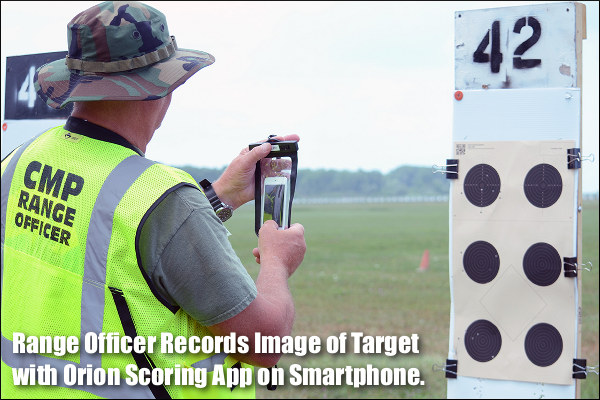
Elite smallbore competition returned to the summer National Matches in high-tech style this year. New Orion scoring software was used to enhance and speed up the scoring process. Range officers simply snapped photos of targets after each relay using the Orion App on smartphones. The software then identified the bullet holes and logged the shot location in the scoring rings. This handy new software was used for 3P and prone smallbore competition. It will also be used tomorrow, July 22nd, at the hugely popular Rimfire Sporter Match.
Story based on Camp Perry Report by Ashley Brugnone, CMP Writer
A staple during the National Matches season for over half a century, high-level Smallbore Matches returned to Camp Perry this summer (after the NRA moved the Smallbore Championships to Camp Wa-Ke’-De in Indiana in 2016).
“We had a lot of competitors who wanted smallbore to return to Camp Perry” said Match Director Brad Donoho. “This year, we tried to give everybody the opportunities they were used to at Camp Perry and try to stay true to history while also being innovative at the same time.”
The CMP’s new National Matches Smallbore series kicked off July 17 on Camp Perry’s Rodriguez Range with the Three-Position Day 1 event. Competitors in the event fired 40 shots onto paper targets at three positions: prone, kneeling and standing.
For the Camp Perry smallbore matches, new image-based software was used for scoring. Orion Scoring System developed scoring software that can read shots from photos captured with smartphones. The Orion Smartphone App links directly to the Orion Scoring system, which then identifies shots on the target and scores accordingly based on shot placement in scoring rings.
Range Officers snap photos of targets with Orion Scoring App.
Once all firing was completed for each stage at the National Matches events, range officers on the line walk downrange with a mobile device loaded with the Orion Scoring System App. The new scoring system drastically slashed competition time while also easing the scoring element for both competitors and match workers.
CMP verifiers reviewed the targets on computers before posting the results online, all in a matter of minutes. The physical paper targets were also retained — just in case a challenge was brought forward by a competitor.
“The hope is, at its best, we should be able to have scores posted online before firing begins for the next stage, which would be pretty revolutionary for paper targets at Camp Perry,” said Donoho.
The electronic Orion Scoring System will also be used to score the National Rimfire Sporter rifle competition, set to take place at Camp Perry on Sunday, July 22. “This is the first step to allow Orion users to use this at their home range”, noted Donoho. An extensive amount of testing was conducted on the Orion electronic scoring system in the months leading up to the National Matches. It performed admirably this past week at Perry
3P Finals and Prone Elimination Match on Electronic Targets
Another exciting element added to the prone match is a prone elimination event, fired on CMP’s electronic targets on the Petrarca Range — another first for a National Match smallbore event. “We wanted to do something new – something creative,” said Donoho. “Hank Gray, from the USAMU suggested an elimination event where we start with a full range of shooters and start elimination shooters after the first stage of fire to get them down to the Top 10.” The Three-Position finals was also fired on the CMP’s Petrarca Range electronic targets at Petrarca Range during the Matches.
Video Demonstrates Kongsberg Electronic Target System Installed at Camp Perry:
These electronic targets have sensors on the target frame that plot each shot’s point of impact in the bullseye. Shot location and score value are calculated instantly with results visible on a monitor placed next to the shooter. This is faster than the Orion system, but it is also much more expensive. The advantage of the Orion system is that it can work with conventional paper targets on standard target frames. Orion scoring does not give instant results, however, unlike the Kongsberg system.
Retired Army Special Forces Sgt. Maj. Walter Wilkinson won two of the four individual 1,000-yard Score titles — for Light Gun and Hunter Classes — at the recent Fifty Caliber Shooters’ Association (FCSA) 2018 World Championships. In addition to his two individual score titles*, Wilkinson was also a member of the winning 4-shooter team.
The FCSA World Championships were held July 5-7, 2018 at the NRA Whittington Center near Raton, New Mexico. There were shooters from Australia, Great Britain, Spain and the USA in attendance. The FCSA 1000-yard matches have four classes: Light Gun, Heavy Gun, Unlimited, and Hunter. In the first three classes, the rifles are normally shot from a machine rest off the bench. Hunter Class requires the shooter to fire from the ground with a bipod. And that’s how Wilkinson shot all his relays…
Remarkably, Wilkinson, who shot his near-“box stock” Steyr HS .50 equipped with factory bipod from the ground in the prone position, posted the FCSA Championships’ highest score, beating out shooters in the Light Gun, Heavy Gun, and even Unlimited Classes.
Beating the Benchresters — While Shooting Prone from Bipod
Wilkinson, a Gunsite instructor from Edgewood, NM, shot a two-day total of 290-10X for the Hunter Score, and his Light Gun Score total of 291-7X was the highest of any shooter in any class — most of whom were firing custom-built rifles from mechanical rests atop concrete benches. Wilkinson also placed fourth overall in the 2-Gun Aggregate, which factors both scores and average group sizes from both classes. Wilksonson’s score wins marks his third FCSA victory in the Hunter Class with his Steyr HS .50 since his first win in 2012, and this year he notched his first Light Gun Score World Title.
The Wicked Whittington Range at Raton
Nestled at the base of the Sangre de Cristo Mountains, the Whittington Center’s 1,000-yard range has notoriously tricky winds, especially in the afternoons. On the first day, Wilkinson shot on the afternoon relays. As usual, switching and swirling winds proved to be a formidable foe for all shooters. Wind coming from behind the shooters was switching from 4 O’clock to 8 O’clock and back again, often changing within seconds. Wilkinson was able to very quickly make wind judgments and adjust his hold accordingly. “I couldn’t do anything wrong,” Wilkinson said. “It was like every time the wind changed, I knew exactly where to hold, and the bullets just kept going where I wanted them to.
Photo courtesy Brett Berger.
Holding Off Right and Left for the Cycling Wind
“The highlights of the day were the last two strings of fire in Hunter Class during Relay 4″, Wilkinson explained. “I shot a 50-2X with a 9.8-inch group and a 49-2X with a 7.9-inch group. The Ten-Ring is right at 1.15 MOA, and when you keep them all in that, it says something about your rifle and your load. During both of those two strings, I changed from holding on the right side of the target to the left side during the string.”
Wilkinson’s .50 Delivered Quarter-MOA Groups During Load Testing
Wilkonson’ Steyr .50-Cal has always been an accurate rig. Back in 2012, when Wilkinson developing loads, the big rig showed outstanding accuracy: “As I was working up a load for the HS.50, I shot groups that amazed me. I was getting groups of 0.214 MOA at 220 yards, and I didn’t know what to think. All the bullets were going in the same hole, and it was like ‘Wow, I’ve really got a rifle that can shoot here’. That stunned Wilkinson: “With my [military] experience with the performance of the same .50 BMG cartridge overseas, I didn’t expect that kind of accuracy out of it.”
Cost of Big-Bore Shooting
Is owning and shooting a 50 BMG caliber rifle expensive? Relatively speaking yes, but one must put it into perspective. Rifles may run from $2500 to $6000, maybe even more for a top of the line custom rifle. (Current MSRP for the Steyr H2 .50 is $5910.00). A premium long-range scope will set you back $1500 to $3000. And while excellent commercial ammo is available, it runs $3 to $5 per round! Most serious shooters start reloading for the rifle as soon as practical, not only for the economics of reloading but also for the ability to fine tune custom ammo for their specific rifle. It’s a very rare match that is won shooting commercial ammo.
*Wilkinson’s FCSA trophies state “Hunter Class Score World Champion” and “Light Class Score World Champion”. NOTE the FCSA also recognizes, for each class, a World Champion for Group size, AND a World Champion for combined Group and Score (Aggregate). Plus there are Championship Trophies for Two-Gun. This gets a little confusing. With other Disciplines there is only ONE World Champion per class, generally the competitor who has the best combination of Group Size and Score.
Photo by SFC Brandon Green, 2018 National High Power Champion.
Some of America’s most prestigious rifle matches take place at Camp Perry later this month. The President’s 100 Match will be held on July 29th, followed by Individual and Team Trophy Matches. For those competing at Camp Perry this month, we offer some insights from Tyrel Cooper, a multi-time National Champion. A past member of the USAMU, Cooper’s shooting resume includes five national championships (one each in 2008, 2011, 2012, and two in 2013). He won the 2013 NRA National Long Range Championship, as well as the 2013 NRA National Service Rifle Championship. In this article, written in 2014, Cooper explains the mental preparation that helped him win National Titles in 2013.
Below is a 2012 file photo of Ty Cooper shooting a service rifle. Cooper won the 2013 Long Range Championship using a Nesika-actioned bolt gun chambered in 7mm SAUM.
Mental Preparation by Tyrel Cooper Getting focused mentally is an important part of preparation for Perry. In 2011 I was chasing Sherri Gallagher, since then I have been chasing Brandon Green[.] If I get beat by a Service Rifle I am going to make him or her work for it. So there is your peak into my mental process. I go for the top and if I am hanging with them then the Service Rifle National Championship will come, Kind of like how I shoot for X’s and Tens will come.
Now I understand everyone is at different levels. You have to figure out what your goals are and then lie to yourself that you’ve already achieved them. Here is a trick that I used back in 2008: When I was a kid just starting out, my Dad made me read several books on shooting. One of them being With Winning In Mind by Lanny Bassham. One of the things I remember from his book is that he would make notes and place them where he would see them often. They contained his goals or stated he was already a world champion. I took a page from his book and did the same thing.
I made 3×5 cards and wrote my personal best 500 and 800 aggregate scores and taped on the horn of my truck, above the radio in my truck, on my laptop and a few other places I would see them often. Every time I saw those I would tell myself that I average those scores and I would get used to seeing them. By doing this you are lying to yourself to overcome the mental blocks the subconscious mind lays out for you.
I went from my worst year in 2007 to winning my first National Championship in 2008. I kind of slacked off in 2009 because I had reached my goals and didn’t set new ones and it showed, so I had to find new goals and motivation which I did and that pushed me back to the top.
Long story short, this is a mental sport and you have to figure out what you need to do to perform at your highest levels and breaking through those mental road blocks. You have to figure out how to get yourself to relax and control your mind keeping calm when you are shooting a personal best, either standing or on the day.
Here is a tip from my mental process from shooting. First I shoot for Xs, I took the line from the movie The Patriot and applied it to my shooting, “Aim small, miss small” and it is true. If you accept wide shots then you will keep shooting wide shots.
Winning Techniques for Rifle Competition
Slow, Solid, Smooth, Center
Always focus on the positive and good shots, and what you did physically and mentally, when you shot them. When I am nervous and need to calm myself down I tell myself: slow, solid, smooth, center.
Slow
I want my movement to be slow…
I can shoot Tens and Xs all day with slow movement.
Solid
Solid like a rock, a rock doesn’t move and that’s how I want my positions. By saying solid it reminds me to go through my little checks to make sure I am doing what I need to do make that happen.
Smooth
Smooth — that is my trigger word for smooth movement. You don’t want fast choppy movement but slow and smooth. This also reminds me to be smooth on the trigger. You can be smooth-fast or you can be smooth-slow but you have to be smooth and most people aren’t when they think they are. Just before leaving the USAMU, I walked up and down the line of five shooters during a rapid fire string and only one of them was smooth with their trigger control. It’s the second most important thing when it comes to shooting.
Center
This reminds me that I want my shots in the middle. It is just a positive reinforcement of where I want my shots to go. I shoot a reverse flat tire so it also kind of reminds me as to what I am looking for.
Story Tip from EdLongrange. We welcome reader submissions.
Congratulations to SFC Brandon Green, the 2018 NRA National High Power Champion. Brandon won yet another High Power title in convincing fashion, with a 2394-147X overall score. Two other soldiers finished second and third, separated by X-Count. Second-place SFC Shane Barnhart scored 2386-137X, while SGT Benjamin Cleland was third with 2386-128X. In fourth place, and top civilian, was Ronald Zerr with 2383-126X. (CLICK HERE for High Power Results.)
Now it’s time for High Power Long Range. For the next few days, the nation’s top long-range “hard-holders” will be competing at Camp Atterbury, Indiana. The NRA High Power Long Range Championships run July 13-17, with the Long Range Palma match on Tuesday the 17th. Many notable shooters will be there, including John Whidden, who is aiming for a “three-peat” after winning the LR Championship for the past two years running (and five times in total: 2007, 2008, 2010, 2016, 2017).
Long Range competitors at 2017 NRA National High Power Rifle Championships.
Long Range and Mid-Range National Matches at Camp Atterbury, Indiana, 2018:
Friday, July 13 – Monday, July 16: NRA Long Range (awards ceremony on concluding day)
Tuesday, July 17: NRA Long Range Palma, Palma Team Awards Ceremony
Wednesday, July 18 – Saturday, July 21: NRA Mid Range Individual
Sunday, July 22: NRA Mid Range Teams, Mid Range Awards Ceremony
Monday, July 23: Range Clean Up/Clear Out
Whidden’s Perfect 2017 Palma Match
Whidden secured the 2017 LR Title by shooting “clean” (not dropping a point) in the tough Palma competition. In the NRA Palma match, rifles must be .223 Rem or .308 Winchester, with metallic sights (no scopes). The match is conducted at three yardages, 15 shots at each distance of 800/900/1000 yards, with unlimited sighters at 800 and two sighters at 900 and 1000.
John liked the Camp Atterbury facility and he credited his equipment for his 2017 victory: “With the change to the new Camp Atterbury venue, many shooters were a little unsure how things were going to shake out. But it all turned out really well. All of my equipment shot fantastic all week long — that certainly made shooting a big score easier.”
Whidden Palma Rifle
Action: Barnard “P” (three lugs, 60° bolt lift)
Barrel: Bartlein 32″, Light Palma contour, cryo-treated by 300 Below.
Stock: Anschutz Precise aluminum smallbore stock, set up for centerfire barreled action.
Trigger: Barnard Two-Stage adjustable
Gunwerks is hosting its first Precision Rifle Series Match, the Monster Steel Challenge, in Cody, Wyoming, July 28-29, 2018. This will be a major match with very different experiences on Day One vs. Day Two. For your hefty $250 fee, you’ll get lots of action with 10 stages on Day One, followed by a “walk in the woods” in the Wyoming back-country on Day Two
The first match day, held at Cody Shooting Complex, will include 10 stages in a fast-paced, square, range-style set-up. Day Two, at Monster Lake Ranch, will provide competitors with a 270-degree fire fan allowing for some incredible vistas and challenging shots. For the practical competitor who enjoys the backcountry — this is as good as it gets.
Watch Monster Steel Challenge Match Preview:
“Gunwerks is very proud and excited to be hosting our first-ever Precision Rifle Series right here in our backyard,” Aaron Davidson, Gunwerks founder and CEO, said. “The courses will be challenging and the vistas that Wyoming will be offering the competitors will be outstanding.”
Match Restrictions on Gun Calibers and Ammo Velocity
As with most other PRS matches, the allowed span of calibers is .224 through .308 inclusive. No .338s and .375s gents. Velocities are limited to 3200 FPS for ALL calibers/chamberings. NOTE: If a competitor’s ammo speed is in question, he must shoot through a LabRadar to verify velocity. If the ammo exceeds 3200 FPS, the competitor will be automatically DQ’d (disqualified), with NO REFUNDS. Competitors will require 200 rounds for both days, plus extra for sight-ins or confirmation shots.
Slots for competitors are limited. Registration is available for a $250 non-refundable fee. For more info, contact Gunwerks (307-298-1313 or team@gunwerks.com), or visit www.gunwerks.com.
The rich prize table will include a complete rifle built by Gunwerks. Nice.
Cody, Wyoming is a beautiful Western locale, suitable for quality vacation time before or after the Monster Steel Challenge match. Photo courtesy City of Cody.
The 2018 National Matches at Camp Perry Ohio kicked off with the NRA Pistol Championship, July 8-13.
The National Matches moved to Camp Perry, Ohio, in 1907 and continue to take place every summer on the shores of Lake Erie, though the NRA High Power Rifle Championships have moved to Camp Atterbury, Indiana. Drawing well over 6,000 annual participants, the National Matches have become a huge, national shooting sports festival. There’s nothing quite like it. Competitors range from beginners to many of the world’s best marksmen. Conducted throughout the month of July through the first week of August, the Camp Perry National months offer a spectacle of shooting with a wide variety of rimfire and centerfire disciplines, with both modern and vintage arms. If you’ve never been to Camp Perry, it is a “bucket list” experience for any serious shooter.
The National Matches at Camp Perry
The National Matches include Small Arms Firing Schools and a series of CMP National Trophy Rifle and Pistol Matches and CMP Games Events as well as NRA Championships that are held in connection with the National Matches. The National Matches at Camp Perry begin with the NRA National Pistol Championships. For 2018, the CMP has added CMP Smallbore and Long Range Matches to the month-long schedule. The CMP fulfills its responsibility to conduct the National Matches through a working partnership with the Ohio National Guard.
The First Shot Ceremony officially opens the National Matches. This year Maj. Gen. Clark W. LeMasters Jr. addressed assembled competitors, match officials, VIPs, volunteers, and spectators. After Gen. LeMaster’s concluded his speech, he had the honor of firing the ceremonial “first shot” of the National Matches, officially signaling the opening of the National Matches. (Read First Shot Ceremony News Report.)
The John C. Garand match is a Camp Perry classic. Note the signature Garand clip in the air.
The National Trophy Junior Team Match attracts squads of young shooters from around the country.
The Springfield M1A Match is popular every year. Here an amputee shooter competes in 2017.
The 2018 Vintage Sniper Rifle Match will be held August 3, 2018 on the Viale Range. This two-man team competition using scoped rifles of WWI and WWII Vintage has become of of the most popular rifle matches held at Perry. Over 250 teams have competed in recent years. Many competitors use the M1903 Springfield, but you’ll also see scoped M1 Garands, K31s, Mausers, and even a Lee-Enfield or two. (Semi-Auto shooters are scored separately).
Serious smallbore rifle competition returns to Camp Perry this year. Smallbore competitions have been slotted into the Camp Perry National Match schedule July 16-22, 2018, though the NRA National Smallbore Championships will still be held at Camp Wa-Ke-De in Indiana. The CMP will host a new series of smallbore events in July at Camp Perry, the Mecca of competitive shooting in the USA. This way elite smallbore competitors, with their premium match rifles, can enjoy the famed Camp Perry ranges. Of course, the CMP also will continue to offer the hugely popular Rimfire Sporter Match, which attracts hundreds of competitors each year.
The smallbore matches will be fired on Rodriguez Range at Camp Perry under a covered firing line. Shooters Technology will provide a scoring App that allows instant scoring for quick results. Finals will be conducted on the CMP’s Electronic Targets installed on the Camp Perry Petrarca Range.
Today, July 10, 2018 is the last day to register for the Crosman All American Field Target Championship.
Upstate New York heats up in the summer with the largest field target event in the country — the Crosman All-American Field Target Championship (CAAFTC). This very popular airgun event takes place July 20-22, 2018 in upstate New York. If you are a Field Target Shooter and want to attend, don’t hesitate — today is the very last day to register for the big event.
Shooters from across the nation and many foreign competitors will compete this year at the CAAFTC held at the Rochester Brooks Int’l Skeet and Trap Club.
On July 20-22, the Crosman All-American Field Target Championship (CAAFTC) will be held at the Rochester Brooks International Skeet and Trap Club in Rush, New York. 0ver 100 air rifle and air pistol competitors will participate in the big event hosted by Crosman. This event attracts top Airgunners from across the nation (and some foreign countries). Along with regular Field Target matches, there will be specialty side matches, plus a factory tour. The event is free to the public.
The CAAFTC is sanctioned by the American Airgun Field Target Association and is a featured AAFTA Grand Prix event. The 120-shot match has competitive rifle divisions based on allowable gun and support equipment. Here are the main air rifle classifications:
Hunter Division – rifle fires at a maximum 20 foot pounds of energy (FPE), shooter may use a non-attached bipod, non-restrictive clothing, and sitting stool. Open Division - maximum 20 FPE maximum rifle, shooter may wear a body harness, no bipod, 6″ maximum height seat. World Field Target Federation (WFTF) – similar to Open but shooters compete according to international standard of maximum 12 fpe for rifles. Freestyle Division – 20 FPE maximum rifle, no other restrictions. (This is new for 2016).
The pistol competition includes similar divisions based on shooting styles. Both rifle and pistol divisions include sub-classes based on the air rifle powerplant: piston driven or precharged pneumatic.
“If you want to see some of the country’s finest airgun shooters, this is the hottest event of the summer and it’s free for the public,” says Chip Hunnicutt, Marketing Manager for Crosman. “Alongside the world-class shooters, we’ll have enthusiasts simply having a good time and even parents bringing their kids for some good fun outdoors.”
The three-day competition features multiple shooting matches including the main two-day rifle event. There are five divisions for competitors: Open, Hunter, WFTF, Freestyle, and Pistol. In addition to the main rifle event, this year will also feature a pistol match, the Quigley Bucket Match and the Pyramyd Air Gunslinger match. The Bucket match re-creates famous scene in the movie “Quigley Down Under” in which the lead character shoots a bucket at 700 yards. Here the distances are scaled down a wee bit (wink). Competitors, using iron sights only, get 5 shots at a 1.75″ bucket placed at 55 yards.
Tech Talk: Why the Big Side-Wheels on the Scopes?
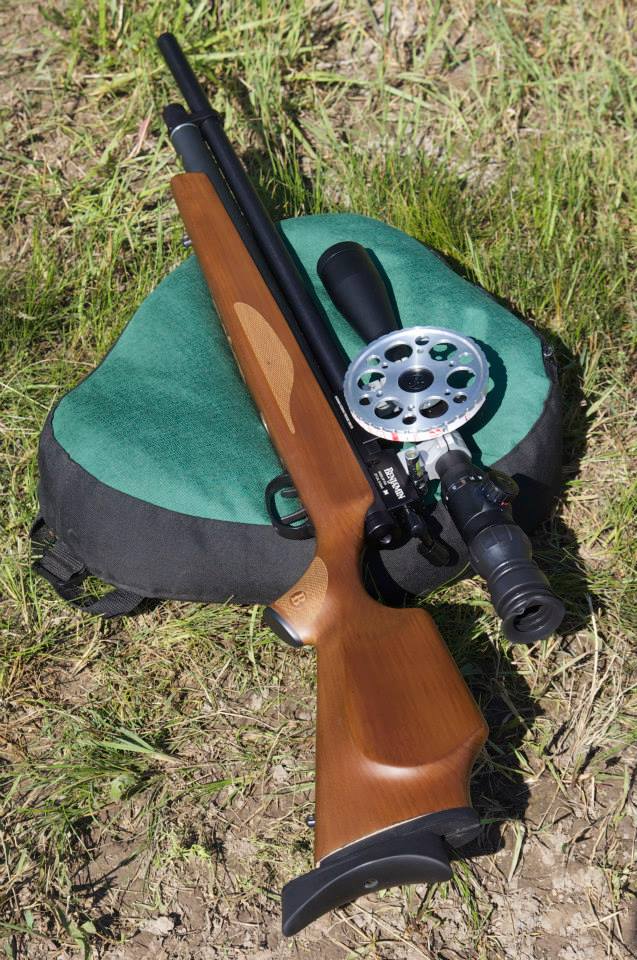
Field Target rifles shoot pellets propelled by compressed air. These light-weight, low-BC projectiles drop very quickly, with a looping trajectory. In order to hit targets at distances out to 50 yards or so, you have to adjust your scope to compensate for pellet drop. But you can’t set the scope correctly without knowing the precise range to the target. This is the function of the big wheels on the side of the scope. Field Target Competitors use the parallax adjustment on high-magnification scopes to determine target range. The big wheel allows quick, yet precise parallax adjustment. Markings on the wheel show the shooter the scope settings required for the distance “dialed-in” via the over-size parallax wheel.






 This was my first opportunity to shoot the NRA Long Range Nationals since its relocation to Camp Atterbury, and it was great to see everyone and get back to the matches. It is always so humbling walking onto the range and seeing all of the people I read about and admire so much. I can’t think of another sport where people so accomplished will share so much and be so helpful.





 Getting focused mentally is an important part of preparation for Perry. In 2011 I was chasing Sherri Gallagher, since then I have been chasing Brandon Green[.] If I get beat by a Service Rifle I am going to make him or her work for it. So there is your peak into my mental process. I go for the top and if I am hanging with them then the Service Rifle National Championship will come, Kind of like how I shoot for X’s and Tens will come.

 Congratulations to SFC Brandon Green, the 2018 NRA National High Power Champion. Brandon won yet another High Power title in convincing fashion, with a 2394-147X overall score. Two other soldiers finished second and third, separated by X-Count. Second-place SFC Shane Barnhart scored 2386-137X, while SGT Benjamin Cleland was third with 2386-128X. In fourth place, and top civilian, was Ronald Zerr with 2383-126X. (