AccurateShooter.com supports the candidacy of John Sigler for re-election to the NRA Board of Directors. A past President of the NRA, John is a competitive shooter and an active member of our Shooters’ Forum. John is a high-integrity individual who will capably represent the interest of serious shooters in the country. We’re behind John 100% and call for readers to vote for John Sigler when your NRA ballot arrives. NRA members eligible to vote for the Board of Directors should start receiving ballots around January 20, 2018 in their NRA magazines. John is the only current Director candidate nominated both by NRA Members (through petitions) AND by the NRA Nominating Committee
Lee Williams, writing on TheGunWriter.com stated: “There are a lot of good [NRA Board of Director] candidates and incumbents. There’s one GREAT one — John Sigler.
I’ve said this before — John does more for the Second Amendment in one week than most people do in an entire lifetime. He is the personification of an American Gun Owner and, in my humble opinion, he’s the best president NRA ever had.
He deserves to continue serving on NRA’s Board of Directors.”
John Sigler Key Background
Two-Term Past NRA President (59th)
Two-Term Past NRA 1st Vice President
Current Member of NRA Board of Directors and Executive Council
Endorsed by Eight Major Clubs and NRA State Associations
Competitive Shooter – Member 2017 U.S. F-Open Rifle Team
Current Vice-Chairman, NRA High Power Committee
Avid Hunter – Member Safari Club International
Retired Police Captain, now Practicing Law
U.S. Navy Veteran – 1967-1971
John has a 100% Attendance record as a current Director:
Key Objectives for John Sigler as NRA Board Member
— We must expand our fight to keep our ranges open and to open new ranges.
— NRA’s competitive shooting programs must be renewed, strengthened, revitalized.
— Our right to keep and bear arms must continue to be vigorously defended.
— NRA must redouble its efforts on behalf of hunting and conservation.
I was privileged to serve the NRA and our great nation for two terms as NRA’s Second Vice President, two terms as NRA’s First Vice President, and two terms as NRA’s 59th National President. — Capt. John C. Sigler (Ret.)
Statement by John Sigler
First, I would like to thank all of the NRA members who were instrumental in circulating and signing my most recent NRA Members’ Petition for re-election to the NRA Board of Directors. Because of your efforts, I was able to submit a total of 181 petition pages to the NRA Secretary containing 1,371 signatures of NRA members from 45 separate states, and to be successfully nominated by NRA Members’ Petition. Thank You!
Because of your efforts, I am only one of three candidates, all incumbent Directors, to be nominated by both the NRA Nominating Committee and by the Members through the petition process – Thank You!
Next, I would like to thank the Board of Directors of the Delaware State Sportsmen’s Association, Delaware’s official NRA state affiliate, for their continued support and their endorsement for re-election to the NRA Board of Directors. With DSSA’s endorsement, I have now been endorsed by a total of eight (8) major clubs and NRA State Associations, including the New York State Rifle & Pistol Association; the Firearms Coalition of Colorado; the Ohio Rifle & Pistol Association; the Ohio Gun Collectors Association; the Fifty Caliber Shooters Association; the Florida Sport Shooting Association; the North Carolina Rifle & Pistol Association; and of course, the Delaware State Sportsmen’s Association.
Finally, I want to thank all of the members of the NRA for all that you have done for me over the years to help me fight for our God-given right to keep and bear arms, at the polls, in Congress and the various legislatures, and in the courts. Without your continued help and support I could never have enjoyed the successes I have enjoyed during my 21+ years on the NRA Board, serving the NRA and all of the people of our great nation. Thank You!
NRA Board Member Attendance
I am proud of my 100% NRA Board Member Meeting Attendance record. Because of you, the members of NRA, in 1996 I became the first person from Delaware to ever be elected to the NRA Board. Because of you and your efforts, I was given the opportunity to work with and under NRA’s two greatest presidents, Marion Hammer and Charlton Heston, both of whom believed in me, trusted me, and gave me the opportunity to serve as the Chairman of NRA’s Finance Committee for 10 years and as the Chairman of NRA’s Law Enforcement Assistance Committee for the same 10 years.
Because of you, the valued members of NRA, I was also granted the opportunity to serve on the NRA’s High Power Rifle Committee as both Chairman and Vice-Chairman; the Competitions Rules & Programs Committee; as Vice-Chairman of the Clubs & Associations Committee, the Bylaws & Resolutions Committee, the Committee on Hearings, the Gun Collectors Committee, the Site Selection Committee, the Legislative Policy Committee and as Chairman of the Sub-Committee on State & Local Affairs, and on NRA’s Executive Committee. Additionally, because of you and your continued support, I have also had the privilege and pleasure of serving as a member of the NRA’s Executive Council and on the Board of the NRA Foundation and as a Whittington Center Trustee. Thank You!
And finally, because of you, I was privileged to serve NRA and our great nation for two terms as NRA’s Second Vice President, two terms as NRA’s First Vice President, and two terms as NRA’s 59th national President. Thanks to you, I was given the opportunity to create two new committees specifically designed to help and serve our veterans, the Committee on Military and Veterans Affairs and the Disabled Shooting Sports Committee.
In closing, I come to you, the voting members of NRA and respectfully ask for your vote. In doing so, I ask that you allow me the honor of continuing to represent you and the opportunity to continue the work I have been privileged to perform on your behalf since 1996. Thank you — John Sigler
When two or more guys get together at a shooting range, sooner or later, a challenge will ensue. It’s a guy thing — guys are competitive. We’ve seen it on varmint hunting trips too: “Bet I can hit that P-dog at 700 yards.” “No you can’t.” “Yes I can.” “Wanna Bet?”
You know how it goes. There are challenges for pride, bragging rights, and often some money is involved, or perhaps a six-pack.
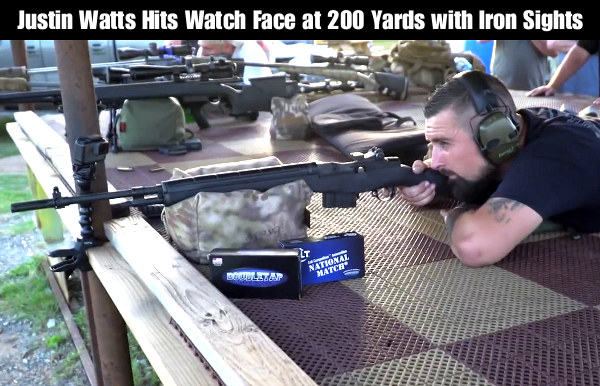
In this GunVenture video, three shooters take on the challenge of hitting the face of a watch at 200 yards using an M1A rifle with standard iron sights. The rules were exact — you had to hit the FACE of the watch, not just the strap. And the bullet had to penetrate the center of the watch — no splash shots or ricochets allowed. Not an easy shot — we figure that watch face is about 1.5″ in diameter or roughly 0.75 MOA at 200 yards. They were shooting factory .308 Win ammo with 155gr bullets — a Palma load.
GunVenture Video — 200 Yard Watch Challenge with Iron Sights M1A
One of the shooters, range owner Justin Watts, rose brilliantly to the challenge. You can see Justin’s remarkable shot at 3:20 time mark. Holding slightly for wind, he drilled the watch face dead center, obliterating it, but leaving most of the band intact. At 4:25 the video reveals that the whole center of the watch (the works) was blown out, leaving nothing but a rubber doughnut. Mighty Impressive.
After making the impressive shot, Justin explained to his buddies what they did wrong. Among other things they did not compensate for the wind. Justin also observed that the first shooter sent his shot right because of the M1A’s heavy trigger pull: “Probably what happened is the trigger pull is so heavy [he] pulled it to the right. Most of the time when you have a right-handed shooter and a heavy trigger like that, it’s going to pull you off to the right.”
Big Bucks. Serious Money. Walther Arms is making a whopping $450,000 in contingency awards available to pistol shooters in 2018. If you shoot pistol games such as USPSA and IDPA, and you “Win with a Walther”, you can go home with a nice check in your pocket. For example the winner of the USPSA Production Nationals will get $6000.00 if he shoots a Walther, while the winner of the IDPA U.S. Nationals will earn $4000. There are prizes for dozens of other competitions as well, with awards in multiple classes for both first and second places. The biggest payout is $6000, the smallest is $150.
Watch Video to Learn How to Win:
Walther has made it easy for shooters to participate in the “Win with Walther” program. For specified classes, Walther will reward top finishers in major pistol tournaments:
1. You must Finish First or Second using a Walther pistol in a Qualifying Tournament.
2. A Walther pistol must be used for the entire tournament. Proof of equipment is required.
3. You MUST email shootingteam@waltherarms.com with proof of your placement and a picture of your winning smile while holding the Walther Pistol you used to win or finish second!
CLICK HERE to learn more about the Walther Contingency Program. Click that link for a list of all qualifying shooting matches (with prize values), plus all the rules and “fine print”.
“We are very excited to not only continue but increase the contingency program for 2018. Walther Arms [will] build on the success of the 2017 contingency program, and increasing the approved events will allow more competitors to participate,” says Kevin Wilkerson, Walther Arms Marketing Manager.
In the 2016 President’s 100 Match, Match Winner Keith Stephens, runner-up SFC Evan Hess, and third-place Hugh Reich all used scopes, making for an All-Optics Podium. Both Stephens and Reich used the 1-4.5x24mm March.
Are you a Service Rifle shooter or would you like to give Service Rifle competition a try? The big news in this discipline is that magnified optics up to 4.5 max power can now be used. You can still use classic iron sights, but most serious Service Rifle competitors have moved to optics — and nearly all the “top guns” at major matches are running optics. Our friend Dennis Santiago, who is doing a long-term test of the Nightforce SR 4.5x24mm scope, says magnified optics are the future of the Service Rifle Game. If you want to win these days, you need glass.
Optics Options from $120 to $2400
You have many optics choices running all the way up to a 1-4.5x24mm March at $2338.00. But you don’t have to spend a fortune to get a good optic. Our Systems Admin, Jay Christopherson, will be trying the Konus XTC-30 1-4X24mm sold by Creedmoor Sports and the CMP. Priced at $495.00, the Konus has good glass and parallax set at 200 yards. And if you want the best deal going for a Service Rifle scope, right now Cabela’s offers the Vortex Crossfire II 1-4x24mm scope for just $119.88 with Free Shipping (Promo Code 2017FREE). That’s an incredible deal on a scope that can do double-duty on your hunting rifle. This same Vortex 1-4X optic sells for $188.88 on Amazon.
Super Deal — Vortex 1-4x24mm Scope for $119.88
Service Rifle Optics — How They Will Change the Game
Under NRA and CMP Rules first promulgated in 2016, Service Rifle competitors can use a scope with up to 4.5X magnification, and 34mm max objective. This rule revision to allow magnified optics will be a game-changer says Service Rifle shooter Dennis Santiago.
Dennis explains: “Per the 2016 Rulebooks of the CMP and NRA, today’s Service Rifle is now defined to include an M-16/AR-15 variant with an optical sighting system not to exceed 4.5X magnification. So, this optic-equipped rifle goes head-to-head with the match-tuned M-16A2/AR-15A2 iron sight guns in the same class. The rules were updated to take into account that some military branches no longer train service members to shoot iron sights as their primary marksmanship method and have switched to reliance on combat optics. The rules were debated and tried in 2015 and codified at the beginning of 2016. The 2016 Nationals were the first where the old and new generation guns compete side-by-side.
Here is my personal prediction: There will be improved scores by Expert Class shooters who figure out how to work with optics jumping into Master class. At the High Master level, there may be a slight rise in numerical scores but there will be a massive jump in X-Count. EICs will remain the all-out race they’ve always been; whoever makes the fewest mistakes wins the day.”
What to Look For in a Service Rifle Optic
by Johnny Fisher
2016 brought with it a long-anticipated rule change that allows for the use of optics in Service Rifle competition. Thus far, it seems the biggest concerns that Service Rifle shooters have when considering an optic are: quality, repeatability, parallax, reticle choices, and durability.
Parallax Considerations
The vast majority of Service Rifle Rule-compliant scopes currently on the market have a fixed parallax. That means there is no separate focus knob to adjust parallax to target distance. Accordingly, there has been much concern about the potential for parallax error over the three different distances in Across-The-Course competition. It is possible that the repeatably-indexed head position maintained while shooting a Service Rifle, along with a little extra emphasis on sight alignment to ensure that the shooter’s eye is directly behind the scope, can greatly mitigate the potential effects of parallax error. [Editor: However, we have talked with a number of Service Rifle shooters. Most would like adjustable parallax. If the parallax must be fixed, they would like it set at 200-300 yards. 100 yards is too close.]
Reticle Choices — Something to Consider
My Nightforce 1-4X scope has the IHR Reticle, which provides a very clear, unobstructed and simple sight picture. The IHR reticle for the NXS 1-4x24mm boasts an illuminated center cross-hair. Unfortunately, the red-color illumination is really only intended for low-light situations and is not bright enough to offer any aid to National Match shooters competing in broad daylight at stationary targets.
Editor: Unlike PRS competitors who (mostly) shoot bright-painted steel plates, Service Rifle competitors aim at traditional black bullseyes. The bullseye target design makes sense for iron sight shooters. With magnified optics you have some kind of black reticle that may not stand out at well against the black bull at 4.5 max power. You probably want to look through a number of different scopes to chose a reticle that works best for your eyes and aiming procedure.
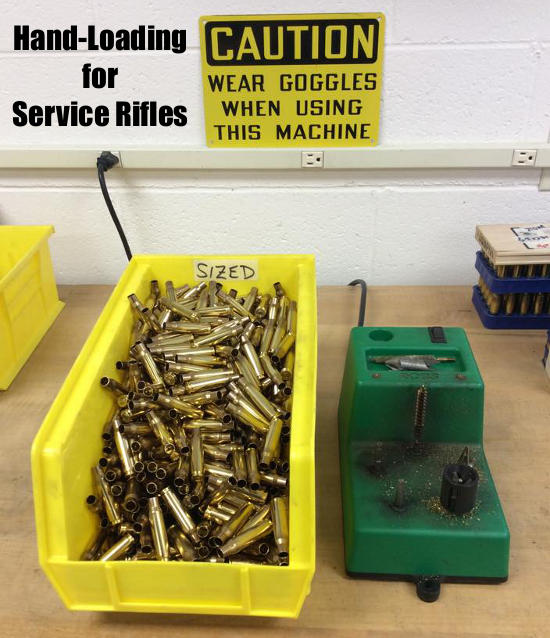
The U.S. Army Marksmanship Unit (USAMU) has published a great series of reloading “how-to” articles on its Facebook Page. This post covers key factors to consider when loading ammunition for Match Rifles and Service Rifles, with a particular focus on self-loading “gas guns”. Visit the USAMU Facebook Page each Wednesday for other, helpful “Handloading Hump-Day” tips.
We offer some “cardinal rules” to help new gas-gun handloaders with safety and efficiency. These address both Match Rifle and Service Rifle versions of the AR15, M1 Garand, M1A, and M110. However, they can also improve safe reloading for many other auto-loaders such as M1 Carbines, FALs, SIGs, etc. The author distilled these principles many years ago to help focus on the essential aspects of these rifles.
RULE ONE: Service Rifles Are Not Benchrest Rifles
Gas-guns require a relatively loose fit between ammunition and chamber (vs. bolt actions) for safe, smooth operation. Many techniques, such as neck sizing and keeping cartridge headspace quite tight, are popular in the extreme bolt gun accuracy realm. However, they are of little value with Service Rifles, and some could even be hazardous. Before adopting a specialized technique, seriously consider whether it is appropriate and beneficial in a gas-gun.
RULE TWO: Never Compromise Safety to Obtain Accuracy
Example: If choosing a brand of great, but ultra-sensitive match primers offers possibly better accuracy at the risk of slam-fires in your design of rifle, don’t do it! You are issued exactly two eyes and ten fingers (best-case scenario). Risking them trying to squeeze 0.25 MOA better accuracy out of an M1A, etc. simply isn’t worth it.
RULE THREE: Tailor the Precision to Your Individual Skill and Your Rifle’s Potential
This has been addressed here before, but bears repeating for newcomers. If you are struggling to break out of the Marksman Class, or using a CMP M1 “As-Issued,” then laboriously turning the necks of your 600-yard brass is a waste of time. Your scores will improve much faster by practicing or dry-firing. On the other hand, if the reigning champions anxiously check your scores each time you fire an event, a little neck-turning might not be so far-fetched.
Verifying Load Improvements — Accuracy hand-loading involves a wide variety of techniques, ranging from basic to rather precise. Carefully select those which offer a good return on investment for your time and labor. In doubt? Do a classic pilot study. Prepare ammo for at least three or four ten-shot groups with your new technique, vs. the same with your standard ammo. Then, pick a calm day and test the ammo as carefully as possible at its full distance (e.g. 200, 300, or 600 yards) to verify a significant improvement. A little testing can save much labor!
RULE FOUR: Be Your Own Efficiency Expert
Serious Service Rifle shooters generally think of ammunition in terms of thousands of rounds, not “boxes”, or even “hundreds”. Analyze, and WRITE DOWN each step in your reloading process. Count the number of times each case is handled. Then, see if any operations can be dropped or changed without reducing safety or accuracy. Eliminating just two operations saves 2000 steps per 1000 rounds loaded. Conversely, carefully consider any measurable benefits before adding a step to your routine.
RULE FIVE: In Searching for Greater Accuracy with Efficiency, Look for System Changes
For example, instead of marking your 300-yard rounds individually to differentiate them from your 200-yard ammo, would a simple change in primers work? If accuracy is maintained, using brass-colored primers for 200 and silver for 300 provides an indelible indicator and eliminates a step! Similarly, rather than spending hours selecting GI surplus brass for weight and neck uniformity, consider splurging on some known, high-quality imported match brass for your 600-yard loads. Results should be excellent, time is saved, and given limited shooting at 600 yards, brass life should be long.
RULE SIX: Check All Your Primers Before Packaging Your Loaded Ammo
This seems simple and even intuitive. However, many slam-fires (which were much more common when M1s and M1As were the standard) are due, at least in part, to “high” primers. Primers should be seated below flush with the case head. The USAMU has addressed this at length in a previous column, but each round should be checked for properly-seated primers before they are packaged for use.
NOTE: Audio may auto-start when you click this graphic — turn down speakers at work
You should tune in to Kelly McMillan’s Taking Stock Internet Radio Show today, Friday, December 15, 2017. Two very smart and talented guys are featured on the show. Kelly’s first guest, Erik Cortina, is Captain of Team Lapua-Brux-Borden and one of American’s Top F-Class competitors. The second guest, Dan Dowling, is a respected name in the field of bolt-action rifle work, with his main focus being benchrest rifles and similar high-accuracy rifles. Today’s live show, and recorded archives, are hosted on the VoiceAmerica Sports Channel.
We have followed Erik’s career as he has risen to be one of the best F-Class and long-range shooters in the world. Texas State LR Champion (3 years in a row), Erik has placed Top 10 in the Berger SW Nationals, won a Bronze medal in World Championship with Rutland team (Team USA Red), placed 3rd in F-Class Nationals. Erik also has produced very informative shooting/reloading videos on his YouTube Channel. Erik tells us: “I am honored to be on Taking Stock with Kelly McMillan. As you all know, I enjoy passing on what I know so that other shooters can benefit from my experience. I received a lot of help from others, epecially Mike Downey and Mark Pharr, starting out, so I’m paying it forward. I also believe it’s a good way to grow the shooting sports.”
On today’s radio show, Erik added: “We will also discuss the importance of using quality equipment as it is the most reliable and gives me the best chance at winning. Another topic we will discuss is learning to win. I believe learning how to shoot is fairly easy, especially with all the info out there these days, but learning how to win, is the difference between a great shooter and a Champion.”
Erik Cortina shows one of his handsome F-Open Rifles at Berger SW Nationals.
You can also access previous episodes. Recent guests have included F-TR World Champion and King of 2 Miles Derek Rodgers, Multi-Time National High Power Champion Carl Bernosky, USA F-TR Team Captain Ray Gross, and GA Precision’s George Gardner.
About McMillan Fiberglass Stocks
Kelly McMillan is the president of McMillan Fiberglass Stocks (MFS). This company began in 1973 when Gale McMillan starting crafting benchrest stocks at home in his carport/garage. In 1975 MFS hired its first employee, Kelly McMillan. By 1979 Kelly was made a partner, and by 1984 Kelly was in charge of running the stock shop. Since that time MFS has continued to grow with innovation and design. Today McMillan Fiberglass Stocks has a 15,000 sq/ft facility and 65 employees.
The latest issue of Shooting USA magazine has a detailed EIGHT-page feature on the Kestrel wind meter. This story covers the development of the Kestrel and explains the advanced technologies now offered with the hand-held Kestrel systems.
The eZine version of Shooting Sports USA (SSUSA) is available for free online. In the latest December 2017 issue you’ll find two excellent articles of interest to all serious rifle shooters. One covers the development of the Kestrel weather meter, which has evolved to serious levels of sophistication. Now premium Kestrels include built-in ballistic calculators and they can “talk” with mobile devices, sharing command functions and data. The second article covers shooting skills. In the first of a three-part series, Glen Zediker talks about NRA High Power rifle competition. Glen spotlights the skills you must master to move from the beginning level, Marksman, to higher levels.
Kestrel Technology Today
The December SSUSA issue features the origin of ballistics-enabled Kestrel weather meters. SSUSA’s Editor John Parker covers the history of the Kestrel, and explains how more and more features were packed into the handheld device as it evolved. Today’s Kestrel is so much more than an impeller with wind speed/direction read-outs.
The impressive Kestrel 5700 Elite with Applied Ballistics software is the latest model of a product that revolutionized long-range shooting by combining ballistic computer and weather meter in one portable device. Shooters can select either G1 or G7 ballistic coefficients, or to be even more specific they can select bullets from the Applied Ballistics custom curves library. With the Kestrel and its software, shooters can plot very precise trajectories, even to extreme long ranges.
Marksman to High Master
High Power Rifle competition originally evolved from the U.S. military course of fire. Climbing the classification ranks in NRA High Power Rifle can be daunting — it requires focus, practice and commitment to move up the ladder from Marksman all the way to High Master.
In Glen Zediker’s three-part series, “Climbing the High Power Ladder”, Glen shares his tips for competitors that are looking to improve their skills beyond the intermediate level. The first installment focuses on stepping past Marksman classification to Sharpshooter. Read PART ONE HERE. In the months ahead, look for parts Two and Three in future SSUSA issues. These will cover the next stages in the climb: Expert, Master, High Master.
DVD Resource for High Power Training
If you’re serious about improving your High Power skill set, we suggest you view a DVD by David Tubb, 11-time National High Power Champion. David’s instructional DVD, “The Art & Technique of the Modern Match Rifle”, is a great resource for any High Power or position shooter. This 2-disc DVD provides over 4.5 hours of instruction and shooting demonstrations. We can confirm that this video is packed with great information — novice High Power and prone shooters who apply David’s methods should definitely improve their scores.
David has included highlights from that DVD in a shorter promo video. While the shorter video is a sales tool, it’s very informative in its own right. Watch the video and you’ll learn a great deal just by watching how David shoulders his rifle, and how he adjusts and maintains his shooting position. David shows examples of prone, sitting, and standing positions. In the short “trailer”, David also provides helpful tips on adjusting sights, and placing the spotting scope.
If you shoot Service Rifle, High Power, or prone, you can benefit from watching this short sampler video. The full 2-disc DVD is available for $49.95 from Creedmoor Sports. With over 4.5 hours of content, the DVD covers all the across-the-course positions, the set-up and use of aperture sights and diopters, High Power and long range targets, the approach method in offhand, proper placement and use of spotting scopes. The DVD includes bonus footage of David shooting strings in all of the across-the-course positions.
Christmas is coming soon. Books have always been popular holiday gifts. If you haven’t completed your holiday shopping, here are some recommended titles that should please the serious shooters and firearms enthusiasts on your shopping list. For shooting clubs, books also make great end-of-season member awards. Most of us would rather have a useful book than one more piece of wood to toss in a box in the closet.
Here Are TEN BOOKS Recommended for Serious Shooters:
Glen Zediker’s latest book, Top-Grade Ammo, is a great resource for all hand-loaders — beginners through advanced. This 314-page guide covers every aspect of the reloading process — component sorting, priming, sizing, bullet seating and more. With 430 photos, Top-Grade Ammo is a richly-illustrated, step-by-step guide to producing high-quality handloads. Unlike many reloading books, Top-Grade Ammo is current and up-to-date, so it covers modern practices and the latest precision reloading tools. While Zediker focuses on producing match-grade ammo for competition, this book will also help novice reloaders on a budget. This book features a special “lay-flat” binding so it’s easy to use as a benchtop reference. To view Chapter List and sample pages visit ZedikerPublishing.com.
If you’re a serious long-range shooter, consider adding this book to your library. Relying on extensive ballistics testing, Modern Advancements contains some fascinating research results, including the effects of twist rate on muzzle velocity, BC, and precision. Other sections detail the evolution of modern rifle, bullet, and optics designs. And there is an important comparison test of chronographs. Laser rangefinders and wind measurement devices are explained in detail by contributing author Nick Vitalbo. This book is a valuable resource for anyone who wants to understand the current “state of the art” in today’s shooting world. There is a ton of “hard science” in this book — not just opinions.
Thinking of getting started in the Practical/Tactical shooting game? Looking for ways to be more stable when shooting from unconventional positions? Then you may want to read Marcus Blanchard’s Practical Shooter’s Guide (A How-To Approach for Unconventional Firing Positions and Training). Unlike almost every “how to shoot” book on the market, Blanchard’s work focuses on the shooting skills and positions you need to succeed in PRS matches and similar tactical competitions. Blanchard provides clear advice on shooting from barricades, from roof-tops, from steep angles. Blanchard says you need to train for these types of challenges: “I believe the largest factor in the improvement of the average shooter isn’t necessarily the gear; it’s the way the shooter approaches obstacles and how they properly train for them.”
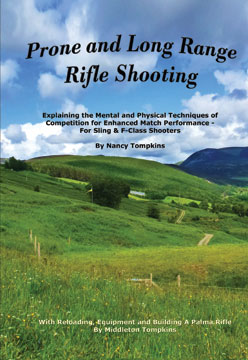
Nancy Tompkins is one of the greatest long-range shooters in American history. She has won five National Long-range Championships. Tompkins’ treatise is a must-read for serious Palma, F-Class, and High Power shooters. The revised Second edition includes F-Class equipment and techniques, and newly updated information. Color pictures. Topics include Mental & Physical training, Reading Wind & Mirage Shooting Fundamentals, International Competition, and Loading for Long Range. Nancy Tompkins is a 4-time winner of the National Long Range Championships, and has won countless other major events. Nancy has been on six Palma Teams (as both a shooter and a coach).
Ryan Cleckner is noted for his ability to explain complex topics in an easy-to-comprehend manner. Now Cleckner has authored a book, the Long Range Shooting Handbook, which expands on the topics covered in Cleckner’s popular NSSF video series. The Long Range Shooting Handbook is divided into three main categories: What It Is/How It Works, Fundamentals, and How to Use It. “What It Is/How It Works” covers equipment, terminology, and basic principles. “Fundamentals” covers the theory of long range shooting. “How to Use It” gives practical advice on implementing what you’ve learned, so you can progress as a skilled, long range shooter. You can view Sample Chapters from Ryan’s Book on Amazon.com.
Tony Boyer, the most successful shooter in the history of short-range benchrest competition, shares many of his match-winning tips in this 323-page book. The book covers all aspect of the benchrest discipline: loading, windflags, rest set-up, addressing the rifle, and match strategies. This is a high-quality publication, filled with valuable insights. Every serious benchrest shooter should read Tony’s book. Boyer has dominated registered benchrest in a fashion that will never be duplicated, having amassed 142 U.S. Benchrest Hall of Fame points. The next closest shooter, Allie Euber, has 47 Hall of Fame points. This handsome, full-color book is 323 pages long, with color photos or color illustrations on nearly every page.
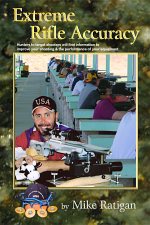
This book should be on the shelf of every short-range benchrest shooter. (Shooters in other disciplines will find the book helpful as well.) Butch Lambert says Mike’s book is “far and away the best Benchrest book written. Very comprehensive, it touches on every aspect of our game.” Mike’s 368-page book is dedicated to getting the most from modern rifle accuracy equipment with an emphasis on shooting 100-200-300 yard group benchrest tournaments. This book covers the most popular hardware plus new equipment offerings are covered, including external mount scopes, actions, triggers, stocks, wind flags, and more. Also covered are rifle handling techniques, note taking, tuning, bullet selection, goals, and match strategies. Mike provides many tips that will help active competitors update their own competitive program.
This book by 11-time National High Power Champion David Tubb focuses on position shooting and High Power disciplines. Section One covers fundamentals: position points, natural point of aim, breathing, triggering mechanics and follow-through, sling selection and use, getting started, getting better, avoiding obstacles. Section Two covers mechanics of offhand, sitting, and prone positions. Section Three covers shooting skills, including wind reading and mental preparation. Section Four covers the technical side of shooting, with extensive disuctions of rifle design, load development, reloading barrel maintenance, and rifle fitting. We consider this book a “must-read” for any sling shooter, and there is plenty of good advice for F-Class shooters too.
Bullseye Mind (Mental Toughness for Sport Shooting) by Dr. Raymond Prior, $14.00 (Softcover).
Having a Bullseye Mind means thinking in ways that create confidence and consistency, even under pressure. A “must-read” for competitive shooters, Bullseye Mind is a mental training book written specifically for the shooting sports. The book is well-organized, with handy highlighted lists and key “talking points”. Each chapter concludes with examples from a world-class shooters such as: Matt Emmons, 2004 Olympic Gold Medalist; Vincent Hancock, 2-time Olympic Gold Medalist; Jamie Corkish, 2012 Olympic Gold Medalist; Petra Zublasing, 2014 World Champion/ISSF Shooter of the Year; and Nicco Campriani, 2012 Olympic Gold Medalist, 2010 World Champion. This book has earned rave reviews from competitive shooters who found it really helped their “Mental Game”. One recent purchaser states: “This book is as though you had a coach in your back pocket…”
Cartridges of the World (15th Edition, 2016), belongs in every serious gun guy’s library. This massive 680-page reference contains illustrations and basic load data for over 1500 cartridges. If you load for a wide variety of cartridges, or are a cartridge collector, this book is a “must-have” resource. The latest edition includes 50 new cartridges and boasts 1500+ photos. The 15th Edition of Cartridges of the World includes cartridge specs, plus tech articles on Cartridge identification, SAAMI guidelines, wildcatting, and new cartridge design trends. In scope and level of detail, Cartridges of the World is the most complete cartridge reference guide in print. Cartridges of the World now includes a 64-page full-color section with feature articles.
Marksman, Sharpshooter, Expert, Master, High Master — how are those classifications set up and how does one move up (or down) from one classification to another? These questions and more are answered by the NRA in a Shooting Sports USA article.
The purpose of the classification system is to allow competitors of the same relative ability to compete on a level playing field. That way relatively new or inexperienced shooters can compete in a class with others of the same skill levels, and be recognized. Likewise, the most skilled or successful shooters compete in the Master and High Master categories. But now and then a Marksman or Sharpshooter can indeed win a match outright or place in the top ten.
How Does a Competitor Receive a Classification?
You begin the classification process by competing in a sanctioned, registered tournament. The match sponsor then sends the scores to the NRA within 30 days. If you are an NRA member, your NRA membership number is your classification ID. Non-NRA members are assigned a classification number.
Competitors may check their classification status at any time via the NRA Classification Page.
What are the Standards for Each Classification (Marksman, Sharpshooter etc.)?
Section 19 in each NRA Rule Book covers the classification rules for that discipline. This section includes the course-of-fire used for classification, number of shots required and the percentage for each class. For example, in High Power Rifle competition a minimum of 120 shots is required for the first classification card. The High Power performance-based classification levels are:
Marksman: Below 84 percent
Sharpshooter: 84-88.99 percent
Expert: 89-93.99 percent
Master: 94-96.99 percent
High Master: 97 percent or above
NOTE: After the initial High Power classification, an additional 240 shots will be required to reevaluate a classification — and each time thereafter.
How Long Does the Classfication Card Remain Valid?
A classification card remains valid as long as the competitor competes in an NRA-sanctioned tournament at least once every three years (five years if the competitor holds a Master card). The date on all classification cards is the effective date, not an expiration date. You do NOT have to shoot three matches a year to maintain your classification (a common misconception).
Is an NRA Classification Card Required to Enter a Tournament?
NRA has no such rule, generally speaking. However, some tournament sponsors may require this as part of their local regulations. You may use a Temporary Score Record Book for your first few tournaments while awaiting your classification card. These books are free and are provided either by your tournament sponsor or by the NRA Competitive Shooting Division. Note that until you are classified, you must compete in the master class for your first few tournaments.
NOTE: Some high-level matches do require NRA membership. For example the 2016 NRA National Smallbore Rifle Championships Program stated: “Competitors who do not hold an NRA Official Classification, either in the type of competition being fired, or an Assigned Classification, will not be allowed to enter.”
We believe in the benefits of rimfire cross-training. With a rimfire rifle that has the same ergonomics and “feel” as your centerfire rig, you can practice more often and more affordably. You can get good rimfire ammo now for under $5.00/box (ten cents per round). Compare that to centerfire factory ammo at $1.40/round or handloads for about $0.70 (bullet, primer, powder, and brass depreciation). We know some successful PRS shooters who shoot five rimfire rounds in practice for every centerfire round.
For a tactical cross-trainer, you want a rimfire rig that feels like your centerfire rifle. McMillan now offers a stock that fits the bill. McMillan’s new A5-22 stock shares the same look and feel as McMillan’s popular A5 centerfire stock. The A5-22 is able to accommodate 10/22 type actions including KIDD 10-22 models with rear tang attachments. McMillan says: “The A5-22 is dimensionally the same as our standard A5 with some minor changes in the tang and floor plate areas. It is available in a fixed comb configuration or with an adjustable saddle-type cheek piece.”
While the new McMillan A5-22 stock was designed expressly for the Ruger 10/22 barreled action it can be inletted to fit other rimfire actions: KIDD 10-22, Volquartsen VCL (Sporter and Magnum), and Volquartsen WSM. With a basic inlet, the A5-22 costs $390.00. Uninletted (flat-top) version costs $338.00. Available options include cheekpiece, pad, studs, and rail.
Rimfire Cross-Training Resources
Quality Affordable Ammo for Rimfire Cross-Training
Looking for good, affordable .22 LR ammo for your rimfire training rifle? We suggest Norma’s Tac-22. This has shown very good accuracy in both bolt-action and self-loading rimfire rigs. The target photos above come from Champion Shooters Supply, which reports: “We have found this to run very well in Ruger rifles, handguns, and target pistols. These are 5-shot groups at 50 yards with an Anschutz 1913 rifle. This is an incredible value.”
Tac-22 ammo is available from many vendors. MidwayUSA currently offers it for $4.49 per 50rd box or $34.99 for 500 rounds. That’s just seven cents per round with the 500-count box — a great deal.
Rimfire Practice Targets
SPECIAL BONUS–Rimfire Tactical Precision Targets
These FREE targets by DesertFrog are offered in Adobe Acrobat format for easy printing. CLICK HERE to download all six targets as a .ZIP archive.
The Concept Behind the Rimfire Tactical Match
Many guys who shoot long-range tactical matches practice with .22 LR rifles of similar configuration. Rimfire ammo is way more affordable than centerfire, you do not need a big range facility, and shooting rimfire saves wear and tear on your centerfire rifle. Further, for learning how to read the wind, there really is no better training tool than a .22 LR, even as close as 50 yards. In California, various clubs have been running rimfire tactical matches for more than a decade now. Hit/miss reactive targets are typically placed from 50 to 150 yards. Some matches combine steel plates with bullseye paper targets so accuracy is important. An accurized 10/22 can be competitive in these matches.
Rimfire Tactical Series
A new .22 LR rimfire shooting discipline has been developed, copying the PRS series. The ELEY Practical Rimfire Challenge series matches are positional shooting events in field conditions out to 300 yards. You can use either a bolt-action or semi-auto .22 LR rimfire rifle. Much like PRS (Precision Rifle Series), competitors will shoot from a variety of positions: prone, strong/weak shoulders, standing, sitting, and kneeling. There will be shots from barricades, and movement from position to position during stages.


 When two or more guys get together at a shooting range, sooner or later, a challenge will ensue. It’s a guy thing — guys are competitive. We’ve seen it on varmint hunting trips too: “Bet I can hit that P-dog at 700 yards.” “No you can’t.” “Yes I can.” “Wanna Bet?”




 Marksman to High Master
 DVD Resource for High Power Training