The movie “The Patriot” gave us the phrase “Aim small, miss small”. While that’s a good mantra, aiming strategies for long-range competition are a bit more complicated, as this article explains…
The The F-Class World Championships (FCWC) in Canada are just one week away. This August 11-17, the world’s top F-Class shooters will gather at the Connaught Ranges outside Ottawa, Ontario. Here are some tips that can help F-TR and F-Open shooters aim more precisely, and achieve higher scores. F-Class ace Monte Milanuk reviews reticle choices and strategies for holding off.
In our Shooters Forum, one newcomer wanted some advice on selecting a reticle for F-Class optics. He wondered about the advantage of Front (first) Focal Plane (FFP) vs. Second Focal Plane scopes and also wondered if one type of reticle was better for “holding off” than others.
In responding to this question, Forum regular Monte Milanuk provided an excellent summary of aiming methods used in F-Class. For anyone shooting score targets, Monte’s post is worth reading:
Aiming Methods for F-Class (and Long-Range) Shooting — by Monte Milanuk
F-Class is a known-distance event, with targets of known dimensions that have markings (rings) of known sizes. Any ‘holding off’ can be done using the target face itself. Most ‘benefits’ of Front (first) focal plain (FFP) optics are null and void here — they work great on two-way ranges where ‘minute of man’ is the defining criteria — but how many FFP scopes do you know of in the 30-40X magnification range? Very, very few, because what people who buy high-magnification scopes want is something that allows them to hold finer on the target, and see more detail of the target, not something where the reticle covers the same amount of real estate and appears ‘coarser’ in view against the target, while getting almost too fine to see at lower powers.
Whether a person clicks or holds off is largely personal preference. Some people might decline to adjust their scope as long as they can hold off somewhere on the target. Some of that may stem from the unfortunate effect of scopes being mechanical objects which sometimes don’t work entirely as advertised (i.e. one or two clicks being more or less than anticipated). Me personally, if I get outside 1-1.5 MOA from center, I usually correct accordingly. I also shoot on a range where wind corrections are often in revolutions, not clicks or minutes, between shots.
Some shooters do a modified form of ‘chase the spotter’ — i.e. Take a swag at the wind, dial it on, aim center and shoot. Spotter comes up mid-ring 10 at 4 o’clock… so for the next shot aim mid-ring 10 at 10 o’clock and shoot. This should come up a center X (in theory). Adjust process as necessary to take into account for varying wind speeds and direction.
Others use a plot sheet that is a scaled representation of the target face, complete with a grid overlaid on it that matches the increments of their optics — usually in MOA. Take your Swag at the wind, dial it on, hold center and shoot. Shot comes up a 10 o’clock ‘8’… plot the shot on the sheet, look at the grid and take your corrections from that and dial the scope accordingly. This process should put you in the center (or pretty close), assuming that you didn’t completely ignore the wind in the mean time. Once in the center, hold off and shoot and plot, and if you see a ‘group’ forming (say low right in the 10 ring) either continue to hold high and left or apply the needed corrections to bring your group into the x-ring.
Just holding is generally faster, and allows the shooter to shoot fast and (hopefully) stay ahead of the wind. Plotting is more methodical and may save your bacon if the wind completely changes on you… plotting provides a good reference for dialing back the other way while staying in the middle of the target. — YMMV, Monte
It’s good to see an ammo-maker step up to help the shooting sports. ELEY Ltd. has recently made significant investments in .22LR rimfire benchrest and competition segments within the USA. ELEY has partnered with the American Rimfire Association (ARA) and Professional Shooting League (PSL) to help promote and expand rimfire benchrest shooting, one of the fastest growing .22 LR rimfire competition disciplines worldwide. The ARA and PSL competitions are leading rimfire benchrest organizations within the United States. ELEY’s financial and logistical support will help the ARA and PSL grow the ranks of rimfire benchrest shooters.
Here’s a record-setting rimfire benchrest rifle owned by our friend Joe Friedrich who competes in ARA matches, primarily using ELEY .22 LR Tenex ammo.
ARA was started in April 1998 by a group of .22 LR shooters who wanted an organization for competitive .22 LR benchrest competition. In 2010, ARA started to transition to what it has become today, with the unique goal of continuing the vision of the ARA founders by providing an honest competitive organization that is true to .22LR shooting.
PSL was founded as a benchrest organization for the true precision shooting professional. With the growth of rimfire benchrest, there was a need to have a professional organization to which shooters would be compensated for their hard work, training and competition success.
Image from National Rimfire Benchrest Association of Ireland (NRBAI)
Among .22 LR rimfire disciplines, benchrest shooting represents the “pinnacle of precision” — the very highest level of accuracy is needed to succeed. As such, ELEY has identified the need to help expand this growing sport. “This support by ELEY will help us bring .22 LR benchrest to the forefront of shooting competitions,” says Dan Killough, Director of ARA & PSL. “The expansion of [rimfire] benchrest … gives shooters a platform to enjoy and participate in rimfire competition that previously may not have been available to them,” stated Mike Corkish, ELEY Director of North America Sales.
2017 USA Smallbore Silhouette Champion | 2017 USA High Power Silhouette Champion
2017 Canada Smallbore Silhouette Champion
We don’t know if there is an official “Lady Rifle Shooter of the Year”, but we would nominate Silhouette shooter Cathy Winstead-Severin, based on her amazing shooting so far this summer. Cathy has delivered some truly dominant performances recently. In mid-July, competing at the Ridgway Rifle Club in PA, Team Lapua’s Cathy Winstead-Severin won the 2017 Hunter Rifle NRA Smallbore Silhouette Championship. Cathy scored 110/120 to win her 20th NRA National Silhouette title. Then Cathy went on to win both the Standard and Hunter High Power Rifle Silhouette National Championships.
With those victories, Cathy completed a clean sweep of Smallbore (Rimfire) AND High Power (Centerfire) awards — a stunning achievement. Cathy was using Lapua cases, VihtaVuori powder, and a combination of Lapua and Berger bullets to win her 21st and 22nd National Silhouette Titles.
More Glory Across the Border — Cathy Wins in Canada Too!
Less than three weeks after her wins at the USA National Silhouette Championships, Team Lapua’s Cathy Winstead-Severin ventured north and won the Canadian NFA National Smallbore Silhouette Championship. After the match she also hosted a very informative clinic for other shooters. Congratulations Cathy Winstead-Severin. You have our vote for Lady Shooter of the Year. We also thank Team Lapua for providing support for major Silhouette Championship events.
The NRA Black Powder Target Rifle Championship will be held August 14-20, 2017 at the Whittington Center in Raton, NM. Top Black Powder Cartridge Rifle (BPCR) shooters from around the country have come to Raton to test their skills during a week-long event with targets set from 200 to 1000 yards. Today through Thursday, mid-range matches continue at 200 to 600 yards. On the firing line you’ll see many handsome, custom-built BPCRs (Sharps, Ballards, Browning High Walls, Rolling Blocks) with exquisite wood, hand-checkering, and color-case-hardened receivers.
The 800-1000 yard Creedmoor matches will be held Friday and Saturday, August 19-20. Interestingly, for safety reasons, there are minimum bullet weight and muzzle velocity requirements for the Creedmoor matches. These BPCR shooters launch some seriously heavy projectiles downrange.
REGISTRATION: Registration will take place at the Eagle’s Nest Building beginning at 13:00 – 17:00 on August 13, and 07:15 – 09:00 August 14 for the Championships. NOTE: The NRA Black Powder Committee and NRAWC has changed the minimum requirements of bullet weight and velocity. There may be a 2% variance in bullet weight or velocity. Numbers in BOLD indicate the 2% variance. Only ammunition which produces these results, or better, and only rifles that have long-range sights will be permitted for use in the Creedmoor Championships. See the BPTR Nationals Ballistic Velocity Chart below for minimum requirements.
ACCOMMODATIONS: There are many motels in the town of Raton, about 10 miles from the Range. In additions, there are accommodations on the grounds of the Whittington Center: 90 beds in Competitors Housing and 100 beds in Log Cabins. These facilities fill up quickly — call the Whittington Center right away at (575) 445-3615 to reserve.
Our friend Doan Trevor is creating a new raffle rifle. This will be raffled off this fall to support the USA Palma Team. Doan is donating his labor and building the stock from a walnut blank. Pierce Engineering will supply the action and Brux Barrels will provide the barrel.
Doan tells us: “I have volunteered to build another raffle rifle for the U.S. Palma National Rifle Team. Work has begun. I am hoping to have this completed for the Spirit of America Match in Raton, NM this fall. The action has been donated by Pierce Engineering and the long Palma barrel has been donated by Brux Barrels. The one item we are lacking at this point is a Remington-style competition trigger.”
Doan says he will craft the stock from hand-selected American Walnut: “This is [my own] Doan Trevor prone design, modified to be used for F-TR. This can be shot either prone or F-TR (with bipod). This will be similar to the stock that I custom-designed for Derek Rodgers, which won several National Championships and other awards.” The photos below show Doan crafting the wood and starting the bedding on the 2017 U.S. Palma Team Raffle Rifle:
Another Doan Trevor Raffle Rifle — for the Veterans’ Team
What will the rifle look like when it’s complete? We can’t show you that yet, but here’s another custom Palma rifle Doan crafted for the 2011 U.S. Veterans’ Team. Doan says: “This is the finished rifle for the U.S. Veterans Palma Team raffle for 2011. It carries a unique serial number signifying the 2011 World Championships in Australia.”
John Whidden of Whidden Gunworks has won his fifth Long Range National Championship, his second title in a row (he also won the LR Title in 2016). This year, competing at Camp Atterbury in Indiana, Whidden pulled together a gritty, come-from-behind victory. John won the title by shooting a perfect 450-28X (not dropping a point) in the final Palma match on the last day of the Long Range Championship. While Whidden, who finished at 1246-91X, edged runner-up Phillip Crowe (1245-68X) by just one point, John enjoyed a huge X-Count margin. Finishing third was past High Power and Long Range National Champion Nancy Tompkins (1244-65X). Here are the Top Ten finishers:
Whidden’s Perfect Palma Match
Whidden secured the 2017 LR Title by shooting “clean” (not dropping a point) in the tough Palma competition. In the NRA Palma match, rifles must be .223 Rem or .308 Winchester, with metallic sights (no scopes). The match is conducted at three yardages, 15 shots at each distance of 800/900/1000 yards, with unlimited sighters at 800 and two sighters at 900 and 1000.
John liked the Camp Atterbury facility and he credited his equipment for his 2017 victory: “With the change to the new Camp Atterbury venue, many shooters were a little unsure how things were going to shake out. But it all turned out really well. All of my equipment shot fantastic all week long — that certainly made shooting a big score easier.”
Whidden’s Championship-Winning Rifle
Since John captured his fifth Long Range crown with a superb performance in the Palma match, we thought we’d give readers a look at John’s very special Palma rifle. This unique .308 Win prone rifle features a Barnard “P” action in a converted aluminum Anschutz “Precise” smallbore (rimfire) stock. The combo of Barnard action and Anschutz ergonomics is hard to beat, says John, who told us: “this is easily the best Palma rifle I’ve ever had.” John told us this gun handles like no other: “After recoil, with this Anschutz stock, the sights fall right back on target — better than any other prone rifle I’ve shot”.
As a bonus, the Barnard “drop-in” required no modification of the Anschutz Precise stock. This means John can actually swap in his rimfire barreled action and shoot smallbore with the same stock.
Sling Rifle Evolved: The Ultra-Accurate Hybrid Palma Rifle
by John Whidden
The mental component of Long Range competitive shooting is always challenging but having tremendous confidence in the accuracy of your equipment is a huge benefit. There’s nothing to start your Palma match off well like knowing that you are shooting the most accurate Palma rifle you’ve ever owned.
Whidden Palma Rifle
Action: Barnard “P” (three lugs, 60° bolt lift)
Barrel: Bartlein 32″, Light Palma contour, cryo-treated by 300 Below.
Stock: Anschutz Precise aluminum smallbore stock, set up for centerfire barreled action.
Trigger: Barnard Two-Stage adjustable
Whidden’s Wonder-Gun: German Stock, New Zealand Action, American Barrel
John built this Palma rifle in early 2016. With it, John won back-to-back long-range Championships in 2016 (Camp Perry) and 2017 (Camp Atterbury). The major components are: Barnard ‘P’ action, Anschutz Precise smallbore stock, and Bartlein barrel. The caliber is .308 Win, as dictated by the Palma rules. Palma matches are fired from 800, 900, and 1000 yards utilizing iron sights only. No optical sights are allowed.
The Anchutz Precise stock is so well-designed that once I finished adjusting the details, I realized that my hold was about 1/3 smaller than with the stocks I shot previously. While in recoil the gun will track vertically and fall back down right on my own target just as it should. In the past, with my other Palma rifles, it was frankly sometimes a struggle to get them to settle back on target after a shot.
Whidden Gunworks has installed a variety of different actions in the Anschutz Precise stocks. Though the stocks are designed for the .22 LR caliber 2013 action rifles, we’ve successfully installed Barnard, Kelbly, Bat, Nesika, and Remington clone actions into them. The Barnard Model P makes a particularly simple installation because there is no modification necessary to the stock at all. A competitor can then shoot both his centerfire rifle as well as his smallbore gun in the exact same stock. The location of the trigger and bolt handle on the Barnard are positioned just right to make this work. Other actions do require at least some amount of modification to the stock, and we have found the Barnard works the best.
Barnard manufactures several models of actions as part of their lineup. All of the actions in the lineup use three lug bolts which give a shorter 60-degree bolt lift when opening and closing. All of the critical surfaces are machined after heat treating. This means that they are exceptionally true and square, more so than other actions. The Model P action is most familiar to Palma and F-Class shooters and are commonly seen on the firing line. The fact that Model P actions include an excellent two-stage trigger makes also the pricing very attractive.
Based on my previous excellent experiences, I selected Bartlein barrels for this rifle. When shooting internationally in the Palma matches we are restricted to 155 grain .308 bullets, but I made the unusual choice of a 1-10″ twist for these bullets. I’ve shot this fast twist for some years with the 155s with good success and it’s pleasing to know that Bryan Litz is finding benefits in some cartridges to shooting faster twist rates than we previously thought we needed. The load is Vihtavuori N140 Powder with Berger 155gr Hybrid bullets. The chamber is the 2011 Palma and the barrel is a Light Palma contour finished at 32” length. The barrel was cryo-treated by 300 Below. The point of impact isn’t changed at all by barrel heating and the accuracy is incredible regardless of the temperature of the barrel. This can’t be said of all the barrels I’ve owned.
Get Your Own Whidden Wonder-Gun for $4500.00
Like what you see — but wonder how much it will cost? Whidden Gunworks can build you a rig like this, fitting a centerfire barreled action in the Anschutz Precise stock. John tells us: “The price of a rifle like this one but without sights or mounts would be just under $4500.00. We attempt to keep all of the parts except the stock in inventory, so lead time should be under eight (8) weeks.”
Stock Offers Great Adjustability One thing that is quickly noticed about the Anschutz Precise stock is its adjustability. The engineers did a very good job of allowing many of these adjustments to be made while in the shooting position, most notably the cheekpiece adjustments. When a shooter picks up a Precise stock for the first time they also notice how narrow the fore-end is. This really contributes to reducing the pain in the forward hand in prone when shooting with a sling. This stock is, by far, the most comfortable sling stock I’ve ever handled.
This rifle was very accurate right away and very comfortable to shoot. I’ve built some really good shooting Palma rifles but this is easily the best Palma rifle I’ve ever had. The Barnard action with its superb quality and excellent two-stage trigger has been the best choice I could have made. When you can go to the firing line knowing that you have the very best, the foundation for success has been set.
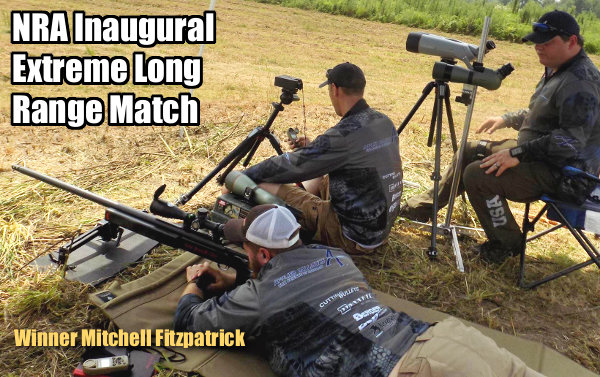
The first-ever NRA Extreme Long Range (ELR) Match took place this past week at Camp Atterbury in Indiana. Also labeled the “One-Mile Match”, this inaugural event ran as a side-match between the NRA’s Mid Range and Long Range Championships at Atterbury. The event drew many of the nation’s top marksmen, including multi-time National High Power and LR Champion David Tubb, recent F-TR National Champion Bryan Litz, and 2016 KO2M winner Mitchell Fitzpatrick.
It was a tightly-fought match. Showing exceptional skills (along with great rifles and ultra-accurate ammo), both Corbin Shell and Team Applied Ballistics’ Mitchell Fitzpatrick were perfect for 15 shots — making every shot at 1400, then 1575, and finally 1788 yards (1.016 miles). With the score tied, a 1000-yard target center (bullseye) was set on a target backer at 1988 yards (1.13 miles). Mitchell hit the target, but sadly Corbin had his first miss of the match. With that 1988-yard hit, Mitchell went down in the history books as the first-ever NRA ELR Champion. Winning at Extreme Long Range is nothing new for Mitchell, who was the winner of last year’s King of 2 Miles match in Raton, NM.
Mitchel posted: “We pulled off the win by shooting clean, never missing a shot! It was a great event and I look forward to competing in the coming years. They are trying to extend the facility to make it a 2400-yard match. With the NRA having such a rich competitive shooting history… I am beyond honored to have won the inaugural NRA ELR match. As ELR grows … it will be awesome to look back and know we were in at the ground level. Also, it should be noted that my extractor broke on the second shot at 1788 yards, and I ended up having to fire the last thre shots while extracting my cases with a cleaning rod from the muzzle end…”
Overall Standings NRA ELR One-Mile Match
1. Mitchell Fitzpatrick
2. Corbin Shell
3. Randy Pike
4. Paul Phillips
5. Dan Pohlabel
6. M. White
7. Rusty Phillips
8. Kent Reeve
9. Bryan Litz
10. David Tubb
Corbin’s Big Rig Built for Extreme Long Range
Runner-Up Corbin Shell was shooting his impressive .338 Lapua Magnum Improved barrel-block rifle, originally built for the KO2M event. It performed superbly in Indiana. This rifle was showcased here on AccurateShooter last month. READ Corbin Shell .338 LM Story.
ELR TECH — Confirming Hits at a Mile (and Beyond)
Confirming hits at extreme yardages is a challenge. With a conventional spotting scope you can see a target swinging but it is very difficult to see actual impact at extreme ranges. For this match, wireless remote TV cameras were placed near each of the targets down range. These fed video signals to monitors and tablet computers, allowing scorers to confirm hits on steel. In addition to the Targetvision target cam systems, GSL Technology had a drone to get aerial footage and augment streaming video coverage on Facebook. Sheri Judd, NRA ELR Match Manager, also captured some great still images of the event, including the images you see in this article.
Like Father, Like Son — Rusty and Paul Phillips
The NRA ELR match was a family affair for the Phillips clan. Paul Phillips shot with his father Rusty. The elder Phillips, at the ripe young age of 80, had multiple hits at one mile, earning his official “One Mile Club Certificate”. You can see Rusty shooting in the video below. Paul says: “I had a great day shooting with my dad at the inaugural NRA ELR match. My dad went four for five at 1 mile (1788 yards) on a 36″ plate and earned his One Mile Club membership. This was his first competitive match ever shot at 80 years old and he finished 7th overall! Bryan Litz and myself help keep him centered up.” Paul and his father Rusty used GSL .375 Lethal Mag Copperhead Suppressor and the .338 Lapua Copperhead.
Rusty Phillips, at 80 years, shot 4 for 5 at 1788 yards (1.016 miles) to earn his One Mile Club Certificate. Congratulations Rusty!
SFC Brandon Green (left above) set four new National Records at Camp Perry this year.
The CMP’s 2017 National Trophy Rifle Match cycle concluded 7/21/2017. There are more special matches (Springfield/Vintage Bolt Rifle today and Sniper Match on Monday), but the major CMP rifle awards ceremony was conducted on Friday the 21st. This was a very successful summer for the CMP — almost 2,500 participants traveled to Camp Perry for CMP matches and clinics. We congratulate the winners, including six rifle shooters who fired 10 new National Records throughout the week. SFC Brandon Green set four new records and was the Overall Individual Service Rifle Champion, dropping only seven (7) points throughout the week (1593-87X). Junior Liam McKenna (below) was the National Trophy Junior Service Rifle Champion (1279-49X). To view hundreds of other images from the 2017 CMP National Trophy Matches at Camp Perry, visit the CMP Zenfolio Photo Archive.
Scenes from Camp Perry 2017
Photos from CMP archive. Bottom photo courtesy SFC Brandon Green
In an impressive performance, the U.S. Army Marksmanship Unit’s Service Rifle Team won the National Trophy Infantry Team (NTIT) Match on July 20th at Camp Perry, Ohio. In this match, also known as the “Rattle Battle”, six-member teams shoot at 200, 300, 500 and 600 yards with time limits — 384 rounds total. To win this match, the six shooters must work like a finely-tuned machine. This is a popular match with spectators as there is plenty of action in a short time span.
This year, the USAMU-Barnhart Team won the title with a score of 1439. The record for this match is 1466, set by the USAMU-Remily Team in 1996. 2017 Team Barnhart members included: SFC Shane Barnhart (coach), SFC Evan Hess (captain), SFC Brandon Green, SFC William Pace, SSG Cody Shields, SGT Joseph Peterson, SPC Lane Ichord, and PVT Forrest Greenwood. The second place USMC team scored a 1406. (U.S. Army photos by Michelle Lunato/released).
The National Trophy Infantry Team Match (NTIT) was first fired in 1922 and is part of the the CMP’s annual National Rifle Matches at Camp Perry. The NTIT is sometimes called the “Rattle Battle” because it emphasizes extremely fast, accurate fire.
Our friend Grant U., who runs the Precision Shooting Journal on Facebook, says the NTIT is a special match, a real “crowd-pleaser: “The National Trophy Infantry Team Match (Rattle Battle)… was always one of my favorite team events. It takes a hell of a lot more planning, practice, and precision than one might expect. You get one shot at it and the entire team had better be running on all cylinders because there are no alibis. Each team of six shooters is allocated 384 rounds and when the teams fire at 600 and 500 yards, it sounds like a war.”
PHOTOS courtesy U.S. Army Marksmanship Unit. See more on USAMU Facebook Page.
Today is living history day at Camp Perry. The CMP hosts the popular M1 Garand Match as well as the Springfield M1A Match. This writer’s father carried a Garand in WWII. That was reason enough for me to want one. But I also loved the look, feel, and heft of this classic American battle rifle. And the unique “Ping” of the ejected en-bloc clip is music to the ears of Garand fans. Some folks own an M1 Garand for the history, while others enjoy competing with this old war-horse. Around the country there are regular competition series for Garand shooters, and the CMP’s John C. Garand Match is one of the most popular events at Camp Perry every year.
M1 Garand Manual
Recommended M1 Garand Manual
Among the many M1 Garand manuals available, we recommend the CMP’s U.S. Rifle, Caliber .30, M1: ‘Read This First’ Manual. This booklet covers take-down, reassembly, cleaning, lubrication, and operation. The manual, included with CMP rifles, is available for $3.25 from the CMP eStore. The author of Garand Tips & Tricks says: “It’s one of the best firearms manuals I’ve seen. I highly recommend it.”
M1 Garand Slow-Motion Shooting Video
What really happens when an M1 Garand fires the final round and the En-Bloc clip ejects with the distinctive “Ping”? Well thanks to ForgottenWeapons.com, you can see for yourself in super-slow-motion. The entire cycling process of a Garand has been captured using a high-speed camera running at 2000 frames per second (about sixty times normal rate). Watch the clip eject at the 00:27 time-mark. It makes an acrobatic exit, spinning 90° counter-clockwise and then tumbling end over end.
2000 frame per second video shows M1 Garand ejecting spent cartridges and En-bloc clip.
M1 Garand History
Jean Cantius Garand, also known as John C. Garand, was a Canadian designer of firearms who created the M1 Garand, a semi-automatic rifle that was widely used by the U.S. Army and U.S. Marine Corps during World War II and the Korean War. The U.S. government employed Garand as an engineer with the Springfield Armory from 1919 until he retired in 1953. At Springfield Armory Garand was tasked with designing a basic gas-actuated self-loading infantry rifle and carbine that would eject the spent cartridge and reload a new round. It took fifteen years to perfect the M1 prototype model to meet all the U.S. Army specifications. The resulting Semiautomatic, Caliber .30, M1 Rifle was patented by Garand in 1932, approved by the U.S. Army on January 9, 1936, and went into mass production in 1940. It replaced the bolt-action M1903 Springfield and became the standard infantry rifle known as the Garand Rifle. During the World War II, over four million M1 rifles were manufactured.


F-Class is a known-distance event, with targets of known dimensions that have markings (rings) of known sizes. Any ‘holding off’ can be done using the target face itself. Most ‘benefits’ of Front (first) focal plain (FFP) optics are null and void here — they work great on two-way ranges where ‘minute of man’ is the defining criteria — but how many FFP scopes do you know of in the 30-40X magnification range? Very, very few, because what people who buy high-magnification scopes want is something that allows them to hold finer on the target, and see more detail of the target, not something where the reticle covers the same amount of real estate and appears ‘coarser’ in view against the target, while getting almost too fine to see at lower powers.
Others use a plot sheet that is a scaled representation of the target face, complete with a grid overlaid on it that matches the increments of their optics — usually in MOA. Take your Swag at the wind, dial it on, hold center and shoot. Shot comes up a 10 o’clock ‘8’… plot the shot on the sheet, look at the grid and take your corrections from that and dial the scope accordingly. This process should put you in the center (or pretty close), assuming that you didn’t completely ignore the wind in the mean time. Once in the center, hold off and shoot and plot, and if you see a ‘group’ forming (say low right in the 10 ring) either continue to hold high and left or apply the needed corrections to bring your group into the x-ring.


 It’s good to see an ammo-maker step up to help the shooting sports.


 One thing that is quickly noticed about the Anschutz Precise stock is its adjustability. The engineers did a very good job of allowing many of these adjustments to be made while in the shooting position, most notably the cheekpiece adjustments. When a shooter picks up a Precise stock for the first time they also notice how narrow the fore-end is. This really contributes to reducing the pain in the forward hand in prone when shooting with a sling. This stock is, by far, the most comfortable sling stock I’ve ever handled.