|
|
July 16th, 2016

After a rip-roaring Opening Ceremony, the 2016 National Matches at Camp Perry commenced with the handgun Small Arms Firing School (SAFS) on July 11th, followed by Excellence-In-Competition (EIC) pistol matches on July 12th. The SAFS was led by USAMU, Military Team, and CMP instructors. Following classroom instruction and practice on the range, SAFS participants fired a true M9 EIC Match with the goal of earning points towards the prestigious Distinguished Badge.
On July 12th, the CMP .22 Rimfire and Service Pistol EIC matches were held. These matches were hugely popular — with 480 Rimfire competitors and 400 Service Pistol shooters. This year, there was plenty of talent on the firing line. Of the top 50 Service Pistol shooters, 46 were Distinguished, including the top 18 competitors.
See All National Trophy Pistol Matches Results | View Camp Perry EIC Match Photos
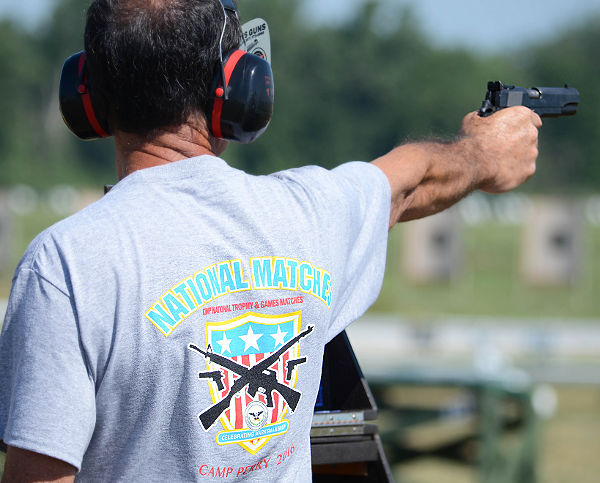
The USAMU’s SSG Greg Markowski won the Service Pistol EIC Match with a score of 293-11X. Fellow USAMU team members SFC Lawrence Cleveland (286-5X) and SFC James Henderson (284-9X) finished second and third respectively.
In the .22 Rimfire EIC Pistol Match a USAMU shooter again took top honors. SFC Michael Gasser shot 293-5X to become the overall winner. Close behind, with identical 292-11X scores, were Jonathan Shue and SGT Ryan Franks. It’s notable that both Shue and Franks had many more Xs than SFC Gasser, the overall winner.
Talented shooters stood shoulder to shoulder on the firing line…

The license plate says it all — perfection at Perry is a 10X.

There were 480 registered competitors in .22 Rimfire EIC match.

USAMU Shooters won both EIC pistol matches (.22 Rimfire and Service Pistol).

Many U.S. Military Service Personnel attended the EIC Matches

It took decades of competition to acquire all those patches — that’s dedication to the sport.

July 16th, 2016

Every month, Shooting Sports USA offers a prize for the best photo caption supplied by a reader. See the photos on the Shooting Sports USA eZine. To be considered for the upcoming August 2016 issue, submit a witty/clever photo caption to shootingsportsusa [at] nrahq.org no later than July 20, 2016. The winning caption earns its author a Nikon Spot-On Wind Meter. This handy, high-tech device connects to your smart phone, providing wind data and ballistics solutions with Nikon software. This month’s photo-to-be-captioned is shown below, along with the June winner. See future contest photos in the Shooting Sports USA eZine or the monthly print magazine.

Nikon’s new Spot On™ Ballistic Wind Meter plugs directly into the headphone port on most popular smart phones. The Spot On Wind Meter reads both wind speed and direction and inputs the data directly into Nikon’s free Spot On Ballistics Mobile App (available for iOS and Android). This allows you to quickly determine and calculate wind drift corrections without needing a separate, dedicated wind meter. When not in use, the Nikon device easily fits in a pocket.

July 12th, 2016

The Talladega Marksmanship Park boasts Kongsberg electronic targets at 200, 300, and 600 Yards.
The CMP’s Talladega Marksmanship Park — the most impressive (and high-tech) shooting facility in North America, will be featured on this week’s episode of Shooting USA television. The show tours the Talladega facility and spotlights Talladega’s first-ever competition, the inaugural D-Day Memorial match last year. (Talladega recently held its second D-Day match on June 4-5, 2016).
| Shooting USA Television Air Times (Wednesday/Thursday) on the Outdoor Channel: |
Eastern Time: 9:00 PM, 12:30 AM, 3:00 AM (Th)
Central Time: 8:00 PM, 11:30 PM, 2:00 AM (Th) |
Mountain Time: 7:00 PM, 10:30 PM, 1:00 AM (Th)
Pacific Time: 6:00 PM, 9:30 PM, Midnight
| |
John C. Garand Match — Part of D-Day Memorial Event

Talladega is known for NASCAR and its super-speedway, but now there is another destination for sports enthusiasts, thanks to the Civilian Marksmanship Program (CMP). Congress created the CMP in 1903 with an original mission to promote civilian marksmanship, but in its 110-year history, the CMP never had its own range. So, the organization built the CMP Talladega Marksmanship Park, a $20 million sports facility, one of the most advanced shooting sports facilities in the world.


“You won’t find another place like this in the United States, and I think in most of the world,” says Rep. Mike Rogers of Alabama. “You know, I brag on the Talladega 500 all the time, being the fastest NASCAR track, and now I’ll be able to brag about having the best, if not the most world-class marksmanship facilities in the world here in the same neck of the woods.”
July 11th, 2016

Establishing zero at 300 yards. Dennis says: “Wow you can really drive that crosshair into the center of the bull with ease” with the 4.5X optic.
Dennis Santiago recently received the all-new Nightforce Competition SR Fixed 4.5x24mm Service Rifle scope. He will be using this at Camp Perry soon, so he needed to get zeros (and click values) for all his yardages. Off he headed to the Burbank Rifle and Revolver Club (BRRC) for a Zero Session.
After establishing a 100-yard, base-line zero from the bench, Dennis put on his sling and jacket to work out to 200, 300, and 600 yards. When shooting at 200, Dennis said: “The target is huge in that 4.5X scope. Fun to drive. Next stop NRA Week at Camp Perry!”

Above you can see Dennis working up two elevation zeroes for 600 yards. First he fired a center hold using the crosshair inside the circle to “pie” the bull. Next, he shot with a 12 o’clock hold using the lower leg of the crosshair to bisect the target. You can see the target at 600 yards in the top right of the photo.

Zeroing Task accomplished, Dennis is ready to take this rifle to Camp Perry for the National Championships. He says: “In the end, it’s always about your handy-dandy notebook.”
New 2016 CMP/NRA Rules Allow 4.5X Optics
Dennis Santiago explains the Service Rifle rule changes that now allow scopes up to 4.5X max magnification (and max 34mm objective):
“Per the 2016 Rulebooks of the CMP and NRA, today’s Service Rifle is now defined to include an M-16/AR-15 variant with an optical sighting system not to exceed 4.5X magnification. So, this optic-equipped rifle goes head-to-head with the match-tuned M-16A2/AR-15A2 iron sight guns in the same class. The rules were updated to take into account that some military branches no longer train service members to shoot iron sights as their primary marksmanship method and have switched to reliance combat optics. The rules were debated and tried in 2015 and codified at the beginning of this year. This will be the first Nationals where the old and new generation guns compete side-by-side.
Here is my personal prediction: There will be improved scores by Expert class shooters who figure out how to work with optics jumping into Master class. At the High Master level, there may be a slight rise in numerical scores but there will be a massive jump in X-Count. EICs will remain the all-out race they’ve always been; whoever makes the fewest mistakes wins the day.”
July 7th, 2016

On Monday, July 11th, the CMP and NRA host the 2016 First Shot Ceremony, the official opening of the National Trophy Pistol and Rifle Matches at Camp Perry, Ohio. The ceremony kicks off at 9:30 am and is open to the public.

The event begins with music from the 122nd Army Band. Next come aerial fly-overs by a Navy TBM Avenger, a WWII-era B-25 bomber, and the Yankee Air Museum’s Yankee Lady B-17. Vintage military vehicles (jeeps and tanks) will also be on display during the ceremony.
After the aircraft, a salute will be fired from four artillery pieces, which span 200+ years of the nation’s history. The “Guns of July” will include: War of 1812-era cannon, Civil War-era cannon, modern-era 37mm anti-aircraft gun, and last but not least, Camp Perry’s own 70mm cannon.
The distinguished First Shot Speaker will be CMP Board Member, Oscar Mahlon Love, a former Commissioner of the New Mexico State Police and Civilian Aide Senior to the Secretary of the Army. After the speech Mr. Love will fire the first official shot of the National Matches down Rodriguez Range.
Birds-Eye View of Camp Perry Ranges
We know many of our worldwide readers may never have a chance to visit Camp Perry in person, but they are still interested in this historic facility on the shore of Lake Erie, near Port Clinton, Ohio. If you’ve always wanted to see what Camp Perry looks like, here are a series of “Birds-eye” photos taken from the Beach Tower.


Photos Courtesy Civilian Marksmanship Program.
July 6th, 2016

This Wednesday, July 6th, Shooting USA features End of Trail, the Cowboy Action World Championship. Hosted annually at the SASS Founders Ranch in New Mexico, End of Trail attracts over 700 shooters, hailing from 50 states and many foreign countries. The event is part shooting competition, part family reunion, and part Wild West jubilee. SASS, the Single Action Shooting Society, is one of the most popular shooting organizations on the planet, having issued over 90,000 member badges. This special Shooting USA broadcast of the 2016 End of Trail airs at 8:00 PM, 11:30, and 2:00 am (Thursday) Central Time on the Outdoor Channel. This year’s End of Trail took place June 16-26, 2016.
Past Champions Randi Rogers (“Holy Terror”) and Spencer Hoglund (“Lead Dispencer”)

If you like multi-gun competition, you’ll enjoy watching Cowboy Action Matches. The top male and female shooters are experts with three kinds of firearms: Lever Rifle, Single-Action Revolver, and Shotgun (which can be a double-barrel side-by-side, or a pump, or even an 1887 lever-action). Generally speaking the guns must be originals or reproductions of pre-1900 designs to be used in competition (however 1911-style pistols are allowed in “Wild Bunch” side matches). A typical stage will require 5 shots from each of two six guns, ten rounds from the rifle, chambered in a pistol caliber, and 6 to 8 shotgun rounds.

24 Rounds from Four Guns in under 13 Seconds
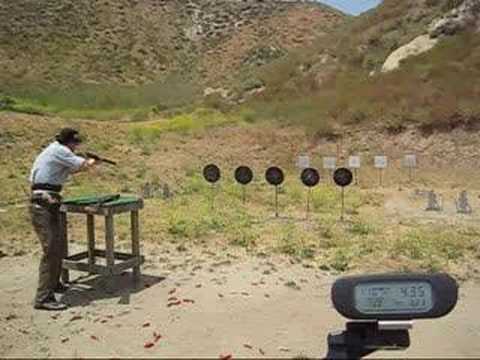
To give you an idea of the action you can see on Shooting USA, here is a video of past world Champion Spencer Hogland, aka “Lead Dispencer”. In this video, Spencer fires 24 rounds, with four guns, in just 12.81 seconds (look at the timer in lower right corner). Spencer shows blazing speed with his lever gun and note how quickly he loads his shotgun. Fast loading is key to a successful stage run. Unlike modern multi-gun comps, normally Cowboy Action Shooters must start with empty shotguns.
July 5th, 2016

Cartridge Choices for F-Class Competition
By Emil Kovan
Kovan Match Rifles LLC, www.matchrifles.com
There are hundreds of cartridge types capable of winning in F-Open. For F-TR you can shoot either the .223 Rem or .308 Win, but you have many load options. This article will focus on proven choices, currently used by the top F-Class shooters in the world. Our discussion will analyze cartridge selection based on the four different F-Class sub-disciplines: Open Mid-Range, Open Long-Range, F-TR Mid-Range, and F-TR Long Range.
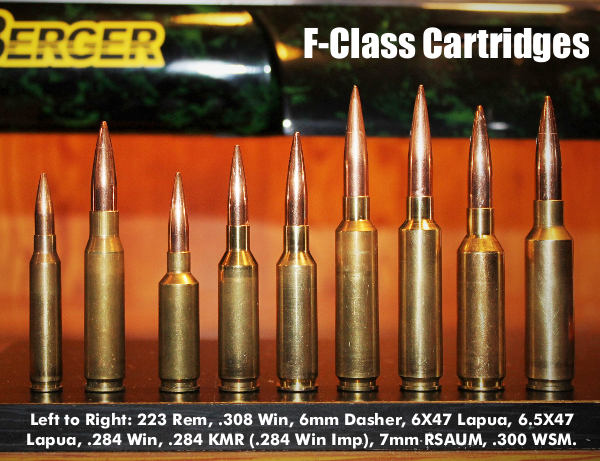
Click image to view full-screen photo.
Mid-Range F-Open Cartridges
For starters, a .300 WSM is certainly capable of winning mid-range matches but it is not ideal. So what is ideal, and why? F-Class Mid-Range matches usually are usually shot at 300, 500, or 600 yards — or all three. At those distances the 6mm and 6.5mm cartridges rule. In moderate conditions, the 6mm Dasher is unbeatable. Its low recoil along with its super grouping ability and good ballistics make it my number one choice for Mid-Range.
Best bullets for the 6mm Dasher are: Vapor Trail 103gr, Berger 105 Hybrid, 108 BT, and 105 VLD (hunting). Best powders are: Varget, H4895, and Reloder 15.
Choices for Mid-Range in Tougher Conditions:
We all know that conditions are not always “moderate” that’s why something a little bit bigger will save you a “Nine” or two. The 6.5X47 Lapua was designed for 300-meter competition, but as soon as it was released, it was adopted by F-Class, benchrest, and tactical shooters. It offers great ballistics with very low recoil and big “accuracy window”. Lapua makes great brass for it (no surprise there) and Berger makes great bullets: 130gr VLD, 140gr VLD, 140gr Hybrids. Best powders in most barrels are Varget and H4350, I don’t use double-based powders such as Reloder 17 and the Vihtavuori N500 series because of their unpredictable performance day to day (greater temp sensitivity).
The 6.5X47 Lapua necked down to 6mm is also a great option for mid range matches. I was able to easily get 3200 fps with 105 hybrids and H4350.
Choice for Long-Range F-Open Competition
In Long-Range F-Open Class (out to 1000 yards), the big, high-BC bullets rule. If I had to pick one cartridge for F-Class (both mid- and long-range) I would pick the .284 Winchester or one of its variants. The .284 Win is currently dominating in F-Open competition. It offers great barrel life, it is super-easy to tune and its recoil is very manageable. The best bullets for it by far (in my opinion), are the Berger 180 Hybrids. But Sierra’s new 183gr MK bullet (with factory-uniformed meplats) seems to perform very well as does the Berger 180 VLD. Best powders for the .284 Win are H4350 and H4831SC.

Long-Range Only F-Open Cartridge
As much as I like the .284 Win, for long-range competitions I like the .300 WSM even more. If you look at a .300 WSM and a 6mm Dasher side by side, they appear almost identical in geometry — the .300 WSM looks like an “super-sized” Dasher. Both cartridges are currently the “darlings” of long-range benchrest due to their extraordinary grouping ability and huge “node’’ windows. Big accuracy windows allow loads to perform well in different conditions and geographical locations. That’s obviously very important if you travel to compete. The .300 WSM loaded with Berger 215gr or 230gr Hybrids is very tough to beat at long range, and it is currently my number one choice.
The 7mm RSAUM is another outstanding long-range round. It resembles a 6BR on steroids and it is almost as easy to tune. Best bullets for it are Berger 180gr Hybrids, 195gr EOLs, and Sierra’s 183gr MatchKing. Best powders for the 7mm RSAUM are: H4350, H4831SC, and VV N160.
Top Caliber/Bullet Combos for F-TR
In F-TR competition, the choice is clear — a .308 Win throated for Berger 185gr BTLRs and 200gr Hybrids will win in mid-range AND long-range comps. Many championships have been won, and many records set with those two bullets in the .308 Win. To quote Danny Biggs (a two times FTR National Champion) “The 185 BTLR is the best bullet for .308 Win ever made”.
The Berger 215gr Hybrids have been used to win many competitions including recently the 2015 F-Class Nationals. Bryan Litz won both the Mid-Range and Long-Range 2015 Championships using 215s. Bryan’s rifle is shown below:

I recommend chambers throated for the 185/200 grain projectiles over the 215/230 grain bullets. The reason is that if you have your barrel throated out for the 215s or the 230s, you could have a “slow” barrel and max out on pressure before the desired velocity is reached. Optimum freebore for the 230s is too long for the 185/200s, so you would be limited to using only 215/230gr bullets in that barrel.Furthermore, the recoil increase with heavier bullets is substantial, causing the rifle to be more difficult to shoot.
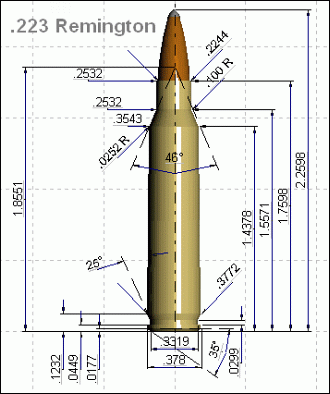 .223 Rem — Not A Competitive Option .223 Rem — Not A Competitive Option
I would stay away from the .223 Remington. On paper the 90gr VLD will shoot inside most .308 Win loads even at a 1000 yards. But in reality, on average, the .223 Rem, regardless of what powder/bullet combo is used, cannot compete with the .308 Win. [Editor: The equipment lists at major F-TR matches will confirm Kovan’s conclusion here.]
Conclusion (and Other Options)
This article covers only the (currently) most popular cartridge/bullet combos for F-Class (F-Open and F-TR). As I said in the beginning, many cartridge types are capable of winning but are not listed due to their low popularity, case design, or lack of quality components. All of the above information is based on my personal experience and it is meant to help new shooters choose the right cartridges for F-Class matches. Thanks for reading and good luck — Emil Kovan
 Emil Kovan Competition History: Emil Kovan Competition History:
– 2014 F-Class Open National Champion
– 2015 F-Class Open National Championship, Silver Medal
– F-Class Open National Championship Teams, 2015, 2014, 2013, Shooting Team Member
– Over 15 wins in Regional and State Championships in Palma, F-TR, F-Open
– 2013 U.S. National Team Member
– 2017 U.S. National Development Team Member
July 5th, 2016
 Did you know the NRA Competition Database lists nearly 7,000 national shooting records? Did you know the NRA Competition Database lists nearly 7,000 national shooting records?
Why are there 7000 records? Start with the fact that there are a host of different NRA disciplines: Air Pistol, Action Pistol, High Power Rifle, Smallbore Rifle, Fullbore, just to name a few. Within each discipline there may be records for metallic sight, any sight, rapid fire, slow fire, prone, standing, and other variations. And then there may be separate records for indoor, outdoor, distance, and number of shots fired. Then add team records on top of the individual records. Finally, there are separate records for all the NRA classifications: Open, Civilian, Service, Woman, Junior, Senior, Police, and so on….
The task of validating and registering so many different records is daunting. And the work never stops. Consider this — the NRA sanctions 11,000 tournaments each year. This means that new record claims are being submitted throughout the year.
Report based on story by Kyle Jillson in NRAblog.com.
July 3rd, 2016

Harold Seagroves’ 3-time Hickory Ground Hog Match-Winning Rifle
At clubs across the country, varmint fun shoots (also known as “groundhog matches”) are becoming more popular every year. In these matches, usually shot from the bench, you engage paper targets, clay pigeons, steel “critter” silhouettes, or some combination of paper and reactive targets. Shooters like these matches because you can shoot a wide variety of rifles, you don’t have to spend a fortune to be competitive, and there is fun for the whole family. Rules are inclusive — you won’t be turned away because your rifle is two ounces overweight. A large percentage of the match fees usually go back to shooters in the form of cash prizes. And the level of camaraderie is high.
 Inclusive Rules Welcome All Shooters Inclusive Rules Welcome All Shooters
Forum member Danny Reever has explained the appeal of groundhog matches: “We don’t have a governing organization, or have to pay $50 a year membership just to compete in matches. Sure the rules vary from club to club, but you adapt. You build your rifle (or even pistol) to fall within the rules of either the clubs you shoot, or to fit all the clubs rules. If not there still is a class for you to compete in. If your factory rifle doesn’t conform to the rules, it can shoot in a custom class. If your custom doesn’t make weight for Light Custom (usually 17 pounds and under), you shoot it in heavy custom class. If you want to try your Tactical rifle or F-Class rig, bring it out there’s a class you can shoot it in. If you don’t like one club’s rules, you just don’t shoot there. It’s no big deal.
There are no National records, or Hall of Fame points — just individual range records. If you want to shoot in BIG matches (with big prizes), there is the Hickory Ground Hog Shoot among others. If competition isn’t your bag, many clubs offer mid-week fun matches that you can shoot just for fun. You shoot the same targets but with a more relaxed atmosphere with no time limits.

The best part is you don’t have to shoot perfect at every yardage. You always have a chance because in this sport it really isn’t over until the last shot is fired. Typically ALL the entry money goes to the host club, with much of the cash returned back to the shooters via prizes. Junior shooters often shoot for free, or at a reduced rate. That lessens the burden on the family’s wallet (not a small thing in these economic times). The low entry cost also encourages young guys to get involved who don’t have $4000 custom rifles or the money to buy them.
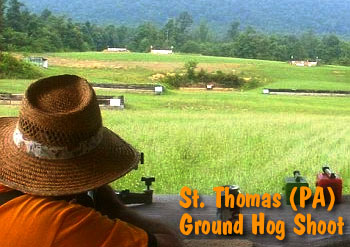 More Fun, Fewer Complications More Fun, Fewer Complications
There isn’t a sea of wind flags to shoot over or to put up and take down. If the range has a couple of flags so much the better, but after all it is a varmint match. No pits to spot shots and slow things down either. If you can’t see your hits through your rifle scope or spotting scope well you are in the same boat as everybody else. That’s what makes it interesting/ sometimes frustrating!
As for calibers, I’ve seen everything from .223 Rem to .338 Lapua and everything in between. Our range record at my club is held by Bill Slattery, who shot a 147 out of a possible 150 with a 22BR 13 months ago. That’s on a target with a 1.250 ten ring at 200/300/500 meters. That record will stand for awhile, and shows you that some very good shooting is done at groundhog matches.
The best part is it’s laid back, everyone gets along, there is no place for big egos here. We who shoot the Ground Hog Matches don’t begrudge the other organizations and shooting disciplines, or those that shoot in them, heck some of us cross over and compete in registered benchrest matches too. Life’s too short, live and let live is our motto so just come out and have fun!”
Fellow Forum members chimed in:
FdShuster: “I’ve competed in our local ground hog matches for several years now, have introduced a number of others to them, and we all enjoy them and more importantly, continue to learn from them. Distances are as close as 100 yards, (with a 5/8″ 10 ring) to as far as 500 meters. With a 2″ 10 ring. Wind, mirage, bullet trajectories, all make them a challenge, and unlike shooting for group, where the group can be anywhere on the paper, in this game they must be very small, but also in the 10 ring. With the different classes — Custom, Factory, Hunter — almost any rifle will fit in somewhere. And Danny is correct about the friendly attitudes. I’ve seen competitors go out of their way, and jeopardize their chances of winning, to help someone else who may have a problem on the line.”
 Mike C: “Here in Texas, our version of groundhog matches involves shooting at clay pigeons at 400 yards. We use 60mm, 90mm, and 108mm clay pigeons attached to target boards. You have 10 shots to break 8 clays, with a seven-minute time limit. We have developed a good following at these matches. In past years, a Shooter of the Year Award was given based on the Aggregate score for three of our matches, which are held in Utopia, San Angelo, and Huntsville.” Mike C: “Here in Texas, our version of groundhog matches involves shooting at clay pigeons at 400 yards. We use 60mm, 90mm, and 108mm clay pigeons attached to target boards. You have 10 shots to break 8 clays, with a seven-minute time limit. We have developed a good following at these matches. In past years, a Shooter of the Year Award was given based on the Aggregate score for three of our matches, which are held in Utopia, San Angelo, and Huntsville.”
40X Guy: “I would have to say upon finishing my first year ever of groundhog matches, that the average Joe can grab his Swift, or his 25-06, or his 22-250 and go rip some holes in paper. Everybody is having a good time and its a gathering of like-minded people who have all shot chucks at some point or another. Even if one does not win the match, you can look at your target and say “darn that chuck target has five holes in him at 400 yards and he’s dead” just as well as the next guy shooting a custom bench rifle. Everybody fits in and everybody, 8 to 80, is having fun! It is addictive and will drive you to spend your hard-earned currency for sure!”
July 1st, 2016

Applied Ballistics team dominates the King of 2 Miles match: Mitchell Fitzpatrick (1st Place), Bryan Litz (2nd Place), and Paul Phillips (4th Place).
The King of 2 Miles event has come to an end, the scores have been tallied, and Team Applied Ballistics finished first, second, and fourth. That’s dominance. The “Top Gun” was young Mitchell Fitzpatrick, who blitzed the field with his impressive .375 Lethal Precision Arms LLC rifle shooting prototype solid 400gr Berger bullets. Mitchell built this rifle himself using a McMillan A5 Super Mag stock. Remarkably, Mitchell nailed first- and second-shot hits at the 2477-yard target, a full 1.4 miles away. That’s amazing shooting. The photo below illustrates the vast distance from firing line to target.

Mitchell gave credit to his team-mates: “We had the best ballistic solutions possible thanks to the work done at Applied Ballistics LLC by the one and only Bryan Litz. Bryan is also a world-class wind coach and world champion shooter. Paul Phillips, also a world-class wind coach, world champion shooter, and just an all-around class act. Paul was invaluable to making the wind calls we needed to win this match. One of the most important parts of any rifle system is the projectile… Berger’s new prototype .375-cal 400gr projectile we have been developing gave us a monumental ballistic advantage. [It was] without a doubt, a key to our success.”
Berger Ballistician Bryan Litz took second place shooting a .338 Edge (the only .338 rifle in the Finals). Durvin Wick finished third, while Paul Phillips, shooting Bryan’s rifle, placed fourth overall.

Report by Bryan Litz, Team Applied Ballistics
The 2016 King of 2 Miles event is in the books. Today the Top 10 teams engaged targets at 2011 yards, 2477 yards, and 3375 yards. All three Applied Ballistics teams had hits at 2011 yards, and two out of three of us scored first-round hits at 2477 yards! Note that no competitor (from any team) hit the two-mile (3375-yard) target, but that gives us a goal to shoot for next year. Many factors contributed to the success of the Applied Ballistics shooters in this event:
1. Teamwork. We shoot together on the U.S. Rifle Team. The standardized communication protocols between coaches and shooters was a big advantage in this timed event. We had excellent team-work, and are already discussing ways to improve and adapt our approach to ELR events.
2. Science. Applied Ballistics specializes in the science of accuracy. First round hits in this event are scored highly and you can get more first round hits if you know your ballistics. The top two shooters in this event both had first round hits at 2477 yards today which was key, and is not possible without highly accurate ballistic solutions.
3. Ballistic Performance. The performance of Mitchell Fitzpatrick’s .375 Lethal Precision Arms LLC rifle with the prototype 400 grain Berger Bullets solid is unmatched (G7 BC of 0.56 at over 3000 fps). This performance helped Mitch win the match by a sizable margin. The other two Applied Ballistics teams were shooting Bryan Litz’s .338 Edge with the Berger Bullets 300 grain Hybrid. Despite being a smaller caliber (compared to the .375s, .416s, and .50-calibers), the .338 Cal 300 grain Berger Hybrid proved to be a great performer.
There were quite a few big .50 Cals on the line, but a .375 topped the field. Sheri Judd photo.

Thanks to Eduardo Abril De Fontcuberta, Founder of the KO2M Event
We would like to thank all those who worked hard to make this event happen especially Eduardo Abril De Fontcuberta (shown below with Mitchell Fitzpatrick and Paul Phillips). Eduardo has worked hard to organize a great event that pushes the limits of ELR shooting in a fun and competitive way. We’re very grateful for the chance to participate and look forward to competing in the King of 2 Miles event next year. Also, thanks to Kelly McMillan for his support of our team. Kelly has been an awesome sponsor of our efforts here, as well as the U.S. Rifle Team, and the shooting community in general.

|


