Well folks, it’s July 1st already — the means we’re moving into “peak heat” summer conditions. It’s vitally important to keep your ammo at “normal” temps during the hot summer months. Even if you use “temp-insensitive” powders, studies suggest that pressures can still rise dramatically when the entire cartridge gets hot, possibly because of primer heating. It’s smart to keep your loaded ammo in an insulated storage unit, possibly with a Blue Ice Cool Pak if you expect it to get quite hot. Don’t leave your ammo in the car or truck — temps can exceed 140° in a vehicle parked in the sun.
To learn more about how ambient temperature (and primer choice) affect pressures (and hence velocities) you should read the article Pressure Factors: How Temperature, Powder, and Primer Affect Pressure by Denton Bramwell. In that article, the author uses a pressure trace instrument to analyze how temperature affects ammo performance. Bramwell’s tests yielded some fascinating results.
For example, barrel temperature was a key factor: “Both barrel temperature and powder temperature are important variables, and they are not the same variable. If you fail to take barrel temperature into account while doing pressure testing, your test results will be very significantly affected. The effect of barrel temperature is around 204 PSI per F° for the Varget load. If you’re not controlling barrel temperature, you about as well might not bother controlling powder temperature, either. In the cases investigated, barrel temperature is a much stronger variable than powder temperature.”
Powder Heat Sensitivity Comparison Test
Our friend Cal Zant of the Precision Rifle Blog recently published a fascinating comparison test of four powders: Hodgdon H4350, Hodgdon Varget, IMR 4451, and IMR 4166. The first two are Hodgdon Extreme powders, while the latter two are part of IMR’s new Enduron line of propellants.
The testers measured the velocity of the powders over a wide temperature range, from 25° F to 140° F. Hodgdon H4350 proved to be the most temp stable of the four powders tested.
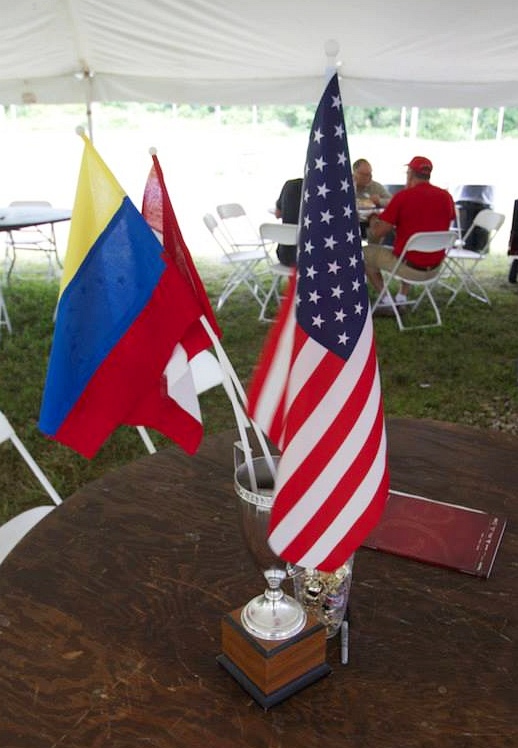
The largest field target event in the country comes to upstate New York next weekend. On July 8-10, the Crosman All-American Field Target Championship (CAAFTC) will be held at the Rochester Brooks International Skeet and Trap Club in Rush, New York. 0ver 100 air rifle and air pistol competitors will participate in the event hosted by Crosman Corporation. This event attracts top Airgunners from across the nation (and some foreign countries). Along with regular Field Target matches, there will be specialty side matches, plus a factory tour. The event is free to the public.
The CAAFTC is sanctioned by the American Airgun Field Target Association and is a featured AAFTA Grand Prix event. The 120-shot match has competitive rifle divisions based on allowable gun and support equipment. Here are the main air rifle classifications:
Hunter Division – rifle fires at a maximum 20 foot pounds of energy (FPE), shooter may use a non-attached bipod, non-restrictive clothing, and sitting stool. Open Division - maximum 20 FPE maximum rifle, shooter may wear a body harness, no bipod, 6″ maximum height seat. World Field Target Federation (WFTF) – similar to Open but shooters compete according to international standard of maximum 12 fpe for rifles. Freestyle Division – 20 FPE maximum rifle, no other restrictions. (This is new for 2016).
The pistol competition includes similar divisions based on shooting styles. Both rifle and pistol divisions include sub-classes based on the air rifle powerplant: piston driven or precharged pneumatic.
“If you want to see some of the country’s finest airgun shooters, this is the hottest event of the summer and it’s free for the public,” says Chip Hunnicutt, Marketing Manager for Crosman. “Alongside the world-class shooters, we’ll have enthusiasts simply having a good time and even parents bringing their kids for some good fun outdoors.”
The weekend begins on Friday, July 8th with the PyramydAir Gunslynger match at noon followed by the Quigley Bucket Challenge at 2:00 pm. A facility tour will be available at 1:00 pm at Crosman’s world headquarters located at 7629 Routes 5 & 20 in Bloomfield. The first round of the rifle match begins Saturday at 9:00 am.
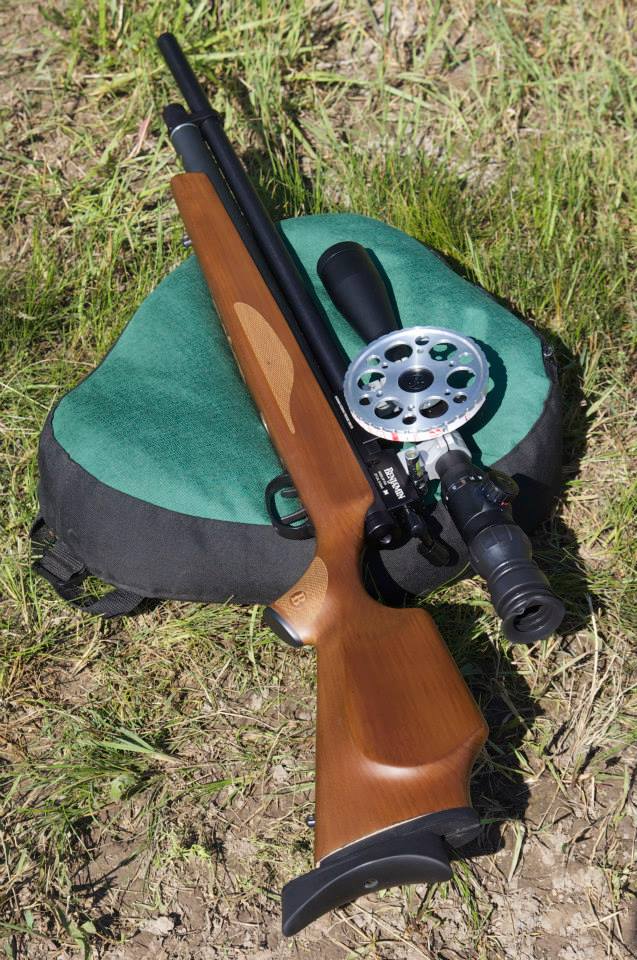
Tech Talk: Why the Big Side-Wheels on the Scopes?
Field Target rifles shoot pellets propelled by compressed air. These light-weight, low-BC projectiles drop very quickly, with a looping trajectory. In order to hit targets at distances out to 50 yards or so, you have to adjust your scope to compensate for pellet drop. But you can’t set the scope correctly without knowing the precise range to the target. This is the function of the big wheels on the side of the scope. Field Target Competitors use the parallax adjustment on high-magnification scopes to determine target range. The big wheel allows quick, yet precise parallax adjustment. Markings on the wheel show the shooter the scope settings required for the distance “dialed-in” via the over-size parallax wheel.
Location: Overlooking Columbia River in Colville, Washington area, (North of Spokane, WA)
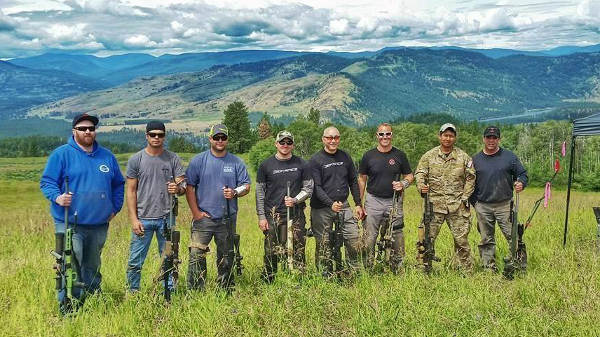
The annual precision tactical rifle event known as the Sniper’s Hide Cup (SHC) wrapped up on Sunday and it was quite an adventure this year. The match, held in a stunningly beautiful corner of Washington State, offered plenty of challenge for the competitors, along with memorable scenery. On the podium this year were: Nick Gadarzi (1st), 2nd Jesse Redell (2nd), and 3rd Brent Webley (3rd). Congrats guys!
These photos come from Frank Galli, Sniper’s Hide Founder, and our friend Steve Lawrence from 6.5Guys.com. Steve competed in Squad 8 with other members of the Northwest precision shooting community. Three members of the squad placed in the top 20. Steve placed 34th out of 148 shooters registered for the event.
Credit goes to Frank Galli of Sniper’s Hide, LLC, Mile High Shooting Accessories, and Carl Taylor of In Motion Targets for organizing, sponsoring, and hosting this event, as well as the dozens of Range Officers, volunteers, and companies who donated to the prize table which made this such a memorable match. The ‘Hide Cup will be featured on the Long Range Reality TV series.
Match Director’s Report — Sniper’s Hide Cup 2016
The 2016 Sniper’s Hide Cup was held in Colville, Washington in one of the most picturesque settings I have ever attended. We had 24 stages, 50 Range Officers, and 148 competitors at this year’s 2.5-day event. Starting off with heavy rain and fog, we quickly rolled in cool temps and partly sunny skies. It made for a great weekend of shooting.
Because Carl Taylor owns and operates In Motion Targets, we had 5 mover (moving target) stages. So every segment included a moving target stage, which was anywhere from 400 to 800 yards. This was a more traditional Field Course-type event, but the SHC was part of the PRS Series. Targets averaged from 300 to 1100 yards during the match, under challenging and unpredictable conditions thanks to the varied terrain. Competitors shot 360 degrees so they were subject to wind from every direction.
Congratulations to the Top 3, Nick Gadarzi, Jesse Redell, and Brent Webley. We thank key Sponsors Sig Optics, Swarovski, and Proof Research, along with Falkor, Prime Ammo, GA Precision, and Kasey Beltz with B&T Industries. They were Segment Sponsors.
We look forward to doing more in the Colville area next year. It was a laid back fun event.
— Frank Galli, Sniper’s Hide Cup Match Director
Steve Lawrence takes aim on a down-angle shot amidst the pines.
Steve (shown above) gave a shout-out to his sponsors: “We want to acknowledge the 6.5 Guys partners/sponsors who make it possible for us to bring viewers along with us on our precision rifle marksmanship quest. Travis Redell of R Bros Rifles who built me a superbly accurate, ultra-dependable match rifle, Jake Vibbert of JC Steel Targets, Glen Harrison and Mike Lee of Defiance Machine, Michael Ryan of Midsouth Shooters Supply, and Kevin Thomas and Adam Braverman of Lapua.
The King of 2 Miles Extreme Long Range (ELR) competition is underway at the NRA Whittington Center in Raton, New Mexico. Many of the nation’s top shooters are competing — aiming for hits on targets as far out as 3500 yards.
Day One went well. I was the third shooter this morning. Started out good with 4/5 hits at 1454 yards including a first-round hit which is worth a lot of points. The second target was only 100 yards further, but the wind cycled and I missed the first two shots. If you miss three shots on any target after the first, you’re out! So cautiously, and with help from my teammates/spotters Paul Phillips and Mitchell Fitzpatrick, I scored a third round hit at 1550 and was able to advance to the 1720-yard target. I manage to hit that 1720-yard target three out of three times.
The final target on Day One was at 2011 yards. Unfortunately I had three close misses. (Editor: Close only counts in horseshoes and hand grenades, Bryan…)
Twenty teams shot today and about 15 more will shoot the qualifying stage tomorrow then the top 10 from the two days will shoot on Thursday at over 3300 yards for the crown. My score of about 29,000 points is good. But I won’t know for certain if I’ve made the Top 10 until all tomorrow’s teams fire.
Mitchell Fitzpatrick hit every target on his first two shots and finished with 40,000 points on Day One. His farthest shots were just over 2000 yards.
So that’s my story so far, but that’s not THE story. Teammate Mitchell Fitzpatrick (with rifle above) topped the field today with a monster score, hitting all targets and racking up over 40,000 points! The prototype Berger .375-caliber, 400gr bullets and Mitch’s .375 Wildcat from Lethal Precision Arms LLC are a super high-performance combination that made short work of the ELR course.
Also, teammate Paul Phillips, who originally was only here to spot, has entered the competition. He’ll be shooting my .338 Edge tomorrow. Luckily I brought plenty of ammo!
Picture below is the full Applied Ballistics team with sponsor Kelly McMillan. Kelly has been great to our team and we’re looking forward to some future projects with him in ELR.
In all the King of 2 Miles event is very enjoyable. It’s a great place to come and learn from fellow ELR shooters what works and what doesn’t work at these ranges. The spirit of the match is education and growing the knowledge base and I think it’s doing a great job at that. We’re thrilled to be a part of it!
DAY 2 UPDATE: Top TEN Shooters
Results of King of 2 Miles After Day Two
The Top 10 listed below continue to Day Three. On this final day, the ten remaining competitors will engage targets from 1-2 miles. Paul Phillips reports: “I managed to finish today with the highest score of the day. That placed me 7th overall and allows me into the shoot-off tomorrow. Team Applied Ballistics place three shooters in the 10 Final: Michael Fitzpatrick, Bryan Litz, Paul Phillips.”
Virginia “Ginny” Thrasher, who will compete in the Rio Olympics this summer, showed continued dominance of her sport by winning the women’s national Air Rifle title last week at Fort Benning, Georgia, home of the USAMU. Mindy has been on fire in recent months. In April she won the 2016 U.S. Olympic Team Trials in Smallbore Rifle, securing a spot at the Rio Olympics. Prior to that, Ginny won individual NCAA titles in both air rifle and smallbore — as a freshman! This girl is a genuine phenom…
Thrasher, a member of the West Virginia University Mountaineers, has been on a tear of late. After winning the the Olympic Trials in Three-Position Rifle in April, she then earned two finals appearances at the Munich World Cup in May. Prior to that, Ginny’s sharpshooting earned her individual NCAA titles in air rifle and smallbore. With those performances, the talented freshman led West Virginia University to the collegiate team title and was named Top Performer of the 2016 NCAA Shooting Championship.
Her WVU coach, Jon Hammond, said Ginny has had an amazing run to Rio: “It’s an unbelievable freshman year to win NCAA championships and qualify for the Olympics. I would hazard she’s probably going to be one of the youngest members of the U.S. shooting team at the Olympics.”
Thrasher earned her way onto the national team with a stellar performance at the 2015 U.S. championships, where she won five medals, three in junior competition and two in open competition. That performance propelled her into her freshman season at West Virginia University.
This year’s USA Shooting National Championships includes more than 300 athletes vying for National Team selections and the upcoming Olympic and Paralympic Games in Rio De Janeiro, Brazil. Other shooters attending this year’s Nationals are looking ahead to the next Olympic Games — Tokyo 2020.
Mindy Miles (Weatherford, Texas) finished second at Nationals behind Thrasher in the women’s Air Rifle Event. Thrasher’s Team USA teammate at the Rio Olympics, Sarah Scherer (Woburn, Massachusetts), won the Final to finish third overall.
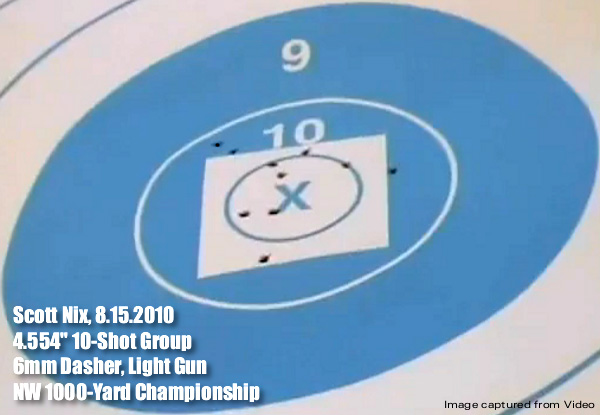
How well can the 6mm Dasher perform at 1000 yards when conditions are good, and the shooter is riding a hot streak? Well here’s a shot-by-shot record of Scott Nix’s 4.554″ 10-shot group shot at Missoula, Montana at the Northwest 1000-yard Championship a few years back. All 10 shots were centered for a 100-6X score. That’s about as good as it gets. If Scott had stopped after 5 shots, his group would have been under 3 inches!
Video Demonstrates Amazing 1000-Yard Accuracy
Watch the video. You can see the group form up, shot by shot. It’s pretty amazing. Scott’s first shot (at the 45-second mark of the video) was right in the X-Ring, and four of Scott’s first five shots were Xs. That’s drilling them! This video was recorded from the pits at the 1000-yard line, during record fire.
Berger Ballistician Bryan Litz has been preparing for the King of Two Miles match next week. He’s been out testing a VERY high-BC bullet — Berger’s new prototype .375 caliber 400-grainer. In the photo above, you can see Applied Ballistics intern Mitch Fitzpatrick (flanked by twin LabRadar chronos) shooting at a target set at 2400 yards. Next week, at the King of Two Miles event, the challenge will be even greater — Bryan and his team will be shooting out to roughly 3600 yards.
Bryan reports: “We’ve been preparing for the King of Two Miles match next week. Last Friday we shot 2400 yards at Thunder Valley Precision in Ohio, measuring time of flight and refining the custom drag model for our bullet. We are logging flight times over three seconds and the bullet is still supersonic at 2400 yards! Tomorrow we’re shooting 1800 yards as a final verification before we load up and begin traveling out west.”
OPTICS for Extreme Long Range Bryan is running Nightforce ATACR scopes on his .375 rifles. These ATACRs offer 120 MOA (or 35 Mils) of elevation. That’s impressive, but you still need more “up” for these extreme distances.
Bryan notes: “No scope has enough elevation to dial direct to two miles even with these large-caliber, high-performance rifles. You need some kind of external adjustment, or use a steep rail (e.g. +80 MOA). This works but can sacrifice your ability to zero under 1000 yards.”
This video shows a hit at 2400 yards with the .375-caliber bullet. The target is 8’x8′ square. The targets Bryan will shoot at next week’s King of Two Miles competition will be up to 1200 yards further than this. (Two miles is 3520 yards).
If you’re interested in this kind of Extreme Long Range shooting, consider attending the Applied Ballistics Seminar. The next seminar will be held July 18-19 in Michigan. Bryan says: “We’ll be sharing our experiences and lessons learned in the Two Mile shooting match among many other things we’re working on.” CLICK HERE for Seminar INFO and Registration.
For the International Benchrest Shooters (IBS) by Frank Danisienka
The IBS Executive Board has voted to create two new awards. These awards recognize the significant performance of a select number of shooters. Patches for Score shooting a perfect score of 750, and a perfect target of 250-25X, were designed by the board. To score 250, you need to shoot five (5) tens on each of the five record targets at a particular yardage. To score 750 you need to do that at all THREE yardages — 100, 200, and 300 yards. Certificates accompanying the patches document the commitment to excellence and dedication by these shooters to our sport.
Perfect 750 Multi-Yardage Score — A Rare Occurrence
In the long history of IBS competition only 16 members have shot a perfect score of 750 in one match! That’s 250 at 100 yards, 200 yards, and 300 yards. This very select group of shooters includes: Al Weaver, Rod Morton, Dave Short, Dennis Collins, Ken Livengood, Wayne Shaw, Dick Spencer, Hal Drake, Kim Llewellyn, Shaun Shank, Roy Hunter (2), Dean Breeden, John Bosley, Wayne France, Ricky Read and John Cascarino.
Dean Breeden is one of only 16 Shooters to have recorded a 750 total score in a match.
All Xs — the Perfect Target, 250-25X
The remarkable feat of shooting a perfect 250-25X target has been accomplished 37 times by 26 members. They are: Dennis Collins (2), Ted Parreco, Jeff Buchannan, Carl Baker, James Goody, Joe Enterkin, Rich Whiteash, Dean Breeden (2), David Apple, Al Weaver, Rod Morton, Mike Bigelow, Ken Livengood (3), Roger Avery (2), Joe Pellegrene, Mark Ludinsky (3). Herb Llewellyn (2), Jackie Stogsdill, Hal Drake (2), Johnny Lorick, Ron Collins, Wayne France (2), Shaun Shank, Steve Jaynes, Kevin Donalds Jr., Randy Jarvais (2).
Our sport continues to evolve toward perfection both in the quality of the equipment and the skill of our members and these awards recognize them for their accomplishments.
22nd Bud Pryor Memorial Matchby Dick Grosbier
Saturday June 11th was the 148th running of the Belmont Stakes in New York, and the 22nd running of the Bud Pryor Memorial Match at Thurmont, Maryland. Since this is a shooting website, I will be writing about the “Bud”. This year’s offering was a two-day match with 100-yard and 200-yard relays on Saturday followed by the 300-yard match on Sunday. This was a return to the format used from 1994 until we started having to turn shooters away in 2004.
It was typical “Bud” weather — hot well into the mid-90s on Saturday. Sunday was considerably cooler and with extremely challenging wind conditions all day long. There was no rain on Saturday but a big threat of a thunderstorm on Sunday. Luckily the thunderstorm held off as the shooters had their hands full just dealing with the high winds.
Wayne Lewis from South Carolina took the early lead in Varmint For Score (VFS) class, by winning the 100-yard stage with a fine 250-23X score. Wayne France, Dave Short, and Jim Cline were right behind him with 21X each. K.L. Miller won the 100-yard event in Hunter class with a 250-16X Score. Millers’s score with his 6X power-scoped rifle would have put him in the top half of VFS class. That’s impressive shooting with a low-power optic.
Pennsylvania shooter Dave Short won the 200-yard VFS with a 250-8X. Paul Bielec took second place honors with a 249-4X. Unfortunately Paul had a misstep at 100 yards on the final match. Cross-firing onto the target of the empty bench to his right and incurring a 5-point penalty marred his otherwise excellent performance for the weekend. Paul’s situation left Dave Short as the only shooter who was not at least two points down going into the 300-yard section on Sunday. Meanwhile in Hunter Class, K.L. Miller trudged along, beating second-place Orland Bunker with a 243-0X to Orland’s 241-6X.
Here are some of the top shooters. Left to Right: Richard Sissel (300-yard VFS Winner), K.L. Miller (Hunter 1st Grand Agg), Hillary Martinez (3rd VFS Grand Agg), Dan Breedan (2nd VFS Grand Agg).
EQUIPMENT Report:
Notably, the top three shooters all used Vihtavuori N130 powder, not Hodgdon H4198, the “go-to” choice for the 30BR for many years. Could this start a trend? Federal 205m primers were used by nearly all, and BAT actions were favored by the majority of competitors. Most of the Top 20 barrels were Kriegers, but Brux barrels took the number two and three spots overall. There were mostly high-end March and Nightforce scopes on the line, but overall winner Dave Short ran a 36X Weaver, proving you don’t need to spend two grand on a scope to win a big match.
Bud Pryor Memorial Shoot Equipment List (Listed in Order of Grand Agg Score) Click Chart to View larger, easier-to-read complete Equipment List
Sunday was the 300-yard stage, this is always the big equalizer in a 100/200/300 match. As previously mentioned, conditions were unusually challenging Sunday. This was demonstrated by the fact that Richard Sissel won the Aggregate with a 243-3X. Dave Short was a close 2nd with a 243-2X. Dean Breeden & Michael Clayton also turned in 243s; after that the scores fell off fairly fast. Back in Hunter Class once again K.L. Miller finished on top with a 238-1X. Scott Garman from Maine turned in a nice performance with a 236-3X.
Grand Aggregate Results — Dave Short Wins Over Runner-Up Breeden
When all the scores were totaled, Dave Short easily won the VFS Grand Aggregate with a 743-31X, Dean Breeden was 2nd with 741-27X, Hillary Martinez 3rd with 739-31X, and 100-yard winner Wayne Lewis was 4th with 739-29X. It looked like Wayne had a second-place finish in he grand until the last target of the day when instead of dropping 1 point per target as he had been doing all day, he dropped 5 points moving him to sixth place. In the Hunter Class, K.L. Miller led the entire weekend. Miller’s 731-17X Grand Agg Score put a substantial distance between himself and second-place Orland Bunker.
File photo from 2014 Bud Pryor match.
All in all I think everybody had a good time (some better than others) and I believe most will be seen back in Maryland the second weekend in June 2017 for the 23rd Annual Bud Pryor Memorial. Unless perhaps they go to New York for a horse race.
About the Bud Pryor Memorial Match Bud Pryor was a fine gentleman who started shooting IBS matches in 1983. He was a machinest turned gunsmith who made friends and got many people started in shooting IBS registered matches over the next few years. Bud and Dick Grosbier ran the first IBS match at the Thurmont range in April 1983. CLICK HERE to see vintage photos of the 1983 match.
After Bud’s untimely passing a few years later, the club decided to put on a big match and dedicate it to him. As Thurmont is one of the few ranges around with 100/200/300 yard capabilities, we decided to put on a 3-yardage Grand Aggregate match. This was not as simple as it seems, since 100/200/300 was not an IBS-recognized Aggregate. After an agenda item was approved at an IBS winter meeting, 100/200/300 records were set at Thurmont. Over the years most records have stayed at this scenic range. There are a total of four IBS ranges now holding 100/200/300 yard matches in 2014.
Old “Number 2″ belonging to Ray Gross. Click Photo for full-screen Image.
Ray Gross is captain of the United States F-TR Team. While he’s mostly involved in F-Class shooting these days, that wasn’t always the case. Ray is an experienced service rifle shooter, who secured his Distinguished Rifleman Badge 21 years ago. Ray has shot many different rifles during his competitive shooting career, but the rifle above has a special place in Ray’s heart. This old semi-auto earned Ray his Distinguished Badge, and he’ll never forget that…
“I said goodbye to an old friend last week…
Affectionately known as ‘Number 2′, she is the rifle that I earned my Distinguished Rifleman Badge with in 1995 (#1159).
That rifle was also responsible for a fair amount of Venison in the ’90s, as well. But since then, she has spent a lot of time in the closet. Last time I got her out was to destroy a bunch of hard drives containing evidence collected during my Computer Forensics days. She deserved better than that.
I will miss the beautiful sound of all that American steel slamming into battery when I tripped her bolt.” – Ray Gross


 To learn more about how ambient temperature (and primer choice) affect pressures (and hence velocities) you should read the article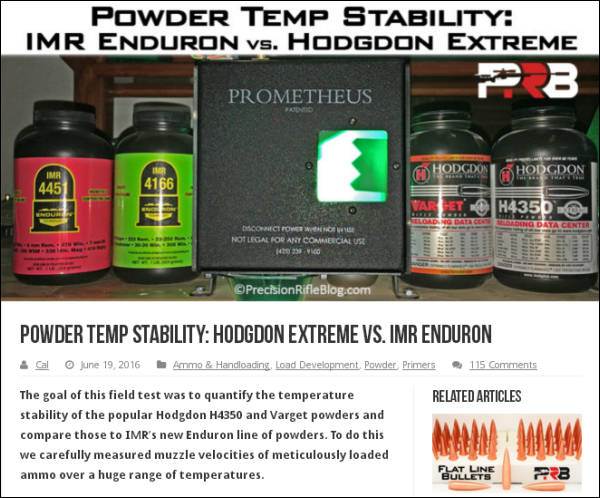







 Bryan Litz of


 How well can the 6mm Dasher perform at 1000 yards when conditions are good, and the shooter is riding a hot streak? Well here’s a shot-by-shot record of Scott Nix’s 4.554″ 10-shot group shot at Missoula, Montana at the Northwest 1000-yard Championship a few years back. All 10 shots were centered for a 100-6X score. That’s about as good as it gets. If Scott had stopped after 5 shots, his group would have been under 3 inches!
 Berger Ballistician Bryan Litz has been preparing for the
  Bryan is running


 Bud Pryor was a fine gentleman who started shooting IBS matches in 1983. He was a machinest turned gunsmith who made friends and got many people started in shooting IBS registered matches over the next few years. Bud and Dick Grosbier ran the first IBS match at the Thurmont range in April 1983.


