How fast can you shoot a bolt-action rifle? We doubt you can out-pace the ace “Stangskyting” shooters from Scandinavia. Some of these guys can run more than two rounds per second, including mag changes! That’s impressive. Bulletin reader C. Lemmermann from Denmark told us: “In Scandinavia we have this competition called ‘Stangskyting’. It’s similar to the ‘Mad Minute’ but we only have 25 seconds to hit the target [at] 200-300m distance with a 6.5×55 [target rifle].” In the Stangskyting video below a shooter named Børklop puts 16 rounds on target in just 25 seconds. (He starts with a round in the chamber and cycles through three, 5-round magazines). Børklop’s performance, with just a sling and iron sights, is impressive. He’s shooting a Sauer 200 STR target rifle with 5-round magazine. Note that Børklop manipulates the Sauer’s bolt with his thumb and index finger, while pulling the trigger with his middle finger. As good as Børklop is, some Stangskyting competitors are even better. Roy Arne Syversrud from Oslo, Norway tells us: “The best shooters in Norway can do 21 shots in 25 seconds, changing the mag three times.”
This Guy Could Break the “Mad Minute” Record
Børklop’s rate of fire, 16 rounds in 25 seconds, is the equivalent of 38.4 rounds in 60 seconds. That’s a notable number because the record for the “Mad Minute”, a British Army marksmanship drill, is 38 rounds in one minute. That record was set in 1914 by Sergeant Instructor Alfred Snoxall, and still stands. So as you watch Børklop, keep in mind that Snoxall shot that fast for a full minute with a Lee-Enfield nearly 100 years ago!
Børklop has an average cycling time of 1.56 seconds per shot, starting with a round in the chamber. To beat the record of 38 rounds, he would need to make seven mag changes in sixty seconds. All those mag swaps could reduce his average time per shot, making it difficult to achieve 38 hits in a minute. But, if Børklop could use 10-round mags with his Sauer STR, this guy has the skills to break the record.
To emphasize the capabilities of the WWI-era British shooter who set the record, Snoxall shot as fast as Børklop does, but Snoxall reloaded with stripper clips. Snoxall’s SMLE (Lee-Enfield) rifle also had relatively crude open sights and the stock was far less ergonomic than Børklop’s Sauer STR stock.
Here’s another Stanskyting video showing John O. Ågotnes shooting rapidfire with his Sauer 200 STR (Scandinavian Target Rifle) chambered in 6.5×55. By our count, Ågotnes manages 17 shots within the 25-second time period. That rate of fire (17 in 25 seconds) equates to 40.8 rounds in one minute!
The 20th Annual MGM Ironman Match was held in Parma, Idaho earlier this month. Over 250 shooters vied for honors at this ultra-challenging event. The “OLHOT” (Open, Limited, Heavy Optics, and Trooper) classes competed June 5-7, while a Scoped Tactical Match followed June 9-11. Present were top pros, privateers, juniors, ladies, plus elite military and LEO teams. This very demanding 3-Gun event features ten tough, high-round count stages, including a signature zip-line descent from a tower. Without question, the MGM Ironman is one of the toughest shooting matches on the planet.
Watch POV view of the Zipline Stage at 2016 MGM Ironman:
Father and Son Duo Dominates 2016 Event
This year’s OLHOT match was definitely a “family affair” for the Gibson clan. In the Trooper Division, 17-year-old Wyatt Gibson won convincingly, finishing 138 points ahead of the next-best shooter. Meanwhile Wyatt’s father Travis Gibson won the Open Division. In true ‘Like father, like son’ fashion, Travis dominated the Open field, finishing 121 points ahead of his closest Open-class competitor.
This year’s aptly-named Ironman was particularly tough with triple-digit temps and strong winds. Over the course of three grueling days, competitors completed ten tough stages, shooting in excess of 1100 rounds per shooter over the course of the match. EVERY stage required the use of ALL three guns with 100 or more rounds. The average time spent shooting on each stage was about seven minutes. The Ironman is long, intense, and you shoot till you drop! Mike Gibson, the founder of MGM Targets, and the “inventor” of the Ironman, has said: “This match isn’t for weenies or crybabies”.
The week-long Ironman event is broken into two, 3-day sessions, with five different divisions. The OLHOT (Open, Limited, Heavy Optics, and Trooper) sessions ran June 5-7. During the second segment, held June 9-11, 120 Scoped Tactical shooters took on the same demanding course.
MGM Ironman Has Unique Stage Designs
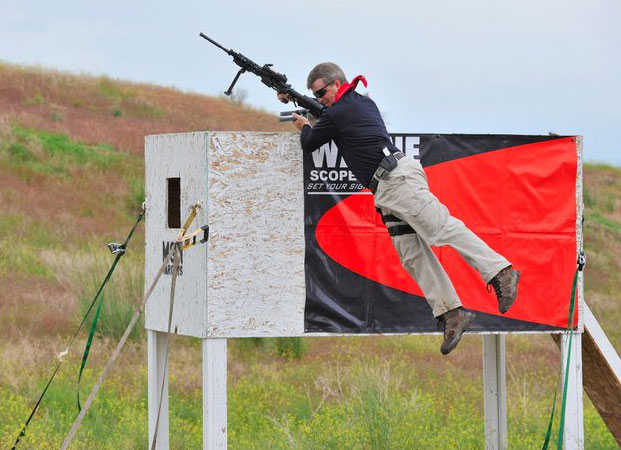
The MGM Ironman is an intense test of both shooter and equipment. Participants shoot a variety of classes and various scenarios including shooting from the back of a moving vehicle, from a 20-foot tower, while driving a golf cart, and while carrying a dummy.
Of course there are plenty of MGM-made reactive targets (photo right). The MGM Ironman regularly offers unique and demanding stages including firing a pistol from a zip line, and plunging down a steep slide from a 30 foot tower, rifle in hand. One stage involves carrying an 80-lb dummy over 100 feet and lifting it to the top of a six-foot platform before climbing it to engage rifle targets at distance. With creative and challenging stage designs and high round counts, he Ironman is truly a unique match.
Here is a video from the 2010 MGM Ironman. It shows many of the multi-gun stages, including the Zipline stage, filmed from multiple camera angles.
The Second Annual D-Day Match in Talladega was a big success. On the weekend of June 4-5, over 250 eager competitors arrived at the Civilian Marksmanship Program’s (CMP) Talladega Marksmanship Park for the D-Day Match commemorating the 72nd Anniversary of the Allied Forces’ landing at Normandy. This was a major match, attracting rifle and pistol shooters from throughout the country.
The Talladega range complex is an impressive, modern facility equipped with a computerized, high-tech Kongsberg electronic target system that plots shot locations and displays scores on monitors at each shooting station. For many competitors, this D-Day match was their first experience with electronic scoring. None complained about being freed from pit duties (the Kongsberg system eliminates the need to raise and lower targets or mark shots).
The John C. Garand Match has become hugely popular…
Georgia boys dominated the popular John C. Garand Match. Winning gold was SSG Jonathan O’Neal of Marietta, GA, who fired a score of 291-13X. Larry Sollars (Cumming, GA) followed closely behind, one point back with a score of 290-9X. Keith Schachle of Brooks, GA, shot a 288-7X for third.
Vintage Sniper Rifle Matches at Talladega
New this year, the D-Day Matches featured the inclusion of one of the CMP’s most popular competitions, the Vintage Sniper Match. During the event, a team of two uses a scoped Korean War, World War II or earlier “as-issued” military rifle to fire at distances of 300 and 600 yards. All shots are taken from the prone position with sand bag rests permitted. Each partner takes a turn as both shooter and spotter.
Over 60 shooters registered for the event’s first showing at the D-Day Matches. CMP Competitions Department manager Shannon Hand said, “The addition of the Sniper Match was very well-received by the competitors! It was a great event!”
Winning the Manual (bolt-action) Vintage Sniper Match were Bobby Robinson and Daniel Henk. In the Semi-Automatic Sniper Match, the team of Franklin Hines III and CMP North general manager Steve Cooper fired the winning overall score of 368-7X.
In pistol action, SSgt. Chad Ranton, 29, of Beaufort, SC, was the overall competitor in the .22 Rimfire Pistol EIC Match with a score of 276-5X. Notably, 15-year-old Katelyn Abeln proved she came to win after recording a score of 254-3X to earn Junior Division gold in the EIC Pistol Match. Katelyn was also the High Non-Distinguished pistol shooter of the match.
All persons are welcome to visit the Talladega Marksmanship Park, which is open to the public all year long. More information on the Talladega Marksmanship Park, including a facility map and description of facilities, can be found at the CMP’s Talladega Webpage.
Take a look at that unusual target below. We bet you’ve never seen one of these before. It’s a 50-Yard Sighting Target for the M1 Garand. It’s designed to allow a rifleman to confirm his zeros for multiple yardages all the way out to 1000 yards. But importantly, he can establish those zeros at a very “short” shooting facility, since the target is positioned at a mere 50 yards.
Here’s how it works. The target is placed at fifty (50) yards. You start at the bottom, aiming at the black circle. Then check your come-up table and work your way up, clicking step-by-step to the various horizontal lines set for 200, 300, 500, 600 and 1000 yards. This is NOT “spray and pray” — you need to have a pretty good idea of the clicks you need, based on your ammo’s ballistics. This target is calibrated for the U.S. Military M72 Ball Ammo. The targets are available from Champion’s Choice ($0.75 each) or from Creedmoor Sports (12 for $5.95).
Lapua’s Kevin Thomas used this target to get zeroed for the recent D-Day Anniversary Match at the Talladega Marksmanship Park. Kevin used the target for both his M1 Garand as well as his M1903A1 Springfield, both chambered for the .30-06 Springfield cartridge.
Zeroing at a Short Distance — How to Use the 50-Yard Sighting Target, by Kevin Thomas
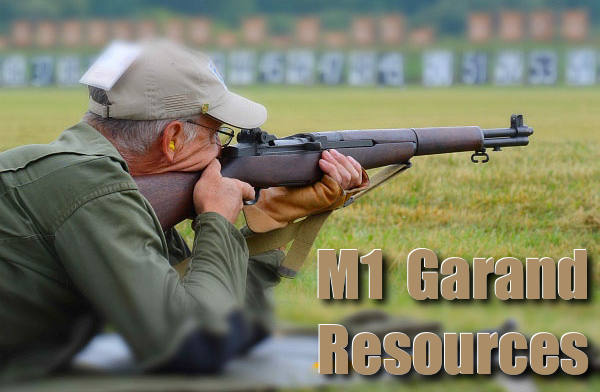
As part of my preparation for the Garand Match at the CMP’s Talladega Marksmanship Park, I needed to zero my new M1 Garand, but I was crunched for time. I didn’t have time to get to my normal range and confirm zeros at actual yardages. But a 50-yard zero target came to the rescue. Made for M1s using the M72 National Match ammo, the target allows the shooter to establish fairly good zeros at 200, 300, 500, 600 and 1,000 yards if you’ve got access to a 50-yard range.
I have no idea when these 50-yard Sighting Targets were first developed, but they’ve been around for at least as long as I’ve been involved in this game (longer than I care to admit). It consists of a tall target, with a smallish black bullseye located at the bottom center. The bullseye is an aiming point only. Extending through the top of the target is a vertical line that runs directly up the center, to nearly the top of the paper. Across this, there are intersecting horizontal lines that are marked 200, 300, 500, 600 and 1,000.
The target was designed for the M1 rifle using then-issued M72 National Match ammunition. This ammo launched a 173gr FMJBT bullet at approximately 2,640 fps. It was a good load in its day, supersonic out to the 1,000-yard line. While that ammo is fairly scarce these days, this isn’t a problem for the handloader. My standard match load for the M1 Garand utilizes the 175gr Lapua Scenar HPBT, and delivers remarkably similar ballistic performance. Thus my normal Garand load translates nicely to this 50-yard target. Yes, this is by design. No point in reinventing the wheel when Lake City has already established what works!
In use, the shooter sets the target up at a measured 50 yards, and (this is critical) checks the vertical line with a plumb bob or a carpenter’s level, to ensure that it is absolutely vertical. Once the target is set, the rifle is fired and the group noted. From there, it is a simple matter of zeroing it normally to bring the groups into alignment with the vertical line, at the elevation needed for a particular range. Once your group is hammering the intersection of the vertical line and the horizontal line marked “200”, you have established your 200-yard zero for that rifle. Record the number of clicks, and you’re good to go. Raise the impacts up to coincide with the line marked “300” and you now have a 300-yard zero as well. And so on, right up the target. Record those settings in your data book, and you’re ready to go to the range at the full distances. If done carefully, you may be in the X-Ring, but at the very least, you’ll be well-centered and ready to get some hard dope recorded for future shoots.
The same target can also be used with an M14/M1A, at least at the shorter distances. The ballistics of the M118 and the current M118LR are similar enough that this will get you on target at the full distances, probably requiring just a half MOA or so change from the 50 yard zero you recorded. Same bullets, moving at a slightly more sedate 2,550 fps, you’ll be in the ballpark at least.
Bryan Litz has recently popularized the short-range zeroing methods once again, reintroducing it to a new generation of shooters that may not have been aware of the old M72 short-range zero target. The same principles apply, and with the advent of the myriad computer ballistics programs and chronographs on the market today, any shooter can rapidly develop his own zero targets to accomplish the same result. But in the meantime, especially with the M1’s resurgent popularity, it’s nice to know that there’s an easy way to do things without a trip to a full-length range. The modestly-priced 50-Yard Sighting Targets can be ordered through Champion’s Choice or Creedmoor Sports.
Oh, and when I arrived in Talladega, yes, my zeros were good! All’s well that ends well. Safe Shooting! — Kevin Thomas
We know that many of our readers will be headed to Camp Perry soon to compete at the National Matches. Most Camp Perry rifle shooters will load their ammunition in advance and then pack the ammo in their car/truck for the drive to Perry. What’s the best way to hold that precious ammo? Well we like the big, lockable ammo crates from MTM. We think these are more way convenient than old mil-surplus metal cans, which are pretty narrow, limiting your options.
These stackable, lockable “Ammo Crates” hold up to 85 pounds of shooting supplies. Choose from two different versions. The Medium (4.5″-deep) Ammo Crate is good for smaller boxes of bullets, factory ammo, or shotshells, while the Large (7.25″-deep) Ammo Crate is ideal for packing the plastic 50-count and 100-count plastic ammo boxes. We like the Large-size, deeper crate for the added capacity since we typical carry our cartridges in the large 100-count MTM boxes with carry handles.
Purchasers like these big brown Ammo Crates. Read the user reviews on Amazon. One purchaser (B-Lo) states: “This thing is sweet and fully-loaded doesn’t flex and has good, tight locking lid/handles. A must have for anyone looking to store or transport larger quantities of ammo”. Another verified purchaser (Go-Navy) wrote: “5 Stars — I have purchased four of these over the last several months. Construction, dimensions, lock ability are all outstanding. When I saw them on sale today … I grabbed another four.”
Can a human, with a sling, shoot as well as a mechanical rest? The answer is “yes” (at least once in a great while) IF that sling shooter can deliver a record-breaking performance. Here’s an interesting tale of man vs. machine from our archives…
The USAMU posed an interesting challenge — could one of their shooters match the performance of a mechanical rest? Who would win in this battle between man and machine? You might just be surprised. At 600 yards, with an AR-platform rifle, the results can be remarkably close, based on targets provided by the USAMU. When clamped in a test rig, a USAMU M16A2 produced a 200-18X group with handloads. The USAMU says this was “one of our better 20-shot groups at 600 yards, testing ammo from a machine rest”. Can a human do better?
Remarkably, a human soldier came very close to matching the group shot from the machine rest. The photo below shows a 20-shot group shot by a USAMU marksman with sling and iron sights, using USAMU-loaded ammunition. The score, 200-16X, was nearly the same. As you can see, the USAMU rifleman didn’t give up much to the machine rest, even at 600 yards!
In fairness, this was no ordinary human performance. The 200-16X score was a new National Record set in December, 1994. This was fired by PFC Coleman in an Interservice Match at Okeechobee, Florida. Brilliant Performance.
Report based on Story by Kyle Jillson inNRAblog.
Air Rifle Shooters — Do you dream of winning the NRA Indoor National Championships or competing in the Olympics some day? All that may be a few years off, but you can work on becoming an NRA Distinguished Shooter in Sporter and Precision Air Rifle right now…
Making Distinguished in Air Rifle shooting is a goal that can be accomplished by a skilled, dedicated shooter in a few seasons. The discipline you learn along the way will help your overall accuracy with just about any gun. Two separate medallions and lapel pins can be earned by each individual who successfully completes the requirements for both 3-Position Precision and Sporter. Shooters who earn both awards will also receive a Double Distinguished pin.
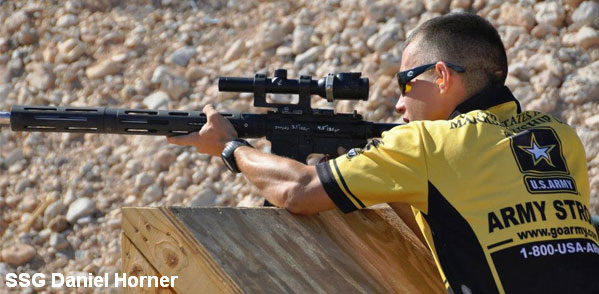
There’s no denying that 3-Gun competition is growing in popularity nationwide. Using a pistol, rifle and shotgun to shoot multiple targets at varying distances is exciting and challenging. Here are some pointers for performing better on the 3-Gun range by the USAMU’s SSG Daniel Horner, a two-time winner of Crimson Trace’s Midnight 3-Gun Invitational (M3GI) match.
Competing in Night-Time Stages
“I use the same gear all year long, so when it comes time for this match (the M3GI), I just adapt the guns, so they will work for the night time,” stated Daniel Horner. “I attach the Crimson Trace lasers and lights to the guns in whatever is the easiest way possible. Last year I just screwed a rail to my shotgun with wood screws. So, people can compete with pretty much whatever they have available and make it work.” Horner also recommends using a pair of head-mounted lamps. One can illuminate your firearms’ iron sights while the other headlamp is aimed at the targets.
It’s Super Shoot time. The “Top Guns” of Point Blank Benchrest are battling for prizes and glory at Kelbly’s Rifle Range in North Lawrence, Ohio. This annual event, held May 25-28 this year, draws some of the best 100-yard and 200-yard benchrest shooters in the world. Recent Super Shoots have drawn 300+ competitors from the USA and more than a dozen other countries (about 15% of the competitors come from overseas).
Past Super Shoot Highlights Video (Watch This — It’s Very Well Done!)
If you’ve never attended the Super Shoot before, and don’t know what to expect, former Sinclair International President Bill Gravatt offers some insights into this great event:
Super Shoot — What It’s All About
The excitement and anticipation leading up to a Super Shoot can be hard to explain to those who haven’t been to one. Every year, some shooters arrive at the Super Shoot a week early to dial in their rifles, learn wind conditions for the range, and enjoy the camaraderie of their fellow shooters. As the match draws closer, campers and RVs fill the area behind the range, and shooters stake out turf all over the property with their reloading and cleaning equipment setups.
Many shooters choose to load cartridges in the main barn directly behind the 60-bench firing line, while others decide to work in pop-ups, campers and other outbuildings around the facility. Benchrest shooters tend to load in small batches, and some most load cartridges between each match. Many shooters clean their rifles after each match, while others sometimes go two or three matches between cleanings, depending on the number of rounds they fire.
Another part of high-level benchrest competition that will amaze first-time attendees is the quality and amount of equipment benchrest shooters use. Just in front of the shooting benches and the targets, range flags of all kinds sprout up, from the typical “daisy wheel” flags to very sophisticated velocity indicators that show varying wind intensity. Shooters adjust their flags to align with the particular target in front of a specific bench, just slightly below the path of the bullet but still partially visible in the high-powered scopes.
The rifles represent a variety of actions, usually custom, with heavy benchrest barrels by various barrel makers. The most popular cartridge used is the 6mm PPC, but occasionally you will run into someone using a 6mm BR or a slightly modified 6mm BR, and as well as a few other cartridges. Rifle rests used are typically heavy tripods or plate rests. You see a lot of Sinclair rests, Farley rests, and a variety of others, including a few homemade rests. Bags are typically Edgewood or Protektor.
Super Shoot — Runners, Pickers and the Pursuit of Perfection
The techniques vary between shooters, and they are interesting to observe. Some shooters “run” their targets and will shoot a quick sighter and then run all 5 shots as fast as they can before conditions change. Others are “pickers” and shoot each shot carefully, going back and forth between the record target and the sighter target to verify wind conditions and bullet drift. These guys will sometimes shoot up to 10 sighters and use the full seven minutes. Both styles of shooting work and many shooters use both techniques depending on the match conditions[.]
Anyone who attends the Super Shoot will come away with a greater appreciation of precision benchrest shooting. Experienced benchresters already know there will be windy days that drive them crazy, and less experienced shooters can get completely lost when… holding off a shot in the wind. But the reward is worth it. It’s very satisfying to hold off a full inch at 100 yards because the wind changes during your string and drop your fifth shot into a sub 0.100″ group with only seconds remaining on the clock. And that’s what the Super Shoot is all about.
The Precision Rifle Series (PRS) has introduced a new, price-capped Production Class in an effort to boost participation by making competition more affordable. Under recently-issued PRS rules, Production Class rifles may cost no more than $2000.00. The rules state:
“Production Division combined rifle and scope MSRP as listed on the company’s website shall not exceed $3,000 USD, the rifle shall not exceed $2,000 USD and the optic not exceed $2,000 USD.
Production Division rifles are not permitted to be altered or improved in any way from the original factory configuration.
In an effort to prevent exorbitant costs for beginning shooters, Production Division round count will not exceed 80 rounds.”
To fit the new Production Class Rules, MasterPiece Arms (MPA) has developed the new BA Lite PCR Competition Rifle built around a Savage Model 12 short action. Designed specifically for the new PRS Production Class, MPA’s PCR Competition Rifle offers many premium features yet stays under the $2,000 Class limit. The Savage action is upgraded with a Rifle Basix 2-lb trigger, and the adjustable, modular chassis offers a bag rider, barricade stop, and even a built-in bubble level. Bipods can be attached up front to a rail, with optional spigot mount. MPA PCR Rifles come with stainless Bergara barrels, 22-26 inches in length, fitted with MPA muzzle brakes (muzzle thread is 5/8-24 TPI).
MPA BA Lite PCR Competition Rifle Specifications:
Chamberings: 6mm Creedmoor, 243 Win, 6.5 Creedmoor, 308 Win, 6.5 x 47 Lapua, 6mm x 47 Lapua
Action: Savage Model 12 Short Action
Trigger: Rifle Basix Savage Trigger Set to 2 lbs.
Barrel: Bergara 416R Stainless Premium Barrel Blank
Chassis: MPA BA Lite Chassis
Muzzle Brake: MPA High Performance Muzzle Brake
Magazine: AICS Type (10 Round Accurate/AICS Type Magazine Included)
Chassis Weight: 2.9 lbs. (Overall rifle weight depends on barrel length and contour.) MSRP: $1,999.99
Left-Hand and Right-Hand Models in Choice of Five Cerakote Colors
The MPA BA Lite PCR Competition Rifle is available in black, burnt bronze, flat dark earth, gunmetal, and tungsten in both left- and right-handed set ups. All chassis and barrels are Cerakoted® in a multitude of colors and patterns. (Custom patterns are $150.00 extra). Barrel lengths available include 22 inches through 26 inches. The barrel twist is caliber-specific and the barrel muzzle thread is 5/8-24 TPI.
Editor’s Note: While the MPA PCR Competition rifle has nice features, it’s hard not to compare it to the Ruger Precision Rifle costing hundreds less. The latest Gen 2 Ruger Precision Rifle, with a sleeker handguard and factory muzzle brake, is available for under $1500.00 “street price”. Ruger lists a $1599.00 MSRP for the Gen 2 RPR versus $1399.00 for Gen 1 models.




 MGM Ironman Has Unique Stage Designs

 The Second Annual D-Day Match in Talladega was a big success. On the weekend of June 4-5, over 250 eager competitors arrived at the Civilian Marksmanship Program’s (CMP) Talladega Marksmanship Park for the D-Day Match commemorating the 72nd Anniversary of the Allied Forces’ landing at Normandy. This was a major match, attracting rifle and pistol shooters from throughout the country.




 Competing in Night-Time Stages
 It’s Super Shoot time. The “Top Guns” of Point Blank Benchrest are battling for prizes and glory at


