Report by Johnny Fisher
The Civilian Marksmanship Program has just finished temporary installation of 15 traveling electronic Kongsberg Targets at the Oklahoma City Gun Club in Arcadia, OK. These high-tech targets will be employed during the Oklahoma CMP Games, slated for April 6-10, 2016. All the High Power rifle events during this year’s Oklahoma Games will be run exclusively on these electronic targets. Competitors will be scored electronically with match results being processed in real-time. Notably, this means High Power competitors will not have to do “pit duty” the entire week since manual target-pulling and shot-marking is no longer required.
The majority of shooting at the Oklahoma CMP Games will be fired at the 200-yard line for the Garand / Springfield / Vintage & Modern Military (GSMM) matches. However, the electronic targets have also been readied for use in the scheduled Excellence In Competition (EIC) and Vintage Sniper matches. Those events require additional firing from 300 yards and 600 yards.
Electronic Target Technology — How Kongsberg Targets Work
CMP Targets technician Bryan Parris explains what makes these targets so special: “These targets were designed by the experts at Kongsberg Targets exclusively for the CMP to fit the standard US target dimensions of 72″ square target backers. What shooters discern as the black of the aiming bull is actually black rubber sheeting that is the entire size of the backer. A layer of white corrugated plastic then covers this rubber with a center hole having been cut out to reveal the appropriate sized bull for that yard-line. All that is required as competitors move further back through the course is to change out the plastic cover to reveal a larger aiming black.”
This acoustically-scored target system uses four microphones to locate the bullet as it passes through the target. The microphone closest to the bullet traveling through the target actuates the remaining three to triangulate the exact shot location for the scoring system and simultaneously display the shot on the shooter’s monitor.
Behind the coroplast face and inside the foam insulation, the target is wrapped with rubber to form a type of chamber. This helps insulate the target’s four microphones stay insulated from extreme temperature changes and also helps keep out ambient noise. This chamber need only exist to the extent that it separates itself from the other targets. Parris states: “We’re building these targets to last a great long while. They are extremely durable and can have anywhere from 3000 to 5000 rounds fired through them before any maintenance is required whatsoever.”
The entire system can be powered via battery, generator, or combination of both. The target line communicates wirelessly with the firing line computer system for timing courses of fire and recording scores. And of course, there is virtual real-time communication with monitors set up on each firing point to display shot / group location and value.
When fully assembled, each target weighs about 200 pounds. They are a little cumbersome in their current form, but the CMP’s target technicians are “still working some things out [for] potential future travel games.”
Registration Still Open for Oklahoma CMP Games
The 2016 CMP Oklahoma Games will be held at the Oklahoma City Gun Club in Arcadia, OK from April 6 – 10, 2016. Registration is still available. For more information about these Kongsberg Electronic Targets, contact Bryan Parris of CMP Targets at (256) 835-8455 or bparris@thecmp.org.
No doubt you’ve heard the term “reticle” before, but it probably brings to mind the cross-hair you see through a rifle-scope. This term “reticle” can also describe an optical aid used to score targets. This story discusses a new scoring reticle with precisely-defined circles etched on clear plexiglass. This scoring reticle (as attached to a magnifying crystal) is used to determine whether bullet holes fall inside or outside the scoring circles on targets. This unique new scoring reticle allows match scorers to “equalize” the shot placements of all popular calibers from .204 up to .308. This way, there’s a “level playing field” for all calibers, and any caliber rifle can compete on an equal basis with the 30s.
New ‘Equalizer’ VFS Scoring Reticle
by Ron Goodger
The ubiquitous controversy over the advantage of larger caliber bullets in VFS (Varmint for Score) matches still rages, but there is a simple solution that is being embraced by all to whom I have shown it. The concept is simple, and it accomplishes the same thing the UBR (Ultimate Benchrest) targets do with the advantage that it can be used on any target a club happens to have on hand.
I had heard shooters complain about the advantage that larger calibers have many times and wish there was a fair way to score targets that would level the playing field for all calibers. The UBR concept came along and I read up on it. When a match was held close enough that I could enter, I did so and observed first hand what it was all about. The UBR targets essentially make the distance from the bullet hole center to the scoring ring edge the same for each caliber by using different-sized rings on the caliber-specific targets. After seeing the accompanying disadvantages of using this method (the chief one being the large number of targets required by UBR rules and the resulting increased time required to hold a match), I began searching for a simpler way to accomplish the same thing. I was aware of a number of mid-West clubs wanting to make scoring fair but unwilling to use the UBR method because of the disadvantages.
I came up with an idea late in 2015 and designed a scoring reticle that would do the job. The following diagrams graphically explain how UBR and my scoring reticle accomplish the same thing. The illustration above shows how different caliber bullets hitting the same center point of impact will each just score the 10 ring edge on the different-sized, caliber-specific UBR 10 Rings . It is clear that it is the distance from the center of the bullet to the scoring ring that is made uniform by the different 10 Ring sizes.
The illustration below shows how my VFS scoring reticle accomplishes the same thing by scoring every shot with an .308-equivalent ring that circumscribes the inner caliber-specific ring. The dotted line shows that the center of each bullet hits the same distance from the edge of the scoring ring. It is clear that, using current VFS scoring techniques, the .224, .243, and .257 bullets would score misses. However, scoring each bullet with the .308 ring around the hole illustrates that all calibers would be scored the same.
Scoring Reticle Converts Any Caliber Shot to a .308-Equivalent Hole
The above photo of an IBS 100-yard target has a 6mm hole that is clearly a nine (9), using current scoring methods. But consider that, if a .308 bullet from a 30 BR hit in the very same location, that .30-caliber shot would score in the Ten Ring. Why should the 6mm bullet, whose center was just as close to the middle of the target, be penalized because of the bullet diameter? The image on the right shows the scoring reticle with the 6mm scoring ring centered on this hole. With this scoring reticle, the .308 ring around the 6mm hole clearly scores the 10 Ring, just as a 30-caliber bullet centered in the same spot would do. That is as fair as it can get.
The above image (two shots per frame) from a Hillsdale Michigan varmint target has two 6mm holes that scored a 16. Score values are 10 points for a shot in the white, 5 points for a shot in the orange, and 1 point for hitting the center dot. This was a match that had 30BRs shooting in it. The next photo shows how scoring this frame with the VFS reticle would have resulted in a 21 because the left side of the reticle’s .308 circle just extends into the 10-point white bulls-eye region. So, in effect, there were two (2) shots in the white for 2×10 points (based on the .308 equalizer effect of the reticle). This shows how the reticle will level the VFS playing field regardless of what target is being used.
VFS Scoring Reticle Features and Specifications
The 6mm circles have been placed in the center of the reticle because it is expected to be the most commonly-used caliber, and that makes it easier to see in the crystal. Any of the ring sets can be used for a .308. The sizes of the circles are guaranteed accurate to within .001″ on the outside edge of the circle by the reticle’s manufacturer. I have found the best magnifier crystal to use is a genuine Badash crystal that measures 3.25″ in diameter. They are available from several eBay sellers and are easily attached using a piece of packing tape about 3/4-inch wide around the edge of the reticle (visible on the crystal in the lower part of the photo). That makes the Plexiglas reticles easy to replace in the event they become scratched up from frequent use.
A number of Midwest rifle clubs have already purchased these scoring reticles. The Plexiglas reticles are available for $15.00 each plus $2.04 shipping from the author (does not include the crystal). Email him at LRGoodger [at] gmail dot com for more information.
Lapua Supports U.S F-TR Rifle Team
Lapua continues its support of the U.S. Rifle Team (F-TR) by donating Lapua factory-loaded .338 Lapua Magnum ammunition as part of a raffle package to raise funds for the Team. The raffle will take place this evening, on March 8, 2016.
The U.S. Rifle Team is raffling off a .338 Lapua Magnum Tactical Rifle donated and built by Kelbly’s Rifles. The raffle package includes a Nightforce Optics ATACR 5-25x56mm scope, 100 rounds of .338 Lapua Magnum 300gr OTM Scenar ammunition, plus a Gemtech Arrow suppressor
The total package value is over $9,000!
All of the proceeds from this raffle will be used to train and equip the U.S. Rifle Team as the team prepares for the 2017 World Championships in Canada.
About the U.S. Rifle Team (F-TR):
The U.S. Rifle Team (F-TR) is the two-time, Farquharson Target Rifle (F-TR) discipline World Championship winning squad. The U.S. Rifle Team competes regularly against other nation’s F-TR squads. At the 2013 World Championships, 17 nations were represented. The next World Championships will be held at Connaught Range near Ottawa, Canada in 2017. All of the rifles used in the F-TR class are chambered in either the .308 Winchester or .223 Remington calibers. This ensures a level playing field for all competitors. Every match winner can rightly say that it was their skill, not their caliber, that won the day. Most of our team events are fired at targets 1000 yards away. The inner-most scoring ring on our target is five inches in diameter. The next ring is ten inches in diameter. These shooters manage to put the vast majority of their shots inside that 10-inch ring at 1000 yards! Learn more about the US Rifle Team at www.USRifleTeam.com.
The U.S. F-TR Team Raffle, report by Ray Gross, Team Captain
Our raffle has been a huge success thanks to a number of sponsors who stepped forward to help out. A special thank you goes to Ian Kelbly, who offered to help out before I even asked. Kelbly’s became the first new sponsor of our team after I became Captain. Nightforce has been a long-time sponsor of our team and has been a huge help this cycle. Bryan Litz is a member of the team and his company, Applied Ballistics, is a sponsor. Bryan contacted Applied Ballistic Munitions and they happily donated ammo to our prize. Adam Braverman of Lapua, also a long-time team sponsor, sought us out, to help with our raffle.
What’s great about all of these companies is that we were already using their products, they didn’t have to sponsor us to get us to use them. We are in the business of winning and we have to use the best products. It speaks very highly of each of them that they are committed to supporting the shooting sports.
Report by Vince Bottomley Victrix Armaments, an Italian company, has developed new technology that could be a major “game-changer” in the world of precision rifles in general, and F-Class in particular. Victrix’s leadership group knows all about excellence — and winning. Giuseppe Valtorta, CEO of Victrix Armaments, is a top competitive shooter who won Gold with his F-TR rifle at the 2015 European F-Class Championships.
A New Breed of F-Class Rifle
Turn back the clock half a century — George Farquharson is happily shooting a modified military rifle with iron sights and sling. He hasn’t even dreamt of F Class…
Benchrest however is beginning to gather momentum. Accuracy seekers are demanding the ultimate in precision engineering. They will go to their favorite gunsmith and, if they’re very lucky, procure one of the new custom actions from Hart or Shilen.
In the last 50 years, what’s changed? Benchrest is still with us but F-Class has emerged as a world discipline and, to some extent, brought new challenges to our accuracy rifle builders. But, whilst the rest of the planet has reveled in the speed and precision of CNC machining, we still love to place our faith in the gunsmith and his trusty old lathe!
But, of course, there is a reason for this. CNC equipment is expensive and geared towards the rapid multiple production of precision parts, whereas the custom gunsmith is dedicated to the ‘one-off’ build.
Also, even with a limited run, CNC does not readily lend itself to chambering our cut- or button-rifled barrels. Good as our barrels are, there are issues that have made CNC machine problematic. Each barrel demands loving care at the hands of our chosen gunsmith – if it is to perform to our expectations.
5-Axis CNC vs Manual Barrel Chambering
What if — What if the whole barrel-fitting and chambering process could be made “CNC compliant” and produce a rifle which would equal (or even exceed) the accepted standard. And do it every time, time after time! Cost could be reduced and also waiting times.
Good as our custom barrels are, they still need to be scrupulously checked — for uniformity of the bore, the lands, the grooves — for straightness, consistency of diameter, and concentricity. This could be achieved, using some pretty sophisticated measuring equipment — but that would be outside the realms of the custom gunsmith.
Even then, how could the barrel be easily accommodated in a CNC five-axis machining center to ensure a set-up for the best possible chamber and threading? Remember, bores are rarely concentric to the outside diameter and seldom straight, so the set-up would need to ensure that any deviation would be in the vertical plane when the barrel is screwed in the action and the chamber-section would need to be exactly aligned.
These are of course the issues faced every day by the custom gunsmith but currently, there are few CNC machines which could easily accommodate this requirement. But yes, there are a few….
Let me introduce you to Victrix, an Italian engineering company with an impressive multi-million euro factory crammed with the very latest in CNC machinery and a state of the art measuring laboratory. They already have a well-established background in the firearms manufacturing industry, at both military and sporting level. Never heard of Victrix? You soon will, for Victrix has chosen the prestigious 2016 IWA Show (Hall 9 – 423) to launch its new range of high-end rifles.
Victrix manufacturing facility in Italy is ‘crammed with the very latest in CNC machinery':
Whilst Victrix initially developed a range of tactical/military firearms — some of which will also be of interest to the sport shooter — the company has now turned its attention to the F-Class discipline. By working with those competing at the highest level of F-Class competition, Victrix has developed a range of “off the shelf” F-Class rifles that are “competition-ready” right out of the box. Incidentally, Victrix have chosen American barrel-maker Benchmark as its exclusive barrel supplier. Victrix has already perfected a way of accurately assessing barrels to adapt them to CNC working, and this is the key to the new project.
Victrix Target Trigger — Adjustable down to an Ounce
Victrix F-Class rifles will feature an advanced, new target trigger engineered by Victrix. This four-lever target trigger boasts an adjustment range of 1 to 2.5 ounces (30 – 70 grams). Another trigger (8 to 21 ounces pull weight), is used for the Victrix tactical rifles.
Victrix Action
For its new line of rifles, Victrix have developed its own proprietary actions. These actions employ some interesting ideas. The bolt is three-lug with a 60-degree lift and 105/105/150 degree lug-geometry. Testing verified that this arrangement provided a greater resistance to flexing in the locked position over the more traditional 120/120/120 geometry. This geometry also aids the pick-up and feeding of rounds from a magazine when used in a tactical configuration.
Above is Victrix’s new action. It’s impressive. Multiple configurations are offered: Right Bolt/Left Port, Right Bolt/Right Port and other variations. The action can be fitted with Victrix Target or Tactical trigger.
The action and bolt are machined from 17.4PH stainless steel and then hardened (body 48 Rockwell, bolt 45 Rockwell) and treated with PVD (physical vapor deposition). Finally the actions are coated with chromium nitride and nobium for wear-resistance and smooth operation. Tenon thread is M27x1.5 and of course, tolerances are ‘benchrest’ standard. Picatinny rails are screwed and pinned to the action.
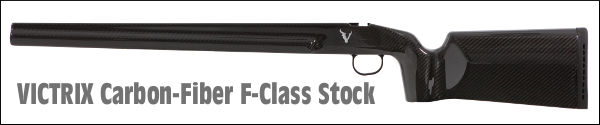
Victrix has certainly done its homework. The company will offer rifles for both F-Open and F-TR classes. Stocks will be offered in a variety of materials: wood, wood-laminate, aluminum, and carbon-fiber. The stocks share a no-nonsense, straight-forward design, specifically for shooting a rested rifle.
Whilst we are focusing on their F-Class rifles, we shouldn’t forget the Victrix tactical range. Although designed with military and police use, they will appeal to anyone who enjoys tactical-style shooting. There is no compromise on quality or accuracy so, expect the same build standard but with stocks CNC’d from 7075 mil-spec aluminum with a hard-anodized coating. The Victrix three-lever tactical trigger adjusts from 8 to 21 ounces (250 – 600 grams).
Victrix has chosen March Scopes UK (IWA Hall 3A – 110) as its business partner in launching the new Victrix F-Class rifles. This was a wise choice, as March Scopes UK proprietor Gary Costello is a former World F-Class Champion. Gary, well-known to F-Class competitors, continues to shoot with the Great Britain Team.
We look forward to taking a closer look at the Victrix F-Class rifles and hope to provide an in-depth range report in the not-too-distant future. Check out the Victrix website at www.Victrixarmaments.com.
Editor’s Comment: All long-range competitive shooters should watch this excellent video — whether you shoot with a team or as an individual. Three cameras were used so you can watch the shooter, the range flags, and the target simultaneously. After a discussion of scoring, the actual shooting starts at the five-minute mark in the video. Under the guidance of wind coach Gary Rasmussen, former U.S. F-Class Open Team Captain Shiraz Balolia shoots 100-7X for ten shots, following Gary’s wind calls. Shiraz is the President of Grizzly Industrial
Team Shooting with a Coach Shiraz tells us: “We come across a lot of shooters who have never shot under a coach. This video was produced to give shooters a basic understanding of shooting with a coach and the importance of releasing a good shot. In a team setting, you basically leave all the decision-making to the coach and aim where you’re told to aim. I’ve worked with Gary many times and it shows in the comfort level we have with each other. The coach plots the shots or a plotter advises the coach of any grouping that is not centered.”
Watch Gary Call the Wind and Shiraz Shoot 100-7X for Ten Shots
For best viewing, click the YouTube settings button to watch in 720p or 1080p HD (high definition).
Shiraz was shooting a 7mm F-Open rig: “My .284 Shehane rifle takes about 10 to 12 shots to settle down and that is probably why we made several scope adjustments while shooting. It is a great caliber and a step up from a straight .284 Winchester. The wind was relatively calm, but sometimes that slow wind with subtle angle changes can be very deceiving.”
The video was shot the first week of May 2013 at a range in Custer, WA located about 20 miles from Bellingham, Washington. The production team included Shiraz Balolia, Gary Rasmussen, three cameramen, and a target puller. Big Thanks to Grizzly Industrial for providing the camera crew and post-production talent.
M-K IIA2 GEN2 Tactical Trigger from The Wisconsin Trigger Co.
Gear Review by Johnny Fisher
Do you shoot an AR-platform rifle? Here’s an excellent trigger upgrade option that has recently returned to the marketplace. The Wisconsin Trigger Company (WITC) has resumed production of the legendary Milazzo-Krieger M-K II trigger for the AR-platform rifles. Not merely marketing a replica of the original Milazzo-Krieger design, Wisconsin Trigger now offers an enhanced, drop-in version called the M-K IIA2. An easy install, the Milazzo-Krieger trigger drops in with no special tools or machining required (and no modification of the safety selector switch).
For those who are looking for an extremely crisp AR15 trigger that closely mirrors the “feel” of a finely tuned M1 / M14 trigger, this trigger might be the solution. The first stage is exceptionally clean and smooth due to a proprietary diamond-grinding process. I felt that the first stage travel was longer than a Geissele, but many guys will prefer that. Upon reaching the very noticeable and defined “wall” of the second stage, a further increase of pressure provides the instantaneous snap one looks for in a high-quality trigger — complete with a total absence of anything resembling creep or slop.
If you follow the instructions in the box and watch WITC’s informative how-to videos, installation of this trigger is extremely straightforward, requiring no special tools or fitting.
As supplied straight from the factory, the first stage requires about 2.25 pounds of take-up before encountering “the wall” of the second stage. For this purpose of this review and to ensure “making weight” in CMP Service Rifle Competitions, the (white) 5-lb. disconnector spring was used. The weight of the second stage came in right at an extremely repeatable 5 lb. 3 oz. (averaging +/- 1.5 oz.) for a ratio of about 40/60 between the two.
Upon release of the hammer, the disconnector reset is decidedly short. National Match shooters in particular will appreciate the very short but easy-to-recognize trigger reset during rapid-fire strings.
Tuning the Trigger Before Installation
As with most National Match-grade triggers on the market, the Millazo-Krieger utilizes proprietary pins that come supplied with this unit. They must be used for final installation and are purposely oversized to a specific diameter for a very snug fit. This is to ensure the trigger and hammer rotate solely on the pins, as opposed to the pins eventually rotating inside the receiver. It is best to use standard sized mil-spec trigger and hammer pins for the setting of tensions (trigger weight) before final installation to help avoid undue wear to the receiver pin holes. Final adjustment of second-stage pull weight must be done BEFORE final installation.
It is recommended to first set the amount of desired disconnector engagement by performing a very simple process that is detailed in the included installation instructions from the TOP of the trigger. The swapping out of disconnector springs and final tuning of the second stage can then be done, but only from UNDERNEATH a disassembled trigger.
The disconnector tensioning springs are easily swapped out by removing the spring plug from the bottom of the trigger housing that exposes the spring pocket. After inserting the desired weight spring, the spring plug must be installed at least flush with the bottom of the trigger housing. Installing it deeper will add trigger pull weight on the second stage. Installing it too shallow will interfere with trigger movement.
Transferable Warrnty:
The Wisconsin Trigger Company offers a full lifetime warranty to all unaltered parts of its triggers. This lifetime warranty is fully transferable when the trigger is sold to a new user! When have you heard of an AR component manufacturer with a transferable warranty — we’re impressed.
Not just a retailer, John Scandale of Keystone Accuracy is a distributor of these triggers. He currently has many in stock and for sale at a very special introductory price.
What Comes in the Box:
The $265.75 trigger kits come complete with everything you need: Trigger unit assembly, trigger return spring, full strength hammer spring, two proprietary oversized trigger & hammer pivot pins and three disconnector tensioning springs (3.25 lb., 4.5 lb., 5.0 lb.). Also included is a comprehensive installation manual, a color-coded disconnector spring selection chart, some promotional items, and the lifetime warranty card.
Report by Johnny Fisher
Here’s something you don’t see very often — a fullbore shooter with a .223 Remington topped a field of talented .308 Win shooters. Not only that, he scored more points than any F-Class competitor (however, F-Classers shot a smaller target). Bob Gill’s performance proves that, even in an era of high-BC .308 bullets, the little .223 Rem cartridge can still hold its own in the hands of a great shooter.
At last weekend’s California State Fullbore Championships, Bob Gill bested over 30 competitors for the championship with a .223 Palma rifle, only dropping 7 points over the weekend for a 993-56X. The event was sponsored by the California Rifle & Pistol Association and hosted by the Coalinga Rifle Club.
Bob Gill Talks about the ‘Mental Game’
Conventional wisdom when shooting any match is to just stay focused on each and every shot and let the scores work themselves out after all firing is complete. “Two To The Mound” shooting changes all of that, as each competitor is not only aware of their own standings throughout the course of the match – but also of their closest competitor during these pair-fire strings. With this championship never further out than a 2-point lead throughout the weekend, stress was high and every once of mental focus needed to be tapped.
Bob recalls, “The entire match was neck and neck. After a few mental mistakes and a few wind mistakes, with three shots remaining the thought is three shots and a 1X lead. I need to shoot three 10s. Everything else goes away. Shoot three 10s and he can’t catch me.”
Three 10s later, Bob won the CA State Fullbore Championship by one point and one X. Well done!
Gun Specifications
Bob was shooting a 1970s-era .223 Remington B-40X action inside a Competition Machine R1 chassis. The barrel is a 30.5″ Heavy Palma taper, 1:7″-twist Brux with a Wylde chamber and .220 freebore done up by Randy Gregory at Accuracy Unlimited. The Tubb 7T7 two-stage trigger was set at 1 + 1 pounds.
.223 Remington Accuracy Load — Berger 90gr VLDS, Varget and BR4s
Gill loaded 90gr Berger VLDs in front of 25.0 grains of Hodgdon Varget powder, jumping 15 to 20 thousandths for a 2.708 COL with a BR4 primer inside Lapua brass. Bob uses a Redding Full-Length S-Die to push the shoulders back .004 to match that of new Lapua brass and a bushing chosen to achieve .004 neck tension. He sorts his brass by weight into 0.5 grain lots and each piece is trimmed on a Giraud trimmer after sizing because he says “it grows like crazy”.
Fullbore Course of Fire — Pair Firing on Day 2 at Coalinga
The Fullbore Course-Of-Fire for this match was squadded on the first day by classification for 15-shots string-fire at each yard-line: 300 / 600 / 900 / 1000 yards. These scores were then used to determine “two to the mound” squadding for the second day, when each competitor pair-fired with his closest competitor, and also kept score in between his own shots. In this “pair fire” arrangement, only 45 seconds are allowed between shots after a shooter accepts his shot score. This forces competitors to shoot through condition changes as opposed to waiting for a more favorable pattern.
The IBS 2016 Long-range shooting season is starting soon, so we thought our readers might enjoy learning about a state-of-the-art 1000-Yard Benchrest rig. This article features the impressive .284 Shehane Light Gun used by Henry Pasquet to capture the 2013 IBS 1000-yard Nationals. With a 5″-wide “hammerhead” front and a special 3″-wide bag-rider plate in the rear, this 17-lb rig is ultra-stable in the bags, and tracks like a dream. In this story, Henry explains his set-up plus his processes for loading super-accurate ammo. Every long-range shooter can benefit from some of tips revealed here. And F-Class guys — if you’re shooting a .284 Win-based case in F-Open you should definitely read Henry’s precision reloading advice.
EDITOR: Guys, there is a ton of solid gold information in this article — take your time and read it carefully.
Yes old dogs can learn new tricks. Just five years ago Forum member Henry Pasquet (aka “HenryP”) got started in 1000-yard benchrest shooting. He was 66 at the time. Henry worked hard, learned fast, and pursued accuracy with a vengence. That all paid off when Henry won the 2013 IBS 1000-yard Nationals this summer, finishing as the Two-Gun Overall National Champion. Henry was kind enough to talk about his rifle, his reloading methods, and his strategy for success. In fact, Henry was eager to share “everything he knows, so that other guys can fast-track their learning process”. Henry told us: “I want to share every lesson I’ve learned, so that other guys can improve their game and enjoy the sport more.” Henry also wants to encourage other senior shooters: “If you pay attention to details (when reloading), and get a good rifle with a good barrel, age is not a handicap. With a good set-up, older guys can compete with anyone out there. This is one sport where you can be a champion in later life.”
Click on Rifle Photos to View Full-screen Versions
Q&A with Henry Pasquet, IBS 1000-Yard National Champion
Q: First, do you have any advice for older shooters getting started in their golden years?
Henry: You’re never too old. In this sport, you can excel even in your 60s, 70s and beyond. At this stage in life, we now have the time and money to get good equipment and rifles. Plus, our years of work experience help us to think, analyze, and thereby make progress. In this game, we older guys can definitely compete on a par with younger shooters.
HARDWARE
Q: Tell us about your Nationals-winning rifle and bench gear. Is there anything unique about your hardware that gave you an edge?
Henry: At the Nationals, I used my 17-lb Light Gun for both Light and Heavy Class. This rifle has a 1.55″, round BAT LP/RE action, fitted with a Bartlein barrel chambered for the .284 Shehane (an improved version of the .284 Winchester). The barrel was near-new; this was the first time I had used it this year. A great barrel and great batch of Berger 180gr VLDs all made a difference. Jay Cutright chambers my barrels. Jay’s metal-work is so precise that I can screw any barrel he’s chambered to any BAT action I own. The laminated stock was modified by Tommy Shurley from a standard 3″-wide fore-end to a 5″-wide True-Trac with an adjustable 3″-wide rear plate. It’s not pretty but it tracks like a Heavy Gun stock. Tommy made my other stocks as well.
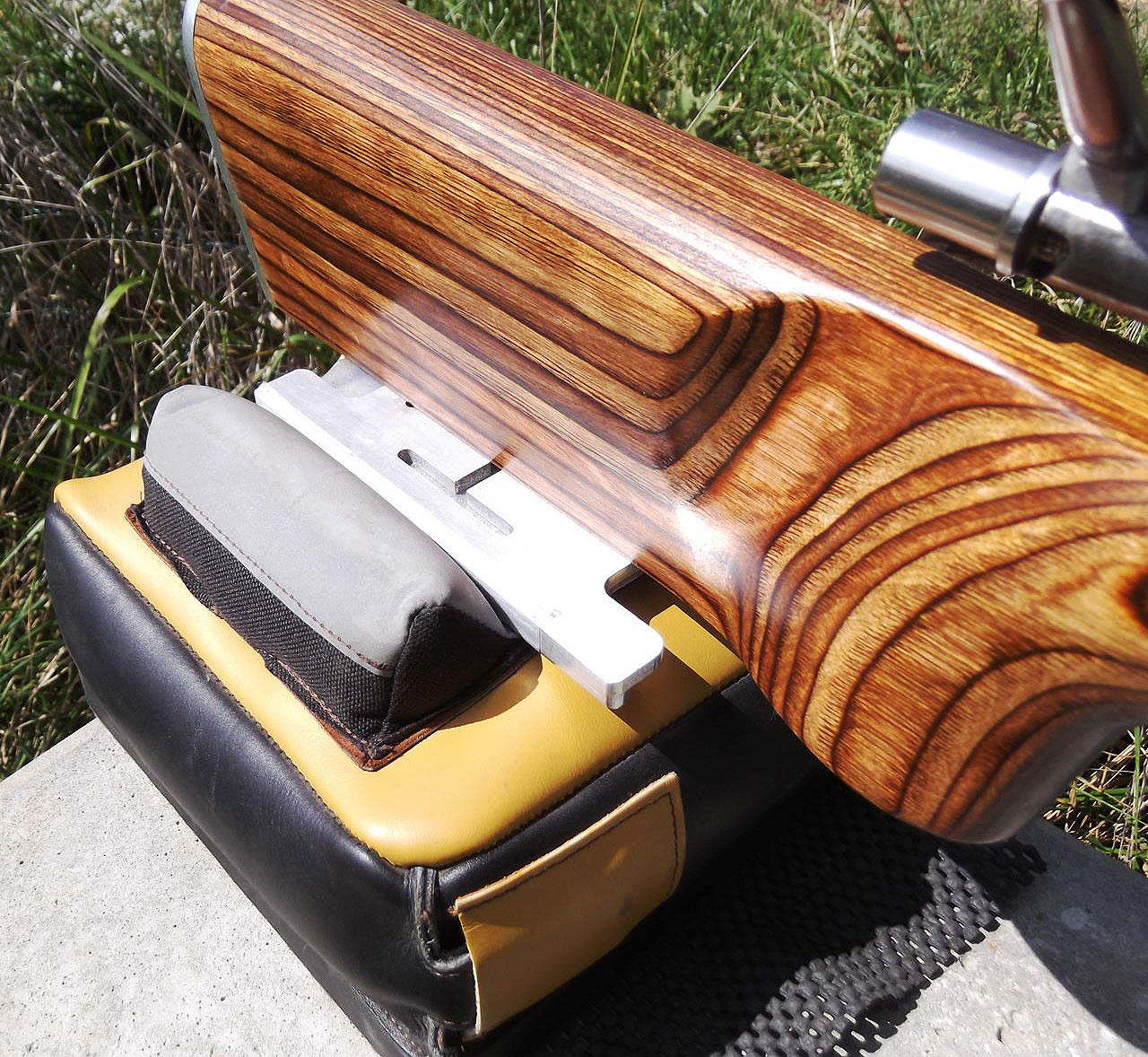
On top is a Nightforce 12-42x52mm Benchrest scope with CH-3 reticle. I used a Fulghum (Randolph Machine) front rest with an Edgewood bag made with the low-friction 3M material. In the rear I use a special-order Protekor rear “Doctor” bag with ears spaced 3 inches apart. The rear bag also has the new 3M material on contact surfaces (photo at right).
Q: During the Nationals, at the last minute you switched guns. Why did you go from a 6mm Dasher to a 7mm Shehane?
Henry: I had planned to use my Light and Heavy Dashers, but after placing the Dasher on the ready line, decided to switch to the .284 Shehane. It was still early in the morning and I felt that the heavier bullets would be easier to see against the berm. The Dasher had actually been giving tighter groups under perfect conditions, but seeing the impact is important.
Q: Tell us about the combined tuner/muzzle brake on some of your barrels. How does this improve rifle performance and how do you set the “tune”? Do you tune the barrel to the load?
Henry: I use a tuner or tuner/brake on every barrel. I started with Time Precision tuners. Art Cocchia advised getting a load with a good known accuracy node with minimum extreme spread, which controls vertical. Do not go for the hottest loads, which just reduces brass life. Then use the tuner and tune the barrel to the load. The .284 Light Gun needed a muzzle brake and tuner. I had a local gunsmith cut a thread on the muzzle brake for a tuner I got from Sid Goodling. (Eric Bostrom developed an almost identical unit at the same time. I use Eric’s tuner/brakes on all my new barrels.) Just before Nationals, I tried going up and down one marker. Down one mark cut the group in half! Think how much range time (and barrel life) that saved me. Using a tuner is easier than messing around changing loads and tweaking seating depths. Tuners definitely can work. Last year I shot a 3.348″ 10-shot group at 1000 with my .284 Win Heavy Gun fitted with a Time Precision Tuner.
Q: What are the advantages of your stock’s 5″-wide fore-end and 3″-wide rear plate? Is there a big difference in tracking and/or stability? Does the extra width make the rifle easier to shoot?
Henry: I had true Heavy Guns with 5-inch fronts and 3-inch rears. They tracked well. I felt the same result could be had with a Light Gun. I talked two stock makers into making them. I initially had the standard rear stock until Tommy Shurley and Mike Hearn came out with an adjustable rear plate. The stocks track perfectly. You can see your scope’s crosshairs stay on the target the whole time and push the rifle back for the next shot. There is no torquing (gun wobbling) when cycling the bolt. Us old guys need all the help we can get. I am getting rid of my 45-pound Heavy Guns and replacing them with Light Guns with heavy barrels.
Q: Some people say the .284 Shehane is not as accurate as the straight .284 Winchester. You’ve proved them wrong. Why do you like the .284 Shehane? More speed, less pressure?
Henry: The reason I rechambered my 7mm barrels to .284 Shehane was not velocity, pressure, or brass life. It was all about bolt lift. My straight .284 almost required me to stand up to eject brass. I damaged an extractor and had to send the bolt back to BAT. With the .284 Shehane, my bolt cycles like there is no case to eject.
Reloading Methods
Q: People want to know about your load and your loading methods. What can you reveal?
Henry: For my .284 Shehane at the Nationals, I loaded 52.5 grains of Hodgdon H4350 and Federal BR-2 primers behind Berger 180gr VLDs. I usually anneal the brass each winter. I have used the same brass for years. I use Redding bushing dies, apply Imperial sizing wax, resize, wipe off wax, clean and uniform the primers pockets using the RCBS Trim Mate Case prep center, then apply Imperial dry neck lube with a bore mop.
To dispense powder, I use a RCBS ChargeMaster set 0.1 grain below my desired load and then weigh them on a Sartorius GD-503 magnetic force restoration scale to get identical charges. I use a K&M Arbor Press with seating force gauge when seating the bullets with a Wilson inline die. My “target” seating force on the K&M dial is 20-23 units for Dashers and 35-40 units for the .284 Shehane. I put any variables aside for sighters. I do not weigh brass, bullets, or primers. My bullets were so consistent that I did not sort by bearing surface. I did trim the Berger VLDs to the shortest bullet length with a Hoover Trimmer, and then pointed the meplats just enough to close them with a Whidden pointer. I sort my bullets to 0.005″ overall length, rejecting about five percent.
Q: What kind of precision are you looking for in your reloads? Do you trickle to the kernel? Does this really help reduce extreme spread?
Henry: I try to keep my charge weights consistent to one kernel of powder. I use the Omega powder trickler with a Sartorius GD-503 lab-grade balance to achieve that. For accurate dispensing, put very little powder into the Omega so you can drop one kernel at a time. Single digit ES (Extreme Spread) is the goal. This does make a difference at 1000 yards. If you get the same push on the same bullet with the same neck tension, good things are going to happen.
Q: You believe consistent neck tension (i.e. grip on the bullet) is really important. What methods are you using to ensure consistent bullet release?
Henry: I apply Imperial dry neck lube to the inside of my case-necks with a bore mop. The K&M arbor with seating force gauge shows the need to do this. If you put a bullet into a clean case, it will be jerky when seating the bullet. You may see 40 units (on the K&M dial) dropping to 20, then slowly increasing pressure. I explained to a friend that not lubing the neck is like overhauling an engine without lubing the cylinders. Smooth entry gives the bullets a smooth release.
Barrel Cleaning
Q: You go 60-80 rounds between cleaning and the results speak for themselves. What is your barrel cleaning procedure? Do you think some guys clean too often or too aggressively?
Henry: I cringe when I see people wearing out their barrels with bronze brushes between relays. I clean my barrels at the end of each day when I get home. I shot my best-ever 1K Heavy Gun group (3.348″) at day’s end after 60 to 80 rounds. After trying other solvents, I have gone back to Wipe-out’s Carb-Out and Patch-Out products. I use about four patches of Carb-Out, let it sit a few minutes, then use one stroke of a nylon brush followed by Patch-Out until the barrel is clean. I use a bore mop to clean inside the chamber, then some Break Free LP on the bolt followed by bolt grease on the lugs and cocking part. I use a bore guide when anything goes down the barrel.
Shooting Skills and the Learning Process
Q: Henry, you can shoot long-distance on your own property in Missouri. How important is practice, and what do you do during a typical practice session?
Henry: I can shoot 1000 yards on my farm. I have a concrete bench using a slab from a yard furniture place on concrete blocks. Two 4 x 8 sheets of plywood hold four IBS targets. I never practice. I only test, keeping a notebook with all the info. I do most of my testing at 300 to 500 yards, shooting off my deck so I can see my shots immediately.
Q: How much of your success do you credit to really accurate rifles, versus superior shooting skills?
Henry: I do not consider myself another Carlos Hathcock or some master marksman. I am an average 1000-yard shooter, but I do work hard getting the most out of my rifles. Four other people have shot their first 1000-yard matches with my rifles, including my wife, and all of them won relays! I loaned my Dasher to another shooter two years ago and he got second at the 600-yard Nationals. Others will tell you that the rifle must be “on” to win. If your barrel or bullets are average, don’t expect to perform above average in competition.
Q: What you do enjoy most about long-range benchrest shooting? What are the attractions of this sport?
Henry: The sport offers good people and a real challenge. 1000-yard shooting keeps us all humble, but we still keep trying to see how good we can do. I am thankful for Robert Ross providing the only match location that I can shoot regularly.
Q: Henry, you have been a Forum member for many years. Have you learned important techniques from other Forum members and other shooters?
Henry: I have followed the AccurateShooter Forum since 2008. At my age I am not good at computers. I copied and analyzed many articles, especially on the .284 and the Dashers. Without AccurateShooter.com, I would probably still be shooting double-digit (10″+) groups at 1000 yards, and I sure wouldn’t have my name on a National Championship trophy.
Q: You are in your 70s now and have only been shooting competitively for a few years. How did you get so good so fast? How did you manage to beat shooters who are decades younger?
Henry: I had 20/10 vision when I was young, but am down to only 20/20. I have been interested in long range shooting for a long time including ground hog hunting. I went to some VHA jamborees also. In 2008, I went to the Williamsport Benchrest School with a friend from Pennsylvania, John Haas. We would compare notes frequently. I bought a BAT three lug from Tom Mousel in Montana. We also compared notes and made each other better. At IBS matches I studied other shooters’ equipment and techniques. I tried some, accepting some and rejecting some.
Here’s my advice:
Always be ready to learn something new. If it makes sense, try it. I would also encourage other older shooters not to quit. Stick to it. You can make enormous progress in a few seasons.
Online registration is officially open for the 2016 NRA National Rifle and Pistol Championships at Camp Perry, Ohio. Held July 11 through August 9, 2016, the National Matches attract the nation’s finest civilian and military marksmen who will participate in a month of competitive shooting on the shores of Lake Erie. From pistol, to smallbore rifle, high power rifle, and long range high power rifle (including F-Class), the national matches have something for just about every serious shooter.
Shooters may now register to compete in this summer’s 2016 NRA National Rifle and Pistol Championships at Camp Perry, Ohio. Championship will be held in NRA’s Pistol, High Power, Mid-Range, and Long Range disciplines. Click the links below for the 2016 NM Calendar and NM Registration Form:
Smallbore Championships Will Be Held in Bristol, Indiana
As usual, the pistol, High Power, and High Power Long Range Championships will be held at Camp Perry, Ohio, on the shores of Lake Erie. However, the NRA National Smallbore Position Championships and Smallbore Prone Championships will be held at the Chief Wa-Ke-De Range in Bristol, Indiana. This year’s Smallbore Championships are scheduled for July 10 through July 18th.
On the Shooting Sports USA website, legendary shooter Middleton (“Mid”) Tompkins is profiled this week. One of the great figures in American rifle shooting, Mid is also the patriarch of the greatest family of shooters in American history. Mid’s wife Nancy Tompkins, and daughters Michelle Gallagher and Sherri Jo Gallagher, have all been National Champions. Mid himself is a six-time, across-the-course national High Power rifle champion. He’s also been on 18 Palma teams as captain, coach or shooter. Mid started shooting smallbore rifle over 60 years ago, competing in that discipline at Camp Perry in 1954. But he committed to High Power in 1955 and never looked back: “I liked High Power’s diversification of standing, sitting, rapid fire and long range shooting.”
Practice Ammo: Mid does not use practice ammo, saying: “If it isn’t the best ammo he owns, the shooter learns absolutely nothing because they don’t know—when they shoot an 8, if they shot it, the ammo shot it or the gun shot it.”
On Scorebooks: “I totally, totally do not believe in scorebooks. It takes away your concentration from what you should be doing, which is doping the wind and pointing the rifle downrange. Shooting is not about book-keeping. Shooting is about putting a bullet in the middle of the target.”
Practice Makes Perfect: For decades, Mid shot every Saturday and Sunday, whether for practice or in a match. Mid shot with four different clubs, each hosting their own match on a different weekend. He shot them all, as well as practicing the day before each match. That’s in addition to competing in Sanctioned and Registered matches.
Middleton Tompkins Interview from 2015:
In the video above, Mid talks candidly about his storied career as a shooter and a shooting coach. He explains what it takes to win, and offers advice on how new shooters can improve their skill sets. Mid also talks about advancements in rifle hardware and bullet design. Mid also offers invaluable advice on how to dope the wind at Ben Avery. Last year, the 1000-yard Range at the Ben Avery Shooting Facility in Phoenix was officially dedicated as the “Middleton Tompkins Range”.




 Shiraz tells us: “We come across a lot of shooters who have never shot under a coach. This video was produced to give shooters a basic understanding of shooting with a coach and the importance of releasing a good shot. In a team setting, you basically leave all the decision-making to the coach and aim where you’re told to aim. I’ve worked with Gary many times and it shows in the comfort level we have with each other. The coach plots the shots or a plotter advises the coach of any grouping that is not centered.”


 Transferable Warrnty:


 Yes old dogs can learn new tricks. Just five years ago Forum member Henry Pasquet (aka “HenryP”) got started in 1000-yard benchrest shooting. He was 66 at the time. Henry worked hard, learned fast, and pursued accuracy with a vengence. That all paid off when Henry won the 2013 IBS 1000-yard Nationals this summer, finishing as the Two-Gun Overall National Champion. Henry was kind enough to talk about his rifle, his reloading methods, and his strategy for success. In fact, Henry was eager to share “everything he knows, so that other guys can fast-track their learning process”. Henry told us: “I want to share every lesson I’ve learned, so that other guys can improve their game and enjoy the sport more.” Henry also wants to encourage other senior shooters: “If you pay attention to details (when reloading), and get a good rifle with a good barrel, age is not a handicap. With a good set-up, older guys can compete with anyone out there. This is one sport where you can be a champion in later life.”

 On top is a Nightforce 12-42x52mm Benchrest scope with CH-3 reticle. I used a Fulghum (
 To dispense powder, I use a RCBS ChargeMaster set 0.1 grain below my desired load and then weigh them on a Sartorius GD-503 magnetic force restoration scale to get identical charges. I use a K&M Arbor Press with seating force gauge when seating the bullets with a Wilson inline die. My “target” seating force on the K&M dial is 20-23 units for Dashers and 35-40 units for the .284 Shehane. I put any variables aside for sighters. I do not weigh brass, bullets, or primers. My bullets were so consistent that I did not sort by bearing surface. I did trim the Berger VLDs to the shortest bullet length with a Hoover Trimmer, and then pointed the meplats just enough to close them with a Whidden pointer. I sort my bullets to 0.005″ overall length, rejecting about five percent.
 Q: You go 60-80 rounds between cleaning and the results speak for themselves. What is your barrel cleaning procedure? Do you think some guys clean too often or too aggressively?


 Highlights of the SSUSA Story:


