Some folks think you need a new (or nearly-new) barrel to win a benchrest match. That may be true in the centerfire game, but in the world of rimfire benchrest, things are different. Good barrels can remain accurate for a long, long time. That was demonstrated by our friend Joe Friedrich who recently set a new ARA 4-target Aggregate record. Joe was shooting his trusty old “Sweet Pea” rifle with a very well-worn barrel. In fact, Joe’s record-setting Benchmark barrel has logged well over 100,000 rounds. That’s right, a barrel with over 100K rounds shot the best 4-target ARA Agg ever. Will wonders never cease…
In this video, Joe talks about his rifle, the amazing longevity of his Benchmark barrel, and the ELEY ammo he used to shoot two 2500s on the same day (with a 2475 average for four targets):
Here are exclusive “Spy Shots” of a soon-to-be released project, the all-new F-Open chassis system from Competition Machine (Gary Eliseo). Dubbed the “F1″ stock by Gary, this radical new chassis system is designed expressly for F-Open competition. With a super-low Center of Gravity (COG), the F1 boasts many innovative features including an epoxy-lined barrel block that allows the action to float. The F1’s length-of-pull is adjustable for length while the buttpad holder adjusts for height.
The stock, which will work with any type of action, should sell for about the same price as a fully-adjustable fiberglass stock. Competition Machine hopes to start shipping F1 stocks in summer 2015.
The F1 stock will accept any action, long or short, right-hand or left-hand. The F1 is shown below with a Pierce magnum long action.
You can read the latest May 2015 edition of Shooting Sports USA for free. This issue covers the 2015 NRA Intercollegiate Rifle Club Championship and includes an exclusive interview with 2015 NCAA Smallbore Rifle Champion Rachel Martin. If you like classic target rifles, you should definitely read the “Yesterday’s Rifle” article. This recounts America’s program to develop a winning Smallbore Rifle for the 1924 Paris Olympics. The full May 2015 issue of Shooting Sports USA is embedded below.
If you want to read the May issue in a larger, dual-page format, CLICK THIS LINK.
Just like the Olympics, the World Long Range Target Shooting Championships event is held every four years. This year the World Championships take place in the USA, at Camp Perry, Ohio. The USA Young Eagles Rifle Team will be there, competing against six other under-25 rifle teams from other countries. You can help the USA Young Eagles Team by visiting the Young Eagles’ GoFundMe Page and making a secure donation.
The 9th Annual Eastern CMP Games and Creedmoor Cup Matches will be held at Camp Butner, North Carolina, May 1-10, 2015. The Eastern CMP Games run May 1-5, while the Creedmoor Cup Matches take place on May 6-10. All interested shooters are invited to participate in this popular event, which includes: Rimfire Sporter Match, M16 Match, M1 Garand Match, Springfield Match, M1-Carbine Match, Vintage Military Match, Modern Military Match, Vintage Sniper Match, Pistol Matches and more. New for 2015, the CMP will be hold a .22 Rimfire EIC Pistol Match.
The Vintage Sniper Match is a two-person team match, utilizing scoped rifles from the Korean War, World War II or earlier, upon sandbags. Teammates take turns as both shooter and spotter.
Well, it appears that youth and skill CAN triumph over “old age and treachery” — at least in the world of IBS benchrest competition. Here’s a feel-good story that should give us confidence in the upcoming generation of new shooters.
A month ago, Henry Miller won the IBS benchrest match at Dunham’s Bay, New York. Henry shot a .2698 Aggregate to top 21 other shooters. That sounds like a standard headline for most any benchrest event, doesn’t it? In the case, however, it was rather exceptional. You see, Henry, the son of long-time benchrester Scott Miller, is just eleven years old. It was an impressive performance by the young man — conditions for the March 22nd match were difficult. In fact, only two shooters finished under .300 for the 100-yard, five-target average. Scott Miller introduced son Henry recently to the world of benchrest competition. In addition to Dunham’s Bay, young Henry has shot at Pine Tree Rifle Club in Johnstown, New York and at Bell City in Connecticut. By the way, Henry beat the Euber brothers (both Hall of Famers) and other veteran shooters many decades older than he. Well done, young man!
The Deep Creek Range near Missoula, Montana, is one of the best 1000-yard ranges in the country. Many long-range benchrest records have been set in this scenic, tree-lined facility. Now, thanks to Forum member David Gosnell (aka “Zilla”), you can see Deep Creek from the air. David attached a High-Def video camera to a quad-rotor drone. He then flew the drone over the Deep Creek Range, soaring from firing line to the target bay and back again. We think you’ll like this video. It gives you a “birds-eye view” of one of America’s elite ranges. Enjoy.
Commentary by Mark Walker, Sierra Bullets Product Development Manager This story originally appeared in the Sierra Bullets Blog. Visit SierraBullets.com.
Some people love tuners and others hate them. I use them on my rifles and I’ve had more than one person ask me why on earth I would put one of those things on my barrel. I’ve even had a national long range champion tell me to unscrew it and throw it into Lake Erie on my next trip to the pits at Camp Perry. However, there are other shooters that swear by them and have many match wins to back it up.
It’s an indisputable fact that tuners do have an effect on a rifle’s accuracy, however how much is somewhat open for debate. The large heavy target barrels that we use for benchrest or f-class may not be affected as much by a tuner as a lighter weight sporter type barrel. Each barrel that I’ve installed a tuner on not only showed improvement in accuracy but also displayed a wider load window. The increased accuracy is because of the ability to adjust the tuner to the load, however I believe the wider load window is due to the added weight of the tuner slowing down the barrel vibrations. These are both very important aspects of having a very accurate rifle.
While better accuracy and a wider load window are two areas of improvement, I believe the most important feature of a tuner is the ability to adjust the tune during the middle of a match. This is especially important during matches where you must load all your ammo earlier and cannot make adjustments to the load during the match. If you happen to miss the load, instead of having to deal with a gun that isn’t shooting you can make an adjustment to the tuner and hopefully improve the accuracy of the rifle.
While I’ve laid out several ways that a tuner can help, there are also a few ways that tuners can cause problems. They add weight so if you are shooting a discipline that has weight limits on the rifle, you may not be able to install a tuner and still make weight. Sometimes, a barrel just doesn’t show improvement with a tuner installed. These are few and far between, but it is something to consider. If you make an adjustment to the tuner in a match, you need to make sure you move it in the right direction. Adjusting a tuner in the wrong direction can cause very large groups. And finally, if they aren’t tightened properly, tuners can come loose during firing which will cause a lot of problems as well.
As you can see, tuners have both positive and negative aspects. In my personal experience, the positives far outweigh the negatives so I will continue to use them on all of my competitive rifles. If you’ve been thinking about installing a tuner, hopefully some of the information that I’ve presented will help you make an informed decision.
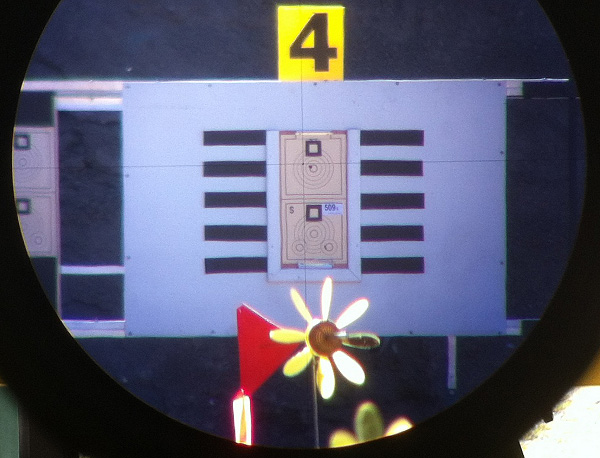
Here’s an example of world-class benchrest shooting. Charles Huckeba of Texas was the top individual shooter at the 2013 World Benchrest Championships (WBC) held near Sydney Australia in October 2013. In this video, 2013 WBC Two-Gun Overall winner Charles shoots a 1/8th MOA group at 200 yards — “a little bitty dot” as a fellow Team USA shooter observes. That’s impressive. If you can describe Huckeba’s style in a nutshell it would be “smooth, consistent, and rapid but not hurried”.
Charles also employed some unusual hardware. In the video, take a close look at the joystick on the Farley Coaxial front rest. There’s no knob at the end. In its place is a small, wood ammo caddy. Charles removed the standard knob from the handle of his Farley rest and replaced it with a home-made wood block that holds cartridges for the record target. The 10.5-lb Light Varmint rifle is chambered in 6PPC with a BAT Machine Action and a composite wood and carbon-fiber stock.
Watch Charles Huckeba Shoot 1/8 MOA, 200-yard group at World Benchrest Championships
Here is the actual 200-yard, 5-shot group Charles shot in the video. Photo (by Stuart Elliot) taken through the lens of Huckeba’s 50X March scope (reticle has 1/16th MOA Dot).
Analyzing the Fine Points — What Makes Huckeba So Good
Short-range benchrest shooter Boyd Allen saw some interesting things in Huckeba’s WBC performance, as captured on video. Boyd noticed Huckeba’s smooth gun-handling and efficient loading. But Boyd also spied some interesting equipment, including an innovative joystick “handle-caddy”.
1. Low Friction Bags — When Huckeba slid his rifle, there was very little apparent friction. The front bag features the new 3M material (ScotchLite) on the sliding surfaces. The rear Protektor bag has ears of the same low-friction material.
2. Pause Before Chambering — While he was watching the flags and deciding when to start firing, Charles kept his first round in the action, but out of the barrel’s chamber, probably so as not to heat the cartridge and change the round’s point of impact.
3. Ammo Caddy on Joystick Arm – Charles shoots a Right Bolt/Left Port action, so he pulls his rounds with his left hand. Note that Huckeba’s record rounds rest in a small, wood ammo caddy attached to the end of the joystick shaft. Look carefully, you’ll see the wood ammo block in place of the normal black ball at the end of the joystick. That allows Charles to pull shots with the absolute minimum of hand movement. Ingenious! Huckeba is very fast, with a great economy of motion. I believe that because his ammo was literally at hand, Charles was better able to keep his focus on aiming and the flags.
4. Smooth-Cycling BAT Action — Note how smoothly Huckeba’s action operates. When Charles lifts the bolt handle (to extract a round and cock the firing pin), this does not disturb the rifle. Likewise, as he closes the bolt, the gun doesn’t wobble. The smooth action allows Charles to hold point of aim even when shooting relatively quickly. Huckeba’s BAT action is chrome-moly steel. Some shooters believe this metal makes for a smoother action than stainless steel or aluminum.
5. Long-Wheelbase Stock — The wood and carbon fiber stock is light, long, and stiff. Yet, importantly, the stock is also well-damped. The longer-than-average stock length (with extended forearm) seems to help the gun track well without jumping or rocking. The longer forearm allows a longer “wheelbase”, effectively shifting the weight distribution rearward (less weight on the front, more weight on the rear). This places a greater share of the gun’s weight on the rear bag, as compared to a more conventional benchrest stock. Huckeba’s stock, built by Bob Scoville, is at the cutting edge of short-range benchrest design. Its light-weight balsa wood and carbon fiber construction provides a combination of stiffness and vibration damping that allows its relatively long fore-end to be fully utilized to increase the weight on the rear bag (always an issue with 10.5-pound rifles).
To learn more about this benchrest stock design, read the comments by stock-builder Bob Scoville in our PPC with Pedigree story in our Gun of the Week Archives. Bob observed:
“There is a lot more to the structure of the stocks than meets the eye. The carbon fiber skin with which I cover the stocks creates a light, tough exterior surface. However, this contributes very little to the overall performance of the stocks. The real strength and stiffness is the result of an internal beam utilizing balsa core/carbon fiber technology.
This type construction can be found in aircraft, race cars, powerboats, and sailboats. It is interesting to note, balsa has the highest strength to weight ratio of all woods and carbon fiber is one of the lowest stretch (modulus of elasticity) relative to weight of all materials. The marriage of these two materials is common in the high-performance world. Additionally, balsa is used commercially for vibration dampening and sound reduction.”
Video find by Boyd Allen. Video by Stuart Elliot of BRT Shooters Supply, Brisbane, Australia.
Report by John Morgan-Hosey
Civilian Service Rifle (CSR) is a shooting sport in the United Kingdom shot with bolt action rifles and ‘Straight-Pull’ derivatives of semi-auto centerfire rifles. Why do the UK shooters use manual-operating versions of popular self-loaders? Well, that’s because of legal restrictions. Civilian ownership of semi-auto centerfire rifles was banned in the United Kingdom in 1987.
Give credit to the ingenuity of competitive shooters in the UK. The ban on semi-autos has not stopped shooters from adapting modern rifles such as the AR15. In fact, CSR is the UK NRA’s fastest growing shooting discipline. There are four classes for competitors:
1. Historic Class — Vintage Rifles, mostly Lee Enfields with iron sights.
2. Iron Sights Class — all non-Historic Rifles with Iron (open) sights.
3. Practical Optic Class — Rifles with bipods (and scopes 4.5X or greater magnification).
4. Service Optic Class — Rifles without bipods (and scopes with no more than 4.5X power).
Surprisingly, shooters in the Service Optic Class dominate these matches. So you don’t need a high-magnification scope or a bipod to do well. The most popular rifles are modified AR-platform rifles. These are set-up in the UK with no gas system to ensure they comply with our laws. Side-charger cocking handles are fitted to allow the rifles to be operated easily while in the shooting position. You can see in the photo above a modified AR with the Union Jack on the buttstock. Notice the bolt handle on the right. This opens and closes the bolt.
This video clip shows the side-charging ARs in use.
Note the side bolt handle that cycles the action on this non-semi-auto AR.
Here shooters advance 100 yards to engage the targets at the next firing line.
Dave Wylde Sets Impressive Record at the Civilian Service Rifle League Match.
The last matches in the 2014/15 CSR League took place on Sunday, 5 April. With final places in all four classes up for grabs, the fine weather and light winds made for some impressive scores, none more so than Dave Wylde in Service Optic Division. Dave scored a mighty impressive 246 (of a possible 250) in the PM Match. Breaking 235 is tough enough and scoring over 240 a rarity with the match includes standing snap shooting at 100 yards, a sitting rapid at 200 yards, and prone snap shooting at 300 yards with and two run downs to raise the shooters heart rate.
The most popular class, Service Optic, had Peter Cottrell retaining the trophy for the fourth consecutive year with a score of 993. Adam Chapman pushed him hard all season to finish a close second on 987 points, with Bill Ellis, one of the most consistent CSR shooters, third with 972.
Civilian Service Rifle Grows in Popularity
As CSR continues to grow in popularity, the sale of ‘Straight-Pull’ AR-platform rifles is increasing year after year. Accordingly, the United Kingdom NRA is allocation more range space at the Bisley National Shooting Centre to accomodate the increasing number of competitors.



 3. Ammo Caddy on Joystick Arm – Charles shoots a Right Bolt/Left Port action, so he pulls his rounds with his left hand. Note that Huckeba’s record rounds rest in a small, wood ammo caddy attached to the end of the joystick shaft. Look carefully, you’ll see the wood ammo block in place of the normal black ball at the end of the joystick. That allows Charles to pull shots with the absolute minimum of hand movement. Ingenious! Huckeba is very fast, with a great economy of motion. I believe that because his ammo was literally at hand, Charles was better able to keep his focus on aiming and the flags.


